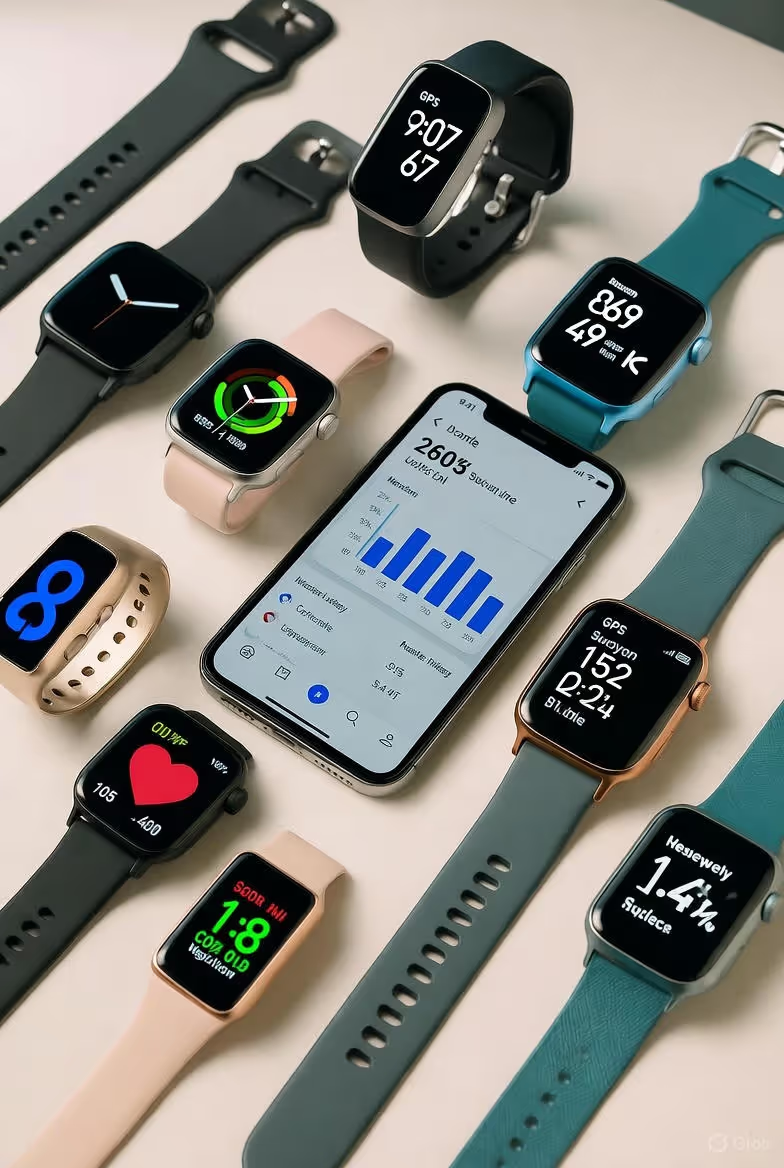
The Best Stress Tracking Apps and Devices Compared (Honest Review)
A review compares devices and apps on accuracy, usability, and the actionable insights they provide, beyond just data collection.
The Best Stress Tracking Apps and Devices Compared (Honest Review)
In our perpetually connected, always-on world, stress has shifted from an occasional visitor to a constant, unwelcome tenant. It whispers during your morning commute, shouts in back-to-back meeting alerts, and tugs at your sleeve long after you’ve powered down your laptop. But what if you could move from simply feeling stressed to truly understanding it? What if you could see your stress not as a monolithic foe, but as a quantifiable pattern with triggers, rhythms, and—most importantly—actionable off-ramps?
Welcome to the frontier of quantified wellness. We’re no longer limited to journaling our mood or guessing at our calm. A new generation of sophisticated stress-tracking technology is putting hard data behind our hard days. From clinical-grade sensors packed into elegant smart rings to AI-powered apps that listen to the tension in your voice, these tools promise a revolutionary insight: objective, physiological truth about your mental state.
But with a market flooded with options—apps that use your phone’s camera, wearables that measure heart rhythms, devices you clip to your ear—how do you choose? Which ones deliver genuine insight versus just another notification? Is a free app enough, or does unlocking true resilience require a dedicated device?
This definitive guide cuts through the noise. We’ve researched, tested, and compared the leading stress-tracking apps and devices on the market. We’ll look beyond the marketing claims to the actual science they use, the user experience they deliver, and the tangible results they enable. Whether you're a biohacker seeking precision, someone navigating a high-pressure career, or simply wanting to reclaim a sense of calm, this honest review will equip you with the knowledge to find your perfect stress-sensing companion. Let’s begin the journey from awareness to mastery.
Why You Can't "Just Feel" Your Stress Accurately
We like to think we’re good judges of our own internal states. “I’m fine,” we say, while clenching our jaw. “Just a bit tired,” we insist, as our mind races at 3 AM. The uncomfortable truth is that human perception of stress is notoriously flawed, often delayed, and easily suppressed by distraction. We are masters of adaptation, which means we can become acclimated to chronically high stress levels, mistaking them for “normal.”
This disconnect exists because stress operates on two parallel tracks: the subjective (how frazzled, anxious, or overwhelmed you feel) and the physiological (what’s actually happening in your nervous system). Your subjective feeling can be influenced by a hundred factors—your morning coffee, a motivating podcast, or simply your innate optimism. Meanwhile, beneath the surface, your body might be telling a different story through biomarkers you cannot consciously perceive.
The gold standard for measuring physiological stress is Heart Rate Variability (HRV). Unlike your simple heart rate (beats per minute), HRV measures the subtle, millisecond variations in the time intervals between each heartbeat. It’s a direct window into your autonomic nervous system (ANS). Your ANS has two main branches:
The Sympathetic Nervous System (SNS): Your "fight-or-flight" accelerator. It mobilizes energy, increases heart rate, and prepares you for action. Stress activates this system.
The Parasympathetic Nervous System (PNS): Your "rest-and-digest" brake. It promotes recovery, digestion, and calm. Resilience is rooted in a strong, responsive PNS.
High HRV indicates a healthy, resilient system that can smoothly switch between acceleration and braking—you respond to a stressor, then recover efficiently. Low HRV suggests a system stuck in "fight-or-flight" or one that lacks the flexibility to adapt. It’s a powerful predictor of everything from burnout risk to cardiovascular health.
The problem? You cannot feel your HRV. You can’t intuit its subtle dips and rises. This is where technology becomes not just helpful, but essential. It closes the perception gap. A reliable stress tracker acts as an objective biofeedback device, showing you:
When your body is stressed even if your mind is distracted or in denial.
Your unique stress triggers, correlating data with your calendar, location, or activities.
Your recovery capacity, showing if your lifestyle (sleep, exercise, nutrition) is truly replenishing you.
The efficacy of your interventions, proving whether that new meditation app or evening walk is actually lowering your physiological stress load.
Without this data, managing stress is like trying to improve your fitness without ever looking at a watch, scale, or mirror. You might be making progress, but you’re working in the dark. By integrating objective metrics with subjective feelings, you gain the complete picture needed for real change. This foundation of understanding is critical as we explore the tools that can provide it. To dive deeper into the science of HRV and autonomic balance, you can always explore our blog for more wellness tech insights.
The Two Philosophies of Stress Tracking: Passive vs. Active
Before we dive into specific products, it’s crucial to understand the two fundamentally different approaches to stress tracking in the market. Your choice here will dictate the entire user experience and, ultimately, the kind of insight you gain.
Passive Tracking (The Continuous Monitor)
This philosophy is embodied by wearable devices like smart rings, chest straps, and some advanced watches. The goal is unobtrusive, 24/7 surveillance of your nervous system.
How it Works: A sensor (usually an optical PPG or an ECG) takes continuous or very frequent readings of your heart rhythm, from which it derives HRV and other markers like resting heart rate and respiratory rate.
The Promise: It captures your baseline and its natural fluctuations throughout the day and night. It sees the stress spike from your 10 AM meeting you’ve already forgotten by lunch. It quantifies the impact of a poor night's sleep on your next-day resilience. It automatically detects periods of focus, relaxation, and agitation without you lifting a finger.
The Power: The data is incredibly rich and contextual. You get trend lines over weeks and months, not just snapshots. You can see how lifestyle factors—alcohol, late meals, intense workouts—truly affect your physiology. It answers the question: “What is my body’s constant, background story?”
The Limitation: It requires a commitment to wearing a device. While smart rings are the most comfortable for all-day wear, it’s still an extra piece of tech on your body.
Active Tracking (The On-Demand Snapshot)
This philosophy is used by most smartphone apps (like Welltory, Elite HRV) and some handheld devices. The goal is targeted, moment-in-time assessment.
How it Works: You initiate a reading, typically by placing your finger over the phone’s camera (which uses the flash to detect pulse) or by connecting a small sensor. You stay still for 1-3 minutes while it captures data.
The Promise: It provides a quick, focused check-in. You can use it before and after a meditation session to measure its direct impact. You can test how you respond to a cup of coffee or take a reading during a moment of anxiety to see its physiological signature.
The Power: It creates direct cause-and-effect learning. It’s excellent for biofeedback training, teaching you to consciously influence your HRV through breathwork. It answers the question: “What is my body’s state right now, in this specific context?”
The Limitation: It only gives you data points, not a continuous story. You might miss the slow build of chronic stress that happens between your intentional check-ins.
Which is Right for You? Choose passive tracking if you want holistic, lifestyle-focused insights and trend data without having to remember to take measurements. It’s for the person who wants to optimize their entire day for balance. Choose active tracking if you are protocol-driven, love biofeedback experiments, and want a tool specifically for mindfulness or training recovery techniques.
The most informed users often employ a hybrid approach: using a passive wearable for baseline trends and an active app for targeted intervention assessments. As we review specific devices, keep this philosophical divide in mind—it’s the key to aligning a tool with your personal goals. For a deeper look at how one company approaches 24/7 passive sensing with a focus on holistic wellness, you can learn more about Oxyzen’s philosophy here.
Deep Dive: Stress Tracking Smart Rings (The All-Day Guardians)
Smart rings represent the pinnacle of passive, unobtrusive stress tracking. Worn 24/7, they gather a profound amount of physiological data, especially during sleep—a critical period for nervous system recovery. Here, we compare the leaders in the space.
Oura Ring (The Established Benchmark)
Oura pioneered the consumer smart ring category and remains a top contender, especially for sleep and recovery analytics.
Stress Tracking Features: Its “Daytime Stress” feature uses HRV, body temperature, and movement data to estimate your stress load throughout the day. It presents this as a graph, showing peaks and valleys. Its crown jewel is the “Readiness” score, a composite metric heavily influenced by overnight HRV, which tells you how prepared your body is to handle stress.
Science & Accuracy: Oura uses a 3D accelerometer, infrared PPG sensors, and an NTC temperature sensor. Its HRV is derived from nighttime readings (which are more stable) and is considered very accurate for a consumer device. The stress metric is a proprietary algorithm.
User Experience: The app is sleek and intuitive. Data is presented as simple scores (Readiness, Sleep, Activity) with deep dives available. It’s excellent for showing trends and correlations.
The Honest Review:
Pros: Unbeatable for sleep and recovery insights. The form factor is sleek and durable. The morning Readiness score is a genuinely useful guide for daily activity.
Cons: The “Daytime Stress” is more of a general load metric than a real-time alert system. Requires a monthly subscription to access all historical data and insights, which adds significant cost over time.
Whoop Strap (The Athlete’s Lens)
While not a ring, the Whoop strap is a direct competitor in the 24/7 recovery wearable space and is often cross-shopped. It’s a band worn on the wrist or bicep.
Stress Tracking Features: Whoop’s “Strain” and “Recovery” scores are its core. “Recovery” (like Oura’s Readiness) is based on HRV, RHR, and sleep. “Strain” quantifies cardiovascular load. The new “Stress Monitor” feature displays real-time physiological stress on a 0-3 scale.
Science & Accuracy: Whoop uses a green-LED PPG sensor. Its data, particularly for 24/7 HRV during sleep and activity, is robust. The bicep wear location is considered optimal for heart rate accuracy during exercise.
User Experience: The app is data-dense and geared towards performance optimization. It pushes you to balance Strain with Recovery.
The Honest Review:
Pros: Unparalleled for athletes quantifying training load. The battery pack allows for 100% uptime. The community and coaching features are engaging.
Cons: The subscription-only model (device included) is expensive. The design is more functional than fashionable. Its stress insights are framed almost entirely through the lens of physical performance.
The Smart Ring Evolution: What's Next?
The next generation of rings, like those being developed, are focusing on more proactive and contextual stress management. Imagine a ring that doesn’t just log your stress spike at 11 AM, but recognizes the pattern, connects it to your calendar (“Weekly Financial Review”), and prompts you with a personalized breathing exercise two minutes before the next occurrence. This shift from retrospective reporting to real-time intervention is the new frontier. For those curious about this future-focused approach to wearable tech, the Oxyzen story explores this vision of anticipatory wellness.
Deep Dive: Smartwatches with Stress Features (The Convenient Compromise)
For many, a smartwatch is the most obvious entry point into stress tracking. It’s already on your wrist. But how deep do their capabilities go?
Apple Watch (The Ecosystem Powerhouse)
Apple Watch uses its excellent optical heart sensor and a feature called “HRV” in the Health app, but its most user-facing stress-related feature is the “Mindful Sessions” metric and the “Reflect” and “State” prompts in the Mindfulness app.
How It Works: It tracks your HRV in the background through periodic readings. However, it doesn’t provide a standalone “stress score.” The focus is on encouraging mindfulness practice, and the Health app will show long-term HRV trends.
Strengths: Seamless integration for iPhone users. The heart rate sensor is one of the best on a wrist-based device. For general wellness awareness, it’s a great start.
Limitations: Lacks a dedicated, actionable stress metric. Background HRV readings can be sparse and are influenced by movement. It’s not designed for continuous ANS monitoring. You need a third-party app like Elite HRV or Welltory to derive serious stress insights from the raw data.
Garmin Watches (The Fitness Tracker's Take)
Garmin has invested heavily in wellness metrics, with “Stress Score” being a core feature on most of its modern devices.
How It Works: Garmin’s score (0-100) is based on continuous HRV data measured from the optical heart rate sensor. A low score indicates physical stress (from training, illness, or psychological stress). It’s displayed continuously and can be toggled to a “Relax Reminder” that prompts breathing exercises during high stress.
Strengths: Truly continuous tracking integrated with rich activity and body battery data. The “Body Battery” feature, which uses stress, sleep, and activity to estimate energy reserves, is a unique and useful concept.
Limitations: The algorithm can misinterpret physical exercise as “stress,” which, while physiologically accurate, can muddy the psychological stress picture. The form factor is sporty and may not suit all environments.
Fitbit Sense & Charge Series (The Accessible Option)
Fitbit offers a dedicated “Stress Management Score” on its Sense, Charge 6, and newer models.
How It Works: The score (1-100) is a daily summary based on responsiveness (HRV), exertion balance, and sleep patterns. The EDA (Electrodermal Activity) sensor on the Sense can scan for subtle skin sweat changes during mindfulness sessions, a unique approach to measuring calm.
Strengths: User-friendly interface and a large community. The EDA scan is a novel, active-check-in tool. Good value within the Fitbit ecosystem.
Limitations: The daily score is less actionable than real-time data. Requires a Fitbit Premium subscription for the full stress analysis and most historical trends. Accuracy of the EDA sensor for all-day stress is debated.
The Watch Verdict: Smartwatches offer a good compromise of convenience and insight, especially Garmin’s continuous tracking. However, for pure, dedicated stress and ANS monitoring, they are generally outclassed by specialized devices due to wrist-based motion artifacts and their multifunctional design compromises.
The App-Only Approach: Using Your Smartphone as a Sensor
Not ready for a wearable? Your smartphone itself can be a powerful stress-tracking tool, using its camera and microphone to gather data. This is the realm of active tracking apps.
Welltory (The Data Aggregator)
Welltory is one of the most comprehensive health data aggregators that uses your phone’s camera (or connects to wearables) for HRV analysis.
How it Works: You take a 2-minute measurement by placing your finger on the camera. It analyzes HRV to give you scores for “Energy,” “Stress,” and “Health.” It can also pull in data from Apple Health, Google Fit, Garmin, Fitbit, etc., to correlate stress with activity, sleep, and more.
Strengths: Incredible depth of analysis from a simple reading. The correlations are its killer feature—seeing a graph that shows your stress spikes every time you have a meeting with “Client X” is eye-opening. Great for the data-obsessed.
Weaknesses: The free version is limited. The interface can feel cluttered. It provides snapshots, not a continuous story, so you must be disciplined about taking readings.
Elite HRV (The Purist's Tool)
Elite HRV is favored by athletes, coaches, and biohackers for its clean, focused approach to HRV measurement. It works with external Bluetooth heart rate monitors (like Polar or Suunto chest straps) for clinical-grade accuracy.
How it Works: You take a guided morning reading (usually 2-3 minutes) to establish your daily “readiness” or baseline. It uses the standard RMSSD HRV metric and provides clear, actionable feedback.
Strengths: Unmatched accuracy when paired with a chest strap. No fluff—just precise data and excellent educational resources. Great for tracking the impact of training protocols.
Weaknesses: Requires an external sensor for best results. It’s purely an active tracking tool with no passive monitoring. The learning curve is steeper.
Other Notables: StressScan & MyCalmBeat
StressScan: Uses the phone’s camera for a quick pulse wave analysis. Simple and fast, good for spot checks.
MyCalmBeat: Focuses on Heart Rate Variability Biofeedback (HRV-B). It finds your unique resonant breathing frequency and trains you to breathe at that pace to maximize HRV, a proven method for reducing stress.
The App Verdict: App-only solutions are perfect for the curious beginner or the focused biohacker who wants high accuracy for specific moments. They are low-cost, low-commitment gateways to understanding your physiology. However, they place the burden of data collection on you. For sustained, holistic insight, they are best paired with—or eventually supplemented by—a passive wearable. For a wider perspective on integrating different wellness technologies, our blog offers comparisons and guides.
Beyond HRV: Innovative Approaches to Stress Detection
While HRV is the scientific cornerstone, researchers and companies are exploring other fascinating biometrics to paint an even richer picture of stress.
This measures tiny changes in the sweat level of your skin, which is controlled by the sympathetic nervous system (“fight-or-flight”).
How it’s Used: The Fitbit Sense has an on-demand EDA sensor. The now-discontinued Spire Stone was a clip-on device that used EDA and movement to detect tension and calm. Specialized devices like the Empatica E4 are used in clinical research.
The Promise: EDA can detect acute, moment-to-moment stress and emotional arousal almost instantaneously, sometimes faster than HRV.
The Limitation: It’s highly sensitive and can be triggered by temperature, physical activity, or even a slight touch. It’s better for short-term measurement or specific sessions than all-day baseline tracking.
Voice Analysis
A groundbreaking area where your smartphone’s microphone becomes the sensor. Apps like Cogito (used in healthcare) and features within some telehealth platforms analyze vocal biomarkers.
How it’s Used: By analyzing pitch, tone, pace, and rhythm of your speech, AI can detect signs of anxiety, depression, or cognitive load.
The Promise: Completely passive and integrated into normal phone calls. Could provide real-time feedback during conversations.
The Limitation: Raises significant privacy concerns. Accuracy is improving but is highly contextual. Not yet mainstream in consumer apps.
Temperature & Peripheral Blood Flow
Continuous body temperature, especially distal (like finger) temperature, can indicate stress. Vasoconstriction (narrowing of blood vessels) from SNS activation cools the extremities.
How it’s Used: The Oura Ring tracks nightly finger temperature deviations. Some clinical devices use finger thermistors for biofeedback.
The Promise: A clear, simple signal—as you become stressed, your hands get colder. Great for biofeedback training (“warm hands” exercises).
The Limitation: Easily confounded by environmental temperature. Best used as a secondary metric alongside HRV.
The Multimodal Future
The most accurate systems won’t rely on one signal. They’ll fuse HRV + EDA + Temperature + Movement + Context (calendar, location) using machine learning. This is where the field is heading: devices that don’t just say “you’re stressed,” but say, “You’re showing signs of cognitive overload, likely because you’ve been in back-to-back meetings for 3 hours. Your recovery tonight is predicted to be poor unless you take a 20-minute walk now.” This level of integration is the ultimate goal for companies dedicated to holistic wellness, a vision you can discover more about through Oxyzen’s approach.
Key Features to Compare: Your Stress Tracker Checklist
With an understanding of the different types of trackers, how do you evaluate them head-to-head? Use this checklist when researching any device or app.
1. Core Measurement Technology & Accuracy:
What is the primary sensor? (Optical PPG, ECG, Camera, Microphone)
Is it validated? Look for published studies or FDA clearances (not just “clinically proven” marketing).
For wearables: Where is it worn? (Finger, wrist, chest) Chest straps (ECG) are gold-standard for HRV accuracy, followed by finger-based optical (rings), then wrist-based optical.
2. Data Presentation & Actionability:
Does it give you a simple score or raw data? Both are valuable.
Does it provide actionable insights? “Your stress is high” is less useful than “Your stress is high, try this guided breathing exercise.”
Can you easily see trends over time? (Weekly/Monthly graphs)
3. Contextual Awareness & Integration:
Can it connect with other apps? (Google/Apple Health, calendar, fitness apps)
Does it allow journaling or tagging? Can you log “drank coffee” or “had argument” to see correlations?
Does it use AI to learn your personal patterns?
4. Intervention Tools:
Are guided interventions built-in? (Breathing exercises, mindfulness, micro-movements)
Are they personalized? A generic 5-minute breathwork may not be as effective as one paced to your resonant frequency.
5. Form Factor & Lifestyle Fit:
Can you wear it 24/7 comfortably? (Sleep, shower, exercise)
Is it aesthetically acceptable for your work and social life?
Battery life: Does it require daily charging, creating data gaps?
6. Privacy & Data Ownership:
Where is your sensitive biometric data stored?
What is the company’s privacy policy? Can they sell aggregated/anonymized data?
Can you export your raw data?
7. Cost Model:
Upfront device cost?
Required subscription? What features are locked behind a paywall?
Long-term value: A $300 ring + $10/month is a different commitment than a free app with premium features.
Running any potential purchase through this checklist will quickly separate the marketing hype from the genuinely useful tools. It’s also worth checking a company’s transparency on these issues; for example, you can often find clear answers in their public FAQ section.
The Science Behind the Scores: How Much Can You Trust the Data?
A flashing “High Stress” alert on your wrist feels authoritative. But should you trust it implicitly? Let’s demystify the accuracy and limitations of consumer stress tech.
Understanding Validation
Clinical vs. Consumer-Grade: A device can be accurate for trending (showing if your HRV is going up or down over weeks) but not perfectly accurate for absolute values compared to a medical ECG. This is usually fine for lifestyle purposes.
Motion Artifact: This is the #1 enemy of optical HRV sensors. Sudden movement can create false heart rate readings, wrecking HRV calculation. This is why nighttime/sleep HRV readings are the most reliable—you’re still. Finger-based rings have an advantage here over wrists.
Algorithm Magic: Your “Stress Score” is rarely a direct readout of HRV. It’s a proprietary algorithm blending HRV, heart rate, movement, and sometimes other data. Two different devices can give different scores for the same moment based on their secret sauce.
How to Be a Savvy User
Focus on Trends, Not Absolute Numbers: Don’t fixate on a single “bad” score. Look at the direction over weeks. Is your baseline HRV slowly rising? That’s excellent progress, even if a single day is low.
Correlate with Subjective Feel: Keep a mental (or actual) note. When the device says you’re stressed, do you feel stressed? If not, could it be physical exertion, caffeine, or dehydration mimicking the stress signature?
Use Consistent Measurement Conditions: For active app readings, always take them at the same time (e.g., morning, after waking, before coffee) in the same posture.
Consider the Source: Look for white papers or validation studies from the company. Be wary of vague claims like “lab tested.”
The Reality Check
No consumer device is a medical diagnostic tool. They are guides for self-awareness and behavior change. Their greatest value isn’t in diagnosing a panic attack, but in revealing the hidden impact of that second glass of wine, the poor sleep hygiene, or the constant context-switching at work. They make the invisible, visible. This educational role is a core part of the mission for many in this space, as sharing real user testimonials often shows how data leads to personal revelation and change.
From Tracking to Managing: How to Actually Use Your Data
Collecting stress data is fascinating for about a week. Then the novelty wears off and the critical question emerges: “Okay, I’m stressed. Now what?” The true value of a tracker is not in its dashboard, but in its ability to drive positive behavioral change. Here’s a framework for moving from passive observer to active manager.
The Awareness Phase (Weeks 1-2)
Goal: Establish your baseline without judgment.
Action: Simply wear the device or take readings as recommended. Observe the patterns. When do scores typically dip or peak? Note anything obvious (poor sleep, intense workout, stressful day at work).
The Correlation Phase (Weeks 3-4)
Goal: Become a stress detective.
Action: Start journaling or using the app’s tagging features. Log:
Nutrition: Caffeine, alcohol, heavy meals.
Sleep: Quality, duration.
Exercise: Type, intensity, duration.
Schedule: Meeting-heavy days, deadlines, social events.
Subjective Mood: Use a simple 1-5 scale.
Look for Links: Does your stress score consistently rise 90 minutes after your morning coffee? Does your recovery plummet after nights you have alcohol? Does a weekly meeting with your manager always register?
The Intervention Phase (Month 2+)
Goal: Run experiments to improve your metrics.
Action: Use the data to test hypotheses.
Hypothesis: “If I do a 10-minute meditation before work, my daytime stress will be lower.”
Experiment: Do it for 5 workdays. Check the trend.
Hypothesis: “If I stop caffeine after 2 PM, my sleep HRV will improve.”
Experiment: Try it for a week.
Use Built-in Tools: Engage with the device’s breathing exercises or mindfulness prompts when you get an alert, and see if you can manually lower the score in real-time (this is powerful biofeedback).
The Integration Phase (Ongoing)
Goal: Make stress-resilient habits automatic.
Action: Let the data inform your lifestyle design.
Schedule Deep Work during your typically high-energy, low-stress windows.
Place recovery activities (walks, meditation) before your known stress peaks.
Use your morning readiness score to modulate workout intensity—push hard on high-score days, opt for yoga or walking on low-score days.
The Ultimate Mindset Shift: Your stress tracker is not a judge; it’s a coach. A low score isn’t a “failure.” It’s valuable feedback, a sign that your body needs support. The goal isn’t to have a perfect, flatline “zero stress” graph—that’s impossible and undesirable (stress is needed for growth). The goal is to see clear recovery, the valleys after the peaks, and to widen your window of tolerance over time. For continued learning on this journey, a wealth of additional resources and guides can be found on our blog.
Privacy, Data Security, and Ethical Considerations
You are handing over your most intimate data—the literal rhythm of your heart, patterns of your sleep, and signals of your emotional state. Who owns it? How is it used? This is the most critical section in your decision-making process.
The Data You Generate is Incredibly Sensitive
Biometric data can reveal:
Underlying health conditions
Patterns of anxiety or depression
Your sleep schedule (and by inference, when your home is empty)
Physical activity patterns
Potentially, even early signs of illness like infection (through elevated resting heart rate/temperature).
Key Questions to Ask Any Company
Where is data stored and processed? (On your device? In the cloud? Where are the servers?)
Is data anonymized and aggregated? Many companies use pooled data to improve algorithms or sell for research. This is often outlined in the privacy policy.
Can you delete your data? Permanently and completely.
Who has access? Are employees or third parties able to view individual user data?
What are the data breach protocols?
Could this data be used by insurers or employers in the future? While currently regulated in some regions (like GDPR, HIPAA), the long-term landscape is uncertain.
How to Protect Yourself
Read the Privacy Policy: Don’t just click “Agree.” Skim for key terms about data sharing, sale, and aggregation.
Use Strong, Unique Passwords: For the associated app account.
Limit Permissions: Does a stress app need access to your contacts or photo library? Probably not.
Prefer Local Processing: Some advanced devices process data directly on the device (like some ECG features on the Apple Watch), which is more secure than cloud transmission.
Choose Reputable Companies: Look for companies that are transparent about their data practices and have a clear, user-first ethos. Understanding a company’s foundational values, which you can often learn about in their ‘Our Story’ section, can be a strong indicator of how they will treat your data.
The Ethical Use of Your Own Data
Finally, use your data ethically towards yourself. Avoid:
Orthosomnia: Becoming obsessed with perfect sleep or stress scores, which ironically increases anxiety.
Ignoring Subjective Feelings: Overriding your felt sense of being “fine” because a device says you’re not, or vice-versa.
Pushing Through Clear Warning Signs: Using a “high readiness” score to justify overtraining or ignoring illness.
Your data should empower you, not enslave you. It’s a tool for self-compassion and intelligent design, not another source of performance anxiety.
The Smartphone as a Lab: A Review of Camera-Based HRV Apps
The most accessible door into stress tracking is already in your pocket. By leveraging the camera and flash, your smartphone can capture your pulse through your fingertip—a method called photoplethysmography (PPG). This has spawned a category of apps that promise clinical-grade insights without any extra hardware. But how good are they, really? Let’s examine the leaders and the science behind the lens.
The Technology: How Your Phone Reads Your Heart
When you place your finger over the camera lens, the flash illuminates the capillaries beneath your skin. With each heartbeat, blood volume in the capillaries increases slightly, changing how much light is reflected back to the sensor. The camera captures these subtle changes in brightness as a waveform, from which the app can derive your pulse rate and, with sophisticated processing, your Heart Rate Variability.
Key Considerations for Accuracy:
Pressure & Motion: Even a slight tremor or too much pressure can distort the signal. Most apps now have on-screen guides to help you maintain perfect stillness.
Skin Tone & Temperature: Very cold fingers or certain skin tones can reduce signal quality. The best apps will warn you of a poor reading.
Algorithm Sophistication: Extracting clean HRV from a noisy smartphone PPG signal is the real magic. It requires advanced filtering algorithms to separate the heart’s signal from motion and other artifacts.
Head-to-Head: Top Contenders Reviewed
1. Welltory (The Power User’s Hub) We touched on Welltory earlier, but it deserves a deeper look as the most comprehensive app in this space.
Measurement Process: A 2-minute reading where you cover both the camera and flash. It provides immediate scores for Energy, Stress, and Health (on a 1-100 scale), along with raw HRV metrics (RMSSD, SDNN).
Core Strength – Data Integration: This is where Welltory shines. It connects to Apple Health, Google Fit, and a staggering array of wearables (Garmin, Fitbit, Oura, Withings, etc.). It then correlates your HRV readings with all that other data. You can see charts showing how your stress correlates with sleep duration, step count, caffeine logs, or even specific calendar events. It turns data into stories.
Insights & Reporting: The app generates daily and weekly reports that highlight key findings, like “Your stress was higher on days with fewer than 7 hours of sleep.” The free version offers limited measurements and history; the premium subscription unlocks unlimited analysis, deep correlations, and advanced insights.
The Verdict: Unbeatable for the data-obsessed who want to connect dots across their entire digital health footprint. It’s less of a simple stress tracker and more of a personal health analytics platform.
2. Elite HRV (The Purist’s Choice) Elite HRV takes a focused, no-nonsense approach rooted in athletic and clinical practice.
Measurement Process: It guides you through a morning “Morning Readiness” reading (typically 2-3 minutes) to establish your daily baseline. It emphasizes consistency: same time, same conditions (upon waking, before coffee).
Core Strength – Accuracy & Education: While it can use the phone’s camera, Elite HRV is designed to pair with Bluetooth chest strap heart rate monitors (like from Polar or Garmin). This provides ECG-grade accuracy, making it a favorite among coaches and biohackers. The app itself is an educational tool, clearly explaining RMSSD, LF/HF ratios, and what they mean.
Interventions: It offers guided breathing exercises tailored to improve HRV and a “Quick Coherence” technique from HeartMath.
The Verdict: The best app for anyone seeking the highest possible accuracy from an active reading and who wants to understand the underlying physiology. Its interface is functional, not flashy, and it demands a more disciplined, protocol-driven user.
3. HRV4Training (The Athlete’s Researcher) Created by physiologist Marco Altini, HRV4Training is built on a foundation of peer-reviewed research and a deep understanding of athletes’ needs.
Measurement Process: It uses the phone’s camera (or connects to external sensors) for a 60-second reading upon waking. It uniquely allows you to take a reading without getting out of bed, minimizing movement.
Core Strength – Contextualization & Planning: Beyond just a number, it places immense emphasis on manual inputs. You rate sleep quality, fatigue, muscle soreness, motivation, and more. Its algorithm then gives personalized training recommendations: “Go ahead,” “Be careful,” or “Take it easy.” It also has innovative features like detecting acute stressors (like air travel) and adjusting recommendations accordingly.
Data Ownership: It champions user privacy, storing data locally on your phone and offering extensive export options.
The Verdict: The ultimate tool for endurance athletes and serious trainees who use HRV for precise training modulation. Its cost (one-time purchase) is a plus for those averse to subscriptions.
4. StressScan (The Simplest Snapshot) For those who want the quickest possible check-in without scores or complex analysis.
Measurement Process: A mere 45-second reading using the camera. It provides a simple, color-coded result: Blue (Calm), Green (Balanced), Yellow (Stressed), Red (High Stress).
Core Strength – Speed & Simplicity: There’s no dashboard, no trends (in the free version), no complex metrics. It answers one question: “What’s my stress level right now?” This can be surprisingly powerful for a quick biofeedback check before a big meeting or after a breathing exercise.
The Verdict: An excellent, no-fuss gateway app. It’s perfect for the casual user or as a complementary spot-check tool alongside a passive wearable.
The Camera-Based App Verdict: Pros, Cons, and Best Fit
Pros:
Zero-Cost Entry: Most have robust free tiers.
High Accuracy (When Done Right): When paired with a chest strap or with perfect finger placement, the data can be very reliable for trend analysis.
Excellent for Cause & Effect: Perfect for testing how specific activities, foods, or interventions affect your physiology in the moment.
Cons:
The Burden is on You: You only get data when you remember to take a reading. This can miss chronic, background stress that builds slowly.
Snapshot, Not a Movie: Lacks the continuous, contextual data that reveals patterns you’re not actively testing for.
Variable Conditions: Readings can be affected by your immediate environment, recent activity, or caffeine, requiring strict protocol for baseline comparisons.
Who Are They For?
The Curious Beginner: Start with StressScan or the free tier of Welltory.
The Data Detective & Integrator: Welltory Premium is your playground.
The Athlete or Biohacking Purist: Elite HRV or HRV4Training are your professional-grade tools.
These apps prove that powerful insights are democratized. However, they represent one piece of the puzzle. For a continuous, 24/7 understanding of your stress landscape—the kind that reveals the impact of your workday, your relationships, and your sleep architecture—a dedicated wearable is the logical next step. Exploring the journey from app-based checking to wearable-based knowing is a common theme, as discussed in various wellness tech guides on our blog.
The Hearables Revolution: Can Your Earbuds Track Stress?
The latest frontier in passive sensing isn’t on your wrist or finger—it’s in your ears. “Hearables” (advanced, sensor-equipped earbuds) are emerging as a powerful, multipurpose platform for stress tracking, leveraging a unique anatomical position.
Why the Ear is a Sweet Spot for Biometrics
The ear canal provides a stable, sheltered location with excellent blood flow, making it ideal for physiological monitoring:
Proximity to the Brain: Allows for potential detection of neural signals.
Stable Position: Minimizes motion artifact compared to a swinging wrist.
Thermal Regulation: Can provide core body temperature estimates.
Acoustic Access: Enables analysis of voice and ambient sound for context.
Current and Emerging Players
1. Current Functionality (Indirect Tracking) Most premium earbuds today (Apple AirPods, Samsung Galaxy Buds, etc.) have accelerometers and skin-detect sensors that can track physical activity and heart rate during exercise. Some, like certain Jabra models, have a “Personalized Sound” feature that uses a hearing test to reduce cognitive load, which can indirectly affect stress. However, dedicated, continuous stress tracking is not yet a mainstream feature.
2. The Specialists on the Horizon Several companies are developing earbuds specifically as health monitors:
Bose: Heavily invested in health-sensing audio, with research into using earbuds for continuous heart rate, HRV, and core temperature. Their noise-canceling technology itself is a powerful stress-management tool.
Stat: A startup creating earbuds focused on EEG (brainwave) and physiological monitoring for mental state, including focus and stress.
Apple's Future Roadmap: Persistent rumors suggest future AirPods will include more advanced health sensors, potentially turning the most popular earbud in the world into a ubiquitous health device.
3. The Voice Analysis Angle This is where hearables have a unique advantage. Apps like Cogito Companion (used in telehealth) can analyze vocal tone, pace, and variability during calls to detect signs of depression or anxiety. Imagine your earbuds performing this analysis in real-time during a work call, then suggesting a calming breathing exercise afterward.
The Potential and The Pitfalls
The Promise of Ubiquitous, Unconscious Tracking: For millions, earbuds are already worn for hours daily during commutes, work, and workouts. Embedding stress sensing here would make it the most seamless form factor of all. The combination of physiological data (HRV from the ear) + auditory context (what you’re listening to) + voice analysis could create an unprecedentedly rich picture of your cognitive and emotional load.
The Significant Hurdles:
Battery Life: Continuous sensor streaming is a major drain.
Fit Consistency: A loose fit destroys data accuracy.
Privacy Nightmares: Continuous audio access for voice stress analysis is a privacy minefield of epic proportions. Companies would need extremely clear, transparent, and secure on-device processing models to gain user trust.
Market Fragmentation: Unlike smartphones with two dominant OSes, the hearables market is fragmented across dozens of brands and proprietary apps.
The Hearables Verdict: Watch This Space
Today, your wireless earbuds are not reliable, dedicated stress trackers. Tomorrow, they likely will be. For now, they serve as excellent intervention devices—delivering calming soundscapes, noise cancellation to reduce auditory stress, and guided meditations. The shift from intervention to detection is coming, and it will be a game-changer for adoption. As we think about the future of integrated wellness, the convergence of audio, sensing, and personalized feedback is a core part of the vision for many innovators, a topic often explored when you learn more about the future of wellness technology.
The Minimalist's Toolkit: Non-Wearable Devices for Targeted Insight
Not everyone wants to wear a device 24/7, and smartphone cameras have limitations. For those seeking higher accuracy than a phone can provide but without the commitment of a ring or watch, a small category of dedicated, on-demand devices offers a compelling middle path.
1. The Chest Strap (The Gold Standard Interface)
While primarily seen as fitness gear, a Bluetooth or ANT+ chest strap is the most accurate consumer-grade heart sensor available.
How it Works: It uses electrocardiography (ECG), measuring the electrical activity of your heart directly via electrodes against your skin. This provides a perfect, clean waveform from which HRV is calculated with clinical precision.
Use Case for Stress: Pair it with apps like Elite HRV, HRV4Training, or Kubios HRV for morning readiness readings or pre/post intervention checks. It’s the tool of choice for researchers, coaches, and serious biohackers.
Pros: Unmatched accuracy. Relatively low cost (~$70-$100). Long battery life.
Cons: Not comfortable for all-day wear. Active measurement only. Can feel intrusive.
Top Picks: Polar H10 (widely regarded as the most accurate), Garmin HRM-Pro, Wahoo TICKR.
2. The Finger Clip (The Clinical Hand-Me-Down)
Devices that clip onto your fingertip, often used in clinical pulse oximetry, can also provide excellent PPG data.
How it Works: Similar to a smart ring, it uses optical sensors, but with a tight, consistent fit that often outperforms a loose-fitting watch.
Examples: The Wellue O2Ring (primarily for overnight oxygen, but provides HRV), or older devices like the Stress Echo (now hard to find). Some are designed to connect to your phone via Bluetooth.
Pros: Good accuracy for spot measurements. Non-obtrusive for short readings.
Cons: Another device to keep charged and remember to use. Not designed for continuous, all-day tracking.
3. The Handheld Biofeedback Devices
These are specialized tools designed explicitly for stress management and HRV biofeedback training.
How it Works: You hold the device, which contains sensors (often for GSR and temperature). It provides real-time audio or visual feedback, teaching you to control your physiology.
Examples:
HeartMath Inner Balance: Connects to your phone via headphone jack or lightning port. You clip a sensor to your earlobe. The app uses HRV coherence training, guiding you to achieve a state of “physiological harmony” with paced breathing and positive emotion focus. It’s one of the most researched biofeedback systems.
emWave2: A standalone earlier version from HeartMath with a simple LED feedback display.
Pros: Highly effective for active stress reduction training. Based on solid science. Creates a direct mind-body connection.
Cons: Very niche use case. Not for general tracking or trend analysis.
4. The "Smart" Meditation Cushion or Chair
An innovative, albeit fringe, category that embeds sensors into furniture.
How it Works: Products like the Muse S (headband) are better known, but concepts for chairs with embedded ECG or force sensors exist. They track your posture, fidgeting, and heart rhythm during meditation, giving feedback on your calmness.
Pros: Turns a stress-reducing activity into a biofeedback session.
Cons: Extremely limited use case and availability. More of a novelty currently.
The Minimalist Verdict: Purpose-Built Precision
These devices are not about convenience or all-day insight. They are specialized tools for specific jobs. If your goal is to:
Get the most accurate HRV reading possible → Use a Polar H10 chest strap with Elite HRV.
Actively train your nervous system to be more resilient → Use the HeartMath Inner Balance.
Get better data than your phone camera without wearing anything → A finger-clip pulse oximeter with HRV output can work.
They represent a focused, intentional approach to stress understanding, perfect for the person who dedicates time for morning rituals or biofeedback practice. For those seeking answers to common technical and usage questions about these kinds of devices, a good resource is often a detailed FAQ from a wellness tech company.
The Psychology of Tracking: Avoiding Obsession and Finding Balance
This is the most important chapter you will read. Bringing quantitative measurement to something as personal and emotional as stress carries a significant risk: turning your pursuit of peace into a source of performance anxiety. This phenomenon even has a name in the sleep world—“orthosomnia”—where the quest for perfect sleep data ruins actual sleep. The same trap awaits the stress tracker.
Recognizing the Signs of Unhealthy Tracking
Checking the app compulsively throughout the day, seeking validation from a “good” score.
Feeling anxious or like a “failure” when you see a low HRV reading or a high stress score, even if you feel subjectively fine.
Making punitive lifestyle choices: “My recovery is low, so I can’t go for a fun hike with friends today,” ignoring your body’s desire for movement and joy.
Dismissing your subjective feelings: “I feel great, but my ring says I’m stressed, so I must be wrong.”
Constantly tweaking variables in a frantic attempt to “fix” the numbers, creating more mental noise.
How to Cultivate a Healthy Relationship with Your Data
Use these principles to keep your tracker as a servant, not a master.
1. Adopt a Curious, Non-Judgmental Stance. Treat your data like a friendly report from a scout, not a report card from a headmaster. Instead of “Ugh, my stress is high, I’m failing,” think, “Hmm, that’s interesting. My body is showing signs of stress. I wonder what’s going on? Did I sleep poorly? Am I coming down with something? Or is there something on my mind I haven’t addressed?” This shifts you from self-criticism to compassionate investigation.
2. Let Trends Trump Daily Numbers. A single data point is noise. The true signal is in the trend line over weeks and months. Zoom out on your app. Is your baseline HRV gradually rising over a 6-month period despite daily fluctuations? That’s a monumental win, even if today’s number is low. Celebrate the direction, not the daily destination.
3. Recalibrate with Subjective Check-Ins. Several times a day, before you look at your device, ask yourself the classic mindfulness question: “How am I feeling, right now, on a scale of 1 to 10?” Note your energy, mood, and tension. Then look at your data. Does it align? If it does, great—your perception is accurate. If it doesn’t, explore the gap without assuming the device is always right. Maybe your body is fighting off a virus you can’t feel yet, or maybe the device’s reading is confounded by caffeine or dehydration.
4. Use Data for “And” Not “Or” Decisions. Don’t let a low score veto an activity you know is nourishing. Use it as a modifier. “My readiness is low AND I have a big hike planned, so I’ll make sure to pace myself, hydrate exceptionally well, and prioritize an early bedtime tonight.” The data informs how you do something, not whether you do it (except in cases of illness or extreme exhaustion).
5. Schedule Data Reviews, Don’t Livestream Your Life. Designate specific times to engage deeply with your data—perhaps 5 minutes in the morning to check your readiness score and plan your day, and 10 minutes on a Sunday evening to review the week’s trends. Outside of those times, put the app away. Constant monitoring fractures your attention and pulls you out of the present moment, which is inherently stressful.
6. Remember the Ultimate Metric: Quality of Life. The final question is not “Did I optimize my HRV today?” It’s “Was today a good day?” Did you connect with loved ones? Did you find moments of joy? Did you do meaningful work? Did you feel alive? If your tracking is improving your answers to those questions, it’s working. If it’s hindering them, it’s time for a break. Reading about real user experiences and transformations can often provide a healthy perspective on how data should ultimately serve a better life.
The most advanced algorithm in this entire ecosystem is your own lived experience. The technology is a tool to refine that experience, not replace it. Master this balance, and you’ve mastered the art of tracking.
The Corporate Wellness Angle: Stress Tracking in the Workplace
The quantified self is moving into the quantified office. Forward-thinking companies are increasingly incorporating stress and recovery tracking into their corporate wellness programs. The rationale is clear: burned-out employees are less productive, creative, and loyal. But this move raises complex questions about utility, privacy, and ethics.
The Employer's Promise: A Healthier, More Resilient Workforce
Proponents argue that providing employees with tools like subsidized smart rings or access to stress management apps is a progressive benefit, akin to providing gym memberships.
Proactive vs. Reactive: Moves wellness from treating burnout to preventing it.
Data-Driven Culture: Applies the same metrics-based approach used in business operations to human sustainability.
Reduced Healthcare Costs: In theory, a less stressed workforce has lower rates of chronic illness and absenteeism.
Talent Attraction & Retention: Positions the company as cutting-edge and caring about holistic employee well-being.
The Implementations: From Voluntary to Integrated
1. The Voluntary, Anonymous Aggregate Model (Safest):
How it works: The company offers a subsidy for a device like an Oura Ring or a Whoop membership. Employees opt in. Data is owned entirely by the employee. The company only receives aggregated, anonymized reports (e.g., “30% of participating employees showed improved sleep scores this quarter”). This is used to gauge program effectiveness and inform broader wellness initiatives (like changing meeting culture or offering mindfulness training).
Pros: Respects individual privacy. Low coercion.
Cons: Limited ability to identify and help individuals who are struggling.
2. The Team-Based "Challenge" Model (Common):
How it works: Departments or teams compete in wellness challenges based on metrics like “sleep consistency” or “recovery days.” This leverages social motivation.
Pros: Can build camaraderie and make wellness fun.
Cons: Can create peer pressure and encourage gaming the system. May penalize those with chronic conditions or caregiving responsibilities that legitimately impact their scores.
3. The Integrated Managerial Tool (Most Controversial):
The Dystopian Fear: This is where ethics break down. Imagine a system where managers can see direct reports’ “stress scores” or “readiness” metrics, using them to assign workloads, deny time off, or gauge engagement. This is a gross violation of privacy and biological freedom.
Critical Ethical Red Lines
Any corporate program must adhere to these non-negotiable principles:
Opt-In Only: Participation must be 100% voluntary, with no incentives so large they feel coercive.
Individual Data Ownership: The employee owns their raw data. It should never be accessible to HR or management.
No Penalties: Data must never be used in performance reviews, for promotion decisions, or to determine compensation or benefits.
Transparency: Complete clarity on what aggregate data is collected and how it’s used.
Purpose Limitation: Data should only be used to improve employee well-being programs, not for other business optimization.
The Employee's Perspective: Should You Participate?
If your employer offers a program, consider:
The Privacy Policy: Read it meticulously. Who gets your data?
The Culture: Do you trust your company to use this data ethically? Does leadership genuinely care about wellness, or is this a PR stunt?
Your Comfort Level: Are you okay with your employer knowing, even in aggregate, patterns about your sleep and stress? For some, the benefit of a free device outweighs the concern. For others, it’s an unacceptable intrusion.
The Future: Building Healthier Work Environments
The highest value of workplace stress tracking isn’t in monitoring individuals, but in diagnosing toxic systems. If anonymized data shows company-wide stress peaks every Thursday afternoon before the weekly financial report is due, or if sleep scores plummet across a department after a new software rollout, that’s powerful feedback. It shifts the responsibility from “employees need to be more resilient” to “our work processes need to be less damaging.”
This evolution—from tracking people to improving structures—is where the real promise lies. It aligns with a vision of work that is sustainable and human-centric, a topic deeply connected to the core mission and values of many wellness-focused organizations.
Integrating Data Streams: Building Your Complete Stress Dashboard
You now understand the spectrum of tools: passive rings, active apps, clinical-grade sensors. The most profound insights, however, rarely come from a single data stream. They emerge from the confluence of multiple sources—the correlations that reveal hidden cause and effect. This is the art and science of building your personal, holistic stress dashboard.
The Core Triad: Stress, Sleep, and Activity
These three pillars are in constant dialogue. You cannot understand one in isolation.
Poor Sleep → Low HRV/High Resting Heart Rate (High Stress physiology) → Low energy for activity.
Excessive Activity without recovery → High physiological stress → Disrupted sleep.
Chronic Stress → Hyper-arousal that ruins sleep → Reduced capacity for beneficial activity.
Your dashboard should visually connect these. Did a day of high work stress (logged in your calendar and seen in elevated daytime HRV) lead to worse sleep architecture (shown by your ring) and a forced rest day (low activity on your watch)? That’s a complete, empathetic story your body is telling.
How to Technically Integrate Your Data
1. Use a Central Health Aggregator:
Apple Health (iOS) or Google Fit (Android): These are the foundational hubs. Configure your devices (ring, watch, scale) and apps (Welltory, meditation app) to read and write data here. Suddenly, your sleep data from Oura, your weight from Withings, and your mindful minutes from Calm all live in one place.
Strava or TrainingPeaks (For Athletes): These can be the central hub for activity and performance data, which can then feed into Apple Health/Google Fit.
2. Employ a Powerful Correlator App:
Welltory’s Superpower: This is where Welltory excels. It sucks in all the data from your health aggregator and looks for statistical relationships. It can generate insights like: “Your stress levels are 22% higher on days when your highest blood glucose reading is above X,” or “Your sleep HRV is strongly correlated with your step count two days prior.”
3. Manual Journaling for the "Ungoogleable" Data: Some of the most important variables have no sensor. You must log them manually in a note-taking app, a dedicated journaling app (like Day One), or within the notes feature of your tracker.
Social & Emotional: Had a difficult conversation with a loved one. Attended a draining social event. Felt a profound sense of accomplishment.
Nutritional: Felt bloated or inflamed after a specific meal.
Cognitive: Experienced “brain fog” or exceptional focus.
Conducting a Personal Data Review: A Step-by-Step Guide
Once a week or month, set aside 30 minutes for a deep review.
Step 1: Look for Obvious Pattern Matches. Open your primary dashboard (e.g., Apple Health trends or your ring’s weekly report). Note the highest and lowest stress/recovery days. Now, cross-reference your calendar, manual journal, and activity log for those days. What jumps out? The low recovery day after your book club (was it the wine? The late night? The stimulating debate?). The high-stress afternoon that coincides with your weekly planning session.
Step 2: Form a Hypothesis. “I suspect that my morning latte is causing a mid-morning stress crash,” or “I think that scrolling social media before bed is fragmenting my deep sleep.”
Step 3: Design an Experiment. For one week, change one variable. Switch to decaf after 10 AM. Implement a strict no-phone 60 minutes before bed rule.
Step 4: Analyze the Results. Check your data at the end of the week. Did your mid-morning stress scores improve? Did your deep sleep increase? The data will confirm or deny your hypothesis, leading to sustainable, personalized lifestyle tweaks.
The Goal: From Data Overload to Wisdom
The aim is not to drown in charts. It’s to identify 2-3 high-leverage habits that have an outsized impact on your resilience. For one person, it’s consistent bedtime. For another, it’s managing caffeine cutoff time. For a third, it’s scheduling a daily walk after lunch to break up cognitive load.
By integrating streams, you move from generic advice (“get more sleep”) to personalized prescription (“prioritize sleep on nights following high-strain strength workouts, and limit alcohol to one drink on those days to protect deep sleep”). This is the pinnacle of personalized wellness. For ongoing ideas and case studies on how to make your data work for you, a great resource is a regularly updated blog dedicated to smart wellness practices.
The Future of Stress Tech: AI, Predictions, and Seamless Integration
We stand at the precipice of a major leap. The current generation of stress trackers is largely diagnostic—they tell us what has happened. The next generation will be predictive, prescriptive, and seamlessly integrated into the fabric of our lives. This shift, powered by artificial intelligence and advanced sensor fusion, promises to move us from reactive management to proactive resilience.
From Descriptive to Predictive: The AI Pivot
Today’s apps show your stress spiked at 11 AM. Tomorrow’s will ping you at 10:50 AM: *“Based on your physiology and calendar, you’re likely to experience elevated stress in 10 minutes. Your recommended intervention: a 90-second breathing exercise now.”*
This predictive capability hinges on AI models trained on vast, anonymized datasets. They learn individual and collective patterns:
Micro-Patterns: Your unique physiological signature preceding a stress event—a slight dip in HRV, a rise in skin temperature, a change in movement variability (fidgeting).
Macro-Patterns: The impact of seasonal changes, menstrual cycle phases, or even local pollen counts on population-level stress resilience.
Contextual Triggers: Learning that video calls with certain individuals, specific types of work tasks (like budgeting), or even locations (open-plan office vs. home office) are reliable predictors for you.
Companies like Oura are already experimenting with this, using their vast dataset to research “stress forecasting.” The goal is an early-warning system for your nervous system.
Once a system predicts stress or identifies a state, the intervention must be as personalized as the diagnosis. Generic “5-minute meditation” will give way to dynamic recommendations.
Adaptive Breathwork: Instead of a fixed pace, an app will analyze your real-time HRV and guide you to breathe at your personal resonant frequency—the precise rhythm that maximizes your heart-brain coherence at that moment.
Context-Aware Suggestions: If it’s 3 PM and you’re showing signs of cognitive fatigue, it might suggest a 10-minute walk outside (citing the boost from sunlight and movement) rather than a meditation. If you’re at home and stressed, it might recommend a brief social connection with a loved one, knowing your data shows that’s a potent recovery tool for you.
Biometric-Activated Content: Imagine your music streaming service subtly shifting the playlist to lower-tempo, instrumental music when your ear buds detect elevated stress physiology. Or your smart lighting gradually warming to a calming hue.
The Invisible Merger: Sensors Disappear into the Environment
The future of tracking is no tracking at all—at least, not as a distinct activity. Sensors will vanish into everyday objects:
Smart Steering Wheels & Office Chairs: With embedded ECG sensors to measure commute or workday stress.
Camera-Based Systems (with strict privacy): Advanced computer vision in private spaces (e.g., a wellness room) could assess posture, facial micro-expressions, and breathing patterns for real-time biofeedback without any wearables.
Toilet Sensors: Japanese companies have prototyped toilets that analyze urine and stool for stress hormones (cortisol metabolites) and other biomarkers, providing daily health snapshots.
Smart Mirrors: A quick glance while brushing your teeth could provide a PPG-based stress readout and the day’s resilience forecast.
This creates a distributed sensor network around you, providing a continuous, multimodal data stream without the need to remember to wear or charge a dedicated device.
The Integration Hub: Your Digital Twin
All this data will feed into a central model: your “Digital Twin” for health. This is a dynamic, AI-driven simulation of you—your physiology, habits, and preferences. It will:
Simulate Outcomes: “If you have that second drink tonight, your model predicts a 40% reduction in deep sleep and a 60% chance of low tomorrow.”
Optimize Schedules: Integrate with your calendar to propose meeting times when you’re historically at your cognitive best, and block “recovery zones” after high-stress events.
Interface with Healthcare: With your explicit permission, your digital twin could provide your doctor with rich, longitudinal data far more revealing than a snapshot during an annual physical.
Ethical and Practical Hurdles on the Horizon
This powerful future is not without profound challenges:
The “Black Box” Problem: If an AI says “you’ll be stressed at 11 AM,” can it explain why in a way you understand and trust?
Data Sovereignty & Security: A distributed sensor network means your biometric data is flowing through dozens of devices and companies. Robust, user-centric data ownership frameworks are non-negotiable.
Over-Reliance & Deskilling: Could we become so dependent on external prompts that we lose the innate ability to sense our own bodies?
The Inequality Gap: The most advanced predictive health tech will likely be expensive, potentially creating a new divide between those who can afford resilience optimization and those who cannot.
The companies that succeed in this future will be those that build not just advanced technology, but also deep trust, transparency, and ethical guardrails. This forward-thinking, human-centric approach is at the core of the vision for many in the wellness tech space, including the team at Oxyzen, which you can learn more about in their story.
The trajectory is clear: stress tech is evolving from a dashboard in your phone to an intelligent, ambient layer of support woven into your world. Its ultimate success will be measured not in gigabytes of data, but in quiet moments of prevented overwhelm and enhanced human flourishing.
Deep Dive: Niche & Medical-Grade Stress Assessment Devices
Beyond the consumer market lies a realm of specialized tools used by researchers, clinicians, and serious biohackers. These devices offer higher precision, different modalities, or diagnostic capabilities that consumer wearables cannot match. Exploring this landscape reveals what’s possible when the primary goal is clinical accuracy, not mass-market appeal.
1. Clinical ECG & HRV Analysis: The Gold Standard
For definitive measurement, nothing beats a proper electrocardiogram.
Devices: Clinical-grade Holter monitors or portable ECG devices like the AliveCor KardiaMobile 6L. These capture a full, medical-quality ECG waveform.
Software: Analysis is done not in a consumer app, but in professional software like Kubios HRV (the industry standard for scientific HRV analysis). Kubios provides dozens of time-domain, frequency-domain, and non-linear HRV parameters (SDNN, LF, HF, LF/HF ratio, DFA-alpha1) that offer nuanced insights into sympathetic/parasympathetic balance.
Use Case: Used in clinical trials, cardiac rehabilitation, and by sports scientists to get an unambiguous snapshot of autonomic function. It’s the tool you’d use to validate the accuracy of your consumer wearable.
2. Continuous Electroencephalography (EEG): Tracking the Brain’s Stress
While HRV measures the body’s response, EEG measures the brain’s activity directly. Consumer “focus” headbands like Muse and Neurosity Crown have popularized this.
How it Works: Sensors on the scalp detect electrical activity from different brain regions. Stress and anxiety are often associated with high beta wave activity, while calm and focused states show more alpha and theta waves.
For Stress: These devices can provide real-time feedback during meditation, showing when your mind is busy (high beta) versus calm (increased alpha). They are powerful biofeedback tools for mental training.
Limitations: The form factor is obtrusive. Consumer-grade EEG has limited spatial resolution compared to clinical setups. It’s excellent for dedicated sessions, not all-day tracking.
3. Cortisol Tracking: The Hormonal Story
Cortisol, the “stress hormone,” follows a diurnal rhythm (high in the morning, low at night). Chronic stress flattens this curve. Until recently, measuring it required blood draws or 24-hour urine/saliva collections.
The New Frontier: Continuous cortisol monitors are in development. Researchers have created prototypes that measure cortisol in sweat. Startups are working on minimally invasive biosensors.
Implication: This would be a game-changer. While HRV shows the nervous system’s response, cortisol shows the hormonal driver. Seeing this data in real-time would allow for incredibly precise intervention timing (e.g., when to exercise, eat, or meditate to best regulate the HPA axis).
4. Biomarker Multiplex Devices: The Full Picture
The most revealing data comes from combining multiple signals.
Empatica E4: A research-grade wearable wristband used in hundreds of studies. It simultaneously measures HRV (via PPG), EDA (electrodermal activity for sympathetic arousal), skin temperature, and 3-axis acceleration. This multimodal approach allows researchers to disentangle physical from psychological stress with greater accuracy. It’s a glimpse at what future consumer devices may integrate.
Biostrap EVO: A consumer-facing device that leans clinical. It’s a wrist-worn pod (with a optional chest strap for sleep) that provides detailed sleep staging, HRV, and blood oxygen saturation (SpO2). Its app provides deep analytics, appealing to the data-savvy user who finds consumer watches too simplistic.
5. The Vagus Nerve Stimulation (VNS) Connection
A direct technological intervention for stress is non-invasive Vagus Nerve Stimulation (nVNS). Devices like tVNS (transcutaneous) or the gammaCore use gentle electrical stimulation on the neck or ear to increase parasympathetic (calming) tone.
Use Case: Clinically used for migraines and cluster headaches, but also shown to reduce anxiety and improve HRV. Users often track their HRV before and after sessions to quantify the effect. This represents a direct hardware-software loop: a device that intervenes and a sensor that measures the outcome.
The Niche User Verdict: Tools for Specific Questions
These devices are not for everyone. They are for:
The Researcher or Clinician: Needing validated data for studies or patient care.
The Extreme Biohacker: Who has exhausted consumer insights and wants to experiment with deeper biomarkers.
The Individual with a Specific Condition: Such as someone with dysautonomia or POTS, who needs more precise ANS monitoring than a smartwatch can provide.
The Deeply Curious: Who views understanding their physiology as a primary hobby.
They remind us that the consumer market is a simplification of a vast and complex field. As these technologies mature and miniaturize, features from this niche tier—like detailed HRV analysis or EDA—will trickle down into mainstream wearables. Staying informed on these advancements is easier when you follow thought leadership in the space, much of which is shared on dedicated wellness tech blogs.



%402x.svg)