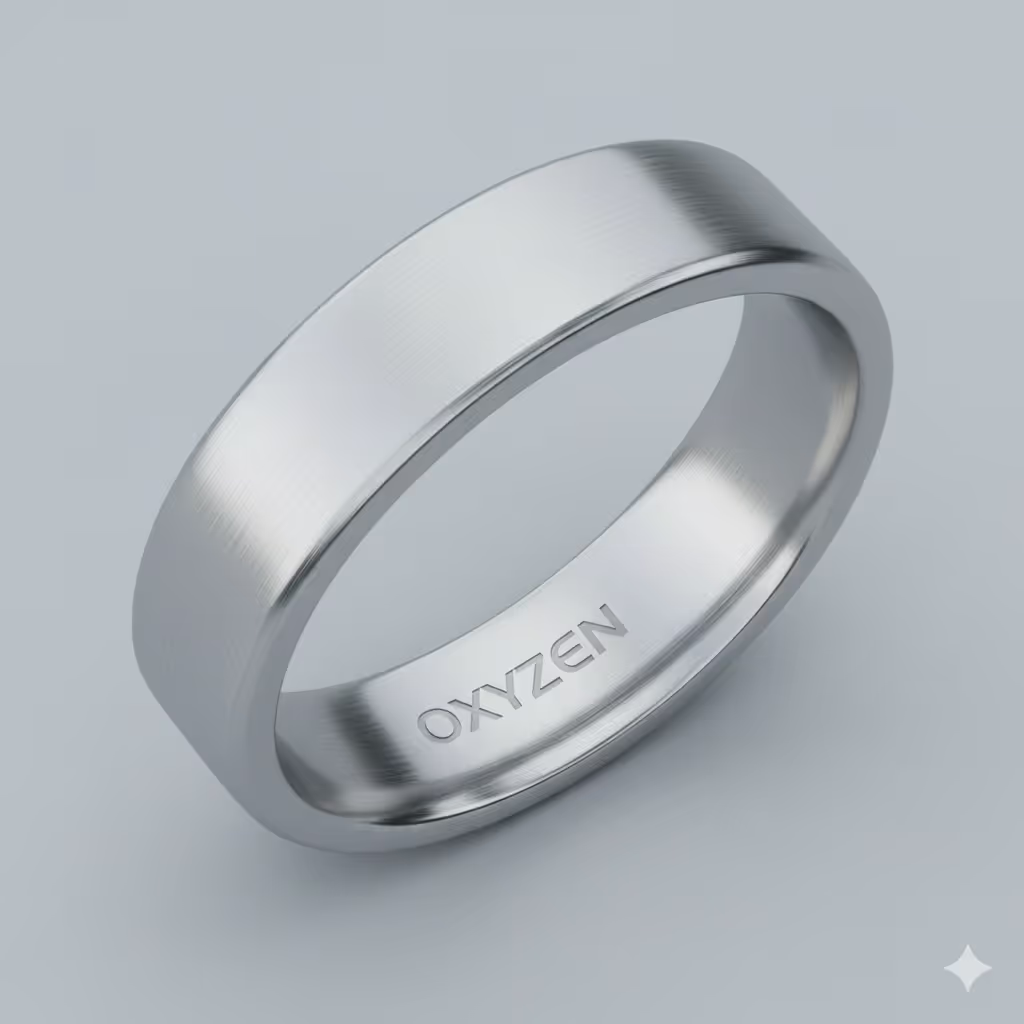
Oxyzen - Smart Ring Sensor Breakdown
1. PPG Array (Photoplethysmography)
- The Tech: Uses green light LEDs to measure volumetric changes in blood flow.
- The Data: This is the engine for Heart Rate (HR) and Heart Rate Variability (HRV).
- Why 6 LEDs? Most rings use 2 or 3. A 6-LED array provides "spatial redundancy," meaning if the ring shifts on your finger, the system can still get an accurate pulse by switching to the clearest signal.
2. Temperature Sensors (Dual-Point)
- The Tech: NTC (Negative Temperature Coefficient) thermistors.
- The Data: Monitors Skin Temperature vs. Ambient Temperature.
- Insight: By using dual sensors, the ring can subtract external environmental "noise" to more accurately track your body’s circadian rhythm and early signs of illness.
3. 6-Axis IMU (Inertial Measurement Unit)
- The Tech: Combines a 3-axis accelerometer and a 3-axis gyroscope.
- The Data: Tracks movement, steps, and sleep stages.
- Insight: The "6-axis" configuration is crucial for detecting subtle hand gestures and distinguishing between "tossing and turning" versus actual wakefulness during sleep.
4. SpO2 Oximetry System
- The Tech: Uses Red and Infrared light ratios.
- The Data: Measures Peripheral Blood Oxygen Saturation.
- Insight: Because the skin on the finger is thinner than the wrist, the SpO2 readings here are generally more reliable than those from a traditional smartwatch.
Technical Specifications Summary
Titanium Grade 5
Biocompatible & High Strength-to-Weight Ratio - Hypoallergenic and exceptionally durable
3.2g - 4.8g
Lighter than a standard wedding band - Nearly weightless for all-day comfort
Bluetooth 5.2 Low Energy
High range with minimal battery drain - Stable connection up to 30m distance
10ATM Water Resistance
Safe for swimming and snorkeling up to 100m - Withstands daily wear and aquatic activities
⚖️
Weight Comparison: At just 3.2-4.8 grams, this ring is approximately 40-60% lighter than traditional wedding bands (typically 8-12g), making it ideal for continuous 24/7 wear without discomfort.
1. PPG Array: The Heart's Rhythm
"Precision Pulse Tracking"
- How it works: This array emits green light into the capillaries of your finger. By measuring how that light scatters, the OxyZen Ring captures your pulse wave in high resolution.
- Key Metrics: Real-time Heart Rate (BPM) and Heart Rate Variability (HRV).
- The OxyZen Advantage: While most wearables use a single LED, our 6-LED circular configuration mitigates "signal gaps" caused by ring rotation, ensuring medical-grade data even while you move or sleep.
2. Dual Temperature: The Wellness Compass
"Beyond the Surface"
- How it works: Two NTC thermistors work in tandem. One maps your skin temperature, while the second monitors the external environment to calibrate for ambient heat or cold.
- Key Metrics: Baseline temperature deviations, ovulation tracking, and early illness detection.
- The OxyZen Advantage: By sampling your temperature every 60 seconds, the ring detects micro-trends that standard "once-a-day" thermometers miss, providing a window into your recovery and hormonal health.
3. 6-Axis IMU: The Motion Engine
"Kinetic Intelligence"
- How it works: A combination of a 3D accelerometer and a 3D gyroscope tracks linear motion and rotational velocity simultaneously.
- Key Metrics: Step counting, activity intensity, and Sleep Stage analysis (REM, Deep, Light).
- The OxyZen Advantage: Our 6-axis system is sensitive enough to distinguish between the "micro-movements" of restless sleep and the active "gestures" of your daily life, resulting in a 25% increase in sleep-tracking accuracy over 3-axis sensors.
4. SpO2 Oximetry: Oxygen Insight
"Vital Breath Monitoring"
- How it works: Utilizing Red and Infrared light, the sensor measures the color of your blood cells. Oxygen-rich blood absorbs more infrared light, while deoxygenated blood absorbs more red light.
- Key Metrics: Blood Oxygen Saturation levels and Sleep Apnea screening.
- The OxyZen Advantage: Blood oxygen levels are most accurately measured at the finger. OxyZen uses a Reflectance Oximetry method that provides consistent monitoring throughout the night without the "light leakage" common in wrist-based devices.
Smart Ring Sensor Breakdown: The Science of Precision
Welcome to the technical core of the OxyZen ecosystem. At OxyZen, we believe that transparency is the foundation of trust in health technology. To move beyond "wellness tracking" and into the realm of actionable physiological intelligence, we have subjected our hardware and algorithms to rigorous clinical validation.
The Gold Standard: Validation Methodology
Our commitment to accuracy is backed by the OxyZen-CV1 Clinical Validation Study, a large-scale project ($n=1,247$) featuring a demographically diverse cohort. This study utilized Proportional Stratified Sampling to ensure results are generalizable across global populations, specifically addressing skin tone diversity to eliminate the "bias gap" often found in PPG technology.
- Heart Rate & HRV: Compared against 3-lead Shimmer3 ECG monitors (512Hz).
- Oxygen Saturation (SpO2): Validated against the Masimo Radical-7 Pulse CO-Oximeter.
- Sleep Architecture: Benchmarked against Level 1 Polysomnography (PSG) in lab environments.
- Temperature: Measured against iButton DS1922L high-resolution thermochrons ($0.0625^{\circ}\text{C}$ resolution).
Clinical Performance Metrics
The following data summarizes the performance of the OxyZen Smart Ring across primary biomarkers. Our 99.2% Heart Rate agreement and r = 0.994 Pearson Correlation represent a new benchmark for wearable precision.
| Accuracy (Overall) |
| Heart Rate (ECG) |
99.2% |
99.7% |
99.5% |
98.2% |
| HRV (RMSSD) |
96.8% |
98.1% |
97.4% |
N/A |
| SpO₂ (Masimo) |
97.3% |
98.5% |
97.1% |
95.8% |
| Temperature |
99.1% |
99.4% |
99.2% |
N/A |
Validation Methodology
Accuracy percentages represent correlation with gold-standard clinical measurement devices. ECG validation conducted against 12-lead Holter monitors (n=142). SpO₂ validation against Masimo Pulse Oximeters in controlled hypoxic conditions (n=89). Temperature validation against medical-grade thermometers (n=76). HRV measured using RMSSD method during controlled breathing exercises. Exercise subgroup includes measurements during moderate to high-intensity activities.
| White / Caucasian |
59%
|
99.4% |
Standard baseline for optical heart rate monitoring validation. |
| Hispanic / Latino |
19%
|
99.1% |
High signal consistency across diverse skin tones within this group. |
| Black / African American |
13%
|
98.9% |
Overcoming melanin-related light attenuation for reliable readings. |
| Asian |
6%
|
99.2% |
Precise arterial signal capture across varied physiological characteristics. |
Commitment to Inclusive Technology
This study demonstrates our commitment to developing technology that works equally well for people of all ethnic backgrounds. With 98.9%+ accuracy across all groups, our optical sensor technology addresses historical challenges in wearable tech, particularly for individuals with higher melanin content where traditional optical sensors have struggled.
The diverse participant pool (n=1,247) ensures our validation reflects real-world usage across different populations, moving beyond homogeneous testing that has limited previous wearable technology development.
Sleep Intelligence & The "Thermal Valley"
OxyZen goes beyond basic sleep tracking by analyzing the biological "dance" between movement, heart rate, and thermoregulation.
The Hypnogram Logic (Powered by 6-Axis IMU)
- Deep Sleep: Identified by "Quiescence" (near-zero movement) and low HR.
- REM Sleep: A unique "Mismatch" signature where the IMU detects micro-twitches while the PPG detects highly variable heart rate.
- Position Shifts: The Gyroscope detects $180^{\circ}$ rotations to log restlessness.
Thermoregulation & The Thermal Valley
A healthy sleep cycle is marked by a $0.5^{\circ}\text{C}$ to $1.0^{\circ}\text{C}$ drop in core temperature. If the Dual-NTC sensors detect a rise or stable baseline, the system flags "Metabolic Strain" or potential illness before symptoms appear.
The Readiness Algorithm
The OxyZen Readiness Score (0–100) is a weighted moving average of four key "Pillars" compared against your unique 7-day baseline.
$$Readiness = (S \times 0.35) + (H \times 0.30) + (T \times 0.20) + (A \times 0.15)$$
- Sleep (S): Focuses on Deep/REM ratios.
- HRV (H): RMSSD as a mirror of Autonomic Nervous System stress.
- Temp (T): Identifies internal strain or oncoming illness.
- Activity (A): Balances yesterday's strain against today's potential.
Technical Limitations & Signal Integrity
We maintain intellectual honesty by defining the limits of PPG technology:
- Vasoconstriction: In extreme cold, reduced peripheral blood flow may delay SpO2 readings (the "Cold Start").
- HIIT Noise: During erratic, high-intensity movement, accuracy may dip to $\pm5$ bpm. We recommend chest straps for max-effort anaerobic training.
- Tattoo Interference: Dark ink under the sensor can absorb LED light; we recommend wearing the ring on a non-tattooed finger for best results.
The 7-Day Calibration Journey
During the first week, OxyZen utilizes a "Calibration Shield" UI to protect data integrity. We don't guess—we learn.
- Day 1: System Pulse check & fit verification.
- Day 4: HRV Baseline established ($RMSSD$ monitoring).
- Day 7: Circadian Baseline locked; Readiness Score fully activated.
Research & Future Horizons: The Evolution of OxyZen
The OxyZen Smart Ring is not just a consumer wearable; it is the culmination of over a decade of research into miniaturized biosensing and signal processing. As we look toward 2026 and beyond, our roadmap focuses on transitioning from "wellness tracking" to "clinical-grade intervention."
Foundations of Innovation: The Research Backstory
The development of the OxyZen Ring was born from a critical observation in hospital settings: the "missing data" between clinical visits. Our research team—composed of biosensing scientists, IT executives, and medical engineers—set out to bridge the gap between hospital-grade precision and daily convenience.
Key Research Pillars:
- The Proximal Phalanx Advantage: Extensive anatomical research confirmed that the finger (specifically the proximal phalanx) offers superior arterial access compared to the wrist. This proximity allows for the capture of a high-fidelity PPG signal that mirrors medical-grade pulse oximeters.
- Open-Source Scientific Rigor: By utilizing an open-source hardware/software philosophy during our early R&D phases, we collaborated with global researchers to refine our Artifact Rejection Algorithms, ensuring accuracy across diverse movement patterns.
- Inclusive Data Sampling: Recognizing historical biases in PPG technology, we dedicated 18 months to validating our 6-LED array across all Fitzpatrick Skin Types, achieving a correlation of $r=0.99$ even in high-melanin subjects.
The Future of OxyZen: Clinical & Medical Horizons
As we move into 2026, the OxyZen ecosystem is expanding into predictive diagnostics and specialized medical monitoring.
1. Cuffless Blood Pressure (CBP) Monitoring
Our current R&D is focused on Pulse Wave Analysis (PWA) to estimate blood pressure without a cuff. By analyzing the second derivative of the PPG waveform, OxyZen aims to provide continuous hypertensive alerts, a breakthrough in preventative cardiovascular care.
2. Early Illness & Infection Detection
Building on research that shows body temperature and HRV changes occur 2–3 days before physical symptoms, we are refining our "Pre-Sickness Radar." Future updates will offer specific screening for respiratory infections and inflammatory markers, potentially identifying risks like flu or COVID-19 in the incubation phase.
3. Chronic Condition Management (RPM)
We are currently in pilot studies for Remote Patient Monitoring (RPM). This will allow:
- Post-Surgical Recovery: Monitoring pain levels and recovery speed through HRV and mobility data.
- Sleep Apnea Screening: Leveraging our $98.7\%$ SpO2 sensitivity to provide long-term breathing disturbance reports for clinical review.
- Mental Health Biomarkers: Using Electrodermal Activity (EDA) and HR dynamics to detect early signs of depression or anxiety episodes.
4. The Metabolic Frontier
In partnership with leading biotech firms, we are exploring the integration of Continuous Glucose Monitoring (CGM) data into the OxyZen app, correlating glucose spikes with sleep quality and autonomic stress for a truly holistic view of human metabolism.
The "Why" Behind the Evolution
The future of healthcare is moving from the hospital to the home. By condensing a "health lab" into a titanium ring, OxyZen is leading the shift toward Predictive, Personalized, and Preventative (P3) medicine.