


How to Build a Personal Stress Relief Toolkit (Customized Approach)
Gardening connects you to nature, provides a sense of agency and accomplishment, and involves rhythmic, mindful activity.
Gardening connects you to nature, provides a sense of agency and accomplishment, and involves rhythmic, mindful activity.
%402x.svg)
We live in a world that glorifies busyness. Our inboxes overflow, our calendars are a mosaic of back-to-back commitments, and the ping of notifications forms the soundtrack of our day. Stress, once a survival mechanism, has become a chronic condition. But what if we told you that you don’t have to accept stress as a permanent resident in your life? What if, instead of reaching for a one-size-fits-all solution, you could build a defense so personal, so tailored to your unique biology and lifestyle, that it could transform your relationship with pressure and overload?
This isn’t about downloading a meditation app you’ll use twice or buying a candle that promises calm. This is a strategic, data-informed, and deeply personal project: building your own Personal Stress Relief Toolkit.
Imagine this: You feel the familiar tightness in your shoulders and the mental fog rolling in. Instead of spiraling, you have a curated set of practices and tools you know work for you. You can deploy a five-minute breathing technique proven to lower your heart rate, choose a movement snack that releases your specific physical tension, or lean on a sensory tool that grounds you instantly. Your toolkit isn’t a collection of generic advice; it’s a living system, designed by you and for you, based on what your body and mind are actually telling you.
The journey to this empowered state begins with a fundamental shift. We move from guessing to knowing, from reactive coping to proactive management. And in this modern age, building the most effective toolkit starts with the most critical component of all: understanding your unique stress signature.

A Personal Stress Relief Toolkit is a curated, evolving collection of strategies, practices, tools, and resources that you have personally vetted and organized to help you prevent, manage, and recover from stress. Think of it less like a first-aid kit you only open in an emergency, and more like a master chef’s meticulously organized kitchen. Every ingredient has a purpose, every tool is chosen for a specific task, and you know exactly how to combine them to create the desired outcome—in this case, resilience and calm.
Unlike generic lists of "10 Ways to Reduce Stress," a personalized toolkit is built on three pillars:
Why is this personalized approach non-negotiable? Because stress is not a monolithic experience. A looming deadline might fill one person with anxious energy they can channel into work, while it paralyzes another. For one person, solitude is restorative; for another, it’s isolating. A vigorous run might clear someone’s head, while for someone else, it might feel like just another draining task.
Relying on generic solutions is like taking medicine without a diagnosis. You might get lucky, but you’re just as likely to waste time and feel discouraged when the popular solution doesn't work for you. A 2022 study in the Journal of Personalized Medicine emphasized that "intervention effectiveness for mental well-being increases dramatically when tailored to an individual's phenotype, lifestyle, and preferences."
Your toolkit becomes your personal operating manual for resilience. It saves you mental energy in moments of distress—you don’t have to decide what to do, you simply execute from your pre-vetted plan. It empowers you by putting you in the driver's seat of your own well-being. And as you refine it, it becomes a powerful feedback loop: the more you use it, the more you learn about yourself, and the more effective it becomes.
To begin this journey of self-understanding, we must first learn to decode the language of our own body. This is where modern technology, particularly biometric wearables like the advanced smart rings from Oxyzen.ai, transitions from a novelty to an essential toolkit component.
The ancient Greek aphorism "know thyself" is the cornerstone of any personalized wellness journey. To build a toolkit that works, you must first become a detective of your own experience. Your "Stress Signature" is the unique combination of physical, emotional, and mental cues that signal your body’s response to pressure.
Most of us are surprisingly poor at recognizing our stress until it’s screaming at us. We ignore the early whispers—the slight jaw clenching, the shortened patience, the restless sleep—until they become shouts in the form of migraines, burnout, or anxiety. The goal here is to elevate your awareness from the shout to the whisper.
Your stress signature consists of several layers:
The challenge with relying solely on this self-reported awareness is what psychologists call "interoceptive awareness"—our ability to perceive internal bodily sensations. It’s a skill that can be clouded by distraction and habit.
This is where objective data becomes revolutionary. Imagine having a 24/7 companion that quantifies the whispers. A advanced smart ring, like those developed by Oxyzen.ai, acts as an unbiased biofeedback tool. It continuously tracks metrics like:
By correlating your subjective feelings ("I feel on edge today") with this objective data ("My HRV dropped 15% last night and my resting heart rate is 8 bpm higher than usual"), you move from guesswork to knowledge. You can start to see patterns: "Every time I have a meeting with my manager, my stress metrics spike two hours beforehand," or "On days I meditate for 10 minutes, my nighttime HRV improves."
This data forms the unshakeable foundation of your toolkit. It tells you when to deploy your strategies, helps you identify your most potent triggers, and, crucially, provides proof of what’s actually working. For a deeper dive into the science behind these metrics and how they guide personal wellness, explore our blog for more insights.

With a growing awareness of your unique stress signature, we can now construct the framework of your toolkit. Effective, modern stress management isn't about a single magic bullet; it's about shoring up your defenses across multiple domains of your life. Think of these as the four load-bearing walls of your resilient home.
This is first for a reason: you cannot think your way out of a physiological stress response. When your body is in "fight-or-flight," the prefrontal cortex (responsible for rational thought) goes offline. Therefore, your toolkit’s most immediate tools must be those that directly signal safety to your nervous system.
Once the physiological alarm is quieted, you can address the thoughts fueling the fire. Stress is often less about an event and more about our perception of it. This pillar contains tools to audit and edit your internal dialogue.
This is the proactive, systems-level work. It’s about structuring your life and environment to minimize unnecessary friction and create automatic buffers against stress.
You cannot pour from an empty cup. This pillar is about intentional, scheduled replenishment. It’s the opposite of burnout—it’s "burn-in," actively fueling your resilience.
These four pillars are your toolkit’s blueprint. In the following sections, we will drill down into each, providing specific, actionable tools you can test and integrate. But first, we must address the critical skill of using the right tool at the right time.
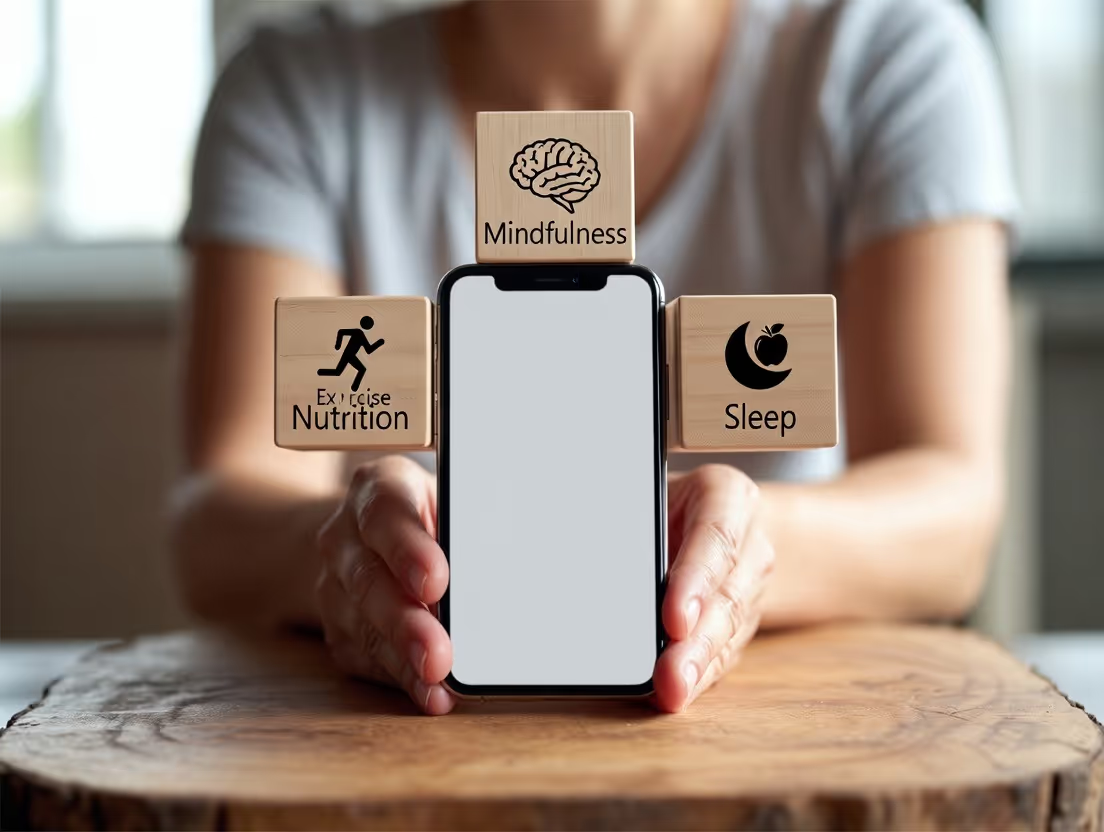
Having a box full of sophisticated tools is useless if you grab a sledgehammer to drive a thumbtack. A key component of your Personal Stress Relief Toolkit is a "matching guide"—a intuitive understanding of which tool to deploy based on the intensity and context of your stress.
Stress exists on a spectrum, from low-grade background irritation to acute panic. Your response should be proportional. We can categorize stress into three tiers and match appropriate toolkit strategies:
The art of matching requires practice. A great way to develop this skill is to review your biometric data after a stressful event. Did a Tier 2 incident cause a Tier 3 physiological response? That tells you your threshold is low and you might need more Tier 1 preventative tools. Conversely, if you navigated a big challenge with minimal physiological disruption, note what preventative tools you used that week. This data-driven refinement is what makes a modern toolkit so powerful. For real-world examples of how individuals have learned to match their responses, our testimonials page shares powerful user journeys.

Let's return to our first and most critical pillar: Physiological Regulation. Since you cannot reason with a revved-up nervous system, the tools here are your first line of defense. Mastery of these creates a "floor" beneath which your stress cannot fall.
Breathing is the remote control for your autonomic nervous system. While "just breathe" is often unhelpful advice, specific breathing patterns are profoundly effective.
Actionable Step: Don't wait for stress. Practice one of these techniques for 5 minutes daily, perhaps while your coffee brews or as you start your car. This builds the neural pathway so it's strong when you need it.
Integrating these physiological tools with feedback from a device like an Oxyzen smart ring creates a powerful biofeedback loop. You can do a 5-minute breathing session and literally see your HRV respond or your resting heart rate drop in real-time. This positive reinforcement makes the practice stick, turning it from a chore into a fascinating experiment in self-mastery. To understand the technology that enables this precise feedback, you can learn more about how Oxyzen works.
Once your body is out of red alert, you can address the cognitive patterns that either ignited the stress or are fanning the flames. Our thoughts are not reality; they are interpretations. This pillar is about becoming the editor of your internal newsfeed.
These are common, irrational thought patterns that magnify stress. Learning to spot them is the first step to disarming them.
Tool: The Thought Record. When you feel a spike of stress, pause and write down:
This simple exercise breaks the automatic connection between trigger and distressed reaction.
Psychologist Carol Dweck's work on mindset is crucial here. Viewing stress through a "threat" lens ("This is going to destroy me") is debilitating. Viewing it through a "challenge" lens ("This is difficult, but I can learn and grow from it") is empowering.
These cognitive tools are muscles that grow stronger with use. They are the software update your brain needs to process challenges more efficiently. For more techniques on mindset and emotional resilience, our blog features ongoing research and practical guides.
Your willpower and conscious coping strategies are finite resources. The smartest approach to stress management is to design your environment and habits so they require less willpower. This is about being a architect of your life, not just a firefighter.
Our devices are arguably the greatest source of modern, chronic, low-grade stress.
Your surroundings directly impact your nervous system.
Unpredictability is stressful for the brain. Creating gentle, flexible routines provides a scaffold of safety.
Implementing even a few of these environmental designs creates a background of lower stress, freeing up your internal resources to handle the inevitable challenges that arise. This proactive design philosophy is core to the mission and vision behind Oxyzen.ai, which aims to seamlessly integrate wellness into the fabric of daily life, not add to its complexity.
If Pillar 3 is about reducing drains on your energy, Pillar 4 is about intentionally installing renewable energy sources. This is where you move from merely surviving stress to thriving in spite of it. Recovery isn't passive; it's an active skill.
Play is not frivolous. It is a state of engaged, relaxed exploration without a specific goal or pressure. It’s a potent antidote to the performance-oriented mindset that drives so much of our stress.
Loneliness is a profound stressor. Conversely, positive social connection releases oxytocin, buffers stress, and improves longevity.
Reframe exercise from a task you "should" do to a gift you give your nervous system.
By deliberately scheduling and protecting these sources of joy and recovery, you ensure your personal "battery" stays charged. You are not being selfish; you are building the capacity to show up as your best self in all areas of your life. The stories of individuals who have transformed their well-being by prioritizing these principles are a testament to their power, many of which are shared on our our story page.
Building the framework of your four-pillar toolkit is a strategic victory, but its true power is unlocked in daily application. This is where we transition from architect to resident—learning to live comfortably and resiliently within the structure we've built. The following sections will guide you through the practical, personalized implementation of your toolkit, ensuring it evolves from a concept into an automatic, life-enhancing system.
You cannot effectively manage what you haven't clearly identified. Before randomly selecting tools, you must conduct a clear-eyed audit of your personal stress landscape. This is a non-judgmental fact-finding mission.
Step 1: The Stressor Inventory
Grab a notebook or digital document. Over the course of a week, jot down every time you feel a flicker of stress, irritation, or overwhelm. For each entry, note:
After a week, look for patterns. Do 80% of your stressors occur between 2-4 PM? Are they mostly related to communication, time pressure, or interpersonal dynamics? This pattern recognition is gold—it tells you where to focus your toolkit's preventative measures.
Step 2: The Energy Audit
Simultaneously, track what gives you energy. Note activities, interactions, and moments that leave you feeling replenished, inspired, or calm. Was it that 10-minute chat with a colleague? The walk you took at lunch? Reading fiction before bed? Cooking a nice meal?
Step 3: Cross-Reference with Data
If you're using a biometric device like the Oxyzen ring, this is where it becomes indispensable. Look at your weekly data. Correlate your self-identified high-stress days with your HRV, resting heart rate, and sleep scores. You might discover that a day you subjectively rated as "moderately stressful" corresponded with a massive dip in HRV, indicating a bigger physiological impact than you realized. Or, you might see that on days you recorded an "energy-giving" activity like a lunchtime walk, your afternoon stress metrics are noticeably better.
This tripartite audit—subjective stressor log, subjective energy log, and objective biometric data—creates a multidimensional map of your personal well-being terrain. It moves you from vague feelings ("I'm always tired and stressed") to specific, actionable insights ("My stress peaks on Tuesday afternoons after the team meeting, and my energy is highest after I've had 20 minutes of quiet time in the morning"). This map is the blueprint for customizing every tool that follows. For support on interpreting your own data patterns, our FAQ section offers detailed guidance.
With your audit complete, you are ready to curate. This is not about adding more to your to-do list; it's about a strategic, experimental selection process. Think of it like a chef tasting ingredients to see which work best together.
Phase 1: Brainstorming & Categorization
Using your audit insights, brainstorm potential tools for each of the Four Pillars, tailored to your specific patterns.
Phase 2: The "Two-Week Test"
Select no more than 2-3 new tools to test over a two-week period. Trying to overhaul everything at once is a recipe for failure and more stress.
Phase 3: Analyze & Iterate
After two weeks, review. Did the tool help? Did you actually do it? Was it tolerable or did it feel like a chore?
This test-learn-adapt cycle turns toolkit building into a curious, personal science experiment. It removes the pressure of finding the "perfect" solution and embraces the process of discovery. The journey of creating a product that supports this kind of iterative self-discovery is at the heart of the Oxyzen story.
A tool is useless if you can't find it in a moment of need. Your toolkit needs an organizational system—a "menu" you can consult instantly, even when your thinking brain is offline.
The "Stress Spectrum Menu"
Organize your vetted tools not by pillar, but by the intensity of stress you defined earlier (Flicker, Flame, Firestorm). Create a physical or digital document you can access easily.
Sample Menu:
TIER 1: THE FLICKER (Low-Grade Irritation)
TIER 2: THE FLAME (Active Overwhelm)
TIER 3: THE FIRESTORM (Acute Panic/Flooding)
The "Preventative Daily Dose"
Also, list 2-3 non-negotiable daily practices that build your baseline resilience, chosen from your audit (e.g., "Morning: 5 mins of gratitude. Afternoon: 15-min walk. Evening: No phone 1 hour before bed").
Choose Your Format:
The key is immediacy. When stress hits, you don't want to be searching through notes; you want to glance at your menu and pick an action. This reduces the cognitive load of decision-making under pressure, which is itself a powerful stress reliever.
Modern personal wellness is uniquely empowered by technology. A device like a smart ring is not a magic solution, but a powerful compass and feedback mechanism for your toolkit. Here’s how to integrate it intelligently.
1. Use Data for Validation, Not Validation.
The goal is not to become a slave to your scores, but to use them to validate your subjective experience and reveal hidden patterns. If you feel great but your HRV is tanking, it might prompt you to check for an underlying infection or overtraining. If you feel stressed but your metrics are stable, it might indicate you're handling the challenge well physiologically, and your cognitive tools are working.
2. Set Up Meaningful Alerts.
Use customizable alerts for moments that matter. For instance, if you know prolonged sitting increases your physical tension, set an inactivity alert to remind you to move every hour. If high heart rate during the workday is a trigger for you, you could set a gentle alert if it stays elevated for a sustained period, prompting you to deploy a breathing tool.
3. Run Formal Experiments.
Go beyond casual correlation. Design a two-week experiment: "For the next 14 days, I will do 10 minutes of resonant breathing before bed." Observe the impact on your Sleep Score and next-day Readiness Score. This turns self-care into concrete, data-driven self-knowledge. Seeing a graph trend upward is a profoundly motivating form of positive reinforcement that mere feeling often can't provide.
4. Track Long-Term Trends, Not Daily Fluctuations.
Stress and recovery are cyclical. Don't get discouraged by a single bad day of data. Look at weekly and monthly trends. Is your baseline HRV gradually improving? Is your average sleep duration increasing? These long-term trends are the true measure of your toolkit's effectiveness, showing you're building a more resilient system overall.
This intelligent partnership with technology—where you are the expert on your life and the device is the expert on your physiology—creates a closed-loop system for continuous refinement. It answers the critical question: "Is what I'm doing actually working inside my body?" To see how others have leveraged this feedback loop, you can read about their experiences in real customer reviews.
While your toolkit is personal, it should not be solitary. Human beings are wired for connection, and a robust support network is a critical component of stress resilience. This is about intentionally building your "circle of support."
Map Your Support Network:
Draw three concentric circles.
Strategically Strengthen Each Layer:
Remember, your social toolkit is reciprocal. Being a supportive listener for others also strengthens your own resilience and sense of purpose. Investing in these relationships is not a distraction from your stress management—it is a foundational part of it.
Even the best-designed toolkit will face real-world challenges. Anticipating these pitfalls allows you to build strategies around them.
Pitfall 1: "I don't have time for this."
Pitfall 2: "I tried it once and it didn't work."
Pitfall 3: "I forgot to use it when I needed it most."
Pitfall 4: "This feels selfish or self-indulgent."
Navigating these pitfalls is part of the process. Each time you recognize and move past one, you strengthen your resilience muscle and deepen your commitment to your own well-being. For additional strategies and community support on maintaining consistency, our blog is a continually updated resource.
Your Personal Stress Relief Toolkit is now operational. You have the map from your audit, a curated set of tested tools organized on a ready menu, and strategies to navigate common obstacles. This is a monumental achievement. Yet, the journey now evolves from building and maintaining to mastering and seamlessly integrating. This phase is about refinement, personalization to an even deeper level, and ensuring your toolkit evolves with you through life’s inevitable changes.
Individual tools are powerful, but their impact multiplies when strategically combined. This is "tool sequencing"—creating personalized protocols that address stress in a layered, comprehensive way. Think of it as a wellness recipe where the whole is greater than the sum of its parts.
The Principle of Physiological First, Cognitive Second:
Always remember the neurobiological hierarchy: you must calm the body to access the thinking brain. An effective sequence therefore almost always starts with a Pillar 1 (Physiological) tool.
Sample Advanced Sequences:
1. The "Pre-Meeting Reset" (For anticipatory anxiety):
2. The "Evening Unwind" (To transition from work stress to home recovery):
3. The "Emotional Flood Protocol" (For Tier 3 Firestorm moments):
Creating Your Own Sequences:
Analyze your Stressor Inventory. For your top 2-3 predictable stress scenarios, design a 3-5 step sequence. Practice this sequence during low-stress times so it becomes an automatic program you can run when needed. The compounding effect of these sequenced actions creates a powerful, holistic intervention that can halt a stress spiral in its tracks.
True customization goes beyond triggers and into the very fabric of your biology and temperament. Two of the most powerful personalization filters are your chronotype (your body's natural timing preference) and core aspects of your personality.
Leveraging Your Chronotype:
Are you a Wolf (night owl), a Lion (morning person), a Bear (follows the sun), or a Dolphin (light sleeper, alert at odd times)? Your energy, focus, and stress resilience fluctuate predictably throughout your day based on this.
Aligning with Your Personality:
If you are introverted, a "social connection" tool might look like a meaningful 1-on-1 call, not a group event. If you are highly conscientious, your toolkit needs permission-to-rest tools to counter overwork. If you are high in openness, you'll need novelty in your recovery tools to stay engaged.
By aligning your toolkit with these innate layers of your being, you reduce friction dramatically. The tools don't just work; they feel right. This deep alignment is a principle we value deeply, as reflected in our company's mission to create personalized, human-centric wellness technology.
Your life is not static, and neither should your toolkit be. A rigid toolkit will break under the pressure of change. You must schedule formal "Toolkit Reviews" to ensure it remains relevant and effective.
The Quarterly Review (Every 3 Months):
Set a calendar reminder. In this 60-minute session, ask yourself:
The Life Transition Overhaul:
Major life events—becoming a parent, changing careers, moving, experiencing loss—require a full toolkit overhaul. The old tools may not fit the new reality. This is not a failure; it's an adaptation.
This cyclical review process ensures your toolkit is a living document, a testament to your growth. It transforms your approach from a static "fix" to a dynamic, lifelong practice of self-awareness and care. For inspiration on navigating life's transitions with resilience, you can find relatable stories shared by our community on our testimonials page.
Here is a profound shift in perspective: Your stress relief toolkit is not merely a damage-control system. It is the very same foundation required for sustained peak performance, creativity, and flow. A nervous system that can recover effectively is a nervous system that can engage effectively.
The Yerkes-Dodson Law in Action:
This classic psychology principle shows that performance increases with physiological or mental arousal (stress), but only up to a point. Beyond that optimal point, performance plummets. Your toolkit’s job is to keep you in the optimal zone—engaged, energized, and challenged, but not overwhelmed.
Toolkit Tools for Entering "Flow State":
Flow, that state of effortless concentration and enjoyment, requires a specific set of conditions that your toolkit can create.
The Performance-Recovery Cycle:
Elite athletes understand this intimately: performance is built in the recovery phase. Your toolkit’s Pillar 4 (Recovery) is not the opposite of work; it is what makes high-quality work possible.
By framing your toolkit as a performance-enhancing system, you integrate it even more deeply into your identity. It’s not just for when you’re “broken”; it’s your daily training regimen for a resilient, impactful, and creative life.
Building your personal resilience does not happen in a vacuum. As you become more regulated, grounded, and emotionally available, you create positive ripples that extend to your family, your workplace, and your broader community. Your toolkit, therefore, becomes a quiet form of leadership and service.
Modeling Regulation:
Children, partners, and colleagues learn emotional regulation through co-regulation. When you feel a stress response rising and you visibly deploy a tool (taking a deep breath, stating you need a moment, going for a walk), you are demonstrating a crucial life skill without saying a word. You give others implicit permission to care for their own nervous systems.
Increasing Your Capacity for Empathy & Patience:
When you are not drowning in your own stress, you have surplus emotional and cognitive resources to truly listen to others. You can offer patience instead of irritation, empathy instead of judgment. Your toolkit directly increases your capacity for compassionate connection.
Contributing to a Healthier Culture:
In a workplace, one person consistently managing their stress well can shift team dynamics. They can be the voice that suggests a breathing break before a tense meeting, or that champions reasonable deadlines. This can slowly transform a culture of burnout into one of sustainable performance. The founding vision behind Oxyzen.ai is rooted in this belief—that empowering individuals with self-knowledge can positively impact the collective well-being of teams and families.
Sharing Tools, Not Imposing Them:
This is key. The ripple effect is not about evangelizing your specific tools. It’s about sharing the process when asked. "I was feeling really overwhelmed by that deadline, so I tried time-blocking my calendar, and it helped me focus. Would you like me to share how I set it up?" This invites curiosity rather than prescribes a solution.
Your personal wellness is a contribution. By taking responsibility for your own state, you free up collective energy and create an environment where others feel safer to do the same. This is perhaps the most powerful and undervalued outcome of building a truly effective, personalized stress relief toolkit.
We have journeyed from the fundamental "why" of a personalized toolkit, through the deep self-discovery of identifying your unique stress signature, to constructing the Four Pillars of a resilient life. We've moved into the practicalities of auditing, curating, and organizing your tools, integrating technology as a guide, and building a support network. Finally, we've explored the advanced stages of mastery—sequencing tools, aligning with your core biology, adapting through life's changes, and recognizing your toolkit as an engine for performance and a gift to your community.
You now hold the blueprint and the tools. The process ahead is one of gentle, consistent application and curious refinement. Remember, the goal is not a stress-free life—that is neither possible nor desirable. The goal is a resilient life: the capacity to meet stress, navigate it skillfully, learn from it, recover from it, and even grow stronger because of it.
Begin where you are. Start with the audit. Get curious about your own data, whether it's subjective feelings or objective metrics from a device like the Oxyzen smart ring. Test one tool. Be patient with the process and compassionate with yourself when you forget. This is not a linear path to a finish line; it is the cultivation of a lifelong relationship with yourself—one built on awareness, kindness, and skillful means.
Your personalized peace is not a destination to be reached, but a toolkit to be carried, forever evolving, always at your service.
Your Trusted Sleep Advocate: Sleep Foundation — https://www.sleepfoundation.org
Discover a digital archive of scholarly articles: NIH — https://www.ncbi.nlm.nih.gov/
39 million citations for biomedical literature :PubMed — https://pubmed.ncbi.nlm.nih.gov/
Experts at Harvard Health Publishing covering a variety of health topics — https://www.health.harvard.edu/blog/
Every life deserves world class care :Cleveland Clinic - https://my.clevelandclinic.org/health
Wearable technology and the future of predictive health monitoring :MIT Technology Review — https://www.technologyreview.com/
Dedicated to the well-being of all people and guided by science :World Health Organization — https://www.who.int/news-room/
Psychological science and knowledge to benefit society and improve lives. :APA — https://www.apa.org/monitor/
Cutting-edge insights on human longevity and peak performance:
Lifespan Research — https://www.lifespan.io/
Global authority on exercise physiology, sports performance, and human recovery:
American College of Sports Medicine — https://www.acsm.org/
Neuroscience-driven guidance for better focus, sleep, and mental clarity:
Stanford Human Performance Lab — https://humanperformance.stanford.edu/
Evidence-based psychology and mind–body wellness resources:
Mayo Clinic — https://www.mayoclinic.org/healthy-lifestyle/
Data-backed research on emotional wellbeing, stress biology, and resilience:
American Institute of Stress — https://www.stress.org/


