


The Calm Mind and High Performance: Why Top Athletes Use These Techniques
Top athletes use calm mind techniques to stay focused under pressure, reduce performance anxiety, and enhance recovery.
Top athletes use calm mind techniques to stay focused under pressure, reduce performance anxiety, and enhance recovery.
%402x.svg)
Imagine the final seconds of a tied championship game. The crowd is a deafening roar, the pressure is a physical weight, and all eyes are on one person. For the elite athlete in that moment, raw physical talent isn’t enough. The difference between a legendary shot and a catastrophic miss isn’t found in the muscles; it’s forged in the silent, stormy arena of the mind.
For decades, the blueprint for athletic greatness was simple: train harder, eat cleaner, sleep longer. Physical metrics were king. But a quiet revolution has been reshaping the pinnacle of sports performance. The new frontier isn’t the body—it’s the mind. Today’s most dominant athletes, from Olympic gold medalists to NBA champions, aren’t just physical specimens; they are masters of their mental landscape. They have discovered a paradoxical secret: ultimate performance is not born from frantic intensity, but from profound calm.
This shift represents a fundamental understanding of human physiology and psychology. The brain is not a passive bystander to athletic achievement; it is the command center, the governor of energy, the interpreter of pressure, and the architect of movement. When the mind is cluttered with anxiety, drowned in past failures, or hijacked by future fears, the body—no matter how well-trained—becomes clumsy, slow, and inefficient. Conversely, a calm, focused, and present mind unlocks the body’s full, fluid potential. It allows for “flow state,” that elusive zone where action and awareness merge, time distorts, and performance seems effortless.
This article is your deep dive into the symbiotic relationship between a calm mind and high performance. We will move beyond the clichés of “mental toughness” to explore the specific, science-backed techniques that champions use to cultivate unshakable focus, resilience, and clarity. We’ll trace the journey from the early, almost mystical Eastern practices adopted by pioneers like Phil Jackson to the cutting-edge, data-driven neurofeedback and biometric tracking used by modern athletes.
Furthermore, we will explore how this wisdom is now accessible to everyone, not just those on a professional roster. The advent of wearable technology, particularly advanced smart rings, has democratized the ability to understand and train our nervous systems. Devices like the Oxyzen smart ring provide a real-time window into the physiological correlates of calm—heart rate variability (HRV), sleep quality, stress readiness, and recovery—allowing anyone to quantify their mental state and track their progress toward a more centered, high-performing self.
The journey to peak performance begins not with a louder roar, but with a quieter mind. Let’s explore why.

For generations, the athletic ideal was sculpted in iron and sweat. Coaches focused on VO2 max, one-rep max, sprint times, and vertical leaps. Training was a brutal arithmetic of more: more miles, more weight, more repetitions. The mind was often an afterthought, addressed with vague exhortations to “be tough” or “get your head in the game.” It was a world where “no pain, no gain” ruled, and psychological struggles were seen as weaknesses to be hidden, not skills to be honed.
This paradigm began to crack as athletes reached apparent physical ceilings. Why did two competitors with near-identical strength, speed, and skill see wildly different outcomes under pressure? Why did some athletes “choke” while others thrived? Researchers and forward-thinking coaches started looking inward. They discovered that the brain’s limbic system—the seat of emotion and the fight-or-flight response—was often the true opponent. In high-stakes situations, the amygdala would sound the alarm, flooding the body with cortisol and adrenaline. This ancient survival mechanism, perfect for escaping a predator, is disastrous for sinking a putt or executing a complex gymnastics routine. It causes muscles to tense, fine motor control to vanish, and perception to narrow into a tunnel of threat.
The new performance paradigm flips the script. It posits that sustainable excellence is built on a foundation of psychophysiological regulation—the ability to consciously manage the interplay between mind and body. It’s not about suppressing emotion or ignoring pressure; it’s about developing the skill to navigate it. This paradigm values recovery as much as exertion, views sleep as critical training, and treats focused mental rehearsal as powerfully as physical practice.
At the core of this model is the autonomic nervous system (ANS), the automatic control system for your heart, digestion, and stress response. The ANS has two main branches: the sympathetic (gas pedal, fight-or-flight) and the parasympathetic (brake pedal, rest-and-digest). Peak performance isn’t a state of being stuck on the gas or the brake; it’s the ability to shift smoothly between intense, sympathetic-driven effort and deep, parasympathetic-led recovery. An athlete who can’t downshift will burn out. An athlete who can’t upshift will lack intensity.
Modern champions now train their nervous systems with the same precision they train their muscles. They learn to tap the brake pedal on command, activating the parasympathetic response to quiet the mind, steady the hands, and see the field with crystalline clarity amid chaos. This ability to cultivate calm on demand is the superpower of the modern athlete. As we’ll see, it’s a skill built through deliberate, evidence-based techniques, and its effects are now measurable down to the millisecond of heart rhythm. To understand how this training began, we must look to a coach who brought meditation to the hardwood.
Before “mindfulness” became a corporate buzzword, it was the secret weapon of the most successful coach in NBA history. Phil Jackson, nicknamed the “Zen Master,” integrated Eastern philosophies and meditation practices into his coaching strategy with the Chicago Bulls and Los Angeles Lakers, leading to a staggering 11 championships. His approach was initially met with skepticism in a league built on aggression and trash talk. Yet, his results were undeniable.
Jackson’s genius was in recognizing that a team of superstars, each with massive egos and relentless pressure, needed a tool to transcend their individual anxieties and function as a single, fluid unit. He introduced techniques like seated meditation, mindful breathing, and even mandatory silence on team buses. He gave his players books on philosophy and used Native American rituals to foster group connection. For Michael Jordan, Scottie Pippen, Kobe Bryant, and Shaquille O’Neal, this wasn’t just New Age fluff; it was a competitive edge.
“I used meditation and mindfulness to… still my mind so I could focus on what was happening right then and there,” Kobe Bryant later said. This ability to be fully present—to not be rattled by a previous turnover or anxious about the final score—allowed his players to access what athletes call “the zone.” Jackson created an environment where mental training was as routine as free-throw practice. He taught his teams that the opponent’s most disruptive tactic wasn’t a full-court press, but the internal chatter of self-doubt and distraction.
The “Phil Jackson Effect” proved that mindfulness could work at the highest level of professional sports. It provided a blueprint: calmness leads to focus, focus leads to awareness, and awareness leads to superior decision-making. It showed that managing the internal environment was prerequisite to dominating the external one.
Jackson’s success opened the floodgates. Suddenly, sports psychologists were in high demand. Teams began hiring “mindfulness coaches” and “performance psychologists.” The conversation shifted from if mental training worked to how to implement it most effectively. The legacy of the Zen Master is a landscape where today, athletes like Novak Djokovic, Russell Wilson, and the entire “Mindful Sports” movement publicly credit meditation and mental conditioning for their success. They understand what Jackson intuited: the court, field, or course is a reflection of the mind. To master the game, you must first master yourself.
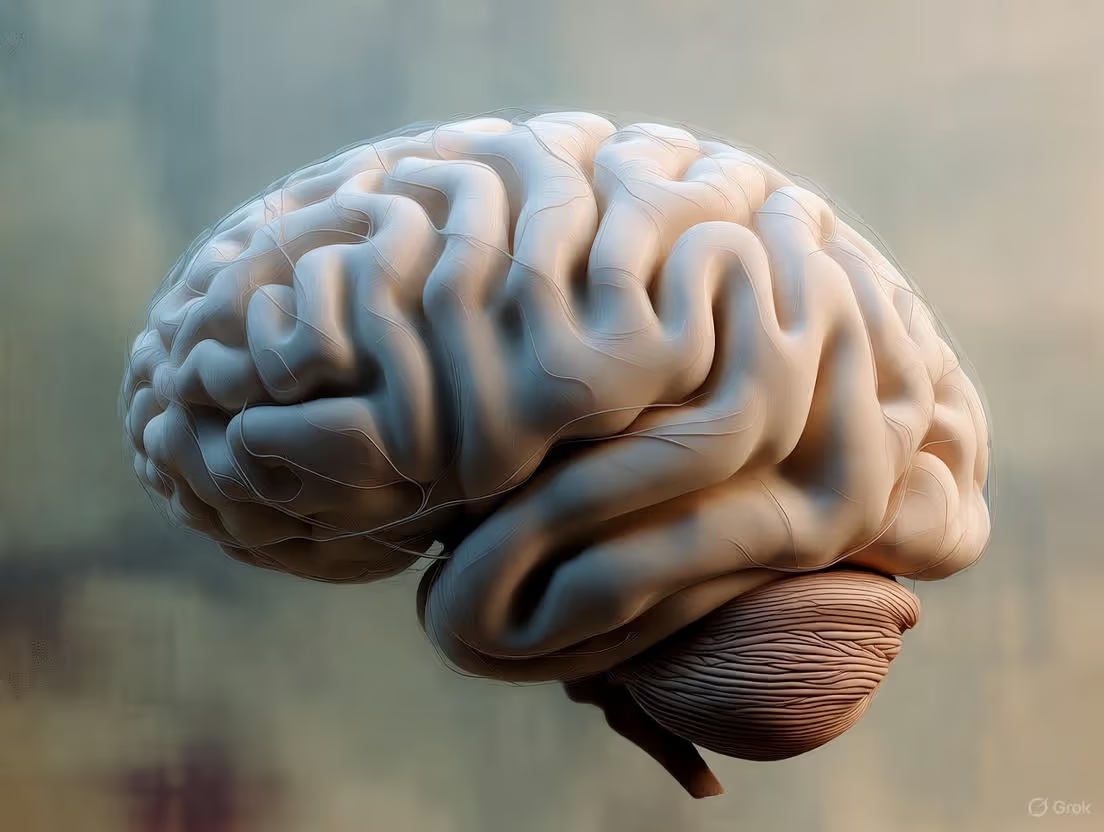
The ultimate goal of cultivating a calm mind is to access the state of peak performance known as flow. Coined by psychologist Mihaly Csikszentmihalyi, flow is that magical experience of being “in the zone”: completely absorbed, effortlessly focused, and performing at your best with a sense of joyful control. For an athlete, it feels like the game slows down, instincts take over, and every action unfolds perfectly. But what’s actually happening inside the brain during flow? Neuroscience provides a fascinating map.
Flow is not a mysterious spiritual event; it’s a measurable neurological state characterized by specific changes in brain activity:
The critical link between calm and flow lies in the initial gate. An overactive, anxious mind—with a hyperactive amygdala and prefrontal cortex stuck in worry—cannot achieve transient hypofrontality. The brain is too busy managing perceived threats to rewire itself for peak efficiency. The calm mind, achieved through the techniques we discuss, is the prerequisite platform from which the brain can launch into the flow state. It lowers the neurological “noise” so the signal of perfect performance can come through.
This is why athletes invest in mental training. They are, quite literally, practicing the neural patterns that allow their brain to shift into its most powerful and efficient state. They aren’t just hoping for flow; they are training for it. And as we’ll see, one of the most direct ways to influence this brain state is by first regulating the body, starting with the most fundamental rhythm of all: the breath.

If the mind and body are inextricably linked, then the breath is the leash that connects them. It’s the only autonomic function we can also consciously control, making it the perfect “remote control” for our nervous system. Every elite athlete today has a breathing protocol, drawn from ancient yogic practices like Pranayama and refined by modern sports science.
Why does breathing hold such power? It directly impacts heart rate variability (HRV), a critical metric for performance and resilience. HRV is not your average heart rate; it’s the subtle variation in the milliseconds between each heartbeat. A higher, more variable HRV indicates a healthy, adaptable nervous system—one that can respond powerfully to stress and then recover quickly. A low, rigid HRV suggests a system stuck in stress mode. HRV is now considered one of the gold-standard biomarkers for tracking an athlete’s readiness to perform and their recovery status.
Conscious breathing techniques are the fastest way to influence HRV and shift the nervous system from stress (sympathetic) to calm (parasympathetic). Here’s how athletes use them:
Athletes don’t just use these techniques during competition. They practice them daily to train their nervous system’s flexibility, just like lifting weights trains muscles. A quarterback might use box breathing in the huddle before a game-winning drive. A free-throw shooter will take a coherent breath to settle their body before the shot. A powerlifter will use a deliberate exhale to engage core stability before a maximal lift.
The beauty of this science is its accessibility. You don’t need a coach to start. By simply paying attention to and directing your breath, you begin to take control of your physiological state. For those wanting to track the impact of these practices, technology like the Oxyzen smart ring provides immediate feedback, showing how your HRV and stress levels respond in real-time to different breathing protocols. You can explore our blog for more on how to use breathwork to optimize your HRV and daily readiness.
Close your eyes. Picture yourself at the starting blocks. Feel the rough track under your fingers, hear the crowd fade into a distant murmur, sense the explosive tension in your legs. See yourself exploding forward, each stride powerful and precise, breaking the tape at the finish line. You have just engaged in one of the most potent performance tools available: mental rehearsal or visualization.
Athletes from Muhammad Ali to Lindsey Vonn have used visualization to craft their success before it happens. But this is not mere daydreaming. Functional MRI scans show that when an athlete visualizes an action with intense detail—the sights, sounds, smells, and kinesthetic feelings—the brain activates the same motor cortex and neural pathways as when physically performing the movement. It’s a neurological dress rehearsal.
The benefits are profound:
The key to effective visualization is specificity and emotion. The best athletes don’t just see a vague success; they feel the sweat, hear the specific sounds of their sport, and experience the triumphant emotion of achieving their goal. This multi-sensory practice builds what psychologists call “self-efficacy”—the unshakeable belief that you can execute the task. It moves the performance from a hopeful possibility to an internalized memory.
This technique requires a calm mind. A stressed, scattered brain cannot sustain the focused, detailed imagery required for effective visualization. The practice itself becomes a meditation, a quiet space where the athlete builds their reality neuron by neuron. It is the ultimate act of mental craftsmanship.
High performance is not a perpetual state of flow and ease. It is often grueling, uncomfortable, and fraught with failure. The difference between those who break and those who break records is resilience—the ability to withstand, adapt, and grow from adversity. Modern athletes don’t just avoid stress; they learn to lean into it, to “embrace the suck,” using it as a training stimulus for the mind.
This concept, known as stress inoculation, involves voluntarily exposing oneself to controlled doses of challenge to build psychological tolerance. Just as muscles need progressive overload to grow, the mind needs progressive challenge to toughen. Here’s how it’s applied:
This training builds what Dr. Angela Duckworth calls “grit”—the passion and perseverance for long-term goals. A calm mind is not a fragile, peaceful bubble that pops at the first sign of trouble. It is a resilient, adaptable system that can acknowledge stress, process it, and continue to function with clarity. It’s the difference between a tree that snaps in a storm and a willow that bends and rebounds.
Building this resilience is a daily practice, a commitment to showing up even when motivation wanes. It’s about learning from losses without being defined by them. For insights into the daily habits that build this kind of mental fortitude, many turn to the real-world experiences shared by users in our Oxyzen testimonials, where individuals track not just their wins, but how they manage and recover from life’s inevitable stressors.
The mental techniques we’ve explored—from breathing to visualization—were once intangible arts, their effects felt but not seen. Today, technology provides the missing link: objective, quantifiable feedback. Enter the era of the smart ring and continuous biometric monitoring, a game-changer for athletes and high performers seeking a data-driven edge.
Devices like the Oxyzen smart ring are at the forefront of this movement. Worn 24/7, they act as a personal, non-invasive lab, tracking the physiological fingerprints of your mental state:
This data “closes the loop” on mental training. An athlete can now:
This transforms mental training from a subjective guess into an objective science. It takes the philosophy of a calm mind and gives it a dashboard. The athlete is no longer flying blind; they are navigating with a detailed map of their own inner landscape. This technology is a core part of the Oxyzen vision & values, which is centered on empowering individuals with actionable, personalized data to unlock their fullest potential, in sport and in life.
Watch any top athlete before a competition. They are rarely just “hanging out.” They are engaged in a series of deliberate, often idiosyncratic, actions: specific music playlists, a set order of equipment checks, a unique warm-up sequence, a particular way of tying their shoes. These are not superstitions; they are performance rituals—the behavioral scaffolding that supports a calm, focused mind.
Rituals serve several critical psychological functions:
The science behind this is rooted in associative learning. Just as Pavlov’s dogs learned to salivate at a bell, an athlete’s brain learns to enter a focused, calm, or energized state in response to their ritual. Over time, the ritual itself becomes a shortcut to the desired mindset.
The most effective rituals are personal, purposeful, and portable. They don’t require special equipment; they are a toolkit the athlete carries within their habits. For the everyday performer—the executive before a big presentation, the musician before a concert—establishing a simple, consistent pre-task routine can be equally powerful. It’s about designing your own psychological launch sequence. For those curious about how top performers structure their entire day, not just pre-event, our blog features deep dives into the science of optimal daily routines and habit stacking.
If mental training is the software of high performance, then sleep is the non-negotiable hardware update. You cannot install elite software on a broken machine. The link between sleep and a calm, high-performing mind is perhaps the most robust in all of sports science, yet it remains the most commonly neglected.
Sleep is not passive downtime; it is an active, neurologically intensive process critical for:
For an athlete, losing a single night of sleep can reduce reaction times and accuracy equivalently to being legally intoxicated. Chronic sleep deprivation destroys HRV, elevates cortisol, and cripples the immune system. It is the fast track to burnout, injury, and underperformance.
Therefore, “mastering sleep” is the foundational pillar of mental performance. Top athletes treat sleep with religious reverence, prioritizing not just quantity (7-9 hours) but quality. They optimize their sleep environment (cool, dark, quiet), establish wind-down routines (no blue light, reading, meditation), and use technology to track their progress. They understand that the calm, focused mind they seek for tomorrow’s competition is being built in the quiet depths of tonight’s sleep. Questions about optimizing sleep hygiene are among our most frequent, and we’ve compiled comprehensive answers in the Oxyzen FAQ, which covers how to use biometric data to improve your sleep architecture.

The modern athlete’s mind is under a new, insidious form of stress that their predecessors never faced: chronic cognitive overload and digital distraction. The constant ping of social media notifications, the 24/7 news cycle, the pressure to cultivate a personal brand, and the sheer volume of information can fragment attention and deplete mental energy reserves.
This matters because focus is a finite resource. Every decision, every bit of willpower, and every moment of divided attention draws from the same pool of mental energy, a concept psychologists call ego depletion. Scrolling through Instagram, crafting a tweet, or worrying about online comments before training is like going for a hard run before your actual workout—you’ve already fatigued the system you need to perform.
Elite performers are now implementing strict “cognitive load management” strategies:
Managing cognitive load is about creating mental clarity by subtraction. It’s recognizing that a calm mind is not just something you add through meditation; it’s also something you protect by removing noise. The goal is to direct your limited cognitive resources toward what truly matters for performance, not let them be scattered by the digital world’s endless demands. In many ways, the journey to mastering your mind mirrors the Oxyzen story—a focus on cutting through the noise of generic wellness advice to deliver personalized, essential data that truly matters for your performance and well-being.
As we stand at the intersection of neuroscience, biometrics, and technology, the future of mental performance training is moving towards hyper-personalization and real-time brain training. The techniques we’ve discussed are being supercharged by direct biofeedback and neurofeedback.
This frontier is about moving from general principles to a fully customized mental operating manual. The data from a smart ring, combined with targeted neurofeedback sessions and personalized recovery protocols, creates a holistic picture of an individual’s unique psychophysiology. The “calm mind” is no longer a vague concept; it is a specific, achievable brain state with a known electrophysiological signature that can be trained and reproduced.
This marks the end of our exploration of the foundational principles and techniques linking a calm mind to high performance. We have seen how champions from Phil Jackson’s era to today’s tech-augmented athletes have harnessed the power of the mind, using breath, visualization, resilience training, sleep, and technology to build an unshakable inner game. This knowledge is no longer confined to the elite; it is the new standard for anyone seeking to perform at their peak, in any arena of life.
In the crucible of competition, where milliseconds and millimeters determine legends, the ability to wield one’s attention with laser precision is the ultimate weapon. This skill—sustained, selective concentration—is not a passive gift. Top athletes treat it as a trainable cognitive muscle, one that can be strengthened, fatigued, and recovered. The journey to a calm mind is, in large part, the journey to mastering attention.
Modern neuroscience reveals our attention systems are not singular but a hierarchy. There’s the alerting system (general readiness), the orienting system (selecting what to focus on), and the executive system (ignoring distractions and resolving conflict). In high-pressure situations, these systems can become dysregulated. The alerting system goes into overdrive (panic), the orienting system jumps chaotically (scanning for threats), and the executive system gets overwhelmed (poor decisions).
Athletes combat this through deliberate “attention training.” This goes beyond “paying attention.” It involves:
The link to a calm mind is direct: a distracted mind is a stressed mind. Every time attention is hijacked by an irrelevant thought (a referee’s bad call, a competitor’s trash talk), it triggers a micro-stress response. By training the “muscle” of attention to stay on task, the athlete minimizes these micro-stressors, conserving mental energy and maintaining physiological calm. This trained focus becomes the doorway through which they enter the flow state. For techniques on building this kind of daily focus outside of sports, our blog offers resources on digital detox and single-tasking methods that can reshape your cognitive resilience.
While much of performance is about projecting force outward, a critical component of a calm, high-performing mind is the ability to turn awareness inward. This is the practice of interoception—the perception of sensations from inside the body—and it forms the foundation of kinesthetic intelligence, or “body sense.”
An athlete with poor interoception is like a pilot flying a $100 million jet with faulty instrument panels. They can’t accurately read their own fuel levels (energy), engine heat (inflammation/stress), or system warnings (pain, fatigue). They push when they should rest, ignore subtle technique flaws, and miss the early signs of injury.
The body scan meditation, borrowed directly from mindfulness-based stress reduction (MBSR), is a primary tool for developing this skill. Athletes practice systematically bringing non-judgmental awareness to each part of the body, from the toes to the crown of the head. They learn to notice:
This practice yields profound performance benefits:
This deep listening creates a feedback loop between mind and body that is the antithesis of dissociation (the “ignoring pain” mentality of old-school training). It fosters a respectful, intelligent partnership where the body’s signals are heard and the mind’s commands are executed with precision. It is the practice of becoming the expert of your own instrument.
The voice inside an athlete’s head is never silent. It is a constant commentator, coach, critic, and narrator. The difference between choking and thriving often boils down to the quality of this self-talk. Champions don’t eliminate the inner voice; they meticulously curate its content and tone.
Sports psychology categorizes self-talk into two main types:
The key is intentionality. Destructive, automatic self-talk (“I always mess this up,” “I’m so slow,” “Here we go again…”) is a cognitive distortion that directly increases stress hormones and sabotages performance. Athletes learn to:
This work is essentially cognitive behavioral therapy (CBT) applied to performance. It recognizes that thoughts create feelings, which drive behavior. By rewriting the inner script from a catastrophe to a challenge, the athlete changes their emotional and physiological response, creating a self-fulfilling prophecy of success. The calm mind is one where the inner voice is a supportive coach, not a tyrannical critic.
The final whistle blows. The race is over. For the high performer, what happens next is as critical as the preparation. The mind must transition from intense, task-locked focus to a state of strategic detachment. This is the deliberate process of psychologically and physiologically unwinding from the performance to enable integration, learning, and recovery.
Failure to detach is a major source of chronic stress, burnout, and insomnia. The body has stopped, but the mind is still on the field, replaying mistakes, fueled by residual adrenaline. The elite recovery protocol includes:
This artful detachment protects the athlete’s identity. They learn to see themselves not as “a winner” or “a loser” based on a single day’s result, but as a skilled craftsperson who participated in an event, gathered information, and will return to the workshop to refine their craft. This mindset fosters long-term resilience and prevents the peaks and valleys of outcomes from dictating self-worth. It’s a lesson in sustainable performance that anyone can apply. Many of our users at Oxyzen share how tracking their stress and recovery scores helps them learn the art of detachment after their own high-stakes workdays, creating a healthier work-life-performance balance.
While we often picture the lone athlete in meditation, human performance is frequently a collective endeavor. The mental atmosphere of a team—its psychological safety, shared focus, and collective resilience—is a powerful force multiplier. A calm mind can be cultivated individually, but it can also be nurtured and protected by a high-functioning community.
The concept of “limbic resonance” suggests that we physiologically sync with those around us. In a team setting, this means anxiety can be contagious, but so can calm. Coaches and team leaders work deliberately to build a container for shared focus:
For the individual athlete, being part of such a team is a sanctuary. It means their hard-won inner calm is less likely to be disrupted by external drama, negativity, or confusion. The team becomes a microclimate optimized for peak mental performance. This principle extends to any performance group, from corporate teams to artistic ensembles. Understanding the dynamics of group psychology is part of our broader mission, detailed further on our about-us page, which outlines our commitment to holistic, community-aware wellness.
The gut is often called the “second brain,” and for a high performer, this isn’t a metaphor. The gut-brain axis is a bi-directional communication superhighway where neurotransmitters, hormones, and immune signals constantly chatter. What an athlete eats directly influences neurotransmitter production, inflammation levels, and ultimately, cognitive clarity and emotional stability.
The modern athlete’s nutrition plan is designed not just for muscles, but for the mind:
This nutritional strategy is a form of biochemical calm. It ensures the physical substrate of the brain—its neurons, synapses, and chemical messengers—is primed for focus, resilience, and positive mood. It removes a major, controllable variable that could otherwise destabilize the mind. Just as they wouldn’t put low-grade fuel in a race car, athletes don’t put mind-fogging food into their performance engine.
High performance doesn’t happen in a vacuum. It occurs within physical spaces that can either support or sabotage a calm mind. Top athletes and their support teams have become masters of environmental design, shaping their surroundings to minimize stress and cue optimal states.
This extends far beyond the locker room:
The principle is choice architecture—designing environments so that the easiest, most automatic choice is the one that supports performance and calm. By removing friction from good habits (like having meditation cushions visible) and adding friction to bad ones (like putting the TV remote in a drawer), they make the desired mental state the path of least resistance. It’s the recognition that willpower is finite, and a well-designed environment conserves it for where it’s needed most: on the field of play.
At the heart of sporting grace—the seemingly effortless swing, the fluid movement through traffic—lies automaticity. This is the state where a skill has been practiced so deeply that it requires minimal conscious thought to execute. It’s stored in the procedural memory of the basal ganglia, freeing up the precious computational power of the prefrontal cortex for strategy, adaptation, and in-the-moment creativity.
The journey from clumsy conscious effort to graceful unconscious competence is the story of deliberate practice. But its purpose is profoundly mental:
The process of building automaticity through repetitive, focused drilling is itself a form of moving meditation. The athlete’s attention is fully absorbed in the sensory feedback of the drill—the feel, the sound, the sight. This single-pointed focus quietens the discursive mind and induces a state of flow on a micro-scale. Each perfectly repeated swing or stride is a neural pathway being insulated and strengthened, a piece of cognitive furniture being moved to a more efficient part of the brain. This is why masters in any field, from music to martial arts, never stop practicing the basics. They are maintaining the automatic foundation upon which the calm, creative, high-performing mind is built.
The old model of mental toughness preached invulnerability—the stoic, unflinching warrior who felt no fear. The new psychology of high performance embraces the vulnerability paradox: that acknowledging fear, doubt, and pain is the first step to transcending them. True resilience is not an armor; it is the ability to be with discomfort without being controlled by it.
Athletes like Michael Phelps and Simone Biles have publicly discussed their battles with anxiety and the pressure of expectation. By doing so, they didn’t reveal weakness; they demonstrated a superior form of strength—the strength of self-awareness and the willingness to seek the tools to manage it.
This mindset transforms setbacks from personal failures into impersonal data:
This approach, rooted in a growth mindset, decouples self-worth from performance outcome. The athlete’s identity is that of a relentless learner, not an infallible winner. This creates a profound psychological stability. The emotional rollercoaster of wins and losses flattens into a more steady journey of upward learning. The mind remains calmer because it is not under attack from its own harsh judgments; it is engaged in a curious, problem-solving dialogue with reality. This journey of embracing the full human experience, with all its ups and downs, is core to the Oxyzen story of helping individuals understand their own unique data—be it stress, sleep, or recovery—not as judgments, but as guides for smarter living.
We have now explored the multifaceted toolkit—from breath and focus to nutrition, environment, and mindset. The final skill, the one that separates the dabbler from the true performer, is integration. The calm, high-performing mind is not the result of a single perfect meditation session or a week of good sleep. It is the product of a daily, layered practice that weaves these threads into the fabric of life.
What does this integrated daily practice look like for a modern athlete or high-performer?
This is not a rigid, punitive schedule. It is a flexible, self-honoring structure. Some days, the mindfulness practice might be two minutes of breathing in the car. Other days, it might be 20 minutes. The integration is in the conscious intent to touch each domain—physical, mental, emotional, environmental—every day, in a way that serves the larger goal of sustainable excellence.
The calm mind is the integrated mind. It is a mind that has made peace with its own physiology, that listens to its body, that feeds itself well, that rests deeply, that focuses fully, and that treats every outcome as a teacher. This is the true hallmark of the modern top athlete, and it is a blueprint available to anyone who wishes to perform at their peak, in any arena of life. The journey continues as we move from individual practice to the tools and technologies that are reshaping the very boundaries of human potential.
We have explored the philosophies, techniques, and daily habits that cultivate a calm, high-performing mind. But in the modern era, these practices are no longer based solely on intuition and feel. They are guided, validated, and personalized by a constant stream of objective data. This is the world of the quantified self, where biometrics act as a real-time performance compass, pointing the way toward optimal readiness, recovery, and resilience.
For the elite athlete, this compass is indispensable. It removes the guesswork from answering critical questions: Am I recovered enough to train at max intensity today? Is that nagging feeling burnout or just a bad mood? Is my nervous system primed for competition? The answers lie in patterns of data collected over time.
The core biometric triumvirate for mental performance is:
The power of this data is in its objectivity. An athlete might feel fine, pushing through a tough training block with gritted teeth, while their HRV data shows a steady, weeks-long decline—a clear warning of non-functional overreaching. Conversely, they might feel sluggish after a poor night’s sleep, but if their HRV remains robust, it might just be transient fatigue, not systemic exhaustion. The data provides a dialogue between subjective feeling and physiological reality, allowing for smarter, more responsive decisions.
This biometric feedback loop closes the circle on mental training. An athlete can see, in hard numbers, that their 10-minute meditation practice last night correlated with a 12% increase in deep sleep. They can prove that consuming alcohol, even socially, crashes their HRV for two days. They learn that their optimal pre-game arousal state coincides with a specific, measurable HRV coherence pattern. This transforms self-awareness from an art into a science. For anyone starting this journey, understanding these metrics is key. The Oxyzen FAQ is an excellent resource for breaking down what your biometric data means and how to act on it.
The journey to this precise biometric awareness has been a rapid technological evolution. The fitness tracker’s story began with simple pedometers counting steps—a crude measure of volume. It then progressed to wrist-based heart rate monitors and GPS for pace and distance. While useful, these devices often missed the mark on what truly drives sustainable performance: the state of the nervous system and the quality of recovery.
The wrist, while convenient, presents challenges for medical-grade accuracy. Movement artifact (noise from wrist motion) can corrupt heart rate data, and the location is suboptimal for measuring precise heart rhythm patterns needed for HRV. This gap led to the rise of more advanced form factors, most notably the smart ring.
Devices like the Oxyzen ring represent the current pinnacle of personal biometrics for two key reasons:
This evolution signifies a paradigm shift in purpose. We have moved from tracking activity (steps, active minutes) to tracking readiness (HRV, recovery scores). The question is no longer “How much did I do?” but “How well am I recovered to do what’s planned?” and “How did my activity affect my system?” This aligns perfectly with the calm mind philosophy: performance is not about constant output, but about the intelligent balance of stress and rest. The ring becomes a silent guardian of that balance, providing alerts when the system is overstressed and encouragement when recovery is optimal.
The modern wearable is less a fitness coach and more of a nervous system consultant. It empowers the user with insights that were once only available in a sports science lab, democratizing the ability to train and live in harmony with one’s own biology.
To see how this all integrates, let’s follow a hypothetical elite endurance athlete, “Maya,” through a data-informed day. Maya is a professional marathoner preparing for a major race.
For Maya, this data isn’t stressful; it’s liberating. It replaces anxiety (“Should I push or rest?”) with clarity. It externalizes the decision, allowing her to trust the signals from her body as interpreted by objective metrics. This is the modern athlete’s reality: a continuous, compassionate conversation with their own physiology, mediated by technology.
For decades, the techniques profiled in this article were the closely guarded secrets of elite sports programs, accessible only to those with teams of psychologists and physiologists. The convergence of widespread mindfulness education, the democratization of sports science knowledge, and the advent of affordable biometric wearables has bridged this gap. The calm, high-performing mind is now a realistic target for the amateur athlete, the busy professional, the dedicated artist, and anyone seeking to optimize their life.
The principles are universal because human physiology is universal. The executive who must deliver a pivotal presentation faces the same amygdala hijack as a footballer taking a penalty kick. The parent managing a household under stress experiences the same depletion of cognitive resources as a cyclist in the final grueling kilometers. The tools are the same:
The goal shifts from winning a championship to winning your day—to showing up with presence, resilience, and clarity for whatever your personal “arena” may be. A smart ring or tracker is no longer just for fitness enthusiasts; it’s a tool for anyone interested in energy management, the true currency of the 21st century. By quantifying stress and recovery, individuals can identify their personal drains and renewers, crafting a lifestyle that sustains performance without leading to burnout. This mission of accessible, personalized wellness is at the heart of why companies like ours exist. You can learn more about the driving vision behind this work on the Oxyzen about-us page.
As with any powerful tool, there is a potential shadow side to the quest for biometric optimization. The very data that can liberate can also become a prison if approached with a rigid, perfectionistic mindset. This manifests as orthosomnia (an unhealthy preoccupation with perfecting sleep data) or data anxiety, where the numbers on the screen provoke more stress than the life they are meant to improve.
An athlete might see a slight dip in HRV and spiral into anxiety about impending failure, thereby creating a self-fulfilling prophecy of stress. A professional might forgo a joyful, late-night social connection to protect a sleep score, missing out on a key aspect of human well-being: community and spontaneity.
The antidote lies in remembering the core philosophy: The data is a guide, not a gospel. It is a servant, not a master. Here are the principles for healthy engagement:
The calm mind, in the end, must be calm about its own tracking. The goal is to use technology to deepen self-trust and body literacy, not to outsource your intuition to an algorithm. The data should lead you back to a felt sense of well-being, not further into abstraction. As you explore your own data, remember that the journey is about progress, not perfection. For balanced perspectives and real-life stories of people using data without obsession, the testimonials page often highlights this nuanced relationship with personal metrics.
We are on the cusp of the next great leap. Current biometrics provide a snapshot and a recent history. The future lies in predictive analytics and hyper-personalized AI coaching. Imagine a system that doesn’t just tell you how you slept last night, but predicts your cognitive performance for tomorrow based on sleep, stress, and activity data from the past week. Or an AI that analyzes your HRV patterns and recommends a specific, personalized breathing exercise (e.g., “4-second inhale, 6-second exhale”) to shift you into an optimal state before your most important meeting of the day.
This future is being built today through:
For the athlete, this could mean receiving a notification: “Based on your current stress load and sleep forecast, your optimal peak performance window for next Saturday’s race will be between 10 AM and 2 PM. Consider discussing a start-time adjustment with organizers.” For the everyday performer, it might mean: “Your data shows a high cognitive load from back-to-back meetings. Your predicted focus is low for your 3 PM creative work block. I suggest a 10-minute nature walk and a protein-rich snack at 2:30 PM to optimize.”
This moves us from reactive monitoring to productive prescription. The technology becomes a true partner in designing a life that not only avoids burnout but actively cultivates the conditions for flourishing. It represents the ultimate synthesis of ancient wisdom and modern science—using the most advanced tools to help us return to our most natural, balanced, and high-performing state.
Armed with the knowledge of the “why” and the “how,” the final step is synthesis: Building Your Personal Performance Blueprint. This is not about mimicking an elite athlete’s 5 AM routine. It’s about conducting a self-audit and designing a sustainable system that works for your unique life, goals, and responsibilities.
Follow this framework to build yours:
1. Foundation Audit (The “Where Am I?” Phase):
2. Prioritize One Keystone Habit (The “Start Small” Principle):
Do not try to change everything at once. Pick the one habit that, if established, would have the greatest positive ripple effect. For most, this is either consistent sleep timing or a daily mindfulness practice (even 5 minutes). Master that single habit for 3-4 weeks before adding another.
3. Integrate a Calm Mind Technique:
Choose one technique from this article to experiment with for a month.
4. Introduce Measurement (Optional but Powerful):
If you want objective feedback, consider a wearable device. Start by simply observing your data for 2-3 weeks to establish a baseline. Don’t change anything. Just learn. Notice connections: “On days I have back-to-back meetings, my night-time resting heart rate is higher.”
5. Design Your Ideal Day:
Now, sketch your “ideal” performance day, incorporating your new keystone habit and calm mind technique. Be realistic. Block time for deep work, strategic breaks, movement, nutrition, and wind-down. Treat this template as a guide, not a rigid schedule.
6. Weekly Review and Refine:
Each week, spend 15 minutes reviewing. What worked? What didn’t? How did you feel? What does your data suggest (if using)? Tweak your blueprint. This is an iterative design process for your life.
Your blueprint is a living document. It will change with seasons, projects, and life stages. The goal is not to create a perfect, rigid system, but to develop the skill of self-regulation—the ability to consciously steer your mind and body toward states that support your goals and well-being. This is the true mark of a high-performer in any domain.
As we conclude this portion of our exploration, the connection between a calm mind and high performance stands not as a theory, but as an empirical truth, validated by neuroscience, psychology, and the lived experience of thousands of top performers across every field.
We have seen that this calm is not passive or placid. It is active, resilient, and highly trained. It is the quiet power that:
This journey from chaos to calm, from distracted to decisive, is the modern path to mastery. It rejects the toxic “grind at all costs” mentality and replaces it with a smarter, more sustainable model: peak performance is the product of peak recovery and peak mental regulation.
The tools and techniques are now in the hands of anyone willing to practice. You do not need a professional contract to start breathing with intention, to observe your thoughts without being ruled by them, or to design a day that supports focus instead of fragmentation. The elite athlete is simply a case study in human potential, showing us what is possible when we dedicate ourselves to mastering the inner game.
The pursuit of a calm mind, therefore, is not just a performance hack. It is a foundational life skill. It is the practice of becoming the author of your own experience, rather than a reactive character in a stressful story. It is about building an inner sanctuary of focus and peace that you can access regardless of the outer storm. In a world of relentless demands and distractions, this may be the ultimate performance advantage—and the ultimate form of well-being.
Your Trusted Sleep Advocate: Sleep Foundation — https://www.sleepfoundation.org
Discover a digital archive of scholarly articles: NIH — https://www.ncbi.nlm.nih.gov/
39 million citations for biomedical literature :PubMed — https://pubmed.ncbi.nlm.nih.gov/
Experts at Harvard Health Publishing covering a variety of health topics — https://www.health.harvard.edu/blog/
Every life deserves world class care :Cleveland Clinic - https://my.clevelandclinic.org/health
Wearable technology and the future of predictive health monitoring :MIT Technology Review — https://www.technologyreview.com/
Dedicated to the well-being of all people and guided by science :World Health Organization — https://www.who.int/news-room/
Psychological science and knowledge to benefit society and improve lives. :APA — https://www.apa.org/monitor/
Cutting-edge insights on human longevity and peak performance:
Lifespan Research — https://www.lifespan.io/
Global authority on exercise physiology, sports performance, and human recovery:
American College of Sports Medicine — https://www.acsm.org/
Neuroscience-driven guidance for better focus, sleep, and mental clarity:
Stanford Human Performance Lab — https://humanperformance.stanford.edu/
Evidence-based psychology and mind–body wellness resources:
Mayo Clinic — https://www.mayoclinic.org/healthy-lifestyle/
Data-backed research on emotional wellbeing, stress biology, and resilience:
American Institute of Stress — https://www.stress.org/


