


The Co-Regulation Method: Using Social Connection for Balance
Hormonal patterns across the cycle require awareness and adjusted self-care practices during more emotionally sensitive phases.
Hormonal patterns across the cycle require awareness and adjusted self-care practices during more emotionally sensitive phases.
%402x.svg)
In the relentless hum of modern life, where stress is a default setting and burnout is a badge of honor, we’ve been sold a narrative of wellness that is profoundly solitary. We are told to meditate alone, track our sleep in isolation, journal our private thoughts, and optimize our personal biology as if we are self-contained units. This paradigm champions self-regulation: the idea that the ultimate state of being is to calmly and independently manage our own nervous system’s storms. Yet, for many, this feels like a frustrating, lonely, and often unattainable ideal. Why, when we follow all the steps, do we still feel so adrift?
The answer lies in a fundamental flaw in our understanding of human design. We are not wired for isolation. Our biology, sculpted over millennia, is built for connection. Our nervous systems are social organs, designed to sync, attune, and find stability not from within a vacuum, but within the resonant field of relationships. This is the heart of co-regulation: the biological process through which one person’s regulated nervous system positively influences and stabilizes another’s. It’s the unseen force in a comforting hug that slows a racing heart, the calm in a friend’s voice that quietens a frantic mind, and the shared laughter that dissolves tension.
This article explores the revolutionary Co-Regulation Method, a framework that moves beyond solo-centric wellness to harness the transformative power of social connection as the primary tool for achieving balance. We will dismantle the myth of the perfectly self-sufficient individual and reveal how our health—from our heart rate variability to our emotional resilience—is fundamentally interwoven with the quality of our connections. In a world growing more digitally connected yet emotionally distant, relearning this innate skill is not just beneficial; it is essential for survival and thriving.
Furthermore, we will examine how modern technology, often blamed for disconnection, can be elegantly recruited to facilitate and enhance co-regulation. By integrating subtle biometric feedback from devices like the Oxyzen smart ring, we can gain an objective lens into our physiological state, creating a powerful feedback loop that deepens our awareness of how connection truly affects us. This isn't about replacing human touch with data, but about using data to illuminate the path back to each other.
Prepare to rethink everything you know about finding your center. Your journey to true balance begins not with looking inward, but with reaching outward.

The wellness industry is a multi-billion-dollar testament to our pursuit of inner peace. We download meditation apps, purchase premium fitness trackers, and devour books on habit formation, all operating under a core assumption: that with enough discipline and the right tools, we can and should master our internal states independently. This "self-regulation imperative" is culturally celebrated as the pinnacle of emotional maturity and success. Yet, for a startling number of people, this solo journey leads to a silent sense of failure. If you can’t “om” your way to calm, what’s wrong with you?
The problem isn’t your lack of willpower; it’s a misunderstanding of human neurobiology. The very concept of a perfectly self-regulating individual is, from a physiological standpoint, something of a myth. Our autonomic nervous system (ANS)—which governs fight, flight, freeze, and rest—did not evolve to function in a closed loop. Pioneering work by neuroscientist Stephen Porges in Polyvagal Theory provides the blueprint. Porges identifies the ventral vagal complex, a social engagement system, as our primary pathway to safety and calm. This system is activated not through introspection, but through prosocial cues: a friendly facial expression, a soothing tone of voice, and warm eye contact. In essence, our biology is primed to be regulated through connection.
When we attempt relentless self-regulation in isolation, we are often trying to brute-force our way down from a state of "fight or flight" (sympathetic arousal) using our prefrontal cortex—the logical, thinking part of our brain. But under stress, this area can go offline. We’re left trying to reason with a system that only understands the language of relational safety. This explains why a few minutes of compassionate conversation with a trusted friend can do what an hour of solitary deep breathing cannot: it engages the social engagement system directly, providing the external anchor our nervous system is seeking.
The cultural emphasis on hyper-independence and productivity exacerbates this. We’re encouraged to compartmentalize our emotions, to "not bring personal stuff to work," and to solve our problems privately. This creates what researchers call "attunement starvation"—a chronic deficit in the resonant connections that our nervous systems require to function optimally. The result is a society of people who are spiritually lonely, physiologically dysregulated, and wondering why their solo wellness practices aren’t filling the void.
Acknowledging this isn’t a mark of weakness; it’s a step toward a more accurate and compassionate science of well-being. It allows us to redirect our energy from striving for an impossible ideal of self-containment toward cultivating the relational ecosystems that truly sustain us. As we explore on our blog in discussions about modern stress solutions, moving beyond the self-regulation myth is the first step toward a more connected and effective path to balance.
To understand co-regulation is to take a masterclass in the hidden, silent conversation happening beneath our social interactions. This isn't just poetry; it's a measurable, physiological reality. Co-regulation is the process by which the state of one person's autonomic nervous system directly influences and helps modulate the state of another's. It's the bedrock of secure attachment, emotional contagion, and even collective experiences like the synchronized cheering of a stadium crowd.
The mechanism is elegantly biological. Our bodies are constantly broadcasting and receiving signals through a suite of channels beyond words. These include:
Consider a mother soothing her crying infant. She doesn't issue a command to "calm down." Instead, she engages in a multisensory dance: she holds the child close (providing deep pressure touch), rocks rhythmically (entraining the infant's nervous system to a slower pace), and hums a gentle tune (using vocal prosody). The infant's frantic nervous system, incapable of self-soothing, entrains to the mother's regulated state. Over thousands of such interactions, the child's brain builds the neural pathways that will eventually allow for more self-regulation—a capacity built on a foundation of co-regulation.
This dynamic is not confined to parent-child bonds. It operates in all secure relationships. When you share a vulnerable worry with a partner who listens with full, calm presence, their physiological stability acts as a buffer for your distress. Your heart rate may slow to match theirs; your breathing deepens. Conversely, a conversation with an agitated, dysregulated person can leave you feeling unexpectedly anxious or drained—a state of "co-dysregulation."
The implications for adult health are profound. Studies show that high-quality social connection is correlated with:
In other words, connection isn't just "nice to have"; it's a critical modulator of our physical health. As we detail in our exploration of how Oxyzen works, understanding these biological underpinnings allows us to move from simply seeking companionship to intentionally engaging in interactions that actively repair and fortify our physiological state. It transforms relationship-building from a social luxury into a core wellness practice.

Co-regulation is far more than a comforting theory; it is the developmental engine that drives us from helpless infancy to capable, connected adulthood. Its role evolves across our lifespan, but its necessity remains constant. Understanding this trajectory reframes our relationships not as optional extras, but as the continuous scaffolding for our well-being.
The Foundational Years: Building the Neural Hardware
In infancy and childhood, co-regulation is quite literal survival. A baby possesses virtually no capacity for self-regulation. Every need—hunger, discomfort, fear—triggers a dysregulated state that must be resolved through caregiver intervention. The consistent, attuned responsiveness of a caregiver ("I see you're upset, I'm here, let's fix this") does two vital things: it meets the immediate need, and, more importantly, it builds the infant's brain. These repeated experiences of being calmed from the outside wire the brain for emotional regulation, stress tolerance, and eventually, self-soothing. The child internalizes a model: "When I am distressed, connection brings me back to safety." This secure attachment becomes the operating system for future relationships.
Adolescence and Social Re-calibration
During adolescence, the primary arena for co-regulation shifts from parents to peers. The turbulent physiological changes of this period often lead to dysregulation, and teens naturally seek mirroring and stability within their friend groups. Shared laughter, inside jokes, and even synchronized rebellious behaviors are, in part, co-regulatory dances. Positive peer connections provide a crucial buffer against the storms of this life stage, while social rejection or bullying can be profoundly dysregulating, with long-term consequences for mental health.
Adulthood: The Reciprocal Dance
In healthy adulthood, co-regulation becomes a dynamic, reciprocal exchange. We move from being solely the recipient to being both a source and a receiver of regulatory support. In a strong friendship or partnership, there is a fluid "give and take." One day, you may provide the calm, listening ear for a partner's work stress; the next, they may hold space for your anxiety. This reciprocity builds immense relational resilience and deep bonds. However, adulthood also introduces challenges: physical distance from loved ones, the isolating nature of remote work, and societal pressures that prioritize transactional interactions over attuned ones. Many adults experience a "co-regulation deficit," lacking the daily micro-moments of sync that stabilize the nervous system.
Later Life: Sustaining Health and Buffering Decline
In our later years, co-regulation takes on renewed importance for cognitive and physical health. Social isolation in the elderly is a staggering risk factor for dementia, depression, and mortality on par with smoking. Conversely, strong social networks and loving touch (like holding hands with a partner) have been shown to lower blood pressure, reduce pain perception, and improve overall outcomes. The gentle, rhythmic co-regulation present in a long-term marriage or a close community circle acts as a powerful buffer against the stresses of aging.
Recognizing that our need for co-regulatory connection never diminishes allows us to prioritize it intentionally at every age. It gives us permission to seek out and nurture the relationships that truly make us feel "at home" in our own bodies. This lifelong journey is part of a broader vision for holistic well-being, a topic central to our mission at Oxyzen, where we believe technology should support, not supplant, these fundamental human needs.
Not all social interactions are created equal, and not all of us engage in—or experience—co-regulation in the same way. Our innate "co-regulation profile" is heavily influenced by our attachment style, a blueprint for relationships formed in our earliest years. By identifying your own tendencies, you can move from unconscious patterns to intentional practice.
Broadly, profiles fall into three categories, echoing classic attachment styles but viewed through a nervous-system lens:
The Attuned Regulator: The Secure Base
The Anxious Attunement-Seeker: The Amplifier
The Avoidant Self-Reliant: The Island
Most people are a mix, with a leaning toward one profile. The goal of this exploration is not to label, but to illuminate. For the Anxious Attunement-Seeker, the work involves learning to ground in one's own body first before seeking external regulation. For the Avoidant Self-Reliant, the challenge is to practice leaning into safe, low-stakes connections and noticing the physiological effect.
How to Discover Your Profile:
Understanding your profile is the first step toward cultivating more secure, mutually regulating relationships. It’s a journey of self-discovery that many of our users embark on, using tools like the Oxyzen ring to gain objective feedback on how different social interactions impact their physiology—data that often confirms or illuminates these very patterns. For those with questions about integrating such tools, our FAQ page offers a great starting point.

We live in the most technologically interconnected age in human history, yet rates of loneliness, anxiety, and depression are soaring. This paradox points to a critical gap: while we have unlimited connection, we are suffering from a drought of co-regulation. Digital interactions, for all their benefits, often lack the precise biological ingredients required to regulate our nervous systems.
Social media, texting, and email are primarily exchanges of symbolic information—words and curated images. They are largely stripped of the co-regulatory channels our biology craves: the calming tone of voice, the softening of the eyes, the syncing of breath, the safe touch. They operate on a delayed, asynchronous timeline, preventing the real-time physiological dance of attunement. Scrolling through a feed can even be dysregulating, exposing us to social comparison, conflict, and alarming news without any of the embodied safety cues that would help us process it.
Furthermore, our lifestyle structures have systematically removed daily, incidental co-regulatory moments. The rise of remote work eliminates the casual coffee chat, the shared laugh in the hallway, the non-verbal reassurance from a colleague. Urban living can mean proximity without community—surrounded by people but known by none. Our cultural script of productivity tells us to optimize every minute, leaving little room for the "inefficient," meandering conversations where co-regulation flourishes.
This deficit has a tangible, physiological cost, often referred to as the "loneliness epidemic." Chronic loneliness:
The result is that people can be socially active online yet physiologically lonely. They may have hundreds of "friends" but lack a single relationship where they feel safe enough to let their guard down and be truly, vulnerably seen—a prerequisite for deep co-regulation.
Addressing this deficit requires a conscious rewiring of our priorities. It means valuing the quality of connection over the quantity. It involves recognizing that a 15-minute video call with a close friend where you can see each other's faces is more regulating than two hours of fragmented texting. It means creating rituals of connection, like regular walks with a friend or weekly family dinners without devices.
Technology itself isn't the enemy; it's about how we wield it. The next frontier of wellness tech, as envisioned in products like Oxyzen, is to create tools that bridge this gap—devices that don't pull us into screens but help us tune into our bodies and, by extension, into more meaningful connections with others. This vision is deeply rooted in our story, which began with the recognition that the future of health is not just digital, but profoundly human.
Understanding co-regulation is one thing; actively cultivating it is another. The Co-Regulation Method is a practical framework of intentional practices designed to rebuild your "connection fitness." These are not grand gestures, but micro-moments of mindful engagement that signal safety to your nervous system and the nervous systems of those around you.
Practice 1: Cultivating Vocal Warmth (Prosody as Medicine)
Your voice is a powerful regulatory tool. Before you even choose your words, your tone is communicating safety or threat.
Practice 2: Attuned Listening (The Presence Anchor)
True listening is a full-body activity of co-regulation. It’s about receiving the other person's state, not just solving their problem.
Practice 3: Synchronized Breathing (The Invisible Bridge)
Breath is the most direct portal to the autonomic nervous system. Syncing breath is a fast track to physiological alignment.
Practice 4: Safe, Consent-Based Touch
Non-sexual, consensual touch is one of the most potent co-regulators. It releases oxytocin (the "bonding hormone") and can directly lower cortisol and heart rate.
Practice 5: Shared Rhythmic Activity
Moving together in rhythm is a primal form of co-regulation, from tribal dances to rowing a boat in sync.
Integrating the Practices: Start small. Choose one practice to focus on for a week. Perhaps begin with your own vocal warmth, noticing how it changes your internal state first. Then, practice attuned listening with a colleague. The goal is not perfection, but increased awareness and intention. As you build this "muscle," you'll start to notice which practices and which people are most regulating for you—a process of discovery that many document in their personal wellness journeys, some of which you can read in user testimonials.
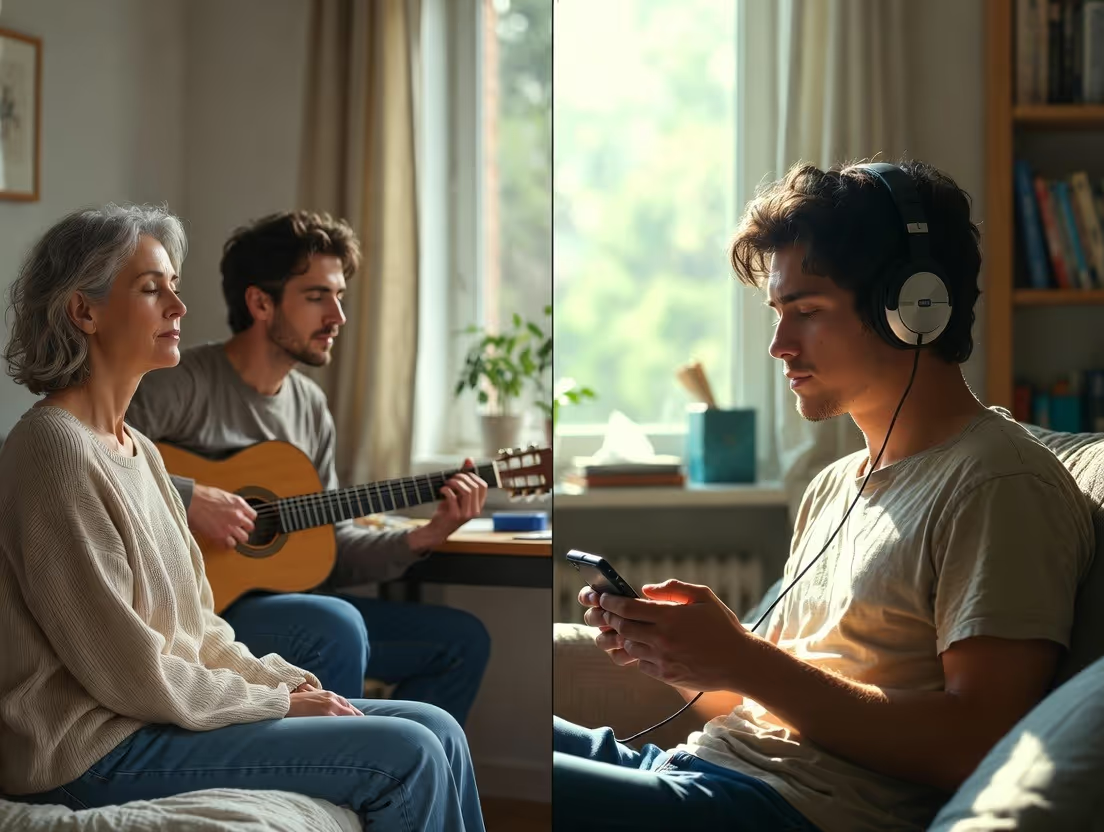
The narrative often pits technology against human connection, framing our devices as the architects of our loneliness. But what if we could flip the script? The Co-Regulation Method proposes that technology, when designed with intention, can be recruited as a powerful ally—not a replacement for human connection, but a catalyst that guides us back to it with greater awareness and precision.
This is where the concept of biometric feedback becomes revolutionary. Tools like advanced smart rings (e.g., the Oxyzen ring) move beyond counting steps and tracking sleep stages. They provide a real-time window into the language of the autonomic nervous system: Heart Rate Variability (HRV), resting heart rate, skin temperature, and respiratory rate. This data is the objective story of your stress, recovery, and, crucially, your physiological response to connection.
Creating a Co-Regulation Feedback Loop:
Imagine this scenario: You have a difficult conversation with a loved one. Afterward, you feel unsettled but can't quite pinpoint why. You check your biometric data from your smart ring and see a sharp, sustained spike in your heart rate and a dip in your HRV during and after the interaction—a clear sign of sympathetic nervous system activation and co-dysregulation.
This data isn't meant to make you blame the other person or yourself. Instead, it serves as a neutral, insightful prompt. It tells you: That interaction had a significant physiological impact. This awareness allows you to:
Conversely, the data can highlight what works. You might see your HRV improve and your heart rate stabilize after a cozy evening chatting with a close friend or playing with your pet. This positive feedback reinforces the value of those regulating connections, encouraging you to prioritize them.
Technology thus becomes a mirror, reflecting the otherwise invisible impact of our social world. It helps us move from guesswork to guided understanding in our relationships. It can also facilitate connection across distances: sharing a moment of synchronized deep breathing with a far-away friend during a video call, guided by both of your device feedback, turns a standard call into a co-regulatory session.
The ethos behind this integration is core to the Oxyzen vision. We believe the pinnacle of wearable tech is not to make us more self-absorbed with our own data, but to use that data to foster deeper empathy—for ourselves and for the people in our lives. It’s about closing the loop between the digital and the biological to enrich the human.
Not every relationship in your life will be—or needs to be—a deep source of co-regulation. The key is to consciously build a diverse ecosystem of connections that collectively meet your need for attunement, stability, and growth. Think of it as curating your personal "board of directors" for nervous system health.
Layer 1: The Inner Circle (Secure Attachments)
These are your primary co-regulators—the 2-5 people with whom you feel profoundly safe, seen, and able to be your authentic, unfiltered self. This is often a partner, a closest friend, a family member, or a therapist.
Layer 2: The Community Pillars (Shared Identity & Rhythm)
These are the people you share a regular activity or identity with—a book club, a faith community, a sports team, close colleagues, or a close-knit neighborhood. The connection is based on shared purpose or proximity.
Layer 3: The Joy Connectors (Play & Affirmation)
These are the friends who are purely about fun, play, and light-hearted affirmation. They're the ones you call for a spontaneous adventure, to share a funny meme, or to engage in a shared hobby.
Layer 4: The Mentors & Mentees (Growth & Purpose)
These relationships are built on guidance, learning, and contribution—a mentor, a coach, or someone you mentor yourself.
Layer 5: The Ambient Community (Weak Ties)
This is the barista who knows your order, the friendly neighbor you chat with while walking the dog, the regulars at your gym. These are "weak ties," but they are far from insignificant.
Audit Your Ecosystem: Take stock of your current relationships across these five layers. Are any layers sparse or empty? Where do you feel you get the most (and least) regulated? The goal is not to have a huge number in each, but to have at least one or two nourishing connections in each layer to create a resilient, multi-source support system. For more ideas on cultivating these layers, our blog offers ongoing insights into relationship-centered wellness.
Conflict is an inevitable part of human relationships, and it is also the ultimate test of our co-regulatory capacity. In moments of high stress, our nervous systems are most prone to flipping into fight, flight, or freeze. Unmanaged, conflict leads to co-dysregulation: two elevated nervous systems hurling threats (words) at each other, ensuring no one feels heard or safe. The Co-Regulation Method provides a roadmap for navigating conflict not to "win," but to preserve connection and find repair.
Step 1: Recognize the Physiological Tipping Point (The "Pause")
The first skill is to notice the signs of your own dysregulation as they happen. This is your cue to pause.
Step 2: Engage in Solo Regulation
During the pause, your job is to soothe your own nervous system enough to re-access your social engagement system.
Step 3: Re-engage with Co-Regulation Intention
Once you are both in a calmer state, re-engage. The goal of this conversation is not to re-argue points, but to co-regulate through mutual understanding.
Step 4: Practice Shared Repair Rituals
After understanding is reached, a repair ritual can powerfully signal safety and re-establish connection to both nervous systems.
Conflict navigated in this way does not break relationships; it strengthens them. Each successful repair builds "rupture-and-repair" resilience, teaching both nervous systems that conflict is survivable and that the bond is secure. This transforms arguments from threats into opportunities for deeper trust. It’s a skill that requires practice, and one that many find is supported by the objective feedback from a wellness tracker, which can help identify those initial dysregulation cues before they become overwhelming. For common questions on using tech in emotional wellness, our support resources can be a helpful guide.
While human relationships are the primary arena for co-regulation, they are not the only one. Our nervous systems are ancient instruments, finely tuned to the rhythms of the natural world and the uncomplicated presence of animals. These connections can provide profound regulating experiences, especially for those who find human relationships challenging or who need to supplement their social ecosystem.
The Grounding Force of Nature (The Original Regulator)
Nature operates on rhythms—day and night, seasons, tides—that are inherently regulating. Unlike the chaotic, high-stimulus modern environment, nature provides what author Clemens G. Arvay calls the "biophilia effect."
The Unconditional Attunement of Animals
Pets, particularly dogs and horses, are masters of co-regulation. They are exquisitely attuned to human non-verbal cues and physiological states, and they offer connection without judgment, complexity, or language.
Integrating these non-human sources into your Co-Regulation Method creates a richer, more resilient web of support. They remind us that we are part of a larger, living world designed for balance. This holistic view of wellness—encompassing human, animal, and environmental connection—is a philosophy that guides much of our thinking at Oxyzen. To learn more about the integrated approach that informs our product development, you can explore our company's foundational story and values.
The journey of integrating the Co-Regulation Method is deeply personal and subjective. How do you know it’s working? While the feeling of increased calm and connection is the ultimate goal, objective biometric data provides a fascinating and validating compass, turning subtle internal shifts into visible, measurable trends.
Key metrics from a device like a smart ring become stories of how your social world shapes your biology:
1. Heart Rate Variability (HRV): Your Resilience Ledger
HRV is the gold-standard, non-invasive window into autonomic nervous system balance. A higher HRV generally indicates greater resilience and a healthy oscillation between sympathetic and parasympathetic activity.
2. Resting Heart Rate (RHR): Your Basal Calm Gauge
Your RHR tends to lower as cardiovascular fitness and parasympathetic (rest-and-digest) tone improve.
3. Sleep Metrics: The Restoration Report
Deep sleep and REM sleep are critical for emotional processing and nervous system repair. Stress and dysregulation directly fragment sleep.
4. Stress Score & Body Battery: Your Daily Energy Budget
Many devices synthesize data (like HRV, RHR, sleep) into a daily "stress" or "readiness" score.
Creating Your Personal Experiment:
For one month, wear your tracking device and keep a simple journal note each evening: "Top 3 social interactions today and how they felt." At the month's end, overlay your journal with your biometric trends. You may discover that your best HRV days follow your weekly coffee with a certain friend, or that your sleep suffers after tense family calls. This isn't about blaming others, but about empowering yourself with knowledge. It allows you to strategically invest your time in the connections that truly restore you and to navigate challenging ones with more preparedness.
This data-informed approach to relational health represents the cutting edge of personalized wellness. It moves us from guesswork to clarity, helping us build a life that is not just productive, but physiologically sustainable and rich in true connection. For a deeper dive into the technology that enables these insights, you can learn more about Oxyzen's approach.
Understanding co-regulation conceptually is one thing; weaving it into the fabric of your daily life is another. To move from theory to embodied practice, we must build rituals—intentional, repeatable practices that signal safety to our nervous system through connection. These rituals transform co-regulation from a reactive strategy (calling a friend in crisis) into a proactive foundation for wellness, preventing dysregulation from accumulating in the first place.
The Architecture of a Co-Regulation Ritual
An effective ritual has three key components: a cue, a practice, and a reward. The cue triggers the ritual, the practice is the co-regulatory act itself, and the reward is the positive physiological shift that reinforces the habit.
Ritual 1: The Morning Anchor
Ritual 2: The Midday Micro-Breach
Ritual 3: The Evening Unwind Sync
Ritual 4: The Weekly Connection Anchor
Tailoring and Troubleshooting:
Start with one ritual. Keep it small and achievable. The goal is consistency, not duration. If you miss a day, simply resume. The most common hurdle is the belief that these moments are "unproductive." Reframe them as the most productive thing you can do for your cognitive function, emotional stability, and physical health. They are system maintenance.
Tracking the impact of these rituals with a device like the Oxyzen ring can be powerfully motivating. Noticing that your "Stress Score" is lower on days you complete your Midday Micro-Breach, or that your sleep scores improve after your Evening Unwind Sync, provides tangible, objective reinforcement that these practices are working on a biological level. For more ideas on building sustainable wellness habits, our blog features continuous exploration of these very topics.
Our digital lives are a dominant social reality. Rather than abandoning them, we can learn to navigate them with intention, using technology in ways that approximate or even facilitate co-regulation, while avoiding the traps that lead to dysregulation. This is about conscious digital hygiene for your social nervous system.
The Co-Regulation Spectrum of Digital Tools:
Not all digital interactions are equal. We can place them on a spectrum from "High Co-Regulation Potential" to "High Dysregulation Risk."
High Co-Regulation Potential:
Moderate Potential (Handle with Care):
High Dysregulation Risk:
Digital Co-Regulation Guidelines:
The guiding principle is intentionality. Ask before you engage: Is this activity likely to make me feel more connected and calm, or more isolated and agitated? Your body already knows the answer. Learning to listen to that signal—perhaps aided by noticing how your device's stress metric reacts after 30 minutes on social media versus after a video call with a grandparent—is the key to a healthier digital diet. For support in setting these boundaries, our FAQ section addresses common questions about tech-life balance.
The modern workplace is often a masterclass in co-dysregulation: unrealistic deadlines, a culture of urgency, lack of psychological safety, and digital communication overload. Yet, work is where many adults spend the majority of their waking social hours. Applying the Co-Regulation Method here isn't just about employee happiness; it's a critical strategy for building resilient, innovative, and high-performing teams. A regulated nervous system is a creative, collaborative, and cognitively flexible one.
Signs of a Co-Dysregulated Team:
Strategies to Foster Co-Regulation at Work:
1. Leader as Chief Regulator:
A leader's nervous system state is contagious. A dysregulated leader (anxious, angry, or checked-out) will dysregulate the entire team. A regulated leader provides a "holding environment" of safety.
2. Ritualize Connection at Team Meetings:
Start meetings not with agenda items, but with a brief human connection.
3. Design for "Attunement Breaks":
Replace the myth of sustained solo focus with a rhythm that includes micro-connections.
4. Normalize Repair After Conflict:
Team conflict is inevitable. What matters is the repair process.
5. Leverage Technology Wisely:
Default to video for complex or sensitive discussions. Use collaborative documents for brainstorming to reduce meeting fatigue. Be explicit about communication norms: "Slack is for quick questions, email for detailed briefs, and video calls for anything nuanced."
The Business Case for Co-Regulation:
Teams that feel psychologically safe and connected show:
Creating this culture starts at the top but is sustained by daily practices. Companies that understand this are investing in the relational fabric of their organization, recognizing it as their most valuable asset. This human-centric approach to performance aligns with the broader vision shared in our story at Oxyzen, where we believe the future of work, like the future of health, is integrated and humane.
As we champion the power of connection, a critical distinction must be made: co-regulation is not co-dependency. This is perhaps the most crucial boundary to understand, as confusing the two can lead to unhealthy, enmeshed relationships that ultimately drain both parties. Healthy co-regulation empowers; co-dependency disempowers.
Defining the Difference:
Healthy Co-Regulation:
Co-Dependency:
Key Warning Signs of Co-Dependency Masquerading as Co-Regulation:
Cultivating Healthy Co-Regulation: The Boundaries Factor
The line between the two is drawn by boundaries. A boundary in this context is not a wall; it is a permeable membrane that allows attunement in but protects your core regulatory self.
The work for the chronic caretaker is to practice tolerating the other person's distress without rushing in to fix it—to offer attuned presence without taking ownership of the problem. The work for the chronic needer is to develop internal resources and other supports, so one relationship doesn't bear the full burden.
True co-regulation requires two whole people choosing to connect, not two halves clinging together out of fear. It's the difference between a dance where both partners are balanced on their own feet, moving in sync, and a lean where one person holds the other entirely upright. For those navigating this complex terrain, reading about the experiences of others who have worked to build healthier relational patterns can provide both insight and reassurance.
The Co-Regulation Method is not a one-size-fits-all wellness tip; it is a scalable framework that can be applied to specific, intense challenges. For individuals dealing with clinical anxiety, trauma histories, or those operating in high-stakes performance environments, intentional co-regulation becomes not just beneficial, but a non-negotiable component of management and growth.
For Anxiety Disorders: Building a "Regulation Team"
Anxiety often involves a hypersensitive threat detection system (amygdala) and a diminished sense of internal safety. While therapy and medication are crucial, co-regulation provides a real-time, somatic antidote.
For Trauma Recovery: Re-establishing Relational Safety
Trauma fundamentally disrupts the capacity to trust and connect. The therapeutic relationship itself is a profound exercise in paced, safe co-regulation. Beyond therapy, carefully building co-regulation can help re-wire the nervous system's association of connection with danger.
For High Performers (Athletes, Executives, Artists): The Secret Weapon
Elite performance requires optimal arousal: not too anxious, not too lethargic. High performers often fall into extreme self-reliance, which can be a vulnerability. A coach, trusted teammate, or partner can serve as an external regulator.
In all these cases, technology can serve as a bridge. A wearable device can help someone with anxiety see the objective calming effect of their "preemptive anchor" practice. Someone in trauma recovery can track how their physiology responds to different types of connection, guiding them toward what feels safest. A performer can correlate their best outcomes with the quality of their team interactions. This data-driven, personalized application is at the forefront of how we think about integrated wellness at Oxyzen.
As we stand at the intersection of neuroscience, wellness, and technology, the future of co-regulation is not about creating AI companions to replace people. It is about developing intelligent tools that act as facilitators, amplifiers, and guides for human-to-human connection, helping us overcome the barriers of distance, distraction, and self-blindness.
Emerging Frontiers:
1. Biometric Synchrony Feedback:
Imagine a couples' therapy session or a team-building workshop where each participant wears a subtle biometric sensor. A display shows aggregate HRV or stress levels in real-time, not as a judgment, but as feedback.
2. Haptic Co-Regulation for Distance:
Haptic technology uses touch-like sensations (vibration, pressure, temperature). Future wearables could enable "touch across distance."
3. AI as a Connection Coach:
Rather than being the connection itself, AI could analyze your biometric and communication patterns to offer personalized prompts.
4. Immersive Shared Reality for Shared Experiences:
Advanced VR/AR could create deeply co-regulatory shared environments for people who are physically apart.
The Guiding Ethical Principles:
For this future to be healthy, it must be guided by core principles:
This envisioned future aligns with a commitment to technology that serves our deepest human needs. It's a commitment you can see reflected in the core principles and vision of companies like Oxyzen, which seek to build tools that remind us of our biology, rather than helping us escape it. The most advanced technology, in the end, may be that which helps us return to our most ancient source of healing: each other.
Knowledge becomes power only when applied. This final section is a practical, step-by-step 30-day plan to integrate the Co-Regulation Method into your life. It’s designed to be progressive, starting with self-awareness, moving into small connection practices, and finally building a sustainable ritual. Consider this your roadmap.
Week 1: The Foundation of Awareness
Theme: Observe Your Current State.
Week 2: Cultivating Internal Safety & Micro-Moments
Theme: Regulate Yourself to Regulate With Others.
Week 3: Intentional Engagement & Ritual Building
Theme: Quality Over Quantity.
Week 4: Integration and Ecosystem Audit
Theme: Build Your Sustainable System.
Day 29-30: Review and Refine
This plan is a starting point, not a rigid prescription. The goal is to cultivate a mindset where you see every interaction as an opportunity for mutual regulation. It’s a journey of becoming an architect of your own social world, consciously designing it for nourishment and resilience. For ongoing support, ideas, and community stories on this journey, remember that our blog is a living resource for connected wellness.
Your Trusted Sleep Advocate: Sleep Foundation — https://www.sleepfoundation.org
Discover a digital archive of scholarly articles: NIH — https://www.ncbi.nlm.nih.gov/
39 million citations for biomedical literature :PubMed — https://pubmed.ncbi.nlm.nih.gov/
Experts at Harvard Health Publishing covering a variety of health topics — https://www.health.harvard.edu/blog/
Every life deserves world class care :Cleveland Clinic - https://my.clevelandclinic.org/health
Wearable technology and the future of predictive health monitoring :MIT Technology Review — https://www.technologyreview.com/
Dedicated to the well-being of all people and guided by science :World Health Organization — https://www.who.int/news-room/
Psychological science and knowledge to benefit society and improve lives. :APA — https://www.apa.org/monitor/
Cutting-edge insights on human longevity and peak performance:
Lifespan Research — https://www.lifespan.io/
Global authority on exercise physiology, sports performance, and human recovery:
American College of Sports Medicine — https://www.acsm.org/
Neuroscience-driven guidance for better focus, sleep, and mental clarity:
Stanford Human Performance Lab — https://humanperformance.stanford.edu/
Evidence-based psychology and mind–body wellness resources:
Mayo Clinic — https://www.mayoclinic.org/healthy-lifestyle/
Data-backed research on emotional wellbeing, stress biology, and resilience:
American Institute of Stress — https://www.stress.org/


