


The Community Factor in Mental Wellness: Finding Your Tribe
Finding a community—people who share your values or interests—provides belonging, support, and reduced feelings of isolation.
Finding a community—people who share your values or interests—provides belonging, support, and reduced feelings of isolation.
%402x.svg)
In the quiet hours of the night, when the world sleeps and our thoughts grow loud, a singular, ancient question echoes in the modern mind: Am I alone in this? We scroll through curated lives on glowing screens, surrounded by digital connections, yet a profound sense of isolation can persist. This paradox is the silent epidemic of our age. We have never been more connected, yet we report unprecedented levels of loneliness, anxiety, and a fragmented sense of self.
But what if the most powerful tool for mental wellness isn’t found in a therapist’s office, a meditation app, or a supplement bottle—though each has its place—but in the very fabric of human connection we’ve woven for millennia? What if the missing piece isn't within us, but between us?
Welcome to an exploration of The Community Factor. This is the undeniable, scientifically-validated truth that our mental and emotional health is inextricably linked to the quality of our social bonds. “Finding your tribe” is not a trendy self-help cliché; it is a biological imperative. Our nervous systems are wired for co-regulation, our minds are shaped through shared narrative, and our resilience is forged in the crucible of supportive community.
This journey will take us from the evolutionary roots of our need to belong, through the modern landscapes where tribes are found (and lost), and into the practical ways we can cultivate the connections that nourish us. We’ll examine why a simple conversation can lower cortisol, how shared purpose can give life meaning, and why feeling understood might be the most potent medicine for a weary soul.
As we navigate this topic, we’ll also explore how modern technology, when used intentionally, can bridge gaps rather than create them. From online support groups to devices that help us understand our body’s stress signals, innovation is offering new pathways to connection. Speaking of which, at Oxyzen, we believe technology should serve human connection, not replace it. Our mission is built on the premise that understanding your personal biometric data is the first step toward a more attuned, present, and connected life.
This is not just an article; it’s an invitation to rediscover a fundamental truth. You are not meant to heal alone, grow alone, or celebrate alone. Let’s begin the journey to find your people.
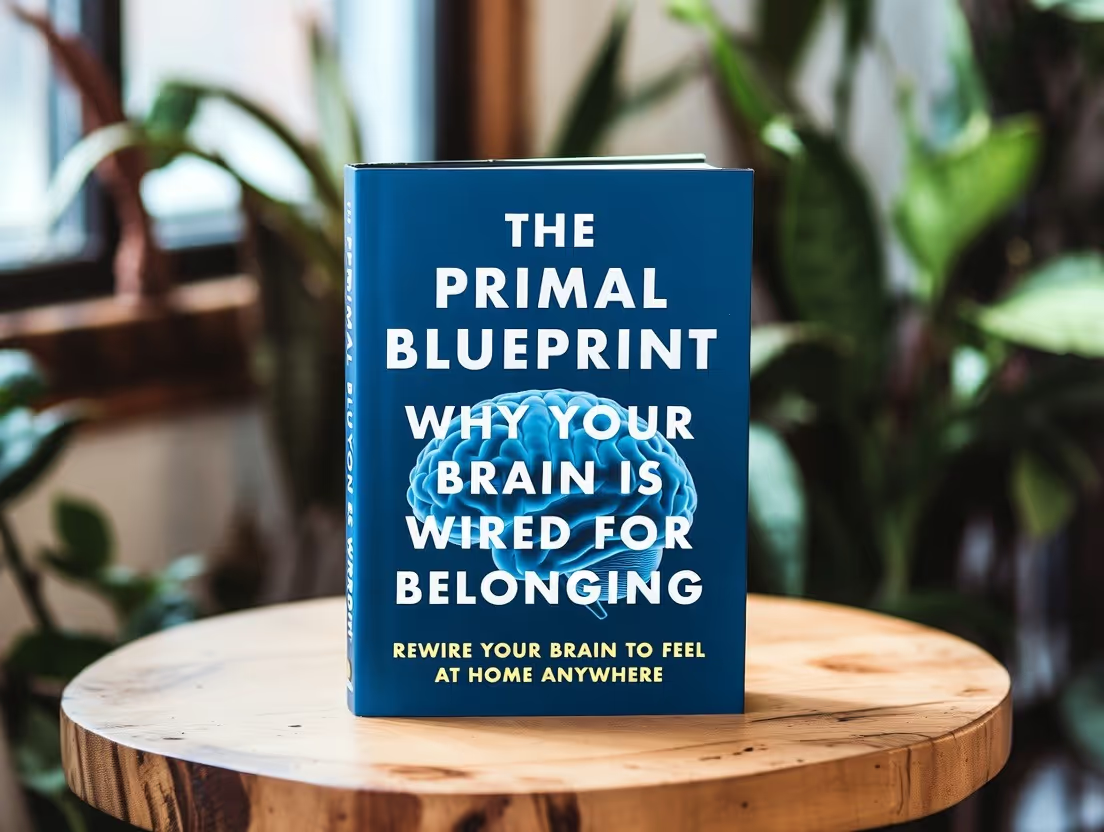
To understand the magnetic pull of "the tribe," we must travel back—far beyond social media algorithms and city limits, to the savannas and forests where humanity took shape. For 99% of our evolutionary history, survival was a team sport. Isolation meant certain death: a lone human was easy prey, a poor hunter, and a vulnerable gatherer. In this context, the brain developed a powerful, non-negotiable directive: belong, or perish.
This imperative is etched into our neurobiology. Dr. Matthew Lieberman, a leading social cognitive neuroscientist and author of Social: Why Our Brains Are Wired to Connect, argues that our need to connect is as fundamental as our need for food and water. He posits that the brain’s "default network"—the circuitry that activates when we’re not focused on a specific task—is primarily dedicated to social cognition. In our downtime, we naturally think about ourselves and others. We are, by design, social thinkers.
Let’s break down the key neurological and physiological systems at play:
1. The Social Pain Alarm System: The brain processes social rejection and ostracization using the same neural pathways as physical pain. The anterior cingulate cortex (ACC), which lights up when you stub your toe, also activates when you feel left out or heartbroken. This isn’t metaphorical. A broken heart and a broken bone share real biological real estate. Evolution made social exclusion hurt because the cost of being cast out from the tribe was existential.
2. The Reward of Connection: Conversely, positive social interactions trigger the release of a cascade of neurochemicals: dopamine (creating pleasure and reinforcing the behavior), oxytocin (the "bonding hormone" that fosters trust and attachment), and endorphins (natural opioids that promote euphoria and pain relief). A simple conversation with a friend, a hug from a loved one, or even collaborative work can deliver a potent cocktail of well-being.
3. Co-Regulation: The Biological Symphony: Our autonomic nervous system (ANS), which governs our stress response (fight-or-flight) and our relaxation response (rest-and-digest), is not an isolated system. It is designed to sync with others—a process called co-regulation. A calm, present person can help soothe an agitated nervous system simply through their demeanor, tone of voice, and attuned presence. A baby is calmed by a parent’s heartbeat. An anxious friend is settled by your steady listening. This is biology, not magic.
The modern world, however, presents a cruel irony. We have constructed an environment of unprecedented individual autonomy, where we can live, work, and entertain ourselves in physical isolation. Yet, our Paleolithic brains still sound the "social pain alarm" when we eat dinner alone for the third night in a row, when our message goes unanswered, or when we feel like an outsider at work. We’re navigating a 21st-century landscape with a 50,000-year-old brain screaming, "Find the tribe! Your survival depends on it!"
This mismatch is at the core of much of our modern mental distress. We’ve optimized for independence at the cost of interdependence. Recognizing this isn't about blaming technology or yearning for a mythical past; it’s about acknowledging a core human need so we can design our lives to meet it. It’s about moving from a mindset of "I should be able to handle this alone" to "I am designed to heal and grow in connection."
Understanding your own stress signals and social needs is the first step toward intentional connection. For those interested in the tangible metrics of well-being, exploring tools like a smart ring can offer fascinating insights. By tracking physiological markers like heart rate variability (HRV) and sleep, you can see in real-time how different social interactions—a draining meeting vs. a joyful dinner with friends—affect your nervous system. You can learn more about smart ring technology and how it translates biometrics into actionable wellness insights.
When we hear "tribe," images of ancient kinship groups or tight-knit village communities may arise. While those are the archetypes, the essence of a modern tribe is more nuanced. It is not merely your family of origin or your accumulated number of social media followers. A true tribe is a curated network of connections that provides mutual support, shared identity, and a sense of belonging.
It’s the difference between a crowded room and a circle where you feel seen. It’s the gap between having contacts and having confidants. To find your tribe, you must first understand its anatomy. A functional, nourishing modern tribe often exhibits these core characteristics:
Modern tribes can manifest in diverse, often overlapping, forms:
The critical shift in the modern age is choice. For much of history, your tribe was an accident of birth and geography. Today, while we still have foundational ties, we have the agency to seek out and cultivate "chosen family" and "affinity tribes" that align with our evolving selves. This is both a tremendous privilege and a new responsibility. We must become architects of our own social ecosystems.
This journey of finding where you belong can raise many questions. You might wonder how to identify your core values or where to even begin looking. For additional resources and stories of how others have navigated this path, you can explore our blog for more wellness tips on building meaningful connections in a digital age.
The feeling of being supported is not just a warm, fuzzy sentiment—it’s a measurable, biological event with profound implications for our mental and physical health. The research is unequivocal: strong social connections are a stronger predictor of longevity than smoking, obesity, or physical inactivity. Let’s delve into the concrete mechanisms by which your tribe becomes your medicine.
1. Stress Buffering: The Cortisol Antidote
Chronic stress, fueled by the hormone cortisol, is a primary culprit in anxiety, depression, inflammation, and a host of physical ailments. Quality social connection acts as a powerful buffer. A seminal study by UCLA’s Dr. Shelley Taylor highlighted the "tend-and-befriend" response, particularly in women, as a counter to the "fight-or-flight" reaction. Reaching out to the tribe—talking, touching, seeking support—reduces cortisol production and initiates calming processes.
2. Immune System Modulation: Fewer Colds, Quicker Healing
Loneliness and social isolation are linked to increased inflammation and a weakened immune response. Researchers at Carnegie Mellon University found that people with diverse social networks were more resistant to developing the common cold after being exposed to the virus. Supportive interaction appears to enhance immune function, while isolation makes the body more vulnerable to illness.
3. Neuroplasticity and Cognitive Reserve: A Sharper, More Resilient Brain
Engaging, stimulating social interaction is a full-brain workout. It requires empathy (theory of mind), memory (recalling shared histories), language processing, and emotional regulation. This complex cognitive engagement helps build and maintain neural pathways, potentially delaying cognitive decline. Furthermore, feeling supported reduces the brain’s cognitive load of constant vigilance ("Am I safe?"), freeing up mental resources for creativity, problem-solving, and learning.
4. Behavioral Reinforcement: The Mirror of Healthy Habits
Tribes provide powerful modeling and gentle accountability. A running group makes exercise a social joy, not a solitary chore. A book club encourages intellectual engagement. A recovery community reinforces sobriety. Our social circles subtly shape our daily habits around health, leisure, and personal growth. As social psychologist Dr. David McClelland’s research suggested, the people we spend time with can literally influence our immune system strength through the "n effect"—the number of close relationships we have.
The Data Speaks:
This science moves the concept of community from the realm of "nice-to-have" to "essential-for-survival." It reframes seeking connection not as a sign of neediness, but as an act of profound self-care. Just as you might track your sleep or nutrition to optimize health, considering your "social fitness" is equally critical. For individuals fascinated by this data-driven approach to well-being, understanding your own physiological data can be empowering. You can discover how Oxyzen works to provide insights into how your daily interactions and stress levels manifest in your biometrics, creating a feedback loop for a healthier, more connected life.

We live in the most interconnected era in human history. A message can circle the globe in milliseconds. We can maintain friendships across continents. Yet, we are facing what former U.S. Surgeon General Dr. Vivek Murthy has termed a "loneliness epidemic." This is not about being alone occasionally, which can be restorative, but about the chronic, painful feeling of being socially isolated, disconnected, and unseen, even amidst a crowd.
This epidemic is a silent public health crisis. In many countries, significant portions of the population report feeling lonely always, often, or sometimes. The drivers are complex and interwoven with the very fabric of modern life:
1. The Digital Paradox: Social media platforms promise connection but often deliver comparison and performance anxiety. We trade deep, messy conversations for shallow, curated approvals (likes, follows). The "highlight reel" effect can make others’ lives seem perfect, deepening our own sense of inadequacy and isolation. Digital communication lacks the neurochemical cues of face-to-face interaction—the tone of voice, the touch, the shared laughter—that our brains crave for true bonding.
2. The Mobility Society: We move for school, for jobs, for opportunity. This severs the roots of long-term, place-based community. The multi-generational household, the lifelong neighbors, the childhood friends in the same town—these have become less common, replaced by the need to constantly rebuild our social worlds from scratch.
3. The Cult of Hyper-Independence: Modern Western culture, in particular, glorifies the "self-made" individual. We are taught to be strong, independent, and self-reliant. Admitting loneliness or a need for deeper connection is often stigmatized as weakness, leaving people to suffer in silent shame.
4. The Erosion of Third Places: Sociologist Ray Oldenburg coined the term "third places"—the informal public spaces that are neither home (first place) nor work (second place). Think cafes, pubs, community centers, libraries, parks. These are the vital arteries of community life where diverse, unplanned interactions occur. Their decline, due to suburban design, digital substitution, and commercial pressures, has removed crucial connective tissue from society.
5. The Pace of Life: Simply put, we are busy. Over-scheduled with work, commutes, and family obligations, we often deprioritize the unstructured time needed to nurture friendships and build new connections. "I’d love to, but I’m swamped" is the anthem of the lonely-but-busy.
The consequences are dire and feed directly into our mental wellness crisis. Chronic loneliness is a significant risk factor for:
Recognizing loneliness as a systemic issue, not a personal failing, is the first step toward healing it. It allows us to shift from self-blame ("What’s wrong with me?") to curious inquiry ("What’s happening around me, and what do I need to change?"). It’s about diagnosing the disconnect in our lives and our culture so we can prescribe the right cure: intentional, authentic community.
If you’re feeling this disconnect and wondering where to start, know that you’re not alone in that feeling either. Many have begun their journey by first looking inward to understand their own patterns. For support and answers to common questions about starting this process, you can always reach out through our FAQ for guidance on using technology as a bridge, not a barrier, to human connection.
Finding your tribe isn’t a single event; it’s a process of cultivation. It requires moving from the periphery of social contact into the inner circle of trusted confidants. This journey typically unfolds in stages, each requiring different skills and levels of vulnerability. Understanding this roadmap can make the process feel less mysterious and more manageable.
Stage 1: Proximity & Repeated, Unplanned Interactions
This is the foundation. Deep bonds rarely sprout from a single meeting. They require physical or digital proximity and the chance for repeated, low-pressure interactions. This is why coworkers, classmates, fellow gym-goers, or consistent online community members become potential tribe material. The key here is consistency. Show up to the same yoga class each week. Participate regularly in the online forum. The mere exposure effect—our tendency to develop preference for things/people we see often—begins to work its magic.
Stage 2: Finding Common Ground & Light Vulnerability
From repeated interaction, shared interests or experiences emerge. A conversation moves from the weather to a shared love of mystery novels or a mutual frustration with a project. This is where you move from "hi" to actual conversation. Light vulnerability is introduced—sharing a minor opinion, a small struggle, or a modest aspiration. The response is crucial. If it’s met with interest, validation, or reciprocal sharing, the connection deepens. If it’s met with dismissal or judgment, the relationship likely stalls here.
Stage 3: Reciprocal Support & Medium Vulnerability
This is the tipping point from acquaintance to friend, from group member to tribe-in-the-making. You begin to offer and ask for small favors or support. You share more significant personal stories, hopes, and fears. You coordinate time together outside the original context (e.g., grabbing coffee after the club meeting). This stage is built on reciprocity and trust. The "social risk" increases, but so does the potential reward. A shared laugh becomes a shared secret; a helpful act becomes a mutual bond.
Stage 4: Shared History & Deep Vulnerability
Over time, through shared experiences—both mundane and significant—you build a joint narrative. "Remember when we..." becomes a common phrase. This history creates a powerful sense of "us." Within this container of trust, deep vulnerability becomes safe. You can share your shame, your grief, your biggest dreams, and your worst failures. You can have a conflict and repair it, which often strengthens the bond further. This stage is characterized by unconditional positive regard—you are valued for your authentic self, not just your curated persona.
Stage 5: Tribal Identity & Mutual Commitment
This is the full flowering of the tribe. The individual connections coalesce into a group identity. There is a sense of mutual commitment and responsibility. You are not just friends with Sam and Jamie; you are part of "the crew," "the writing group," "the chosen family." The tribe has its own rituals, inside jokes, and norms. It serves as a secure base from which its members can venture out into the world and a safe harbor to which they can return.
Practical Steps to Navigate the Stages:
This progression isn’t always linear, and different relationships in your life will occupy different stages. The goal is not to force every contact to Stage 5, but to consciously nurture a few key connections into deep, tribal bonds while maintaining a wider network of lighter, supportive contacts. It’s about building a diversified social portfolio.
For real-world inspiration on how people have built these life-changing connections, you can read real customer reviews and stories that often highlight the role of community in their wellness journeys.

The internet has irrevocably changed the landscape of community. It has dissolved geographical barriers, allowing us to find people who share our most niche interests or profound struggles, no matter where they live. An online community can be a lifeline for someone in a rural area, someone with a rare illness, or someone exploring an identity not accepted in their immediate surroundings. But as we know, digital connection is a double-edged sword. How do we harness its power for genuine tribe-building while avoiding its pitfalls?
The Unique Strengths of Digital Tribes:
The Inherent Challenges & Risks:
Building an Authentic Digital Tribe: A Best-Practice Guide
A digital tribe can be a powerful component of your overall social wellness ecosystem, but it should complement, not fully replace, face-to-face connections. Think of it as a specialized satellite community that orbits your core, local tribe. Used wisely, it can provide a unique form of support that is both vast and specific.
For more on balancing technology and human connection, and how tools are designed with this balance in mind, you can delve into the brand journey and vision behind companies striving to make tech more human-centric.
At the heart of every deep connection lies a moment of courage: the decision to be vulnerable. Researcher and storyteller Brené Brown defines vulnerability as "uncertainty, risk, and emotional exposure." It is the cornerstone of trust, intimacy, and true belonging. Yet, in a culture that often equates vulnerability with weakness, it is the very thing we arm ourselves against. To build a tribe, we must learn to disarm.
The mechanism through which vulnerability builds connection is often a "vulnerability loop," a term inspired by the work of Harvard negotiation researchers. It’s a reciprocal, escalating process of sharing and responsiveness that builds intense trust rapidly.
How the Vulnerability Loop Works:
Why We Avoid It & How to Lean In:
We avoid vulnerability because it feels dangerous. Our primal brain warns us: "If you show your soft underbelly, you might be rejected or attacked." To override this alarm, we must reframe vulnerability not as a weakness, but as the only authentic path to the connection we crave.
The Role of the Tribe in Holding Vulnerability:
A true tribe creates a container where vulnerability is not just allowed but valued as currency. It becomes the norm, not the exception. In such a group:
By initiating and participating in vulnerability loops, you are not just sharing information; you are issuing an invitation. You are saying, "This is the real me. Is there a place for me here?" And when that invitation is met with acceptance, you have found a piece of your tribe. This courage is the price of admission to a life of deep connection, and it is worth every ounce of risk.
For those interested in how a company’s values can reflect this same commitment to authentic human experience, you can learn more about our mission and values that guide everything we do.
A tribe is more than a collection of individuals who like each other. It is a living entity with its own culture, and culture is created and sustained through shared practices. These are the rituals, rhythms, and narratives that transform a group of friends into a cohesive unit with a distinct identity. They are the invisible architecture of belonging.
Rituals: The Sacred in the Ordinary
Rituals are formalized, repeated actions imbued with meaning. They provide predictability, create touchstones of connection, and mark the passage of time together. In a tribe, rituals can be grand or simple:
These acts become sacred not because of their complexity, but because of their consistency and shared intentionality. They create a sense of "this is what we do."
Rhythms: The Pulse of the Community
If rituals are the landmarks, rhythms are the daily roads. This is the predictable pattern of interaction that makes the tribe a reliable part of life. It answers the question, "How do we stay connected between the big events?"
Rhythms prevent the community from becoming event-dependent and fading during busy times. They provide a low-effort, high-connection lifeline that maintains the bond’s vitality.
Shared Stories: The Mythology of "Us"
Every tribe has its lore. These are the stories you tell and re-tell—the hilarious mishap on the first trip, the time you all pulled an all-nighter to help one member, the inside jokes that have become legend. These narratives do powerful psychological work:
Creating the Glue: Practical Applications
These elements—ritual, rhythm, and story—are what make a tribe feel like home. They provide the structure within which spontaneous connection and deep vulnerability can safely occur. They turn a support network into a culture, and a culture into a sanctuary.
For a deeper look at how a brand’s own story and rituals are formed, you can explore the founding story and vision that creates a company’s culture, much like the glue that binds a personal tribe.
While mutual affection is vital, tribes bound together solely by socializing can lack resilience during times of conflict or change. The most enduring and empowering communities often share a purpose that transcends the individual members. This shared mission—whether it’s creating art, advocating for a cause, raising families with specific values, or building a business—adds a powerful dimension to the bond. It shifts the focus from "What can I get from this group?" to "What can we create or achieve together?"
A purpose-driven tribe provides unique mental wellness benefits:
1. Meaning and Significance: Participating in something larger than oneself is a proven antidote to existential anxiety and depression. Viktor Frankl, in Man’s Search for Meaning, argued that our primary drive is not pleasure, but the discovery and pursuit of what we find meaningful. A tribe with a shared purpose provides a ready-made, collaborative context for this pursuit.
2. Flow and Collective Efficacy: Working collaboratively toward a shared goal can induce states of "group flow"—a highly productive, focused, and joyful state where individual egos dissolve into the team effort. Achieving small wins together builds "collective efficacy," the shared belief that "we can do hard things." This belief then spills over into individual members’ confidence in their own lives.
3. A Framework for Conflict Resolution: When disagreements arise (and they will), a shared purpose provides a north star. You can ask, "How do we solve this in a way that best serves our mission?" This depersonalizes conflict and turns it into a collaborative problem-solving exercise, rather than a relational threat.
4. Legacy and Continuity: A purpose-driven tribe often has a vision that extends beyond the current members. This creates a sense of legacy and continuity, which can be profoundly comforting and motivating. You are part of a story that began before you and will continue after you.
Examples of Purpose-Driven Tribes:
Cultivating Purpose in Your Existing Tribe:
You don’t need to found a non-profit. You can inject purpose into any existing group.
This outward focus paradoxically deepens the inward bond. Serving, creating, or striving together builds a different kind of trust and respect—one based on witnessed character and shared effort, not just shared leisure. It makes the tribe a vehicle for growth and contribution, which are pillars of long-term well-being.
If the idea of a mission-driven community resonates with you, understanding the core values that bring people together can be enlightening. You can read about the company information and mission behind platforms designed to serve collective well-being.
No community is a perpetual harmony of agreement and good feelings. Conflict, disagreement, and change are inevitable. People grow, circumstances shift, misunderstandings occur, and feelings get hurt. The strength of a tribe is not measured by the absence of conflict, but by its capacity to navigate it with grace, repair ruptures, and adapt to change. This is what separates fragile cliques from resilient communities.
Why Conflict is Inevitable (And Necessary):
Principles for Healthy Conflict Navigation:
Managing Change Within the Tribe:
Change is the other great test. People move, have children, change jobs, enter or leave relationships, and evolve personally.
A tribe that masters conflict and change becomes a "secure base" in attachment theory terms—a safe, reliable foundation from which its members can venture out, take risks, and grow, knowing they have a place to return to for comfort and perspective. This security is a cornerstone of long-term mental and emotional resilience.
For anyone seeking support in understanding their own stress responses during conflict or change, having objective data can be helpful. You can explore how wellness tracking devices can provide insights into your body's unique signals, helping you navigate interpersonal dynamics with greater self-awareness.
The previous sections might sound energizing to some and utterly exhausting to others. For introverts and highly sensitive people, the very language of "community" and "tribe" can evoke anxiety. The stereotype is that introverts are antisocial or dislike people. This is a profound misunderstanding. Introverts typically crave deep, meaningful connection just as much as anyone else—they simply recharge through solitude and prefer interactions that are substantive over superficial. The key is to build a tribe that aligns with an introverted nervous system’s needs for depth, authenticity, and manageable stimulation.
Reframing Tribe for the Introvert:
An introvert’s tribe is unlikely to be a large, boisterous crowd that meets constantly. It is more likely to be:
Strategies for Sustainable Connection:
Remember, finding your tribe as an introvert is not about becoming more extroverted. It’s about finding people who appreciate your quiet nature and creating structures for connection that feel energizing, not depleting. Your tribe will be the people who don’t mistake your silence for disinterest, who value the depth you bring, and who respect your need for space. They are the ones you can sit with in comfortable silence, knowing the connection is still powerfully alive.
For introverts interested in the quantifiable aspects of their energy and stress, technology can offer a non-judgmental mirror. You can discover how Oxyzen works to track how different social settings impact your physiological state, helping you make more informed choices about how and when to engage to protect your energy.
The digital age has gifted us with global tribes, but we remain physical beings anchored in place. Our immediate, local environment—our neighborhood, our town, our city block—is the frontline of daily connection. Cultivating a "geographic tribe" provides a unique, irreplaceable form of support: the neighbor who has a spare egg, the familiar face at the coffee shop, the local parent you chat with at the park. This layer of community fosters a primal sense of safety, belonging, and practical interdependence that virtual connections cannot fully replicate.
Why Local Community Matters for Mental Wellness:
The Modern Barriers to Local Connection:
We often live in "communities of strangers." Suburban design prioritizes cars over pedestrians. Apartment buildings can feel anonymous. Busy schedules mean we drive from private garage to private destination, with little unstructured time in public spaces. The first step is recognizing these barriers so we can consciously dismantle them.
Strategies for Cultivating Your Geographic Tribe:
The Ripple Effect:
Building local community has a contagious quality. Your effort to say hello and learn a name makes it easier for the next person to do the same. You become a "node of connection," informally linking others. One person organizing a potluck can slowly reactivate the social life of an entire apartment building or street.
This work requires a shift from being a passive consumer of a neighborhood to an active participant and co-creator. The mental wellness payoff is a deep-seated feeling of being at home in the world, not just inside your own four walls, but in the vibrant, supportive ecosystem right outside your door. It answers the ancient need to know the people with whom you share the land.
For those who are data-inclined, observing how engaging with your local environment affects your biometrics can be revealing. Does a walk where you exchange greetings with neighbors lower your stress markers more than a walk with headphones in? You can learn more about how wellness tracking can help you correlate community behaviors with personal well-being metrics.
The journey to finding your tribe often requires a shift in mindset: from passively waiting to be invited, to actively participating in the creation of community. Being a "tribal leader" doesn't mean being the most charismatic extrovert; it means being a catalyst, a connector, and a custodian of the space where connections can grow. This role is open to anyone willing to exercise a bit of intentionality and courage.
The Archetypes of Tribal Leadership:
Practical Steps to Step Into Leadership:
For the Introverted Leader:
Your strengths are your superpowers. Your preference for depth makes you an excellent facilitator of meaningful conversation. Your comfort with silence allows others space to think. Your sensitivity helps you attune to group dynamics and notice who needs inclusion. You can lead from the side of the circle, not just the center.
Being a tribal leader is ultimately an act of service—to your own need for connection and to the needs of others. It is saying, "I value this enough to help make it happen." In doing so, you not only find your tribe; you become essential to its heartbeat. And in the economy of human connection, that is a role of immense value and fulfillment.
The principles of building human community often mirror the values behind building a meaningful brand. To see how this philosophy of intentional creation and stewardship plays out on a larger scale, you can read about our mission and company information.
Not all communities are healthy. The same powerful human drives for belonging and identity can be twisted into cult-like mentalities, cliques, and emotionally abusive systems. A toxic tribe doesn't feel like a sanctuary; it feels like a cage. Your mental wellness depends not only on finding connection but also on cultivating the discernment to recognize when a group is harming you. Protection is just as important as connection.
Warning Signs of a Toxic Tribe:
Why Smart People Get Stuck:
Toxic groups are often skilled at "love-bombing" newcomers with intense affection and validation, fulfilling the deep need to belong. They provide clear, if rigid, answers to life's complex questions, which can be a relief in times of uncertainty. Leaving isn't just about losing friends; it can feel like losing your entire identity and worldview, which is a terrifying prospect.
How to Protect Yourself and Exit Gracefully:
Remember: A healthy tribe expands your world; a toxic one shrinks it. A healthy tribe celebrates your growth; a toxic one fears it. Your quest for belonging should never require the surrender of your critical thinking, your autonomy, or your inner peace. The courage to leave a bad tribe is just as important as the courage to join a good one.
Navigating complex social dynamics requires a strong sense of self. Sometimes, having objective data on your stress and recovery can help validate your internal experience when something feels "off." For insights into tools that support this kind of self-awareness, you can explore our blog for more wellness tips on setting boundaries and listening to your body.
Modern society is starkly age-segregated. Children go to schools with children, adults work with adults, and seniors often live in communities with other seniors. This segregation represents a profound loss. Our tribes have become narrower, depriving us of the rich tapestry of perspective, wisdom, and energy that comes from relationships spanning decades. Intentional intergenerational community is a powerful, often overlooked component of holistic mental wellness.
The Unique Gifts of Cross-Age Bonds:
How to Cultivate Intergenerational Tribes:
The mental wellness benefits are systemic. For a young person facing anxiety about the future, a 75-year-old friend who has navigated wars, recessions, and personal loss is a walking testament to human adaptability. For an elder feeling invisible, a 25-year-old who seeks their advice is an affirmation of enduring worth. These relationships heal the fractures in our social timeline, creating a more cohesive, compassionate, and wise community for everyone.
Building a legacy of connection is at the heart of many meaningful ventures. To understand how a company embeds long-term values and intergenerational thinking into its work, you can explore the founding story and vision that guides its path.
In our quest for community, we must address the elephant in the room: the smartphone, the smartwatch, the very devices often blamed for our isolation. But what if technology could be harnessed not as a distraction from human connection, but as a tool to deepen our understanding of it and guide us toward more meaningful interactions? This is the promise of the biometric feedback loop—using data about our own bodies to become more attuned, present, and intentional community members.
The Concept: From Data to Self-Awareness to Better Connection
Devices like advanced smart rings can track physiological markers such as Heart Rate Variability (HRV), resting heart rate, sleep stages, and body temperature. These aren't just fitness metrics; they are windows into your nervous system's state.
How This Informs Tribal Life:
A Tool, Not a Tyrant: Essential Caveats
This technology must serve human connection, not usurp it. The data is a guide for self-reflection, not a replacement for intuition or a scorecard for relationships. The goal is never to optimize human interaction into a sterile data set, but to use the data to remove the obstacles—like unrecognized chronic stress or poor sleep—that prevent us from showing up as our best, most connected selves.
Practical Integration:
In this vision, technology becomes the bridge back to our biology and, by extension, to each other. It helps us honor the fact that we are social animals, with bodies that are deeply affected by the quality of our bonds. By understanding our inner landscape better, we can more skillfully navigate the shared landscape of community.
For those curious about how this philosophy is put into practice through a specific product, you can discover how Oxyzen works to turn biometric data into actionable insights for a more balanced and connected life.
Your need for tribe is constant, but the specific form of your tribe will—and should—change dramatically across your lifespan. The tight-knit crew of your 20s, bound by adventure and identity exploration, will likely not be the same as the tribe of your 40s, which may revolve around parenting, career building, and navigating mid-life complexities. The community of your 70s may prioritize legacy, wisdom-sharing, and mutual support in health. Recognizing that tribes have seasons is key to avoiding stagnation and grief, and to embracing the evolving nature of a connected life.
The Seasons of Tribal Life:
Navigating Tribal Transitions Gracefully:
Letting go can be painful, but it creates the space necessary for new growth. Clinging to a tribe that no longer fits is like wearing clothes from childhood—constricting and impractical. Trust that the skills you learned in building past communities—vulnerability, ritual-making, showing up—are portable. They are the tools you will use to build your next tribe, and the one after that. The journey of finding your tribe is, ultimately, a lifelong practice of finding yourself in relation to others.
If you're navigating a major life transition and seeking support, hearing how others have used tools to maintain balance can be helpful. You can read real customer reviews and experiences of people who have integrated technology into their evolving wellness journeys.
Your Trusted Sleep Advocate: Sleep Foundation — https://www.sleepfoundation.org
Discover a digital archive of scholarly articles: NIH — https://www.ncbi.nlm.nih.gov/
39 million citations for biomedical literature :PubMed — https://pubmed.ncbi.nlm.nih.gov/
Experts at Harvard Health Publishing covering a variety of health topics — https://www.health.harvard.edu/blog/
Every life deserves world class care :Cleveland Clinic - https://my.clevelandclinic.org/health
Wearable technology and the future of predictive health monitoring :MIT Technology Review — https://www.technologyreview.com/
Dedicated to the well-being of all people and guided by science :World Health Organization — https://www.who.int/news-room/
Psychological science and knowledge to benefit society and improve lives. :APA — https://www.apa.org/monitor/
Cutting-edge insights on human longevity and peak performance:
Lifespan Research — https://www.lifespan.io/
Global authority on exercise physiology, sports performance, and human recovery:
American College of Sports Medicine — https://www.acsm.org/
Neuroscience-driven guidance for better focus, sleep, and mental clarity:
Stanford Human Performance Lab — https://humanperformance.stanford.edu/
Evidence-based psychology and mind–body wellness resources:
Mayo Clinic — https://www.mayoclinic.org/healthy-lifestyle/
Data-backed research on emotional wellbeing, stress biology, and resilience:
American Institute of Stress — https://www.stress.org/


