


The Complete Beginner-Friendly Guide to Flexible Work Using Ring Guidance
A complete beginner's guide to creating a flexible work schedule based on guidance from your ring's data.
A complete beginner's guide to creating a flexible work schedule based on guidance from your ring's data.
%402x.svg)
The world of work has shattered. Gone are the days of mandatory 9-to-5 schedules, fluorescent-lit cubicles, and the soul-crushing daily commute. In its place, a new frontier has emerged: flexible work. You might be a digital nomad coding from a Bali beach, a hybrid employee splitting time between home and office, a freelancer juggling five clients, or a parent crafting a career around childcare. This freedom is exhilarating—but it’s also uncharted, isolating, and fraught with hidden pitfalls. How do you structure your day when no one is watching? How do you maintain energy when work bleeds into every hour? How do you know if your “flexible” schedule is actually sustainable, or secretly burning you out?
For decades, productivity advice has been guesswork. We’ve relied on brittle willpower, generic time-blocking techniques, and caffeine to power through. But what if the most critical data for mastering flexible work wasn’t on your to-do list or calendar, but on your finger?
Enter the era of the smart ring. This unassuming piece of wearable technology is revolutionizing how we understand our personal capacity. Unlike a smartwatch that buzzes with notifications, a smart ring like those powered by advanced platforms operates silently in the background, gathering a continuous stream of sleep pattern analysis and physiological data. It doesn’t just track steps; it deciphers your body’s unique language of stress, recovery, readiness, and focus.
This guide is your master key to merging the external world of flexible work with your internal biological reality. We will move beyond generic hacks and into the realm of personalized, data-driven self-management. You will learn how to translate the raw metrics from your ring—your heart rate variability (HRV), resting heart rate, sleep stages, and body temperature—into a dynamic, adaptive work blueprint. This isn’t about working more; it’s about working smarter by aligning your tasks with your energy, your creative sessions with your cognitive peaks, and your rest with your genuine need for recovery.
Consider this your first lesson: Flexible work succeeds not when you control your time, but when you harmonize with your biology. Let’s begin the journey.

The promise of flexible work is autonomy. You choose your hours, your environment, your projects. Yet, for countless professionals, this freedom curdles into a new form of exhaustion. The home office becomes a 24/7 workplace. The lack of a "clocking out" ritual means the workday never truly ends. Social connections fray, and the blurring of boundaries leads to a phenomenon researchers call "role blurring," where your identity as a worker, parent, partner, and individual becomes indistinct.
The root of this paradox is a fundamental mismatch: we are applying industrial-era management techniques—rigid schedules, constant availability, linear productivity—to a post-industrial work model, all while ignoring the non-linear, rhythmic nature of the human operating system. Your brain and body have natural cycles of high and low energy, focus and diffusion, stress and recovery, known as ultradian rhythms. Fighting these cycles with sheer willpower is a recipe for burnout.
A landmark study in the Journal of Occupational Health Psychology found that employees with high schedule control but low boundary-strengthening skills reported significantly higher levels of emotional exhaustion. The freedom was there, but the internal compass was missing.
This is where objective biometric data becomes not just helpful, but essential. You cannot "feel" your way out of burnout, because chronic stress impairs your very ability to perceive your own exhaustion—a state known as allostatic load. You need an external, impartial system to tell you the truth about your capacity. A smart ring provides that truth. By monitoring your nervous system’s state through metrics like HRV—a key indicator of recovery and resilience—it can alert you to rising stress long before you consciously notice irritability, brain fog, or fatigue.
Think of it this way: You wouldn’t drive a high-performance car without a dashboard. You’d monitor the fuel gauge, the engine temperature, the oil light. Yet, we try to navigate the complex terrain of flexible work, the most demanding vehicle we’ll ever operate—our own body and mind—with little more than a vague sense of "being tired." Sleep pattern disruption is often the first and most telling sign that your flexible schedule is off-track, a silent alarm bell that your current way of working is unsustainable.
Mastering flexible work, therefore, begins with turning inward. It starts with accepting that your greatest productivity asset is not a new app, but your own well-managed biology. The smart ring is your dashboard, giving you the real-time feedback needed to shift from surviving your workday to thriving within it.
So, you’ve got this sleek piece of tech on your finger. It’s syncing to an app, and you’re seeing graphs and numbers. What does it all mean, and how does it translate to choosing between a deep work session or a client call at 2 PM?
Let’s demystify the core metrics. These are the vital signs of your work-ready self.
Heart Rate Variability (HRV): Your Readiness Score
HRV is the single most important metric for flexible workers. It measures the subtle variations in time between each heartbeat. Contrary to intuition, a higher HRV is better. It indicates a resilient, adaptive autonomic nervous system—meaning your body can smoothly shift from focused stress (sympathetic "fight or flight") to calm recovery (parasympathetic "rest and digest"). A consistently high or trending-upward HRV suggests you are well-recovered, resilient to stress, and primed for cognitive challenge. A dipping HRV is a clear signal from your body that resources are low; it’s time for lighter cognitive load, administrative tasks, or genuine rest. It’s your body’s way of saying, "Not today, boss."
Resting Heart Rate (RHR): Your Basal Stress Gauge
Your RHR is your heart’s idle speed. While influenced by fitness, it’s acutely sensitive to stress, illness, and lack of recovery. A elevated RHR trend over several days often indicates your body is fighting something—be it an oncoming illness, dehydration, excessive caffeine, or chronic work stress. For the flexible worker, a creeping RHR is a mandate to audit your workload and stress triggers.
Sleep Metrics: The Foundation of Everything
This is where your ring earns its keep. It goes beyond just "8 hours." It analyzes:
Body Temperature & Respiratory Rate: The Early Warning System
Nocturnal body temperature and breathing rate are finely tuned indicators. Significant deviations can signal the onset of illness, excessive stress, or hormonal fluctuations long before symptoms appear. For a freelancer or solo entrepreneur, this advanced notice can be the difference between pivoting your week to rest and pushing through into a week-long flu.
Putting It All Together: The Readiness Score
Most ring platforms synthesize these metrics into a single, easy-to-grasp "Readiness" or "Recovery" score each morning. This is your daily work prescription. A high score? Attack that big project, schedule important pitches, do your most demanding creative work. A low score? It’s a day for maintenance, communication, learning, and deliberate recovery. It’s not a judgment; it’s strategic intelligence.
By learning to speak this biometric language, you stop fighting your body and start collaborating with it. You move from a rigid, calendar-driven schedule to a fluid, capacity-driven workflow. In the next section, we’ll build your first flexible work blueprint based on this very data.
With an understanding of your ring’s metrics, we now move from diagnosis to design. Your goal is to construct a Personal Energy Blueprint—a flexible but informed framework for your workweek that respects your biological design. This is where you become the architect of your own sustainable productivity.
Step 1: Discover Your Non-Negotiable Rhythm – Your Chronotype
Are you a morning lark, a night owl, or somewhere in between? Your chronotype is genetically influenced and dictates your natural peaks and troughs in alertness, mood, and cognitive function throughout the 24-hour cycle. Forcing a night owl into a 6 AM deep work session is an exercise in frustration. A smart ring helps identify this by analyzing your natural sleep onset and wake times, along with periods of high nighttime restlessness.
You can take our natural sleep pattern chronotype quiz to get a clearer picture. Once you know your type, you can honor it. Schedule demanding, focused work during your biological peak (e.g., 10 AM - 12 PM for many morning types, 4 PM - 7 PM for many night owls). Place meetings, administrative tasks, and low-cognitive work in your natural energy dips.
Step 2: Audit Your Historical Data for Patterns
Look back over 2-4 weeks of ring data. Ask:
You are looking for cause-and-effect relationships between your work behaviors and your physiological outcomes. This turns abstract advice into personal fact.
Step 3: Create Your Dynamic Task Taxonomy
Not all work is created equal. Classify your tasks by their energy demands:
Step 4: Build Your Prototype Schedule
Now, layer your Task Taxonomy onto your Chronotype and historical data.
This blueprint is not a prison. It’s a hypothesis. You will test it, refine it, and use your daily ring score to make adaptive choices. A 90% Readiness score means you execute the blueprint as planned. A 60% score means you might swap a Red Task for a Yellow one. The system is alive, responsive, and uniquely yours. It directly addresses the painful sleep pattern mismatch when work and biology clash.
In the old productivity paradigm, recovery was what happened when you crashed. It was a sign of failure. In the new, biology-aligned model of flexible work, strategic recovery is a scheduled, non-negotiable performance tool. It’s the deliberate reloading of your cognitive and emotional capacity. Your ring’s data makes this practice non-negotiable, because it shows you the tangible cost of skipping it.
Micro-Recovery: The 90-Minute Ultradian Rhythm
Human brains don’t focus for 8 hours straight. We operate on ~90-minute ultradian cycles. Pushing beyond this leads to diminishing returns and mental fatigue. Use your ring’s body temperature or subtle heart rate trends as a guide. When focus wanes, take a true 5-10 minute micro-break: look out a window, step outside, do some gentle stretching—no screens. This respects your neurology and sustains energy throughout the day.
Meal-Time Resets
Lunch is not a distraction. It’s a system reset. A ring can show how a heavy, high-glycemic meal spikes your heart rate and induces post-lunch lethargy. Use this data to make nutrition choices that stabilize energy. More importantly, physically disconnect from your workspace. Eat away from your desk. This creates a crucial psychological boundary, preventing the "one long blur" feeling of remote work.
The Strategic Nap (Data-Validated)
If your schedule allows, a short 10-20 minute power nap in your early afternoon dip can be revolutionary for cognitive recovery. Your ring can help you nail the timing and duration to avoid sleep inertia. A study in Sleep journal found that a 10-minute nap produced immediate improvements in cognitive performance and reduced sleepiness. Track your post-nap HRV and evening sleep data to see if it works for you.
The End-of-Day Shutdown Ritual
The biggest failure point for flexible workers is the lack of a commute—that built-in buffer to transition from "work self" to "home self." You must engineer this ritual. Your shutdown ritual should last 15-30 minutes and include:
Weekly Deep Recovery
One full day (or at least 24 hours) of true digital and work disconnection each week is essential. This isn’t laziness; it’s what author Cal Newport calls "productive meditation" for the subconscious mind. Your weekly trends will show the restorative effect on your HRV and sleep quality, proving its value as an investment, not an expense.
By scheduling recovery with the same intentionality you schedule work, you break the burnout cycle. You stop viewing time away from your keyboard as lost time, and start seeing it as the essential fuel for your most valuable work. This paradigm shift is what allows for true long-term sustainability in a flexible career.
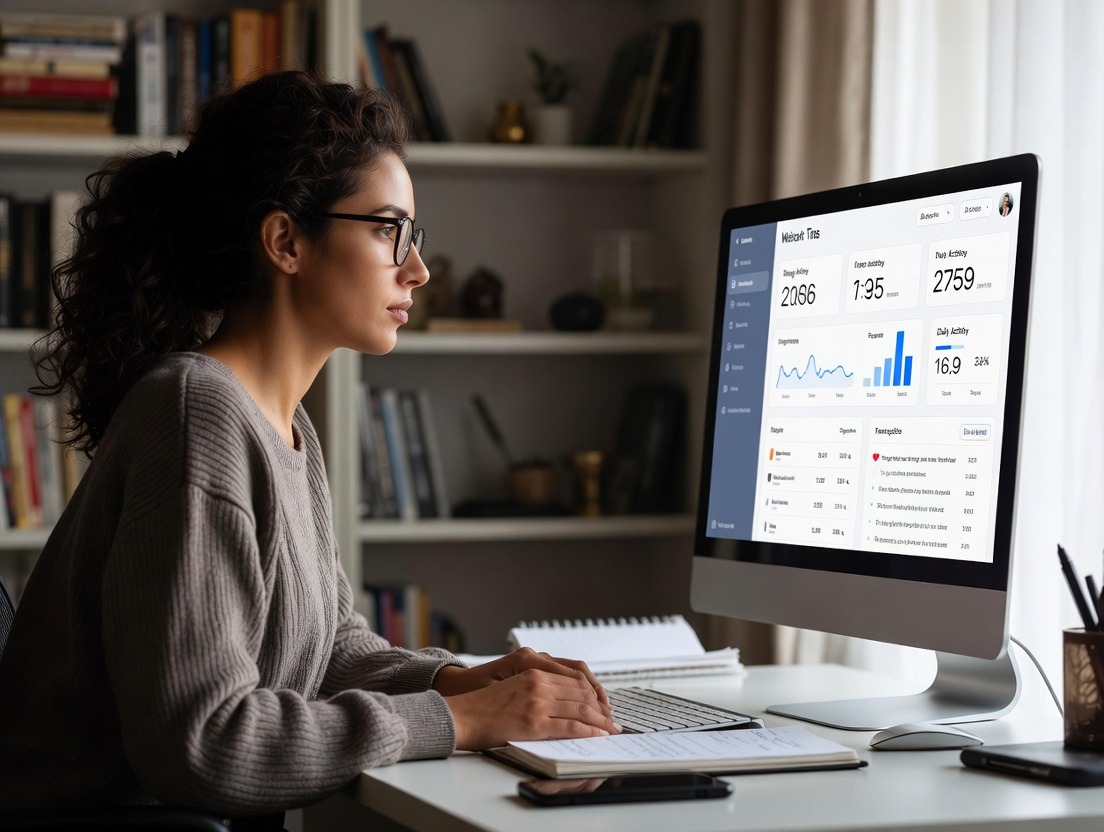
Your environment is not a passive container for your work; it’s an active participant in your physiological state. The flexible worker has the unique power to shape this environment. Using ring data as feedback, you can engineer a workspace that promotes focus, minimizes stress, and supports recovery.
Light: The Master Circadian Regulator
Light exposure is the most powerful cue for your internal body clock. Poor lighting leads to eye strain, fatigue, and circadian disruption. Your goal is to sync with the natural solar cycle.
Ergonomics & Movement: Beyond the Standing Desk
Static posture, even in a perfect chair, is stressful for the body. It increases RHR and reduces circulation. Your ring can detect prolonged sedentary stress.
Sound & Atmosphere: The Auditory Landscape
Noise pollution is a silent stressor. Constant background noise (traffic, HVAC) can elevate cortisol. Conversely, controlled sound can enhance focus.
Temperature & Airflow
Being slightly too warm or too cold is a constant, low-grade stressor that diverts cognitive resources. Most people focus best in a slightly cool environment (around 68-72°F or 20-22°C). Ensure good airflow to prevent a stuffy, CO2-heavy environment that induces drowsiness.
By treating your workspace as a lab and your ring as the measurement tool, you can iteratively design an environment that doesn’t just house your work, but actively amplifies your human potential. You are creating an ecosystem for sustainable performance.
The currency of the flexible work economy is not time, but focused attention. The ability to enter a state of deep, uninterrupted concentration is what turns hours into tangible, high-value outcomes. Yet, distractions are engineered to be addictive. Your ring data provides the "why" and the "when" for deep work, while behavioral systems provide the "how."
Using Readiness to Schedule Depth
Your morning Readiness score is your deep work permit. On high-readiness days, your brain is physiologically prepared for intense cognitive labor—your prefrontal cortex is fueled, your stress systems are regulated. This is when you must schedule your most important Red Task. Block 2-4 hours of this time in your calendar as a non-negotiable appointment with yourself, titled "Productivity Peak Hours."
On low-readiness days, attempting deep work will be an uphill battle, leading to frustration and poor output. Respect the data. Use those days for shallow work, planning, and relationship-building.
The Pre-Deep Work Ritual
Just as you need a shutdown ritual, you need a startup ritual to cue your brain for depth. This should last 5-10 minutes:
Taming the Digital Environment
Distraction is a form of stress. Each ping pulls you out of flow, triggering a micro-shot of cortisol and adrenaline.
The Role of Movement in Sustaining Focus
When you hit a wall during a deep work session, the worst thing you can do is switch to another tab. The best thing is a brief, non-digital movement break. A 3-5 minute walk, some stretching, or even just looking out the window at a distant object allows your brain’s diffuse mode to work on the problem subconsciously. You’ll often return with the solution. Your ring’s activity reminder can be a helpful nudge for this.
By marrying the strategic timing from your biometrics with ruthless environmental control, you transform deep work from a sporadic, willpower-dependent event into a reliable, scheduled output of your most valuable work. It turns the scattered reality of flexible work into a focused advantage.
Flexible work often means less face-to-face interaction. This can lead to isolation, miscommunication, and a weakened sense of team cohesion. While your ring tracks your internal state, you must proactively manage these external human factors. The goal is to use communication not as a constant distraction, but as a strategic tool for connection and clarity.
Aligning Communication with Energy, Not Just Time
Just as you schedule deep work during peaks, schedule different types of communication based on your energy.
The Asynchronous Advantage
One of the superpowers of flexible work is breaking free from real-time communication for everything. Champion asynchronous (async) practices:
Virtual Presence and the "Watercooler" Problem
Isolation is a real biometric stressor. Lack of social connection can negatively impact mood and even sleep. You must engineer virtual cohesion.
Setting Boundaries with Grace
"Flexible" does not mean "available 24/7." Protecting your downtime is critical for recovery. Communicate boundaries proactively and positively:
By managing communication strategically, you prevent it from becoming the primary stressor that destroys your carefully planned energy blueprint. You build stronger, more trusting relationships while safeguarding the focus and recovery time that make your flexible work effective. This is especially crucial for couples managing different chronotypes if both partners work from home.
You can’t hack a biological system with poor fuel. For the flexible worker, eating and drinking are often afterthoughts—grabbed between calls, heavy on convenience. Yet, these choices have immediate and dramatic effects on your energy, focus, and the very biometrics your ring is tracking. Let’s use data to build intelligent fueling strategies.
The Glycemic Rollercoaster and Your Heart Rate
A large, carbohydrate-heavy lunch (think: pasta, sandwich, rice bowl) causes a rapid spike in blood sugar, followed by a steep crash. Your ring will capture this: watch for a noticeable rise in resting heart rate for 60-90 minutes post-meal, followed by a period of low HRV and high subjective fatigue—the infamous "post-lunch coma."
Hydration: The Invisible Performance Drag
Mild dehydration (as little as 1-2% of body weight) impairs concentration, short-term memory, and increases perception of task difficulty. It also directly elevates your resting heart rate, as your heart works harder to pump thicker blood.
Caffeine: The Double-Edged Sword
Caffeine is the flexible worker’s ubiquitous tool. Used wisely, it enhances alertness and focus. Used poorly, it destroys sleep and creates anxiety-laden energy.
Strategic Snacking for Sustained Energy
Avoid the high-sugar snack that gives a 20-minute buzz followed by a crash. Instead, pair a complex carb with a protein or fat: apple with almond butter, Greek yogurt, a handful of nuts. This provides a slow, steady release of energy that supports, rather than disrupts, a focused work block.
The Meal-as-Ritual Opportunity
In an office, lunch might be a social break. At home, it can vanish. Use meal times as forced recovery rituals. Step away from your screen. Eat mindfully. This 20-minute pause is a cognitive reset that pays dividends in afternoon focus, and your ring will show the positive impact on your nervous system recovery compared to eating while working.
By treating your nutrition as a source of data and an input for performance, you move from passive consumption to active fueling. You are literally programming your biology for stable energy, sharper focus, and better recovery, making your flexible workday smoother and more productive from the inside out.
For the digital nomad or the frequent business traveler, flexible work reaches its apex—and its greatest biological challenge. Jet lag, unfamiliar environments, and disrupted routines can demolish the careful energy blueprint you’ve built. Here, your smart ring transforms from an advisor to an essential survival guide, providing real-time feedback as you navigate new time zones and workspaces.
Pre-Travel Preparation: Pre-Adapting Your Rhythm
Don’t wait until you land to adjust.
In-Transit Strategy: Minimizing the Biometric Hit
The First 72 Hours: Data-Driven Resynchronization
The first three days are critical. Your goal is to entrain your new local rhythm as fast as possible.
Creating a Portable "Focus Bubble"
Your deep work ritual must be portable.
The Return Home: Often Harder Than Leaving
Re-adapting to your home time zone can be surprisingly difficult—a phenomenon known as "re-entry jet lag." Apply the same light, meal, and sleep schedule discipline in reverse. Your ring data will be crucial in objectively showing when your body has fully resynchronized, which often takes a day for every time zone crossed.
By leveraging your biometric data as a compass, you can navigate the disorientation of travel with confidence. You move from being a victim of time zones to being a master of them, preserving your productivity and well-being no matter where in the world your work takes you.
Flexible work provides the time and autonomy to integrate wellness practices directly into your day, not just cram them in before or after. The key is to move beyond viewing these as "extra" and to see them as core system maintenance, using your ring data to validate their impact and optimize their timing.
Stress Response Training: Meditation and Breathwork
The flexible work life comes with unique stressors: isolation, uncertainty, self-motivation. Meditation and controlled breathing are direct levers for your autonomic nervous system, which your ring measures via HRV.
Movement as Cognitive Fuel, Not Just Exercise
You don’t need a 60-minute gym session (though it’s great). The flexible worker benefits enormously from frequent, low-dose movement.
Nature Exposure ("Green Time") as a Reset
Time in nature—"forest bathing" or even just a walk in a park—lowers cortisol, reduces rumination, and improves mood. For the home-based worker, this is a critical antidote to cabin fever.
Digital Detox and Sensory Calming
The constant stimulation of screens is a neurological tax. Your wind-down ritual should include a deliberate reduction in sensory input.
By weaving these practices into the fabric of your day—and using your ring to confirm their value—you build a resilient system. You are no longer just avoiding burnout; you are actively cultivating a state of sustained vitality that makes your flexible work not just manageable, but profoundly fulfilling. This holistic approach is the final piece in building a life where work serves you, not the other way around.
The true test of any system is not in the first month of enthusiastic adoption, but in its ability to sustain you over quarters and years. Flexible work is a marathon, not a sprint. The initial rush of autonomy can give way to stagnation, boredom, or the slow creep of old, unhealthy patterns. This is where your relationship with your ring data must evolve from daily tactical guidance to strategic, lifelong insight. The goal is to internalize the wisdom, so the habits become second nature, and the data serves as a periodic check-in rather than a constant crutch.
From Monitoring to Internalizing: Building Intuition
In the beginning, you rely on the app to tell you your Readiness score. Over 6-12 months, a profound shift should occur: you start to feel what a 90% day versus a 60% day is like in your body before you even check. The ring’s data trains your interoception—your sense of your internal state.
Quarterly Reviews: The Big Picture Audit
Set a calendar reminder every three months for a “Biometric Quarterly Review.”
Preventing Data Anxiety and Ring Dependency
A tool is meant to serve you, not induce stress. Beware of “orthosomnia”—an unhealthy preoccupation with perfect sleep data.
Evolving with Life’s Seasons
Your flexible work strategy cannot be static. Life changes: you might have a child, change careers, move across the world, or enter a new decade of life. Each of these shifts will rewrite your biological and energetic needs.
By adopting this long-term view, you transform the pursuit of productivity into a practice of sustainable self-management. The smart ring becomes a lifelong companion in self-knowledge, providing an objective record of how you lived, worked, and thrived across the changing seasons of your career and life. It ensures that your flexible work life remains a source of liberation and energy, not a slow path to depletion.
To truly harness the power of your biometric data, it must escape the silo of its proprietary app and interact with the other digital tools that govern your work life. This is where you move from reactive observation to proactive, automated system management. By creating a connected ecosystem, your physiology can directly influence your schedule, task list, and environment.
Calendar Orchestration: Letting Readiness Dictate Your Schedule
This is the frontier of bio-productivity. Using platforms like Zapier or IFTTT, you can create “if-then” rules based on your ring’s morning Readiness score.
Task Management Synergy: Energy-Based Task Sorting
Connect your ring data to task managers like Todoist, Asana, or ClickUp.
Environmental Control: Building a Responsive Workspace
With smart home devices, your data can shape your physical space.
The Quantified Communication Pause
This is an advanced boundary-setting technique. An automation can monitor your last interaction with your keyboard/mouse or your location. If it detects no activity at your workspace for 30 minutes past your official end time, it can automatically set your messaging apps (Slack, Teams) to “Away” or “Offline,” preventing after-hours pings and reinforcing your boundary to colleagues in different time zones.
Health Data Aggregation Dashboards
For the ultimate overview, use a platform like Google Data Studio or Apple Health (if compatible) to pull in data from your ring, your nutrition tracker (like MyFitnessPal), and your workout app (like Strava). Seeing sleep, nutrition, exercise, and HRV on one dashboard reveals holistic patterns no single app can show. You might discover, for instance, that your best recovery days follow a combination of 8+ hours of sleep, 120g of protein, and a yoga session—powerful intelligence for replicating success.
By building these integrations, you create a “smart” work life that responds to you. It reduces decision fatigue, enforces your boundaries automatically, and ensures your daily plan is always in alignment with your biological reality. It’s the final step in becoming the effortless conductor of your own flexible work symphony.
Even with the best tools and intentions, you will hit plateaus. Your Readiness scores might stagnate. Sleep quality might dip for no apparent reason. Work might start to feel draining again. This is normal. The key is to use your data not as a report card, but as a diagnostic tool to investigate and correct course. Here are common pitfalls and how to use your ring to solve them.
The “Everything is Optimal, But I’m Still Tired” Plateau
Your sleep is 8 hours, HRV is stable, but energy and focus are lacking. This often points to psychological or motivational factors that biometrics can’t directly measure.
The “Inconsistent Sleep Despite a Regular Schedule” Problem
You’re going to bed at the same time, but your deep and REM sleep percentages are all over the place.
The “Weekend Rebound” Cycle
Your data is great Monday-Wednesday, crashes Thursday, you sleep in massively on Saturday, and feel groggy Sunday night—a classic sign of social jet lag.
The “Work Creep” and Vanishing Boundaries
Your evening HRV is getting lower, and your sleep latency is increasing. This is a classic sign that work is mentally spilling into your personal time.
When Life Throws a Curveball: Illness, Stress, Grief
Your data will look “bad” during these times. The critical mistake is trying to “fix” it or work through it.
By learning to troubleshoot with curiosity rather than frustration, you turn obstacles into masterclasses in self-knowledge. Each pitfall resolved deepens your understanding of your unique operating manual, making you more resilient and adaptable for the long journey ahead.
The principles of biometric alignment are universal, but their application varies dramatically depending on the structure of your work. A freelancer’s stressors differ from a corporate hybrid employee’s, whose challenges are worlds apart from a digital nomad’s or a solopreneur’s. Let’s tailor the ring guidance framework to fit the unique contours of these common flexible work identities.
For the hybrid worker, the challenge is bifurcation: home days vs. office days. Each environment has different rules, distractions, and energy drains. Your data will show two distinct physiological profiles, and your goal is to optimize both, not force them to be the same.
The Office Day Strategy: Managing the Commute and Open Floorplans
The freelancer’s life is defined by variable income, self-directed hustle, and client anxiety. The ring becomes a stability anchor against this volatility.
Using Data for Proposal and Pricing Confidence
Building Recovery into the Work Cycle
Freelancers often work intensely until delivery, then collapse. Use your ring to institute a mandatory “Recovery Sprint” after every project.
As discussed in travel, the nomad’s core challenge is environmental inconsistency. The specialization here is about creating portable anchors.
The Non-Negotiable Travel Kit
Beyond the laptop, your nomad kit must include:
You are the CEO, CFO, CMO, and janitor. The mental context-switching is immense. Your ring helps you compartmentalize these roles to prevent executive fatigue.
Role-Based Time Blocking by Energy
For writers, designers, and artists, the metric of success is often unpredictable creative flow. The ring can help you capture its conditions.
By customizing the approach, you move from generic wellness advice to a precise operating system for your specific career path. The ring data provides the feedback loop to constantly refine this system, making your unique form of flexible work not just viable, but optimally prosperous.
All the data in the world is useless without the correct mindset to interpret and act on it. Flexible work demands immense psychological fortitude: self-motivation, tolerance for ambiguity, and the ability to weather isolation and rejection without external validation. Your ring tracks the physiological symptoms of your mental state; the work here is on the cognitive source.
From Boss-Dependency to Self-Leadership
The office provided external structure: a boss’s expectations, colleague pressure, a physical location. At home, you must become your own benevolent leader.
Managing the “Visibility Anxiety”
A pervasive fear for remote workers is being “out of sight, out of mind.” This can lead to overcompensation: being always-on, sending unnecessary updates, working late to be seen online.
Building Grit Through Ritual, Not Willpower
Motivation is fleeting. Flexible work runs on discipline, which is best built through unshakeable rituals.
Embracing Strategic Loneliness
Isolation is a real physiological stressor. Your ring might show poorer sleep after days with zero human interaction.
By cultivating this resilient, self-led mindset, you build the psychological infrastructure to support the physical optimization your ring guides. You become not just a better flexible worker, but a more grounded, autonomous, and confident individual.

For many in flexible work—freelancers, consultants, seasonal workers—financial stability is the ever-present undercurrent of stress. This anxiety has a direct, measurable impact on your physiology. Worrying about cash flow at 2 AM will crater your deep sleep and HRV, which in turn impairs your decision-making and productivity the next day, creating a vicious cycle. Breaking this cycle requires merging financial strategy with biometric awareness.
Using Ring Data to Identify Financial Stress Signatures
First, become a detective. When you review your monthly data, look for patterns:
The “Financial Readiness” Buffer: Your Monetary HRV
Just as HRV measures your physiological resilience, a “Financial Runway” measures your economic resilience. Your goal is to build a buffer so your biology isn’t hostage to every cash flow hiccup.
Energy-Aligned Financial Tasks
Money admin is often a Yellow or Green Task. Don’t waste a high-readiness morning on it.
Pricing Your Work with the “Stress Tax” Included
This is a revolutionary use of your data. When determining your rate or project fee, add a line item: The Biological Cost.
Investing in Recovery as a Business Expense
The most counterintuitive but powerful financial shift: view money spent on recovery not as a personal luxury, but as a business investment in your primary asset—you.
By integrating financial and physiological planning, you create a holistic picture of sustainability. You reduce the anxiety that sabotages your sleep, and you make financial decisions from a place of abundance and strategic self-worth, creating a virtuous cycle of well-being and prosperity.
The watercooler is gone. The conference room small talk is gone. For the flexible worker, community and professional networks don’t happen by accident; they must be intentionally architected. This is critical not just for opportunity, but for mental health. Loneliness is a productivity killer, and as your ring data on stress and sleep may show, it’s a biological stressor. The solution is deliberate, low-friction, value-driven connection.
The “Micro-Community” Strategy
Forget trying to build a massive network. Focus on cultivating 3-5 key micro-communities that serve different needs.
Leverifying Events and Conferences with Biometric Strategy
Attending a virtual or in-person conference can be overwhelming. Use your ring to navigate strategically.
Creating Serendipity Digitally
In an office, serendipity happens in hallways. Online, you must create it.
Using Data to Advocate for Connection
If you are a remote employee within a company, you may need to advocate for the budget and time for connection.
By treating community as a mandatory component of your work system—as vital as your laptop—you inoculate yourself against the isolation that undermines so many flexible work arrangements. You build a web of support, inspiration, and opportunity that is independent of any single job or location, making your career truly resilient.
We are standing at the precipice of a fundamental shift. The fusion of biometric wearables, AI, and work is moving from personal optimization to organizational integration. The future flexible worker will navigate a landscape where their physiological data could be a two-way street, shared with employers or platforms. This presents extraordinary possibilities for human-centric work design, but also profound ethical questions. Let’s explore the horizon.
The Personalized, Adaptive Work Platform
Imagine a future version of Asana or Slack that integrates with your wearable (with your explicit, revocable consent).
The Quantified Workplace
Companies serious about talent retention in a remote world might offer “biometric wellness benefits.”
The Ethical Minefield and Non-Negotiables
This future is not inevitable, nor is it inherently good. It must be built on an unshakeable ethical foundation.
Preparing Yourself for this Future
As a flexible worker, your stance should be one of informed empowerment.
The future of flexible work should be one where technology serves to make us more human—more creative, more resilient, more balanced. By engaging with these tools and this conversation proactively, we can steer toward that future, building work lives that are not only flexible but truly flourishing.
Your Trusted Sleep Advocate: Sleep Foundation — https://www.sleepfoundation.org
Discover a digital archive of scholarly articles: NIH — https://www.ncbi.nlm.nih.gov/
39 million citations for biomedical literature :PubMed — https://pubmed.ncbi.nlm.nih.gov/
Experts at Harvard Health Publishing covering a variety of health topics — https://www.health.harvard.edu/blog/
Every life deserves world class care :Cleveland Clinic - https://my.clevelandclinic.org/health
Wearable technology and the future of predictive health monitoring :MIT Technology Review — https://www.technologyreview.com/
Dedicated to the well-being of all people and guided by science :World Health Organization — https://www.who.int/news-room/
Psychological science and knowledge to benefit society and improve lives. :APA — https://www.apa.org/monitor/
Cutting-edge insights on human longevity and peak performance:
Lifespan Research — https://www.lifespan.io/
Global authority on exercise physiology, sports performance, and human recovery:
American College of Sports Medicine — https://www.acsm.org/
Neuroscience-driven guidance for better focus, sleep, and mental clarity:
Stanford Human Performance Lab — https://humanperformance.stanford.edu/
Evidence-based psychology and mind–body wellness resources:
Mayo Clinic — https://www.mayoclinic.org/healthy-lifestyle/
Data-backed research on emotional wellbeing, stress biology, and resilience:
American Institute of Stress — https://www.stress.org/


