


How to Develop Unshakeable Mental Calm in 90 Days
Developing unshakeable calm is a gradual process of consistent practice that builds new neural pathways over approximately three months.
Developing unshakeable calm is a gradual process of consistent practice that builds new neural pathways over approximately three months.
%402x.svg)
We live in a world of endless pings. A constant stream of notifications, news cycles, and demands has turned our minds into a browser with too many tabs open—each one draining focus, energy, and peace. The quest for mental calm isn't just a luxury for yogis on mountaintops; it's a fundamental requirement for clarity, resilience, and a life lived with intention, not just reaction.
But "calm" can feel elusive. It's not a permanent state you achieve and forget, like riding a bike. It's a dynamic skill—a muscle that must be built, nurtured, and protected. It’s the space between stimulus and response, and in that space lies our power to choose. What if you could systematically construct that space, brick by brick, until you possessed an unshakeable inner sanctuary, regardless of external chaos?
This is your comprehensive protocol. Over the next 90 days, you will not simply dabble in mindfulness or try a few breathing exercises. You will engineer a foundation of mental calm through neuroscience-backed principles, actionable daily practices, and measurable lifestyle shifts. We will move beyond theory into the architecture of a tranquil mind, exploring everything from the biology of stress to the technology that can accelerate your progress. Modern tools like the advanced wellness tracking from Oxyzen can provide the objective data needed to turn self-awareness from a guess into a science.
The promise is profound: in three months, you can rewire your nervous system, reshape your cognitive habits, and develop a calm so integrated into your being that it becomes your default setting. This isn't about suppressing emotion or avoiding life's challenges. It's about cultivating a steady core from which you can meet anything with grace, focus, and strength.
Let’s begin the construction.

Before we can build calm, we must understand what we're building against. The feeling of being "stressed" or "uncalm" isn't a character flaw or a lack of discipline. It's a sophisticated, ancient biological program running in the hardware of your body and brain.
At the heart of this system is the autonomic nervous system (ANS), your body's autopilot. The ANS has two primary gears: the sympathetic nervous system (SNS), your "gas pedal" for fight-or-flight, and the parasympathetic nervous system (PNS), your "brake pedal" for rest-and-digest. Chronic stress, anxiety, and mental turmoil occur when your SNS is perpetually tapped, and your PNS is underused and underdeveloped. Your body lives in a state of high alert, interpreting emails, traffic, and social tensions as existential threats.
The Cortisol Cascade: When your brain perceives a threat (real or imagined), your hypothalamus triggers a cascade. Your adrenal glands release cortisol and adrenaline. Your heart rate and blood pressure spike, blood shunts to your limbs, and non-essential functions like digestion and immune response are suppressed. This is brilliant for escaping a saber-toothed tiger. It's catastrophic when triggered by a critical email at 10 AM, a family disagreement at 7 PM, and a worrying news headline at 11 PM. The cortisol never fully clears, leading to a low-grade, corrosive stress that erodes mental calm at its foundation.
The Amygdala Hijack: Deep in your brain's temporal lobe sits the amygdala, your threat radar. In a chronically stressed state, the amygdala becomes hyper-vigilant and hypersensitive—like a smoke alarm that goes off when you make toast. It can trigger a full SNS response before your rational, thinking prefrontal cortex has a chance to assess the situation. This is the "amygdala hijack," where you react emotionally and impulsively, later wondering why you overreacted. Calm is impossible when you are hostage to this hijack.
This is why "just calm down" is perhaps the most useless phrase in the English language. You cannot think your way out of a biological response with willpower alone. You must use biology to outsmart biology. The 90-day protocol works because it doesn't ask you to fight your nervous system; it teaches you to retrain it. By consistently engaging the parasympathetic "brake," you increase its tone and resilience, making it the dominant, default state. It's the equivalent of building a stronger, more responsive brake system for your car so you can navigate any road with control.
Understanding this foundation transforms the journey from a battle of will into a strategic retraining. It’s the critical first step. As you’ll see, every practice that follows—from breathwork to sleep optimization—is designed to send a direct, physiological signal to your ANS: "You are safe. Stand down."
Embarking on a 90-day transformation requires a specific mindset. The all-or-nothing, perfectionist approach is the nemesis of sustainable calm. It creates a brittle framework that shatters at the first missed meditation session or stressful day, leading to abandonment and self-criticism—the very opposite of the calm we seek.
Instead, we embrace the Process Mindset. This paradigm shift is non-negotiable for success. Here’s what it entails:
1. The Compound Effect of Micro-Habits: You will not find calm in a single, grand gesture. You will discover it in the relentless consistency of small, daily deposits into your neurological "calm account." One mindful breath seems insignificant. But 50 mindful breaths per day, for 90 days, is 4,500 moments of neural repatterning. It’s the compound interest of mental fitness. Your focus is not on the size of the action, but the unbroken chain of repetition.
2. Non-Judgmental Awareness: This is the cornerstone of the process. When you inevitably miss a practice, react poorly, or have a "bad" day, the practice is to observe it without layering on a story of failure. "I noticed I felt anxious during that meeting" is a neutral observation. "I'm a failure at staying calm; this whole thing is pointless" is a judgment that amplifies stress. The goal is to become a compassionate scientist of your own inner world, collecting data without criticism. This skill alone cultivates profound calm.
3. The 1% Better Rule: Each day, you are not seeking monumental change. You are aiming to be 1% more skillful at noticing your stress signals, 1% faster at engaging your breath, 1% more consistent with your wind-down routine. These tiny margins, compounded over 90 days, create a transformative shift that feels almost effortless. It’s the slow, steady pressure that shapes the canyon.
4. Embracing the Dip: Around days 30-45, you will likely hit a "dip." The novelty has worn off, progress feels slow, and old patterns tug hard. This is not a sign of failure; it is a predictable and necessary phase of neuroplasticity—the point where your brain is reorganizing its pathways. Persisting through the dip is where true rewiring occurs. Knowing it's coming allows you to greet it as a milestone, not a setback.
Adopting this mindset turns the 90 days into a laboratory, not a courtroom. Every experience, pleasant or challenging, becomes data that informs your practice. For those who love tracking progress with more than just intuition, leveraging objective biometric data can be incredibly reinforcing. Devices that monitor heart rate variability (HRV)—a key indicator of nervous system balance—like those explored in resources at the Oxyzen blog, can provide tangible proof that your 1% efforts are moving the needle at a physiological level. The process mindset, supported by data, creates a self-reinforcing loop of motivation and calm.

We begin with the most powerful, portable, and foundational tool in the calm arsenal: your breath. Breathing is the only autonomic function you can also control voluntarily, making it the perfect bridge between your conscious mind and your subconscious stress response. But not all breathing is created equal.
For the first two weeks, your sole, non-negotiable focus is mastering diaphragmatic breathing (also called belly breathing) and integrating it into your daily life.
The Science of the Sigh: Shallow, chest-based breathing (common during stress) stimulates the SNS. Deep, diaphragmatic breathing stimulates the vagus nerve—the main superhighway of the PNS—triggering a relaxation response. It slows your heart rate, lowers blood pressure, and signals safety to the brain. Research shows that just 5-10 minutes of daily diaphragmatic breathing can significantly reduce cortisol levels and anxiety.
Your Practice Protocol:
Storytelling Example: Consider Maya, a project manager. Her old pattern: She'd get a last-minute change request, feel her chest tighten, and immediately fire off a terse, defensive reply, creating more tension. After week one of this protocol, the same request arrives. She feels the chest tightness—but now that sensation is a cue. She leans back, takes three deep belly breaths while looking out the window. Her heart rate settles. She then drafts a composed, solution-oriented response. The situation is de-escalated, and she remains the calm in the storm. The trigger was the same; her internal response was rebuilt.
By the end of Week 2, diaphragmatic breathing should start to feel less like an exercise and more like a default setting. You are literally strengthening your physiological "brake pedal." This single habit forms the bedrock upon which all other practices are built. For common questions on integrating such habits with busy lifestyles, our comprehensive FAQ addresses how to make technology and routine work for you, not against you.
With your breath as an anchor, we now add structure to your awareness practice. If diaphragmatic breathing is training your nervous system, formal mindfulness meditation is training your attention. It's the gym for your mind, where you learn to observe the chaotic traffic of thoughts and feelings without getting hit by any of them.
Mindfulness is not about emptying your mind—an impossible task. It is about changing your relationship to your mind's content. It’s the practice of noticing that you are having a thought, rather than being the thought. This meta-awareness is the essence of unshakeable calm.
Your 10-Minute Daily Meditation Protocol:
Neurological Rewiring: MRI studies show that consistent meditation increases gray matter density in the prefrontal cortex (improving focus and emotional regulation) and decreases amygdala size (reducing reactivity). You are literally sculpting a calmer brain.
Common Hurdles & Solutions:
By the end of Week 4, you should begin to experience "gap moments" in daily life—a brief, conscious space between a feeling and an action. You might feel anger, but in the new gap, you choose a measured response. This is the beginning of unshakeable calm in action. To deepen your understanding of the science behind these practices, a wealth of research and expert insights can be found on our blog, dedicated to cutting-edge wellness.

Your mind cannot be calm if your attention is perpetually for sale. The greatest threat to modern mental calm is not any single life stressor; it’s the fragmented, dopamine-driven, endless scroll of the digital world. Your attention is your most precious resource. Where you place it determines your reality. Weeks 5-6 are about conducting a strategic audit and implementing a sustainable Information Diet.
This isn't about Luddite rejection of technology, but about conscious, intentional use. Every notification, news alert, and social comparison is a micro-stressor, a tiny SNS activation that accumulates into a background hum of anxiety.
The Audit (Day 1-3):
The Protocol Implementation:
The result of this two-week intensive is a dramatic quieting of your mental environment. You'll discover that much of your anxiety wasn't "yours"—it was absorbed from the digital ether. By reclaiming your attention, you create the empty space necessary for calm to grow. This philosophy of intentional living is core to our mission at Oxyzen, where we believe technology should serve human wellness, not undermine it.
You cannot hack a calm mind on a sleep-deprived brain. Sleep is the master regulator of your nervous system, emotional resilience, and cognitive function. Poor sleep is like pouring gasoline on the fire of stress, while deep, restorative sleep is the ultimate coolant. Weeks 7-8 are dedicated to making your sleep non-negotiable and syncing your body with its natural rhythm—your circadian clock.
The Calm-Sleep Connection:
During deep sleep (slow-wave sleep), your brain clears out metabolic waste, including beta-amyloid proteins linked to stress. REM sleep processes emotional experiences, stripping away the sharp edges from the previous day's events. Skimp on sleep, and you wake with a neurologically "cluttered" and emotionally raw brain, primed for reactivity.
Your Sleep Optimization Protocol:
Tracking for Insight: How do you know if your protocol is working? Beyond feeling more rested, objective data is invaluable. Monitoring sleep stages, resting heart rate, and HRV can show you the direct impact of your new ritual. For those interested in leveraging precise biometric feedback to optimize this pillar of calm, exploring the technology behind devices like those from Oxyzen can provide a clear window into your sleep physiology.
By the end of Week 8, falling asleep should feel easier, and you should wake feeling more restored. This solid foundation of recovery makes every other calm practice exponentially more effective. A well-rested brain is a trainable brain.
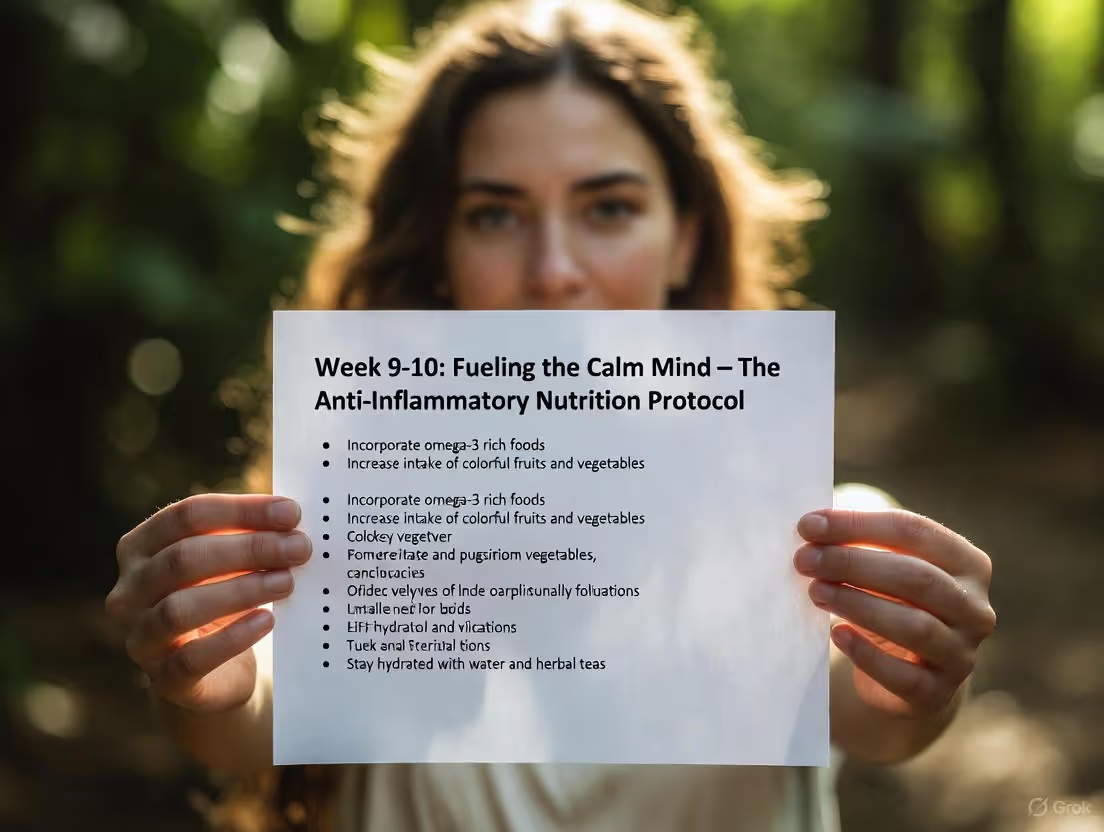
The gut is often called the "second brain" for a reason. The vagus nerve forms a direct communication highway between your gut and your brain. What you eat directly influences inflammation, neurotransmitter production, and hormonal balance—all of which dictate your mood, energy, and stress resilience. You cannot drink cortisol-spiking beverages and eat anxiety-provoking foods while expecting to maintain mental calm. Weeks 9-10 focus on an Anti-Inflammatory Nutrition Protocol designed to stabilize your energy and soothe your nervous system.
The Core Principles:
Your 10-Day Calm Eating Challenge:
Notice how you feel after 10 days. Most report significantly more stable energy, less afternoon fog, reduced cravings, and a baseline sense of physical—and therefore mental—lightness. The body is no longer a source of constant biochemical stress signals. For personalized guidance and to see how others have transformed their wellness through holistic habits, our community's real-world experiences are shared in our testimonials.
Exercise is a double-edged sword for stress. Intense, chronic, high-intensity exercise without recovery can be another stressor on the system. But the right kind of movement is potent medicine for the nervous system. Weeks 11-12 are about shifting from "working out" to nervous system-regulating movement. The goal is not to exhaust, but to resource.
We focus on three key modalities:
1. Nature-Integrated Walking (The Ultimate Dual Therapy):
2. Yoga or Tai Chi (Conscious Movement & Breath Synergy):
3. Strength Training (Empowerment & Resilience):
The "Feel, Don't Force" Rule: Let your body guide you. On high-stress days, choose a nature walk or gentle yoga. On days you feel energetic and strong, opt for strength training. The objective is to listen to and respect your body's signals—a core skill of a calm mind.
By the end of Week 12, movement becomes less of a chore and more of a cherished ritual for self-regulation. You are using your body not to punish yourself, but to cultivate a state of balanced, resilient energy. This holistic approach to wellness—integrating body, mind, and environment—reflects the vision that drives our our story and the products we create to support it.
By now, you have built a robust physiological and behavioral foundation for calm. Your nervous system is more regulated, your attention is more disciplined, and your body is better nourished and rested. Yet, the most persistent source of turbulence often remains: the voice in your head. Weeks 13-14 target the software of your mind—your thoughts. Through Cognitive Restructuring, you will learn to identify, challenge, and rewrite the catastrophic, distorted, and self-critical narratives that fuel anxiety and erode peace.
Cognitive Behavioral Theory posits a simple but profound chain: Situation -> Thought -> Emotion -> Behavior. You cannot always control the situation, but you have immense power to intervene at the level of your thought about it, which then changes the emotion and the behavior that follows.
The 3-Step Cognitive Restructuring Protocol:
Step 1: Catch & Label the Distorted Thought.
The first skill is to become a observer of your own thinking. Common cognitive distortions include:
Your practice: When you feel a spike of negative emotion (worry, shame, anger), pause. Ask: “What thought just went through my mind?” Write it down. Then, label the distortion. This alone creates distance—you are not the thought; you are the one observing the thought.
Step 2: Challenge with Evidence & Alternative Perspectives.
Interrogate the thought like a scientist or a fair-minded lawyer.
Step 3: Craft a Power Statement.
Create a new, evidence-based, balanced thought to replace the old, distorted one. It should feel authentic, not just a hollow positive affirmation.
Daily Practice – The Thought Record: For these two weeks, dedicate 10 minutes each evening to a formal “Thought Record.” Document 1-2 stressful moments from the day, and run them through the 3-step protocol. This builds the mental muscle of cognitive flexibility.
Over time, this practice fundamentally changes your internal climate. The anxious inner critic transforms into a grounded, compassionate inner coach. The mental chatter loses its power to derail you, because you have developed the meta-skill of not believing everything you think. This advanced skill of self-awareness is what turns situational calm into unshakeable character. For further exploration of mindset techniques and cognitive tools, our blog offers a continuous stream of research-driven insights.
Mental calm is not the absence of emotion. It is the capacity to experience the full spectrum of human emotion—fear, anger, sadness, joy—without being overwhelmed or hijacked by any single one. Weeks 15-16 focus on developing Emotional Agility, a concept popularized by psychologist Dr. Susan David. It is the process of meeting your emotions with curiosity and compassion, then choosing values-aligned actions.
The opposite of agility is rigidity (getting stuck in an emotion) or chaos (being tossed by them). Both lead to suffering.
The 4-Step Emotional Agility Framework:
This process breaks the automatic link between difficult feelings and reactive behavior (like lashing out, numbing out, or ruminating). You learn to “walk with” discomfort, which paradoxically makes it pass more quickly. You become the skilled captain of your emotional ship, able to navigate stormy seas without fearing you’ll sink. Learning to work with, not against, your emotional data is a key principle in holistic wellness, a topic we often explore in depth for our community at Oxyzen.
Your external environment is a direct reflection and reinforcement of your internal state. A cluttered, chaotic, and overstimulating space will constantly pull your nervous system into a state of low-grade alert. Weeks 17-18 are dedicated to applying the principles of Environmental Psychology to design physical spaces—your home and your workspace—that actively cultivate and protect your mental calm.
This is not about minimalist aesthetic dogma, but about intentional design that serves your nervous system.
The Pillars of a Calm-Enhancing Environment:
1. Sensory Hygiene:
2. The “Zoning” Strategy:
Create clear physical zones for specific mental modes. This trains your brain to switch contexts.
3. The Digital Feng Shui: Extend the digital detox to your environment.
Your 2-Week Environmental Audit & Overhaul:
The result is a living and working space that feels like a retreat, not a demand. Your environment now works for you, constantly sending subtle cues of safety, order, and peace to your nervous system. This philosophy of designing supportive ecosystems is central to our vision, as shared in our story.
Humans are wired for connection, but relationships can be our greatest source of both joy and stress. Unhealthy dynamics, poor boundaries, and emotional contagion can shred our hard-earned calm. Weeks 19-20 focus on building a Social Scaffold—a network of relationships and communication skills that support, rather than undermine, your inner peace.
Part 1: The Circle Audit – Energy Mapping
Draw three concentric circles.
Part 2: Mastering Calm Communication
Even with nourishing people, conflict and misunderstanding arise. The skill is to navigate them without losing your center.
By auditing your social landscape and upgrading your communication tools, you protect your calm from external draining forces. You become a source of calm for others, which in turn reinforces it within yourself. Building a supportive community is part of our core mission, and hearing how others navigate these challenges can be inspiring—you can find such shared experiences in our testimonials.
You have a strong foundational mindfulness practice. Now, we deepen it to cultivate two advanced qualities that are the hallmarks of true, unshakeable calm: Equanimity and Compassion.
Equanimity (Upekkha): This is the pinnacle of mental calm. It is a state of inner balance and non-reactivity amidst the “eight worldly winds”: praise and blame, pleasure and pain, gain and loss, fame and disrepute. Equanimity is not indifference. It is a profound, wise acceptance that life contains both pleasant and unpleasant experiences, and you have the capacity to meet them all with a steady heart.
Compassion (Karuna): Often misunderstood as pity or softness, true compassion is a fierce and active state. It is the recognition of suffering in oneself and others, coupled with the wish to alleviate it. Self-compassion is the critical antidote to the inner critic and a direct source of calm, as it soothes the threat system in the brain.
Your Advanced Practice Protocol:
1. Equanimity Meditation (20 minutes daily):
2. Self-Compassion Break (In-the-Moment Practice):
Developed by Dr. Kristin Neff, use this when you stumble, fail, or feel inadequate.
3. Loving-Kindness (Metta) Meditation Expansion:
Extend your traditional Metta practice to include the “difficult person.” This is not about condoning their actions, but about freeing yourself from the corrosive energy of resentment. Sending them phrases like “May you be free from anger” is a radical act of self-liberation that creates immense internal calm.
These practices rewire the brain for resilience and connection. They move you from a self-centered focus on your own comfort to a stable, compassionate presence that can hold space for all of life. This deep, principled approach to inner development is what we stand for, a reflection of the values you can learn more about at Oxyzen.
You have assembled a powerful toolkit. You've trained your physiology, curated your environment, and honed your mind. Now, the final weeks of the core 90-day protocol are dedicated to Integration. This is the process of weaving your discrete practices into a seamless, personal Calm Operating System (C.O.S.)—a fluid, intuitive set of responses that automatically engage in the face of life's demands. The goal is to move from conscious practice to unconscious competence.
Integration is where true mastery lives. It’s the difference between a mechanic who needs a manual for every repair and one who can feel what’s wrong with an engine. Your calm becomes embodied, not just intellectual.
The Three Pillars of Integration:
1. Create Your "If-Then" Calm Playbook.
This is a personalized decision tree for stress. You pre-program your responses so you don't have to think when stressed (when thinking is hardest).
2. Develop Rituals, Not Just Routines.
A routine is a sequence of actions (e.g., brush teeth, shower, dress). A ritual is the same sequence performed with mindful intention and symbolic meaning. Rituals anchor your calm throughout the day.
3. The Weekly Review & Tuning Session.
Once a week (Sunday evening works well), conduct a 30-minute review.
This integrated C.O.S. becomes your autopilot for resilience. You are no longer doing practices; you are living from a place of calibrated calm. For those who thrive on data to optimize their system, exploring the precise feedback offered by advanced wellness technology, like the insights available through Oxyzen, can take this integration to a deeply personalized level.
Your Calm Operating System is built and integrated. But what happens when life delivers not just daily stress, but a genuine crisis—a significant loss, a health scare, a financial shock? This is the ultimate stress test for unshakeable calm. The protocol doesn't promise you won't feel pain, fear, or grief. It ensures you have a structure to navigate it without fragmenting.
The Crisis Protocol – When the Foundation Shakes:
1. Anchor to the Foundational Three.
In acute crisis, your cognitive bandwidth shrinks. Return to the non-negotiable physiological basics. These are your life rafts.
2. Radical Permission & Containment.
3. Activate the Social Scaffold – With Precision.
Do not isolate. But communicate your needs clearly to your Inner Circle.
4. Implement "Next-Right-Action" Focus.
In the fog of crisis, grand planning is impossible. The only question is: What is the single, next, smallest right action?
It might be: Make a cup of tea. Call the insurance company. Put on clean socks. Write one email.
Complete that action. Then ask the question again. This forward motion, however tiny, prevents paralysis and maintains a thread of agency.
Navigating a crisis with this protocol proves the durability of your calm. You discover that unshakeable doesn't mean unmoving; it means you have a deep, flexible root structure that allows you to bend in the storm without breaking. For ongoing support and to read how others have applied these principles during difficult times, our community's shared journeys offer powerful insights in our testimonials.
Throughout this protocol, we've often framed technology—particularly smartphones and constant connectivity—as an antagonist to calm. This is only half the story. When used with supreme intention, technology transforms from the primary source of distraction into a powerful ally for data-driven self-awareness. The key is shifting from passive consumption to active, mindful utilization.
The Biometric Feedback Loop:
The most significant tech-enabled advancement in personal wellness is the ability to easily measure physiological markers of stress and recovery. This moves you from guessing about your internal state to knowing.
Using a Wellness Tracker Intentionally:
The device itself is inert. The power is in how you use the data.
This conscious, measured approach to technology embodies the principle of being in the driver's seat. You leverage tools for empowerment, not escape. For those interested in a device designed with this precise, intentional philosophy—to provide clarity without obsession—learning more about the technology behind Oxyzen can be a logical next step. The journey to calm is deeply personal, and finding the right tools for your path is essential.
The 90-day mark is not a finish line; it is a launchpad. You have crossed the threshold from seeking calm to embodying it. The work now shifts from construction to stewardship. How do you maintain and continue to deepen this unshakeable quality for a lifetime?
The Maintenance Framework:
1. The Seasonal Audit:
Every 3-4 months, conduct a deeper version of your weekly review. Life changes—new jobs, relationships, locations, challenges. Your Calm Operating System must evolve.
2. Embrace the Concept of "Practice Seasons":
You don't need to practice every tool with equal intensity forever. You can enter focused "seasons" of practice.
3. The Apprenticeship Model – Learn to Teach:
One of the most powerful ways to deepen your own understanding is to explain the principles to someone else. You don't need to be a guru. Simply share what has worked for you with a curious friend or family member. As you articulate the "why" behind the breath or the science of cognitive distortions, your own neural pathways are reinforced. Consider it becoming a steward of calm in your community.
4. Cultivate Awe and Wonder:
Advanced calm is not a flatline. It is a rich, vibrant inner landscape. Regularly seek out experiences that inspire awe—the feeling of being in the presence of something vast that transcends your understanding.
This lifelong path ensures your calm continues to mature, becoming wiser, more compassionate, and more resilient with each passing year. It becomes less of a "state" you manage and more of the essence from which you live. This holistic, evolving approach to human potential is what drives our continued work and innovation, a journey you can learn more about through our story.
You began this protocol likely seeking relief—a way to quiet the noise, to find a pause in the relentless pace. What you have built, step by step over these 90 days, is something far more powerful than mere relief. You have engineered a capacity.
You have built the capacity to feel fear without being ruled by it.
The capacity to hold pain without being shattered by it.
The capacity to engage with a chaotic world without becoming chaotic yourself.
This is unshakeable mental calm. It is not a destination you arrive at and unpack your bags. It is the very ground you now walk upon. It is the stable, fertile soil from which every other aspect of your life—your work, your creativity, your relationships, your contributions—can grow with strength and vitality.
Remember, the calm you have cultivated is not fragile. You have not built a house of cards that one strong wind will topple. You have forged a foundation of reinforced concrete and flexible steel, designed to withstand pressure and adapt to shifting loads. There will be days you forget to breathe, nights you don't sleep well, and moments the old patterns tug. This is not failure; it is feedback. Your system includes the tools to recalibrate.
You now possess your own inner sanctuary. The door is always open. The lights are always on. And no external event has the key. This is your birthright—not as a passive gift, but as an active creation, built through the deliberate, compassionate work you have done.
Take this calm into your world. Let it be the space from which you listen, the patience with which you respond, the clarity with which you decide, and the compassion with which you connect. In a world that often values noise over silence, reaction over response, and speed over depth, your calm is a quiet revolution. It is, perhaps, the most impactful thing you can offer—to yourself, and to everyone around you.
The protocol is complete. The practice is lifelong. Your unshakeable calm has begun. For continued exploration, support, and resources on this ever-unfolding journey, remember that a community and a wealth of knowledge are always available through our blog and support channels. You are not just building a calmer mind; you are building a more grounded, resilient, and impactful life.
Your Trusted Sleep Advocate: Sleep Foundation — https://www.sleepfoundation.org
Discover a digital archive of scholarly articles: NIH — https://www.ncbi.nlm.nih.gov/
39 million citations for biomedical literature :PubMed — https://pubmed.ncbi.nlm.nih.gov/
Experts at Harvard Health Publishing covering a variety of health topics — https://www.health.harvard.edu/blog/
Every life deserves world class care :Cleveland Clinic - https://my.clevelandclinic.org/health
Wearable technology and the future of predictive health monitoring :MIT Technology Review — https://www.technologyreview.com/
Dedicated to the well-being of all people and guided by science :World Health Organization — https://www.who.int/news-room/
Psychological science and knowledge to benefit society and improve lives. :APA — https://www.apa.org/monitor/
Cutting-edge insights on human longevity and peak performance:
Lifespan Research — https://www.lifespan.io/
Global authority on exercise physiology, sports performance, and human recovery:
American College of Sports Medicine — https://www.acsm.org/
Neuroscience-driven guidance for better focus, sleep, and mental clarity:
Stanford Human Performance Lab — https://humanperformance.stanford.edu/
Evidence-based psychology and mind–body wellness resources:
Mayo Clinic — https://www.mayoclinic.org/healthy-lifestyle/
Data-backed research on emotional wellbeing, stress biology, and resilience:
American Institute of Stress — https://www.stress.org/


