


Guided vs Unguided Calm Practices: Which Is Right for You?
Guided practices are helpful for beginners, while unguided practices foster greater independence and deeper internal awareness over time.
Guided practices are helpful for beginners, while unguided practices foster greater independence and deeper internal awareness over time.
%402x.svg)
In the relentless hum of modern life, the pursuit of calm is no longer a luxury; it’s a survival skill. From the incessant pings of notifications to the pressure of always-on productivity, our nervous systems are under siege. It’s little wonder that mindfulness, meditation, and breathwork have surged into the mainstream wellness lexicon. Yet, as you stand at the threshold of this quieter world, you face a fundamental, often unasked, question: Do you need a guide, or do you venture in alone?
This is the core of the guided versus unguided calm practice debate. It’s a choice between structure and spontaneity, between learning from an external voice and listening to your internal one. On one side, guided sessions—through apps, videos, or teachers—offer a hand to hold, a voice to pull you back from distraction, and a map for uncharted territory. On the other, unguided practice is the art of silent sitting, of self-directed breathing, of confronting the raw, unfiltered experience of your own mind without a narrator. One is not inherently superior to the other; they are simply different tools for different moments, different personalities, and different stages of the journey.
But how do you choose? The answer is not a binary switch but a dynamic dial, one you might adjust throughout your life, your week, or even your day. It depends on your goals, your temperament, your current stress load, and your readiness to face what lies within. This exploration aims to be your compass. We’ll dissect the neuroscience, the practicalities, the profound benefits, and the potential pitfalls of both paths. We’ll consider how modern technology, like the sophisticated biometric tracking from Oxyzen smart rings, can provide objective feedback to inform your choice. Ultimately, this is about empowering you to craft a personalized calm practice that doesn’t just exist as another item on your to-do list, but evolves as a resilient, responsive foundation for your well-being.
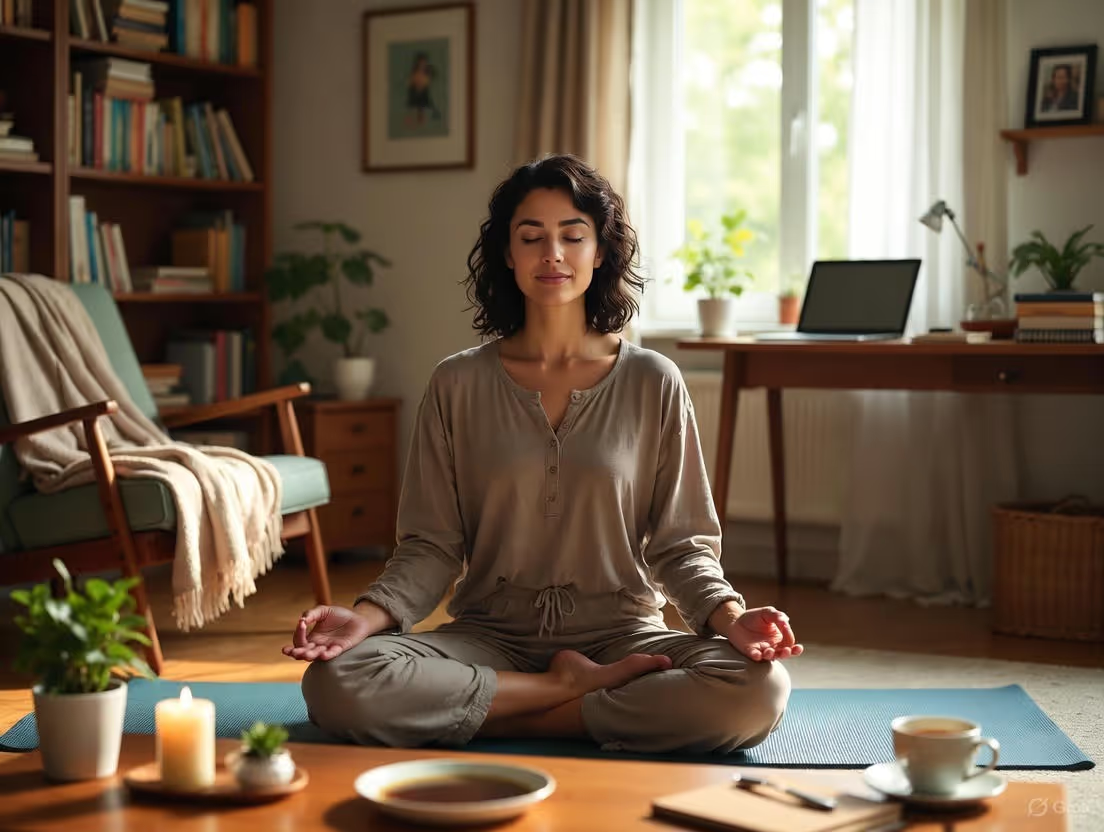
Before we can compare paths, we must understand the destination. "Calm" is often used as a fluffy, catch-all term, but from a physiological and psychological standpoint, it is a specific, measurable state. It’s the antithesis of the fight-or-flight response orchestrated by the sympathetic nervous system. True calm is the activation of the parasympathetic nervous system—your body’s "rest and digest" mechanism.
This shift isn't merely about feeling relaxed. It’s a whole-body renovation. When you achieve a state of calm, your heart rate variability (HRV) increases—a key marker of resilience and autonomic nervous system balance. Cortisol, the primary stress hormone, dips. Blood pressure often lowers. Brainwave patterns may shift from the frantic beta waves of active thought toward the more serene alpha and theta waves associated with relaxation and creativity. This state is where repair happens: the immune system functions more effectively, digestion improves, and the mind gains the space for clarity and emotional regulation.
However, achieving this state in the 21st century is akin to trying to hear a whisper in a hurricane. Our environments and lifestyles are engineered to keep us in a low-grade state of sympathetic arousal. This is where calm practices come in. They are not passive experiences but active skills we train, much like building a muscle. Whether guided or unguided, every practice aims to be a deliberate interruption of the stress cycle, a conscious steering of your internal systems back toward equilibrium.
Understanding this "anatomy of calm" is crucial because it frames the guided vs. unguided debate not as a matter of taste, but of efficacy. Which method more reliably and efficiently helps your unique system downshift into that restorative state? The answer begins with knowing thyself—and perhaps, with a little help from technology. Devices that track HRV and sleep, like those detailed in Oxyzen's blog, can offer invaluable, objective data on how different practices actually affect your nervous system, moving you from guesswork to insight.
Let’s crystallize our definitions. The distinction between guided and unguided practices is more nuanced than simply "with an app" or "in silence." It’s about the source of direction and the focus of attention.
Guided Practices are characterized by external instruction. A teacher, a recorded voice, an app prompt, or even a written script provides the structure. This guidance typically includes:
The guide acts as a shepherd for your attention. Every time your mind wanders—which it will, countless times—the voice is there to gently, non-judgmentally lead it back. This can be immensely supportive, reducing the cognitive load of "what do I do next?" and providing a point of focus outside of your own potentially chaotic thoughts. Popular examples include Headspace or Calm app sessions, a yoga class where the teacher talks you through poses and breath, or a live meditation group.
Unguided Practices, in contrast, are self-directed. They involve sitting (or walking, or lying) in silence, using a technique you’ve internalized, without external prompts. The structure comes from you. This might mean:
Here, you are both the explorer and the map. The "work" is in maintaining your own intention and returning your own attention, again and again, to your chosen anchor. It is a deeply personal, often more challenging, and ultimately empowering form of practice. It’s the difference between following a GPS and navigating by the stars.
Both paths lead to the same destination—increased awareness and nervous system regulation—but the journey, the scenery, and the challenges along the way are distinctly different. For those curious about how individuals structure their personal journeys, the real-world experiences shared in Oxyzen's testimonials often reveal fascinating blends of both approaches, tailored to individual lifestyles.

For the vast majority of people beginning their journey toward calm, guided practice is not just helpful—it’s essential. Imagine trying to learn the violin by sitting in a silent room versus having a teacher show you how to hold the bow, read the music, and practice scales. Guidance provides the foundational pedagogy of inner awareness.
Lowering the Barrier to Entry. The single biggest benefit of guided practice is that it makes starting possible. When you’re stressed, anxious, or overwhelmed, the idea of "sitting with your thoughts" can feel terrifying or impossible. A gentle, calming voice provides an immediate external focus, pulling you out of ruminative cycles. It gives you permission to pause and offers a clear, simple task: just listen. This removes the paralysis of choice and the performance anxiety of "am I doing this right?"
Building the Scaffolding of Skill. Calm is a skill, and skills are built through proper technique. A good guide doesn’t just provide a relaxing soundtrack; they teach you the mechanics. They explain how to notice the breath without controlling it, how to label thoughts as "thinking," how to release tension in the jaw. They offer metaphors—"imagine your thoughts as clouds passing in the sky"—that make abstract concepts tangible. This structured learning is invaluable for building a repertoire of techniques you can later use on your own.
Combating Loneliness and Providing Validation. The inner landscape can feel isolating. When you’re frustrated by a "monkey mind," hearing a guide say, "It’s completely normal for the mind to wander; this is the practice," is a powerful moment of validation. It normalizes the struggle, reducing self-criticism and fostering self-compassion. This communal aspect, even from a recording, can make the practice feel less like a solitary burden and more like a shared human experience.
Navigating Difficult Terrain. Certain practices, like trauma-sensitive mindfulness or deep transcendental work, almost always require skilled guidance. A trained teacher can create a container safe enough to explore challenging emotions and can offer modifications if a technique becomes distressing. They can help you navigate intense experiences without becoming overwhelmed. For anyone with a history of trauma or severe anxiety, starting with qualified guidance is not just recommended—it’s a matter of safety.
In essence, guided practice is the training wheels, the supportive teacher, and the reassuring companion all in one. It builds competence and confidence, which are the very prerequisites for eventually venturing out on your own.
If guided practice builds the vessel, unguided practice is the open sea voyage. It is where the training wheels come off and the real, deeply personal integration of calm begins. The transition to unguided practice is often where mindfulness moves from being an activity you do to a state you inhabit.
Cultivating True Autonomy and Self-Reliance. The core gift of unguided practice is the development of an internal locus of control. Instead of relying on an external voice to regulate your state, you learn to become your own guide. You develop the confidence to sit with discomfort, to navigate boredom, to greet a racing mind not as a failure but as the very material of your practice. This fosters a profound sense of self-efficacy that permeates off the cushion: you become less reactive to external stressors because you trust in your own capacity to find equilibrium.
Deeper Self-Discovery and Intimacy. Without a narrator framing your experience, you meet your mind in its raw, unfiltered form. You begin to notice the subtle patterns of your thinking, the habitual emotional currents, and the somatic whispers of your body that a guided script might otherwise override. This undistracted intimacy is where true insight arises. You might discover that anxiety feels like a tightening in your chest, or that a specific memory triggers a physical response. This level of self-knowledge is the bedrock of emotional intelligence and lasting change.
Unstructured Flexibility and Spontaneity. Unguided practice is inherently flexible. It can happen anywhere, anytime—during a two-minute work break, while waiting in line, or in the middle of the night when you can’t sleep. There’s no need to find the right app or the perfect track. You can simply drop into the sensations of three conscious breaths. This spontaneity integrates calm into the fabric of daily life, breaking the association that peace is only available during a scheduled 10-minute session.
The Gateway to Non-Dual Awareness. Advanced contemplative traditions point toward states of awareness where the separation between observer and observed dissolves. While not the goal for everyone, this deep unity is more readily accessible in sustained, silent practice. Without the constant external object of a voice or instruction, the mind can settle into its own natural, unconditioned state—a silence that is not empty, but vividly alive and interconnected.
Unguided practice, therefore, is the maturation of the journey. It demands more, but it also gives more. It asks for courage to face the self directly, and in return, offers a freedom and depth that guided practice can point toward but cannot fully deliver.
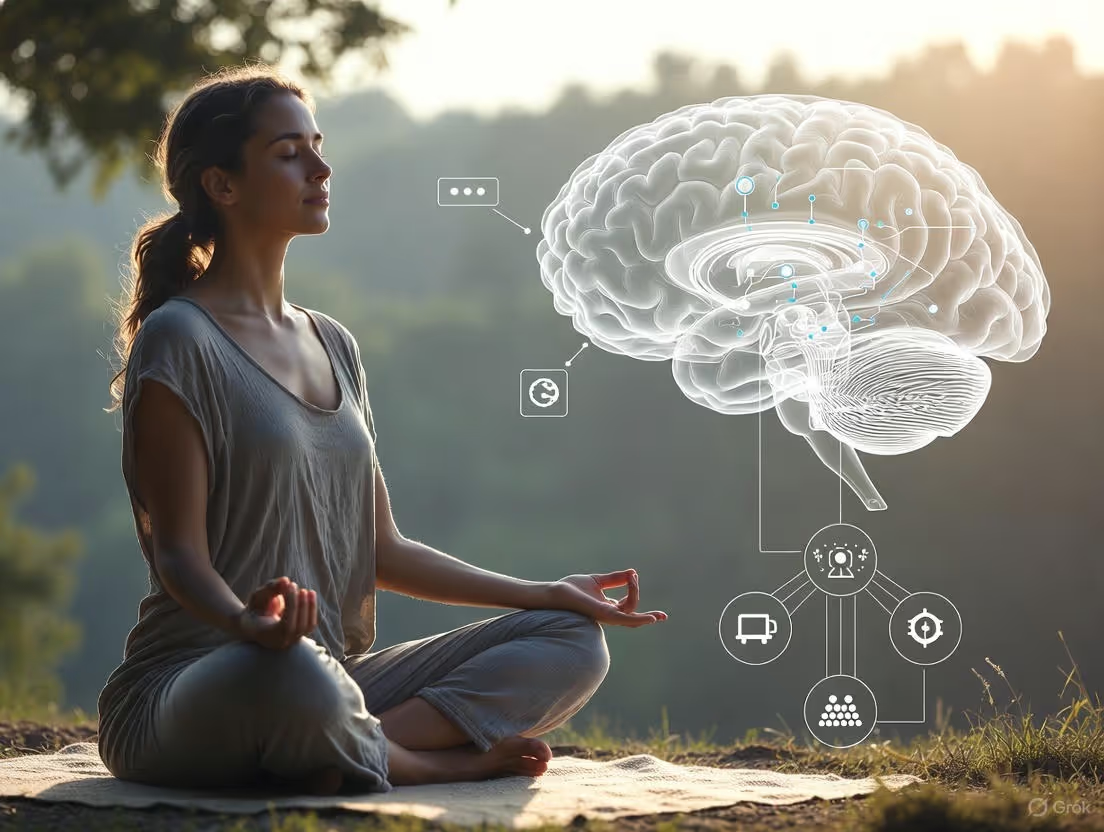
Modern neuroscience offers a fascinating lens through which to view the guided vs. unguided dichotomy. Functional MRI (fMRI) and EEG studies show that these two modes of practice engage and train the brain in distinctly different, though complementary, ways.
Guided Practice and the Focused Attention Network. When you follow a guide’s instructions—"feel the breath here," "notice the sounds around you"—you are primarily strengthening the brain’s focused attention network. This network, centered in the prefrontal cortex and the anterior cingulate cortex, is your brain’s CEO. It’s responsible for top-down, goal-directed focus. Each time your mind wanders and the guide’s voice brings you back, you are performing a "rep" for this neural circuitry. You’re literally building the muscle of concentration and cognitive control. This is incredibly beneficial for our distraction-plagued minds and is linked to improved performance on tasks requiring sustained attention.
Unguided Practice and the Default Mode & Salience Networks. In silent, self-directed practice, especially open monitoring or "choiceless awareness," a different set of networks takes center stage. The default mode network (DMN), often active during mind-wandering and self-referential thought, becomes an object of observation itself. Instead of getting lost in its narrative (the DMN’s usual program), you learn to witness its activity with detachment. Simultaneously, the salience network, which acts as a switch between the DMN and the focused attention network, becomes more efficient. It gets better at detecting what is important among internal signals (e.g., "that’s just a thought," "this is a moment of sadness") without triggering a full-blown reactive story.
The Long-Term Rewiring: Neuroplasticity in Action. Over time, both practices contribute to structural changes. They can increase gray matter density in the prefrontal cortex (enhancing regulation) and the hippocampus (supporting memory and emotional context), while decreasing the size and reactivity of the amygdala, the brain’s fear center. However, the pathway to these changes differs. Guided practice might lead there via the disciplined road of focused attention, while unguided practice might take the winding path of panoramic awareness and equanimity.
Think of it this way: Guided practice is like targeted weight training for your "attention bicep." Unguided practice is like learning the fluid, responsive movements of a martial art, where you must sense and adapt to an ever-changing flow of internal stimuli. Both make you stronger, but they develop different kinds of strength. Understanding this can help you choose a practice based on your neural goals—do you need more focused control, or more receptive, panoramic awareness?

You’ve read the science, understood the definitions, and felt the intuitive pull toward one path or the other. But if you’re brand new, where do you actually begin? The sheer volume of apps, techniques, and advice can create a "wellness paradox": the quest to reduce stress becomes a source of it.
The Almost Universal Rule: Start with Guidance. For approximately 95% of beginners, the most effective and sustainable entry point is a structured, guided program. Why? Because the novice mind doesn’t yet know what it’s looking for or how to handle what it finds. Trying to sit in silence from day one often leads to frustration, as the untrained mind quickly becomes a storm of planning, remembering, and judging. A guided program provides a clear on-ramp. It manages expectations, offers encouragement, and delivers small, digestible victories that build motivation.
Choosing Your First Guide. Not all guidance is created equal. Look for:
The 30-Day "Learning the Ropes" Experiment. Commit to a very short, guided daily practice (5-10 minutes) for one month. The goal is not enlightenment, but consistency and familiarization. Use this time not just to follow along, but to actively learn the techniques: How does the teacher direct the breath? How do they suggest handling distractions? This period is your foundational training course.
The Role of Objective Feedback. As a beginner, it’s hard to know if you’re "doing it right." This is where biometric feedback can be a game-changer. Wearing a device like an Oxyzen smart ring during your practice can show you tangible, physiological results. Did your heart rate drop and your HRV increase during that 10-minute guided session? Seeing that data provides powerful reinforcement, proving that the practice is working on a biological level, even if your mind felt busy. It turns an abstract experience into a measurable one, fueling your commitment. You can learn more about how this technology works to support your early journey.
The beginner’s phase is about building a positive association with the practice itself. It should feel like a welcome respite, not a chore. Guidance is the most reliable way to cultivate that association.
There is no official certificate for graduating from guided to unguided practice. The shift is a gradual, often intuitive, process. You’ll know you’re entering the transition zone when guided sessions start to feel, at times, slightly restrictive or distracting. The voice that was once a lifeline might begin to feel like an interruption to a deeper silence you’re starting to touch.
Signs You Might Be Ready to Explore Silence:
How to Make the Leap (Gently): Abandoning guidance cold turkey can be jarring. Instead, try a phased approach:
Managing the New Challenges. Your first pure silent sits will likely be confronting. Without the external anchor, the mind’s activity can feel magnified. This is normal. The key is to adjust your success metrics. In guided practice, success might be "following the voice." In unguided, success is simply noticing—noticing you’re lost, noticing impatience, noticing a moment of quiet. The act of noticing itself is the practice. It can be helpful to keep a brief journal post-sit, not to analyze, but to note patterns: "Today was very restless," or "Felt a deep calm for a few breaths." Over time, this builds your unique map of your inner world.
This transition is a deeply personal rite of passage. It’s where you move from practicing a technique to developing a relationship with your own consciousness. For inspiration on how others have navigated their own wellness transitions, the Oxyzen story shares a foundational journey of turning personal insight into a tool for others—a metaphor for your own path from guided learning to self-directed mastery.
We cannot discuss modern calm practices without addressing the elephant in the room: technology. It is often cast as the villain in our stress narrative, yet it also holds the potential to be a powerful ally in our quest for peace. The key lies in intentional, non-addictive use.
Guided Apps: The Digital Guru. Apps like Calm, Headspace, and Waking Up are the most prevalent form of guided practice today. Their benefits are immense: unprecedented accessibility, vast libraries for every need (anxiety, sleep, focus), and structured courses. They democratize mindfulness, putting a teacher in your pocket. However, the risk is turning practice into another item to check off, or getting lost in the endless search for the "perfect" track. The technology should serve the practice, not the other way around.
Biometric Feedback: The Mirror of Your Nervous System. This is where wearable technology, like advanced smart rings, transforms the landscape. Devices that track HRV, sleep stages, resting heart rate, and stress biomarkers provide something previously inaccessible: objective, real-time feedback on your inner state.
The Danger of Quantification. The pitfall is becoming obsessed with the metrics, a state sometimes called "data anxiety." If your HRV dips after a day you felt great, it can cause confusion or self-doubt. It’s vital to remember that biometrics are one data point, not the full truth of your experience. They are best used as a compassionate guide, not a harsh judge. The mission behind tools like Oxyzen is often to provide this kind of insightful, non-judgmental feedback—to empower your intuition with information, not to replace it.
Ultimately, technology in calm practices should act as a scaffold. It provides structure (guidance), offers reflection (feedback), and then, ideally, recedes into the background as your own internal wisdom becomes the primary guide.
Beyond goals and experience, your innate personality and preferred learning style play a decisive role in which practice will feel more natural, effective, and sustainable. Forcing a square-peg practice into a round-hole personality is a recipe for abandonment.
The "Novice Navigator" vs. The "Independent Explorer."
The "External Processor" vs. The "Internal Processor."
Sensory Preferences Matter.
There is no "right" personality for mindfulness. The field is big enough for all types. The work is one of self-honesty. Are you choosing a practice because it’s trendy, or because it genuinely suits the way your mind works? Sometimes, the best practice is the one you’ll actually do consistently. If you’re unsure of your style, our FAQ page addresses common questions about starting a practice that aligns with different lifestyles and preferences, which can be a helpful starting point for self-reflection.
Your ideal practice is not a fixed setting but a dynamic tool. Even the most devoted silent meditator might turn to a guided sleep story after a traumatic day. The most app-reliant beginner might find themselves naturally watching their breath while stuck in traffic. Wisdom lies in matching the practice to the context of the moment.
When Guided Practices Shine:
When Unguided Practices Are Ideal:
Think of your calm practice toolkit as having both a precision scalpel (unguided, for specific, deep work) and a broad, comforting blanket (guided, for general soothing and support). The most adept practitioners learn to reach for the right tool intuitively. They might use their smart ring’s stress score to decide: "My readiness is low today; I’ll use a 10-minute guided recovery." Or, "I’m feeling balanced and alert; it’s a good day for a 30-minute silent sit." This contextual approach ensures your practice remains a living, responsive part of your life, not a rigid dogma.
No path is without its obstacles. Awareness of these common pitfalls isn’t meant to discourage you, but to inoculate you against disillusionment. Knowing that struggle is part of the process allows you to meet it with curiosity rather than frustration.
The Guided Practice Traps:
The Unguided Practice Challenges:
Recognizing these pitfalls is the first step in navigating them. They are not signs you’re doing it wrong; they are the very terrain you’re learning to traverse. Each time you notice passive listening or a harsh self-judgment, you’re given an opportunity to course-correct, deepening your skill and self-understanding.
The guided vs. unguided debate is not a war with two sides; it’s a spectrum. The most sophisticated and responsive personal practices often live in the fertile middle ground, artfully blending both elements. This hybrid model leverages the strengths of each while mitigating their weaknesses.
Why Hybridize?
The hybrid approach recognizes that your needs change daily. It embraces guidance as a tool for learning, recalibration, and deep healing, while honoring silence as the space for integration, autonomy, and profound discovery. It is flexible, resilient, and personalized.
Effective Hybrid Frameworks:
The "Coach and Athlete" Metaphor: Think of guided practices as your coaching sessions—times for technical instruction, strategy, and motivation. Unguided practices are your independent training sessions—where you build endurance, apply the techniques, and develop your own style. You need both to excel.
Adopting a hybrid model requires you to become the CEO of your own well-being, making conscious choices rather than running on autopilot. It’s a dynamic, engaged relationship with your inner life. For ideas on how to structure such an approach, exploring related articles on our blog can provide practical schedules and user-tested frameworks.
As your practice matures, you can begin to wield guided and unguided techniques with precision, selecting them like specialized instruments to achieve specific psychological and physiological outcomes.
For Deep Healing and Trauma-Informed Work:
For Cultivating Peak Focus and Flow States:
For Emotional Regulation and Working with Difficult Emotions:
For Enhancing Creativity and Problem-Solving:
For Physical Recovery and Sleep Optimization:
A calm practice is not a project with an end date. It is a lifelong relationship with your own consciousness—one that will evolve as you do. The guided/unguided dynamic is not static; it will shift across the seasons of your life.
The Evolution of a Practice:
Adapting to Life’s Seasons:
The Role of Community and Teachers: Even the most seasoned practitioners benefit from community (sangha) and teachers. Attending a group sit provides the shared energy of collective practice. Periodic retreats or workshops with a teacher can offer profound course corrections, answer deep questions, and reinspire your commitment. This reflects a core value often found in a company’s mission—the belief that while the journey is personal, we don’t have to walk it alone. You can read about the community-focused vision that inspires many wellness tools today.
The long game is about faithfulness, not perfection. It’s about showing up for yourself with curiosity again and again, whether led by a gentle voice or by the vast, silent intelligence of your own being. The path itself becomes the teacher.
Theory is valuable, but wisdom comes from direct experience. The only way to truly know which balance of guided and unguided practice is right for you is to conduct your own personal, mindful experiment. Here is a structured, 6-week framework to do just that.
The Hypothesis: "By systematically testing different modes of practice, I will discover which blend most effectively reduces my subjective stress and improves my objective biomarkers of recovery."
Materials Needed: A journal, a timer, access to a few high-quality guided resources, and if possible, a biometric tracker like an Oxyzen ring for objective data.
The 6-Week Protocol:
Weeks 1 & 2: The Guided Immersion
Weeks 3 & 4: The Silent Immersion
Weeks 5 & 6: The Hybrid Creation
Analyzing Your Results:
After 6 weeks, review your journal and data. Look for patterns.
There are no failing grades in this experiment. Every data point—the restless sit, the frustrating day, the moment of perfect clarity—teaches you about your mind. This empirical, self-compassionate inquiry is the heart of a genuine practice. For common questions that arise during such self-experimentation, our comprehensive FAQ can be a helpful support resource.
Armed with knowledge, how do you make the right choice in the moment? This decision matrix is designed to cut through indecision and provide clear, situational guidance. Think of it as your first-aid kit for inner turbulence.
Scenario 1: "I'm Overwhelmed and My Mind is Racing."
Scenario 2: "I Feel Stuck in a Creative or Professional Rut."
Scenario 3: "I'm Preparing for Sleep or Need Physical Recovery."
Scenario 4: "I Want to Build Mental Discipline and Focus."
Scenario 5: "I'm a Complete Beginner and Feel Intimidated."
Scenario 6: "My Practice Feels Stale and Routine."
The true measure of a calm practice is not what happens during your dedicated session, but how it transforms the other 23 hours of your day. Integration is the art of weaving mindful awareness into the fabric of your ordinary life.
Micro-Practices (The Unguided Thread): These are seconds-long moments of unguided awareness that act as reset buttons.
Ritual Anchors (The Guided/Structured Thread): Pairing a short guided practice with a daily habit creates a powerful ritual.
Technology as an Integration Partner: Your biometric wearable isn't just for formal practice; it's an integration coach.
Integration removes the dichotomy between "practice time" and "life time." It fosters a background of awareness from which you can live more responsively, rather than reactively. The ultimate goal is for the calm, clear presence you cultivate in silence or with guidance to become your default operating system.
Knowledge and good intentions often crumble against the wall of daily life. The final, most profound challenge is not starting, but continuing. Here are strategies to build a practice that endures.
1. Redefine "Practice." Break free from the all-or-nothing mindset. One minute of mindful breathing counts. A single conscious pause counts. Consistency over time is infinitely more valuable than perfect, lengthy sessions that happen sporadically. A missed day is not a failure; it's data. Just restart.
2. Anchor to a Keystone Habit. Link your practice to an existing, non-negotiable habit (a "keystone habit"). The strongest anchors are "after I wake up and use the bathroom" or "after I brush my teeth at night." The existing habit acts as the trigger, reducing decision fatigue.
3. Embrace the "Minimum Viable Practice" (MVP). Define the absolute smallest version of your practice you can do on your worst, busiest, most resistant day. It might be "one conscious breath" or "a 90-second guided track." Commit to doing your MVP daily. On better days, you'll naturally do more, but the MVP keeps the chain unbroken.
4. Cultivate Self-Compassion, Not Self-Judgment. The voice that says, "You failed because you missed two days," is the very voice your practice is meant to help you relate to differently. Treat yourself as you would a good friend learning a new skill—with encouragement and kindness. This compassionate inner climate is the only one in which long-term growth can flourish.
5. Reconnect to Your "Why" Regularly. Write down your core reasons for practicing. Is it to be a more patient parent? A more focused professional? To manage anxiety? To simply experience more joy? Keep this "why" visible. When motivation wanes, revisit it. This connects your practice to your deepest values, transforming it from a chore into an act of self-honoring.
6. Seek Community and Shared Inspiration. We are social creatures. Joining a local meditation group, an online community, or simply sharing your journey with a friend creates accountability and normalizes the struggles. Learning about the broader mission and community behind wellness tools can also reinforce your sense of being part of a collective journey toward well-being.
Sustained practice is a gentle, persistent returning. It's the commitment to coming home to yourself, day after day, whether you arrive via a guided path or a silent one.
Having dissected the two paths, we must now reassemble them into a unified whole. The most mature perspective sees guided and unguided not as opposing choices, but as complementary voices in an ongoing, dynamic dialogue with your own awareness.
Guidance is the voice of learning, support, and skillful means. It is the wisdom of others, internalized. It is the compassionate friend, the skilled teacher, the map when you are lost. It says, "Try this," "Notice that," "It's okay."
Silence is the voice of being, knowing, and inherent wisdom. It is your own deepest intelligence, emerging. It is the raw data of direct experience, the space where true integration happens, the inner teacher that speaks in feelings, sensations, and intuitions.
Your practice life is the art of listening to both. Some days, you need to actively call upon the voice of guidance. Other days, you need to courageously sit and listen to the silence until it reveals its wisdom. The balance shifts like breath itself—sometimes an intentional inhale (guided), sometimes a releasing exhale (unguided).
This dynamic dialogue is the essence of a resilient inner life. It means you are never without resources. In a moment of panic, you have a technique (guided) to apply. In a moment of wonder, you have the capacity (unguided) to fully inhabit it without filter.
If you take one thing from this extensive exploration, let it be this: You already possess everything you need to cultivate calm. The question is not if you can do it, but how you will best learn to access what is already within you.
Let your practice be alive, curious, and forgiving. Let it be informed by science, enriched by technology, and guided by your own direct experience. Use tools like biometric feedback from Oxyzen not as a scorecard, but as a conversation with your body—a way to understand how different forms of practice affect your unique physiology.
The journey to calm is the journey home to yourself. It is the most important work you will ever do, because it forms the foundation from which you experience everything else in your life. Whether you walk the path with a guide or in sacred silence, each step taken with intention is a step toward a more centered, resilient, and vibrant you.
Your Trusted Sleep Advocate: Sleep Foundation — https://www.sleepfoundation.org
Discover a digital archive of scholarly articles: NIH — https://www.ncbi.nlm.nih.gov/
39 million citations for biomedical literature :PubMed — https://pubmed.ncbi.nlm.nih.gov/
Experts at Harvard Health Publishing covering a variety of health topics — https://www.health.harvard.edu/blog/
Every life deserves world class care :Cleveland Clinic - https://my.clevelandclinic.org/health
Wearable technology and the future of predictive health monitoring :MIT Technology Review — https://www.technologyreview.com/
Dedicated to the well-being of all people and guided by science :World Health Organization — https://www.who.int/news-room/
Psychological science and knowledge to benefit society and improve lives. :APA — https://www.apa.org/monitor/
Cutting-edge insights on human longevity and peak performance:
Lifespan Research — https://www.lifespan.io/
Global authority on exercise physiology, sports performance, and human recovery:
American College of Sports Medicine — https://www.acsm.org/
Neuroscience-driven guidance for better focus, sleep, and mental clarity:
Stanford Human Performance Lab — https://humanperformance.stanford.edu/
Evidence-based psychology and mind–body wellness resources:
Mayo Clinic — https://www.mayoclinic.org/healthy-lifestyle/
Data-backed research on emotional wellbeing, stress biology, and resilience:
American Institute of Stress — https://www.stress.org/


