


The Hidden Smart Ring Benefits No One Talks About (Until Now)
The lesser-known advantages of smart rings that people discover later.
The lesser-known advantages of smart rings that people discover later.
%402x.svg)
We live in a world obsessed with optimization. From morning routines to sleep hygiene, we relentlessly track our steps, monitor our heart rates, and quantify our every move. The smartwatch, strapped to our wrist, became the universal symbol of this quantified self-movement—a constant, buzzing companion nudging us to stand, move, and breathe. But for a growing number, this digital companion has started to feel less like an assistant and more like a taskmaster, a source of constant notifications and digital noise.
In the quiet space left by this growing wearable fatigue, something new is taking shape. It’s not worn on the wrist, but on the finger. It has no screen to light up in a dark theater, no vibrations to interrupt a thoughtful moment. This is the smart ring, and its rise is about more than just a smaller gadget. It represents a fundamental shift: from loud, demanding health tracking to quiet, insightful health understanding. While you may know it tracks sleep and steps, the most profound advantages of this technology are the ones nobody’s talking about. They are the hidden benefits that redefine your relationship with your own body, your technology, and your daily peace.
The smart ring is the antidote to the “always-on” wearable culture. While smartwatches are often designed to be a primary device for your wrist, requiring daily charging and acting as a notification hub, smart rings are purposefully different. They are engineered to be an effortless, secondary source of truth about your physiology, designed for seamless, 24/7 wear to gather a complete picture of your health.
Consider this: global shipments of smart rings more than doubled from 2023 to 2024, soaring from 850,000 to 1.8 million units, and are projected to hit over 4 million for the full year 2025. People aren’t just buying another gadget; they are voting for a different experience—one of discretion, comfort, and deeper insight.
This isn't about choosing sides in a tech war. It’s about uncovering a layer of wellness intelligence that has been missing. This is an exploration of the hidden world of smart ring benefits—the psychological shifts, the unseen data goldmines, and the subtle ways this tiny device can create monumental changes in how you live, work, and rest.

The first and most profound hidden benefit of a smart ring isn’t about data at all. It’s about cognitive liberation. Most wearable technology operates on a principle of engagement. It wants your attention. It buzzes with texts, glows with notifications, and flashes reminders to stand up. This creates a constant, low-level dialogue between you and your device, fragmenting your focus and adding to the digital clutter of modern life.
A smart ring inverts this model. Its core design principle is passive, screen-free monitoring. With no display to check, it collects data in the background, completely silently. You are not meant to interact with it during the day. This transforms it from a digital interlocutor into a silent observer.
This shift has powerful psychological consequences:
The result is what industry experts call a tool for those experiencing "digital fatigue". In a 2024 consumer study, nearly half of Europeans felt they spent too much time on screens, a concern especially acute among younger users. The smart ring offers a path to reclaiming that attention and time, proving that sometimes, the most powerful technology is the kind you can ignore.
If the psychological benefit is about what you don’t notice, the next is about a data source you’ve likely never considered: the unique vascular access point of your finger. This is where smart rings move from convenient to clinically insightful.
While smartwatches take readings from the wrist, smart rings leverage the rich network of capillaries in your fingertip. This location offers a stronger, cleaner signal for key optical sensors. The primary technology at work is Photoplethysmography (PPG), which uses light to measure blood volume changes. Simply put, the ring shines a light (often green or infrared) into your skin and measures how much is absorbed. More blood absorbs more light, allowing the device to detect each heartbeat with remarkable precision.

The consistent, snug fit of a ring on your finger provides distinct advantages for health monitoring:
This isn't just theoretical. Advanced rings are already capable of sleep apnea detection with accuracy rates as high as 90.7%, analyzing overnight SpO2 and breathing patterns to flag potential issues. For heart health, the continuous tracking of HRV—a key marker of your nervous system’s resilience—provides a direct window into your stress and recovery state that is often more sensitive than wrist-based readings.
By leveraging the unique physiology of the finger, the smart ring transforms from a simple activity tracker into a guardian of your foundational health metrics, operating with a level of quiet precision that was previously the domain of clinical equipment.
Most wearables tell you how you slept. The hidden intelligence of a smart ring lies in its ability to tell you why you slept that way, by connecting your sleep to your body’s master clock: your circadian rhythm.
Your circadian rhythm is the approximately 24-hour cycle that regulates not just sleepiness and wakefulness, but also hormone release, body temperature, digestion, and even gene expression. Smart rings, through 24/7 wear, are uniquely positioned to map this rhythm by tracking two key biomarkers:
By synthesizing this data, advanced smart ring algorithms don't just give you a sleep score; they paint a picture of your circadian alignment.
Understanding your circadian rhythm unlocks benefits far beyond better sleep:
This transforms the ring from a sleep tracker into a circadian coach. It moves the focus from a single night's performance to the overall health of your daily biological rhythm, offering insights that can improve metabolic health, mood, and cognitive function across your entire day, not just your night.
In a professional setting, a buzzing smartwatch is more than an annoyance—it can be perceived as a distraction, a sign of divided attention, or simply unprofessional. This is where the smart ring’s hidden benefit of absolute discretion becomes a powerful professional tool.
A smart ring is practically invisible. It doesn't light up during a client presentation. It doesn't vibrate on your wrist as you shake an investor's hand. It allows you to maintain a polished, focused appearance while continuing to gather invaluable data about your physiological state throughout the workday.
This discreet operation allows you to measure what was previously unmeasurable in a professional context: your biological response to work.
The ring becomes a personal biofeedback device for the workplace, providing a private, data-driven understanding of your performance, resilience, and burnout risk. It empowers you to manage your energy and stress proactively, not reactively, turning personal wellness into a professional superpower—all without a single notification to give you away.

Fitness trackers excel at telling you what you did today. The transcendent hidden benefit of a smart ring is its capacity to tell you who you are over months and years. It builds a longitudinal health map—a living document of your physiology that becomes more valuable with each day of wear.
This is possible because of the "wearability gap." Many people find smartwatches uncomfortable to wear 24/7, especially to bed, leading to inconsistent data. The comfort and simplicity of a ring close this gap. You wear it constantly, creating an unbroken stream of data that reveals trends invisible in daily or weekly snapshots.
This long-term perspective unlocks transformative insights:
This transforms health from a daily score to a continuous, evolving story. It empowers you with a form of preventative self-knowledge, allowing you and your healthcare provider to make decisions informed by a rich history of your personal metrics, not just a one-time measurement. This long-game approach is where the smart ring’s value compounds, making it less of a purchase and more of an investment in your future self.
A common misconception is that a smart ring seeks to replace your smartwatch. The hidden reality is more synergistic. The smart ring is emerging as the central, passive hub in a holistic health ecosystem, while other devices play more active, situational roles.
Think of it this way: your smartwatch is your daytime active companion for workouts, notifications, and GPS. Your smart ring is your 24/7 passive guardian of core physiology, recovery, and sleep. Together, they provide a complete picture that neither could alone.
This ecosystem thinking is the forefront of wearable tech:
This vision positions the smart ring not as a competitor, but as the foundational layer of a personalized health intelligence network. It’s the always-on sensor in the background, making the entire ecosystem smarter and more attuned to your true state of well-being. To see how this vision is being built from the ground up, you can explore the philosophy behind companies dedicated to this integrated future on their our story page.
Beyond optimization and performance, one of the most socially significant yet under-discussed benefits of smart rings is their potential as discreet safety and independence devices. This application extends their value far beyond the typical tech-enthusiast demographic.
The form factor is key. A ring is a socially innocuous, ever-present item. For populations that may reject bulky "medical alert" pendants or find smartwatches confusing, a smart ring can be a graceful, empowering solution.
This benefit transforms the smart ring from a luxury wellness product into a tool for compassionate, connected care. It upholds dignity and autonomy while providing a layer of security, proving that the most powerful technology often works to give us more independence, not less.
In the world of wearables, aesthetics have often been an afterthought. The smart ring, by necessity and design, changes this. Its hidden benefit is the seamless reintegration of technology into personal adornment, making advanced health monitoring a natural part of your style, not a tech badge you wear.
Unlike a smartwatch that announces itself, a well-designed smart ring can be a sleek titanium band, a brushed metallic finish, or even ceramic. It coexists with your wedding band, your favorite watch, or other jewelry without conflict. For the first time, you don’t have to choose between tracking your health and wearing what you love.
This matters more than mere vanity:
The smart ring successfully bridges the often-wide gap between the lab and the runway. It proves that for technology to be truly integrated into our lives, it must appeal not just to our logical desire for health, but to our innate human desire for beauty and self-expression. If you're curious about how different designs and form factors can fit into various lifestyles, a visit to the testimonials page often reveals how real users incorporate these devices into their daily style.
At the heart of every hidden benefit lies a core, technical advantage: unmatched data consistency. This is the engine that makes all the other benefits possible. A smartwatch, with its screen and interactivity, is built for moments of engagement. A smart ring is built for a single purpose: to be a relentless, consistent, and accurate sensor.
The constraints of the ring form factor—no screen, limited real estate—force a focus on core sensor performance and power efficiency. This results in two major advantages over wrist-based devices:
For health insights, consistency is king. You can have the most advanced sensor in the world, but if the device is in a charger or uncomfortable to wear at night, its data is incomplete. The smart ring’s entire value proposition is built on providing that complete, unbroken data stream.
This integrity is what allows for the circadian mapping, the longitudinal health legacy, and the early-warning potential. It turns raw data into a trustworthy narrative about your body. While smartwatches offer a wider array of interactive features, the smart ring offers something potentially more valuable: a dependable, unwavering record of your physiological truth.
The wearable tech landscape, particularly in the high-end wellness sector, has increasingly shifted toward subscription-based models. You buy the hardware, but you rent the insights, with monthly fees required to access your own advanced data and personalized recommendations. This has been a point of significant friction for consumers.
A pivotal and often overlooked benefit of the burgeoning smart ring market is the democratization of data access. While the current market leader, Oura, employs a subscription, its rapid growth has catalyzed intense competition. Major players entering the space, like Samsung with its Galaxy Ring, and highly-rated alternatives like Ultrahuman and RingConn, are offering full-featured experiences with no ongoing subscription fees.
This shift is crucial because it aligns the company's success with yours in a more direct way:
This competitive pressure is fostering innovation and giving consumers power. It signals a future where advanced health monitoring and insightful analytics can be a product you own, not a service you indefinitely lease. For those weighing their options and the long-term costs, the FAQ pages of these companies are essential reading to understand exactly what is included in the purchase price.
The hidden benefits we've explored—from psychological peace to medical-grade insights—stem from a device that is worn on the body. But the logical endpoint of this journey toward seamless, continuous monitoring is technology that moves into the body. The ultimate hidden benefit of today's smart ring may be that it is preparing us culturally and technologically for the next revolution: implantable biometrics.
The smart ring is the perfect stepping stone. It normalizes the concept of 24/7 physiological data gathering. It proves the value of a continuous stream over spot checks. It makes us comfortable with the idea of a technological device as a constant, intimate companion for health.
The advantages of a subdermal implant are the ultimate extension of the ring's benefits:
While widespread consumer implantables are likely years away, the smart ring is the critical bridge. It is socializing the idea and proving the value proposition in a low-friction, reversible way. By adopting a smart ring today, you are not just buying a gadget; you are participating in the early stages of a fundamental shift in how humans will interface with technology for health—a shift from external monitors to integrated biological dashboards.
The journey through these hidden benefits reveals a clear truth: the smart ring is not a smaller smartwatch. It is a different category entirely, built on a different philosophy. It is a product of subtraction—removing screens, notifications, and complexity—to achieve a deeper form of addition: adding genuine awareness, predictive insight, and uninterrupted peace.
From liberating your mind from digital chatter to guarding your long-term health legacy; from being your invisible professional biofeedback tool to acting as a discreet guardian for loved ones; the smart ring’s value is multifaceted and profoundly personal. It represents a move away from loud, demanding quantification toward quiet, insightful qualification of your well-being.
The market's explosive growth, led by innovators and now challenged by tech giants, is a testament to this demand for a better way. As these devices become more integrated into broader health ecosystems and leverage AI for more predictive insights, their hidden benefits will only become more powerful and personalized.
This is just the beginning of the conversation. We've explored the foundational, hidden layers of value that make the smart ring a transformative tool. But the story doesn't end here. In the next portion of this deep dive, we will move from the conceptual to the utterly practical.
We will investigate the real-world accuracy of these devices: how they truly stack up against medical equipment in clinical studies, where they excel, and where prudent caution is still needed. We will provide a detailed actionable framework for interpreting your data—transforming scores and graphs into a personalized plan for better sleep, stress management, and recovery. We will also peer into the near-future pipeline of technologies, from non-invasive blood pressure monitoring to advanced fertility and hormonal insights, that will soon make these rings even more indispensable.
The quiet revolution is already on your finger, or perhaps waiting for you to discover it. It’s a shift from being told what to do by your technology, to finally understanding what your body has been trying to tell you all along. To continue exploring how this technology integrates into a holistic wellness journey, a wealth of community experiences and deeper dives await on our blog.
Before you can trust the insights, you must trust the data. The meteoric rise of smart rings has been accompanied by bold claims about their capabilities. The critical, and often unasked, question is: How accurate are they, really? The answer is nuanced, revealing a landscape where these devices excel in specific, clinically validated areas while reminding us they are powerful wellness tools, not diagnostic medical devices.
The gold standard for validation is peer-reviewed research published in scientific journals. Unlike marketing materials, these studies involve rigorous protocols that compare the ring’s sensors against certified medical equipment in controlled settings. The results paint a promising picture of reliability in core metrics.
It’s equally important to understand the limitations, which are often a function of physics and form factor.
The Verdict: For 24/7 wellness monitoring—particularly sleep quality, recovery readiness, circadian rhythm, and screening for breathing irregularities—the smart ring provides data of exceptional and clinically relevant quality. It is a prosumer health instrument, perfect for the motivated individual seeking to optimize well-being and catch early warning signs. For specific athletic performance metrics or medical diagnosis, it is a complementary tool that should be part of a broader strategy. For a deeper exploration of how specific metrics are captured and used, our blog features ongoing analysis and user guides.

You open your app and see a readiness score of 72, a sleep score of 85, a lowered HRV, and a elevated resting heart rate. What now? The hidden power of a smart ring is unlocked not by passively observing scores, but by actively interpreting the interplay between metrics. Here is a practical framework to move from data to decisive action.
Ignore the “ideal” scores promoted by the app initially. Your first month is a discovery phase. Wear the ring consistently to answer: What are my normal ranges for sleep duration, deep sleep %, resting heart rate, and HRV? This personal baseline is your single most important reference point.
Think of your key metrics as a storytelling ensemble:
Create personal rules based on your data’s story.
This framework transforms the ring from a reporter into a guide. It empowers you to have a dynamic, responsive relationship with your health, making informed daily choices based on your body’s actual state, not just your planned schedule. For common questions on interpreting specific data patterns or troubleshooting, a great resource is the comprehensive FAQ section of your device’s website.
The smart ring is not a static product. It is a rapidly evolving platform. The next wave of features, already in advanced testing or beginning to roll out, promises to deepen its role as an essential health guardian. These innovations move beyond monitoring into the realm of predictive and preventive health management.
This is the holy grail of wearable cardiology. While not yet commercially widespread on rings, several companies have published promising research on using pulse wave velocity (PWV) and pulse arrival time (PAT)—measured via the PPG sensor—to estimate blood pressure trends. The technology would allow for effortless, all-day BP monitoring, capturing the critical fluctuations that happen during sleep, stress, and exercise—data a once-a-year doctor’s visit completely misses. This could revolutionize the management of hypertension.
While direct, non-invasive glucose sensing remains a future goal, the immediate frontier is seamless integration with wearable CGMs like those from Dexcom or Abbott. Imagine your smart ring app as a unified dashboard: your overnight glucose stability is correlated with your sleep quality and HRV; a glucose spike after a meal is viewed alongside its impact on your energy levels and heart rate. This creates a powerful feedback loop for metabolic health, helping users understand the unique impact of food, sleep, and stress on their physiology.
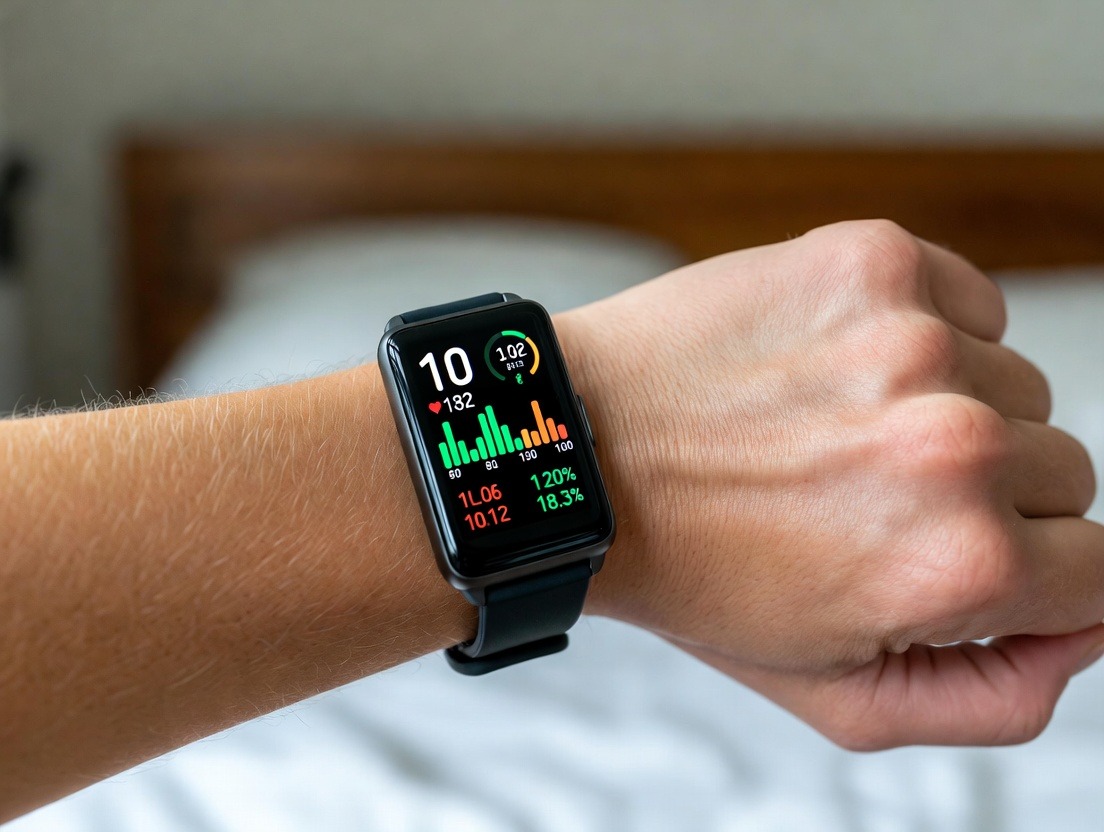
Moving far beyond simple period logging, next-gen rings are leveraging their accurate, continuous temperature data to provide highly precise ovulation confirmation and cycle insights. By detecting the subtle biphasic shift in basal body temperature that occurs after ovulation, they can confirm the fertile window has passed. This data, combined with HRV and sleep metrics, can also provide insights into cycle-related changes in energy, recovery capacity, and mood, empowering women to tailor training, nutrition, and workload across their cycle phases.
Future algorithms will go beyond HRV to analyze the shape of the PPG waveform itself. Subtle characteristics of the pulse wave can contain information about arterial stiffness, sympathetic nervous system activation, and other markers of stress and cardiovascular aging. This could lead to a more nuanced “stress resilience” score, helping users identify not just when they are stressed, but how their body is managing that stress over time.
The future lies in localized intelligence. Instead of just logging data, the ring’s onboard processor will learn your ultra-personal patterns and deliver context-aware, private nudges. A gentle vibration when it detects you’ve been in a high-stress state for 90 minutes, prompting a breathing break. A warning if it detects signs of extreme fatigue while you’re driving. This proactive, real-time guidance will make the technology feel less like a tracker and more like an intelligent guardian.
This pipeline of innovation underscores that the smart ring’s evolution is focused on depth, not distraction. Each new capability is designed to provide a clearer, more actionable window into the unseen workings of the body, fulfilling the original promise of truly personalized, preventive health. To understand the vision driving these innovations, it’s often insightful to learn about the our story and mission of the companies building them.
No single device is an island. The ultimate hidden benefit of a smart ring may be its role as the central, anchoring node in your personalized health technology ecosystem. When its continuous, passive data stream is combined with other situational devices, the resulting insights are greater than the sum of their parts.
The magic happens when all this data converges in a single health platform (like Apple Health or Google Fit). Here, AI and machine learning can begin to find cross-correlations that are impossible to see in isolation.
By building this stack, you move from one-dimensional tracking (steps, sleep) to multi-dimensional understanding. The smart ring, with its 24/7 foundational data, provides the consistent timeline upon which all other data points are placed, creating a rich, actionable biography of your health.
With options proliferating—from Oura and Circular to the new Samsung Galaxy Ring, Ultrahuman Ring Air, and RingConn—choosing the right device can be overwhelming. Beyond marketing claims, your decision should be guided by how the device’s specific attributes align with your personal priorities. Let’s break down the critical decision factors.
The right choice is deeply personal. Before deciding, immerse yourself in real user experiences. Reading detailed, long-term testimonials from people with similar lifestyles can be more revealing than any spec sheet.
As we invite these devices deeper into our lives, recording our most intimate biological rhythms, a crucial conversation emerges about ethics, privacy, and data sovereignty. The hidden benefit of control over your health narrative comes with the hidden responsibility of safeguarding it.
Your longitudinal health data—your sleep patterns, stress responses, temperature cycles—is incredibly valuable. It’s valuable to you for optimizing your life. It’s also valuable to tech companies for improving algorithms, and potentially to third parties like insurers, employers, or marketers. This creates essential questions:
The smart ring is part of a broader movement toward quantified self-sovereignty. Used wisely and with conscious privacy settings, it can be a tool that empowers you with knowledge while keeping that knowledge under your control. It’s a reminder that in the digital age, our biological data is a core part of our identity, and its stewardship is paramount.
We have navigated the paradigm shift—from the cognitive liberation of passive monitoring to the clinical validation of finger-based sensors. We have built a framework to interpret the data and surveyed the horizon of coming innovations. This knowledge is powerful, but a tool’s true test is not in its acquisition, but in its sustained, meaningful integration into the fabric of your life over months and years.
This final section addresses the long arc of ownership. How do you move beyond the initial fascination to cultivate a lasting, insightful partnership with your device? We will explore strategies to prevent disengagement, share real stories of health transformation, and finally, synthesize everything into a holistic philosophy for living with technology that serves you, not the other way around.
The “honeymoon phase” with any new wearable lasts about 3-6 months. The initial excitement of seeing your sleep scores and daily readiness can fade into data fatigue—a sense of overwhelm or indifference where the device ends up in a drawer. The hidden benefit of a smart ring is its design for longevity, but maintaining a productive relationship with it requires intentional strategy.
Sustainable engagement is about transforming the ring from a source of daily pressure into a source of periodic perspective. It’s a logbook of your life’s impact on your body, meant to be reviewed in chapters, not on every page.
Beyond optimization, the most profound value of continuous monitoring often reveals itself in unexpected, personal moments. These are not hypotheticals; they are real patterns and discoveries shared by users that highlight the ring’s role as a silent guardian.
The Pattern: A user in their 40s, physically active, noticed a gradual, sustained elevation in their resting heart rate (about 8 bpm above baseline) and a significant drop in HRV over 5 days. Their sleep scores were poor despite no change in routine. They felt “off” but not acutely ill—just unusually fatigued.
The Action & Outcome: Recognizing this as a classic biometric signature of immune system activation (fighting an infection), they took extra rest, hydrated, and monitored closely. On day 6, mild symptoms appeared. Because they had rested proactively, the illness was short-lived. They credited the early warning with preventing a more severe, prolonged sickness that might have stemmed from “pushing through.”
The Pattern: A user purchased a ring primarily for sleep tracking. The app’s SpO2 report consistently flagged moderate breathing disturbances, with blood oxygen dipping repeatedly throughout the night. They did not snore loudly and had never considered sleep apnea.
The Action & Outcome: Armed with this tangible, nightly data, they brought the reports to their doctor. A subsequent clinical sleep study confirmed moderate obstructive sleep apnea. They were fitted with a CPAP machine. The result was transformative: within weeks, their readiness scores soared, daytime fatigue vanished, and their long-term cardiovascular risk profile improved dramatically.
The Pattern: A female user tracking her cycle noticed that her baseline temperature and HRV patterns began to shift subtly month-over-month in her mid-30s. The ring’s cycle predictions became less regular. The data provided a clear, graphical representation of perimenopausal transition.
The Action & Outcome: This objective record allowed her to have a precise, informed conversation with her gynecologist about her hormonal health, leading to tailored lifestyle and supplement strategies to manage the transition smoothly, years before more disruptive symptoms might have appeared.
These stories underscore a critical point: the smart ring’s greatest gift is often objectivity. It provides an unbiased, physiological truth that can cut through the fog of “feeling fine” or normalize unexplained symptoms, empowering users to advocate for their health with concrete evidence. For more firsthand accounts of how this data impacts real lives, exploring a company’s testimonials page can be both inspiring and enlightening.
After dissecting its components, we must reassemble the whole. The ultimate hidden benefit of the smart ring is its potential to foster a more attuned, balanced, and intentional way of living. It is not a goal in itself, but a compass.
The smart ring, at its best, embodies calm technology—a concept coined by PARC researchers Mark Weiser and John Seely Brown describing tech that informs but doesn’t demand. It engages the periphery of our attention and only moves to the center when crucial. To integrate it mindfully:
In this synthesis, the smart ring finds its highest purpose: as a tool for self-knowledge and self-compassion. It helps you craft a life that respects your biology, so you have more energy, focus, and health to invest in what truly matters to you. To delve deeper into the philosophy behind creating technology that serves human well-being in this way, the about us pages of pioneering companies often articulate this mission clearly.
Our exploration of the hidden smart ring benefits has taken us from the micro-details of photoplethysmography to the macro-questions of how to live a good life with technology. We’ve uncovered that its value is not found in any single feature, but in the synergistic effect of its design, its data, and its philosophy.
It is the benefit of quiet over noise. In a world of constant alerts, it offers insight without interruption.
It is the benefit of depth over breadth. It forgoes a thousand apps to master a few, profound biomarkers.
It is the benefit of the long-term view over the daily grind. It values the trend of a year over the score of a day.
It is the benefit of empowerment over dependency. It aims to make you the expert on your own body, fluent in its unique language.
The smart ring represents a mature step in personal technology. It is not about doing more, but about understanding better. It provides a missing feedback loop in modern life, connecting our daily choices to their invisible, biological consequences.
As this category evolves—with more players, more advanced sensors, and smarter AI—the core promise will remain for those who choose to engage deeply: a chance to move from guessing about your health to knowing, from pushing blindly to recovering wisely, and from being a passenger in your body to becoming its skilled navigator.
The revolution is indeed quiet. It doesn’t buzz on your wrist. It simply rests on your finger, listening intently to the story your body is telling, and waiting patiently for you to discover what it has to say.
The journey through these hidden benefits reveals a clear truth: the smart ring is not a smaller smartwatch. It is a different category entirely, built on a different philosophy. It is a product of subtraction—removing screens, notifications, and complexity—to achieve a deeper form of addition: adding genuine awareness, predictive insight, and uninterrupted peace.
From liberating your mind from digital chatter to guarding your long-term health legacy; from being your invisible professional biofeedback tool to acting as a discreet guardian for loved ones; the smart ring’s value is multifaceted and profoundly personal. It represents a move away from loud, demanding quantification toward quiet, insightful qualification of your well-being.
The market's explosive growth, led by innovators and now challenged by tech giants, is a testament to this demand for a better way. As these devices become more integrated into broader health ecosystems and leverage AI for more predictive insights, their hidden benefits will only become more powerful and personalized.
This is just the beginning of the conversation. We've explored the foundational, hidden layers of value that make the smart ring a transformative tool. But the story doesn't end here. In the next portion of this deep dive, we will move from the conceptual to the utterly practical.
We will investigate the real-world accuracy of these devices: how they truly stack up against medical equipment in clinical studies, where they excel, and where prudent caution is still needed. We will provide a detailed actionable framework for interpreting your data—transforming scores and graphs into a personalized plan for better sleep, stress management, and recovery. We will also peer into the near-future pipeline of technologies, from non-invasive blood pressure monitoring to advanced fertility and hormonal insights, that will soon make these rings even more indispensable.
The quiet revolution is already on your finger, or perhaps waiting for you to discover it. It’s a shift from being told what to do by your technology, to finally understanding what your body has been trying to tell you all along. To continue exploring how this technology integrates into a holistic wellness journey, a wealth of community experiences and deeper dives await on our blog.


