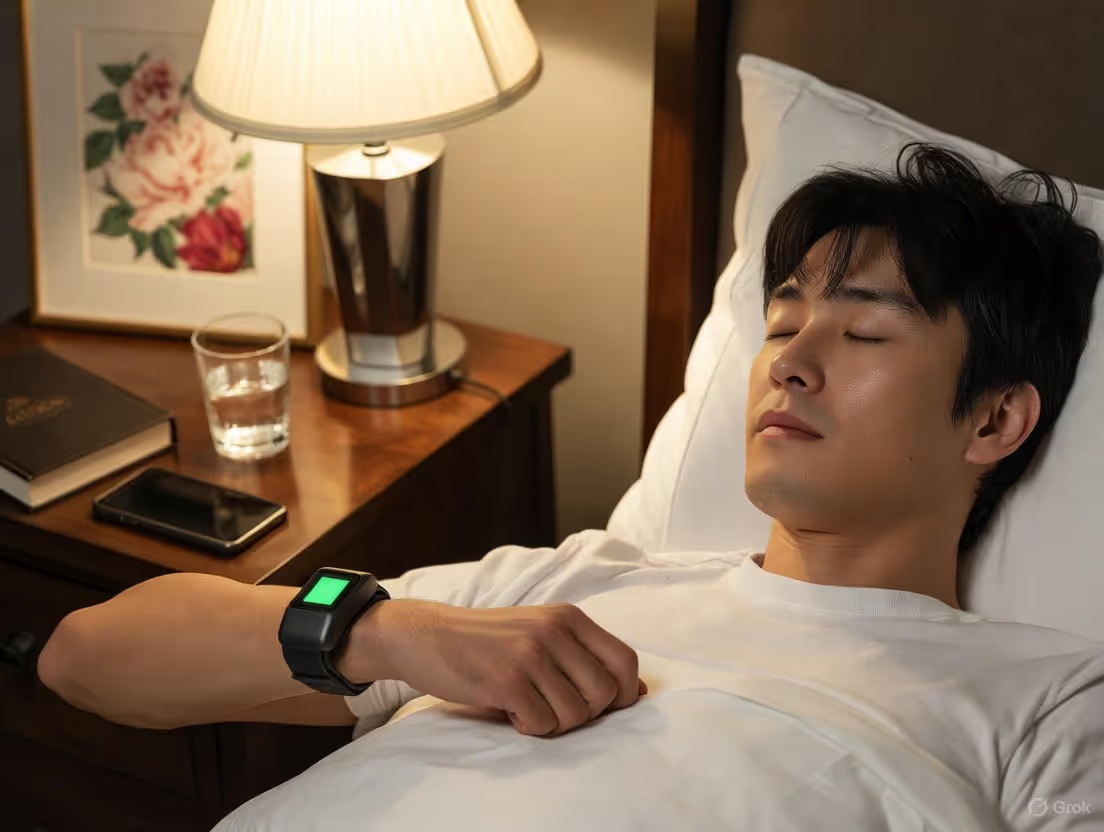
To honor your natural pattern in a rigid work world, use light therapy, negotiate flexible hours if possible, and protect your sleep time as non-negotiable.
How to Honor Your Sleep Pattern in a 9-to-5 World
In the silent, dark hours before dawn, a ritual repeats itself in millions of homes: the blare of an alarm, a groan of protest, and the slow, heavy ascent from warmth into the day. You are not just waking up; you are tearing yourself away from a biological process that was, quite literally, incomplete. For many, the modern 9-to-5 structure isn't just a schedule—it’s a straitjacket for our innate sleep patterns, a constant source of friction between our evolutionary design and societal demands. We chug caffeine to override our body’s signals, stare at screens that confuse our internal clocks, and wear our sleep deprivation like a badge of busy honor. Yet, we wonder why we’re drained, foggy, and perpetually out of sync.
This isn’t merely about getting “eight hours.” It’s about chronotype—your personal, genetic blueprint for sleep and wakefulness. Are you a lion, alert at sunrise? A wolf, who finds peak creativity at midnight? Or perhaps a bear, following the solar cycle? The rigid 9-to-5 world is built for lions, leaving wolves and even many bears in a state of chronic misalignment, known as social jet lag. The cost is staggering: impaired cognition, weakened immunity, heightened stress, and a profound disconnect from your natural rhythm.
But what if you could negotiate a truce? This article is your guide to doing exactly that. We will move beyond generic sleep hygiene tips and delve into a holistic strategy for harmonizing your inherent sleep pattern with the necessities of modern life. This isn’t about quitting your job; it’s about leveraging science, technology, and behavioral nuance to claim ownership of your rest. We’ll explore the foundational biology of sleep, decode your unique chronotype, and provide actionable, sustainable tactics—from strategic light exposure and caffeine timing to environmental engineering and the strategic use of cutting-edge technology like the Oxyzen smart ring. The goal is to transform your sleep from a recurring battle into a honored ritual, empowering you to live, and work, in closer alignment with who you truly are.
The Tyranny of the Alarm Clock: Why Your 9-to-5 Is at War with Your Biology
The alarm clock is the most universally obeyed dictator on the planet. Its decree marks a daily, artificial sundown for our natural circadian rhythms. To understand why this simple device represents such a profound conflict, we must go back—way back. For hundreds of thousands of years, human sleep-wake cycles were governed by the sun, temperature, and community—not by Greenwich Mean Time or a manager’s meeting schedule.
Our internal master clock, a tiny cluster of neurons in the hypothalamus called the suprachiasmatic nucleus (SCN), evolved to synchronize with the 24-hour light-dark cycle. At dawn, even through closed eyelids, specific photoreceptors in our eyes detect increasing blue-light wavelengths. This signal hits the SCN like a starter’s pistol, halting the production of melatonin (the sleep hormone) and triggering a cascade of cortisol and other alertness-promoting chemicals. Conversely, dusk’s red-hued light and dropping temperature cue the SCN to wind down alertness and initiate the melatonin release that guides us into sleep. This system is exquisitely tuned and, crucially, highly individual. Your genetic chronotype dictates the precise timing of this rhythm.
The industrial revolution and the subsequent invention of the electric light began the great uncoupling. We gained productivity but severed our tether to the sun. The modern 9-to-5 workday, solidified in the 20th century, was an economic and administrative convenience, not a biological one. It assumes a one-size-fits-all rhythm that simply doesn’t exist. When a natural “night owl” (or late chronotype) is forced to wake at 6:00 AM for a commute, they are essentially being roused during their biological night. Their melatonin levels may still be high, core body temperature at its lowest, and cognitive function profoundly impaired. This is social jet lag, and its effects are comparable to flying across multiple time zones every single weekend, only to fly back on Friday night.
The consequences are systemic. Studies consistently link chronic social jet lag to:
A 33% higher risk of obesity and metabolic disorders, as hunger hormones like ghrelin and leptin become dysregulated.
Significantly increased risk for depression and anxiety.
Impaired immune function, leaving you more susceptible to infections.
A measurable decline in cognitive performance, memory consolidation, and creativity.
Chronic, low-grade inflammation, a precursor to numerous diseases.
We are not just tired; we are forcing our bodies to operate in a perpetual state of biological distress. Recognizing this conflict is the first, crucial step toward resolving it. It shifts the blame from personal failing (“Why can’t I just get up earlier?”) to a systemic mismatch, empowering you to seek personalized solutions. The journey to honoring your sleep begins with this acknowledgment: your biology is not wrong. The challenge is to build a bridge between its ancient wisdom and your modern world.
Decoding Your Inner Rhythm: A Deep Dive into Chronotypes (It’s More Than Early Bird vs. Night Owl)
“I’m a night person.” We’ve all said it. But this casual label barely scratches the surface of a complex biological profile. Chronotype is your body’s innate predisposition for the timing of sleep, activity, meals, and even cognitive peaks. It’s genetically influenced, stable in adulthood, and governs the when of your bodily processes, not just the what.
While models like Dr. Michael Breus’s “Sleep Animal” chronotypes (Bear, Lion, Wolf, Dolphin) are excellent for public understanding, the science goes deeper. Your chronotype is primarily determined by your Period (PER) genes, which influence the intrinsic length of your circadian cycle. Some people have a cycle that runs slightly shorter than 24 hours (pulling them toward earlier sleep and wake times), while others have a cycle longer than 24 hours (pushing them later). Light exposure then acts as the primary “zeitgeber” (time-giver) to entrain this cycle to the 24-hour day.
Let’s explore the key chronotypes and their real-world implications in a 9-to-5 world:
The Early Chronotype (The Lion):
Natural Rhythm: Asleep by 9-10 PM, awake by 5-6 AM without an alarm. Peak alertness and productivity occur in the morning, often fading by mid-afternoon.
9-to-5 Fit: Excellent on paper. They easily make morning meetings and are praised for their “discipline.” However, their challenge comes in the late afternoon “lion’s slump” and societal pressure for evening social or work events, which can cut into their necessary early bedtime.
Primary Conflict: Evening social obligations leading to sleep deprivation.
The Intermediate Chronotype (The Bear):
Natural Rhythm: Follows the sun. Asleep around 11 PM, awake around 7 AM. They have good energy throughout the core daylight hours but lack the extreme peaks and troughs of Lions or Wolves.
9-to-5 Fit: Good, but not perfect. The standard schedule is manageable, but they are highly dependent on consistent light cues. A week of cloudy weather or poor office lighting can leave them feeling sluggish.
Primary Conflict: Insufficient natural light exposure during the workday, especially in winter months.
The Late Chronotype (The Wolf):
Natural Rhythm: Naturally alert until midnight or later, struggling to fall asleep before then. Most restorative sleep occurs in the early morning hours (e.g., 2 AM - 10 AM). Peak mental clarity often hits in the late morning or evening.
9-to-5 Fit: Poor to terrible. The standard start time is a biological assault. They are forced to wake during deep sleep phases, resulting in profound sleep inertia (grogginess). Their most productive hours are wasted on commuting and low-focus morning routines, while their creative energy sparks just as the workday ends.
Primary Conflict: The entire morning schedule, leading to chronic sleep debt and social jet lag.
The Irregular/Variable Chronotype (The Dolphin):
Natural Rhythm: Light, anxious sleepers with fragmented sleep patterns. They often have low sleep drive and high situational awareness, making it hard to shut down. Their rhythm is less predictable.
9-to-5 Fit: Highly stressful. The pressure to conform to a rigid schedule can exacerbate anxiety, creating a vicious cycle of poor sleep.
Primary Conflict: Anxiety around sleep itself and the inflexibility of fixed wake-up times.
How do you find yours? Beyond online quizzes, the gold standard is behavioral observation. On a week-long vacation without alarms or work commitments, when do you naturally fall asleep and wake up? Track your energy and focus levels hourly. For a more precise, data-driven approach, wearable technology has revolutionized this field. A device like the Oxyzen smart ring can passively track your sleep-wake patterns, heart rate variability, and body temperature trends—offering an objective, multi-night analysis of your unique rhythm far beyond self-reporting. You can learn more about how this technology decodes personal chronobiology on our dedicated blog.
Understanding your chronotype isn’t about resignation; it’s about strategic intelligence. It tells you when to schedule your most demanding cognitive work, when to take a break, and how to structure your day for maximum harmony. It is the foundational map for the journey ahead.
Light: The Master Conductor of Your Sleep Symphony
If your circadian rhythm is an orchestra, light is its conductor. It is the single most powerful environmental cue for your SCN, and manipulating it consciously is your most effective tool for aligning your internal clock with external demands. The problem in our modern world isn’t a lack of light—it’s the wrong light at the wrong time.
The Science of Sync: Specialized cells in your retina called intrinsically photosensitive retinal ganglion cells (ipRGCs) are uniquely sensitive to short-wavelength (blue) light. When they detect it, they send a powerful “IT IS DAY” signal to the SCN, suppressing melatonin and promoting alertness. This system evolved with the sun, which emits strong blue light in the morning, transitioning to warmer, red-toned light at dusk.
Our artificial environment has turned this elegant system on its head. We spend our days indoors under dim, often blue-poor lighting, then bombard our eyes with blue-rich light from screens and LEDs in the evening. This confuses the SCN, delaying the melatonin signal and pushing your entire rhythm later—a disaster for anyone needing to wake early.
Becoming a Light Conductor: A Practical Guide
Morning (Within 30-60 Minutes of Wake-Up):
Seek Bright, Blue-Rich Light: Go outside for 10-15 minutes without sunglasses. Even on a cloudy day, outdoor light is exponentially brighter than indoor light. No time? Consider a light therapy lamp (10,000 lux) at your breakfast table or desk for 20-30 minutes.
Strategy for Wolves: This is non-negotiable. Morning light is the anchor that pulls your rhythm earlier. Pair it with a morning walk or commute with a view of the sky. Every minute counts.
Daytime (Especially 10 AM - 4 PM):
Maximize Ambient Brightness: Position your desk near a window. Take walking meetings outside. The goal is to reinforce the strength of the daytime signal.
The Office Trap: If you work in a windowless cave, advocate for brighter, cooler (bluer) overhead lighting during core hours, and seriously invest in a personal light therapy device. It’s not a luxury; it’s a biological necessity. For more insights on engineering your environment for wellness, explore our blog.
Evening (Starting 2-3 Hours Before Bed):
The Great Dim-Down: This is the flip side of the morning ritual. Begin reducing light intensity. Use lamps instead of overhead lights. Install dimmer switches.
Manage Blue Light: Enable “Night Shift” or “Night Mode” on all devices. Consider blue-light-blocking glasses (with amber or red lenses) if you must use screens. The goal is to mimic the sunset.
Bedroom Sanctity: Your bedroom should be pitch black. Blackout curtains are essential. Eliminate all standby LEDs (use electrical tape). Even small amounts of light can fragment sleep. Consider a sleep mask if perfect darkness isn’t achievable.
By curating your light exposure with this level of intention, you stop being a passive recipient of environmental chaos and become the active conductor of your own rhythm. You are giving your biology the clear, consistent cues it craves to perform at its best.
The Caffeine & Nutrition Tango: Timing Your Fuel for Better Sleep
You are not just what you eat; you are when you eat and drink. The substances we consume are powerful zeitgebers that can either synchronize or sabotage our circadian rhythms. Mastering their timing is a critical skill for sleep alignment.
Caffeine: The Double-Edged Sword Caffeine works by antagonizing adenosine receptors in the brain. Adenosine is a neurotransmitter that builds up throughout the day, creating “sleep pressure.” By blocking its receptors, caffeine masks fatigue—it doesn’t erase it. This has major implications for timing.
The Half-Life Problem: Caffeine has an average half-life of 5-6 hours. If you consume 200 mg of caffeine at 3:00 PM, about 100 mg is still active in your system at 8:00-9:00 PM, interfering with sleep onset and architecture.
The Cortisol Crutch: Drinking caffeine during your body’s natural cortisol peak (upon waking for most) is like yelling at someone who’s already shouting. It can lead to a sharper afternoon crash and blunt your body’s natural wake-up signal over time.
Smart Strategy: Wait 60-90 minutes after waking before your first cup. This allows your natural cortisol rhythm to clear adenosine, making the caffeine more effective and reducing dependency. Establish a “caffeine curfew” based on your chronotype. For most, this means no caffeine after 2:00 PM. For Wolves, who metabolize caffeine differently and later, a 4:00 PM cut-off might be possible, but experimentation with tracking is key.
Alcohol: The Sleep Saboteur Alcohol is a sedative, not a sleep aid. It may help you fall asleep faster, but it devastates sleep quality.
It suppresses REM sleep, the crucial phase for memory consolidation and emotional processing.
As it metabolizes, it causes wakefulness and fragments the second half of sleep.
It relaxes upper airway muscles, worsening snoring and sleep apnea.
Strategy: Avoid alcohol within 3 hours of bedtime. For every drink, add an extra hour buffer.
Food as a Zeitgeber: Your digestive system has its own circadian clocks. Eating at consistent times helps set these peripheral clocks, which then communicate with the master clock in the SCN.
Morning Fuel: A protein-rich breakfast within an hour of waking (after your light exposure) signals “daytime” to your metabolism. This is crucial for rhythm setting.
The Last Meal: Finish eating at least 2-3 hours before bedtime. A heavy, late meal forces your body to digest when it should be cooling down and repairing. It can also trigger acid reflux, disrupting sleep.
Macronutrient Nuance: While complex carbs at dinner can promote tryptophan uptake (a melatonin precursor), a large portion may cause discomfort. Listen to your body. A light, balanced meal is ideal.
Hydration Rhythm: Stay hydrated throughout the day, but taper fluid intake 1-2 hours before bed to minimize disruptive nighttime trips to the bathroom.
Think of your day as a nutritional symphony: a strong, alert opening movement in the morning, a sustained and balanced middle, and a gentle, quiet resolution in the evening. Every bite and sip is a note. Playing them in the right order creates harmony.
Engineering Your Environment: Building a Sleep Sanctuary
Your bedroom should be a sanctuary dedicated to one thing: restorative sleep. In a world filled with stimulation and stress, this physical space must be engineered to send an unambiguous signal to your brain and body: it is time to rest. This goes far beyond a comfortable mattress.
The Non-Negotiable Trinity: Dark, Cool, and Quiet
Pitch Blackness: As discussed, light is enemy number one for sleep onset and maintenance. Invest in high-quality blackout curtains or shades. Apply blackout film to windows if necessary. Cover or remove every tiny light source—power strips, smoke detectors, electronics. The goal is a darkness so complete you cannot see your hand in front of your face. A comfortable sleep mask is an excellent portable solution.
Optimal Temperature: Your core body temperature needs to drop by about 1-2 degrees Fahrenheit to initiate and maintain sleep. A cool room facilitates this. The consensus for most people is between 60-67°F (15.5-19.5°C). Experiment within this range. Use breathable, natural-fiber bedding (cotton, linen, bamboo). Consider a mattress cooling pad or a bed fan like the BedJet if you tend to sleep hot.
Profound Silence: Sudden noises, even those that don’t fully wake you, cause micro-arousals and fragment sleep architecture. If you can’t control noise (traffic, neighbors, a snoring partner), generate a consistent, masking sound. White noise machines, fans, or apps that play brown or pink noise (which has a deeper, more soothing sound than white noise) are incredibly effective. They create an auditory blanket that buffers against disruptive spikes.
Beyond the Basics: Sensory and Psychological Cues
Declutter the Visual Space: A cluttered room can lead to a cluttered, anxious mind. Keep surfaces clear. Make your bed each morning. The room should feel calm, orderly, and peaceful.
Scent as a Sedative: Introduce calming aromatherapy scents that you associate only with sleep. Lavender, chamomile, and sandalwood are backed by research for their relaxing properties. Use a diffuser with pure essential oils (not synthetic plugins) for 30-60 minutes before bed, then turn it off for safety.
The Tech-Free Zone: This is critical. The bedroom is not for work, scrolling, or watching thrilling TV shows. The blue light aside, these activities create mental associations of alertness and stress with your sleep space. Charge your phone in another room. If you must use it as an alarm, place it across the room, face down, in Do Not Disturb mode.
Comfort is King: Invest in the best mattress, pillows, and bedding you can afford. This is not an expense; it’s an investment in one-third of your life and the quality of the other two-thirds. Your pillow should keep your neck in a neutral alignment. The tactile feel of your sheets should be pleasant to you.
Your sleep sanctuary is a physical manifestation of your commitment to honoring your rhythm. It is a fortress against the intrusions of the 9-to-5 world. When you cross its threshold, you are telling your nervous system, “Here, you are safe. Here, you can rest.”
The Wind-Down Ritual: Programming Your Nervous System for Sleep
You cannot sprint into sleep. The transition from the sympathetic-dominant “fight or flight” state of modern life to the parasympathetic “rest and digest” state required for sleep must be guided. A consistent, intentional wind-down ritual is the bridge between these two worlds. It’s a series of cues that condition your body to expect sleep, lowering physiological arousal on a predictable schedule.
Why a Ritual Works: It leverages classical conditioning (like Pavlov’s dogs). When you repeat the same calming behaviors in the same order each night, they become powerful signals that trigger a relaxation response. This is especially vital for those with anxious minds or late chronotypes, whose bodies may still be buzzing from the day’s demands.
Building Your Personalized Ritual (60-90 Minutes Before Bed):
Phase 1: The Digital Sunset (T-90 minutes): This is your official signal to begin. It’s more than a screen setting.
Put all phones, tablets, and laptops on their chargers outside the bedroom.
If you watch TV, make it the last activity of the evening and ensure it’s at least 10 feet away with brightness minimized and a warm color filter on.
The goal is to disconnect from the flow of information, social comparison, and work emails that keep the mind in problem-solving mode.
Phase 2: The Sensory Shift (T-60 minutes):
Lower Lights: Implement the evening light strategy. Use lamps and candles (safely).
Soothing Sounds: Play calm, instrumental music, nature sounds, or an audiobook you know well (so it’s not too engaging).
Temperature Prep: Take a warm (not hot) bath or shower. The rise in core body temperature from the bath, followed by the rapid cooldown as you dry, mimics the natural pre-sleep temperature drop and is highly soporific.
Aromatherapy: Start your essential oil diffuser with a calming scent.
Phase 3: The Mind & Body Preparation (T-30 minutes):
Gentle Movement: Light stretching, restorative yoga poses (like legs-up-the-wall), or foam rolling can release physical tension. Avoid anything strenuous.
Gratitude or Reflection: Write down 3 things you were grateful for that day in a journal. Alternatively, do a “brain dump”—write down every nagging thought or to-do item for the next day to get it out of your head and onto paper.
Mindful Reading: Read a physical book (fiction or non-stimulating non-fiction) under soft light. This is active relaxation for the mind.
Phase 4: The Final Cues (In Bed):
Breathing Exercise: Practice a simple 4-7-8 breathing pattern (inhale for 4, hold for 7, exhale slowly for 8). Repeat 4-5 times. This directly stimulates the parasympathetic nervous system.
Body Scan: Starting at your toes, mentally scan your body for any areas of tension and consciously release them.
Consistency is Everything: Perform this ritual at the same time each night, even on weekends. This regularity strengthens the conditioning effect. Your ritual is a sacred contract with yourself—a daily promise that you will prioritize the transition into rest. For more ideas on crafting the perfect evening routine, our blog offers a wealth of science-backed strategies.
Leveraging Technology: How a Smart Ring Becomes Your Sleep Advocate
In the quest to honor your sleep pattern, data is your most powerful ally. Guessing at your sleep quality based on how you feel (“I slept like a rock”) is notoriously inaccurate due to a phenomenon called “sleep state misperception.” You need objective, personalized, and continuous feedback. This is where modern wearable technology, specifically the smart ring, shifts from a gadget to an essential tool for biohacking your rhythm.
Unlike wrist-worn devices, a ring like Oxyzen sits on your finger, a location with a rich capillary bed that allows for exceptional accuracy in measuring key physiological signals:
Heart Rate (HR) & Heart Rate Variability (HRV): Your nighttime HRV is a direct window into your autonomic nervous system balance and recovery status. A higher HRV generally indicates better resilience and recovery.
Body Temperature: Circadian rhythm drives a core body temperature cycle. Tracking your distal (finger) temperature trend provides profound insights into your rhythm’s timing and stability.
Blood Oxygen Saturation (SpO2): Can identify potential breathing disturbances during sleep.
Movement: Accurately differentiates between sleep stages (light, deep, REM) and wakefulness.
How This Data Honors Your Unique Pattern:
Chronotype Validation & Tracking: It moves you from a quiz-based label to a data-driven profile. The ring observes your actual sleep onset, offset, and mid-point over weeks, confirming your natural tendency and measuring the degree of your social jet lag.
The “Why” Behind the Grogginess: Did you feel awful because you went to bed late, or because you had a late meal, drank alcohol, or were stressed? The ring correlates your lifestyle inputs (which you can log in the app) with your sleep metrics. You’ll see clear graphs showing how a 4:00 PM coffee or a stressful workday directly impacted your deep sleep or HRV that night.
Personalized, Dynamic Bedtime Guidance: Instead of a generic “get 8 hours,” the Oxyzen app can analyze your recent sleep debt and current physiological state to recommend an ideal bedtime for you, on that specific night. It learns what “fully recovered” looks like for your body.
Optimizing Your Interventions: Is your new light therapy lamp working? Is shifting your caffeine curfew by 30 minutes making a difference? The data provides immediate, objective feedback, allowing you to fine-tune the strategies discussed in this article with precision. You move from generic advice to a personalized sleep optimization protocol.
The Oxyzen ring is designed for this seamless, 24/7 insight. Its long battery life and comfortable form factor mean you can wear it continuously, capturing data during workouts, workdays, and sleep without intrusion—giving you a holistic picture of your readiness and recovery. For those curious about the technology and science behind this approach, a deep dive is available on our about us page.
By wearing this technology, you are no longer a passive victim of your schedule. You become a scientist of your own body, equipped with the evidence needed to advocate for your sleep and make informed adjustments that truly work.
The Art of the Schedule: Strategically Aligning Work, Life, and Sleep
Armed with knowledge of your chronotype and data on your rhythm, you can now approach the structure of your day not as a fixed prison, but as a flexible framework to be negotiated and optimized. This is about strategic scheduling—placing your most important life activities in harmony with your biological peaks and troughs.
Mapping Your Energy Landscape: First, use your self-observation and wearable data to map your typical daily energy curve across a week. When is your focus sharpest? When do you hit a post-lunch slump? When does a second wind arrive?
Strategic Work Blocking:
Lions: Schedule demanding, analytical, and decision-heavy work for the morning (8 AM - 12 PM). Use afternoons for meetings, administrative tasks, and collaboration. Protect your evening wind-down fiercely.
Bears: Your peak is typically late morning through mid-afternoon (10 AM - 3 PM). Block this for deep work. Mornings are good for planning, and late afternoons for wrapping up and communication.
Wolves: This requires the most creativity. Your peak may be late morning (11 AM - 1 PM) and again in the evening (after 5 PM). Advocate for a later start if possible. If not, use the first work hour for low-cognitive-load tasks (email, organizing). Schedule critical thinking for late morning. If you have control, save complex, creative problem-solving for your natural evening peak after work. Avoid scheduling important meetings first thing.
Dolphins: Focus on creating routine within the day. Schedule consistent times for breaks, meals, and work blocks to provide external structure for your variable rhythm.
The Power of the “Sleep-Positive” Meeting: Challenge the default 8:30 AM or 4:30 PM meeting. When proposing times, consider chronodiversity. “Would 10 AM work instead? I find we’re all more alert then.” This subtle shift begins to culture-change your environment.
Strategic Break Timing:
The Mid-Afternoon Slump (2-4 PM): This is biological, not moral. For most chronotypes, this is the worst time for focused work. Schedule a true break: a 10-minute walk outside (more light!), a non-caffeinated tea, or a short meditation. Don’t fight it; flow with it.
The Post-Lunch Dip: Make lunch lighter and take a short post-lunch stroll to aid digestion and combat drowsiness.
Aligning Social & Family Time:
Lions need to schedule dinners earlier or make morning social connections (e.g., breakfast meetings, weekend morning hikes).
Wolves can thrive at later dinners and should seek social circles that align with their later energy.
Communicate your rhythm with loved ones. “I’m at my best for a fun family activity before 8 PM” or “Let’s plan a late brunch on Saturday so I can be fully present.”
The Weekend Dilemma: While consistency is king, a Wolf shouldn’t be forced to wake at 6 AM on Saturday. Allow for a modest shift—sleeping in 1-2 hours later than your weekday alarm is fine and can help repay sleep debt. But avoid a 4+ hour shift, as this creates social jet lag. The goal is a sustainable rhythm, not perfection. For more on creating a sustainable personal schedule, our community shares their experiences in our testimonials.
This artful scheduling turns time from an adversary into an ally. It’s about respecting your biology enough to place your most valuable efforts where they will have the greatest return.
The Mindset Shift: Reframing Sleep from Luxury to Non-Negotiable Foundation
The final, and perhaps most profound, barrier to honoring your sleep is not your boss, your schedule, or your genes—it’s your own mindset. In a culture that glorifies “the grind” and “hustle,” prioritizing sleep is often mischaracterized as laziness, lack of ambition, or self-indulgence. To make lasting change, you must dismantle this internalized narrative and rebuild sleep as the non-negotiable cornerstone of a high-performance, healthy, and fulfilling life.
From “I’ll Sleep When I’m Dead” to “I’m Alive Because I Sleep” This toxic mantra celebrates self-destruction. Reframe sleep as the very source of your vitality. Every cognitive function—creativity, problem-solving, emotional regulation, memory, learning—is dependent on sleep. Studies show that well-rested individuals work more efficiently, make fewer errors, and demonstrate better leadership skills. Sleep is not time away from productivity; it is the engine of productivity.
Sleep as the Ultimate Act of Self-Respect Choosing to go to bed is not a defeat; it’s a declaration of self-worth. It says, “My health, my well-being, and my future self matter enough that I will invest in them tonight.” This shifts the action from one of deprivation (“I have to miss out on that show”) to one of investment (“I am giving myself the gift of a great tomorrow”).
Combating FOMO (Fear Of Missing Out) The illuminated world of social media and streaming makes night seem full of possibility. Reframe this. The real “missing out” is missing out on your potential—on being patient with your kids, sharp in your presentation, joyful in your hobbies, and resilient in the face of stress because you are chronically depleted.
Practical Mindset Tools:
Redefine “Discipline.” True discipline isn’t forcing yourself to wake up exhausted; it’s having the discipline to shut down the day and go to bed. The discipline of rest.
Use Empowering Language. Instead of “I have to go to bed,” try “I get to go to bed and recharge.” Instead of “I’m so tired,” try “My body is signaling it needs recovery, and I will honor that.”
Calculate the ROI of Sleep. For one week, consciously note how a good night’s sleep improves your mood, your interactions, and your work output. Make the tangible benefits your internal motivator.
Set Boundaries Gracefully. You don’t need to announce your sleep schedule to everyone. A simple, “I have an early commitment tomorrow, so I need to head out,” or “I’ve got to be up for my morning routine, so I’m signing off for the night,” is sufficient and professional.
This mindset shift is what turns the tactics in this guide from a temporary experiment into a permanent lifestyle. It’s the internal compass that guides you back to your rhythm when life inevitably tries to pull you off course. It’s understanding that by honoring your sleep, you are ultimately honoring your entire life. For inspiration on this journey, you can read about the vision and values that drive our commitment to this holistic view of wellness in our story.
Navigating Workplace Realities: Advocacy, Flexibility, and Smart Compromise
For most people, the 9-to-5 structure is a fixed reality. The goal isn’t necessarily to overthrow it, but to find intelligent, professional ways to work within (or slightly reshape) its boundaries to better accommodate your biology. This requires a blend of self-advocacy, evidence-based proposals, and smart compromise.
Step 1: Gather Your Data (Your Secret Weapon) Before any conversation, arm yourself with information. This is where a device like the Oxyzen ring becomes invaluable. Instead of saying, “I’m just not a morning person,” you can approach the topic from a performance and wellness perspective. You can track how your current schedule impacts your measured sleep quality, recovery (HRV), and readiness scores.
Step 2: Frame it as a Performance & Wellness Initiative Managers care about outcomes: productivity, quality of work, reduced errors, and employee well-being (which impacts retention and healthcare costs).
For Early Birds (Lions): You might not need flexibility, but you can advocate for protecting morning focus time. Propose “no-meeting blocks” in the morning for deep work.
For Wolves & Others Needing Flexibility: Prepare a proposal. “Based on my natural energy rhythm and using data from my wellness tracker, I’ve found my peak focus hours are between X and Y. To maximize my contribution, I’d like to propose a slightly adjusted schedule of [e.g., 9:30 AM - 5:30 PM or 8 AM - 4 PM with a condensed lunch]. I will ensure full overlap with core team hours (10 AM - 3 PM) for collaboration and meetings. I believe this will lead to higher-quality output.”
Step 3: Start Small and Prove it If a formal schedule change isn’t possible initially, propose a trial period for one or two key focus areas. “Could I trial blocking my calendar for deep work during my peak hours for the next two weeks and report back on the project progress?” Success builds a case for more permanent change.
Step 4: Optimize Your Current Setup Regardless of formal flexibility, you can optimize:
Commute: If possible, avoid driving during your circadian trough (e.g., very early for a Wolf). Could you use public transport and listen to an energizing podcast or audiobook? If you drive, ensure maximal morning light exposure.
Workspace: Advocate for better lighting or bring your own light therapy lamp. Use noise-canceling headphones to create focus zones.
Meeting Culture: Suggest implementing “meeting-free” days or afternoons. Advocate for shorter, more focused meetings (25 or 50 minutes instead of 30 or 60) to allow for bio-breaks.
Step 5: The Power of a “Sleep CV” In forward-thinking industries, some are starting to discuss their sleep optimization as a professional asset. Mentioning in an interview or review that you actively manage your energy and sleep for peak performance frames you as someone who is strategic, health-aware, and committed to sustainable high output.
Remember, you are not asking for a favor. You are proposing a strategic adjustment to unlock your highest and most valuable contribution. For common questions on integrating wellness tech into a professional lifestyle, our FAQ provides helpful guidance. The modern workplace is slowly evolving. By approaching the conversation with data, professionalism, and a focus on mutual benefit, you become an agent of that positive change.
The Recovery Paradox: Why Rest Days and Downtime Are Non-Negotiable for Sleep Alignment
In our relentless pursuit of productivity, we have turned rest into a guilty pleasure—something to be earned after all tasks are complete. But in the calculus of human biology, rest is not the reward for work; it is the prerequisite for sustainable performance. This is the recovery paradox: the more intelligently you rest, the more capable and productive you become during your active hours. For sleep alignment, this principle is paramount. Without deliberate, high-quality downtime, your sleep becomes a shallow recovery pool, unable to replenish the deep reserves drained by constant doing.
The nervous system operates on a balance between the sympathetic (accelerator) and parasympathetic (brake) states. The 9-to-5 world, with its deadlines, commutes, and digital notifications, chronically engages the sympathetic system. This state elevates cortisol, increases heart rate, and primes the body for action—the exact opposite of what’s needed for sleep initiation. If you never fully disengage the accelerator, you cannot expect to shift seamlessly into the restorative parasympathetic state required for deep sleep.
Understanding the Layers of Recovery:
Physical Recovery: This goes beyond post-exercise muscle repair. It includes the physical strain of sitting at a desk, commuting, and chronic low-grade tension. Poor physical recovery manifests as muscle stiffness, aches, and a body that feels "wired but tired" at bedtime.
Mental Recovery: The cognitive load of decision-making, problem-solving, and continuous partial attention. An unrecovered mind races at night, replaying conversations and to-do lists, directly blocking sleep onset.
Social Recovery: The energy expended in social interactions, even enjoyable ones. Introverts, in particular, need solitude to recharge their nervous systems.
Strategies for Intentional Downtime:
Schedule "Buffer Zones": Build 15-minute transitions between work blocks and between work and home life. Use this time not to scroll, but to walk, stare out a window, or listen to calming music. This prevents work stress from bleeding directly into your evening.
Embrace "True" Rest Days: A day off spent running errands, doing house projects, and managing family logistics is not rest. It’s life-admin. At least one day per week (or equivalent blocks over the week) should contain activities with no objective, no metric, and no outcome. This could be reading fiction, wandering in nature, sketching, or simply napping. This unstructured time is where the subconscious mind integrates learning and creativity sparks—processes essential for mental recovery that directly improve sleep quality.
Practice "Digital Fasting": Designate periods—perhaps Sunday mornings or Wednesday evenings—where you completely disconnect from all screens and communicative devices. This isn't just about blue light; it's about freeing your mind from the relentless pull of external demands and comparison. Notice how your mental chatter slows.
Incorporate Active Recovery: For physical recovery, not all movement is stress. Gentle activities like walking, yoga, stretching, or foam rolling signal to your body that it’s safe to relax and repair, promoting better sleep architecture.
By reframing rest as a proactive, strategic component of your daily and weekly rhythm—not as laziness—you build a deeper reservoir of calm. You arrive at your bedtime with a nervous system already tilted toward restoration, rather than trying to execute an emergency shutdown. Your sleep becomes deeper and more efficient because it’s not fighting against a body still stuck in "go" mode. For a deeper exploration of the science of recovery and how to track it, our blog features extensive resources on using data to guide your rest.
The Social Sync: Aligning Your Sleep with Relationships and Social Life
Humans are social creatures, and our relationships are fundamental to our well-being. Yet, they can pose one of the greatest challenges to a consistent sleep schedule. Late-night dinners, weekend parties, early-morning family obligations, and the simple desire to connect with a partner who may have a different rhythm can all pull you away from your ideal sleep window. Honoring your sleep pattern doesn’t mean becoming a hermit; it means learning the art of the social sync—negotiating your biological needs within the context of connection.
The Challenge of Chronotype Mismatch: Living with a partner or family member on a different schedule is a common stressor. A Lion married to a Wolf faces a nightly negotiation: does the Lion sacrifice sleep for connection, or does the Wolf force themselves into unnatural drowsiness, only to lie awake later? Resentment can build on both sides.
Strategies for Harmonious Co-Existence:
Open Communication Without Judgment: Frame the conversation around biology, not preference. “My body’s natural wind-down time seems to be 9:30 PM, which is why I get quiet then,” is more factual and less personal than, “You know I like to go to bed early.” Share what you’ve learned about your chronotype. Encourage your partner to explore theirs—you might learn more about smart ring technology together to gain objective data.
Create Overlap in Your "Goldilocks Zones": Identify the time of day when both of you feel good—not when one is peaking and the other is crashing. For a Lion/Wolf pair, this might be the early evening (6-8 PM). Protect this time for quality connection: cook dinner together, take a walk, have a real conversation. Make this shared time so meaningful that it reduces the pressure to stay connected during mismatched hours.
Design a Bedroom that Works for Both: If sleep schedules differ:
Use a white noise machine or headphones for the later sleeper.
Invest in a quality mattress that minimizes motion transfer.
The earlier sleeper can use a sleep mask and earplugs.
The later sleeper agrees to use a very dim, amber reading light and keep screen use to a minimum once the other is in bed.
Respect Solo Sleep: It is perfectly healthy and sometimes necessary for partners to sleep in separate rooms or beds if their rhythms are severely misaligned and impacting health. This isn’t a sign of a failing relationship; it’s a pragmatic, loving solution to ensure both people get the rest they need.
Navigating Friendships and Social Obligations:
Become the Architect of Plans: Don’t just accept invitations that conflict with your rhythm; proactively suggest alternatives. “A 9 PM movie will be tough for my schedule, but I’d love to grab an early dinner at 6 PM or meet for a hike Saturday morning!” You’ll often find others are relieved by the earlier option.
Master the Graceful Exit: Have a polite, prepared exit line you can use without guilt. “This has been wonderful, but I need to head home to stick to my sleep routine. Let’s do this again soon!” True friends will respect your commitment to your health.
Batch Your Socializing: If you’re a Wolf, maybe Friday and Saturday nights are your social times, and you accept a later bedtime those nights, knowing you can sleep in slightly the next day. If you’re a Lion, become the champion of brunch, coffee dates, and afternoon gatherings.
Redefine "Quality Time": Connection doesn’t always have to happen late at night. A 15-minute phone call during your afternoon walk, a shared lunch break over video chat, or sending an article with a note (“This made me think of you”) can maintain bonds without sacrificing sleep.
The goal is to move from a place of constant compromise (where sleep always loses) to one of creative collaboration. By communicating your needs clearly and offering appealing alternatives, you honor your biology while strengthening your relationships. It’s a powerful demonstration that self-care and social care are not mutually exclusive. For real-world examples of how people balance these priorities, our community’s testimonials often highlight this very challenge.
Mastering the Micro: Naps, Power-Downs, and Strategic Resets
You cannot control every variable in a 9-to-5 day, but you can learn to master the micro-opportunities for rhythm correction and energy renewal scattered throughout it. Strategic use of short, intentional breaks—including the art of the nap—can help mitigate sleep debt, lower nervous system arousal, and improve your alignment over the long term, without requiring a major schedule overhaul.
The Science of the Strategic Nap: Napping is not just for children. A well-timed nap can improve alertness, mood, and cognitive performance. The key is in the timing and duration, which must be tailored to your goal and chronotype.
The Power Nap (10-20 minutes): Ideal for a quick boost in alertness and energy without entering deep sleep (Stage N3), which can cause sleep inertia (grogginess). This nap is primarily slow-wave sleep, which refreshes the brain. Best for: Anyone experiencing a post-lunch dip or mid-afternoon slump. Best time: Early afternoon, ideally between 1 PM and 3 PM. Lions may benefit earlier; Wolves may push it later, but never too close to bedtime.
The Cognitive Nap (30-60 minutes): Includes deep sleep, which enhances memory consolidation and creativity. However, you risk waking from deep sleep and experiencing inertia. Best for: When you have a clear 90-minute window and need creative problem-solving or are significantly sleep-deprived. Best time: Same window as power nap, but only if you can afford a 15-minute grogginess buffer afterward.
The Full Cycle Nap (90 minutes): Allows you to complete a full sleep cycle (light, deep, REM). You’ll wake from REM or light sleep, minimizing inertia. This nap can significantly improve procedural and emotional memory. Best for: Serious sleep debt recovery on a weekend or a day off. Avoid this close to your regular bedtime.
Crucial Note for Wolves & Those with Insomnia: If you struggle with sleep onset at night, napping after 4 PM can be detrimental. Stick to power naps before 3 PM, or avoid them altogether if you find they worsen nighttime sleep.
Beyond Naps: The Power-Down Protocol
When napping isn’t feasible (in an office, on a commute), you can use “power-down” techniques to achieve a similar nervous system reset.
NSDR (Non-Sleep Deep Rest): Protocols like Yoga Nidra or guided 10-20 minute body-scan meditations have been shown to produce brainwave states and recovery benefits similar to light sleep. Apps offer short sessions perfect for a lunch break.
The Physiological Sigh: A rapid, double-inhalation through the nose, followed by a long, slow exhalation through the mouth. Doing this for 1-3 cycles can rapidly reduce stress and alertness in the moment.
The 5-Minute Sensory Break: Step away from your desk. For five minutes, consciously engage each sense: feel the sun or air on your skin, listen to distant sounds, notice three things you can see in detail, savor a sip of water. This forces a break in cognitive processing.
Strategic Caffeine Resets (The "Nap-A-Latte"): For a powerful, evidence-based combo, consume a small cup of coffee immediately before a 20-minute power nap. Caffeine takes about 20-30 minutes to hit your bloodstream. You nap, wake up just as the caffeine is kicking in, and experience a synergistic surge in alertness without significant sleep inertia.
Integrating these micro-resets into your day acts as a pressure-release valve for accumulated fatigue and stress. They prevent you from arriving home in a state of total exhaustion, making your evening wind-down and eventual sleep more natural and effective. They are tactical tools for staying in sync, minute by minute, in a world designed to push you out of rhythm. For more specific protocols and guided sessions, our blog is regularly updated with science-backed techniques.
Tracking Your Progress: Moving from Guessing to Knowing with Data
Embarking on the journey to honor your sleep pattern is an exercise in self-experimentation. What works for a Lion may backfire for a Wolf; the perfect wind-down for one person may be boring for another. To move beyond generic advice and folk wisdom, you need objective feedback. This is where the paradigm shifts from guessing to knowing, and tracking becomes your most trusted guide.
Why Subjective Feeling Fails: "How did you sleep?" "Okay, I guess." This common exchange is meaningless. Sleep state misperception is real—you can feel you were awake all night but the data shows solid sleep, or vice versa. Fatigue can be masked by caffeine and stress hormones, making it a poor indicator of true recovery. Relying on feeling alone leaves you flying blind.
The Pillars of Objective Sleep Tracking:
Sleep Duration & Consistency: Not just total hours, but the regularity of your bedtime and wake time. This is the bedrock metric for circadian health.
Sleep Architecture: The balance of Light, Deep, and REM sleep. Deep sleep is crucial for physical recovery; REM for mental and emotional processing. Disruptions (from alcohol, stress, or a mismatched schedule) show up here first.
Sleep Latency: How long it takes you to fall asleep. Consistently short latency (<20 min) suggests good sleep pressure and rhythm alignment. Consistently long latency suggests timing or wind-down issues.
Resting Heart Rate (RHR) & Heart Rate Variability (HRV): These are your VIP metrics. Your nocturnal RHR tends to drop as you enter deep recovery. HRV is arguably the single best non-invasive measure of your autonomic nervous system balance and recovery status. A higher HRV generally indicates better resilience and a body ready for stress; a downward trend can signal impending illness, overtraining, or chronic stress, often before you feel symptoms.
Body Temperature Trend: Your distal temperature (like at your finger) follows a circadian rhythm, dropping as you prepare for sleep and rising toward morning. A flattened curve suggests a dysregulated rhythm.
How a Device Like Oxyzen Integrates This Data: A smart ring worn 24/7 becomes your personal sleep lab. It doesn’t just track sleep; it tracks your readiness for the day.
The Morning Readiness Score: Instead of just saying you slept 7 hours, it synthesizes your sleep quality, HRV, RHR, and temperature data into a single, actionable score. A low score despite long sleep tells you your body is still recovering—a cue to take it easy.
Lifestyle Correlation: The accompanying app allows you to log potential sleep influencers: caffeine intake, alcohol, stress levels, workout intensity, and late meals. Over time, you see clear graphs: “On nights I had wine, my deep sleep dropped 40%.” or “When I finished eating 3 hours before bed, my HRV was 15% higher.” This transforms advice into personal law.
Trend Analysis, Not Nightly Noise: One bad night is irrelevant. The power is in seeing weekly and monthly trends. Is your average HRV creeping up since you started morning light therapy? Is your sleep midpoint gradually shifting earlier? This long-view data provides motivation and proves what’s working.
Using Data Without Becoming Obsessed: The goal is insight, not anxiety. Check your data once in the morning to guide your day, and perhaps once in the evening to reflect. Don’t fixate on a single night’s score. Look at the 7-day average. Let the data be a compassionate coach, not a harsh critic. It removes the emotion and gives you clear cause-and-effect relationships to work with.
By embracing data-driven tracking, you exit the realm of popular sleep myths and enter a personalized optimization loop. You can confidently adjust one variable at a time—like your caffeine curfew or bedtime—and immediately see its impact on your biology. This is the modern, scientific path to truly honoring your unique sleep pattern. For any technical questions on how this tracking works in practice, our comprehensive FAQ is an excellent resource.
The Long Game: Maintaining Your Sleep Alignment Through Life’s Seasons
Aligning your sleep with a 9-to-5 schedule is not a one-time project with a fixed endpoint. It is a lifelong practice of tuning and adapting—a long game where the rules change with each season of life. Career shifts, parenthood, aging, and changes in health all apply new pressures to your circadian rhythm. The strategies that served you in your twenties may need refinement in your forties. Honoring your sleep pattern requires a flexible, resilient approach that evolves as you do.
Navigating Major Life Transitions:
Parenthood: This is arguably the most dramatic circadian disruptor. The fragmentation of sleep with a newborn is a biological imperative, but it doesn’t have to descend into chronic chaos. The key is strategic tag-teaming and micro-syncronization. If possible, align sleep shifts with chronotypes (the night-owl parent takes the late shift; the early bird takes the dawn shift). Embrace the power of the 20-minute power nap whenever the baby sleeps—forget the laundry. Use wearable data not to judge your broken sleep, but to identify when you are most depleted so your partner can step in. This phase is about damage control and partnership, not perfect sleep. As children age, establishing their consistent sleep schedules paradoxically helps reclaim your own.
Career Advancement & Travel: A promotion often brings more responsibility, stress, and travel. Protecting your sleep now becomes a critical leadership skill.
For Business Travel: Your mission is to minimize jet lag. Use light exposure aggressively. When flying east, seek morning light at your destination; when flying west, seek afternoon/evening light. Use a device like Oxyzen to track your adaptation. Hydrate excessively on the plane, avoid alcohol, and use naps strategically (under 30 minutes) upon arrival.
For Increased Workload: Guard your sleep time as a non-negotiable business asset. Schedule your “sleep appointment” in your calendar with the same importance as a client meeting. Use your data to demonstrate to yourself that sacrificing sleep for extra work hours leads to diminishing cognitive returns the next day.
Perimenopause & Menopause: Hormonal fluctuations can profoundly disrupt sleep, causing night sweats, increased awakenings, and changes in sleep architecture. This requires a tactical shift:
Temperature Regulation Becomes Paramount: Layer bedding, use moisture-wicking pajamas, and consider a cooling mattress pad. Keep the bedroom even cooler (aim for 65°F or lower).
Stress Management is Critical: Cortisol dysregulation often accompanies this stage. Double down on wind-down rituals, mindfulness, and possibly seek guidance on hormone or supplement support from a healthcare provider.
Data Provides Validation: Seeing the objective data—increased wake-ups, elevated nighttime heart rate—can validate the experience and help track what interventions (like avoiding spicy food or timing exercise) actually help.
The Aging Rhythm: As we age, our circadian rhythm often advances (we get sleepier earlier and wake earlier), and sleep becomes more fragile. Deep sleep decreases. This makes consistency and environment even more critical.
Light Exposure is Medicine: Age-related eye changes reduce light transmission to the SCN. Older adults need brighter and longer morning light exposure (30+ minutes) to maintain a strong rhythm and prevent evening sleepiness from creeping too early.
Social & Purposeful Days: Retirement can remove the external structure of a workday. Creating a new, consistent daily schedule with social engagement, purposeful activity, and regular mealtimes is essential to prevent the circadian rhythm from weakening.
The Philosophy of the Long Game: The goal is not to achieve a perfect sleep score every night for the rest of your life. That’s impossible. The goal is to build a resilient system—a deep understanding of your own needs and a toolkit of practices—so that when life inevitably knocks you out of sync (with illness, a crisis, a vacation), you have a clear pathway back. You know the levers to pull: more morning light, stricter caffeine boundaries, an earlier wind-down. You treat these disruptions not as failures, but as part of the rhythm itself—the occasional discordant note in a long, well-composed symphony. For ongoing support and stories of adaptation from our community, our testimonials page offers continuous inspiration.
When the World Works Against You: Strategies for Shift Work and Extreme Schedules
For millions, the challenge isn’t a 9-to-5 schedule but a rotating, overnight, or otherwise non-traditional shift. Nurses, firefighters, factory workers, pilots, and tech support staff face the Herculean task of sleeping when the sun is up and working when the body’s biological drive for sleep is at its peak. This is the front line of circadian misalignment, and it carries serious health risks. Honoring your sleep pattern here is less about syncing with society and more about strategic survival and harm reduction.
Understanding the Risks: Chronic shift work disorder is linked to significantly higher rates of cardiovascular disease, metabolic syndrome (obesity, diabetes), gastrointestinal issues, certain cancers, and mood disorders. The constant state of internal desynchronization is a profound physiological stressor.
Strategic Pillars for Shift Workers:
1. Masterful Light Management (Your Most Powerful Tool):
During the Night Shift: You want to promote alertness. Expose yourself to bright light during your shift, especially in the first half. Many workplaces now have special blue-enriched lighting for this purpose. Avoid bright light on your commute home in the morning, as this will signal “day” to your brain and prevent sleep. Use blue-blocking glasses (amber or red lenses) for the 60 minutes before you leave work and during your commute. This mimics dusk and triggers melatonin release.
Before Day Sleep: Create absolute darkness. Your bedroom must be a blackout cave. Use blackout curtains, aluminum foil on windows, or a sleep mask. White noise is essential to mask daytime sounds (lawnmowers, traffic, family).
2. The Nap Arsenal:
The Prophylactic Nap: A 20-30 minute nap before reporting for a night shift can increase alertness and performance.
The Strategic Intra-Shift Nap: If policy and safety allow, a short nap (10-20 minutes) during a night shift break can provide a critical cognitive reset.
The Recovery Nap: After a series of night shifts, a longer nap (90 minutes) can help repay sleep debt before attempting to readjust to a daytime schedule.
3. Strategic Scheduling & Rotation:
Direction of Rotation is Key: If shifts must rotate, a forward (clockwise) rotation (Day → Evening → Night) is easier on the body than a backward rotation, as it follows the natural tendency of the circadian rhythm to delay.
The Power of Consistency: If possible, lobbying for a permanent shift, rather than a rotating one, is far healthier. The body can sometimes adapt to a permanent night schedule, but it never adapts to a constantly shifting one.
4. Nutrition & Caffeine Timing for the Night:
Meal Timing: Eat your “main meal” at the start of your shift, like others would at dinner time. Have a light “lunch” snack in the middle of the shift. Avoid large, heavy meals in the second half of your shift, as digestion will compete with sleep readiness.
Caffeine Discipline: Use caffeine strategically in the first half of your shift to promote alertness. Establish a strict caffeine cut-off 4-6 hours before your planned daytime bedtime to avoid interfering with sleep onset.
5. The Social & Family Negotiation: This is the profound personal challenge. Communicate clearly with family about your “nighttime” (your day sleep). Use “Do Not Disturb” modes on phones and hang signs on your door. Create protected time for family connection when you are awake and alert, even if it’s unconventional (e.g., family dinner at 3 PM before you leave for work). It requires immense understanding from loved ones and clear advocacy from you.
Leveraging Technology for Survival: For shift workers, a smart ring like Oxyzen is not a luxury; it’s a vital monitoring system. It can:
Objectively track how different shift patterns affect your HRV and resting heart rate, providing hard data on which rotations are most damaging.
Help you identify your personal best sleep window after a night shift.
Provide a Readiness Score that tells you if you’re truly recovered enough for another shift or need to prioritize deeper rest.
Honoring your sleep on shift work is an act of defiance against a profoundly unnatural schedule. It requires militant discipline with light, sound, and schedule. By adopting these harm-reduction strategies, you take back a measure of control, protecting your long-term health in a system that often overlooks its cost. For more specialized guidance on using technology in these extreme conditions, our blog delves into specific case studies and protocols.
The Gut-Sleep Axis: How Your Second Brain Dictates Your Slumber
We often think of sleep as a function of the brain alone. But a growing body of revolutionary science points to a powerful, bidirectional highway connecting your gut—your “second brain” or enteric nervous system—to your sleep quality and circadian rhythm. This gut-sleep axis reveals that what you eat, and the health of your gut microbiome, may be as influential as your light exposure in determining how you sleep.
The Science of the Connection:
The Microbiome’s Clock: Your gut bacteria have their own circadian rhythms, which influence and are influenced by your central clock. Disrupting your sleep (like with shift work) disrupts these microbial rhythms, leading to dysbiosis (an imbalance of good and bad bacteria).
Neurotransmitter Production: Your gut microbes are prolific chemists. They produce a significant portion of your body’s serotonin (about 95%). Serotonin is the precursor to melatonin, the sleep hormone. An unhealthy gut can mean inadequate raw materials for proper melatonin synthesis.
Inflammation & The Vagus Nerve: An imbalanced microbiome can increase systemic inflammation, which disrupts sleep architecture and promotes wakefulness. The vagus nerve is the main information superhighway between gut and brain, sending constant signals about inflammation, nutrient status, and stress.
How Diet Disrupts or Enhances Sleep:
The Fiber & Prebiotic Advantage: A diet rich in diverse fibers (from vegetables, fruits, legumes, whole grains) feeds beneficial bacteria that produce short-chain fatty acids (SCFAs) like butyrate. SCFAs have anti-inflammatory effects and may help regulate sleep. Studies show higher fiber intake is linked to more deep, restorative slow-wave sleep.
The Sugar & Saturated Fat Problem: Diets high in sugar and unhealthy fats promote the growth of pro-inflammatory bacteria and can fragment sleep, leading to more nighttime awakenings.
Timing is Everything (Again): Late-night eating doesn’t just cause physical discomfort. It forces your digestive system and its circadian clocks to work when they should be resting, sending conflicting signals to the master clock in the brain. This can delay your rhythm and reduce sleep quality.
Practical Strategies to Optimize the Gut-Sleep Axis:
Eat for Your Microbes: Prioritize a wide variety of plant-based foods (aim for 30+ different plants per week). Include fermented foods like yogurt, kefir, sauerkraut, kimchi, and kombucha to introduce beneficial live cultures.
Establish a Firm "Kitchen Closed" Time: Consistently finish eating 3 hours before bedtime. This gives your gut time to process food and align its rhythm with your sleep-wake cycle.
Mind Your Macronutrients at Dinner:
Complex Carbohydrates (sweet potato, oats, brown rice) can help tryptophan cross the blood-brain barrier.
Lean Protein provides the tryptophan itself.
Avoid heavy, greasy meals and excessive simple sugars close to bed.
Consider Targeted Prebiotics: Foods like garlic, onions, leeks, asparagus, and bananas are rich in prebiotics (food for good bacteria). Including them regularly can foster a sleep-supportive microbiome.
Hydrate Smartly: Drink plenty of water during the day, but taper off 1-2 hours before bed to avoid disruptive trips to the bathroom.
Listening to Your Gut: Pay attention to how different foods affect your sleep. Does a dairy-heavy meal make you stuffy? Does a spicy dinner cause restless sleep? Use a wearable to correlate meals with sleep metrics. You might find that a specific “gut-friendly” meal pattern leads to a higher HRV and more deep sleep. This isn’t just about digestion; it’s about feeding the microbial partners that help regulate your entire nervous system.
By nourishing your gut, you are indirectly nourishing your sleep. This axis turns your diet from mere fuel into a powerful chronobiotic—a substance that can directly influence your biological timing. It’s a profound reminder that honoring your sleep requires honoring your whole body’s ecosystem. To explore how holistic wellness tracking encompasses these connections, you can read about our integrated approach on the about us page.



%402x.svg)