


Mental Wellness and Creativity: The Psychological Link
Engaging in creative acts provides expression, flow states, and problem-solving, all of which contribute to psychological well-being.
Engaging in creative acts provides expression, flow states, and problem-solving, all of which contribute to psychological well-being.
%402x.svg)
Have you ever wondered why your most brilliant ideas seem to arrive not in the frantic hustle of a deadline, but in the quiet stillness of a morning walk? Or why a period of profound personal peace often precedes an explosive surge of artistic or intellectual output? This is not coincidence. It is the profound and intricate dance between mental wellness and creativity—a psychological link that modern science is only beginning to fully map.
For centuries, the archetype of the "tortured artist" or "mad genius" has dominated our cultural narrative, suggesting that creativity is born from chaos, neurosis, and suffering. Yet, an emerging body of cutting-edge research is radically rewriting this script. It reveals that true, sustainable, and innovative creativity is not a symptom of distress, but a flowering of psychological health. Creativity is less a lightning bolt from a stormy mind and more a sustained, renewable energy source powered by a well-tended mental landscape.
This connection forms a virtuous cycle: a foundation of mental wellness provides the cognitive stability, emotional bandwidth, and neural flexibility necessary for creative thinking. In turn, engaging in creative acts—whether painting, writing, problem-solving, or even creative cooking—acts as a powerful therapeutic tool, reducing stress, fostering flow states, and enhancing self-awareness. It is a symbiotic relationship where each element nourishes and amplifies the other.
Understanding this link is more than an academic curiosity; it's a practical roadmap for anyone seeking to unlock their innate creative potential, foster innovation in their work, and build a more resilient, fulfilling life. In this exploration, we will delve deep into the neuroscience, psychology, and lived experience of this connection, moving beyond myth to uncover the tangible practices that can harmonize your well-being and your creativity.

To grasp the link between mental wellness and creativity, we must first journey inside the brain. Creativity is not localized in a single "creative center"; it is a whole-brain symphony. It involves a complex interplay between three key neural networks: the Default Mode Network (DMN), the Executive Control Network (ECN), and the Salience Network (SN).
The Default Mode Network is the brain's "resting state" engine. It activates when we are daydreaming, reflecting, or mind-wandering—precisely when we are not focused on a demanding external task. This network is the wellspring of self-referential thought, memory integration, and, crucially, imaginative simulation. It's where ideas begin to percolate and combine in novel ways. A mind constantly under stress, however, struggles to access this state. The brain is too busy managing perceived threats to engage in the leisurely cognitive wandering where creativity germinates.
The Executive Control Network is the conductor of the symphony. It governs focused attention, decision-making, and working memory. This network takes the raw, associative ideas generated by the DMN and evaluates, refines, and implements them. Mental wellness supports a strong, but not overbearing, ECN. Anxiety can hijack this network, causing rigid, repetitive thinking (often called "cognitive inflexibility"), while a calm, regulated mind allows the ECN to flexibly guide the creative process without shutting down the DMN's free-flowing ideas.
The Salience Network acts as the switchboard operator. It constantly monitors internal and external stimuli, deciding which thoughts or sensations are important enough to pass on to the DMN or ECN. A healthy Salience Network allows you to notice a fleeting inspiration (a pattern in nature, an interesting snippet of conversation) and tag it for further exploration. Chronic stress can dysregulate this network, causing it to tag every minor worry as "salient," creating mental static that drowns out subtle creative signals.
Neuroplasticity and Neurogenesis: Mental wellness, characterized by low stress, good sleep, and positive affect, directly promotes neuroplasticity—the brain's ability to form new neural connections. It can even support neurogenesis, the birth of new neurons, particularly in the hippocampus, a region vital for memory and learning. A plastic brain is a creative brain; it is more adept at forming the novel connections between disparate concepts that define original thought. Practices that support wellness, like mindfulness and physical exercise, are potent enhancers of this neural adaptability.
The takeaway is clear: the brain's creative architecture functions optimally not under duress, but under conditions of equilibrium. The calm, focused, and internally attuned state fostered by mental wellness is not the opposite of a creative state—it is its prerequisite. As we explore how holistic tracking can illuminate these internal states, the connection between measurable well-being and creative output becomes impossible to ignore.
The image of Vincent van Gogh severing his ear, or the trope of the drunken, depressed writer, has been romanticized for generations. This "tortured artist" mythos is pervasive, suggesting that anguish is the necessary fuel for great art and breakthrough ideas. It’s time to deconstruct this dangerous and inaccurate narrative.
Firstly, this myth conflates correlation with causation. While it is true that many brilliant creators have struggled with mental health challenges, their creativity often emerged in spite of their suffering, not because of it. Their great works were frequently produced during periods of relative stability or remission. The pain provided subject matter, but the act of creation itself was often a lifeline—an attempt to impose order on chaos, to communicate the incommunicable, or to find temporary respite in a state of flow. The suffering was the obstacle; the creative practice was the tool to navigate it.
Secondly, the myth ignores survivorship and selection bias. We remember the tortured geniuses whose stories are dramatic and whose art was shaped by their pain. We do not recount the legions of equally talented individuals whose mental health struggles completely silenced them, or who never had the support to develop their gifts. History is written by those who endure, creating a skewed sample that over-represents the link between pathology and creation.
Modern psychological research provides a more nuanced and empowering view. Studies on the "affective underpinnings of creativity" reveal that while mild negative moods can sometimes deepen focus on a problem (a state often linked to persistence and refinement), it is overwhelmingly positive affective states—joy, curiosity, calm, and a sense of safety—that foster the cognitive flexibility, broadened attention, and risk-taking necessary for divergent thinking and original ideation.
The flourishing creator model posits that sustained, innovative output is rooted in:
This model aligns not with torment, but with the core tenets of mental wellness and self-determination theory. It shifts the paradigm from creativity as a symptom of dysfunction to creativity as an expression of human flourishing. For a deeper look at how modern tools support this flourishing, the real user experiences shared in our testimonials often highlight breakthroughs in personal creativity alongside improvements in tracked well-being metrics.
If mental wellness is the soil from which creativity grows, what are its essential nutrients? Several core pillars of psychological health directly feed and enhance our creative capacities.
1. Emotional Regulation: The Foundation of Cognitive Flexibility
The ability to manage and respond to emotional experiences appropriately is paramount. When emotions are dysregulated—such as in chronic anxiety or depression—the brain's resources are diverted to survival and emotional containment. This leaves little energy for the playful, expansive thinking creativity requires. Emotional regulation, cultivated through practices like mindfulness, cognitive reframing, and somatic awareness, creates a stable internal platform. From this platform, you can safely explore ambiguous, novel, or challenging ideas without being overwhelmed by the emotional turbulence they might provoke.
2. Mindfulness and Present-Moment Awareness
Mindfulness, the practice of non-judgmental present-moment awareness, is a turbocharger for creativity. It does this in two key ways:
3. Quality Sleep: The Nocturnal Workshop
Sleep, particularly REM sleep, is perhaps the most potent (and underutilized) creative tool. During sleep, the brain engages in a process called memory consolidation, but not merely as a filing cabinet. It actively restructures and integrates memories, stripping them of their emotional charge and forging new, unexpected connections between distant neural nodes. This is why we so often "sleep on a problem" and wake with a solution. Sleep deprivation, on the other hand, cripples the prefrontal cortex (the seat of the ECN), impairs cognitive flexibility, and amplifies negative emotional bias, creating a perfect storm for creative block.
4. Physical Vitality and Movement
The mind does not exist in a vacuum; it is embodied. Regular physical exercise boosts blood flow to the brain, delivers oxygen and nutrients, and stimulates the release of Brain-Derived Neurotrophic Factor (BDNF)—a protein that supports neuroplasticity. Furthermore, rhythmic, low-stakes movement (like walking, swimming, or gardening) often induces a mild meditative state that allows the DMN to activate. Countless anecdotes and studies confirm that ideas flow more freely during or after physical activity, as the body's vitality directly fuels the brain's associative networks.
5. Purpose and Autonomy
A deep-seated sense of purpose and the autonomy to direct one's own efforts are profound well-being drivers that directly impact creative motivation. When we work on projects aligned with our values and have agency over the process, we experience intrinsic motivation. This state, described by psychologist Mihaly Csikszentmihalyi as "flow," is the ultimate creative zone: a state of complete immersion where time distorts, self-consciousness vanishes, and action and awareness merge. Flow is both a product of wellness and a contributor to it, creating a powerful positive feedback loop for creative work.
Every creator encounters the block: the staring at a blank page, the frustrating inability to generate ideas, the feeling of being utterly drained of inspiration. Traditionally, we frame this as a failure of skill, discipline, or "muse." However, when viewed through the lens of mental wellness, a creative block often emerges not as a personal failing, but as a symptom—a distress signal from your psychological ecosystem.
A block can be your mind's way of communicating that one or more of the wellness pillars is compromised. It’s a form of psychic homeostasis, forcing a slowdown to prevent burnout or to address an underlying imbalance.
Reframing block from "enemy to be conquered" to "symptom to be understood" is transformative. It shifts the response from forced, grim determination (which often worsens the block) to compassionate inquiry. The solution is not merely to "try harder," but to diagnose the imbalance. Are you anxious, tired, overwhelmed, or misaligned? The remedy for each is different: relaxation protocols, rest and rejuvenation, creating external stability, or a purposeful reevaluation of your projects. Tracking your holistic state can provide invaluable clues here; understanding your sleep, stress, and recovery data can help you pinpoint whether a block is rooted in physiological depletion or psychological friction. For those navigating these challenges, our FAQ section offers insights on how data can inform personal strategy.
If creative block is the drought, the flow state is the river in full flood. Psychologist Mihaly Csikszentmihalyi, who named the concept, described it as "the state in which people are so involved in an activity that nothing else seems to matter; the experience itself is so enjoyable that people will do it even at great cost, for the sheer sake of doing it."
Flow is not merely being "in the zone" during a creative act; it is the phenomenological proof of the wellness-creativity link. The conditions required to enter flow are virtually identical to the markers of peak mental wellness in that moment:
Neurologically, flow is characterized by a beautiful, efficient neural state. There is a downregulation of the prefrontal cortex's self-monitoring functions (the "hypofrontality" theory), which silences the inner critic. Simultaneously, there is a release of a potent cocktail of neurochemicals: dopamine (for focus, motivation, and pattern recognition), norepinephrine (for alertness and arousal), anandamide (for lateral thinking and bliss), endorphins (for pain suppression and euphoria), and serotonin (post-flow contentment).
This state is profoundly therapeutic. It provides a respite from chronic worry and rumination, boosts self-esteem through mastery, and creates a deep sense of meaning and engagement. Furthermore, the skills and neural pathways strengthened during flow persist afterward, enhancing overall cognitive function and emotional resilience. Thus, the pursuit of creative flow becomes a direct practice in cultivating mental wellness. It trains the brain to achieve focused calm, to find joy in challenge, and to operate at its integrated best. For a company built on facilitating such mindful awareness, this state is central to our vision, which you can learn more about in our story.
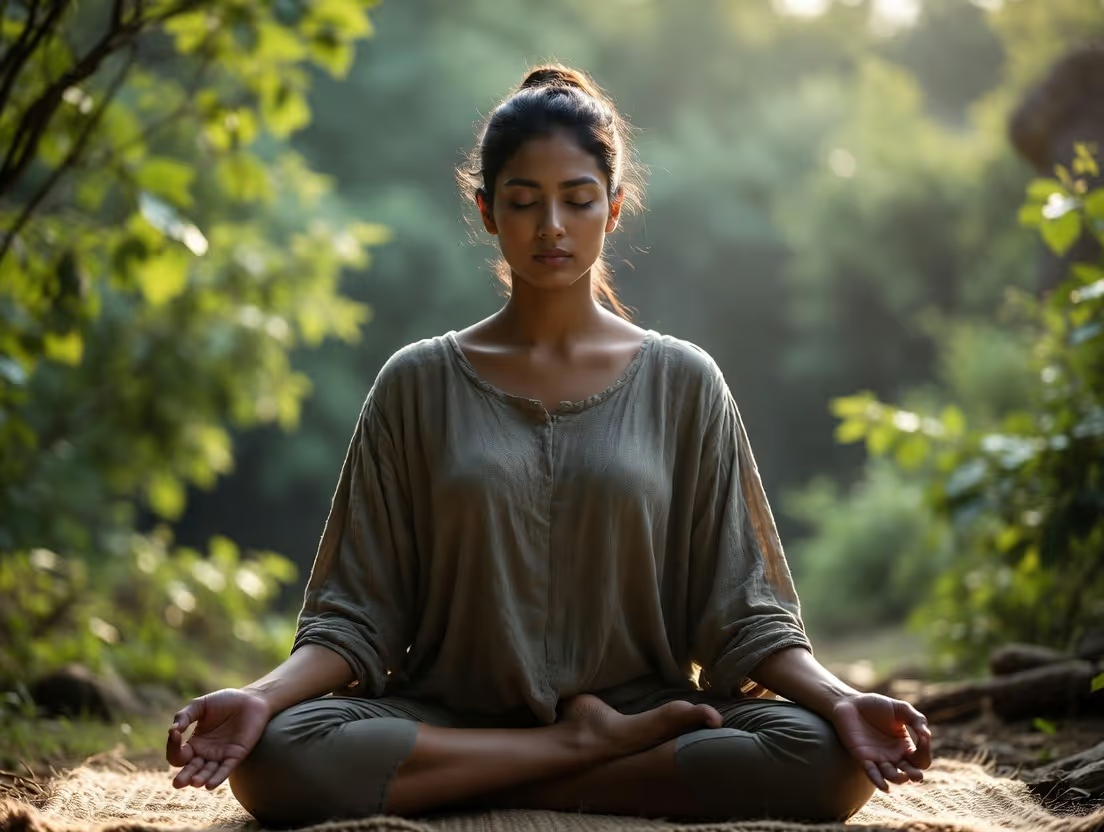
While flow is the peak experience, mindfulness meditation is the daily training regimen that builds the mental fitness to reach those peaks more reliably. Think of it as strength training for the attention and awareness networks of the brain, with direct carryover to creative prowess.
How Mindfulness Reshapes the Brain for Creativity:
Practical Meditative Tools for Creators:
We spend about one-third of our lives asleep, and for the creative mind, this is not downtime—it is the most critical phase of the creative process: incubation. The conscious mind rests, but the unconscious gets to work, integrating and recombining information free from the constraints of logic and linearity.
Sleep Architecture and Creativity:
The Science of Hypnagogia and Hypnopompia:
These are the transitional states between wakefulness and sleep (hypnagogia, as you fall asleep) and between sleep and wakefulness (hypnopompia, as you wake up). These twilight zones are notoriously fertile ground for creativity. In these states, the grip of the ECN has loosened, but the conscious mind is still faintly online, allowing bizarre, vivid, and often profoundly insightful imagery, phrases, or concepts to float into awareness. Inventors like Thomas Edison and Salvador Dali intentionally cultivated these states to capture creative insights.
Harnessing Your Nocturnal Creativity:
Sleep deprivation, therefore, isn't just making you tired; it's systematically dismantling your brain's most powerful creative processing unit. Honoring sleep is one of the most potent, evidence-based strategies any creator can employ. Understanding your own unique sleep patterns is the first step, a topic we often discuss in the context of holistic wellness tracking.
While we have dismantled the myth that suffering is necessary for creativity, we must honestly address how clinical and subclinical mental health challenges actually impact the creative process. The relationship is complex and often debilitating, not inspirational.
Chronic Stress and the Creative Mind:
Chronic stress keeps the body in a sustained "fight-or-flight" response, flooding the system with cortisol. This hormone, in excess:
Anxiety's Creative Paralysis:
Anxiety often manifests in creativity as:
Depression and the Drained Well:
Depression's impact is often one of profound energetic and motivational depletion. The neurochemical underpinnings of motivation (dopamine, serotonin) are dysregulated.
It is vital to understand that during acute episodes of these conditions, the primary goal must be treatment and healing, not creative output. Pushing for productivity in this state can worsen the condition. However, the therapeutic use of creative expression (art therapy, journaling) under guidance can be a valuable part of recovery, as it helps externalize and process difficult emotions. The key distinction is removing the pressure for a "product" and embracing the process as a means of self-care and communication.
Sustainable creativity isn't about sporadic bursts of inspiration; it's about designing a lifestyle that consistently nurtures the wellness-creativity link. It's about becoming a curator of your own psychological environment.
1. Design Your Rhythms, Don't Just Follow the Clock:
2. Cultivate a Nutrient-Rich Input Diet:
Garbage in, garbage out. Your creative output is directly influenced by the quality of your inputs.
3. Foster a Supportive Physical and Social Ecology:
Building this lifestyle is an ongoing, personal experiment. It requires tuning into your own rhythms, respecting your limits, and continually refining your habits to support the delicate interplay between a well mind and a creative spirit.
We've explored how wellness fosters creativity. Now, let's turn the lens around and examine the powerful therapeutic role of creative expression itself. Engaging in creative acts is not merely an outcome of mental health; it is a proven pathway to achieving it.
The Mechanisms of Creative Healing:
Evidence-Based Creative Therapies:
Incorporating a Creative Practice for Wellness:
You do not need to be a professional artist to reap these benefits. The key is in the process, not the product.
As we look forward, the intersection of technology, neuroscience, and personal well-being is poised to revolutionize how we understand and cultivate the link between mental wellness and creativity. We are moving from anecdote and generic advice into an era of personalized creative optimization.
Biometric Feedback and the Creative State:
Imagine a tool that could give you real-time feedback on your physiological state as you work. Wearable technology that measures heart rate variability (HRV), skin conductance, and body temperature can indicate when you are entering a state of stress (sympathetic nervous system dominance) or a state of calm, focused readiness (parasympathetic dominance). By correlating this data with your subjective experience of creative flow or block, you can learn your unique bodily signatures for optimal creative conditions. You might discover, for instance, that your best ideas come not when you are perfectly calm, but when you are in a state of "calm excitement"—a specific HRV pattern you can learn to cultivate.
Neurofeedback and Brainwave Training:
Neurofeedback (EEG) technology allows individuals to observe their own brainwave patterns in real-time. Research suggests certain brainwave states are conducive to creativity:
Data-Informed Lifestyle Design:
The future lies in synthesizing data from sleep, activity, stress, and work output. An integrated dashboard could reveal powerful personal insights: "On days following 7+ hours of sleep with high REM, my writing output increases by 40%." Or, "My most innovative design solutions consistently occur the day after a long walk in nature, as indicated by lowered resting heart rate." This moves wellness from a vague concept to a quantifiable, optimizable variable in your creative equation.
The promise of this future is not to turn creativity into a sterile, algorithmic process, but to remove the guesswork and friction. By using technology to illuminate the invisible inner workings of our minds and bodies, we can more deliberately create the conditions—the mental wellness—in which our innate creativity can thrive most abundantly. It’s about leveraging insight to serve the human spirit, a balance that sits at the heart of our vision for the future of wellness technology.
Our surroundings are not passive backdrops to our creative work; they are active participants in the cognitive process. The environments we inhabit—both physical and digital—exert a profound influence on our mental state, either fostering the relaxed focus needed for creativity or inducing the stress and distraction that stifle it. Designing an "environment of innovation" is a deliberate act of self-care for the creative mind.
The Physical Sanctuary:
Research in environmental psychology reveals key principles for a creativity-conducive space:
The Digital Landscape:
In the modern era, our most disruptive environment is often digital. A cluttered, demanding digital space is a primary creator of cognitive fragmentation.
By taking conscious control of your environmental design, you architect the external conditions for internal calm and focused exploration. You reduce the friction to starting creative work and increase the likelihood of entering and sustaining flow states. It’s a practical step toward aligning your outer world with the inner state required for innovation, a principle that guides holistic product design, as reflected in the thoughtful development of our own tools.

Creativity is often portrayed as a solitary endeavor, the lone genius toiling in isolation. While deep work requires solitude, the broader creative process is profoundly social. Our mental wellness and creative output are deeply interwoven with the quality of our social connections. A supportive community provides the psychological safety net that allows for risk-taking, while toxic dynamics can trigger the anxiety and self-doubt that kill creative projects in their infancy.
Building Your "Creative Scaffolding":
Every creator needs a network of supportive relationships that serve different functions:
Navigating Criticism and Rejection:
No creative work enters the world without encountering criticism or rejection. How you process this feedback is a direct test of your mental wellness and resilience.
A robust social fabric doesn't just make the creative journey more pleasant; it makes it possible. It mitigates the inherent loneliness and uncertainty of creation, provides essential reality checks, and turns the process from a solo sprint into a supported marathon. For many, finding this community is a transformative step, a journey echoed in the shared experiences of our user community.
At the heart of both childhood development and groundbreaking adult creativity lies a single, powerful force: play. Play is the purest expression of an unburdened mind—a state of open-ended exploration driven by intrinsic curiosity rather than external reward. For the adult creator, reintegrating a sense of play is not a frivolous distraction; it is a non-negotiable strategy for bypassing the inner critic, overcoming fear, and accessing original thought.
Why Play is a Serious Creative Tool:
Practical Strategies to Inject Play into Your Process:
Play is the antidote to creative burnout and the engine of curiosity. It reminds us that creativity is, at its core, a form of exploration and delight. By safeguarding and scheduling play, we protect the most vulnerable and vital part of the creative self. This philosophy of joyful exploration is central to a sustainable creative practice, a theme often explored in our blog's resources.
We are not static cognitive machines. Our energy, focus, and mood oscillate in predictable rhythms throughout the day, week, and even year. These biological clocks—our circadian rhythms and ultradian rhythms—have a dramatic impact on the type of cognitive work we are best suited for at any given time. "Harnessing your chronobiology" means aligning your tasks with your natural energy cycles, a practice that reduces willpower depletion and maximizes creative output.
The Daily Cycle: Identifying Your Creative Chronotype
Are you a morning person (lark), an evening person (owl), or somewhere in between? Your chronotype dictates your ideal windows for different kinds of work.
The 90-Minute Ultradian Rhythm:
Within the daily cycle, our brains operate on ~90-minute ultradian rhythms, alternating between high-alertness (peak) and lower-alertness (trough) phases. Pushing through a trough leads to fatigue, stress, and diminishing returns.
Seasonal and Long-Term Rhythms:
Creativity also has seasons. There may be periods of intense, prolific output (spring/summer) and periods that feel fallow, better suited for research, planning, and incubation (autumn/winter). Respecting these longer cycles prevents the destructive narrative that you are "blocked" when you may simply be in a necessary, different phase of the creative process.
Actionable Steps:
By syncing your creative schedule with your internal clock, you work with your biology, reducing stress and making high-level creative thinking feel more effortless and sustainable. Understanding these personal rhythms is a cornerstone of personalized wellness intelligence.
In a culture obsessed with productivity, rest is often viewed as the enemy of output—time wasted that could be spent doing. For the creative mind, this is a catastrophic misunderstanding. Rest is not the absence of work; it is a different mode of work. It is the essential phase in which unconscious processing, connection-making, and restoration occur. Strategic rest is the discipline that transforms raw effort into insight.
Defining the Modes of Strategic Rest:
Not all rest is equal. Strategic rest is intentional and varied.
The Zeigarnik Effect and the Power of Unfinished Business:
The Zeigarnik Effect is a psychological phenomenon where people remember uncompleted or interrupted tasks better than completed ones. The brain maintains an elevated level of cognitive tension around unfinished business. The creative application is brilliant: stop your work sessions mid-sentence, mid-sketch, or mid-problem. By creating a deliberate "open loop," you prime your unconscious mind to continue working on the problem during your rest periods. The strategic break becomes an active incubation period, not just passive downtime.
Designing Your Rest Protocol:
Strategic rest is an act of profound trust—trust that your mind is working even when you are not consciously directing it. It is the practice of stepping back to allow the deeper, associative networks the space they need to do their mysterious, essential work. It reframes the creative process from constant grinding to a rhythmic dance between focused effort and intentional release. For creators seeking sustainable rhythms, exploring frequently asked questions about balancing effort and recovery can offer valuable perspectives.

A silent saboteur lives in the minds of countless creators, from novices to Nobel laureates: Impostor Syndrome. The persistent, irrational fear of being exposed as a fraud, the belief that your successes are due to luck, and the discounting of your own skills and accomplishments. This psychological phenomenon is a direct attack on mental wellness and a major blocker of creative risk-taking and sharing. Overcoming it is not about achieving flawless confidence, but about developing a resilient, realistic self-assessment.
Why Creators Are Especially Vulnerable:
Strategies for Disarming the Impostor:
Creative confidence is not the loud, brash certainty of never doubting. It is the quiet, persistent courage to create despite the doubt. It is the willingness to be a beginner, to be imperfect, and to view the creative journey itself as the worthy pursuit, not just the flawless outcome. Building this resilience is a journey shared by many, as seen in the authentic stories of growth from our community.
The blank page, the empty canvas, the silent instrument—these can be terrifying. The resistance to starting, described eloquently by Steven Pressfield as "The War of Art," is a universal creative experience. It is in these moments that we rely on raw willpower, which is a finite and unreliable resource. The most effective weapon against resistance is not more discipline, but ritual and routine. By building automatic, pre-defined pathways, you conserve willpower for the creative work itself and trick the anxious mind into beginning.
The Neuroscience of Habit:
Habits are formed in a neurological loop: Cue -> Routine -> Reward. A ritual is a deliberately designed cue that triggers a creative routine, leading to the intrinsic reward of engagement or accomplishment. By ritualizing the start of your creative work, you bypass the prefrontal cortex's decision-making fatigue ("Should I start? When? How?") and hand control to the basal ganglia, the brain's habit center.
Crafting Effective Creative Rituals:
Your ritual should be simple, repeatable, and sensory. It acts as a "threshold ceremony" signaling the shift from ordinary life to creative time.
The "Gateway Task" Routine:
Even with a ritual, facing the core creative task can be daunting. The solution is to begin with a gateway task—a tiny, absurdly easy, related action that requires almost no creative energy.
The psychological trick is that action precedes motivation. By completing the tiny gateway task, you generate a small sense of momentum and accomplishment. This often creates the motivation to continue, pulling you into the creative work almost before resistance has a chance to mount. The goal of the ritual and gateway task is not to produce great work; it is simply to start. The quality emerges from the sustained engagement that follows.
By investing in the design of your rituals and routines, you architect a system that supports your creative self on days when inspiration is absent. You build a bridge over the chasm of resistance, ensuring that your creative practice is resilient and consistent, regardless of fleeting moods or external pressures.
Originality is a myth—but innovation is real. What we perceive as a "new" idea is almost always a novel combination of pre-existing elements. Steve Jobs famously said, "Creativity is just connecting things." Therefore, the richest source of creative fuel is not digging deeper into your own field, but venturing far outside of it. This practice of cross-pollination—seeking inspiration from disparate domains—is how you stock the combinatorial library of your mind with unexpected and rich raw materials.
The Adjacent Possible and the Value of "Weird" Knowledge:
Theorist Stuart Kauffman coined the term "adjacent possible" to describe the realm of all potential innovations that are one step away from what currently exists. You expand your adjacent possible not by focusing narrowly, but by exploring the boundaries and beyond. This requires accumulating what investor and author David Epstein calls "wicked learning"—broad, general knowledge across many fields, as opposed to "kind learning" (deep, narrow expertise in predictable domains). In a complex, unpredictable world (and creative problems are always complex), breadth of experience is a greater predictor of innovative success than narrow depth alone.
Strategies for Intentional Cross-Pollination:
Cross-pollination combats the biggest creativity killer: sameness. It breaks the cognitive fixation that occurs when you stare too long at the same problem from the same angle. By flooding your mind with diverse stimuli, you increase the probability of forming the unexpected, valuable connection that defines a creative leap. This philosophy of interconnected learning and holistic insight mirrors the approach we take to understanding well-being from multiple data dimensions.
The flash of insight—the "Aha!" moment in the shower or on a walk—is the glamorous part of creativity. But it is worthless if it evaporates into the ether. The vast, unglamorous majority of the creative process is the disciplined work of capturing, developing, and executing that fragile insight into a tangible form. This phase requires a different kind of mental wellness: the resilience for sustained effort, the emotional regulation to handle frustration, and the executive function to manage a project from conception to completion.
Phase 1: The Relentless Capture System
You must have a foolproof, low-friction system to capture ideas the moment they arrive. The brain is a brilliant idea generator but a terrible storage device.
Phase 2: The Weekly Review and Development "Seedling"
Raw ideas are seeds. They need to be planted and nurtured. Establish a weekly review (e.g., Friday afternoon) where you process your captured notes.
Phase 3: The Project Pipeline and the Power of the "Ugly Draft"
For ideas that merit full projects, you need a pipeline and a commitment to ugly first drafts.
Phase 4: The Marathon of Revision and the Editor's Mindset
Once the draft exists, the creative mind must temporarily shift into an editor's mindset. This requires a different form of mental wellness: detachment, analytical thinking, and patience.
The journey from insight to finished work is a test of your creative system and your psychological endurance. By building robust capture and development habits, and by embracing the necessary messiness of the process, you ensure that your valuable insights don't die as ephemeral thoughts, but live on as realized contributions. For those building systems for their own goals and well-being, exploring our resources can offer supportive frameworks and community wisdom.
Your Trusted Sleep Advocate: Sleep Foundation — https://www.sleepfoundation.org
Discover a digital archive of scholarly articles: NIH — https://www.ncbi.nlm.nih.gov/
39 million citations for biomedical literature :PubMed — https://pubmed.ncbi.nlm.nih.gov/
Experts at Harvard Health Publishing covering a variety of health topics — https://www.health.harvard.edu/blog/
Every life deserves world class care :Cleveland Clinic - https://my.clevelandclinic.org/health
Wearable technology and the future of predictive health monitoring :MIT Technology Review — https://www.technologyreview.com/
Dedicated to the well-being of all people and guided by science :World Health Organization — https://www.who.int/news-room/
Psychological science and knowledge to benefit society and improve lives. :APA — https://www.apa.org/monitor/
Cutting-edge insights on human longevity and peak performance:
Lifespan Research — https://www.lifespan.io/
Global authority on exercise physiology, sports performance, and human recovery:
American College of Sports Medicine — https://www.acsm.org/
Neuroscience-driven guidance for better focus, sleep, and mental clarity:
Stanford Human Performance Lab — https://humanperformance.stanford.edu/
Evidence-based psychology and mind–body wellness resources:
Mayo Clinic — https://www.mayoclinic.org/healthy-lifestyle/
Data-backed research on emotional wellbeing, stress biology, and resilience:
American Institute of Stress — https://www.stress.org/


