


Micro-Calm Practices: Finding Peace in Everyday Moments
Micro-calm practices are brief moments of mindfulness inserted into daily tasks—like mindful dishwashing or conscious breathing at a red light.
Micro-calm practices are brief moments of mindfulness inserted into daily tasks—like mindful dishwashing or conscious breathing at a red light.
%402x.svg)
In a world that glorifies hustle, prizes constant connection, and measures worth in productivity, a quiet revolution is brewing. It’s not a call to drop out or meditate on a mountaintop for a decade. It’s an invitation to drop in—to the next minute, the next breath, the next mundane task. This is the practice of Micro-Calm: the deliberate, accessible, and scientifically-grounded art of finding profound peace in the smallest, most ordinary moments of your day.
We’ve been sold a narrative that peace requires escape—a two-week vacation, a silent retreat, a perfectly curated life. But what if the gateway to serenity wasn’t in changing your life, but in changing your relationship to the life you already have? Neuroscience and ancient wisdom traditions converge on a simple truth: our nervous systems aren’t designed for perpetual peak performance or drama. They crave moments of restful integration, tiny resets that act as pressure valves for the soul.
This is where modern life and modern technology can form an unexpected alliance. Imagine having a gentle, personal guide on your finger, not to push you to do more, but to notice more. A guide that observes the subtle physiological whispers of rising stress—an elevated heart rate, a slight dip in heart rate variability—and prompts you to reclaim the present moment before anxiety becomes a storm. This is the promise of integrated wellness, where tools like the Oxyzen smart ring move beyond simple tracking to become partners in conscious living. They help us bridge the gap between intention and action, between knowing we should pause and actually remembering to do so. To understand the full potential of this integrated approach, you can explore Oxyzen's vision for a calmer future on their about page.
Micro-Calm dismantles the all-or-nothing approach to wellness. You don’t need 30 minutes; you need 30 seconds. You don’t need a yoga mat; you need the feeling of your feet on the floor. It’s the practice of turning waiting in line into a sensory exercise, of transforming a deep sigh into a nervous system command, of finding stillness while the kettle boils. This article is your comprehensive guide to weaving these microscopic threads of peace into the fabric of your daily life, creating a tapestry of resilience that holds you steady, no matter what the day brings.

We often think of stress relief and calm as grand undertakings, but the real magic happens at a microscopic level—within our very biology. To understand why Micro-Calm practices are so potent, we must first visit the command center of our stress and relaxation response: the autonomic nervous system (ANS).
Your ANS operates two primary branches: the sympathetic (gas pedal) and the parasympathetic (brake pedal). The sympathetic system is your fight-or-flight response, brilliantly designed for short-term threats. The parasympathetic system is your rest-and-digest state, responsible for recovery, healing, and calm. Modern chronic stress is essentially a case of a stuck gas pedal. Our bodies are flooded with low-grade sympathetic arousal from pinging notifications, endless to-do lists, and social pressures, with little opportunity to engage the brake.
This is where the revolutionary concept of neuroplasticity meets the power of small moments. Neuroplasticity is your brain's ability to rewire itself based on experience. Every time you react with panic to an email, you strengthen that neural pathway. Conversely, every time you consciously choose a calming breath, you strengthen that pathway instead. Dr. Rick Hanson, a renowned neuropsychologist, summarizes this with the phrase, “neurons that fire together, wire together.”
Micro-Calms are the perfect tool for strategic rewiring. A single, conscious breath might seem insignificant, but from a neurological perspective, it’s a deliberate rep. It’s a forceful activation of the vagus nerve—the superhighway of the parasympathetic system—sending a direct signal to your brain and heart to slow down. Research published in Frontiers in Human Neuroscience shows that even brief mindfulness interventions can improve heart rate variability (HRV), a key metric of nervous system resilience and adaptability.
Think of your nervous system not as a light switch, but as a dial. You’re not trying to flip from “frantic” to “zoned-out” instantly. You’re trying to turn the dial, degree by tiny degree, toward calm. Each Micro-Calm practice is a tiny turn of that dial. Over time, these micro-adjustments change the default setting. Your baseline state becomes one of greater equilibrium, and you recover from stressors far more quickly. For those curious about how technology can help track this dial-turning by monitoring biomarkers like HRV, a wealth of information is available in the resources at Oxyzen's blog.
The data is clear: accumulated micro-moments of mindfulness have a compound effect greater than one long, isolated session. A 2018 study from Carnegie Mellon University found that brief, daily mindfulness practice not only reduced stress but also decreased inflammation at a cellular level. By integrating calm into the flow of your life, you’re not just managing stress in the moment; you’re conducting a full-scale, biological renovation toward sustained peace.
Our psychological framework for self-care is broken. We have internalized a cultural script that tells us wellness is a commodity to be acquired in large, Instagrammable chunks: the hour-long spin class, the weekend detox, the 10-day silent retreat. When we can’t achieve these “ideal” blocks of time, we feel we’ve failed, leading to a perverse outcome: the pursuit of wellness becomes another source of stress and inadequacy. This is what psychologists call “all-or-nothing” or “perfectionist” thinking, and it’s the primary enemy of sustainable peace.
Fractional Wellness is the antidote. It is the conscious, liberating decision that something is always better than nothing. It’s the recognition that a 90-second breathing exercise between meetings is not a “lesser than” version of a 30-minute meditation; it is a valid, powerful, and complete practice in its own right. This mindset shift is psychological liberation.
Consider the concept of “atomic habits” popularized by James Clear. The core idea is that tiny changes, repeated consistently, yield remarkable results. A 1% improvement daily compounds exponentially. Micro-Calm applies this law directly to your emotional and mental state. One conscious breath is your 1%. One moment of noticing the sky is your 1%. These fractions of peace are the compound interest of emotional resilience.
This approach also shatters the myth of “finding time.” You don’t find time; you claim the moments that already exist. The 45 seconds your computer takes to boot up. The two minutes you wait for your morning coffee to brew. The pause at a red light. These are not empty spaces to be filled with scrolling; they are micro-sanctuaries, waiting to be claimed. By reframing these interstitial moments as opportunities, we reclaim agency over our inner state. We move from being passive victims of a busy schedule to active architects of our daily peace.
Furthermore, Fractional Wellness is inherently self-compassionate. It meets you where you are, on your most chaotic day, and whispers, “What can you do right now?” It eliminates the barrier to entry. When the goal is a “micro” moment, you cannot fail. This consistent, gentle success builds self-efficacy—the belief in your own ability to affect your state of mind. This is perhaps the most profound psychological outcome: the quiet confidence that no matter what is happening around you, you possess the tools to anchor yourself within. For anyone struggling to start, reading about real user experiences and testimonials can provide that initial spark of inspiration, showing how others have integrated small changes with great effect.
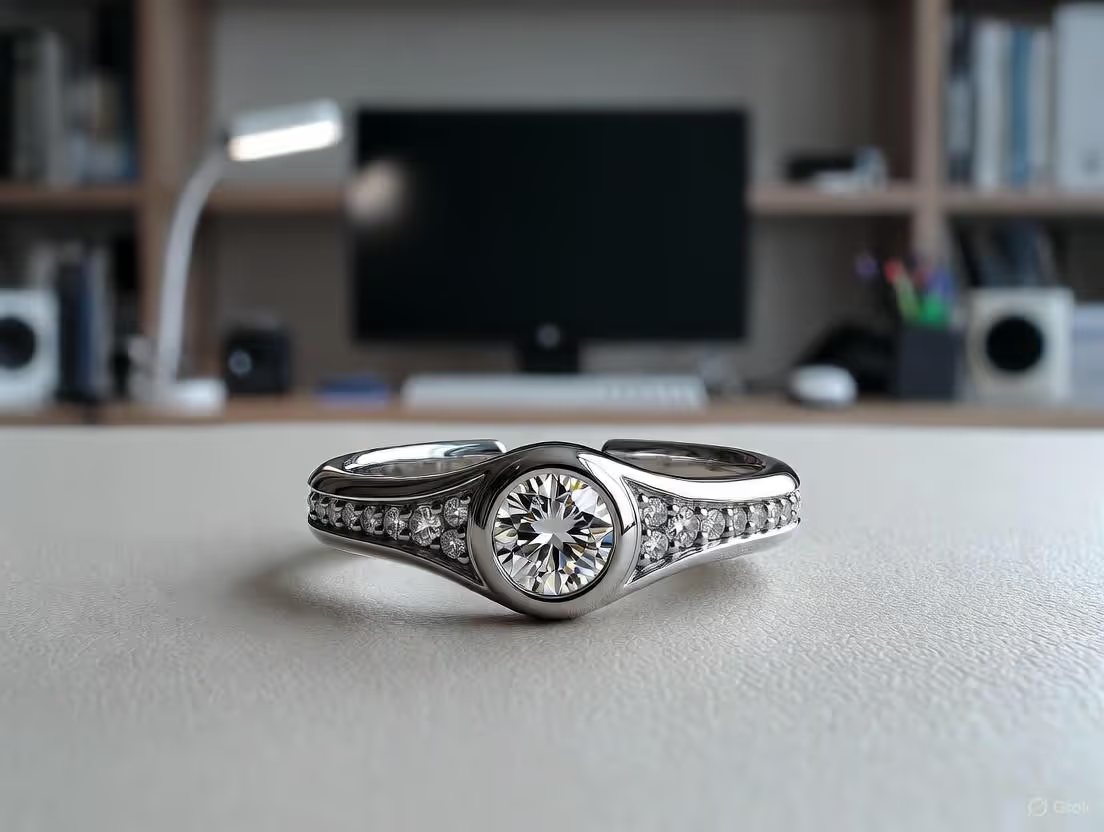
In the journey toward Micro-Calm, awareness is the first and most crucial step. You cannot change what you cannot see. This is the transformative role of modern, intuitive technology. Moving beyond the wrist, the smart ring—discreet, always-on, and intimately connected to your body’s core signals—emerges as the ideal companion for this practice. It acts not as a judge, but as a gentle mirror and a proactive guide.
Imagine you’re rushing through a work deadline. Subjectively, you might feel “fine” or “in the zone.” But beneath the surface, your physiology tells a different story: your heart rate has climbed 15 beats per minute above your resting rate, your heart rate variability (a key stress resilience metric) has plummeted, and your skin temperature is fluctuating with subtle stress. Your conscious mind is focused on the task, but your body is in a state of sympathetic arousal. Without data, you miss this disconnect until it manifests as a tension headache, snapping at a colleague, or evening exhaustion.
A device like the Oxyzen smart ring observes these biomarkers in real-time. Its power in Micro-Calm practice lies in two key functions: detection and invitation.
First, it detects the physiological signature of creeping stress, often before you’re cognitively aware of it. Then, rather than just logging this data in an app for later review, it can be configured to offer a gentle, haptic nudge—a subtle vibration on your finger. This isn’t an alarm; it’s an invitation. It’s a signal that says, “I notice your system is rising. This is a potential Micro-Calm moment. Would you like to pause?”
This transforms the ring from a tracker to an intervention tool. That vibration becomes a modern mindfulness bell, pulling you from autopilot into presence. You can then employ a 60-second breathing exercise (guided by the app), simply feel your feet on the floor, or gaze out the window. The ring can then show you the direct, near-instantaneous impact: watching your heart rate line dip and your HRV begin to rise on the screen as you breathe. This creates a powerful feedback loop. You perform a simple action (a breath), and you see a concrete, physiological result (a calmer nervous system). This positive reinforcement wires the habit deeply into your brain.
Furthermore, the Oxyzen ecosystem provides structure and insight. Its app can help you identify your personal stress patterns—do you spike every day at 3 PM? Does your sleep readiness score plummet after days with back-to-back meetings? With this knowledge, you can schedule proactive Micro-Calm practices, turning recovery from a reactive to a proactive strategy. To see how this technology fits into a larger mission of accessible wellness, you can discover Oxyzen's unique story and founding vision. It’s about leveraging precise, personal data not for optimization anxiety, but for compassionate self-awareness, creating a seamless dialogue between your body’s wisdom and your conscious mind’s intention.
When anxiety about the future or ruminations about the past hijack your mind, the most powerful anchor is the reality of the present moment. Your senses are the direct conduit to the "here and now." The 60-Second Sensory Reset, also known as the 5-4-3-2-1 grounding technique, is a clinically recognized tool to short-circuit the stress response and bring you back into your body. It’s the ultimate Micro-Calm practice because it requires nothing but your attention and can be done anywhere, anytime.
The Science of Grounding: Anxiety and overwhelm often manifest as a state of “hyper-awareness” to internal, fearful thoughts, coupled with a dissociation from the external environment. This technique works by forcibly redirecting cognitive resources. By demanding focused attention on external sensory input, it occupies the working memory that was previously feeding the cycle of worry. It stimulates the parasympathetic nervous system by engaging you in a non-threatening, exploratory task.
The Step-by-Step Practice:
Do this slowly and deliberately, aiming to spend about 10-12 seconds on each step.
Integration: Don’t just rush off. Take one final, deep breath after completing the cycle. Notice the state of your mind and body. Has the frantic edge softened? Has your awareness expanded beyond the spiral of thought? This practice is a hard reset for your perception. It’s especially powerful when you feel an Oxyzen alert or simply notice yourself getting lost in thought. It proves that you are never more than 60 seconds away from a more grounded, peaceful state.

Breath is the remote control for your nervous system, and the purposeful sigh is perhaps its most powerful, underrated button. Unlike the shallow, chest-bound breathing of stress, a deliberate sigh engages the full diaphragm and triggers an immediate physiological shift. It’s a tool so quick and discreet you can use it in the middle of a tense conversation, before answering a difficult call, or while staring at an overwhelming inbox.
The Physiology of a Sigh: A spontaneous sigh is actually a built-in biological reset. Research from Stanford University identified the precise neurons in the brainstem that trigger natural sighs, which are essential for reinflating tiny air sacs (alveoli) in the lungs and preventing collapse. More importantly, they found that a double-inhalation sigh is the fastest way to induce a state of calm. The first inhalation fills the lungs more completely, and the second, shorter “sip” of air maximizes lung expansion. The long, slow exhale that follows is what directly stimulates the vagus nerve, signaling the heart to slow down and the body to relax.
How to Practice the Purposeful Sigh:
When to Use It: This is your stealth Micro-Calm superpower. Use it:
This practice demonstrates that profound calm doesn’t require a complicated technique. It’s embedded in a natural bodily function, waiting to be harnessed with intention. For a deeper dive into the science of breath and other data-driven wellness techniques, Oxyzen's blog offers a library of expert insights.
In a culture addicted to action, the most radical act may be conscious inaction. The Mindful Pause is not zoning out, scrolling passively, or daydreaming. It is the deliberate, willful decision to stop doing and simply be with whatever is happening, for a pre-determined, brief period. It is the practice of creating a micro-sanctuary of non-striving in the middle of your day.
The "Doing" vs. "Being" Mode: Psychologists differentiate between two fundamental modes of mind: “Doing Mode” and “Being Mode.” Doing Mode is goal-oriented, analytical, and focused on changing things from how they are to how we think they should be. It’s essential for tasks, but when it dominates, it leads to perpetual dissatisfaction and stress. Being Mode is characterized by acceptance, direct sensory experience, and a focus on the present moment without an agenda. The Mindful Pause is a deliberate switch from Doing to Being.
How to Cultivate a Mindful Pause:
The Power of the Pause: This practice builds your “mental muscle” for non-reactivity. It creates a gap between stimulus and response. In that gap lies your freedom and choice. It teaches you that you are not your thoughts or your to-do list; you are the aware space in which they occur. By regularly dipping into Being Mode, you recharge the mental resources depleted by constant Doing. You begin to bring the qualities of the pause—acceptance, curiosity, presence—into your active moments. If questions arise about integrating such pauses with wearable technology or their impact on tracked metrics, a great place to find answers is the comprehensive FAQ section.

Daily life is filled with repetitive tasks we often treat as burdens to be rushed through: washing dishes, brushing teeth, commuting, making coffee. Ritualizing the Routine is the practice of transforming these automatic behaviors into sacred, sensory-rich Micro-Calm ceremonies. It’s about infusing intention into the infrastructure of your day.
The Psychology of Ritual: Rituals, from a psychological standpoint, provide structure, meaning, and a sense of control. A study in the Journal of Experimental Psychology found that performing a ritual before a high-anxiety task (like public speaking) significantly reduced stress levels and improved performance. By converting a routine into a ritual, you assign it a new purpose beyond utility: the purpose of presence, care, or gratitude.
How to Create Micro-Rituals:
Choose one or two daily routines to start. The goal is depth of attention, not adding more to your plate.
By ritualizing routines, you stitch mindfulness into the very fabric of your existence. These acts become automatic triggers for presence, turning what was dead time into a tapestry of small, nourishing moments. The story of Oxyzen itself is rooted in this idea—transforming a everyday object (a ring) into a meaningful tool for awareness. You can learn more about this philosophy in Oxyzen's our story page.
Gratitude is often prescribed as a daily journaling exercise, which can feel like another evening chore. The Gratitude Glance distills this powerful practice into a micro-moment that can be scattered throughout your day. It’s the intentional, fleeting recognition of something good, pleasant, or simply not wrong in your immediate environment or experience. This practice directly counters the brain’s innate negativity bias—its tendency to scan for, register, and dwell on threats—by actively training it to scan for gifts.
The Neuroscience of Spot Gratitude: Research by Dr. Richard Davidson and others shows that frequent, brief practices of gratitude can increase activity in the prefrontal cortex (associated with higher-order thinking) and boost dopamine and serotonin—neurotransmitters linked to happiness and well-being. Unlike sustained reflection, a Gratitude Glance works by creating frequent “positive spikes” throughout the day, which cumulatively elevate your emotional baseline.
How to Practice the Gratitude Glance:
The rule is: keep it quick, specific, and sensory.
This practice doesn’t deny life’s challenges; it simply ensures they don’t monopolize your perceptual field. By routinely glancing at the good, you build a brain that is more resilient, optimistic, and primed to notice peace. It turns ordinary moments into tiny, discoverable treasures.
You don’t need a three-hour hike to reap the profound restorative benefits of nature. The Japanese practice of Shinrin-yoku, or “forest bathing,” has been rigorously studied, showing reductions in cortisol, blood pressure, and sympathetic activity. The core mechanism isn’t exercise, but immersive sensory engagement with the natural world. We can adapt this as a “Nature Nano-Dose”—a brief, intense immersion that acts as a system reboot.
Biophilia in Brief: The Biophilia Hypothesis suggests humans have an innate, genetic tendency to connect with nature and other living forms. Even micro-exposures can trigger this connection. A study from the University of Michigan found that just a brief glance at nature (versus an urban setting) could improve cognitive performance and focus. A 120-second dose is enough to shift your physiological state.
How to Take Your Nature Nano-Dose:
This is not about going for a walk while on a phone call. It’s about dedicated, focused immersion.
The Urban Adaptation: In a concrete jungle, seek out “pockets of aliveness.” A fountain, a potted plant on a windowsill, a courtyard with a single tree, a bowl of fruit on your desk. The principle remains: full sensory engagement with the non-man-made element for two focused minutes.
This practice leverages the fact that our nervous systems recognize and relax in natural environments. It’s a direct download of calm from the wider world, reminding you that you are part of a larger, slower, more resilient system. For more research-backed practices on using your environment for wellness, the Oxyzen blog is a continually updated resource.
Amidst the drive to be productive and positive, we often become strangers to our own inner weather. The Compassionate Check-In is a 90-second practice of turning inward with an attitude of kindness and curiosity, rather than judgment or analysis. It’s the practice of asking yourself, “How am I, right now?” and listening to the answer from your body and heart, not just your thinking mind.
From Self-Criticism to Self-Compassion: Dr. Kristin Neff’s research on self-compassion identifies three core elements: mindfulness (acknowledging our pain without over-identifying), common humanity (seeing our experience as part of the human condition), and self-kindness (responding with warmth). This Micro-Calm practice bundles these into a quick, accessible format. It interrupts the cycle of ignoring or berating ourselves for feeling stressed.
The Step-by-Step Check-In:
Linking with Technology: This is a profound practice to pair with a wellness tool. When your Oxyzen ring indicates elevated stress, instead of thinking, “I need to lower my score,” use it as a cue for a Compassionate Check-In. Think, “My body is signaling. Let me listen with kindness.” This aligns technology with self-compassion, not self-optimization. It turns data into a dialogue of care.
This practice builds emotional intelligence and resilience from the inside out. It ensures that your quest for Micro-Calm is grounded in a fundamental friendship with yourself. For further guidance on tuning into your body's signals or troubleshooting your practice, support is always available through Oxyzen's FAQ and help resources.
We live in a sea of digital interruptions—pings, buzzes, and banners that fragment our attention and spike our stress. The average person receives dozens, if not hundreds, of notifications daily. But what if we could reclaim these interruptions, turning them from sources of anxiety into cues for calm? Tech-Assisted Transitions is the practice of hijacking the notification framework to serve your well-being, creating deliberate Micro-Calm moments at the digital thresholds you already cross.
The Problem with Passive Notifications: Default app notifications are designed to capture attention, often triggering a dopamine-driven "what is it?" response that pulls you out of flow. This constant context-switching is neurologically expensive, leading to cognitive fatigue and a low-grade sense of urgency. The solution isn't just to turn them all off (though that helps), but to strategically repurpose the notification mechanism itself.
Creating Your Calm Cue System:
This involves a two-part strategy: first, a ruthless pruning of harmful notifications, and second, the intentional programming of helpful ones.
The "Threshold Breather" Protocol: This is a specific Tech-Assisted Transition for communication.
By doing this, you rewire your relationship with technology. The buzz on your wrist or the chime from your phone is no longer an alarm; it becomes a temple bell, calling you back to yourself. It externalizes the remembering function, so your conscious mind is free to immerse in tasks, knowing a compassionate system will remind you to pause. For insights on how to optimally configure technology for mindfulness, Oxyzen's blog features detailed guides and user tips.
Stress doesn't just live in the mind; it crystallizes in the body. The hunched shoulders from hours at a computer, the clenched jaw during a tense call, the tight hips from sitting—these are the physical archives of our mental state. The Micro-Movement Break uses tiny, intentional physical actions to release stored tension and send safety signals directly to the brain. It’s based on somatics, the field that studies the mind-body connection, and the principle that to change how you feel, you can start by changing how you move.
The Body-Mind Feedback Loop: The brain constantly monitors the body’s posture and tension to assess safety. A slumped, tense posture signals "threat," perpetuating stress chemistry. Conversely, open, relaxed, and fluid movements signal "safety," activating the parasympathetic nervous system. Micro-movements leverage this loop, using physical release to trigger mental and emotional calm.
A Toolkit of 90-Second Somatic Resets:
These can be done seated at a desk, standing in line, or even in a bathroom stall.
Integration: After a sequence of 2-3 of these movements, pause for a moment. Close your eyes. Scan your body. Notice the before-and-after difference in sensation. The feeling of "more space," "less tightness," or "warmth" is the feeling of your nervous system downshifting. Pair this with your tech cues; when your Oxyzen ring nudges you, stand for a 90-second Micro-Movement sequence. It transforms a data point into a direct physical intervention. Hearing how others integrate movement with mindful tech can be motivating; consider exploring real user stories and testimonials for inspiration.
We spend most of our listening time planning what we’ll say next, judging what’s being said, or drifting into our own thoughts. This not only harms our relationships but also keeps us locked in our own mental narrative, a primary source of stress. The Focused Listening Micro-Meditation turns any ambient sound or conversation into an object of mindful attention, pulling you completely into the present moment and training a mind that is calm and concentrated.
The Art of Deep Listening as Meditation: In traditional meditation, you might focus on the breath or a mantra. In this practice, you use sound as your anchor. This aligns with "open monitoring" meditation styles, which cultivate a non-reactive awareness of all sensory experience. By focusing on listening, you give the analytical, problem-solving part of your mind a rest, while honing attention and cultivating acceptance (you can’t control the sounds you hear).
How to Practice in Two Minutes:
You can do this with intentional sounds (music) or the chaotic sounds of daily life.
Version A: With Music or Nature Sounds (The 2-Minute Immersion)
Version B: With Ambient Noise (The "Soundscape Safari")
The Social Application: You can bring a micro-version of this into conversations. In your next interaction, for just 60 seconds, make it your sole mission to truly listen to the other person. Listen to their words, their tone, their pauses. Don't formulate a response. This level of presence is profoundly calming for you and deeply validating for them. It turns a social interaction into a shared Micro-Calm moment.
This practice trains equanimity—the ability to be with experience without being thrown by it. It proves that peace isn't the absence of noise, but the way you hold yourself in the midst of it.
The hour before sleep is arguably the most important for your nervous system’s recovery and your next day’s emotional baseline. Yet, most of us spend it bathed in the blue light of screens, consuming stimulating content, or mentally reviewing the day’s stresses. The Digital Sunset is a 20-30 minute ritual designed to gently lower the "mental temperature," signaling to your brain and body that it is safe to shift into restorative sleep mode. It’s a series of Micro-Calms strung together to create a powerful macro-effect.
The Physiology of the Wind-Down: Exposure to blue light from screens suppresses melatonin production, the hormone essential for sleep. Furthermore, engaging with work emails or stressful news activates the sympathetic nervous system and the cognitive "doing" networks of the brain, making it physiologically harder to fall asleep. The Digital Sunset creates a buffer zone, allowing melatonin to rise naturally and the mind to transition from doing to being.
Crafting Your Personalized Digital Sunset (Start 30-60 Minutes Before Bed):
The Role of Your Smart Ring: A tool like the Oxyzen ring can provide invaluable feedback on the effectiveness of your Digital Sunset. By tracking your sleep readiness score, heart rate dip, and HRV overnight, it can show you, over time, how your pre-sleep ritual directly correlates with deeper, more restorative sleep. It closes the loop, proving that these peaceful evening moments are a functional investment in your next day’s resilience. To understand how sleep tracking integrates into holistic wellness, you can learn more about Oxyzen's comprehensive approach.
You now possess a toolkit of eleven diverse, science-backed Micro-Calm practices. The final step—and perhaps the most important—is moving from a collection of techniques to a personalized, fluid system that works for your unique life, temperament, and rhythms. Integration is where practice becomes a living, breathing part of your identity, not just another item on a to-do list. This is about designing your own protocol for everyday peace.
The Principle of "Skill Stacking": You don't need to use all eleven practices every day. That would be overwhelming and counterproductive. Instead, think of them as skills you can "stack" onto existing habits or triggers in your life—a concept borrowed from productivity that works beautifully for wellness. The goal is to create effortless associations.
How to Build Your Protocol in 4 Steps:
Creating Your "Calm Menu": Have a go-to list for different "flavors" of stress. Post it somewhere visible or in your phone's notes.
Remember, the protocol is a living document of your self-care. It will evolve with your seasons of life. The mission of Oxyzen is to support this exact kind of personalized, intelligent integration. To see how a device can serve as the central hub for this protocol, gathering your body's data to inform your practice, you can explore the full capabilities on the main site. The ultimate goal is for these Micro-Calm practices to become as automatic and essential as breathing—a gentle, continuous conversation of care between you and the present moment, building a life not of isolated calm, but of pervasive, durable peace.
A critical, often unspoken, barrier to sustaining any wellness practice is the tyranny of perfectionism—the belief that if we can’t do it “right,” with perfect consistency and flawless execution, it’s not worth doing. This mindset is the arch-nemesis of Micro-Calm. The philosophy here is the radical embrace of imperfection, of missed days, of distracted attempts, and of starting over countless times. This isn’t a failure of the practice; it is the practice.
The "Non-Zero Day" Principle: Borrowed from behavioral psychology, this principle states that anything above zero is a victory. A five-second breath is better than no breath. One Gratitude Glance is better than none. Forgetting for three days and remembering on the fourth is not a setback; it’s a successful re-engagement. Micro-Calm is engineered for the "non-zero day." Its very nature—micro, brief, accessible—makes failure almost impossible. The goal is not a streak on an app (though those can be fun motivators); the goal is a gentle, persistent return to the present, however messy that return may be.
The "Two-Minute Rule" for Habit Formation: James Clear’s Two-Minute Rule for building habits is perfectly suited here: when you start a new habit, it should take less than two minutes to do. Every single one of our Micro-Calm practices fits this rule. The secret is that once you start the two-minute version, you’ll often do more, but the barrier to entry is virtually nonexistent. Don’t feel like a 10-minute meditation? Commit to a 60-second sensory reset. That’s the practice. This approach dismantles resistance by making the action so small that the mind cannot rationally argue against it.
Reframing "Forgetting" as Part of the Process: You will forget. Your day will spiral, and you’ll realize at 9 PM that you haven’t done a single intentional practice. This moment is not a verdict; it’s the richest opportunity for Micro-Calm. The practice, in that moment, becomes a Compassionate Check-In. You notice the forgetting with kindness—“Ah, I was swept away today.” That noticing itself is a triumphant moment of awareness, a Micro-Calm of acceptance. Then, without self-recrimination, you have a simple choice: can I take one purposeful sigh right now? The cycle of forgetting and remembering is the rhythm of building a new neural pathway. Each "remembering" strengthens it.
Using Your Tools Without Attachment: This applies directly to technology like the Oxyzen ring. The goal is not to have a “perfect” HRV graph or unbroken sleep scores. That path leads to “data anxiety,” where the tool meant to reduce stress becomes a source of it. Instead, use the data as a curious guide, not a report card. A low “readiness” score isn’t a “F” for the day; it’s useful information. It’s your body saying, “Go gently today.” It’s an invitation to lean into more Micro-Calms, not to judge yourself for needing them. For support on cultivating this healthy relationship with wellness tech, the FAQ section offers helpful perspectives.
By releasing the need for a perfect performance, you unlock the true, sustainable power of these practices. You move from practicing Micro-Calm to living from a Micro-Calm mindset—a mindset that is forgiving, adaptable, and always willing to begin again, right here, right now, in the beautifully imperfect present.
The journey of Micro-Calm begins as a deeply personal, interior one. Yet, its impact cannot be contained within the individual. Like a stone dropped in a pond, the peace cultivated in these small moments radiates outward, subtly but powerfully transforming your interactions, relationships, and ultimately, the micro-communities you inhabit. When you are grounded, you become a grounding force for others.
From Reactivity to Responsiveness: A stressed, dysregulated nervous system is primed for threat detection and reactivity. In this state, a partner’s offhand comment becomes a criticism, a child’s whine feels like an assault, a colleague’s question seems like an interrogation. Micro-Calm practices increase your "window of tolerance"—the zone of arousal in which you can handle life’s stressors without flipping into fight, flight, or freeze. With a regulated system, you create a sacred pause between stimulus and response. In that pause, you gain the capacity to choose. You can respond with patience instead of snapping, with curiosity instead of judgment, with empathy instead of defensiveness.
The Practice of "Micro-Presence" in Conversation: This is the social application of the Focused Listening Micro-Meditation. When you are with someone, give them the gift of your full attention for just one minute. Put your phone down, soften your gaze, and truly listen. Don’t formulate your reply. This level of micro-presence is profoundly validating. It communicates, “You matter. What you are saying matters.” This single minute of authentic connection can do more for a relationship than hours of distracted time together. It turns ordinary interactions into micro-moments of mutual respect and understanding.
Modeling Calm as a Non-Verbal Teaching Tool: Especially for parents, teachers, or leaders, your state of being is contagious. When stress hits a group, everyone looks to the perceived leader for cues on how to react. If you can employ a Micro-Calm practice in that moment—a deep, audible sigh, a conscious pause before speaking, a grounding movement—you model emotional regulation. You show, without lecturing, that it is possible to face difficulty with centeredness. Children, in particular, are brilliant somatic mirrors; they absorb your calm (or chaos) directly into their own developing nervous systems. By managing your own micro-moments, you gift them a blueprint for resilience.
Creating Collective Rituals: Micro-Calm can become a shared language. A family can institute a “Gratitude Glance” at the dinner table. A team can start a meeting with a collective 60-second “Purposeful Sigh” to transition in together. Friends on a walk can agree to a 2-minute “Nature Nano-Dose” of silent observation. These tiny, shared rituals build bonds and create containers of collective calm, strengthening the social fabric against the fraying forces of modern haste.
The ultimate truth is that inner peace is not a selfish pursuit. It is a social good. Every time you choose a Micro-Calm, you are not just lowering your own cortisol; you are contributing to a calmer, more compassionate, more present environment for everyone around you. You become a node of stability in the network, proving that peace is not found in isolation, but is a quality we co-regulate and cultivate together. For stories of how individuals have created these ripples in their own communities, the testimonials page offers powerful, real-world examples.
While the primary lens for Micro-Calm practices is stress reduction and emotional regulation, their benefits cascade into the cognitive and creative domains. A calm mind is not a vacant mind; it is a clear, fertile, and focused mind. The state of “flow”—that elusive zone of peak performance and effortless concentration—is not accessed through frantic effort, but through a specific kind of relaxed, present-moment awareness that Micro-Calms expertly cultivate.
Quieting the "Noise" to Hear the "Signal": Creativity and insight often arise from the subconscious, from the spaces between our conscious thoughts. A mind buzzing with anxiety, to-do lists, and internal commentary is like a radio full of static; you can’t hear the subtle signal of a new idea. Practices like the Mindful Pause or Focused Listening create moments of internal silence. They lower the volume of the default mode network (the brain’s "background noise" generator), allowing novel connections and insights to surface. Many great thinkers attribute their "aha!" moments to walks, showers, or daydreams—activities that are, in essence, Micro-Calm states.
The "Priming" Power of a Micro-Reset: Cognitive research shows that taking a brief break after intense focus can dramatically improve subsequent concentration and problem-solving abilities—a phenomenon known as the "incubation period." A Tech-Assisted Transition or a Nature Nano-Dose between work blocks isn’t wasted time; it’s an essential cognitive reset. It prevents mental fatigue, reduces error rates, and allows you to return to the task with renewed perspective. It’s the mental equivalent of rebooting a glitchy computer.
Micro-Calms as Flow-State Gateways: Psychologist Mihaly Csikszentmihalyi identified the conditions for flow: a clear goal, immediate feedback, and a balance between challenge and skill. Crucially, he noted that anxiety arises when the challenge exceeds perceived skill, while boredom arises when skill exceeds challenge. Micro-Calms directly address the anxiety side of this equation. When you feel overwhelmed by a challenge, a Compassionate Check-In or Purposeful Sigh can down-regulate the anxiety, bringing you back to a state where you perceive your skills as adequate to the task. This re-balancing is the entry point to flow.
Enhancing Mind-Body Connection for Physical Creativity: For athletes, artists, musicians, or anyone engaged in physical performance, Micro-Calm is essential. The Micro-Movement Break releases muscular tension that impedes fluid motion. The 60-Second Sensory Reset heightens proprioception—the sense of where your body is in space. A dancer who is fully present in their body will move with more grace and intention. A surgeon who takes a conscious breath before a precise incision steadies their hand. These practices cultivate the serene focus required for expert physical execution.
By integrating Micro-Calms into your work and creative process, you stop fighting your nervous system and start collaborating with it. You learn to use moments of deliberate calm not as an escape from productivity, but as its very fuel. You move from working harder to working smarter, from a place of strained effort to a state of intelligent ease.
In our quantified-self era, the desire to measure improvement is natural. For the Micro-Calm practitioner, data can be a powerful ally, providing objective feedback that motivates and guides. However, the pitfall is turning self-care into a high-stakes self-optimization project, where numbers become a source of new anxiety. The key is to adopt a curious, non-attached relationship with your data, using it to inform—not define—your practice.
Choosing Your Meaningful Metrics: Not all data is created equal. Focus on a small set of biomarkers that are directly influenced by the state of your nervous system and that align with your Micro-Calm goals.
The Role of a Smart Ring in Gentle Tracking: A device like the Oxyzen ring excels here because it collects this data passively and continuously, without requiring you to start or stop a tracking session. It operates in the background. You can review your daily “stress load” graph not to judge a “bad” day, but to understand your patterns. Did a spike in stress correlate with a specific meeting? Did a period of calm follow your afternoon Nature Nano-Dose? This turns data into insight, helping you refine your Personal Micro-Calm Protocol.
Creating a "Review, Don't Rue" Ritual: Set aside 5 minutes once a week—perhaps on a Sunday evening—to look at your data. Do this with a scientist’s curiosity, not a critic’s eye.
When Data Becomes Noise: If you find yourself checking your app anxiously multiple times a day, feeling defeated by a low score, or prioritizing “fixing” your data over listening to your body, it’s time for a data detox. Turn off non-essential notifications. Hide the app on a secondary screen. Reconnect with the foundational practices—the breath, the senses, the pause—without any technology at all. Remember, the Oxyzen ring, and all such tools, are servants to your well-being, not its masters. Their purpose is to support the lived, felt experience of calm, not to replace it. For a deeper understanding of how this philosophy is built into the product, you can explore Oxyzen's mission and values.
By tracking with intention and detachment, you harness the power of information to deepen your self-knowledge and empower your practice, all while keeping the tender, human experience of peace at the very center.
The true test of any wellness practice is not how it functions on a peaceful Sunday morning, but how it holds up in the gale-force winds of real crisis—the sudden job loss, the health scare, the family emergency, the period of profound grief. It is in these seasons that the diligent, daily cultivation of Micro-Calm pays its most profound dividend. You have been building a neurological and psychological shelter, brick by tiny brick, and when the storm hits, you have a place of refuge within yourself.
From Practice to Trait: The Concept of Allostasis: Psychologists differentiate between state and trait. A state is a temporary condition (e.g., feeling calm right now). A trait is an enduring characteristic (e.g., being a resilient person). The goal of sustained Micro-Calm practice is allostatic load reduction—reducing the cumulative wear and tear on the body from chronic stress—and fostering allostatic resilience, the ability to adapt successfully to challenges. Through neuroplasticity, consistent practice can shift calm from a fleeting state you occasionally access to a resilient trait you carry with you.
The "Emergency Micro-Calm" Toolkit: When a major crisis strikes, your elaborate 20-minute ritual may be impossible. This is when you pare down to the most essential, portable practices. Have a mental (or physical) list of your top three “crisis anchors”:
The Power of the "Micro-Momentum": In prolonged adversity, the idea of “feeling better” can feel impossible and insulting. Don’t aim for better. Aim for one moment of slight relief. Can you create a 10-second pause between waves of panic? Can you notice the feeling of the floor under your feet for one breath? This “micro-momentum” is critical. It proves to your beleaguered nervous system that you still have agency, that not every single moment must be consumed by the storm. These tiny pockets of presence prevent total overwhelm and build a ladder out of the pit, one microscopic rung at a time.
Leaning on Your Ecosystem: This is when your integrated tools prove their worth. Your Oxyzen ring’s data can be a neutral, compassionate observer. It might show your HRV has crashed—not as a judgment, but as a validation. “Yes, your body is under immense strain. The data confirms what you feel. Be extra gentle.” You can use its alerts as even more crucial cues to take those emergency Micro-Calms. Furthermore, the community you’ve perhaps built or influenced through the ripple effect becomes your support network. You may find yourself naturally offering each other Micro-Calms—a quiet cup of tea shared in silence (a Focused Listening meditation together), a walk in nature without the need to talk.
Sustaining the practice through crisis reinforces its deepest lesson: peace is not the absence of pain or difficulty. It is the unwavering, gentle awareness that holds the pain. It is the quiet space around the storm. By practicing in the easy times, you forge an unbreakable connection to that inner space, so that when the hard times come—as they always do—you know the way home. For ongoing support and a community navigating similar journeys, remember that resources and connections are always available through the Oxyzen platform.
As we look forward, the intersection of personal wellness technology and ancient wisdom practices like mindfulness is only going to deepen and become more sophisticated. The future of Micro-Calm lies in hyper-personalized, context-aware, and anticipatory systems that integrate seamlessly into our lives, moving from reactive prompts to proactive partnerships in well-being. This evolution promises to make the cultivation of everyday peace more intuitive, effective, and accessible than ever before.
Hyper-Personalization through AI and Biomarkers: The next generation of devices like the Oxyzen ring will move beyond generic alerts. By leveraging artificial intelligence and machine learning on aggregated, anonymized biomarker data (HRV, skin temperature, sleep stages, activity), they will learn your unique stress signatures and recovery patterns. The system won’t just know you’re stressed; it will learn that for you, a rising skin temperature combined with a specific HRV dip at 4 PM typically precedes a migraine, and will cue a specific Micro-Calm protocol (e.g., a guided breathing sequence for headache prevention) 30 minutes prior. It will know which type of Micro-Calm practice (breathwork vs. movement vs. listening) is most effective for you in different contexts.
Context-Aware Calm: Future technology will integrate with your calendar, location, and even environmental data. It will know you’re about to enter a weekly meeting that historically spikes your stress, and will prompt a pre-emptive Mindful Pause 2 minutes before. It will detect via GPS that you’re sitting in heavy traffic and offer an audio-guided Focused Listening meditation using the sounds of the rain outside your car. It will sync with your smart home to gradually dim the lights and play calming soundscapes as it detects your body beginning its natural wind-down phase, initiating your Digital Sunset for you.
Biofeedback and Immersive Micro-Calms: We will see more advanced, real-time biofeedback loops. Imagine your smart ring guiding your breathing via haptic pulses (inhale as it vibrates slowly, exhale as it stops), and you watch your HRV rise in real-time on a simple display, creating an immediate, powerful mind-body connection. Or, using gentle bone conduction audio, it could deliver 90-second nature immersions (Nature Nano-Doses) with binaural beats scientifically tuned to boost parasympathetic activity, directly into your awareness during a work break.
The Ethical Imperative: Compassion by Design: As this technology evolves, the guiding principle must be “Compassion by Design.” The goal cannot be to create perfectly optimized, stress-free human robots. The goal must be to use technology to foster greater self-compassion, acceptance, and human connection. Alerts should be framed as invitations, not demands. Data should be presented as a story of your body’s wisdom, not a performance chart. The technology should ultimately encourage you to rely on your own inner resources, not create a dependency on the device itself. This human-centric philosophy is at the core of forward-thinking wellness brands; you can see how Oxyzen approaches this balance on their about page.
The future is not one of technology replacing the human quest for peace, but of technology becoming a more fluent translator of the body’s language, a more intuitive guide back to the present moment, and a more powerful amplifier of our innate capacity for calm. It will help make the practice of Micro-Calm so effortless and interwoven with daily life that peace becomes less something we do, and more something we simply are, in flow with the world around us.
You have now journeyed through the foundational philosophy, the core science, and a comprehensive toolkit of Micro-Calm practices. We've explored how to integrate them into the fabric of your life, sustain them through challenge, and glimpse their future. This first portion of our exploration has laid the essential groundwork.
In the next segment, we will dive even deeper. We will explore specialized applications of Micro-Calm for specific populations (parents, students, healthcare workers, leaders). We will investigate the intersection of Micro-Calm with nutrition and movement, examining how what we eat and how we move can amplify or undermine our nervous system's state. We will build detailed, sample daily blueprints for different life phases, and answer the most frequently asked questions from those beginning this practice.
The path to pervasive peace is not a single, monumental leap, but a landscape discovered step by tiny, conscious step. You now have the map and the compass. Let's continue walking it together.
Your Trusted Sleep Advocate: Sleep Foundation — https://www.sleepfoundation.org
Discover a digital archive of scholarly articles: NIH — https://www.ncbi.nlm.nih.gov/
39 million citations for biomedical literature :PubMed — https://pubmed.ncbi.nlm.nih.gov/
Experts at Harvard Health Publishing covering a variety of health topics — https://www.health.harvard.edu/blog/
Every life deserves world class care :Cleveland Clinic - https://my.clevelandclinic.org/health
Wearable technology and the future of predictive health monitoring :MIT Technology Review — https://www.technologyreview.com/
Dedicated to the well-being of all people and guided by science :World Health Organization — https://www.who.int/news-room/
Psychological science and knowledge to benefit society and improve lives. :APA — https://www.apa.org/monitor/
Cutting-edge insights on human longevity and peak performance:
Lifespan Research — https://www.lifespan.io/
Global authority on exercise physiology, sports performance, and human recovery:
American College of Sports Medicine — https://www.acsm.org/
Neuroscience-driven guidance for better focus, sleep, and mental clarity:
Stanford Human Performance Lab — https://humanperformance.stanford.edu/
Evidence-based psychology and mind–body wellness resources:
Mayo Clinic — https://www.mayoclinic.org/healthy-lifestyle/
Data-backed research on emotional wellbeing, stress biology, and resilience:
American Institute of Stress — https://www.stress.org/


