


Mindful Living on a Budget: Free Practices Anyone Can Do
Mindful living improves markers like blood pressure and inflammation by reducing chronic stress.
Mindful living improves markers like blood pressure and inflammation by reducing chronic stress.
%402x.svg)
The city never sleeps. It thrums with a kinetic energy that is both its greatest allure and its most exhausting demand. From the moment your alarm shatters the morning silence to the final scroll through a glowing screen at midnight, the urban environment operates on a currency of speed, stimulus, and relentless productivity. Sirens wail, notifications ping, crowds jostle, and deadlines loom. In this perpetual motion machine, our inner world—the quiet space of our thoughts, emotions, and physical sensations—often becomes collateral damage. We become reactive passengers in our own lives, disconnected from the present moment, our well-being fraying at the edges.
Yet, what if the very place that seems designed to shatter our peace could become the ground for cultivating a deeper, more resilient mindfulness? This is not about escaping to a remote mountain retreat, but about learning to build your sanctuary within the hustle. It’s about transforming the commute, the crowded street, the noisy apartment, and the overflowing inbox into opportunities for presence. Mindful urban living is the conscious practice of anchoring yourself in the here and now, amidst the chaos, to reduce stress, enhance focus, and reclaim a sense of agency and calm.
This guide is your blueprint for that transformation. We will move beyond abstract philosophy into actionable, street-level strategies. We’ll explore how to rewire your nervous system to thrive under city pressures, design a personal oasis in a small space, and use technology—not as a distraction—but as a tool for profound self-awareness. This journey is about learning to hear your own breath above the traffic, to find pockets of stillness between meetings, and to turn your daily urban routine into a practice of intentional living.
And in this modern pursuit, we have a powerful, silent ally: the smart ring. Unlike obtrusive watches or phones that demand attention, a device like the Oxyzen smart ring operates subtly, gathering continuous biometric data—stress levels, sleep quality, recovery status—to give you an objective readout of your inner state. It’s like having a personal mindfulness coach on your finger, offering insights to help you navigate the urban day with greater intelligence and grace. You can learn more about how this discreet technology works to support a mindful lifestyle.
Let’s begin the work of building your urban peace, from the inside out.

To cultivate mindfulness in the city, we must first understand the profound impact the urban environment has on our biology. It’s not just in your head; the stress is literally in your nervous system. The human body is exquisitely adapted for environments with natural rhythms, open spaces, and predictable social groups. The modern metropolis, with its sensory overload, social density, and constant low-grade unpredictability, creates a chronic state of physiological arousal known as the "stress response."
When you step onto a bustling sidewalk, your brain is subprocessing thousands of stimuli: avoiding collisions, processing anonymous faces, filtering machine noise, navigating artificial light. Your amygdala, the brain’s threat detector, can interpret this constant bombardment as a series of micro-threats. This triggers the sympathetic nervous system, releasing cortisol and adrenaline—the "fight-or-flight" hormones. Your heart rate increases, muscles tense, breath becomes shallow, and digestion slows. In short bursts, this is survival. In a sustained, chronic loop—the default for many urban dwellers—it becomes corrosive.
Research is stark on this urban penalty. A seminal study published in Nature found that city living is associated with a 21% increased risk for anxiety disorders and a 39% increased risk for mood disorders compared to rural living. The constant noise pollution of a city has been linked to elevated hypertension and cardiovascular risk. The lack of natural sunlight in cubicles and apartments can disrupt circadian rhythms, impacting everything from sleep to immune function.
This physiological reality is the foundational challenge of urban mindfulness. You are not trying to calm a naturally quiet system; you are attempting to down-regulate a system that is being actively, persistently up-regulated by your environment. Your mindfulness practice is therefore a direct counter-measure—a deliberate activation of the parasympathetic "rest-and-digest" nervous system to combat the city’s siege on your senses.
Understanding this is empowering. That feeling of being "wired and tired" at the end of the day is not a personal failing; it’s a predictable biological outcome. The first step to mindful living is recognizing these signals in your own body. Is your jaw clenched during the subway ride? Are your shoulders up by your ears after hours at the computer? This is your physiology talking. Tools that provide biofeedback, like advanced wearables, can make these invisible processes visible. For instance, by tracking your heart rate variability (HRV)—a key metric of nervous system balance—you can identify which parts of your urban day are most de-regulating. You can discover how Oxyzen works to provide this kind of actionable physiological insight, helping you pinpoint your personal stress triggers in the urban landscape.
By mapping the external chaos to your internal state, you move from being a passive victim of your environment to an active participant in managing your well-being. You begin the essential work of building a buffer between the city’s demands and your inner peace.
Before we dive into the practical techniques, a crucial reframe is necessary. A common misconception paints mindfulness as the achievement of a perfectly blank, serene mind, preferably while sitting in lotus position for an hour. In an urban context, this ideal is not only intimidating but fundamentally misguided. If your goal is to stop thinking while a jackhammer operates outside your window, you are setting yourself up for frustration and failure.
True mindfulness, especially for city life, is something far more accessible and robust. It is the practice of paying deliberate, non-judgmental attention to the present moment. It’s not about stopping the traffic of your thoughts or the traffic on the street. It’s about choosing where you place your attention, and observing what’s happening—both internally and externally—with a stance of curiosity rather than criticism.
Think of it like this: Your mind is a busy, grand central station. Trains (thoughts) are constantly arriving and departing: a worry about a work project, a memory of a conversation, a plan for dinner. The city’s noise is the sound system in the station. Mindfulness is not about shutting down the station. It’s about finding a steady bench on the platform, sitting down, and simply watching the trains come and go without feeling compelled to board every single one. You notice the thought-train labeled "Anxiety About Deadline," but you let it pass through without jumping on and riding it to its catastrophic final destination.
In an urban setting, this skill is transformative. It means when you’re stuck in a gridlock, instead of spiraling into rage and frustration (boarding the "This Ruins My Whole Day" train), you notice the tension in your hands on the wheel, feel the heat of your own anger, hear the cacophony of horns, and take a deliberate, deep breath. You have acknowledged the reality without being entirely consumed by your reaction to it. This creates a critical sliver of space—a choice point—between stimulus and response.
This redefinition makes mindfulness a 24/7 practice, integrable into the most mundane or irritating urban moments. It can be practiced:
This pragmatic approach to mindfulness is the cornerstone of resilience. For deeper dives into specific techniques and the science behind them, our resource hub offers a wealth of information. You can explore our blog for more wellness tips that translate ancient practices into modern, urban life. The goal is not perfection, but practice. Each moment of returning your attention to the present is a rep that strengthens your "mindfulness muscle," making you more resilient to the city’s incessant pulls.

We begin our toolkit with the most portable and immediate practice you possess: turning attention to your physical body. The body is always in the present moment—a perfect anchor when your mind is ricocheting between past regrets and future anxieties. The Body Scan is a systematic practice of "checking in" with physical sensations, and it can be done in as little as 90 seconds, making it ideal for urban life.
Why it works for the city: When stress hits, we "disembody." We live in our racing thoughts while ignoring the tension in our neck, the clenching in our gut, or our shallow breath. The Body Scan reverses this. It pulls you out of the chaotic narrative in your head and into the tangible reality of your physical experience. This grounds you, literally, in the here and now. Neuroscience shows this practice increases interoceptive awareness (sensitivity to internal body signals), which is linked to better emotional regulation.
The Micro Body Scan (90-Second Version):
This is your urban emergency grounding tool. You can do it standing on a train platform, sitting at your desk, or waiting in line.
Integrating into Urban Life:
The Body Scan is not about fixing or changing sensations, but about meeting your present-moment experience with awareness. This simple act of turning inward is a radical declaration of autonomy in a world constantly demanding your attention outward.
If the body is your anchor, then the breath is your steering wheel. It is the only autonomic function we can easily consciously control, making it a direct line to the nervous system. You cannot directly will your heart rate to drop or your cortisol levels to fall, but you can use specific breathing patterns to trigger the physiological changes that cause them to happen. This is biohacking at its most ancient and effective.
The Science of the Sigh: When stressed, our breathing becomes rapid and shallow, originating high in the chest. This reinforces the "fight-or-flight" signal. Deep, diaphragmatic breathing—where the belly expands on the inhale—stimulates the vagus nerve, the main conduit of the parasympathetic nervous system. This triggers a "relaxation response": heart rate slows, blood pressure lowers, and mental clarity can return.
Here are three powerful, urban-appropriate breathing techniques:
1. The Tactical Sigh (For Instant Relief - 30 seconds)
Popularized by neuroscientist Dr. Andrew Huberman, this is the fastest physiological stress reducer.
2. Box Breathing (For Focus and Calm - 1-5 minutes)
Used by Navy SEALs to remain calm and focused in high-stakes situations. The equal parts promote balance.
3. 4-7-8 Breathing (For Sleep and Deep Relaxation - 2-4 minutes)
Developed by Dr. Andrew Weil, this technique is a natural tranquilizer for the nervous system.
Making it a Habit in the City:
The key is to pair these techniques with existing "anchors" in your day. Link them to:
Breathing is your ever-present, zero-cost, superpower. Mastering these patterns equips you with a direct dial to calm, ready to be used in a crowded elevator, an important meeting, or your own overactive mind at 3 a.m.

Your physical environment exerts a powerful influence on your mental state. While you can’t control the city’s noise or pace, you have sovereign authority over your personal space—your apartment, your room, even your desk. Transforming this space from a mere crash pad into a deliberate sanctuary is a critical act of urban mindfulness. This isn’t about expensive minimalist aesthetics; it’s about intentional design that supports your nervous system.
The Principles of a Mindful Space:
Storytelling: Maya’s Micro-Sanctuary
Take Maya, a graphic designer living in a 400-square-foot apartment in a noisy downtown neighborhood. Her space felt like an extension of the chaotic street. She began by decluttering her surfaces, storing supplies in labeled bins. She bought two large snake plants and a small tabletop fountain for the gentle sound of water. She designated her armchair by the window as her "breathing chair," adding a cozy wool blanket. She installed blackout curtains and a simple essential oil diffuser on her nightstand. The transformation wasn’t architectural, but sensory. Her apartment was no longer just a place to sleep and work; it became a refuge she felt in her body when she walked in. "It’s like I have a volume knob for the city now," she says. "When I close my door, I can finally turn it down."
Your sanctuary is your base camp for urban exploration. It’s where you recover, recharge, and remember who you are beneath the noise. Investing in this space is a non-negotiable investment in your mental well-being.
For the urban dweller, the daily commute is often the peak stressor—a mandatory, frustrating, and seemingly wasted chunk of time. It represents a lack of control, packed with delays, crowds, and irritation. But with a mindful reframe, the commute can be transformed from a daily ordeal into a dedicated practice period. It is a protected bubble of time where you are literally in transit, with no other task possible except to be.
Shift the Goal: The goal of a mindful commute is not to arrive faster or less annoyed (though that may be a side effect). The goal is to arrive more present, grounded, and emotionally regulated. It’s about reclaiming this time for yourself.
Strategies for Different Modes of Transit:
If You Walk:
If You Drive or Bike:
If You Take Public Transit:
The Key Mindset: Non-Striving
The commute will have delays. Someone will bump into you. A siren will blare. The practice is not to prevent these things, but to notice your reaction to them. When frustration arises, acknowledge it: "Ah, there is frustration." Feel it in your body, breathe, and return to your chosen anchor (your breath, your audiobook, the sensation of movement). Each time you do this, you are practicing equanimity—the ability to be with life as it is, not as you wish it to be.
This daily practice of using transition time mindfully has a cumulative effect. It ensures you don’t arrive at work already depleted or return home carrying the stress of the day. You create a buffer, a ritual of arrival and departure. It turns lost time into a profound training ground for presence. For more ideas on optimizing every part of your day for wellness, our blog is a great resource for continuous learning and inspiration.
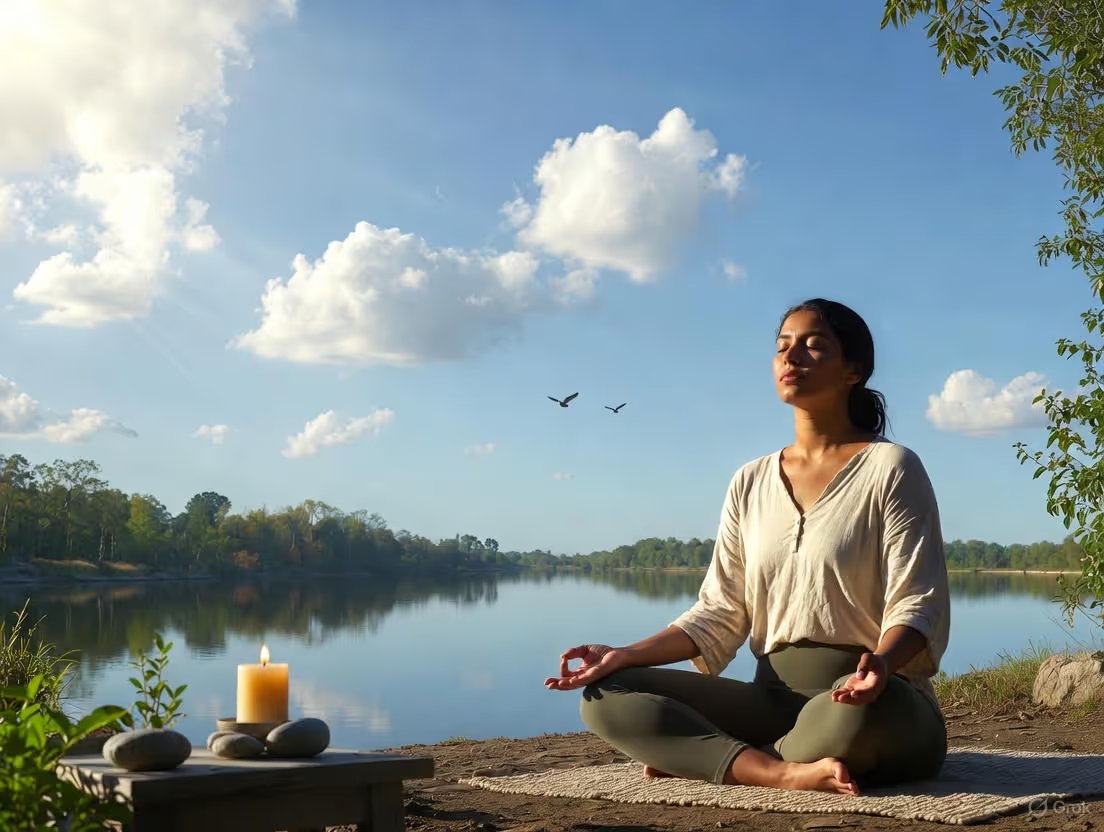
In the urban ecosystem, our digital devices are the primary vectors of distraction and stress. The smartphone is a pocket-sized portal to the city’s relentless demands: work emails at midnight, social comparisons, news cycles of crisis, and the infinite scroll. Digital mindfulness isn’t about Luddite rejection of technology; it’s about developing a conscious, intentional relationship with it, so it serves you rather than hijacks your nervous system.
The Problem: Continuous Partial Attention
We’ve adapted to a state of "continuous partial attention," constantly scanning our environment (real and digital) for the next thing to focus on. This fractures our cognitive resources, increases anxiety, and makes deep focus—or deep relaxation—impossible. Every ping is a micro-interruption, triggering a dopamine loop that keeps us hooked.
Actionable Strategies for Digital Sanity:
Using Technology as the Solution:
Paradoxically, technology itself can be a powerful ally in cultivating digital mindfulness.
Digital mindfulness is an ongoing practice of reclamation. It’s about remembering that you are the user, not the product. Each time you choose to place your phone face down, each time you savor a meal without documenting it, each time you listen fully to a friend, you are strengthening your attention muscle and taking back your most valuable urban resource: your presence.
Eating in an urban setting is often an afterthought—a hurried bite between meetings, a distracted scroll-and-scroll at your desk, or a late-night delivery eaten straight from the container. We consume calories for fuel, but disconnect from the profound experience of nourishment. Mindful eating is the practice of bringing full attention to the process of eating, reconnecting with the tastes, textures, and signals of our body. In a fast-paced city, it is a revolutionary act of self-care that improves digestion, regulates appetite, and turns a daily necessity into a source of pleasure and calm.
The Cost of Unmindful Eating: When we eat while stressed, working, or rushing, our body is in "fight-or-flight" mode. Blood flow is directed away from the digestive system, impairing nutrient absorption and leading to bloating, discomfort, and energy crashes. We also fail to register our body’s satiety signals, often leading to overeating.
How to Practice Urban Mindful Eating (Even with 20 Minutes):
Applying This in Real Urban Scenarios:
Mindful eating transforms a routine act into a ritual of nurturing. It teaches you to listen to your body’s true needs in a culture of overconsumption and distraction. It’s a daily reminder that you deserve to be nourished, not just fed. The benefits extend beyond the meal, as proper digestion and regulated blood sugar are foundational for stable energy and mood—two things every urban warrior needs. For more on how holistic wellness tracking can illuminate the connection between your habits and your health, explore the resources available to guide your journey.
Urban life can be profoundly lonely despite being surrounded by millions. We pass by countless faces, yet meaningful connection can feel scarce. This social anonymity can erode our sense of belonging and contribute to stress. Mindful urban living, therefore, must include the intentional cultivation of connection—not just deep relationships, but the small, human micro-moments that weave a fabric of belonging and remind us of our shared humanity.
The Power of "Weak Ties": Sociological research shows that interactions with casual acquaintances—the barista, the security guard, the neighbor you see in the elevator—known as "weak ties," are crucial for community well-being and personal happiness. They provide a sense of embeddedness and safety.
Mindful Practices for Urban Connection:
Storytelling: David and the Coffee Shop
David, a freelance writer, felt isolated working from home. He started working three mornings a week from a local independent coffee shop. He didn’t go with the goal of making friends, but to be around people. He made eye contact and smiled at the regulars. He learned the names of the two baristas. After a few weeks, he and another regular, an older man named Henry who came to read the paper, began nodding and then saying a few words about the weather. Over months, this evolved into brief chats about books and neighborhood history. This tiny thread of connection became a valued part of David’s week—a touchpoint of predictable, friendly human contact that alleviated his loneliness. It started with nothing more than a decision to be present and open in a shared space.
These micro-moments are the antidote to urban alienation. They require you to look up from your screen and see the people around you as individuals, not obstacles. They build a neural pathway away from fear and anonymity and toward kindness and shared space. This sense of belonging is a core component of wellness, and it’s something we think deeply about in our mission. To understand the human-centric values behind the tools we build, you can learn about our company’s mission and the vision that drives us.
In our journey thus far, we’ve focused on internal, subjective practices. Now, we integrate a powerful modern tool: objective data. While mindfulness is fundamentally about subjective experience, biometric feedback from wearable technology can act as a mirror, revealing patterns and truths about our physiology that our conscious mind might miss, rationalize, or ignore. This is not about outsourcing your intuition to a device; it’s about augmenting your self-awareness with precise, personalized insight.
From Subjective Feeling to Objective Insight: You might feel "stressed," but is it the stimulating stress of a productive challenge (eustress) or the draining stress of chronic overwhelm? You might think you slept okay, but did you truly achieve the deep, restorative sleep your brain needs? Biometric data translates vague feelings into clear metrics, allowing for more intelligent lifestyle choices.
Key Metrics for Urban Mindfulness:
How to Use Data Mindfully (Without Becoming Obsessive):
A device like the Oxyzen smart ring is designed for this kind of seamless, continuous insight. Worn on the finger, it gathers data from the rich vasculature there without the need for a bulky watch face lighting up on your wrist. It operates in the background, providing a weekly report on your inner ecosystem. This partnership between your internal awareness and external data creates a powerful feedback loop for sustainable urban living. For those curious about the specifics of how such technology fits into a daily routine, our FAQ page offers detailed support.
In the next portion of this guide, we will build upon this foundation of personal practice and insight to explore how to navigate specific high-stress urban scenarios, build a sustainable long-term mindfulness habit, and deepen your practice into a true philosophy for urban life. The journey from reactive survival to intentional thriving continues.
Having explored the foundational free practices, the natural next step is weaving them into the fabric of your daily life in a way that feels sustainable, not like another chore. A "ritual" differs from a routine in its quality of mindful intention and sacredness—it's an act done with purpose and presence. Your mindfulness ritual doesn't need candles or incense (though you can use them if you have them); it needs consistency and heart. This is about designing a personalized, resilient structure for your practice that can withstand the fluctuations of motivation and a busy life.
The core principle is flexible consistency. It's not about rigidly doing the same 45-minute practice at 5 AM every day without fail. It's about having a compassionate, adaptable plan that honors your energy levels and schedule while maintaining the thread of practice.
Steps to Build Your Personal Mindfulness Ritual:
1. Audit Your Current Energy & Time Landscape:
2. Design a "Core + Flex" Practice Model:
This model ensures you have a non-negotiable foundation and adaptable extensions.
3. Create Ritual Cues & Environment:
4. Embrace the "Minimum Viable Practice" (MVP) Mindset:
On days when motivation is zero, your only goal is to complete your Core practice. Often, just starting the 2-minute practice creates momentum to continue longer, but if not, you have still honored your commitment. This eliminates all-or-nothing thinking, the most common reason practices fail.
5. Practice the Ritual of Review:
Once a week, perhaps on a Sunday evening, take 5 minutes for a kind review.
Example of a Personalized Ritual:
This ritual is free, personal, and powerful. It belongs entirely to you. For those who enjoy tracking consistency or observing physiological correlations to their practice, some find value in unobtrusive tools. Reading about real customer reviews can illustrate how others use subtle feedback to support their ritual without becoming dependent on it.
Understanding how habits form is the key to moving mindfulness from a sporadic "good idea" to an automatic part of your identity. Neuroscience reveals that habits are formed in a loop: Cue > Craving > Response > Reward. To build a lasting mindfulness habit, we can consciously design each part of this loop.
1. The Cue (The Trigger):
This is the event that initiates the behavior. To make mindfulness habitual, you must attach it to an undeniable, existing cue.
2. The Craving (The Motivation):
The craving is not for the action itself, but for the change in state it delivers. You must learn to crave the reward that mindfulness brings.
3. The Response (The Actual Practice):
This is the habit you perform. For a habit to form, the response must be easy.
4. The Reward (The Satisfaction):
Rewards close the loop and teach your brain that the action is worth remembering. The reward for mindfulness is often intrinsic (a feeling of calm), but we can make it more immediate, especially in the early stages.
Overcoming Common Habit-Formation Hurdles:
By understanding this loop, you move from relying on willpower to engineering an environment and a mindset where mindful living becomes the natural, default option. It's the ultimate budget-friendly life hack, turning scattered efforts into a compound interest of well-being.
For many, the concept of "mindful living" can feel laughably distant when you're in the middle of a high-pressure work deadline, managing the relentless demands of caregiving, or navigating the sensory overload of a city. This is precisely where mindfulness transitions from a nice-to-have luxury to a non-negotiable survival skill. The practices must adapt to be micro-doses of presence that fit into the cracks of your demanding day.
Mindfulness for the High-Pressure Workplace:
Work stress often comes from a feeling of being overwhelmed by future tasks (anxiety) or ruminating on past mistakes. Mindfulness brings you back to the single task at hand.
Mindfulness for Caregivers & Parents:
Caregiving is a marathon of constant demands, where your attention is perpetually focused outward. Mindful self-care here is not selfish; it's the oxygen mask you put on yourself first.
Mindfulness for Urban Dwellers (Sensory Overload Management):
Cities bombard us with noise, visual stimuli, and pace. Mindfulness becomes a tool to find stillness within the storm.
In all these environments, the principle is the same: you are not trying to change the external stressor in the moment (you often can't). You are changing your relationship to it by anchoring in your embodied present experience. This shifts you from a state of reactive survival to responsive agency. For additional strategies on managing specific stress triggers, you can explore our blog for more wellness tips that address modern-life challenges.
Mindful living naturally extends to how we interact with the material world. "Mindful consumption" is the practice of bringing conscious awareness to what we buy, eat, watch, and listen to. It’s a powerful, twofold budget strategy: it saves money by reducing impulse and automatic spending, and it aligns your financial resources with your deepest values, creating a profound sense of integrity and purpose.
This goes beyond simple frugality. It’s about asking, "Does this purchase/addiction/activity truly serve my well-being and the well-being of others?"
The PAUSE Practice Before Any Purchase:
Create a mindful buffer between the impulse to buy and the action of buying.
Applying Mindfulness to Different Consumption Areas:
1. Food & Groceries:
2. Media & Entertainment:
3. The "One In, One Out" Rule for Clutter:
The Deep Reward: Values-Aligned Spending:
Money is simply stored life energy—the time and effort you exchanged to earn it. Mindful consumption means spending your life energy on things that truly matter to you. This could mean:
This practice transforms budgeting from a restrictive, scarcity-based activity into a proactive, values-based design for your life. It cultivates a deep sense of "enough," reducing the psychological drive to fill emotional voids with material goods. To see how a company embeds mindful intentionality into its own creation process, you can read our company information, mission.
While mindfulness is an inner practice, it is profoundly supported and deepened in community. In Buddhist tradition, this is called Sangha—a community of practitioners. On a budget, finding or creating this support is essential for sustaining motivation, gaining perspective, and feeling connected in what can sometimes be a solitary journey. The good news is that genuine community support is abundantly available for free.
Why Community Matters:
Finding Your Free Mindfulness Community:
1. Local, In-Person Options:
2. Digital & Virtual Sanghas (A Wealth of Free Resources):
3. Creating Your Own Micro-Sangha:
You don't need a formal group. Start small.
Engaging with Community Mindfully:
Remember, the community supports the practice; the practice is still yours. This free web of connection can be the single most important factor in maintaining a lifelong mindful journey. For those seeking to understand the community and experiences built around specific wellness tools, reading real customer reviews can offer a sense of shared user experience and learning.
After establishing a stable foundation in present-moment awareness (through breath, body, and daily activities), you may feel drawn to explore the nature of the mind itself. This moves into the territory of Insight Meditation (Vipassana), a practice of deepening wisdom by directly observing the three characteristics of all experience: impermanence (Anicca), unsatisfactoriness/stress (Dukkha), and non-self (Anatta). These are not philosophical beliefs to be adopted, but realities to be investigated through your own direct experience. This exploration is the ultimate free education, offering liberation from deeply held patterns of suffering.
1. Mindfulness of Thought (The Sky Metaphor):
You've practiced noticing when your mind has wandered from the breath. Now, you can make the thoughts themselves the object of mindfulness.
2. Observing Sensations & Emotions (The Laboratory of the Body):
All thoughts have a corresponding sensation in the body. This practice bridges mind and body.
3. The Practice of "Noting" or Labeling:
This is a classic Vipassana technique to cultivate precise, moment-to-moment awareness.
The Insight into Non-Self (Anatta):
This is the most subtle and profound investigation. Through sustained observation, you may begin to see that there is no single, permanent "controller" inside. There is seeing, but can you find a permanent "seer"? There is thinking, but can you locate a solid "thinker"? There is simply a flowing process of causes and conditions—sensations, perceptions, thoughts, consciousness—all interdependent and in constant flux. This insight, when directly experienced (not just intellectually understood), leads to a profound easing of identification with struggles and a deep sense of freedom.
Important Note: These practices can bring up deep-seated emotions or challenging psychological material. They are best undertaken with a foundation of stability and self-compassion (the Metta practice is an essential balance). If you have a history of severe trauma, it is wise to explore these under the guidance of an experienced teacher. The journey inward is the most valuable one you can take, and it requires no financial investment, only courage and curiosity.
Sleep is the foundation of physical and mental health, yet financial stress and an overactive mind are two of its greatest thieves. Mindfulness offers a powerful, drug-free, and cost-free approach to improving sleep hygiene by calming the nervous system and disentangling from the racing thoughts that keep us awake. The goal is not to force sleep, but to create the internal conditions where sleep can naturally arise.
The Pre-Bed Wind-Down Ritual (The 60-Minute Transition):
Create a buffer zone between your active day and sleep. This is a ritual of progressive sensory quieting.
Mindfulness Practices for Falling Asleep:
1. The 4-7-8 Breathing Technique (The Physiological Sigh):
This practice actively stimulates the parasympathetic nervous system.
2. The Body Scan for Sleep (A Deeper Version):
Use the body scan practice from earlier, but with the explicit intention of releasing and letting go into the support of the bed. As you scan each part, mentally whisper "release" or "let go" as you exhale. Imagine each muscle group melting into the mattress. Spend extra time on areas that hold tension (jaw, shoulders, forehead).
3. Mindfulness of Sound (The "Gateway to Sleep" Practice):
Instead of fighting ambient noise, use it as an anchor for attention.
Working with Insomnia and Wakefulness:
If you wake up in the middle of the night and can't fall back asleep, resist the urge to check the clock or your phone.
Mindfulness Upon Waking:
Set the tone for your day. Before you check your phone or even open your eyes, take 30-60 seconds.
By applying mindfulness to your sleep routine, you treat rest as a sacred part of your well-being practice, not just an automated function. You reclaim your right to rest without expensive aids, finding that the quietest place—and the one most conducive to sleep—is a mind anchored in the present. For common questions on using mindfulness or complementary tools for better sleep, our FAQ page offers further support.
We have now traversed a wide landscape of practices, from the simplest breath to the insights into the nature of mind. It is vital to conclude this portion by framing mindful living not as a self-improvement project with an endpoint, but as a lifelong path of deepening understanding, compassion, and freedom. This perspective is what makes the practice sustainable, forgiving, and infinitely rich.
Letting Go of the "Perfect Practitioner" Fantasy:
You will have days, weeks, even months where your formal practice feels inconsistent or where you react unconsciously. This is not failure; it is data. The path is not linear. The mindful response to "falling off" is not self-criticism, but the simple, gentle question: "What is happening now?" and the tender return. Each return is the practice.
The Expanding Circles of Benefit:
Mindfulness practice often begins as a personal stress-reduction tool. As it deepens, its benefits ripple outward in unexpected ways:
Continuous Learning & The Beginner's Mind:
Approach your practice with Shoshin—the beginner's mind. This is a mindset of openness, eagerness, and lack of preconceptions. No matter how long you practice, each breath is new. Each moment is fresh. This attitude keeps the practice alive and prevents it from becoming a stale routine. There are always deeper layers of stillness to discover and subtler levels of clinging to see through.
Finding Your Teachers & Resources (On a Budget):
The path is yours to walk, but you don't need to walk it alone. A wealth of free or low-cost wisdom exists:
Your Evolving Practice:
Your practice will change with the seasons of your life. What serves you as a single professional may differ from what serves you as a parent, a caregiver, or a retiree. The practices in this guide are a toolkit. You learn which tool to use for which job. Sometimes you need the gentle hammer of Metta. Sometimes you need the precise screwdriver of noting. Sometimes you just need to sit on the bench and breathe.
The journey of mindful living on a budget is the ultimate proof that the most valuable things in life are not things. They are presence, connection, compassion, and peace. These are your birthright, and they are accessed not through acquisition, but through a gentle, courageous turning of your own awareness inward and outward, again and again.
This concludes the first major portion of our comprehensive guide. You now have a robust framework of theory, practice, and integration for living mindfully without financial burden. In the final installment, we will address specific populations (students, seniors, etc.), explore the intersection of mindfulness with creativity and problem-solving, provide troubleshooting for persistent obstacles, and offer guidance on building a complete, personalized mindful life system that endures. To continue your exploration of holistic well-being, remember you can always explore our blog for more wellness tips.
Your Trusted Sleep Advocate: Sleep Foundation — https://www.sleepfoundation.org
Discover a digital archive of scholarly articles: NIH — https://www.ncbi.nlm.nih.gov/
39 million citations for biomedical literature :PubMed — https://pubmed.ncbi.nlm.nih.gov/
Experts at Harvard Health Publishing covering a variety of health topics — https://www.health.harvard.edu/blog/
Every life deserves world class care :Cleveland Clinic - https://my.clevelandclinic.org/health
Wearable technology and the future of predictive health monitoring :MIT Technology Review — https://www.technologyreview.com/
Dedicated to the well-being of all people and guided by science :World Health Organization — https://www.who.int/news-room/
Psychological science and knowledge to benefit society and improve lives. :APA — https://www.apa.org/monitor/
Cutting-edge insights on human longevity and peak performance:
Lifespan Research — https://www.lifespan.io/
Global authority on exercise physiology, sports performance, and human recovery:
American College of Sports Medicine — https://www.acsm.org/
Neuroscience-driven guidance for better focus, sleep, and mental clarity:
Stanford Human Performance Lab — https://humanperformance.stanford.edu/
Evidence-based psychology and mind–body wellness resources:
Mayo Clinic — https://www.mayoclinic.org/healthy-lifestyle/
Data-backed research on emotional wellbeing, stress biology, and resilience:
American Institute of Stress — https://www.stress.org/


