


The Morning Pages Practice: Writing for Mental Clarity and Calm
Morning Pages involve writing three pages of stream-of-consciousness thoughts first thing in the morning to clear mental clutter and foster calm clarity.
Morning Pages involve writing three pages of stream-of-consciousness thoughts first thing in the morning to clear mental clutter and foster calm clarity.
%402x.svg)
The most potent tool for mental wellness may already be sitting on your desk. It doesn’t require a subscription, an app download, or a specialized device. It asks only for three pages, a pen, and the raw, unfiltered contents of your mind first thing in the morning. This is the practice of Morning Pages, a simple yet profoundly transformative ritual that has quietly guided artists, executives, and seekers toward clarity, creativity, and calm for decades.
In our hyper-connected, data-saturated world, the internal noise has never been louder. We track our sleep, our steps, and our heart rate variability, optimizing our bodies while our minds churn with to-do lists, anxieties, and digital detritus. We seek external solutions for internal states. But what if the key to managing that mental chaos wasn’t another notification, but an ancient, analog act of release? The Morning Pages practice, popularized by Julia Cameron in her seminal work The Artist’s Way, is not about writing well. It’s about writing to think well. It is a daily brain drain, a spiritual windshield wiper, a dedicated space to meet yourself before the world tells you who you should be.
This practice aligns perfectly with a modern, holistic approach to wellness—one that values subjective, internal data as much as objective, external metrics. Just as a smart ring like those developed by Oxyzen provides insights into your physiological state, Morning Pages provide an unvarnished log of your psychological and emotional landscape. Together, they form a complete picture of well-being: the quantifiable and the qualitative, the body and the mind.
This article is your deep dive into the art, science, and soul of Morning Pages. We will explore its origins, dismantle its mechanics, and uncover the robust neuroscience that explains why this simple act works. We’ll guide you through starting and sustaining the practice, troubleshoot common hurdles, and examine its synergistic relationship with modern wellness technology. This is more than a writing guide; it’s an invitation to build a foundational habit for a clearer, calmer, and more creative life.
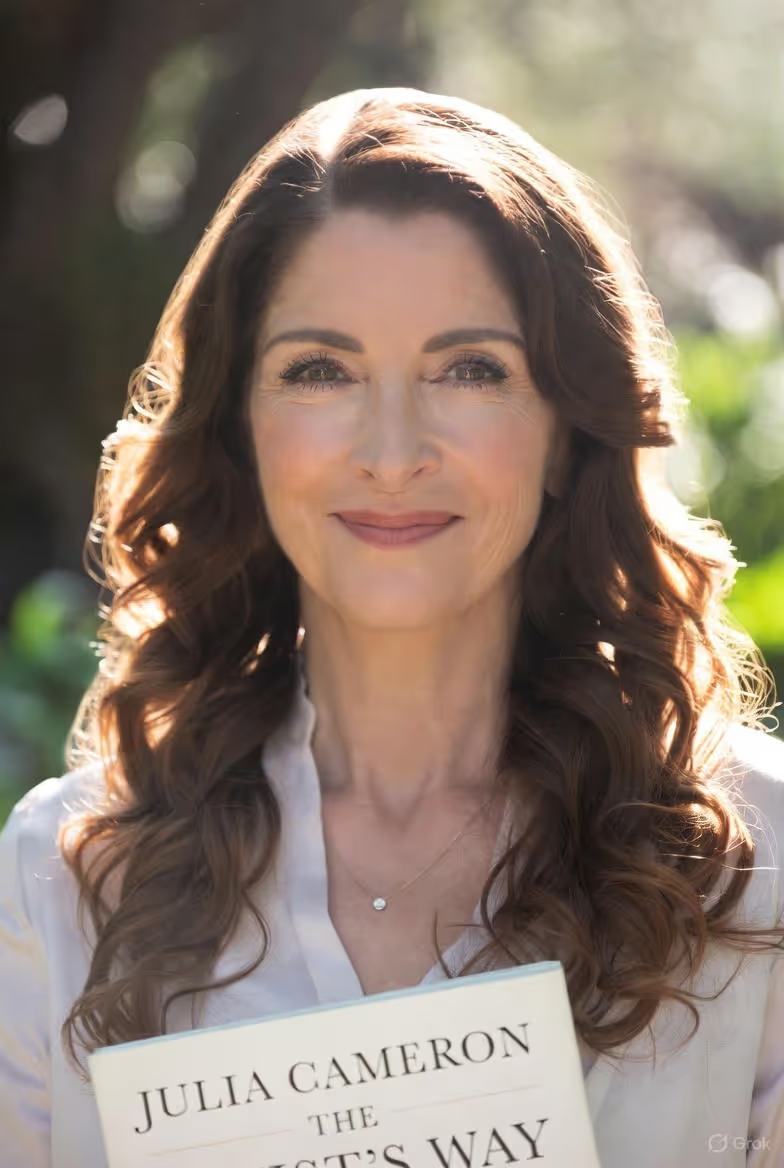
To understand the weight of the Morning Pages practice, one must first appreciate its source. The practice did not emerge from a corporate wellness blog or a Silicon Valley biohacker’s manifesto. It flowed from the heart of a creative recovery, a spiritual journey meant to unblock artists of all kinds. Julia Cameron, a filmmaker, poet, and teacher, crystallized the practice in her 1992 book, The Artist’s Way: A Spiritual Path to Higher Creativity. The book, often described as a course in discovering and recovering your creative self, positioned Morning Pages as its non-negotiable bedrock, the “primary tool” of creative recovery.
Cameron herself developed the practice out of necessity. As an artist grappling with the tumult of Hollywood and personal challenges, she began writing daily pages as a way to navigate her own mind. She discovered that this daily dumping ground for fears, petty annoyances, dreams, and mundane thoughts had a paradoxical effect: it didn’t amplify the noise; it silenced it. By externalizing the mental static onto the page, she cleared psychic space for inspiration, intuition, and focused action to enter. She began teaching the method to her students, witnessing its power to break through creative blocks, alleviate anxiety, and reconnect individuals with a sense of playful possibility.
The Artist’s Way framed Morning Pages not as a literary endeavor but as a spiritual practice. Cameron often refers to them as “meditation for writers,” or more broadly, “prayer.” They are a form of active listening directed inward. The instructions were, and remain, deceptively simple: upon waking, write three longhand, stream-of-consciousness pages. Do not edit, do not censor, do not worry about grammar, spelling, or coherence. The content is irrelevant; the act is everything. It is a transaction between you and you, with the page as the witness.
The book struck a chord that has reverberated for over thirty years. It has sold millions of copies, spawned dedicated groups and workshops worldwide, and seen a significant resurgence in recent years—particularly among a generation drowning in digital distraction and seeking authentic self-expression. The practice has transcended its original artistic context. Today, it is used by entrepreneurs to clarify business goals, by therapists as a supplementary tool for clients, by parents managing household chaos, and by anyone feeling cognitively overloaded. Its endurance is a testament to a universal human need: to process our experience in a safe, private, and structured way.
The genius of Cameron’s formulation lies in its constraints and its consistency. The “three pages” requirement creates a tangible finish line, making a nebulous goal (“clear my mind”) concrete. The “morning” timing hijacks the brain in its most impressionable state, before the defenses of the day are fully armored. This ritualistic aspect is key; as Cameron writes, “Pages are a way to greet the day on your own terms.” For a deeper look at how foundational rituals support holistic well-being, you can explore related topics on our wellness and technology blog.
At first glance, Morning Pages might be mistaken for traditional journaling or a daily diary entry. The confusion is understandable—both involve writing in a notebook. But to equate them is to miss the radical, functional difference that makes Morning Pages a unique cognitive tool. Understanding this distinction is crucial for practicing them correctly and reaping their full benefits.
Traditional journaling is often reflective, narrative, and curated. You might write about your day’s events, explore a specific emotion in depth, document gratitude, or craft a coherent story about your life. It can be thematic, structured, and look back on what has already happened. There is often an implicit, or even explicit, sense of an audience—even if that audience is your future self. This makes journaling a wonderful practice for memory-keeping, emotional processing, and crafting a personal narrative.
Morning Pages, by contrast, are prospective, process-oriented, and purely private. They are not meant to be re-read, shared, or even understood. Let’s break down the core differentiators:
In essence, if journaling is like having a thoughtful conversation with yourself, Morning Pages are like undergoing a mental colonic irrigation. One is communicative; the other is cathartic. One builds a story; the other clears the debris so a new story can be written. For individuals who use devices like the Oxyzen smart ring to quantify physical stress, Morning Pages offer the qualitative counterpart—a way to express that stress, giving context to the physiological data. You can learn more about how Oxyzen integrates data for holistic insight to see how internal and external tracking can merge.

The transformative testimonials surrounding Morning Pages are compelling, but is there scientific substance behind the spiritual sheen? Remarkably, modern neuroscience and psychology provide robust frameworks for understanding why this analog habit can be so effective for digital-age minds. The benefits are not merely poetic; they are physiological and cognitive.
1. Cognitive Offloading and the Brain’s RAM:
The brain’s prefrontal cortex is like a CEO, managing working memory, decision-making, and emotional regulation. But its capacity is finite—a concept known as cognitive load. When cluttered with unresolved thoughts, worries, and to-do items (a state psychologists call “cognitive rumination”), its processing power for focused tasks diminishes. The act of expressive writing, particularly the stream-of-consciousness style of Morning Pages, functions as cognitive offloading. By externalizing these thoughts onto paper, you literally clear them from your working memory. A study published in the Journal of Experimental Psychology has shown that writing about unfinished tasks and worries can help the brain release them, improving subsequent focus and reducing anxiety. The page becomes your external hard drive, freeing up your brain’s RAM for the day’s work.
2. Emotional Regulation through Labeling:
Neuroscience research using fMRI scans reveals a fascinating phenomenon: when you assign a word to an emotion—a process called “affect labeling”—it can dampen the activity of the amygdala, the brain’s fear and alarm center. Writing about anxious or stressful feelings in a free-form manner is a powerful form of affect labeling. You are not just feeling the anxiety; you are observing it, describing it, and thereby creating a slight distance from it. This process moves the experience from the reactive limbic system to the more regulatory prefrontal cortex, promoting calm and control.
3. Breaking the Cycle of Rumination:
Rumination—the repetitive, obsessive cycling of negative thoughts—is a core feature of anxiety and depression. It’s a mental loop that feels impossible to escape. Morning Pages interrupt this loop by providing a structured outlet. The instruction to keep the hand moving forces the ruminative thoughts onto the page and, crucially, through their cycle to exhaustion. Once written, the mind often finds it can move on. Clinical psychologists often use similar expressive writing exercises (like James Pennebaker’s paradigm of writing about traumatic experiences) because it helps organize chaotic experiences into a narrative, reducing their intrusive power.
4. Accessing the Subconscious and Default Mode Network (DMN):
The early morning, dreamy state is when the brain’s Default Mode Network (DMN) is most active. The DMN is associated with self-referential thinking, introspection, daydreaming, and creative incubation. Morning Pages act as a targeted probe into this network. The non-directed writing allows connections to form between disparate ideas, forgotten memories, and novel solutions—often leading to the “aha!” moments users frequently report. It’s a way to harness the brain’s natural, inward-focused cycle for problem-solving and insight.
5. The Kinesthetic Benefit of Longhand:
The requirement to write by hand is not an arbitrary, nostalgic choice. The physical act of forming letters engages the brain differently than typing. It involves fine motor skills, tactile feedback, and a slower pace that is better matched to conscious thought formation. This slower process can deepen processing and improve memory encoding. Furthermore, the ritual of putting pen to paper can trigger a calming, mindful state, reducing cortisol levels—a direct bridge to the calm that many practitioners seek. This focus on the foundational elements of well-being aligns with the philosophy behind Oxyzen, where we believe in returning to core principles, enhanced by understanding. You can read more about our story and mission here.
In summary, Morning Pages work because they leverage fundamental brain mechanics: they offload cognitive clutter, regulate emotion through expression, disrupt negative thought loops, tap into creative neural networks, and utilize the mindful benefits of handwriting. It’s a holistic brain-training exercise.
One of the great beauties of Morning Pages is their radical accessibility. In a world that often gates wellness behind paywalls and product purchases, this practice requires minimal investment. However, the right tools, while simple, can lower the barrier to entry and make the ritual more inviting. Let’s demystify the essentials.
The Non-Negotiables:
The Optional Enhancers:
What You Don’t Need:
Addressing the Digital Temptation: “But what about an app that mimics a notebook?” While apps like Day One or Journey are excellent for reflective journaling, they fail the core test for Morning Pages: they exist on the same device that delivers the world’s demands. The separation is the point. The analog nature creates a sacred buffer between your inner world and the digital chaos. For those deeply immersed in the quantified self, think of it this way: your Oxyzen ring collects passive physiological data; your Morning Pages are active, conscious data entry for the soul. They are two complementary streams of self-knowledge. If you have questions about integrating different wellness practices, our FAQ section often addresses such holistic approaches.
The message is liberating: your investment is not in gear, but in commitment. The simplest tools, used consistently, yield the richest returns.
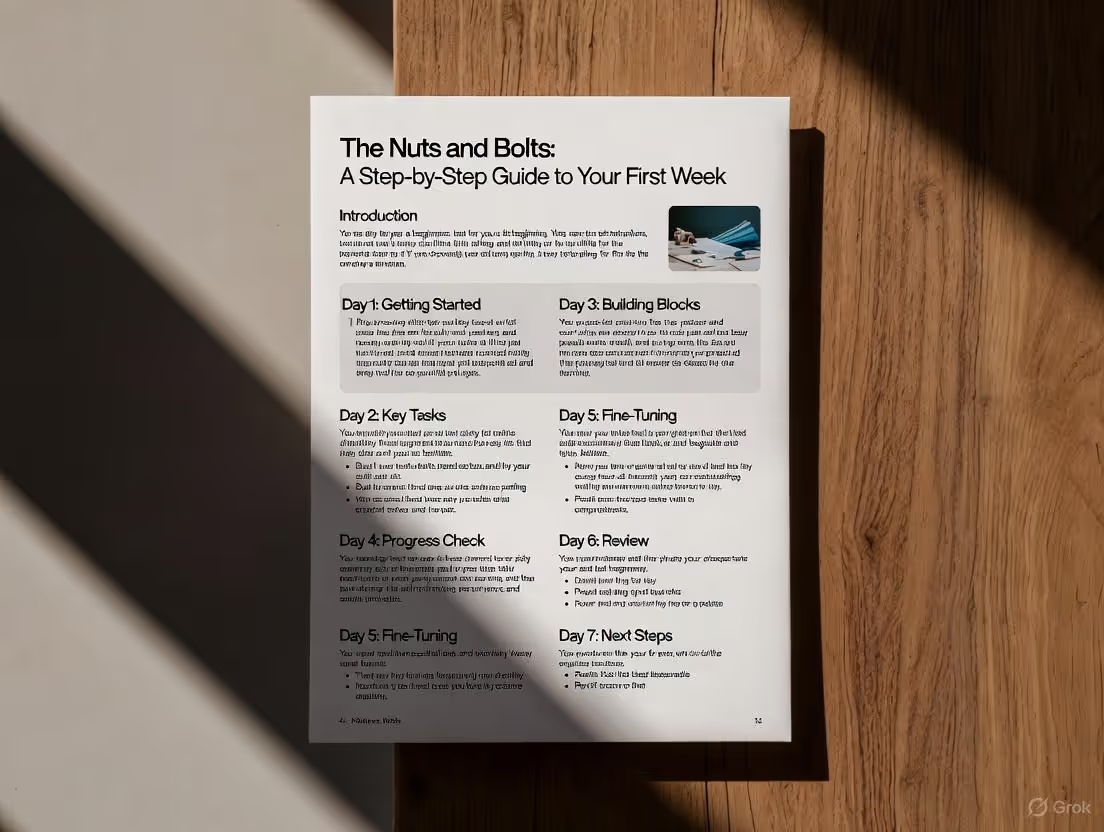
Understanding the theory is one thing; putting pen to paper is another. The first week of Morning Pages can feel awkward, frustrating, and surprisingly challenging. This step-by-step guide is designed to bypass the resistance and build a sustainable habit from day one.
Pre-Game: The Night Before
Set your notebook and pen in your designated spot—on the kitchen table, your bedside stand, your home office desk. This small act of preparation does two things: it reduces friction in the sleepy morning, and it serves as a visual commitment to your future self.
The Morning Ritual (Approx. 20-30 Minutes)
A Week-Long Sample Journey:
Crucial Mindset Tips for the First Week:
This structured start builds the neural pathway for the habit. For additional support in building lasting wellness routines, you can find community stories and shared experiences in our testimonials section, where many discuss their journey with foundational habits.
After the initial hurdle of the first week, the benefits of Morning Pages begin to crystallize. The most immediate and universally reported effect is a profound sense of mental clarity. But what does that actually mean in cognitive and practical terms? Let’s dissect how this simple act declutters the psyche.
1. The Vortex of Worries Becomes a List on a Page.
Anxiety often thrives in ambiguity and abstraction. A swirling, nebulous worry about “work” or “money” or “the future” feels overwhelming because it has no edges. Morning Pages force these vortices onto the linear path of sentences. As you write “I’m worried about the Q3 presentation,” you might naturally continue with “because I haven’t finalized the slides, and I’m not sure about the data from the marketing team, and I need to email Sarah for the figures…” Suddenly, the monolithic “work worry” is broken down into discrete, actionable (or at least identifiable) components. The anxiety doesn’t necessarily vanish, but it is contained and often diminished. The page holds it so your mind doesn’t have to.
2. Decision-Making Becomes Decisive.
Indecision is frequently a product of cognitive overload—too many pros and cons, fears, and variables competing for mental bandwidth. Pages act as a decision lab. You can write out the options for a dilemma (“Should I take the new job?”) and then freely explore your feelings about each without social or internal censorship. The stream-of-consciousness format allows hidden fears (“I’m afraid I’m not skilled enough”) and true desires (“I really want a fresh challenge”) to surface. Often, by the bottom of the third page, your gut feeling has articulated itself clearly. The page becomes a neutral sounding board that reflects back your own wisdom.
3. Prioritization Emerges Naturally.
When you brain-dump everything in your mental cache, an interesting thing happens: the trivial (what to make for dinner) and the significant (a strained relationship) end up side-by-side. This juxtaposition alone can provide perspective. Furthermore, as you write about your upcoming day, your true priorities often announce themselves. The item you keep avoiding or circling back to is usually the one that needs your energy. The pages help you distinguish between the urgent and the important, creating a mental to-do list sorted by subconscious weight, not just random recall.
4. The “Psychic Ping-Pong” Ceases.
Have you ever had an imaginary argument or rehearsed a difficult conversation in your head on a loop? This internal ping-pong is exhausting. Morning Pages provide the court for that game to finish. You can write out both sides of the argument, say all the things you wish you could say, and explore the outcomes. Once it’s on the page, the mind often stops replaying it. It’s been expressed; its energy is spent.
5. Creating a Baseline of Calm.
By evacuating the mental static first thing in the morning, you establish a cleaner cognitive baseline for the day. It’s akin to starting your computer with fewer background programs running. This doesn’t mean the day will be stress-free, but it means you begin from a place of greater capacity to handle stress. Reactions become more considered, focus is easier to summon, and the general “noise level” in your head is turned down. This cultivated calm is a form of mental clarity in itself—the space between thoughts grows wider.
This clarity isn’t mystical; it’s functional. It’s the difference between navigating your day with a foggy, smudged windshield and one that’s been meticulously cleaned. You see obstacles, opportunities, and your own intentions with greater sharpness. For the data-driven individual, this subjective clarity can be observed indirectly through other metrics. You might notice, for example, that on days you do your Pages, your Oxyzen ring shows lower resting heart rate or more stable stress scores, a tangible correlation between mental purging and physiological calm. To see how others have connected these dots, browse stories on our blog about integrative wellness practices.
While mental clarity is the immediate gift, one of the most celebrated long-term benefits of Morning Pages is their profound impact on creativity and problem-solving. This isn’t limited to “artists” in the traditional sense. Creativity here refers to the ability to generate novel and useful ideas—a skill vital for entrepreneurs, engineers, parents planning a week’s meals, or anyone facing a complex challenge. Morning Pages work as a creativity incubator through several key mechanisms.
1. Silencing the Inner Critic (The “Censor”).
Julia Cameron’s central creative monster is the “Censor”—that internal voice that says, “That’s a stupid idea,” “You’re not a real writer/artist/thinker,” “That’s been done before,” or “Who do you think you are?” This Censor lives in the left-brain, logical, editorial mind. The non-stop, no-editing rule of Morning Pages is a direct muzzle for this voice. By forcing yourself to write without regard for quality, you are training your brain to bypass the Censor’s gatekeeping. Over time, this permission to be “bad” in your private pages transfers to other areas of your life, allowing more raw, unconventional ideas to surface in your work without being immediately shot down internally.
2. Mining the Subconscious for “Brain Gold.”
The subconscious mind is a vast repository of memories, observations, half-formed connections, and intuitive leaps. Our conscious, task-oriented day mind rarely has access to this treasure trove. The morning, stream-of-consciousness writing style is like sending a mining drone into the depths. You start with surface gravel (“I need coffee”), but as you keep writing, you strike veins of more interesting material: a forgotten conversation, a vivid sensory memory, a symbolic dream image, a sudden solution to a coding problem that stalled you yesterday. These gems appear because you are not trying to find them; you are simply creating the conditions for them to emerge.
3. Connecting Disparate Dots.
Creativity is often about making novel connections between existing concepts. The free-flowing, associative nature of Morning Pages is a perfect engine for this. Writing about a stressful meeting might lead you to a memory of your third-grade teacher, which might spark an analogy you can use in a presentation, which might remind you of a book you wanted to read. On the page, these seemingly random associations can collide and combust into a truly original idea. The linear process of writing facilitates non-linear thinking.
4. Problem-Solving Through Peripheral Vision.
When you’re stuck on a problem, staring directly at it often tightens the mental knot. Morning Pages allow you to approach it peripherally. You can write around the problem—describe your frustration with it, reminisce about a time you solved something similar, or even write a fictional dialogue with the problem personified. This indirect exploration relaxes the rigid, focused problem-solving mode and often allows a solution to appear from an unexpected angle. Many practitioners report that answers to work dilemmas or creative blocks simply “pop out” during their pages, unbidden.
5. Building a Volume of Ideas.
A core principle in creative work is that quantity leads to quality. To get a few great ideas, you must generate a lot of ideas, most of which will be mediocre or bad. Morning Pages are a daily exercise in generating volume without judgment. This builds your “idea muscle.” Over time, you become more fluent in ideation, and the frequency of usable, interesting ideas increases. The pages become your private idea compost heap—much of it will decompose, but it creates rich soil from which brilliant shoots can grow.
For the innovator or the problem-solver, Morning Pages are a clandestine business meeting with your deepest intelligence. They ensure you’re not just running on the treadmill of execution, but are regularly tapping the wellspring of insight. In a world that values constant output, this practice is a dedicated input for your most valuable resource: your original thinking. This philosophy of nurturing core capacity is shared by our approach at Oxyzen, where we focus on providing foundational data to empower your personal growth. Learn more about our mission and values here.

Our emotional lives are not static. They are rivers of feeling—sometimes calm, often turbulent. When denied a healthy outlet, these emotions can flood our mental landscape, manifesting as anxiety, irritability, or numbness. Morning Pages act as a constructed emotional spillway, a safe channel to direct and process this flow, preventing internal dam breaks. This function is perhaps the practice’s most powerful therapeutic attribute.
1. The Container Effect.
Strong emotions, especially negative ones like anger, fear, or grief, can feel boundless and therefore terrifying. The physical notebook provides a concrete, finite container for these boundless feelings. You can pour your rage, your sadness, your jealousy onto its pages, and the notebook holds it. This act of containment alone is regulating. It creates a boundary between you and the emotion; you are not the emotion, you are the one experiencing it and choosing to place it here. This subtle shift from “I am angry” to “I am feeling anger, and I am writing about it” is a foundational step in emotional intelligence.
2. Depriving Anxiety of Its Fuel: Avoidance.
Anxiety thrives on avoidance. The more we try to suppress or run from an anxious thought, the more power it gains. Morning Pages are a practice of radical approach. You sit down and directly face whatever is swirling inside. You write, “I am so anxious about my finances” and then you stay with it. You don’t distract yourself with your phone. You write into the anxiety. What’s the worst-case scenario? What’s a more likely scenario? What’s one tiny step you could take? This exposure therapy in written form robs anxiety of its primary maintenance mechanism. It teaches your nervous system that you can tolerate these feelings and that they eventually pass.
3. Differentiation and Nuance.
Often, we feel a general “bad” feeling—a heavy soup of stress, overwhelm, and sadness. Writing forces this soup through the colander of language. To describe the feeling, you must differentiate it. “I feel overwhelmed because my inbox has 200 messages, and I feel sad because I miss my friend, and I feel inadequate because I compared myself to someone on Instagram.” Naming these component parts makes each one smaller and more manageable. You move from an overwhelming fog to a list of specific weather conditions you can address one by one.
4. Completing the Stress Cycle.
Psychologists note that the body’s stress response is designed to culminate in a physical action (fight or flight). In modern life, we often trigger the stress response (with a worrying thought or an email) but don’t complete the cycle with action, leaving stress hormones lingering. The physical act of writing—moving your hand, gripping the pen—is a mild, constructive physical outlet. Furthermore, the act of expressing the worry is a cognitive completion. It signals to the limbic system, “Threat has been addressed.” This can help bring the nervous system back to a state of equilibrium.
5. Cultivating Self-Compassion.
As you write your uncensored truth day after day, you witness yourself—your pettiness, your fears, your hopes. Without the filter of performance, you meet your authentic self. This daily, non-judgmental encounter is a masterclass in self-compassion. You begin to see your patterns, your triggers, and your resilience. You become your own confidant. This internal relationship of witness and acceptance is a potent antidote to the self-criticism that underpins much of our anxiety.
For anyone tracking their well-being, the emotional regulation from Morning Pages can have downstream effects on every other metric. Less chronic anxiety often correlates with better sleep, improved heart rate variability, and lower cortisol—all things a sophisticated wellness tracker might monitor. It’s the ultimate biohack for the emotional body. If you’re curious about the intersection of emotional well-being and physiological data, our community testimonials often highlight these personal discoveries.
The brilliance of Morning Pages is not in doing them once, but in weaving them into the fabric of your life. They are what author Charles Duhigg calls a “keystone habit”—a single practice that, once established, has ripple effects that reorganize and improve other areas of your routine. But how do you move from a motivated start to a non-negotiable ritual? The key lies in smart integration and a compassionate approach to consistency.
Strategic Integration into Your Morning:
Navigating the Inevitable Resistance:
You will miss days. You will have mornings where you “don’t have time.” The practice is not about perfection.
Sustaining the Practice for the Long Term:
When Morning Pages become a keystone habit, the benefits multiply. The discipline spills over, making it easier to establish other healthy routines—like exercise, mindful eating, or a consistent sleep schedule. The clarity they provide makes you more effective, potentially freeing up time. The emotional processing makes you more resilient, improving relationships. It is a small daily investment with compounding interest for your entire life ecosystem. For more ideas on building synergistic wellness systems, our blog offers a wealth of related resources.
If Morning Pages were only a receptacle for to-do lists and daily musings, their power would be limited. Their true transformational depth is revealed when they become the arena for shadow work—the conscious confrontation with the parts of ourselves we typically avoid, suppress, or deny. This includes our deep-seated fears, our sharpest self-criticism, our unexpressed anger, and our limiting beliefs. The pages provide a safe, private laboratory to bring these elements into the light, where they lose their coercive power.
1. Giving Form to the Formless Critic.
The “Inner Critic” or “Censor” is often a vague, menacing presence. In the pages, you can personify it. Give it a name, a voice, a ridiculous costume. Write a dialogue with it. “Okay, Nigel (the Critic), what do you have for me today? Oh, I’m a fraud for attempting this project? Tell me more.” By externalizing this voice onto the page, you separate your identity from it. You see its arguments as repetitive, often absurd scripts, not ultimate truths. This act of objectification is the beginning of disidentification. You are not the critic; you are the one listening to (and now writing down) the critic.
2. Mapping the Territory of Resistance.
When you consistently avoid your Pages, or when you find yourself writing the same complaints day after day, you have hit a rich vein of resistance. Resistance is not the enemy; it is a signpost pointing to something important beneath the surface—a fear of failure, a grief you haven’t processed, a boundary you need to set. The instruction to “keep the hand moving” forces you to write into the resistance. “I don’t want to write about why I’m angry at my partner… fine, I’ll write about not wanting to write about it…” This circular path almost always leads to the core issue. The page becomes a map of your own psychic defenses, allowing you to see and eventually navigate around them.
3. The Alchemy of Complaining.
Morning Pages are famously a dumping ground for petty grievances. This is a feature, not a bug. There is cathartic value in the unrestrained whine. But beyond catharsis, there is alchemy. When you complain about the same thing for three days straight, a shift often occurs. First, you bore yourself. Then, you might ask, “If I hate this so much, what am I going to do about it?” The endless complaint can spontaneously combust into a spark of personal agency. The negativity, fully expressed, exhausts itself and makes space for solution-oriented thinking.
4. Unearthing Core Wounds and Limiting Beliefs.
Beneath the surface-level anxiety about a work presentation might lie a deeper belief: “I am not smart enough.” Beneath the jealousy of a friend’s success might be the wound: “I am unworthy of good things.” Stream-of-consciousness writing is a dredging tool that can pull these buried structures into view. You might write, “I’m scared of the meeting because I’ll look stupid…” and then suddenly remember a time in 4th grade when a teacher humiliated you. This connection—made not in therapy but in your own private writing—is profoundly illuminating. It explains the present emotional charge and allows you to address the adult reality separately from the childhood memory.
5. Integrating the Shadow.
Psychologist Carl Jung posited that integration of the shadow—the rejected parts of the self—is essential for wholeness. Morning Pages are a daily practice of shadow integration. You allow the “unacceptable” thoughts (the jealousies, the mean judgments, the lazy desires) to exist on the page without judgment. By acknowledging them, you drain them of their secret control. You no longer have to expend energy pretending you don’t have these thoughts. This integration leads to a more authentic, grounded, and less reactive self.
This shadow work is not always pleasant, but it is ultimately liberating. It’s akin to cleaning a wound so it can heal properly. The practice builds emotional resilience by teaching you that you can encounter your own darkness and not be destroyed by it. In fact, you can learn from it. This deep internal work complements the external awareness provided by tools like the Oxyzen ring, which might show you the physiological cost of unprocessed stress (elevated nighttime heart rate, poor HRV). The Pages give you the qualitative context to understand and address what the quantitative data reveals. For more on the philosophy of integrating internal and external awareness, you can explore our story of creating tools for holistic insight.
The benefits of Morning Pages radiate outward. While the practice is profoundly personal, its impact on your relationships and communication can be dramatic. By managing your internal world, you change how you show up in your external world. The pages act as a filter, a rehearsal space, and a clarity-bringer for your interactions with others.
1. The Relationship Pressure Valve.
How often do we bring the baggage of our day—frustrations from work, anxiety about finances, general irritability—into our interactions with partners, children, or friends? Morning Pages siphon off this diffuse emotional charge before you engage. By writing out your frustrations about your boss, you’re less likely to snap at your spouse over a misplaced dish. The page absorbs the overreaction, allowing you to address the real issue with the appropriate person, or simply let it go. It prevents “emotional spillover,” creating cleaner boundaries between the different areas of your life.
2. From Reaction to Response.
When a conflict arises, our immediate reaction is often defensive, emotional, and rooted in old patterns. Morning Pages create a crucial pause. You can write about the conflict the morning after, or even in anticipation of a difficult conversation. On the page, you can spew your unfiltered anger, your hurt, your blame. Once that’s out, you can often access a more mature, empathetic perspective. “Okay, I’m furious they didn’t consult me. But I can also see they were under deadline pressure. How can I express my need for inclusion without attacking?” The page allows you to move from a reactive state to a considered, responsive state, leading to more constructive communication.
3. Clarifying Your Needs and Boundaries.
Many relationship conflicts stem from unexpressed needs or porous boundaries. In the meandering safety of the pages, you can discover what you truly need. You might write, “I’m resentful that my friend always cancels last minute…” which leads to, “I need friends who respect my time,” which clarifies a boundary you need to set. The pages help you articulate these things to yourself first, which is the essential step before you can healthily communicate them to others.
4. Cultivating Empathy and Perspective.
As you practice non-judgmental observation of your own messy mind, you subtly extend that skill to others. Writing about a conflict often leads to spontaneously seeing the other person’s side. “I was so hurt when they said that… though, I guess from their perspective, they were just stressed about X.” This doesn’t mean excusing poor behavior, but it does prevent you from solidifying into a rigid, victimized position. The pages become a training ground for the complex, nuanced empathy required for deep relationships.
5. Rehearsing Difficult Conversations.
The page is the safest place in the world to practice. You can write the blistering email you want to send—and then delete it (from your mind, by closing the notebook). You can draft and re-draft how you might bring up a sensitive topic with a loved one. You can find the core message beneath your anger or fear. This rehearsal reduces anxiety and increases the likelihood of a successful, real-world conversation. You’ve already navigated the emotional rapids on paper; the actual conversation becomes a calmer river.
6. Appreciation and Connection.
While not their primary function, Pages can also surface gratitude and love that gets lost in daily busyness. Amidst the clutter, you might find yourself writing, “I saw the way my kid concentrated on their drawing yesterday and my heart just burst.” This conscious recognition, captured on paper, can inspire you to express that appreciation directly, strengthening the bonds that matter most.
In essence, Morning Pages make you a better relational partner by making you a more self-aware, self-regulated individual. You stop demanding that others manage your emotions for you. You enter interactions with greater clarity about your own position and greater curiosity about theirs. This creates a foundation for healthier, more authentic connections. For those navigating the complexities of modern life and wellness, finding these foundational practices is key. Discover how others have used mindful rituals to enhance their lives by reading real user experiences and testimonials.
Morning Pages do not exist in a vacuum. They are one powerful strand in the braid of holistic well-being. When intentionally paired with other wellness practices—particularly sleep, nutrition, and biometric tracking—they create a synergistic effect where the whole becomes greater than the sum of its parts. This integrated approach addresses the human being as a system of mind, body, and behavior.
1. The Sleep-Pages Feedback Loop.
Pages → Sleep: By offloading worries and processing the day’s emotions, Pages can significantly reduce cognitive rumination at bedtime. The mind that has had its daily “debrief” is less likely to replay anxieties on the ceiling at 2 a.m. This can lead to easier sleep onset and less disrupted sleep.
Sleep → Pages: Quality sleep is the foundation of mental clarity and emotional regulation. A well-rested brain is better able to engage in the focused, yet free, act of stream-of-consciousness writing. Poor sleep can make Pages feel more sluggish, but doing them anyway can help process the irritability that comes with fatigue, creating a positive feedback loop. Using a device like the Oxyzen ring to track sleep stages and quality can provide objective data to correlate with your subjective experience noted in your Pages (e.g., “Woke up feeling ragged today,” corresponding with low deep sleep).
2. Nutritional Awareness and Mindful Eating.
Pages → Nutrition: Your writing may unveil patterns you hadn’t noticed. You might find yourself repeatedly writing about the 3 p.m. energy crash, or digestive discomfort, or emotional eating triggers (“I felt stressed and ate the whole bag of chips”). This conscious awareness is the first and most crucial step toward change. Pages can help you connect cravings to emotions, leading to more mindful food choices.
Nutrition → Pages: Stable blood sugar from balanced nutrition supports consistent energy and mood, creating a more stable internal environment from which to write. The brain fog from a high-sugar breakfast is not conducive to clear writing (or clear thinking). Pages can become a log to experiment with: “Had a protein-rich breakfast today, and my Pages felt more focused.”
3. The Quantified Self Meets the Qualified Self.
This is where the synergy with technology becomes particularly potent. Biometric trackers (like smart rings or watches) provide objective, quantitative data about your body’s state.
4. Creating a Holistic Morning Ritual.
The most powerful integration is operational. You can design a morning routine that seamlessly blends these practices:
This ritual addresses multiple layers of your well-being in under an hour, setting a tone of intentional self-care. The Pages are the bridge between the physical data and your conscious psychological state. For more ideas on crafting such integrative routines, our blog is a resource for modern wellness strategies.
The journey with Morning Pages is not static. Like any deep practice, it evolves in stages, each with its own challenges and revelations. Understanding this natural progression can help you stay committed through the inevitable plateaus and periods of doubt, transforming the practice from a 30-day experiment into a lifelong companion.
Stage 1: The Honeymoon & The Grind (Weeks 1-8)
Stage 2: First Glimmers and Functional Benefits (Months 2-6)
Stage 3: The Depths and the Shadows (6 Months - 2 Years)
Stage 4: Integration and Fluidity (2+ Years)
Stage 5: The Lifelong Lens
Navigating this evolution requires patience. There will be backslides to Stage 1 feelings. The key is to keep the hand moving, trust the process, and remember that the practice itself is the teacher. For those on a dedicated wellness journey, this long-term perspective is similar to the commitment to understanding one’s health data over years, not days—a philosophy embraced in the design and support of tools like Oxyzen. If you have questions about sustaining long-term wellness practices, our FAQ section offers support and answers.
Once the core habit of Morning Pages is firmly established—a daily ritual as reliable as the sunrise—a new frontier opens. The foundational practice of three stream-of-consciousness pages becomes a launchpad for specialized, intentional applications. These advanced expansions allow you to harness the cleared mental space and accessed subconscious for targeted outcomes, from creative projects to life transitions. Think of it as learning basic grammar before writing poetry; you now have the fluency to compose with purpose.
1. Thematic Pages: Diving Deep on a Single Topic.
Instead of a total brain dump, you dedicate your three pages to exploring one pressing theme. This is not an essay; it’s still stream-of-consciousness, but with a focal point.
2. Project Incubation Pages.
Use your Pages as a dedicated “meeting space” for a long-term creative or professional project—writing a book, starting a business, planning a renovation.
3. Dialogue Pages for Problem-Solving.
When stuck, writing a dialogue can unlock perspectives that direct prose cannot.
4. Gratitude & Affirmation Integration (Post-Dump).
While pure Morning Pages reject intentional positivity (the “shoulds”), a natural expansion for seasoned practitioners is to add a brief, intentional component after the three pages are complete.
5. The “Evening Pages” or “Before-Bed Brain Dump” Variation.
For those whose minds race at night, an evening complement can be revolutionary.
6. Artistic and Non-Linear Expansions.
For the visually inclined, the practice can transcend words.
These expansions keep the practice vital and responsive to your evolving life. They prevent it from becoming rote and demonstrate its incredible flexibility as a tool for conscious living. Just as advanced users of a wellness device like Oxyzen learn to interpret their HRV trends in the context of training load or life stress, advanced Morning Pages practitioners learn to use the tool for targeted, sophisticated self-inquiry. For more on evolving your personal wellness system, our blog features stories of adaptation and growth.
While Morning Pages are an intensely private dialogue with the self, they paradoxically thrive within the context of community. Engaging with others who practice creates a container of accountability, normalizes the struggles, and amplifies the insights. This community can range from a single accountability partner to a global online movement, weaving a tapestry of shared experience that reinforces the individual journey.
1. The Accountability Partnership.
This is the simplest and most powerful form of community.
2. The Artist’s Way Groups and Workshops.
Julia Cameron’s book is designed as a 12-week course, and for decades, people have formed groups to go through it together.
3. Digital Communities and Challenges.
The internet has spawned vibrant spaces for Morning Pages practitioners.
4. The Power of Witness Without Feedback.
A unique and critical aspect of healthy Morning Pages community is the understanding that the content of Pages is never shared or critiqued. The community discusses the process, not the prose.
5. Collective Wisdom and Normalization.
In community, you learn that everyone’s Pages are “bad.” Everyone has days of writing “I can’t think of anything to write” for three pages. Everyone battles the critic. This universalizes the struggle, removing shame and self-judgment. You also witness the wide array of benefits—from someone using it to heal grief to another using it to launch a business—which expands your own perception of what the practice can do.
Engaging in community around such an intimate practice reinforces that while the journey inward is solitary, we don’t have to walk the path alone. This balance between private work and public support mirrors a modern approach to wellness: we use personal devices like the Oxyzen ring for private data, but we often seek community—online forums, coaching, friends—to share insights, get motivated, and feel understood in our health goals. To see how a community forms around shared values of growth and awareness, you can explore the story behind our own mission and user base.
The greatest adversary of the Morning Pages practice is not the inner critic, but the smartphone. The practice was conceived in an analog era, yet its necessity has exploded in the digital age precisely because it serves as an antidote to the fragmentation that our devices induce. Successfully integrating this analog ritual into a digital life requires intentional strategy. It’s not about rejecting technology, but about creating a protected space where your mind can function by its own organic rules.
1. The Neurological Antithesis.
Understanding why the fight is uneven is key:
2. The Non-Negotiable Boundary: A Phone-Free Dawn.
Your primary defense is a temporal and spatial boundary.
3. Taming the Digital Environment.
4. Using Technology as a Supportive Tool (After the Fact).
Technology can serve the practice if kept in its proper place—as a documenter, not a participant.
5. Reframing the Practice as Digital Detox.
Morning Pages are a daily digital detox for your mind. In a world where our attention is the most valuable commodity, these 20-30 minutes are an act of reclaiming your cognitive sovereignty. You are choosing your own thoughts over curated content, your inner narrative over the news feed, and self-connection over network connection. This framing can transform the practice from a chore into a radical, rebellious act of self-care in the 21st century.
The discipline cultivated here—the ability to direct your attention voluntarily—then feeds back into your digital life. You may find yourself less compulsively reaching for your phone, more able to focus during work, and more present in conversations. The Pages practice trains the muscle of sustained attention that the digital world constantly seeks to atrophy. For answers to common questions about balancing tech use with mindful wellness, our FAQ section provides practical guidance.
In a wellness landscape perpetually chasing the new—the next superfood, the groundbreaking supplement, the revolutionary workout—the enduring, decades-long persistence of the Morning Pages practice is an anomaly. It requires no technology, has no corporate backing, and offers no quick fixes. Yet, it continues to attract and transform lives across generations. This staying power points to something fundamental. It’s not a trend; it’s a truth about human psychology and spiritual need that has been packaged in a perfectly simple, universally accessible form.
1. It Addresses a Universal, Timeless Human Experience: Mental Chatter.
Whether in 1992, 2024, or 2054, the human mind will generate a constant stream of thoughts, worries, and desires. This is not a pathology of the modern age; it is the condition of having a brain. Morning Pages offer an elegant, direct solution to managing this condition. They don’t pathologize the chatter; they provide a routine outlet for it. This addresses a core human need that transcends culture and era.
2. It is Radically Accessible and Democratized.
The practice requires only literacy and a pen and paper. It is free, portable, and available to anyone, anywhere, regardless of socioeconomic status. There are no barriers to entry. This democratization of a powerful mental tool is part of its moral appeal and widespread adoption. In a world of expensive wellness solutions, it stands as a potent equalizer.
3. It is Process-Oriented, Not Goal-Oriented.
Modern life is obsessed with outcomes, metrics, and optimization. Morning Pages are a refuge from this. Their value is in the act itself, not in a measurable product. You cannot fail at them. There is no “best” or “worst” page. This offers a rare experience of pure being, without evaluation—a spiritual reprieve that is deeply nourishing to the soul.
4. It Fosters Self-Reliance and Internal Authority.
The practice teaches you that the answers, clarity, and calm you seek are not external. They are within you, accessible through a simple, consistent process. It builds a muscle of self-trust. You learn to consult yourself first. In an age of influencers, experts, and algorithmic guidance, this cultivation of internal authority is a revolutionary act of independence.
5. It is Infinitely Adaptable to a Changing Life.
As we’ve explored, the practice can morph and expand. It can support you through career changes, grief, creative projects, parenting, and retirement. It is a constant companion that adapts to your season of life. Its simplicity is its flexibility; because it has no rigid content rules, it can hold whatever content your life produces.
6. It Creates a Sacred, Uncommodified Space.
The page is one of the last truly private, unmonetized spaces left. No algorithm is parsing your words to sell you ads. No one is “reacting” to them. This sacred privacy is increasingly rare and precious. It allows for a degree of honesty that is healing in itself. In this space, you are not a consumer or a data point; you are simply a human being, meeting yourself.
This enduring quality is what makes Morning Pages more than a habit; they are a practice in the oldest sense—a dedicated activity undertaken regularly to cultivate a state of being. It shares this philosophical ground with meditation, prayer, and other contemplative disciplines that have stood the test of time because they meet perennial human needs. For a company like Oxyzen, which aims to create enduring tools for well-being, there is a shared respect for practices that provide foundational, timeless support for the human experience. Discover more about our mission to support lasting wellness journeys.
We have journeyed from the genesis of this practice with Julia Cameron to its neurological underpinnings, from the mechanics of the first week to its advanced, lifelong evolution. We’ve seen how it clears mental clutter, unlocks creativity, processes emotion, improves relationships, and synergizes with a holistic wellness lifestyle. We’ve acknowledged its battles with the digital world and celebrated its enduring, simple power. Now, we arrive at synthesis: what does it mean to have this practice as part of your life?
It means you have a daily appointment with authenticity. Before you put on any role—professional, parent, partner, friend—you spend time in the raw, unfiltered state of being you. This daily touchstone prevents you from losing yourself in the performance of life.
It means you have a built-in processing plant for experience. Life’s events, big and small, do not just accumulate as undigested psychic weight. They have a pathway to be metabolized, understood, and integrated. This leads to wisdom, not just accumulation of years.
It means you cultivate a functional, working relationship with your entire mind—not just the presentable, logical part, but with the fearful, creative, jealous, joyful, and mysterious parts. You become whole.
Most practically, it means you start your days with a profound advantage: clarity. In that clarity, calm naturally resides. From that calm, effective action springs. Your decisions are more aligned, your communication is cleaner, your creativity is more accessible, and your resilience is stronger.
This is not about becoming a different person. It is about becoming the clearest, most grounded version of the person you already are. The Morning Pages practice doesn’t add something foreign; it removes the static that obscures your own signal.
As you move forward, remember that the path is the practice. Some days the pages will feel like magic, others like drudgery. Both are correct. The commitment is not to a certain feeling, but to the act itself. Trust that the cumulative effect—over weeks, months, and years—is a life lived with greater intention, awareness, and peace.
In a world that pulls your attention outward, this is your sacred contract to turn inward, daily. It is the ultimate act of self-respect and the most reliable tool for crafting a life of purpose and calm. The blank page awaits, not as a test, but as an invitation. An invitation to meet yourself, every morning, and begin again.
For those who seek to pair this inner clarity with outer awareness, exploring tools that provide objective data on your physical well-being can create a powerful feedback loop. To see how a community is integrating these approaches, browse the experiences and reviews shared by others on a similar path.
Your Trusted Sleep Advocate: Sleep Foundation — https://www.sleepfoundation.org
Discover a digital archive of scholarly articles: NIH — https://www.ncbi.nlm.nih.gov/
39 million citations for biomedical literature :PubMed — https://pubmed.ncbi.nlm.nih.gov/
Experts at Harvard Health Publishing covering a variety of health topics — https://www.health.harvard.edu/blog/
Every life deserves world class care :Cleveland Clinic - https://my.clevelandclinic.org/health
Wearable technology and the future of predictive health monitoring :MIT Technology Review — https://www.technologyreview.com/
Dedicated to the well-being of all people and guided by science :World Health Organization — https://www.who.int/news-room/
Psychological science and knowledge to benefit society and improve lives. :APA — https://www.apa.org/monitor/
Cutting-edge insights on human longevity and peak performance:
Lifespan Research — https://www.lifespan.io/
Global authority on exercise physiology, sports performance, and human recovery:
American College of Sports Medicine — https://www.acsm.org/
Neuroscience-driven guidance for better focus, sleep, and mental clarity:
Stanford Human Performance Lab — https://humanperformance.stanford.edu/
Evidence-based psychology and mind–body wellness resources:
Mayo Clinic — https://www.mayoclinic.org/healthy-lifestyle/
Data-backed research on emotional wellbeing, stress biology, and resilience:
American Institute of Stress — https://www.stress.org/


