


The Perfect Sleep Pattern: Does It Exist?
The "perfect" pattern is the one that is consistent, provides 7-9 hours of quality sleep, and leaves you feeling refreshed—it is personal and not one-size-fits-all.
The "perfect" pattern is the one that is consistent, provides 7-9 hours of quality sleep, and leaves you feeling refreshed—it is personal and not one-size-fits-all.
%402x.svg)
You wake up feeling groggy, reach for your phone, and see the data: 7 hours and 25 minutes of sleep. Your wellness tracker shows a decent sleep score. Yet, you don’t feel good. You don’t feel restored. The question nags at you as you pour your first coffee: If I’m hitting the magic number, why don’t I feel magical?
For generations, we’ve been sold a simple, universal prescription for health: Get eight hours of sleep. It’s a tidy, one-size-fits-all rule that fits neatly into health pamphlets and morning show segments. But in our modern age of biometric tracking, where devices like smart rings can measure our heart rate variability, skin temperature, and blood oxygen levels throughout the night, we’re discovering a more complex, personalized truth. The rigid “8-hour” mandate is crumbling, replaced by a more nuanced, but also more confusing, landscape.
This article embarks on a deep, evidence-based exploration to answer a provocative question: Does the perfect sleep pattern actually exist? Is there a universal, ideal rhythm that all humans should aspire to, or is “perfection” in sleep as unique as a fingerprint? We will journey through the history of sleep science, deconstruct the architecture of a single night, examine the wild variations across cultures and eras, and ultimately look to the cutting edge of personalized health technology to see how we might each discover our own version of sleep perfection. For those dedicated to optimizing their wellbeing, the answer is more profound—and more personal—than you might think. It begins not with following a rule, but with understanding the story your own body is telling you every single night.

To understand where we’re going, we must first understand where the most pervasive sleep advice of all time came from. The “eight hours of sleep” axiom is not a law of human biology divined from millennia of research. In fact, its origins are surprisingly modern and intertwined with the very invention of the industrial workday.
Prior to the Industrial Revolution, sleep patterns were far more fluid and, in many cases, segmented. Historical records, including diaries and literature from 17th and 18th-century Europe, frequently reference “first sleep” and “second sleep”—a period of wakefulness in the middle of the night used for prayer, contemplation, intimacy, or even visiting neighbors. Sleep was biphasic, a rhythm dictated by the sun’s cycle rather than the factory whistle. The widespread adoption of artificial lighting, first with gas lamps and then electricity, along with the rigid timekeeping demands of industrialized labor, compressed and consolidated sleep into a single, uninterrupted block. The eight-hour figure emerged less from physiology and more from labor activism: a convenient, divisible portion of the 24-hour day to split between work, rest, and leisure. “Eight hours for work, eight hours for rest, eight hours for what we will” was a union slogan that hardened into a health prescription.
This cultural mandate was then superficially bolstered by early sleep science, which, while identifying critical stages like REM, often sought averages and norms. Headlines and doctors’ advice simplified complex research into a memorable number. The result is what we live with today: a monolithic standard against which we measure ourselves, often with guilt or anxiety. We view any deviation—a night of six hours, a night of nine—as a failure, without asking if that deviation might be what our individual biology actually needs.
Modern research has systematically dismantled this monolith. While public health guidelines often cite 7-9 hours for adults as a healthy range, the individual variation within that range is immense. Landmark studies, such as those by the University of California, San Francisco, have even identified individuals with a specific genetic mutation (DEC2) who thrive naturally on as little as six hours of sleep without any apparent cognitive deficit. This proves that the genetic blueprint for sleep need is not uniform.
The pursuit of perfect sleep, then, cannot begin with chasing a universal number. It begins by recognizing that the eight-hour rule is a cultural artifact, a useful but deeply flawed starting point. True understanding requires looking beneath the simple metric of duration and into the rich, complex architecture of the night itself—the quality, timing, and structure that truly define restorative rest. For a deeper dive into how technology is helping us move beyond these outdated norms, you can explore related articles on our blog.
If sleep duration is a crude measure, akin to judging a symphony by its total runtime, then sleep architecture is the intricate arrangement of movements, themes, and harmonies that create its power. This architecture is composed of recurring cycles, each lasting roughly 90 to 120 minutes, that we journey through 4-6 times per night. Each cycle is built from distinct, brainwave-defined stages that serve unique, non-negotiable functions for our minds and bodies.
The Non-REM Stages: Physical Restoration and Memory Consolidation
The night begins not with dreams, but with deep, quiet work.
The REM Stage: Mental Reboot and Emotional Processing
Following deep sleep, we enter the most famous and fascinating stage: Rapid Eye Movement (REM) sleep.
The “perfect” pattern isn’t just about racking up hours; it’s about achieving the right balance and progression of these stages. A night with sufficient, uninterrupted deep sleep early on and long, productive REM periods later is the hallmark of high-quality rest. Disruptions—from stress and alcohol to sleep apnea or an irregular schedule—can fragment this architecture, robbing you of specific stages even if your total sleep time looks adequate on paper. This is why someone can sleep for nine hours and still feel exhausted: the symphony of their night was riddled with pauses and discordant notes. Understanding this internal rhythm is the first step toward curating it, a journey that smart ring technology from Oxyzen is uniquely positioned to illuminate by tracking biomarkers like HRV and temperature that correlate with these deep and REM states.
Imagine two people following an identical “perfect” sleep schedule: lights out at 10 PM, alarm at 6 AM. For one, it feels natural and energizing. For the other, it’s a constant struggle against evening alertness and morning grogginess. This difference isn’t a matter of discipline; it’s a matter of chronotype—your genetically predisposed natural inclination for sleep and wakefulness times, your body’s internal master clock.
Chronotype is governed by the suprachiasmatic nucleus (SCN), a tiny region in the hypothalamus that synchronizes your circadian rhythms with the Earth’s 24-hour light-dark cycle. However, the “setting” of this master clock varies from person to person on a spectrum, popularized by sleep researcher Dr. Michael Breus as:
Your chronotype influences far more than just your ideal bedtime. It dictates your daily rhythms of core body temperature, hormone secretion (like melatonin and cortisol), cognitive performance, and even the best time to exercise or take medication. Fighting your chronotype—a Wolf trying to perform complex analytical work at 7 AM, or a Lion forcing themselves to be socially vibrant at 10 PM—is a recipe for poor sleep, suboptimal performance, and long-term health stress.
Therefore, the quest for a perfect sleep pattern must account for this fundamental biological wiring. There is no single perfect clock time for sleep. The perfect timing is relative to you. For a Wolf, perfection might be a 1 AM to 9 AM sleep window. For a Lion, it’s 9 PM to 5 AM. Acknowledging and, where possible, structuring your life around your chronotype is a revolutionary act of self-care that moves you from fighting your biology to working with it. It’s a core principle of personalized wellness that guides the philosophy behind Oxyzen’s approach to health tracking.
While chronotype defines the when of your sleep propensity, your genetics play a commanding role in the how much and how deeply you need. The idea that sleep need is purely a lifestyle choice is a myth; a significant portion is written in your DNA.
Scientific breakthroughs have identified specific “sleep genes” that act as levers on our need for sleep. The most famous example is the DEC2 gene mutation (mentioned earlier), sometimes called the “short sleep” gene. Individuals with this rare mutation naturally sleep for only 4-6 hours per night yet wake feeling fully rested and show no negative cognitive or health impacts. Their sleep is remarkably efficient, often with a higher percentage of deep, restorative stages packed into a shorter timeframe.
But DEC2 is just the tip of the iceberg. Broader genome-wide association studies (GWAS) have identified dozens of other genetic loci linked to:
This genetic landscape creates a compelling argument against the monolithic sleep ideal. You may be genetically programmed to be a 6.5-hour “efficient sleeper” or a 9-hour “recovery sleeper.” Trying to force yourself into an 8-hour box if you’re genetically predisposed to less can lead to long periods of frustrating wakefulness in bed, which can itself trigger insomnia. Conversely, a long-sleeper trying to subsist on 7 hours accrues a devastating sleep debt.
The implication is profound: The perfect sleep pattern must respect your genetic baseline. You cannot will yourself to need significantly less sleep than your biology demands without consequence. The goal of sleep optimization, therefore, is not to minimize sleep time, but to maximize the quality and alignment of the sleep you are genetically wired to get. This requires listening to your body’s signals over the long term, a task made infinitely easier with objective data from a device that tracks your physiological readiness and sleep continuity, like the Oxyzen ring.
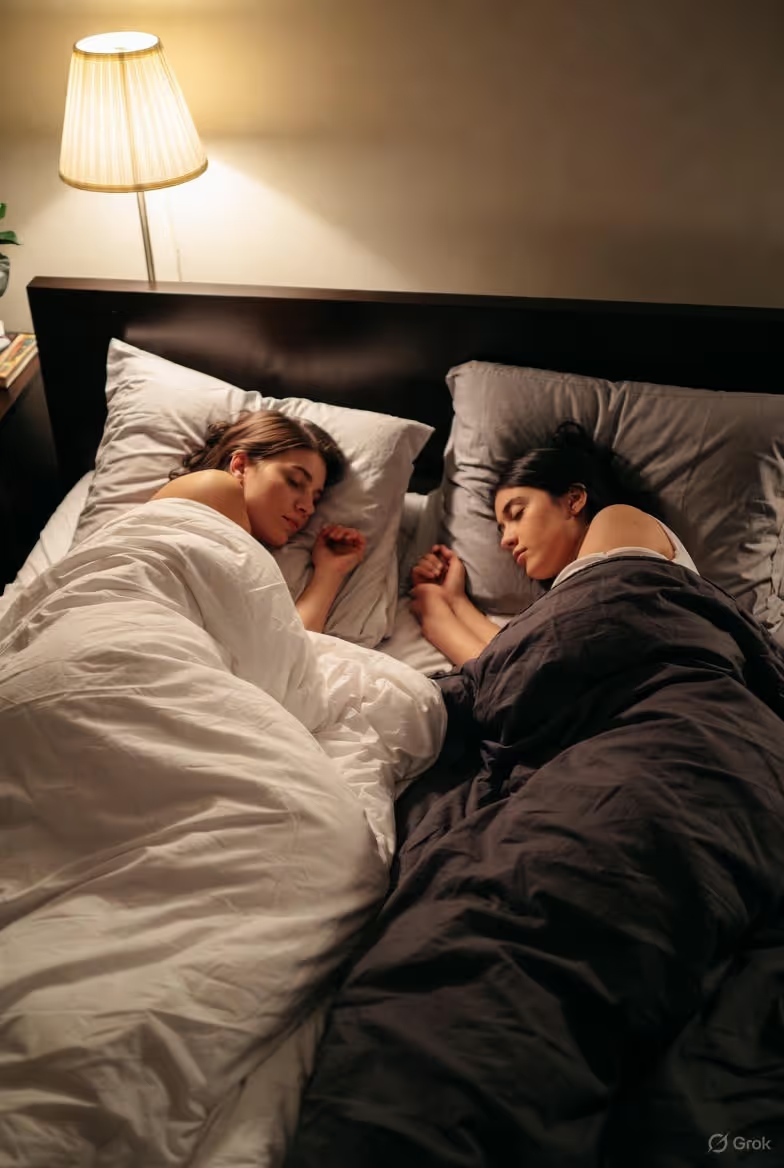
If genetics provide the blueprint, then age is the contractor that constantly renovates the building. The “perfect” sleep pattern for a newborn is catastrophic for a teenager, and the solid 8-hour block of a 30-year-old often becomes a fragmented memory for a 70-year-old. This evolution is not a defect; it’s a programmed, lifelong adaptation to our changing biological and developmental needs.
Infancy and Childhood: The Architects of the Brain
Newborns sleep a chaotic 14-17 hours per day, with nearly 50% of that in REM sleep. This REM saturation is believed to be crucial for the explosive brain development happening in early life, facilitating the formation of neural pathways. As children grow, total sleep time decreases, but deep sleep (N3) reaches its lifetime peak. This deep sleep fuels physical growth, immune development, and the consolidation of the enormous amounts of learning a child undertakes daily. The “perfect” pattern here is one of abundant, flexible sleep that supports rapid growth.
Adolescence: The Great Shift
Puberty brings a dramatic, biologically-driven shift in chronotype towards “eveningness.” A teenager’s melatonin secretion shifts later, making early bedtimes physiologically difficult and early wake times brutally unnatural. This clashes spectacularly with early school start times, creating a population-wide state of chronic sleep deprivation during a critical period of cognitive and emotional maturation. The perfect pattern for a teen would involve a much later start to the school day, aligning with their delayed circadian rhythm.
Adulthood: The Fragile Balance
In early and mid-adulthood, sleep architecture typically stabilizes into the classic 90-minute cycle pattern with a 20-25% REM allocation. However, this is the period where lifestyle pressures—career, parenting, stress—most aggressively encroach on sleep. The perfect pattern becomes one of consistency and protection: defending sleep duration and quality against the erosive forces of modern life to maintain cognitive sharpness, metabolic health, and emotional resilience.
Older Adulthood: The Changing Landscape
As we age, sleep becomes more fragmented. Total sleep time may decrease slightly, but the more noticeable changes are in architecture. Deep sleep (N3) diminishes significantly—by age 70, it may be reduced by 70-80% compared to young adulthood. Sleep becomes lighter, with more frequent awakenings and a shift toward earlier bedtimes and wake times (“morningness”). While part of this is natural, excessive fragmentation is not; it’s often linked to health issues, medications, or reduced daylight exposure. The perfect pattern for an older adult focuses on sleep hygiene, daylight exposure to strengthen the circadian signal, and managing health conditions to preserve the quality of the sleep that is still achievable.
Understanding this lifelong trajectory removes the anxiety of comparing your sleep to others in a different life stage. It frames your personal quest for perfect sleep as a dynamic process, where the goalposts move in a predictable and natural way. Your optimal sleep at 25 will not be your optimal sleep at 55. Staying attuned to these shifts is key, a process that can be supported by the longitudinal tracking offered by a comprehensive wellness device.
Our modern conception of a single, consolidated sleep block is, from a historical and global perspective, the anomaly. Stepping outside of our 21st-century, electrified bubble reveals a stunning diversity of sleep practices that challenge the very foundation of what we consider “normal” or “perfect.”
Segmented Sleep: A Historical Norm
As touched upon earlier, pre-industrial Western societies commonly practiced segmented or biphasic sleep. Historian A. Roger Ekirch’s seminal work, At Day’s Close: Night in Times Past, compiled extensive evidence of this pattern. People would sleep for a “first sleep” of 3-4 hours after dusk, wake for an hour or more of quiet activity (the “watch”), and then return for a “second sleep” until morning. This nocturnal intermission was a time of profound quiet, intimacy, prayer, or reflection. It wasn’t seen as insomnia, but as a natural part of the night’s rhythm. This suggests that our brains may be naturally inclined toward a segmented pattern, which artificial light and industrial schedules have overridden.
Global Variations in Siestas and Polyphasic Sleep
Many Mediterranean, Latin American, and Asian cultures have traditional biphasic patterns centered around a midday rest or siesta. This aligns with a natural dip in circadian alertness (the “post-lunch dip”) and is often an adaptive response to a hot climate. Similarly, polyphasic sleep patterns—multiple short sleep episodes throughout a 24-hour period—are practiced in various forms, from the segmented schedules of new parents to the extreme “Uberman” schedule (six 20-minute naps per day) attempted by biohackers. While the health implications of extreme polyphasic schedules are dubious, they highlight the plasticity of human sleep.
Co-Sleeping and Social Sleep
In much of the world, solitary sleep in a private room is a modern luxury. The historical and cross-cultural norm is co-sleeping: with partners, children, or extended family. This practice regulates emotions, provides physical security, and can synchronize sleep-wake rhythms within a family unit. Our rigid ideal of perfect sleep as requiring absolute darkness, silence, and solitude is a culturally specific construct, not a biological imperative.
What do these perspectives teach us? They powerfully demonstrate that there is no single, evolutionarily “correct” way to sleep. Human sleep is adaptable to environmental, social, and cultural pressures. The perfect pattern is, in many ways, the one that best fits your environment and lifestyle while still meeting your core physiological needs for restorative deep and REM sleep. It liberates us from the tyranny of a single model and invites a more flexible, personalized inquiry. For more insights into how different lifestyles impact physiological metrics, our blog features numerous case studies and articles.
Your sleep is not an isolated event; it is the mirror of your day. Every choice, from your morning coffee to your evening scroll, sends ripples into the nocturnal landscape. Crafting a perfect sleep pattern is therefore as much about managing your waking hours as it is about what happens in bed. Key lifestyle pillars exert a dominant influence:
Light Exposure: The Prime Zeitgeber
Light is the most powerful cue for your circadian clock. Bright, blue-wavelength-rich morning light suppresses melatonin and signals your SCN that it’s time for alertness. Conversely, exposure to bright light—especially from screens—in the evening delays melatonin release, pushing your chronotype later and making it harder to fall asleep. The perfect pattern requires disciplined light hygiene: seeking daylight early and dimming artificial lights after sunset.
Nutrition and Meal Timing
What and when you eat profoundly affects sleep. Heavy, rich, or spicy meals too close to bedtime can cause discomfort and disrupt sleep through digestion. Caffeine, with a half-life of 5-6 hours, can linger in your system long after your last cup, fragmenting sleep architecture. Alcohol, while sedating, is a potent REM sleep suppressant, leading to non-restorative, fragmented sleep later in the night. A pattern aligned with perfection involves mindful caffeine curfews, light evening meals, and limited alcohol.
Movement and Exercise
Regular physical activity is one of the most reliable promoters of deep sleep. It helps regulate circadian rhythms, reduces anxiety, and raises body temperature, allowing for a more pronounced cooling drop at night that facilitates sleep onset. However, timing matters. Intense exercise too close to bedtime can be stimulating for some, while gentle movement like yoga or stretching can be beneficial. The perfect pattern integrates consistent, daily movement, ideally finishing vigorous workouts at least 2-3 hours before bed.
Stress and Mental Load
The hyper-arousal of chronic stress is the arch-nemesis of sleep. It keeps the sympathetic nervous system (“fight-or-flight”) engaged, elevating cortisol when it should be falling, and making it impossible for the brain to transition into the quiet states of N1 and N2 sleep. Racing thoughts and anxiety are the most common self-reported causes of insomnia. Therefore, the perfect sleep pattern is impossible without effective stress management. This is where practices like mindfulness, journaling, and using data to understand your body’s stress load become critical. By tracking your daytime heart rate variability (HRV) and nighttime resting heart rate with a device like the Oxyzen ring, you can gain objective insight into your nervous system state, allowing you to proactively manage stress before it hijacks your night.
For most of human history, we judged our sleep subjectively: “I slept like a log” or “I tossed and turned all night.” The 21st century has ushered in an era of radical quantification, where consumer-grade technology promises to unveil the objective truth of our nights. From early pedometers that guessed at sleep based on movement to today’s advanced biometric wearables, this revolution has fundamentally changed our relationship with rest.
The evolution has been rapid:
This data deluge is a double-edged sword. On one hand, it provides unprecedented personal insight. You can see how your late workout affects your deep sleep, how alcohol decimates your REM, or how a stressful day tanks your HRV. It moves you from guesswork to knowledge. On the other hand, it can fuel orthosomnia—a clinical term for an unhealthy preoccupation with achieving perfect sleep data, which in itself creates anxiety and worsens sleep. The numbers become a source of stress rather than a tool for improvement.
The key is to use technology not as a judge, but as a guide. The perfect pattern isn’t about getting a sleep score of 95 every night; it’s about observing long-term trends, understanding the impact of your lifestyle experiments, and using data to make informed, gentle adjustments. It’s about moving from obsessive quantification to intelligent, personalized optimization. For those navigating this balance, our FAQ section addresses many common questions on using data wisely.
Perfect sleep doesn’t exist in a vacuum. Its ultimate proof and purpose are manifested in your waking life. The quality of your night sets the physiological and psychological stage for your day. Conversely, how you spend your day determines the quality of your next night. This creates a virtuous (or vicious) cycle that we can now measure with surprising precision through daytime biomarkers.
Heart Rate Variability (HRV): The Ultimate Readiness Metric
HRV—the variation in time between consecutive heartbeats—is a powerful, non-invasive window into your autonomic nervous system. A higher HRV (indicating more variation) generally signifies a healthy balance, where the body can easily switch between alertness (sympathetic tone) and recovery (parasympathetic, or “rest-and-digest,” tone). It is a superb indicator of recovery status and resilience to stress.
Resting Heart Rate (RHR) and Body Temperature
Your 24-hour resting heart rate and nocturnal skin temperature are also vital signs of balance.
The Perfect Pattern is a 24-Hour Rhythm
Therefore, the search for the perfect sleep pattern expands into a search for the perfect daily rhythm. It’s a holistic loop:
This is where comprehensive wellness tracking becomes indispensable. By monitoring not just your sleep but also your daytime HRV, RHR, and activity, you can close the loop. You can see, in objective data, the complete story of your recovery and readiness. It transforms sleep from an isolated metric into the cornerstone of a continuous, data-informed wellness practice. This holistic view is central to the mission and vision behind Oxyzen.

Even with the best intentions and deep knowledge, life happens. Our pursuit of a perfect sleep pattern is perpetually challenged by a host of common disruptors. Understanding these saboteurs is not about fostering avoidance, but about building resilience and implementing intelligent damage control. They fall into several key categories:
Environmental Disruptors
Physiological & Health Disruptors
Behavioral & Chemical Disruptors
The Role of Consistent Tracking
This is where passive, objective tracking proves its worth. You might feel you slept poorly after a night out, but seeing your REM graph nearly flatline and your resting heart rate elevated by 10-15 BPM provides irrefutable, motivating evidence of the impact. Similarly, you might not realize how much that occasional evening coffee is affecting you until you see a correlation in your data between caffeine after 2 PM and a longer “time to fall asleep” metric. By identifying your personal disruptors through data, you can move from guesswork to targeted, effective behavior change. Reading about real user experiences with identifying their disruptors can provide powerful motivation and relatable insight.
Our journey through the first third of this exploration has systematically deconstructed the monolithic ideal of sleep. We have seen that the perfect sleep pattern is not a universal prescription, but a personal discovery. It does not reside in a single number, but in a harmonious balance of architecture, timing, and quality that is uniquely tailored to your genetics, your age, your lifestyle, and your life’s current season.
The eight-hour rule is a historical relic. True perfection is:
We stand at a remarkable point in history. For the first time, we have the tools to move beyond folklore and frustration into a realm of personalized sleep science. Devices that track the nuanced biomarkers of sleep and recovery allow us to become researchers of our own biology. The data they provide is the compass for this personal exploration.
In the next portion of this article, we will dive into the actionable strategies derived from this knowledge. We will explore the concrete steps for finding your personal sleep signature, designing a 24-hour routine for optimal sleep, leveraging technology without anxiety, and implementing advanced recovery protocols for athletes, shift workers, and those with specific health challenges. The goal is to provide you with a comprehensive, personalized framework to not just chase an abstract ideal, but to cultivate the truly perfect-for-you sleep pattern that unlocks your fullest potential for health, performance, and wellbeing.
Armed with the knowledge that “perfect” is personal, the logical next step is the most exciting one: becoming a detective of your own rest. Discovering your personal sleep signature isn’t about following another generic protocol; it’s a structured yet flexible process of self-experimentation. This is where you move from theory to practice, using both subjective feeling and objective data to map the unique terrain of your sleep needs.
Step 1: Establish a Baseline – The “Do Nothing” Experiment
Before you can change anything, you need to know your starting point. For one to two weeks, commit to a simple experiment: go to bed when you feel naturally sleepy (not just tired, but actually sleepy—eyes heavy, yawning) and wake up without an alarm on days you can (weekends are perfect). Keep a simple log:
This “free-running” sleep period reveals your natural, debt-free sleep duration and your innate chronotype-driven schedule. It’s your body’s unadulterated preference. You may find you naturally sleep 8.5 hours, or a solid 6.75. Both are valid data points.
Step 2: Introduce Objective Measurement
This is where a device like the Oxyzen smart ring becomes an invaluable partner. Wear it consistently during your baseline period. Don’t obsess over daily scores; instead, look for weekly averages and trends. Key metrics to observe:
This creates a multi-dimensional baseline: not just how long you sleep, but how well you sleep, and how recovered you are.
Step 3: The One-Variable Change Protocol
Now, begin experimenting. The golden rule: change only one thing at a time for at least 3-4 nights to see its effect. Good starting experiments include:
After each experiment, check three things: 1) Your subjective feeling (energy, mood), 2) Your sleep data (did deep sleep increase? did sleep latency decrease?), and 3) Your morning readiness metrics (did HRV improve? did RHR drop?).
Step 4: Identify Your Non-Negotiables and Flex Points
Through this process, you’ll discover what your sleep absolutely requires (e.g., “I must have complete darkness or my deep sleep plummets”) and where you have flexibility (e.g., “I can tolerate a slightly later bedtime on weekends if I keep my morning light routine”). Your personal signature emerges from these insights. It might look like: “My perfect pattern is 7 hours 20 minutes, with a 10:30 PM bedtime, zero caffeine after 1 PM, a 10-minute journaling routine, and a room temperature of 66°F. When I hit this, my HRV is consistently above 60 and I wake up feeling a 9/10.”
This signature is dynamic—it will change with stress, illness, training cycles, and age. The goal is not to etch it in stone, but to learn the language of your body so you can adjust the dials as needed, using data as your guide. This journey of self-discovery is at the heart of modern, personalized wellness. For a deeper look at how others have approached this, our community’s testimonials share powerful stories of discovery.
A perfect night of sleep is built not at bedtime, but from the moment you wake. It’s the culmination of a day lived in rhythm with your circadian biology. Designing a sleep-positive routine means creating a scaffold of habits that support your body’s natural sleep-wake cycle, making excellent sleep the default, not a struggle.
The Morning (6 AM - 12 PM): Setting Your Circadian Clock
The Afternoon (12 PM - 6 PM): Navigating the Dip
The Evening (6 PM - Bedtime): The Wind-Down Symphony
This is the critical period for transitioning your nervous system from “fight-or-flight” (sympathetic) to “rest-and-digest” (parasympathetic).
The Power of Consistency
The most important element of this 24-hour routine is consistency—especially wake time. Waking at the same time every day, even on weekends, is the anchor that keeps your circadian rhythm strong. A variable wake time is like giving yourself weekly jetlag. A fixed wake time makes a flexible bedtime more workable, as sleep pressure will ensure you fall asleep at a reasonable hour.
By designing your day with sleep in mind, you stop “trying” to sleep and start allowing sleep to happen naturally. It becomes the inevitable, refreshing conclusion to a well-lived day. This holistic philosophy is woven into the design and purpose of tools like the Oxyzen ring, which track your readiness to help you navigate each phase of your day effectively. You can learn more about this integrated approach on our about page.
As we integrate advanced wearables into our quest for better sleep, a new psychological challenge has emerged: data anxiety, or “orthosomnia.” The very tool meant to empower can become a source of stress when we misinterpret its role. The goal is not to become a slave to a sleep score, but to use technology as a wise, objective advisor. Here’s how to leverage your sleep tracker without letting it hijack your peace.
1. Focus on Trends, Not Nightly Scores.
A single night of poor sleep data is meaningless noise. Life happens: you had a stressful conversation, ate a late meal, or are fighting off a virus. The power of technology lies in revealing patterns over weeks and months. Look at your weekly and monthly averages. Is your deep sleep gradually increasing since you started your wind-down routine? Is your resting heart rate trending downward over the past quarter? These long-term trends are the true measure of progress, not whether you hit a 90 last night.
2. Use Data to Corroborate Feelings, Not Replace Them.
Your subjective feeling upon waking—the “sleepy, tired, refreshed” scale—is a valid and important data point. Use your device to explain your feelings, not dismiss them. If you feel exhausted but your tracker says you slept 8 hours with great scores, dig deeper. Was your HRV low? Was your temperature elevated? The data might point to unperceived stress, illness, or poor sleep quality despite adequate duration. Conversely, if you feel great on 6.5 hours, but your app is scolding you, trust your body if the other metrics (HRV, RHR, daytime energy) support it. You may be an efficient sleeper.
3. Let It Guide Gentle Curiosity, Not Harsh Judgment.
View your data through a lens of curiosity, not criticism. Instead of thinking, “My REM was terrible last night, I failed,” ask, “I wonder what affected my REM? Let’s see… I had that glass of wine with dinner. I’ll experiment with cutting that out and see what happens.” This transforms the tracker from a judge into a partner in self-experimentation.
4. Know the Limits of Consumer Technology.
Consumer wearables are remarkably sophisticated, but they are not medical-grade polysomnography (PSG). Their sleep stage estimations are educated algorithms based on movement and heart rate patterns. While excellent for tracking relative changes (your own deep sleep from night to night), the absolute percentages (e.g., “You got 22% REM”) should be taken as an estimate, not gospel. Their greatest strength is in measuring physiological markers like HRV, RHR, and temperature with high accuracy, which are profound indicators of autonomic nervous system state and recovery.
5. Take Regular “Data Vacations.”
If you find yourself checking your sleep score before you’ve even gotten out of bed, or feeling genuine anxiety over a bad night, it’s time for a break. Put the device away for a week or two. Reconnect with your body’s natural signals. Sleep without monitoring. This resets your relationship with the tool and reminds you that you are more than your data.
Used wisely, technology like a smart ring provides a kind of biofeedback. It makes the invisible visible: the calm of your nervous system (high HRV), the toll of stress (elevated nighttime heart rate), the rhythm of your temperature. This feedback loop allows for precise, personalized adjustments that would otherwise be guesswork. For answers to common questions on optimizing your use of this technology, our FAQ is a great resource.
The connection between food and sleep is intimate and complex. Every meal is a set of instructions for your hormones, neurotransmitters, and circadian system. Moving beyond old wives’ tales, modern nutritional science reveals how we can strategically eat to support, not sabotage, our sleep architecture.
Macronutrients and Their Nightly Roles:
Key Micronutrients for Sleep Biochemistry:
Timing and Practical Strategies:
Personalizing Your Plate:
Just as with sleep patterns, nutritional needs are individual. Some may sleep better with a light, early dinner; others may need a small snack to prevent waking from hunger. Tracking your food intake alongside your sleep data (many apps allow for this) can reveal powerful personal correlations. You might discover that salmon for dinner correlates with higher deep sleep, or that a late dessert consistently fragments your rest. This data-driven approach to nutrition turns eating into a deliberate strategy for recovery, a concept central to a holistic wellness practice. For more on integrating nutrition with biometric data, our blog explores these synergies in depth.
Physical activity is one of the most potent, evidence-based sleep promoters available—a natural, side-effect-free prescription for deeper sleep. Yet, like any powerful tool, its effects depend profoundly on dosage, timing, and individual response. Understanding this relationship allows you to wield exercise not just for fitness, but as a precision instrument for sleep optimization.
The Sleep-Enhancing Effects of Regular Exercise:
The Timing Conundrum: When to Work Out for Optimal Sleep
The old adage “never exercise before bed” is being refined. The impact depends on the individual, the exercise intensity, and their chronotype.
Listening to Your Body’s Data:
This is where personalization via tracking is critical. You can experiment and observe:
Your body will give you the answer through your recovery metrics. The goal is to find the type, intensity, and timing of movement that leaves your nervous system in a state primed for recovery, not hyper-arousal. For athletes and active individuals, this data is indispensable for periodizing training and avoiding overtraining, which is notoriously destructive to sleep. Sharing and reading about others’ experiences with activity and recovery can provide valuable community insight.
For millions, the primary barrier to perfect sleep isn’t caffeine or light—it’s the relentless chatter of the mind and the clenched feeling of the body. Stress and anxiety activate the sympathetic nervous system, the biological opposite of the state required for sleep. Mastering the mind-body connection is therefore not a supplementary “wellness” tip; it is foundational to sleep health.
The Physiology of a Worried Night:
When stressed, the brain’s amygdala (the fear center) becomes hyperactive, and the hypothalamic-pituitary-adrenal (HPA) axis pumps out cortisol. Cortisol’s natural rhythm is to be low at bedtime; stress flips this, creating high evening cortisol, which blocks melatonin and keeps the brain in a state of vigilant alertness. Physically, this manifests as a higher resting heart rate, lower HRV, muscle tension, and rapid, shallow breathing—all antithetical to sleep.
Evidence-Based Practices to Downregulate the Nervous System:
The goal is to activate the parasympathetic nervous system, the “rest-and-digest” counterpart. This must be practiced to become effective.
1. Diaphragmatic Breathing (The Instant Reset):
This is the fastest way to influence autonomic state. Deep, slow breaths stimulate the vagus nerve, signaling safety to the brain.
2. Progressive Muscle Relaxation (PMR):
Systematically tensing and then relaxing muscle groups teaches the body the difference between tension and relaxation, and promotes physical calm. Starting from your toes and moving up to your scalp, tense each muscle group for 5 seconds, then release for 30 seconds, noticing the sensation of letting go.
3. Mindfulness and Meditation:
Regular practice changes your relationship with thoughts. Instead of getting caught in the story of anxiety (“I’ll never sleep, tomorrow will be ruined”), you learn to observe thoughts as passing events. A simple 10-minute daily meditation practice has been shown to improve sleep quality significantly. Guided sleep meditations or body scans are particularly useful at bedtime.
4. Cognitive Reframing for Sleep Anxiety:
“Orthosomnia” and performance anxiety about sleep create a vicious cycle: “I must sleep” → anxiety about not sleeping → adrenaline release → inability to sleep. Cognitive Behavioral Therapy for Insomnia (CBT-I) is the gold-standard psychological treatment, and its principles can be self-applied:
5. The Daytime Practice:
Stress management cannot be crammed into 10 minutes before bed. It requires a daily practice. Regular mindfulness, time in nature, setting boundaries, and using your wellness data to recognize when you’re trending toward burnout (e.g., a sustained drop in HRV) are all preventative measures. The Oxyzen ring’s continuous tracking provides an objective measure of your nervous system load, prompting you to intervene with these techniques before your sleep is hijacked.
By building a toolkit of mind-body practices, you develop resilience. You learn to shepherd your nervous system from the frantic pace of the day into the quiet harbor of the night, making perfect sleep not just a possibility, but a predictable outcome.
While the core principles of sleep biology apply to everyone, certain life circumstances present extreme challenges to achieving a “perfect” pattern. For these individuals, optimization requires advanced, tailored protocols that work with, not against, their unique constraints.
For the Athlete and High-Performance Individual:
Sleep is the ultimate performance-enhancing drug. For athletes, the goal is to maximize recovery and adaptation from training.
For the Shift Worker:
Shift work, especially night shifts, is a direct assault on circadian biology. The goal is damage mitigation, as perfect alignment is often impossible.
For New Parents:
The newborn phase is a survival period where “perfect sleep” is redefined as “any sleep.”
For Menopausal Women:
Hormonal changes can cause insomnia, night sweats, and temperature dysregulation.
For all these groups, the constant is the need for heightened self-awareness and a willingness to adopt non-standard strategies. The definition of “perfect” becomes “optimal within my current constraints,” and the focus shifts to maximizing recovery quality wherever possible. The journey to find what works for you is personal, and learning about our own story of creating solutions for complex wellness challenges reflects this commitment to personalized care.
We have now journeyed through the foundational science of sleep and delved into the actionable, personalized strategies that can transform your rest. From deconstructing myths to designing 24-hour routines, from leveraging technology wisely to mastering the mind-body connection, the path to your perfect sleep pattern is now illuminated with both knowledge and practical tools.
The critical insight is this: The perfect sleep pattern is not a destination you arrive at and inhabit forever. It is a dynamic, fluid state of harmony between your biology and your life. It is a practice—a daily, conscious curation of light, food, movement, thought, and environment. Some nights will be textbook perfect. Many will be “good enough.” And some will be poor, and that is an intrinsic part of being human.
The goal of all this knowledge is not to achieve a flawless 100% score, but to build resilience. It is to:
Your sleep data and subjective feelings are the feedback loop for this lifelong practice. They tell you when you’re in sync and when you’ve drifted off course. They empower you to make informed adjustments, not desperate guesses.
In the final portion of this comprehensive guide, we will look forward to The Future of Sleep Optimization. We will explore emerging technologies, the frontiers of sleep science (like sleep and longevity), and how to build a lifelong, adaptable philosophy of rest that serves you through every season of life. We’ll answer the ultimate question: Once you find your signature, how do you protect it and let it evolve in a changing world?
Your Trusted Sleep Advocate: Sleep Foundation — https://www.sleepfoundation.org
Discover a digital archive of scholarly articles: NIH — https://www.ncbi.nlm.nih.gov/
39 million citations for biomedical literature :PubMed — https://pubmed.ncbi.nlm.nih.gov/
Experts at Harvard Health Publishing covering a variety of health topics — https://www.health.harvard.edu/blog/
Every life deserves world class care :Cleveland Clinic - https://my.clevelandclinic.org/health
Wearable technology and the future of predictive health monitoring :MIT Technology Review — https://www.technologyreview.com/
Dedicated to the well-being of all people and guided by science :World Health Organization — https://www.who.int/news-room/
Psychological science and knowledge to benefit society and improve lives. :APA — https://www.apa.org/monitor/
Cutting-edge insights on human longevity and peak performance:
Lifespan Research — https://www.lifespan.io/
Global authority on exercise physiology, sports performance, and human recovery:
American College of Sports Medicine — https://www.acsm.org/
Neuroscience-driven guidance for better focus, sleep, and mental clarity:
Stanford Human Performance Lab — https://humanperformance.stanford.edu/
Evidence-based psychology and mind–body wellness resources:
Mayo Clinic — https://www.mayoclinic.org/healthy-lifestyle/
Data-backed research on emotional wellbeing, stress biology, and resilience:
American Institute of Stress — https://www.stress.org/


