


Restful Living and Creativity: The Inspiration-Rest Connection
Periods of rest and incubation are scientifically linked to increased creativity and innovative thinking.
Periods of rest and incubation are scientifically linked to increased creativity and innovative thinking.
%402x.svg)
We live in a culture that worships the grind. Hustle, burnout, and sleepless nights are often worn as badges of honor, signaling a deep commitment to one’s craft, career, or ambitions. Creativity, in this narrative, is a finite resource to be mercilessly extracted through sheer willpower and endless hours. We imagine our most brilliant ideas striking in a flurry of caffeinated activity, a eureka moment born from exhaustion.
But what if this story is profoundly wrong? What if the wellspring of creativity isn’t found in the storm of constant doing, but in the quiet eye of the storm—in deep, restorative rest? An emerging synthesis of neuroscience, psychology, and the lived experience of history’s greatest minds suggests that inspiration isn’t a byproduct of relentless effort, but a dividend paid by genuine rest.
This article explores the powerful, symbiotic relationship between restful living and creativity. We will dismantle the myth of the tortured, sleepless genius and replace it with a science-backed blueprint for sustainable innovation. We’ll journey into the brain’s nocturnal laboratories, where problems are solved and memories are forged without our conscious awareness. We’ll examine how different forms of rest—from sleep to daydreaming to mindful movement—act as essential catalysts for the creative process.
This isn’t about working less, but about resting smarter. It’s about recognizing that creativity is not a linear process you can force, but a cyclical dance between focused attention and diffused relaxation. By understanding and honoring the inspiration-rest connection, we can unlock more consistent, profound, and joyful creative output. And in our modern, hyper-connected world, achieving this kind of restful living requires both intention and insight—precisely the kind of insight that technology, like the advanced biometric tracking from Oxyzen, can provide to guide our journey.

We’ve all seen the archetype: the visionary founder sleeping under their desk, the artist surviving on espresso and adrenaline, the writer facing a blank page at 3 a.m., convinced that breakthrough lies just beyond one more hour of struggle. This "tortured genius" myth is romanticized, but it’s a creativity killer. To understand why, we must first dissect the physiological and psychological state of burnout and chronic stress—the antithesis of restful living.
When we operate in a perpetual state of "fight or flight," our sympathetic nervous system is chronically activated. Cortisol and adrenaline flood our system, sharpening our focus to a narrow point—excellent for escaping immediate danger, but disastrous for generative thinking. This state:
This is the burnout paradox: the more desperately we grind for a creative breakthrough, the more we undermine the very brain functions required to achieve it. We mistake motion for progress, and activity for achievement.
The alternative is not laziness, but strategic rest. It’s the understanding that the brain has two primary modes relevant to creativity: the Task-Positive Network (TPN) and the Default Mode Network (DMN). The TPN is active when we’re focused on external tasks—writing code, analyzing data, composing an email. The DMN, once thought to be merely the brain’s "idle" state, is now understood to be a hive of activity when we are at rest. It’s the network responsible for introspection, imagining the future, recalling the past, and, most importantly, making spontaneous, novel connections between disparate ideas. You cannot access the DMN’s creative magic while the TPN is dominantly engaged. The hustle keeps you locked in the TPN. Restful living opens the door to the DMN.
Real-world examples abound. Ray Bradbury famously said his ideas came from his "subconscious working at the problem." He advocated for feeding the subconscious through diverse experiences and then trusting it to deliver. This is a poetic description of the DMN at work. Modern creators are now explicitly designing "DMN time" into their schedules—taking walks without podcasts, practicing meditation, or simply staring out a window. It’s a deliberate shift from production to incubation.
For those seeking to escape the burnout paradox, the first step is awareness. How much of your life is spent in stress-induced TPN mode versus restorative DMN mode? Tools that provide objective data on stress and recovery, like the insights offered by Oxyzen’s smart ring technology, can be invaluable. By quantifying your body’s readiness and stress levels, you can begin to identify the patterns that lead to creative blocks and consciously cultivate the restorative states where inspiration truly lives. You can explore more about the science behind these states on the Oxyzen blog, which features deep dives into wellness and performance optimization.
If the "burnout brain" is creativity’s prison, the "rested brain" is its playground. The moment of insight—the "aha!" or "eureka!"—feels magical, as if the answer arrives from nowhere. Neuroscience reveals it’s not magic, but a precise neurological process that is critically dependent on rest, particularly sleep. Understanding this process demystifies creativity and gives us a blueprint for fostering it.
The creative process is often described in four stages: Preparation, Incubation, Illumination, and Verification. Rest is the silent partner in Incubation and Illumination.
1. Sleep-Dependent Memory Processing and Association:
During sleep, especially during deep (Slow-Wave Sleep) and REM stages, the brain is not passive. It undertakes a massive "filing and connecting" project. The hippocampus replays the day’s events, and the neocortex integrates this new information with existing knowledge. This process, called systems consolidation, is where disparate ideas can collide. A problem you wrestled with during the day (Preparation) gets stripped of its context and its elements are scattered across the vast network of your existing memories. In this state, novel associations can form that your conscious, logical mind might have dismissed.
A seminal study at the University of Lübeck demonstrated this powerfully. Participants were given a number puzzle with a hidden, simpler rule for solving it. Those who slept for eight hours between attempts were almost three times more likely to discover the hidden rule than those who stayed awake. The sleep didn’t just restore energy; it actively restructured the problem, leading to insight.
2. The Role of Theta Waves and the Hypnagogic State:
The twilight zone between wakefulness and sleep—the hypnagogic state—is a notorious hotbed for creativity. Scientists like Thomas Edison and Salvador Dalí deliberately exploited this state. Edison would nap holding a ball in his hand; as he fell asleep, the ball would drop and wake him, capturing ideas from the edge of sleep.
In this state, the brain generates abundant theta waves (4-8 Hz). Theta activity is associated with deep relaxation, vivid imagery, and a loosening of executive control, allowing for freer, more abstract connections. It’s the brain entering a state of open, defocused awareness where the DMN is highly active.
3. Pruning and Synaptic Homeostasis:
Another critical nocturnal process is synaptic homeostasis. During waking hours, we learn and form countless neural connections (synapses). Sleep, particularly slow-wave sleep, acts like a gardener, selectively "pruning" weaker synapses and strengthening important ones. This isn’t about losing information, but about improving the signal-to-noise ratio of your neural network. It clears out the cognitive clutter, making the pathways to important memories and ideas stronger and more efficient. A creative insight often requires cutting through noise to see a clean, elegant connection—sleep provides the neural pruning shears.
Practical Implications for the Creative:
This science tells us that "sleeping on a problem" is not a cliché; it’s a high-yield creative strategy. It means:
For the modern individual seeking to optimize this process, subjective guesswork isn’t enough. How do you know if you’re getting the deep and REM sleep necessary for creative consolidation? Biometric tracking moves this from the abstract to the actionable. By monitoring sleep stages, heart rate variability (HRV), and resting heart rate, a device like the Oxyzen ring provides a window into your nightly neurological maintenance. You can learn more about how this technology supports holistic wellness by visiting the Oxyzen about-us page, which details the mission to bridge the gap between health data and actionable insight. This data empowers you to see the direct correlation between a night of high-quality sleep and your mental clarity and problem-solving ability the following day, turning the neuroscience of "eureka" into a repeatable practice.
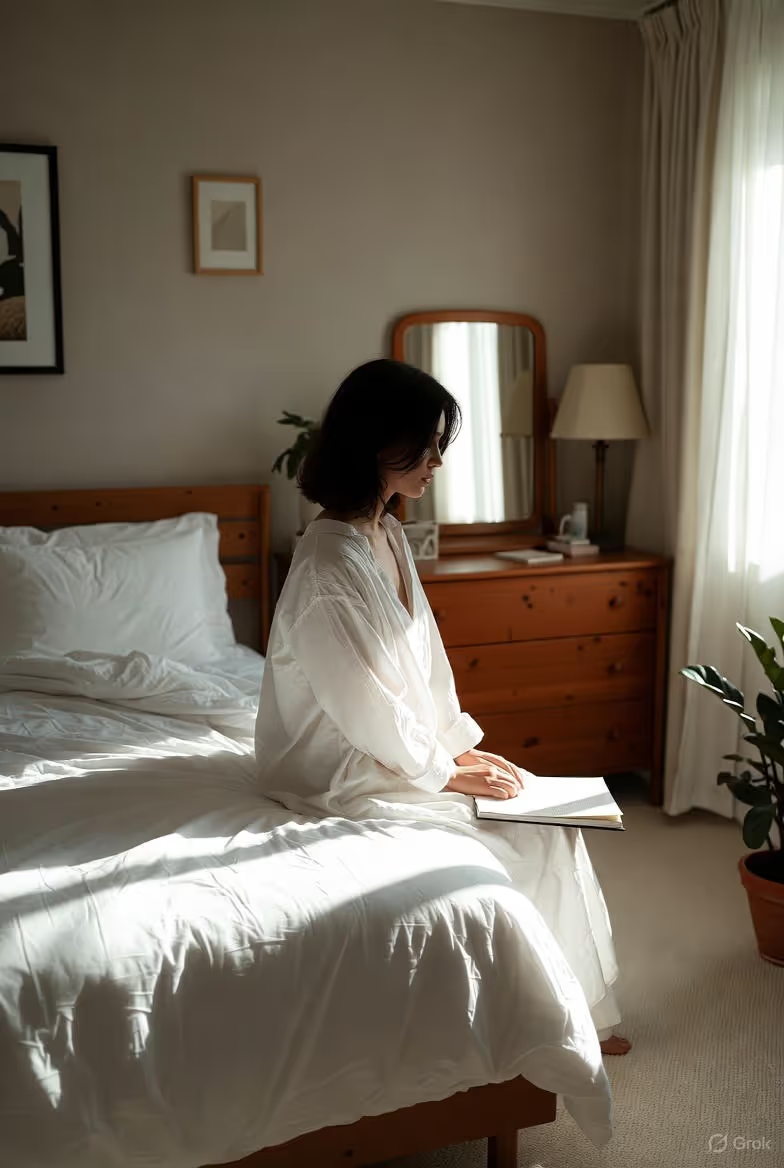
While sleep is the cornerstone, creativity’s restful allies extend into our waking hours. In a world designed to eliminate every moment of "idleness" with notifications, podcasts, and streaming content, we have declared war on one of our mind’s most fertile states: the unrestrained, inward-focused drift known as mind-wandering. We label it as distraction or a lack of focus, but neuroscience reveals it as a vital creative engine.
When your gaze goes soft out the window on a train ride, or you find yourself pacing without a clear purpose, your brain has likely switched from the Task-Positive Network (TPN) to the Default Mode Network (DMN). This is not downtime. The DMN is active in:
This last function is the essence of creative insight. A study from the University of California, Santa Barbara, found that people who engaged in an undemanding task that allowed for mind-wandering before a creativity test performed significantly better than those who stayed focused on a demanding task or rested without a mental break.
Boredom as a Catalyst:
Similarly, boredom—the uncomfortable feeling of wanting but being unable to engage in satisfying activity—is a potent creativity trigger. It creates a psychic itch that the mind desperately tries to scratch by generating its own stimulation. This often takes the form of novel ideas, fantasies, and solutions to latent problems. A series of studies published in the journal Creativity Research Journal found that participants who first engaged in a boring activity (like reading a phone book) subsequently produced more creative ideas in brainstorming tasks than those who did not.
The "Incubation" Period in Action:
This explains why breakthroughs so often happen in the shower, on a walk, or while doing the dishes. These low-stimulus, semi-automatic activities free up cognitive resources and allow the DMN to take the wheel. The conscious mind is gently occupied, preventing it from interfering with the subconscious connections being formed. This is the Incubation stage in real-time. You’ve done the Preparation (focused work), you’ve stepped away (initiating Incubation via mind-wandering), and the Illumination often follows.
Cultivating Constructive Mind-Wandering:
The key is to move from distracted mind-wandering (constantly pulled by external alerts) to constructive mind-wandering. This requires:
The challenge in our digital age is protecting these fragile states. We must become custodians of our own attention. For many, this starts with understanding their daily rhythms of focus and fatigue. When are you most likely to benefit from a focused work sprint, and when is your brain signaling for a diffused-thinking break? By tracking physiological markers of stress and recovery throughout the day, you can learn to identify the optimal times to step back and let the DMN work its magic. The personalized data and trends provided by a tool like Oxyzen can help you design a daily rhythm that intentionally cycles between deep focus and restorative mind-wandering, turning what feels like unproductive time into your most powerful creative incubator. For answers to common questions on integrating such tracking into a busy life, the Oxyzen FAQ is an excellent resource.
The mind does not exist in a vacuum. It is inextricably embodied. Therefore, the state of the body—its tension, its rhythm, its vitality—profoundly influences the creative capacities of the mind. True restful living isn’t just about mental quiet; it’s about physical restoration and intelligent movement, which in turn clear the channels for inspiration.
Physical Rest as Neural Reset:
Chronic muscle tension, often held in the neck, shoulders, and jaw, is a physical manifestation of psychological stress. This tension sends a constant "danger" signal to the brain, keeping the nervous system on alert and the prefrontal cortex inhibited. Techniques that induce physical relaxation are thus direct interventions for creative block:
Movement as a Cognitive Catalyst:
Conversely, certain types of movement are powerful creative stimulants. The link is not just metaphorical; it’s physiological:
The "Green" Effect: Nature’s Impact on Creativity:
The research on nature’s cognitive benefits is overwhelming. "Attention Restoration Theory" posits that urban environments demand "directed attention" (effortful focus), which fatigues the prefrontal cortex. Natural environments, rich in "soft fascinations" (like clouds, leaves, water), allow directed attention to rest and recover.
A landmark study led by David Strayer at the University of Utah found that participants scored 50% higher on a creativity test after a four-day backpacking trip immersed in nature, disconnected from technology. Nature doesn’t just provide a pretty backdrop; it provides a cognitive reset. It reduces stress hormone levels, lowers heart rate, and encourages a state of open, effortless attention—the perfect incubator for creative thought.
Integrating the Body-Mind Connection:
The practical application is to view physical rest and mindful movement as part of your creative toolkit, not a diversion from it.
Understanding your body’s unique needs is key. Does your creativity flourish after a vigorous workout, or after a session of gentle yoga? When do you feel most physically stiff and mentally blocked? Biometric feedback can illuminate these patterns. Tracking metrics like Heart Rate Variability (HRV)—a key indicator of your nervous system’s balance and recovery capacity—can tell you if your body is in a state ready for focused creative work or if it desperately needs physical restoration first. The holistic approach championed by Oxyzen recognizes that innovation springs from a well-rested and a well-moved body. Real user experiences often highlight this connection, as seen in the Oxyzen testimonials, where individuals share how understanding their physical data transformed their daily rhythm and output.
Our modern environment is arguably the greatest adversary of restful living and, by extension, sustained creativity. The constant, fragmented demand of digital notifications, the infinite scroll of social media, and the expectation of perpetual availability have shattered our attention and colonized the cognitive space required for deep thought. A digital detox, therefore, is not a trendy luxury; it is a non-negotiable foundation for rebuilding creative capacity.
The Cost of Continuous Partial Attention:
Author Linda Stone coined the term "continuous partial attention" to describe the state of constantly scanning multiple inputs for the most rewarding or threatening information. This is different from multitasking; it’s a state of hyper-vigilance that places the brain in a persistent, low-grade stress response. The cognitive cost is immense:
The Architecture of Deep Work:
Author Cal Newport argues for "deep work"—professional activities performed in a state of distraction-free concentration that push your cognitive capabilities to their limit. This state is the engine of high-value creative production. Yet, deep work requires "deep rest" as its counterpart. If your leisure time is filled with shallow, digital consumption (endless scrolling, reactive browsing), your mind never truly disengages from the "task-positive" mode. You remain in a state of cognitive agitation that prevents the restorative, DMN-led thinking necessary for breakthrough ideas.
Strategies for Reclaiming Cognitive Space:
A digital detox is less about total abstinence (for most) and more about creating intentional boundaries to protect your mental space.
The Role of Technology in the Detox:
Ironically, technology itself can be part of the solution when used with intention. The goal is not to become a Luddite, but to move from being used by technology to using it as a tool for better living. This is where purpose-built wellness technology distinguishes itself from attention-hijacking platforms. A device focused on collecting data about you to give you back to yourself serves the opposite function of a social media platform designed to capture your attention for advertisers.
By using a tool like the Oxyzen ring to monitor stress and readiness, you receive objective feedback on the impact of your digital habits. You might see that days with high "screen time" after 9 p.m. correlate with poor sleep scores and low readiness the next morning—direct, quantifiable evidence of the creativity tax. This data empowers you to make informed boundaries, turning a vague intention to "use my phone less" into a specific, impactful rule like "no screens 60 minutes before bed." This is the essence of a modern, intentional digital detox: using one form of conscious technology to liberate yourself from the unconscious grip of others. For more strategies on creating a balanced digital life, the Oxyzen blog offers a wealth of practical guides and insights.

The romantic image of the creative genius is one of chaotic inspiration, of ideas striking at random. Yet, history’s most prolific creators tell a different story: one of meticulous routine, disciplined rituals, and sacred rhythms. From Beethoven’s predawn coffee counted out by exactly 60 beans to Maya Angelou’s habit of renting a sparse, hotel-like room to write in every day, structure is not the enemy of creativity—it’s its guardian. These rituals are the architecture that supports both focused work and essential rest, creating a reliable container for inspiration to flow.
The Psychology of the Ritual:
A pre-work ritual acts as a cognitive trigger. It signals to the brain, "It is now time to enter a state of deep focus." This transition lowers the activation energy required to start a daunting creative task. Similarly, an end-of-work ritual signals, "The work is complete for now; it is time to rest." This psychological closure is critical. It prevents work thoughts from infiltrating rest time, which is essential for that restorative DMN activity to occur unhindered.
Circadian Rhythms and Creative Chronotypes:
We all have an internal biological clock governing our energy, alertness, and cognitive function throughout the 24-hour day. Your "chronotype"—whether you’re a morning lark, a night owl, or somewhere in between—determines your natural peaks for analytical focus and, potentially, for creative insight.
Designing Your Creative Rhythm:
The goal is to align your work with your biology, not fight against it.
The Role of Consistent Sleep/Wake Times:
Perhaps the most powerful rhythm of all is your sleep schedule. Going to bed and waking up at consistent times, even on weekends, stabilizes your circadian rhythm. This leads to more predictable energy levels, better sleep quality, and a more reliable internal environment for creative work. Chaos in your sleep schedule creates chaos in your cognitive function.
Implementing these rhythms requires self-awareness. When are you truly at your best? When does your energy dip? While intuition is a guide, data provides clarity. By tracking your sleep consistency, daily activity, and physiological readiness, you can move from guessing about your rhythms to knowing them. The longitudinal data from a wellness tracker helps you see the impact of a consistent routine on your recovery scores and, by extension, your creative stamina. It turns the art of routine-building into a science. The story behind Oxyzen is rooted in this quest for personalized, data-informed harmony, a journey you can explore in detail at Oxyzen our-story.
Creativity is an act of vulnerability. It requires putting novel ideas, which are fragile and unproven, into the world. This process is emotionally charged and can be easily sabotaged by two major internal adversaries: chronic stress/anxiety and the harsh voice of the inner critic. True restful living, therefore, must address not just physical and cognitive rest, but emotional and psychological rest—creating a safe internal environment for ideas to germinate.
Stress and the Closed Mind:
As established, the stress response (high cortisol, amygdala activation) is the enemy of the prefrontal cortex and the DMN. But beyond the neurology, stress and anxiety create a state of psychological threat. In this state, the mind’s priority is safety, prediction, and control. It becomes risk-averse and defensive. Creativity, by its nature, is uncertain, risky, and involves a loss of control (you cannot force an insight). A threatened mind will therefore shut down creative exploration. It’s a survival mechanism: don’t wander into unknown mental territory when you perceive danger.
The Inner Critic and Premature Editing:
The "inner critic" is that voice of judgment that declares an idea "stupid," "unoriginal," or "bound to fail" before it’s even fully formed. This voice is often the internalized accumulation of past criticism, societal expectations, and perfectionism. Its primary destructive function in the creative process is premature editing. During the generative, ideation phase, the goal is quantity and wildness of ideas (think "brainstorming"). The inner critic, applying the logical standards of the Verification stage, kills ideas in their infancy. It stops the flow before it can even begin.
Cultivating Emotional Rest and Safety:
To create a psychologically safe space for creativity, we must practice emotional regulation and self-compassion. This is a form of rest for the psyche.
The Biometric Feedback Loop for Emotional Awareness:
We are not always conscious of our own stress levels. We might normalize a state of low-grade anxiety, not realizing it’s forming a constant background noise that stifles our creative voice. This is where biometric feedback becomes a mirror for our emotional state.
A sharp, unexplained dip in your Heart Rate Variability (HRV) or a spike in your resting heart rate can be an objective signal of underlying stress, even if you feel "fine" subjectively. This data acts as an early warning system, prompting you to ask, "What’s causing this physiological reaction?" It might be a difficult project, an unresolved conflict, or simply overload. By catching these signals, you can proactively employ your emotional regulation tools—a few minutes of breathing exercises, a short walk, a mindfulness session—before the stress solidifies into a creative block. This proactive approach to emotional management is a cornerstone of sustainable creativity. For those curious about how this technology supports mental well-being, the Oxyzen about-us page elaborates on the holistic design philosophy behind it.
The brain, representing only about 2% of body weight, consumes roughly 20% of the body’s energy. The quality of that energy—derived from what we eat and drink—profoundly affects cognitive function, mood stability, and neural flexibility. "Nutritional rest" doesn’t just mean eating healthy; it refers to providing the brain with optimal fuel while also giving the digestive system periods of respite, creating an internal environment conducive to clear, energetic, and associative thinking.
The Glucose Rollercoaster and Brain Fog:
A diet high in refined sugars and simple carbohydrates leads to rapid spikes and crashes in blood glucose. The brain is highly sensitive to these fluctuations.
Inflammation and Cognitive Function:
Chronic, low-grade systemic inflammation, often driven by diets high in processed foods, sugars, and unhealthy fats, has a direct negative impact on the brain. Inflammatory cytokines can cross the blood-brain barrier, impairing neurogenesis, reducing neuroplasticity, and contributing to "brain fog." A creative mind needs a nimble, plastic, and clear-thinking brain.
Nutrients for Neurotransmitters:
Creativity is linked to balanced neurotransmitters. Key nutrients are their building blocks:
The Creative Potential of Intermittent Fasting:
Beyond what we eat, the timing of eating—specifically, periods of fasting—can enhance cognitive clarity for many. During a fasted state (12-16 hours after your last meal), insulin levels drop, and the body may begin to produce ketones from fat stores. The brain can use ketones very efficiently for energy. Many report heightened mental clarity, focus, and a sense of "quiet" in the mind during a fasted state. This could be due to:
Hydration: The Foundation of Cognitive Fluidity:
Even mild dehydration (a 1-2% loss of body water) is consistently linked to impaired concentration, short-term memory, and mood. The brain is about 75% water. Proper hydration is essential for the electrical neurotransmission that underlies every thought, including your most creative ones.
Practical Guidelines for Creative Nutrition:
Listening to Your Body’s Signals:
How do you know if your diet is supporting or hindering your creativity? While food journals are useful, the body gives direct physiological feedback. Does a heavy lunch lead to an afternoon creative slump? Does poor sleep after a late, sugary snack impact the next day’s insight? Biometric tracking can help connect these dots. By correlating your dietary choices (which you can log) with metrics like sleep quality, resting heart rate, and HRV, you can build a data-informed picture of which foods and eating patterns leave you feeling—and thinking—at your best. It moves nutrition from generic advice to personalized creative fuel strategy. To see how others have used data to optimize their lifestyle, the Oxyzen testimonials page shares real-world journeys of discovery.

Creativity is often portrayed as a solitary struggle. While deep work requires solitude, the full creative cycle exists within a social ecosystem. The inspiration-rest connection extends into our relationships. Healthy social rest—through supportive community, intentional solitude, and unstructured play—provides the emotional safety, diverse input, and psychological freedom that fuel both individual and collective innovation.
The Dual Needs: Community and Solitude:
Psychologist Mihaly Csikszentmihalyi, who studied flow states, emphasized that creative individuals tend to exhibit a paradoxical set of traits: they are both highly energetic and often quiet and at rest; they are smart yet naive; and crucially, they alternate between imagination/fantasy and a rooted sense of reality. This last paradox speaks to the social dimension. Creativity requires both:
The Restorative Power of a Creative Community:
A supportive community acts as a form of social rest. It provides:
The Critical Role of Play:
Play is perhaps the purest form of social and cognitive rest for creativity. Play is intrinsically motivated, rule-bound (but freely accepted), and conducted in a low-stakes, "what-if" space. In adults, play:
Understanding the science and philosophy of the inspiration-rest connection is only the first step. The true transformation occurs when this knowledge is translated into daily, actionable systems. This is where theory meets practice, and intention becomes ingrained habit. Building a sustainable creative life isn't about grand, sweeping changes that fade in a week; it's about designing an environment and a set of personalized rituals that automatically guide you toward the restorative rhythms where creativity thrives.
The Power of Environmental Design:
Your physical and digital environments are not passive backdrops; they are active participants in your cognitive state. To foster restful creativity, you must engineer environments that minimize friction for focus and maximize opportunities for restorative breaks.
The "Creative Dashboard" Approach:
Manage your creative energy like a project manager, not a crisis manager. This means proactive planning based on your biological and psychological rhythms, not reactive scrambling.
Quantified Creativity: Using Data to Refine Your System (Without Killing the Magic):
While creativity itself is not a metric, the conditions for creativity are measurable. This is not about judging your output, but about optimizing your input. By tracking key lifestyle factors, you can move from guesswork to insight.
This is where a holistic wearable like the Oxyzen smart ring transitions from a fitness device to a creative system optimizer. It automates the tracking of foundational variables like sleep stages, Heart Rate Variability (HRV—your body's readiness score), resting heart rate, and activity. By providing an objective, 24/7 readout of your nervous system's state, it removes the bias of subjective feeling. You might feel fine, but if your HRV is chronically low, your body is signaling a need for deeper recovery before your next creative sprint. This data allows you to design and refine your personal system with precision, ensuring your rituals and rhythms are truly aligned with your biology. For a deeper look at the technology that enables this kind of insight, you can learn more about Oxyzen's approach.
History and modern industry are replete with examples that vindicate the rest-inspiration model. Moving beyond anecdote, these case studies reveal a pattern: groundbreaking creativity is rarely born in a frenzy of overwork, but in the disciplined interplay of intense focus and profound rest.
The Historical Pattern: From Darwin to Dalí
The Modern Corporate Laboratory: From 3M to Google
The business world has institutionalized these principles in some of its most innovative companies.
The Writer's Ritual: From Murakami to King
These diverse examples, spanning centuries and disciplines, share a common thread: they treat rest not as the absence of work, but as a distinct, active, and essential phase of the creative cycle. They institutionalize incubation. For the modern creative professional or entrepreneur, the lesson is to study these patterns and adapt their principles—structured time, protected rest, physical movement, psychological safety—to your own context and chronobiology. The journey of every innovator is unique, but the foundational need for rhythm is universal, a truth echoed in the Oxyzen our-story which chronicles a quest to build technology that honors these human rhythms.
Every creative person encounters the wall. The blank page mocks, the solution remains hidden, and frustration mounts. The instinctive, culturally-conditioned response is to push harder: to stare longer, to will the idea into existence through sheer force of effort. But as we now understand, this is the least effective strategy. When you hit a creative block, it is not a signal to work more; it is a signal that your current mode of thinking is exhausted. It is an invitation—a demand, even—to switch states. Rest becomes your most powerful strategic tool for breakthrough.
Diagnosing the Block: Different Rests for Different Locks
Not all blocks are the same, and neither are all rest solutions. A strategic approach involves a quick diagnosis:
The "Intentional Incubation" Protocol:
Instead of waiting for a block to strike, build intentional incubation into your process. After a 90-minute deep work session on a complex problem, immediately transition to a 20-30 minute incubation activity. Do not check email or social media—these are not restorative. Choose from the list above based on your need. This proactive rhythm prevents blocks from forming in the first place by regularly resetting your cognitive and emotional state.
Listening to Your Body's "Block Signals":
Often, your body knows you're heading for a block before your conscious mind admits it. That tightness in your shoulders, the headache forming, the restless leg, the craving for sugar—these are somatic signals of rising stress and depleting resources. Learning to heed these early warnings allows you to deploy strategic rest before you crash into a full creative halt.
This is another domain where biometric awareness transforms your practice. Imagine working on a difficult problem. Subjectively, you feel you're "making progress" by grinding away. But your Oxyzen ring, monitoring your stress levels through heart rate and HRV, shows a steady climb in your stress signature and a dip in your readiness score. This objective data is an impartial signal: "Your current approach is physiologically taxing and inefficient. A break is not procrastination; it is a performance-enhancing necessity." It gives you permission to step away with confidence, knowing you are acting on evidence, not weakness. It turns the culturally-loaded concept of "taking a break" into the scientifically-grounded strategy of "strategic state-shifting." For practical tips on integrating these mindful breaks, the Oxyzen blog is a repository of user-tested strategies.
A creative sprint can be powered by adrenaline. A creative career—spanning decades—must be powered by sustainable practices. The "tortured genius" model has a notoriously short shelf life, often ending in burnout, silence, or self-destruction. The goal is not a single masterpiece, but a lifelong conversation with your craft, marked by resilience, evolution, and consistent joy in the process. This requires viewing rest not as a periodic treat, but as the foundational bedrock of your professional life.
From Cycles to Seasons: Expanding the Timeframe
We've discussed daily rhythms and weekly routines. The sustainable creative also thinks in seasonal and project-based cycles.
Preventing Creative Depletion: The Portfolio of Renewal
A sustainable career is built on diverse sources of renewal, ensuring you're not drawing from a single, easily depleted well.
Legacy and the Letting Go of Hustle:
Ultimately, building a sustainable creative life is an act of profound self-respect and a rejection of the exploitative hustle culture. It is the understanding that your creativity is a renewable resource only if the system (you) is properly maintained. It means measuring success not just in outputs and accolades, but in the quality of your creative process, your well-being, and your ability to continue showing up at the page, the canvas, or the keyboard with curiosity and energy, year after year.
The tools we choose to surround ourselves with should support this long-term vision, not undermine it. A wellness device that promotes awareness of recovery and stress is an investment in your creative longevity. It helps you build a personal corpus of data that proves, over months and years, the tangible link between your self-care practices and your creative endurance. It shifts the internal narrative from "I should rest" to "My data shows I need to rest to perform." This evidence-based approach to self-management is the cornerstone of a creative life that doesn't just start with a flash of inspiration, but endures through a lifetime of balanced, restful living. The founders of Oxyzen envisioned this very paradigm, a story of building technology for longevity that you can discover here.
As we stand at the frontier of artificial intelligence, biohacking, and advanced neurotechnology, a critical question emerges: What is the future of human creativity in a world of thinking machines? The answer lies not in competing with AI's speed and data-crunching power, but in doubling down on our uniquely human biological advantage: the inspiration-rest connection. The future belongs not to those who can work like machines, but to those who can best orchestrate their human cycles of focus, incubation, and restoration. Technology, when designed with wisdom, will be the great enabler of this human-centric creative renaissance.
AI as the Ultimate Assistant for the Preparation & Verification Stages:
AI excels at the bookends of the creative process.
Biometric Tech as the Guardian of the Incubation Stage:
This is where the true synergy emerges. While AI handles information, human-centric technology like advanced biometric wearables will become essential partners in safeguarding the biological conditions necessary for insight.
The Augmented Creative: A Hybrid Model:
The future creative professional will operate a hybrid system:
In this future, the value of a creative human skyrockets. Our worth is not in our processing speed, but in our capacity for rest, our subconscious associative power, our emotional intelligence, and our ability to ask questions that machines wouldn't think to ask. Technology like that being developed at the forefront of human-centric design, which you can learn more about at Oxyzen, isn't about making us more machine-like; it's about making us more profoundly, intelligently, and sustainably human. It is the technology of self-awareness, designed to protect and amplify the fragile, biological miracle of human creativity.
Your Trusted Sleep Advocate: Sleep Foundation — https://www.sleepfoundation.org
Discover a digital archive of scholarly articles: NIH — https://www.ncbi.nlm.nih.gov/
39 million citations for biomedical literature :PubMed — https://pubmed.ncbi.nlm.nih.gov/
Experts at Harvard Health Publishing covering a variety of health topics — https://www.health.harvard.edu/blog/
Every life deserves world class care :Cleveland Clinic - https://my.clevelandclinic.org/health
Wearable technology and the future of predictive health monitoring :MIT Technology Review — https://www.technologyreview.com/
Dedicated to the well-being of all people and guided by science :World Health Organization — https://www.who.int/news-room/
Psychological science and knowledge to benefit society and improve lives. :APA — https://www.apa.org/monitor/
Cutting-edge insights on human longevity and peak performance:
Lifespan Research — https://www.lifespan.io/
Global authority on exercise physiology, sports performance, and human recovery:
American College of Sports Medicine — https://www.acsm.org/
Neuroscience-driven guidance for better focus, sleep, and mental clarity:
Stanford Human Performance Lab — https://humanperformance.stanford.edu/
Evidence-based psychology and mind–body wellness resources:
Mayo Clinic — https://www.mayoclinic.org/healthy-lifestyle/
Data-backed research on emotional wellbeing, stress biology, and resilience:
American Institute of Stress — https://www.stress.org/


