


Restful Living for Entrepreneurs: Sustainable Business Building
Entrepreneurs can build sustainably by setting work hours, outsourcing, and viewing rest as essential for longevity.
Entrepreneurs can build sustainably by setting work hours, outsourcing, and viewing rest as essential for longevity.
%402x.svg)
The entrepreneurial dream is a paradox. We launch ventures for freedom, passion, and impact, only to find ourselves shackled to a relentless grind. The badge of honor becomes sleep deprivation, the 80-hour workweek, and a nervous system perpetually buzzing on cortisol and caffeine. We glorify "the hustle," mistaking burnout for dedication and depletion for success. But what if the most radical, disruptive business strategy isn't working harder—but resting smarter? What if true, sustainable scale is built not by burning out, but by building in?
This isn't another lecture on "work-life balance"—a term that implies work and life are opposing forces to be precariously juggled. This is about Restful Living: a foundational philosophy and practice where deep, regenerative rest becomes the core operating system for your business and your life. It's the understanding that your creativity, decision-making, resilience, and leadership are not infinite resources. They are biological outputs, deeply tied to your sleep, your nervous system state, and your physiological recovery.
For the modern entrepreneur, optimizing these invisible inputs is no longer a luxury; it's a critical competitive advantage. This is where the era of guesswork ends and the era of quantified wellness begins. Emerging technology, like the advanced biometric tracking offered by Oxyzen smart rings, provides a window into your internal state, turning subjective feelings of fatigue into objective data. It allows you to engineer a life and business that doesn't just look successful on a spreadsheet, but feels sustainable in your body and mind.
Welcome to a new blueprint for building. This is a comprehensive guide to weaving rest into the very fabric of your entrepreneurial journey, creating a venture that thrives because you do.

We begin with a hard look at the landscape. Entrepreneurial burnout isn't a personal failing; it's a systemic crisis fueled by a toxic culture. It's the silent killer of innovation, relationships, and health. While passion drives us, an unchecked "hustle mentality" acts like a slow leak, draining our most vital resources until we're running on empty.
The data is alarming. Studies consistently show entrepreneurs experience higher rates of mental health challenges, including anxiety (30%+), depression, and chronic stress, compared to the general population. The "solopreneur" or small team founder often wears every hat, blurring boundaries until the workday never truly ends. This constant cognitive load and emotional labor create a state of chronic sympathetic arousal—the "fight or flight" mode—which is brilliant for sprinting but catastrophic for marathon building.
The real cost extends far beyond personal misery. For your business, burnout manifests as:
The old model is clear: Burn out, crash, (maybe) recover, repeat. The new model of Restful Living asks: What if we never crashed at all? What if we could measure our depletion and intervene before the warning signs become crises?
This is the paradigm shift. Moving from celebrating exhaustion to optimizing recovery. It starts with understanding that your body is your first and most important business asset. As you'll see in later sections, tools that provide insight into this asset, like those explored in Oxyzen's blog on founder wellness, are becoming non-negotiable for the savvy entrepreneur. The journey to sustainable building begins with acknowledging the true, unsustainable cost of the hustle we've been sold.
To master Restful Living, you must become a student of your own biology. Your brilliant ideas, your persuasive pitches, your gritty perseverance—they all originate not from some abstract "willpower," but from tangible, measurable physiological processes. Let's demystify the core systems that dictate your entrepreneurial output.
The Nervous System: Your Internal CEO
Your autonomic nervous system has two primary gears: Sympathetic (SNS) – "accelerator" for action, focus, and dealing with threats; and Parasympathetic (PNS) – "brake" for rest, digestion, repair, and creativity. Entrepreneurs often get stuck in SNS overdrive. The constant ping of notifications, looming deadlines, and financial pressure keep the accelerator floored. True performance requires the ability to shift smoothly into the PNS—the state where strategic insight, long-term vision, and bodily repair happen. Practices that stimulate the PNS, like deliberate breathwork or meditation, aren't just "relaxation"; they're essential maintenance for your cognitive engine.
Sleep: The Nightly Board Meeting for Your Brain
Sleep is non-negotiable capital investment. During deep sleep (N3), your body repairs tissues, regulates hormones, and consolidates memories. REM sleep, however, is the entrepreneur's secret weapon. This is when your brain makes novel connections, solves problems subconsciously, and fuels creative insight. Skimping on sleep isn't "getting more hours"; it's literally defunding your R&D department. Waking up with a "Eureka!" moment is not magic—it's the product of a well-funded sleep cycle.
Circadian Rhythm: Your Strategic Timeline
Your body operates on a master 24-hour clock influencing hormone release, body temperature, and alertness. Disrupting this rhythm with erratic sleep schedules, late-night blue light, or inconsistent meals is like forcing your team to work in random time zones. Alignment means harnessing natural cortisol peaks in the morning for deep work and respecting the melatonin rise in the evening for wind-down.
The Recovery Metrics: HRV, RSA, and Body Battery
This is where modern biohacking meets ancient wisdom. Heart Rate Variability (HRV) is the gold-standard, objective measure of your autonomic nervous system balance and recovery readiness. A higher HRV typically indicates greater PNS activity and resilience. Respiratory Sinus Arrhythmia (RSA) is the natural variation in heart rate linked to your breath, a direct window into PNS strength. Think of these as your body's internal "readiness score."
Tracking these metrics moves you from guessing ("I feel okay") to knowing ("My HRV dropped 15% this week, I need to prioritize recovery"). This is the power of accessible technology. A device like the Oxyzen ring, worn continuously, can track your sleep stages, HRV, and overall "body battery" score, giving you an unvarnished look at your physiological capital. To understand how this translates to daily choices, you can explore detailed FAQs on biometric tracking. By learning this language, you stop fighting your biology and start partnering with it to build a stronger business.

Knowing the science is one thing. Applying it is another. The Restful Living Framework translates physiology into daily practice. It's built on four interdependent pillars that form the foundation of a business that endures.
Pillar 1: Intentional Rest
This is proactive, scheduled, and non-negotiable rest. It’s the opposite of collapsing after exhaustion. It includes:
Pillar 2: Mindful Momentum
This is about bringing full, present awareness to your work. It’s the quality of attention over the quantity of hours. Practices include:
Pillar 3: Aligned Action
This ensures your daily efforts are pulling in the direction of your core vision and values, eliminating energy-draining friction. It involves:
Pillar 4: Quantified Recovery
This is the pillar powered by data. It moves wellness from subjective feeling to objective strategy. It involves:
This framework isn't about doing more; it's about doing what matters with more of yourself available. It turns rest from a passive state into an active skill. As the team at Oxyzen emphasizes in their story, this mission of empowering people with personal data is rooted in the belief that knowing yourself is the first step to thriving. The following sections will dive deep into the practical application of each of these pillars in the chaotic, beautiful life of an entrepreneur.
If you could invest in one thing that improves every aspect of your business—creativity, mood, health, charisma, and decision-making—it would be sleep. Let's move beyond "get more sleep" to "engineer better sleep." This is about architecting your night to fuel your day.
The Entrepreneur's Sleep Cycle Breakdown:
Actionable Strategies for Sleep Optimization:
1. Pre-Sleep Ritual (The 60-Minute Wind-Down):
Treat the hour before bed as a sacred transition from "CEO" to "human."
2. Sleep Environment Engineering (Your Sanctuary):
3. Leveraging Data for Sleep Intelligence:
This is where passive tracking becomes powerful. By wearing a device like the Oxyzen ring, you move beyond "I slept 7 hours" to "I got 1.5 hours of deep sleep and my REM was fragmented, likely due to my late dinner." You can spot patterns:
Armed with this data, you can experiment. Test an earlier dinner. Try a magnesium supplement. Implement a strict 10 PM phone curfew. The goal isn't a perfect score every night, but a clear understanding of what your body needs for restorative rest. For real-world examples of how data transforms habits, reading user testimonials can be incredibly motivating. Your sleep data is the quarterly report for your most important asset. Start reading it.
Entrepreneurs are master time-managers, but time is a constant. Energy is the variable. Restful Living is about managing your four core energy currencies—physical, emotional, mental, and spiritual—so that you can invest them in what truly moves the needle.
The Four Energy Currencies & How to Replenish Them:
1. Physical Energy: The foundation. This is the quantity of your energy.
2. Emotional Energy: The quality of your energy. This governs your resilience, empathy, and interactions.
3. Mental Energy: The focus of your energy. This is for concentration, learning, and problem-solving.
4. Spiritual Energy: The purpose of your energy. This is your connection to meaning, values, and a larger "why."
The Energy Audit & Allocation Plan:
Once a week, conduct a brief audit:
Then, align your tasks with your energy. Schedule your most demanding creative work (high mental/spiritual energy cost) for when your physical and emotional energy are highest. Schedule administrative tasks (low energy cost) for your lower-energy periods. This is strategic energy allocation—the hallmark of a sustainable operator.

In an age of infinite connectivity, your ability to disconnect deeply is your superpower. Cal Newport's concept of "Deep Work"—the ability to focus without distraction on a cognitively demanding task—is the engine of real value creation for entrepreneurs. Yet, it's constantly sabotaged by the "shallow work" of emails, messages, and reactive tasks. Restful Living requires you to master both focused depth and intentional disconnection.
Building Your Deep Work Ritual:
1. Environment Design:
2. The Session Structure:
The Critical Counterpoint: Deliberate Disconnection
Deep work is futile if you never truly recharge. Deliberate disconnection is the practice of creating periods where you are wholly unreachable for work, allowing your PNS to dominate and your mind to wander—the birthplace of insight.
The paradox is this: the more fiercely you protect your disconnection, the more potent and valuable your periods of connection and deep work become. Your Oxyzen ring can provide fascinating feedback here. You might see your resting heart rate drop and your HRV climb during a successful digital Sabbath, giving you tangible proof of the physiological benefit of true downtime. For more ideas on weaving these practices into a tech-enabled life, the Oxyzen blog offers a wealth of resources.
An entrepreneur's world is inherently volatile. Market shifts, client emergencies, team issues—the stimuli are relentless. The difference between burning out and thriving lies not in eliminating stress, but in changing your relationship to it. It's about upgrading your nervous system's capacity to handle stress and return to calm—a quality called resilience.
Understanding Your Stress Signature:
Everyone has a unique physiological response to stress. Do you get a tight jaw, a racing heart, digestive upset, or mental fog? Start by noticing your personal "tells." Biometric data can illuminate this further. A sudden dip in your HRV or a spike in your nighttime resting heart rate can be an objective signal that you're carrying excess stress, even if you feel "fine."
Daily Practices for Nervous System Tuning:
1. The Breath: Your Direct Dial to Calm
Breathing is the only autonomic function you can easily control. It's your lever to shift from SNS to PNS.
2. Embodiment Practices: Getting Out of Your Head
Stress lives in the mind and the body. Release it through the body.
3. The Power of Nature & Awe:
Exposure to nature is a proven nervous system regulator. A 20-minute walk in a park lowers cortisol more effectively than a 20-minute walk in an urban setting. Seeking "awe"—the feeling of vastness when looking at a mountain range, the night sky, or even profound art—can temporarily quiet the default mode network (the "worrying self") in the brain.
Creating a "Stress-Proof" Daily Rhythm:
Weave these practices into your day, not as extras, but as core operating procedures.
By actively training your nervous system like a muscle, you build your capacity to face challenges from a place of calm power, not reactive panic. This isn't about avoiding the fire of entrepreneurship; it's about becoming fireproof. The journey to this kind of resilience is personal, and sometimes having a guide or tool can make all the difference, a principle central to the story behind Oxyzen's development.
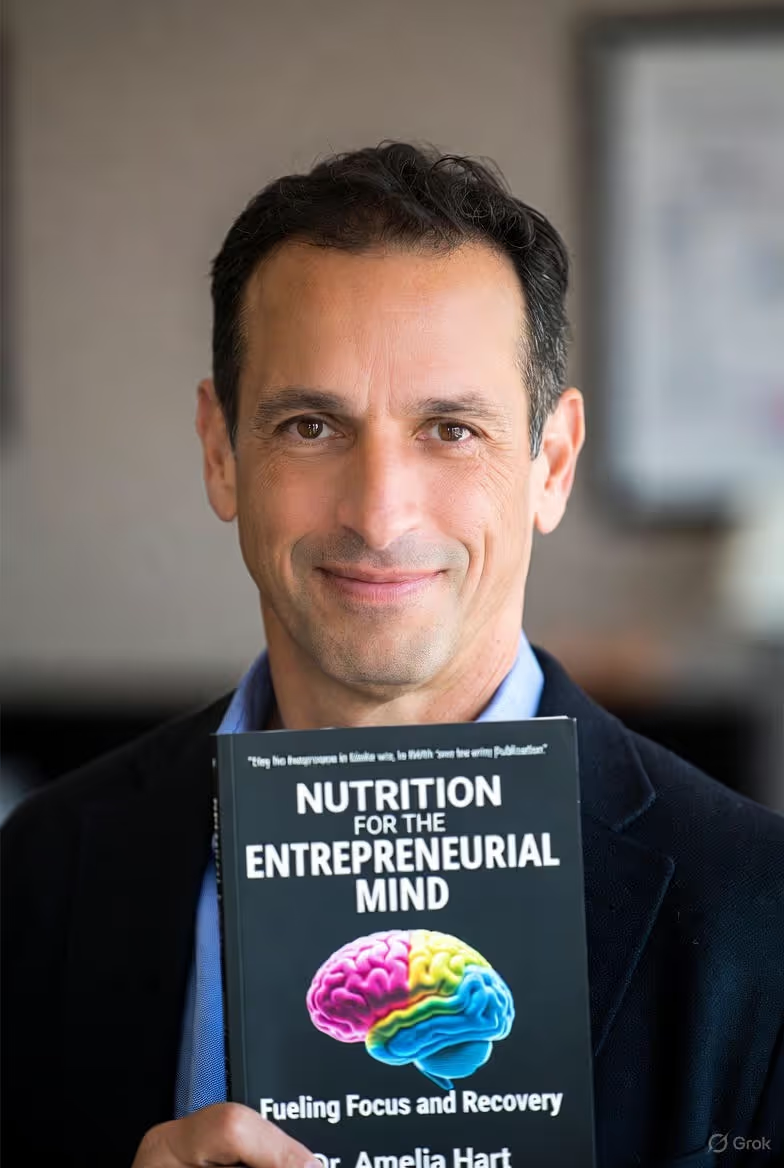
You wouldn't put low-grade fuel in a high-performance engine. Yet, entrepreneurs routinely fuel their complex brains with sugar, processed foods, and erratic eating patterns that create energy spikes and crashes. Nutrition for Restful Living is about strategic fueling: eating to sustain steady energy, sharpen cognition, and support nighttime recovery.
The Entrepreneur's Eating Pitfalls:
Strategic Nutrition Principles:
1. Stabilize Your Blood Sugar:
This is the single most important factor for steady energy and mood.
2. Time Your Nutrients for Performance & Sleep:
3. Master Your Hydration:
Dehydration by just 2% impairs cognitive performance, attention, and memory. Keep a water bottle at your desk. Herbal teas (like chamomile in the evening) are excellent. Monitor your urine color—aim for pale straw.
4. Use Caffeine, Don't Be Used by It:
Caffeine is a powerful performance tool if used strategically.
Listening with Data:
How does that late-afternoon coffee really affect your sleep architecture? Does a high-sugar lunch correlate with an afternoon energy crash you can see in your activity levels? Does staying well-hydrated improve your sleep quality scores? Using a biometric tracker allows you to connect the dots between fuel and function in a personalized way. It turns nutrition from a vague concept into a precise performance strategy. For specific questions on how lifestyle factors impact your biometrics, a great resource is the Oxyzen FAQ section.
The philosophy of Restful Living must be embedded not just in your personal habits, but in the very architecture of your business. A chaotic, reactive, founder-dependent operation is a recipe for burnout. A restful business is built on systems, clarity, and delegation that create space for strategic leadership and personal renewal. This is about designing a company that can run smoothly, even when you step away to recharge.
The Pillars of a Restful Business System:
1. Process Documentation (The Company Brain):
Your brain should not be the sole repository of "how things are done." Every repetitive task—from onboarding a client to posting on social media to closing the monthly books—needs a documented Standard Operating Procedure (SOP). This serves two critical purposes:
2. Communication Cadence & Channels:
End the tyranny of the constant, context-less ping. Establish clear rules of engagement.
3. Strategic Delegation & The "Zone of Genius":
The Entrepreneur's Trap is doing things you're good at but shouldn't be doing. The "Zone of Genius" framework asks: What activities bring you energy, leverage your unique talents, and directly drive the business forward? Everything else is a candidate for delegation or deletion.
The "CEO Day" vs. "Operator Mode":
A critical architectural shift is separating your time into distinct modes. Many founders are stuck in perpetual "Operator Mode"—reacting, doing, managing the day-to-day. A Restful Business requires you to carve out and fiercely protect "CEO Days" or "Strategic Blocks."
Creating this architecture isn't selfish; it's the foundation of a scalable, valuable asset. It signals to your team that you trust the system, which builds a culture of ownership and accountability. It also creates the psychological safety for you to truly disconnect, knowing the machine will hum along. This operational peace is a direct contributor to physiological peace, something you can see reflected in improved biometric scores after implementing such systems. As many successful founders featured in Oxyzen testimonials have discovered, when your business has a strong architecture, your personal recovery metrics often follow suit.
Even with perfect systems and sleep, many entrepreneurs are haunted by an internal driver: the feeling of "never enough." Not enough revenue, not enough growth, not enough impact, not enough time. This scarcity mindset is a deep-seated source of chronic stress that no biohack can fully counteract. Restful Living requires addressing this psychological foundation.
Scarcity vs. Abundance: The Mental Operating Systems
For the entrepreneur, scarcity often manifests as:
Cultivating an Abundance Practice:
1. Define "Enough" for Yourself:
This is a radical act. Ask yourself, quantitatively and qualitatively:
2. Implement a Gratitude Audit:
Scarcity focuses on what's missing. Abundance acknowledges what's present. At the end of each workday, write down 3 specific things about your business you are grateful for. It could be a loyal client, a breakthrough idea, a team member's initiative, or simply the ability to pursue this path. This rewires your brain to scan for positives.
3. Practice Strategic Generosity:
Generosity is the most potent antidote to scarcity. It proves to your psyche that you have enough to share.
4. Reframe "Rest" as Strategic Investment:
In a scarcity mindset, rest is wasted time—a lost opportunity to get ahead. In an abundance mindset, rest is a capital investment in your future creativity, health, and longevity. It's the compound interest of performance. When you view that afternoon walk or full weekend off not as "laziness" but as a necessary deposit into your cognitive and energetic bank account, it becomes non-negotiable.
This psychological shift is what allows you to truly implement the frameworks and systems. It's the inner work that makes the outer work sustainable. It aligns with the core vision of holistic wellness tools, which, as discussed in Oxyzen's about page, aim to support not just physical metrics, but a more mindful and intentional approach to life and work. When you operate from "enough," you build from a place of strength, not fear.
Your attention is your most precious entrepreneurial currency. Yet, it is under constant siege by designed-to-distract technology. Digital minimalism isn't about becoming a Luddite; it's a philosophy of intentionally curating your digital tools to massively support your values and goals, while ruthlessly eliminating what drains you. It's the practice of making technology a tool, not a tyrant.
The Cost of Digital Clutter:
A Digital Declutter Strategy for Founders:
1. The 30-Day Digital Declutter (Inspired by Cal Newport):
This is a radical reset. For 30 days:
After 30 days, you slowly reintroduce only the tools that provide significant value, on terms you define (e.g., "I will use LinkedIn for 20 minutes on Tuesday and Thursday to post and engage").
2. Create Friction for Distraction:
Make distraction difficult. Make focus easy.
3. Curate Your Inputs with Extreme Selectivity:
You are the average of the five pieces of content you consume. Be the ruthless editor of your own mind.
The impact of digital minimalism on Restful Living is profound. By reclaiming your attention, you reduce cognitive load and anxiety. You create mental space for original thought. You might even see this reflected in your biometrics—less screen time before bed can improve sleep scores, and less reactive stress during the day can support a healthier HRV. For ongoing tips on creating a healthier relationship with technology, the Oxyzen blog regularly covers this intersection. A calm digital environment is a prerequisite for a calm mind and a sustainable business.
Entrepreneurship can be lonely. The weight of decisions, the isolation of leadership, and the unique pressures you face are often incomprehensible to friends in traditional jobs. Trying to practice Restful Living in a vacuum is difficult. You need a community that understands the journey and supports the whole person—not just the "CEO" persona. This is about moving from solitary hustle to connected resilience.
Why Go It Alone is a Failing Strategy:
The "lone wolf" founder is a myth perpetuated by harmful stereotypes. In reality, isolation:
Building Your Restful Support Ecosystem:
1. The Mastermind or Peer Advisory Group:
This is a small, curated group of non-competing entrepreneurs who meet regularly with strict confidentiality and a structured format. The value is immense:
2. The Mentor(s):
Seek mentors for different facets of your life:
3. Your "Inner Circle" Recalibration:
Audit your personal relationships. Do they fill you up or drain you? Do they respect your boundaries around work and rest? Gently but firmly spend less time with people who glorify burnout or undermine your new priorities. Invest more in relationships that are restorative.
4. Professional Support:
This is non-negotiable maintenance, not a sign of weakness.
Creating a Culture of Rest Within Your Company:
As a leader, you set the tone. If you email at midnight, you implicitly expect others to be on. If you never take vacation, you create a culture where no one feels they can.
This supportive architecture—both personal and professional—creates a container for your growth. It's the safety net that allows you to take the risks necessary for innovation and the space necessary for recovery. It echoes the philosophy of building tools for holistic self-awareness, a journey you can learn more about through Oxyzen's own story of development and community. You are not a machine, and you were not meant to build alone.
The true test of Restful Living isn't a productive week or a calm month. It’s the ability to sustain passion, creativity, and health over a decades-long entrepreneurial journey. This is about playing the long game—shifting from sprint tactics to marathon strategy. It requires integrating all the principles we've discussed into a seamless, personal operating system that evolves with you and your business.
From Initiative to Identity:
The initial stages of adopting Restful Living practices can feel like adding more tasks to your list: "Now I have to meditate, track my sleep, do breathwork, and document processes?" The goal is to move these practices from being discrete "initiatives" to becoming part of your core identity—who you are as a founder.
This identity shift is powerful. When challenges arise, you don't fall back on old hustle habits; you ask, "How does the well-rested version of me handle this?" This is the foundation of sustainable performance.
The Quarterly Life Review:
Just as you review business KPIs, you must review your life and wellness KPIs. Every quarter, set aside time for a "Life & Leadership Review." This isn't a business planning session; it's a holistic check-in.
This ritual ensures your Restful Living practice adapts and grows with you, preventing it from becoming another rigid, unsustainable system.
Embracing Seasons and Cycles:
Nature doesn't operate at a constant, frenetic pace. It has seasons of growth, harvest, rest, and renewal. Your business and your body have these cycles too. The long-game entrepreneur learns to recognize and honor them.
Fighting against your natural and business cycles is exhausting. Flowing with them is sustainable. Your biometric data can be a crucial guide here, signaling when you've been in a "sprint season" for too long and your body is demanding a "renewal season."
We have covered immense ground in this first portion of our guide to Restful Living for Entrepreneurs. We began by confronting the brutal reality of the burnout epidemic and redefining the cost of the hustle culture. We then dove deep into the physiology of peak performance, understanding that our business output is a direct product of sleep, nervous system state, and recovery metrics.
From that science, we built the Restful Living Framework—the four pillars of Intentional Rest, Mindful Momentum, Aligned Action, and Quantified Recovery. We applied this framework practically, exploring how to master your sleep architecture as the ultimate growth hack, and how to practice strategic energy management over mere time management.
We championed the necessity of deep work and deliberate disconnection in an age of distraction, and learned techniques for cultivating a resilient nervous system to move from reactivity to response-ability. We examined how nutrition fuels the entrepreneurial mind and laid out the principles of digital minimalism to reclaim our attention capital.
We then zoomed out to design a Restful Business Architecture built on systems and delegation, and did the critical inner work of cultivating an abundance mindset to overcome scarcity. Finally, we emphasized that you cannot do this alone, outlining how to build a supportive community that sustains you.
This is your new blueprint. The path forward is not about perfection, but about progression. It’s about making one better choice today that your future self will thank you for. It’s about building a business that is a reflection of your fullest, healthiest, most creative self—not a relic of your depleted sacrifice.
The journey continues. In the next portion of this guide, we will build upon this foundation, delving into advanced integration techniques, navigating specific high-stress entrepreneurial scenarios, and exploring the future of bio-hacking and personalized wellness. We’ll look at building a legacy, not just an exit strategy. This is just the beginning.
Remember, the most sustainable business you will ever build is the life you are designing while you do it. To continue exploring resources and insights on this journey, a wealth of information awaits on the Oxyzen blog. Your rest is your secret advantage. Now, go use it.
You now possess the blueprint—the science, the philosophy, and the foundational practices of Restful Living. Knowledge, however, is not power. Applied knowledge is power. This section is the crucible where theory is forged into unshakable daily practice. We move from "knowing what to do" to "making it non-negotiable," even amidst the beautiful chaos of entrepreneurship.
The Practice of Non-Negotiables (The Anchors):
Every ship needs an anchor to hold steady in a storm. Your Restful Living practice needs the same. Identify 2-3 "non-negotiables"—tiny, ironclad rituals that you defend with your life. These are not elaborate; they are simple and profound.
The power of a non-negotiable isn't in the act itself, but in the identity it reinforces. Every time you defend that boundary, you whisper to yourself, "My well-being is the priority." When a client asks for a "quick call" at 8 PM, your non-negotiable becomes the graceful, firm reason you can't. "I have a prior commitment to my morning routine, so an evening call would compromise that. Can we schedule for 9 AM tomorrow?" This is leadership of the self.
Habit Stacking for the Time-Poor Founder:
"I don't have time" is the anthem of the overwhelmed. Habit stacking, a concept from James Clear's Atomic Habits, solves this by attaching a new, desired behavior to an existing habit.
These micro-practices, piggybacking on established routines, require no extra time and compound into significant wellness gains. They are the threads that weave rest into the fabric of your workday.
The "Reset Button" Ritual:
Despite our best efforts, days will go off the rails. A deal falls through, a team conflict erupts, a server crashes. The old response: spiral, work frantically, drink more coffee, ruin the night. The Restful Living response: hit your personal "reset button."
This is a pre-programmed, 5-10 minute sequence you deploy in moments of high stress to regain homeostasis. It should be somatic (in the body) to break the cognitive panic loop.
Theory is peaceful. Reality is a client screaming on the phone two hours before your product launch. Let’s apply Restful Living principles to the specific, high-stakes scenarios every entrepreneur inevitably faces.
Scenario 1: The Funding Round or Major Pitch
This is a quintessential entrepreneurial sprint, fraught with anxiety, long hours, and intense performance pressure.
Scenario 2: The Product Launch or Major Public Event
The culmination of months of work, with everyone watching. The pressure to perform and the fear of public failure are immense.
Scenario 3: The Crisis (PR Nightmare, Key Employee Departure, Cash Flow Crunch)
This is when the survival brain wants to take over, triggering panic, short-termism, and isolation.
In each scenario, the principles are the same: Protect core recovery, use data for self-awareness, deploy somatic resets, and lead from a state of regulated calm. This is what it means to have Restful Resilience—not the absence of fire, but the ability to walk through it without getting burned.
Wearing a smart ring like Oxyzen gives you a stream of data. That data is noise until you learn to interpret it as a narrative—the story of your body's interaction with your life and business. This is about moving beyond the daily score to insightful pattern recognition.
Reading the Symphony, Not Just the Notes:
Don't fixate on a single night of poor sleep. Look for trends over 7-30 days.
Key Metric Correlations for the Entrepreneur:
Creating Your Personal "Owner's Manual":
This is the ultimate goal. Through months of observation, you start to write your own manual.
This manual turns you from a passive passenger in your body to an expert pilot. For nuanced questions on interpreting specific data from advanced wearables, resources like the Oxyzen FAQ can provide valuable support. You are no longer guessing what works; you are running experiments and collecting evidence. Your life becomes your most important R&D project.
Your personal practice is the spark. Your leadership is how you set the whole forest ablaze—with sustainable fire, not a destructive burn. The culture you create as a founder is the single biggest determinant of your company's ability to perform sustainably. A Restful Leader builds a company where people can do the best work of their lives without sacrificing their lives.
Modeling, Not Mandating:
You cannot decree a culture of rest. You must embody it. This is "shadow leadership"—the unspoken signals you send.
Reward Outcomes, Not Optics:
Shift the cultural currency from "who stays latest" to "who delivers the most impact efficiently."
Designing Work for Human Beings:
Examine your company's default settings. Are they designed for machines or for humans?
By leading this way, you attract and retain top talent who value a life of meaning, not just a job. You build an organization with inherent resilience. The positive feedback is immense—as your team thrives, the business thrives, and your own sustainable practice is reinforced. This is the legacy of the Restful Leader, a philosophy deeply aligned with a mission to empower holistic success, much like the vision shared in Oxyzen's story. You are building a future of work that works for humans.
Your Trusted Sleep Advocate: Sleep Foundation — https://www.sleepfoundation.org
Discover a digital archive of scholarly articles: NIH — https://www.ncbi.nlm.nih.gov/
39 million citations for biomedical literature :PubMed — https://pubmed.ncbi.nlm.nih.gov/
Experts at Harvard Health Publishing covering a variety of health topics — https://www.health.harvard.edu/blog/
Every life deserves world class care :Cleveland Clinic - https://my.clevelandclinic.org/health
Wearable technology and the future of predictive health monitoring :MIT Technology Review — https://www.technologyreview.com/
Dedicated to the well-being of all people and guided by science :World Health Organization — https://www.who.int/news-room/
Psychological science and knowledge to benefit society and improve lives. :APA — https://www.apa.org/monitor/
Cutting-edge insights on human longevity and peak performance:
Lifespan Research — https://www.lifespan.io/
Global authority on exercise physiology, sports performance, and human recovery:
American College of Sports Medicine — https://www.acsm.org/
Neuroscience-driven guidance for better focus, sleep, and mental clarity:
Stanford Human Performance Lab — https://humanperformance.stanford.edu/
Evidence-based psychology and mind–body wellness resources:
Mayo Clinic — https://www.mayoclinic.org/healthy-lifestyle/
Data-backed research on emotional wellbeing, stress biology, and resilience:
American Institute of Stress — https://www.stress.org/


