


Sleep Patterns in Couples: Managing Different Chronotypes
Couples with different chronotypes can manage by compromising on sleep schedules, using separate blankets, and respecting each other's morning/evening preferences.
Couples with different chronotypes can manage by compromising on sleep schedules, using separate blankets, and respecting each other's morning/evening preferences.
%402x.svg)
It’s 2:13 AM. You’re awake, staring at the ceiling, your mind racing through tomorrow’s to-do list. Beside you, your partner is a portrait of serene, deep slumber, barely stirring as you shift for the hundredth time. Fast forward to 6:30 AM. The alarm shrieks. You, finally drifting into meaningful sleep, feel like you’ve been hit by a truck. Your partner, however, is already halfway to the coffee maker, humming, energized, ready to conquer the world before sunrise. Sound familiar?
This isn’t just a case of “being a light sleeper” or having a bad night. This is a fundamental biological mismatch. It’s the story of the Night Owl and the Early Bird sharing a nest—a tale as old as time, yet profoundly misunderstood. We call these inherent sleep-wake preferences “chronotypes,” and they are hardwired into our DNA, governed by a complex internal clock known as the circadian rhythm. When two different chronotypes fall in love, they don’t just merge lives; they attempt to synchronize two distinct, powerful, and often opposing biological universes.
For couples, mismatched sleep patterns are far more than a minor inconvenience. They are a stealth stressor, a silent thief of intimacy, and a significant source of chronic relationship friction. Research indicates that couples with divergent sleep schedules report more conflict, less conversation, and lower levels of relationship satisfaction. The precious, quiet hours meant for connection—mornings and evenings—become zones of negotiation, resentment, or solitude. The shared bed, a symbol of unity, can transform into a battleground of stolen blankets, glaring screens, and mismatched energy.
But what if this wasn’t a problem to be solved, but a rhythm to be understood? What if, instead of forcing one another to change, you could learn to harmonize? This is not about one partner “winning.” It’s about moving from a state of sleep strife to one of sleep synergy. It’s about reclaiming your rest, your energy, and the connective tissue of your relationship.
The journey begins with a radical shift in perspective: your partner is not trying to annoy you. Their rhythm is as authentic to them as yours is to you. With empathy, science, and a touch of modern technology, you can learn to manage these differences, not just in the bedroom, but in the very fabric of your daily lives. This is your guide to navigating the beautiful, complex, and sometimes frustrating world of sleep patterns in couples. We’ll explore the science of chronotypes, decode their impact on your relationship dynamics, and provide actionable, compassionate strategies to build a shared life that honors both your biological blueprints. Let’s begin by understanding the forces at play within each of you.

To navigate the waters of mismatched sleep, we must first understand the current. Your chronotype is your body’s natural predisposition for when you feel most alert, sleepy, and energetic throughout the 24-hour day. Think of it not as a habit, but as an innate, genetically influenced trait—much like being left-handed or having a particular eye color. This internal timing system is orchestrated by your circadian rhythm, a master biological clock located in the brain's suprachiasmatic nucleus (SCN). This clock is fine-tuned by external cues, primarily light, but its default settings are unique to you.
Chronotypes exist on a spectrum, but they are commonly categorized into three archetypes, with some researchers adding a fourth:
The clash between chronotypes, particularly between distinct Larks and Owls, is rooted in biology, not stubbornness. Key hormones are out of phase:
When an Owl tries to converse with a Lark at 10 PM, it’s a conversation between an alert mind and one bathed in sleep-inducing melatonin. When a Lark cheerfully proposes a 7 AM weekend hike to an Owl, it’s akin to asking them to run a marathon in a physiological fog. This mismatch extends beyond bedtime. It affects meal times, social plans, sex drive, parenting styles, and even core temperature rhythms.
Understanding that these are deep-seated biological differences is the first, crucial step toward empathy. It removes blame. Your Owl partner isn’t lazy; their biological sunrise is simply later. Your Lark partner isn’t boring; their system is following an ancient, light-driven rhythm. The goal isn’t to fundamentally change these blueprints—a notoriously difficult feat—but to build a shared life architecture that accommodates them both. For those looking to objectively identify their own and their partner’s chronotype, tools like the Morningness-Eveningness Questionnaire are a great start, and wearable technology can provide fascinating, data-driven insights. You can explore the science behind personalized rhythm tracking further on our dedicated blog, where we break down complex wellness topics.
The impact of divergent chronotypes reverberates far beyond the edges of the mattress. It seeps into the very foundation of a relationship, influencing communication, intimacy, shared time, and even the division of daily labor. It’s a 24-hour cycle of micro-misalignments that, over time, can create a tangible emotional distance.
The Intimacy & Connection Gap: Quality couples’ time often naturally occurs in the “shoulder hours” of the day—the quiet evening after work and the calm morning before the day begins. For a misaligned couple, these windows are fundamentally broken. The Owl may crave deep, connecting conversation or physical intimacy at 10 PM, just as the Lark’s brain is switching into sleep mode, leading to perceived rejection or lack of interest. Conversely, the Lark may wake up feeling amorous or eager for morning coffee chat, only to find a groggy, unresponsive partner. This repeated misconnection can erode the sense of being “in sync” on a fundamental level, making partners feel like they are living parallel, rather than intertwined, lives.
Communication Breakdowns: Our ability to communicate effectively is tightly linked to our energy and cognitive sharpness. A Lark trying to discuss finances or plan the week with an Owl at 8 PM is operating with a fully engaged prefrontal cortex, while the Owl might still be processing the day. The Owl may seem distracted or disengaged. Conversely, an Owl’s passionate late-night idea might be met with a Lark’s grumpy, sleep-deprived dismissal. Important conversations often happen at the wrong biological time for one partner, leading to misunderstandings, frustration, and arguments where the timing is the real culprit, not the topic.
The Shared Experience Deficit: “Let’s go to that Saturday morning farmer’s market!” “How about catching that late-night comedy show?” For aligned couples, these are simple suggestions. For misaligned ones, they are potential sources of conflict. The Lark may resent always missing out on vibrant nightlife, while the Owl may dread the obligatory, exhausting early weekend activities. This can lead to a reduction in shared novel experiences, which are critical for bonding and relationship freshness. Partners may start doing more things separately, which, without careful management, can create emotional drift.
Household Logistics & Resentment: The mundane becomes monumental. Who lets the dog out at 6 AM? Who stays up to turn off the lights and lock up? Does the early-rising Lark always handle morning childcare, building silent resentment? Does the night-owl always handle late-night chores, feeling like their productive hours are taken for granted? Without conscious negotiation, these patterns can solidify into perceived inequity, where one partner feels their natural rhythm is a burden or is being exploited.
The Health Spillover: Chronic sleep disruption or social jetlag—the strain of living against your natural rhythm—has documented health consequences: weakened immune function, increased stress, and higher risk for mood disorders. When one or both partners are chronically out of sync, they bring this physiological stress into the relationship. A sleep-deprived, cranky partner is not their best selves. The relationship becomes a stressor instead of a sanctuary.
Recognizing these broader impacts is vital. It moves the issue from “my partner won’t go to bed” to “our biological differences are creating systemic friction in our shared life.” This systemic view is the key to seeking holistic solutions, not just bedtime compromises. For many couples, witnessing this data in their own lives can be a revelation. By using a device like the Oxyzen smart ring to track sleep phases, heart rate variability (a stress indicator), and activity, couples can move from subjective blame (“you’re always tired”) to objective observation (“my data shows my deep sleep is fragmented when our bedtimes differ by more than two hours”). Seeing the tangible impact can be the catalyst for compassionate change. Discover how real couples have used this data-driven approach to improve their dynamics by reading their stories in our testimonials section.
Before you can build a bridge, you need to know where both banks are. Identifying your and your partner’s chronotypes with clarity and empathy is the foundational step. This isn’t about labeling or boxing each other in, but about gathering objective and subjective data to understand your natural tendencies, separate from the demands of work, children, or social life.
Start with Subjective Reflection: Ask yourselves key questions independently, then compare notes.
Utilize the Morningness-Eveningness Questionnaire (MEQ): This is a scientifically validated, simple self-assessment that places you on a spectrum from “Definite Morning” to “Definite Evening” type. Taking it together can be an enlightening, non-confrontational activity. It frames your differences in neutral, scientific language.
Leverage Technology for Objective Data: This is where modern wellness tools become invaluable. Subjective feeling can be clouded by stress or perception. Objective data provides a clear picture. A smart ring like Oxyzen is an ideal tool for this discovery phase, as it collects data seamlessly throughout the night and day.
The “Weekend vs. Weekday” Analysis: For many, work schedules brutally override their chronotype. Compare your sleep data from workdays to free days. A large discrepancy (e.g., sleeping 2+ hours later on weekends) is a classic sign of “social jetlag” and a strong indicator of a mismatched chronotype and lifestyle.
Approach with Curiosity, Not Judgment: When sharing your findings, frame it as a collaborative exploration. “Look at this interesting pattern my data shows—I really do seem to have a later temperature drop. What does your data say about your deep sleep?” This depersonalizes the issue and makes you a team investigating a fascinating biological puzzle.
This process of identification does more than provide answers; it builds a shared language. You’re no longer “annoyingly perky” or “impossibly sluggish.” You are a “Lark with a cortisol peak at 6 AM” and an “Owl with a melatonin delay.” This scientific framework fosters empathy and becomes the basis for all the practical strategies to follow. To learn more about the specific biomarkers tracked by advanced wearables and how they paint a picture of your health, visit our comprehensive FAQ page.
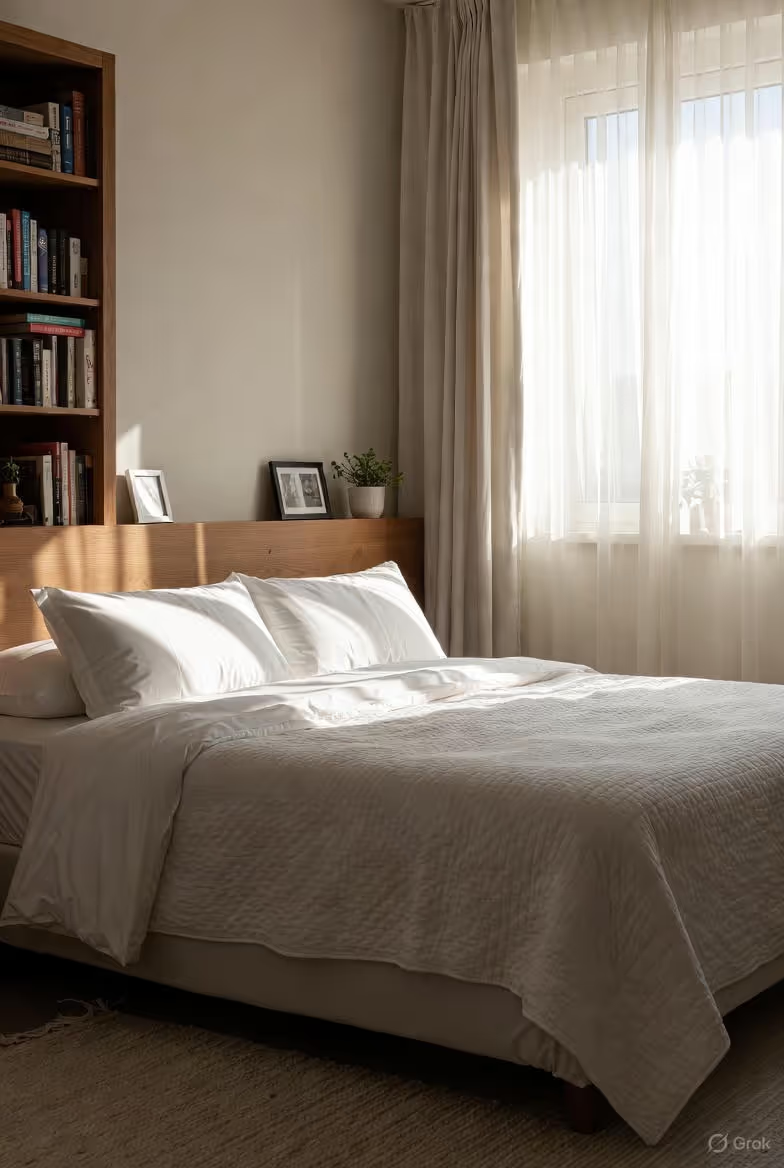
Once you understand your chronotypes, the next mission is to reclaim your shared bedroom as a sanctuary for both of you. This is often the most tangible pain point, and solving it requires practicality, compromise, and sometimes, a touch of creativity. The goal is to maximize sleep quality for each partner, even if the timing differs.
Mastering the Staggered Sleep Schedule: This is the cornerstone tactic for many successful mismatched couples. Accept that going to bed and waking up at the same time may not be feasible or healthy. Instead, create a respectful routine around the difference.
Optimize the Sleep Environment for Both:
The Pre-Sleep Connection Ritual: Just because you don’t fall asleep together doesn’t mean you lose the intimacy of bedtime. Create a 15-20 minute “connection ritual” at the Lark’s bedtime. This could involve:
Navigating Intimacy: Spontaneity can suffer with staggered schedules. Combat this by scheduling intimacy. It may sound unromantic, but it actually builds anticipation and ensures both partners are in a receptive state. Consider lunch breaks, late mornings on weekends (when the Owl is more awake), or specific evenings designated as “late nights” for the Lark (perhaps with a strategic afternoon nap). Communication is key—express needs without making the other’s rhythm feel like an obstacle.
The Separate Rooms Question: For some couples, the ultimate solution is a sleep divorce—sleeping in separate rooms or beds. This can be emotionally charged, often feeling like a failure. Reframe it: it is a sleep alliance. It’s a proactive, loving decision to ensure you both get the restorative sleep needed to be healthy, happy, and present for each other during the waking hours. It doesn’t preclude intimacy; it protects it from the corrosive effects of chronic sleep deprivation and resentment. Many couples who make this switch report dramatically improved relationships because they are no longer sleep adversaries.
The bedroom strategy is about operationalizing respect. It’s a series of small, considerate actions that say, “I value your sleep and your biological needs as much as my own.” It turns the shared space from a zone of conflict into a customized haven for rest. For more ideas on crafting the perfect personal sleep sanctuary, our blog features numerous guides on environmental optimization for different sleep types.
Your social life and shared daily routines don’t have to be casualties of your chronotype mismatch. With intentional planning and flexible thinking, you can design a joint life that honors both rhythms and creates meaningful, shared experiences. This is about moving from a default “one-size-fits-all” approach to a customized, collaborative schedule.
The Art of the Compromise Calendar: Sit down together—perhaps during a time when you’re both at moderate energy levels—and look at your week. Proactively block out time for different types of shared activities.
Communicate as a Team with Others: Presenting a united front to friends and family reduces external pressure. You might say, “We’d love to join for dinner, but we need to make it an earlier reservation,” or “Brunch is perfect for us, but we’ll have to skip the late-night part of the party.” This prevents one partner from being labeled the “boring” or “difficult” one.
Embrace Parallel & Solitary Time: A healthy relationship does not require 100% shared activities. Reframe solo time not as rejection, but as recharging. The Lark’s early morning can be a sacred, quiet period for meditation, reading, or a solo walk. The Owl’s late night can be a productive or creative sanctuary. This independent time allows each partner to honor their rhythm fully and brings more individual contentment into the relationship. The key is that this time is agreed upon and respected, not taken by default out of frustration.
Create New, Neutral Rituals: Invent connection points that aren’t tied to traditional morning or evening patterns. Could you have a “midday check-in call” during your workday? A dedicated “Saturday afternoon coffee and plan” session? A weekly “lunch date” on a weekday? These rituals become your unique signature as a couple, defined by your synergy, not by societal norms.
Travel & Vacation Planning: Holidays can be a chronotype minefield. Discuss expectations beforehand. Is this a “see-the-sunrise-from-the-mountain” trip or a “vibrant-nightlife” city break? Often, the best solution is a blend: one day with an early start, the next with a sleep-in and late dinner. Booking accommodations with separate living/sleeping areas or two rooms can provide flexibility and peace.
Managing your social sync is about proactive leadership of your shared life, rather than reactive suffering through mismatched events. It requires more communication and planning than an aligned couple might need, but this very process can foster deeper teamwork and understanding. It ensures that your life together is built on conscious choice, not biological default. For inspiration on how other couples design their unique shared rhythms, the stories and community insights found on our about-us page can provide valuable perspective on building a life around wellness and mutual respect.
All the strategies in the world will fail without the glue of effective, compassionate communication. When discussing sleep, a topic so tied to primal need and personal habit, conversations can easily become charged. The goal is to shift from a blame-oriented dialogue (“You keep me awake!”) to a solution-oriented partnership (“How can we both get better rest?”).
Establish “Neutral Time” for Sleep Talks: Never, ever, have a significant conversation about sleep logistics when one of you is sleep-deprived, cranky, or in your biological “off” zone. For a Lark, this means not right before bed. For an Owl, not first thing in the morning. Schedule a weekly or bi-weekly “relationship operations” meeting during a neutral, overlapping energy window—like a Sunday afternoon. This is the time to calmly review what’s working, what’s not, and brainstorm adjustments.
Use “I Feel” Statements and Biological Language: Frame issues from your experience using the chronotype language you’ve learned.
This removes the attack and presents the issue as a shared problem with a biological cause.
Practice Active Listening & Validation: When your partner expresses frustration, listen to understand, not to defend or correct. Validate their experience, even if it’s different from yours.
Set Shared Goals, Not Demands: Move the focus from individual complaints to shared aspirations. “Our goal is for both of us to feel rested and connected” is a powerful unifying statement. Then, every tactic—from separate blankets to staggered schedules—can be evaluated against this shared goal. Ask, “Does this new idea move us toward our goal of both being rested and connected?”
Celebrate the Wins & Express Gratitude: This journey is hard. Acknowledge efforts, no matter how small. “Thank you for using headphones last night, I slept so much better.” “I really appreciated you getting up for that early breakfast with my parents; I know that was a sacrifice.” Positive reinforcement makes compromises feel valued and sustainable.
Know When to Seek Help: If conversations consistently spiral into arguments or if resentment is deeply entrenched, consider seeking a couples therapist. A skilled therapist can provide a neutral framework for these discussions and help you build the communication tools specific to this challenge. There is no shame in seeking guidance; it’s a proactive investment in your relationship’s health.
Communication is the operating system for your chronotype compromise. It turns two individuals with conflicting needs into a coordinated team. By adopting a curious, validating, and goal-oriented communication style, you build a bridge over the natural divide created by your biology, creating a stronger, more resilient partnership in the process. For further resources on building healthy communication habits in relationships, our curated content on the Oxyzen blog offers insights that extend beyond sleep.
While you can’t change your core chronotype, you can influence its expression and mitigate extreme misalignment through deliberate daily habits. Lifestyle acts as the conductor, helping to gently nudge both internal clocks closer to a harmonious, if not identical, rhythm. This is about leveraging science to create convergence where possible.
Mastering Light Exposure: Your Most Powerful Tool: Light is the primary “zeitgeber” (time-giver) for your circadian clock. Strategic light exposure is your most effective non-invasive tool for adjustment.
Coordinate Meal Times: Eating is a secondary circadian cue. Try to align your main meals as closely as possible, even if your sleep times differ. A large, heavy meal right before bed (for the Owl) or very early in the morning (for the Lark before the Owl is hungry) can disrupt the other’s rhythm. Aim for the last large meal to finish 2-3 hours before the earlier partner’s bedtime. This also creates a shared daily ritual.
Caffeine & Alcohol Awareness:
Exercise Timing: Vigorous exercise is alerting for most people. Encourage it during each partner’s natural “peak” or “shoulder” times (morning for Larks, late afternoon for Owls). Avoid intense exercise within 2-3 hours of the Lark’s bedtime, as it can raise core body temperature and delay sleep onset. Gentle, restorative movement like stretching or yoga can be a wonderful shared wind-down activity before the Lark’s bedtime.
The Weekend Lie-In Dilemma: Owls naturally crave long weekend sleep-ins to pay off their social jetlag debt. However, sleeping in more than 1-2 hours past your weekday wake time can confuse your internal clock, making Monday morning a brutal shock (a phenomenon sometimes called “Sunday Night Insomnia”). A better strategy for the Owl is to go to bed a bit earlier on weekends and try to wake within a 90-minute window of their weekday wake-up, using naps for additional recovery if needed. This helps maintain a more stable rhythm that’s closer to their Lark partner’s.
By co-creating lifestyle routines that respect these principles, you build a scaffolding of daily habits that support both of your biological needs. It turns the home into an environment that promotes rhythm convergence. This isn’t about one partner doing all the changing; it’s about both adapting your shared environment and habits for mutual benefit. Understanding the science behind these lifestyle levers is a passion of ours at Oxyzen, and you can dive deeper into the research on our dedicated blog.

In the quest to harmonize chronotypes, subjective feelings can only take you so far. Memory is flawed, and perception is biased by mood and fatigue. This is where modern wellness technology shifts from a gadget to a relationship aid. Objective data provides a neutral, factual foundation for understanding and change, replacing “I feel like…” with “The data shows…”.
From Argument to Analysis: A common couple’s argument: “You were tossing and turning all night and kept me up!” “I was not! I slept like a rock!” With sleep tracking, you can move past this. You can both review the night’s data. The ring might show one partner had high restlessness (periods of movement) coinciding with the other’s periods of light sleep. This isn’t about blame; it’s about identifying a pattern: “Look, my deep sleep periods seem fragile when there’s movement after midnight. Maybe we need a better mattress or I should try earplugs.”
Tracking the Impact of Compromises: Did agreeing to a slightly earlier bedtime for the Owl actually improve their Sleep Score or HRV? Did the Lark’s decision to use a sleep mask result in more consistent deep sleep? Data provides immediate, tangible feedback on whether a compromise is working physiologically. This reinforces positive changes and helps you abandon strategies that aren’t yielding results.
Understanding “Social Jetlag” Quantitatively: By comparing sleep metrics on free days vs. workdays, both partners can visually see the strain their schedule imposes. An Owl might see their HRV (a marker of recovery) plummet on days with early meetings. A Lark might see their sleep efficiency drop on nights they force themselves to stay up late. This shared visualization builds profound mutual empathy. It’s no longer “my partner is complaining,” it’s “my partner’s nervous system is under measurable stress.”
Synchronized Bio-Monitoring: Using a platform where both partners can view each other’s aggregated, anonymized trends (with permission) is powerful. You might discover that your best weeks, where you both report high relationship satisfaction, correlate with weeks where both your sleep consistency scores are high, even if the times differ. This reinforces the idea that quality, predictable sleep for each individual is the true goal, not identical sleep times.
Guided Experiments: Use the data to run two-week experiments. “For the next two weeks, let’s try you using blue-light glasses after 8 PM. We’ll track your sleep latency (time to fall asleep) and my sleep disruptions.” This turns problem-solving into a collaborative, almost scientific project. The objective results remove ego and emotion from the assessment.
Choosing the Right Tool: For sleep and rhythm tracking, a device worn 24/7 is ideal. A smart ring like Oxyzen is particularly well-suited for couples’ tracking because it’s unobtrusive, comfortable for all-night wear, and tracks a comprehensive suite of metrics beyond simple movement: heart rate, HRV, skin temperature, and blood oxygen—all of which are key outputs of your circadian system. Its long battery life also means less choreography of charging, making adherence easy for both partners.
Technology, when used with intention, becomes a translator between two different biological languages. It fosters a team mindset, where you are both allied against the problem of poor sleep, not against each other. It provides the clarity needed to make informed, compassionate decisions about your shared life. To see how this technology works and how it can be seamlessly integrated into a couple’s life, you can learn more about Oxyzen’s features and philosophy.
Life doesn’t stand still. Major transitions—having a baby, changing jobs, entering menopause, retirement—can dramatically disrupt even the most carefully crafted sleep synergy. These events stress individual sleep and amplify chronotype differences. Navigating them successfully requires anticipating the disruption and adapting your strategies with extra grace and communication.
The New Parent Phase: This is the ultimate sleep disruptor, often flattening chronotype differences in a haze of exhaustion for both. However, your underlying tendencies will resurface and can be leveraged.
Career Changes & Shift Work: A job change can flip your entire schedule. If an Owl takes a job requiring 5 AM starts, or a Lark takes a role in hospitality ending at midnight, the strain is immense.
Menopause & Andropause: Hormonal changes can brutally disrupt sleep architecture, often causing night sweats, insomnia, and lighter sleep. This can turn a Lark into a frazzled insomniac or make an Owl’s sleep even later and more fragmented.
Retirement & The Empty Nest: For the first time in decades, you may have complete control over your schedule. This can be a beautiful opportunity to relax into your natural rhythms, but it can also widen the gap if not managed.
Every major transition tests the resilience of your chronotype compromise. By viewing these challenges as external events to be weathered as a team—using your established language of empathy, data, and negotiation—you can prevent them from fracturing your bond. In fact, successfully navigating these storms can make your partnership stronger and more adaptable. The journey of Oxyzen itself, from an idea to a tool for couples, was born from navigating personal health challenges; you can read about that foundational our-story on our site.

So far, we’ve focused on the challenges. But what if your chronotype difference isn’t just a hurdle to clear, but a unique asset to your relationship? When reframed and managed well, living with a different rhythm can confer surprising advantages that aligned couples might never experience.
Built-In “Me Time”: In our hyper-connected world, finding guilt-free, scheduled time for oneself is a luxury. Mismatched couples have this built into their daily architecture. The Lark’s early mornings and the Owl’s late nights become natural sanctuaries for personal pursuits, hobbies, or simple solitude without negotiation or FOMO (Fear Of Missing Out). This fosters individual growth and self-care, which is the bedrock of a healthy partnership.
Extended Household Coverage: You essentially have someone “on watch” for more hours of the day. The early-riser can handle morning emergencies, accept early deliveries, or care for pets. The night-owl can handle late-night tasks, be the last to secure the house, or care for a sick child in the wee hours. This can make your household run more efficiently and feel more secure.
Diverse Perspectives and Energy: Your different peaks bring complementary strengths to problem-solving and projects. The Lark can tackle complex, analytical tasks with a fresh morning brain, laying the groundwork. The Owl can then review, refine, and add creative insights with their evening cognitive boost. This “tag-team” approach to life’s challenges can be highly effective.
A Forcing Function for Proactive Communication: Because nothing can be assumed, mismatched couples are often forced to communicate more explicitly about schedules, needs, and plans. This habit of proactive negotiation can spill over into all areas of the relationship—finances, parenting, future planning—making you a more communicative and intentional couple overall.
A Buffer Against Enmeshment: The natural time apart provides a healthy degree of independence, preventing the kind of co-dependency or loss of self that can sometimes occur in very tightly synchronized couples. You maintain your individuality within the union, which is a key ingredient for long-term attraction and respect.
Appreciation for Your Time Together: When shared awake time is not a default state but a conscious creation, you tend to value it more. Your dates, conversations, and cuddles are intentional, not just what happens because you’re both awake. This can lead to higher-quality interaction and a deeper appreciation for the moments you are truly in sync.
A Master Class in Empathy and Compromise: Navigating this fundamental difference is a continuous practice in seeing the world from another’s perspective, in validating experiences different from your own, and in finding middle ground. These are the muscles of a strong, mature relationship. Honing them through sleep makes you better equipped to handle any other difference that life throws your way.
Your chronotype mismatch is not a flaw in your relationship; it’s a feature. It’s a unique design element that, when understood and worked with, can create a partnership that is more resilient, communicative, and rich than you might have imagined. It asks more of you, but it also gives more back. Embracing this perspective transforms the journey from one of management to one of celebration. For more insights on turning lifestyle differences into strengths, explore the articles and community discussions hosted on our blog.
We have journeyed from the frustrating 2 AM wakefulness to a place of understanding and strategic empowerment. You now see that the tension between night owl and early bird is not a personal failure, but a biological reality—a clash of circadian rhythms written into your DNA. We’ve explored how this mismatch strains intimacy, communication, and daily logistics, moving the issue from the bedroom into the core of your shared life.
The path forward is built on the twin pillars of knowledge and empathy. You’ve learned how to identify your chronotypes, not through guesswork, but through reflection and objective data. You have a toolkit of practical strategies: from transforming your bedroom into a dual-sanctuary with staggered schedules and optimized environments, to proactively synchronizing your social calendar and mastering the art of compromise. You understand that communication must shift from blame to collaborative problem-solving, using a shared biological language.
Perhaps most importantly, we’ve flipped the script. Your difference isn’t just a problem to solve; it’s a potential source of strength—offering built-in personal time, complementary energies, and a powerful training ground for empathy.
This is the foundation. You have the map and the initial tools. But the journey to true, sustainable sleep synergy continues. In the next portion of this guide, we will delve even deeper into the advanced tactics for long-term harmony. We will explore the critical role of stress management and recovery for mismatched couples, as sleep disparity often exacerbates stress, creating a vicious cycle. We’ll provide a comprehensive guide on how to use biofeedback data from devices like the Oxyzen ring not just for insight, but for creating personalized, joint action plans that evolve with your lives.
We’ll examine long-term health implications and how protecting your individual sleep is an investment in your future together. We’ll also tackle niche scenarios, from parenting teenagers (who are often extreme Owls) with a mismatched parent pair, to managing chronic health conditions within a chronotype-divided household. Furthermore, we’ll look at the future of couple-centric wellness technology and how shared data dashboards and AI-driven insights are poised to make this journey of synchronization smoother and more intuitive.
The goal is no longer just to survive your different sleep patterns, but to thrive within them—to build a relationship that is not in spite of your rhythms, but beautifully, uniquely because of them. You are now equipped with the understanding to begin. To continue this journey and discover the advanced strategies for creating a lifelong sleep alliance, the next chapter awaits, building directly upon the foundation we’ve laid here. For any questions on the concepts covered so far or the technology that can assist, our supportive team has compiled answers on our FAQ page.
You've laid the groundwork. You've identified your chronotypes, transformed your bedroom, and established new communication rhythms. The initial friction has eased, replaced by a system of respectful compromises. But the journey to deep, sustainable sleep synergy doesn't end here. This is where we move from management to mastery—from simply co-existing with your differences to leveraging them for a healthier, more connected, and more resilient partnership.
The advanced phase is about fine-tuning the engine of your relationship. It focuses on breaking the insidious feedback loops where sleep disruption fuels stress, which in turn fuels more sleep disruption. It’s about moving from reactive problem-solving to proactive, data-informed co-regulation. Here, the tools and understanding you’ve built become the foundation for a more sophisticated approach to shared wellness. We will explore how to use biofeedback not just as a mirror, but as a guide; how to protect your long-term health as a unit; and how to navigate the complex life stages that test your hard-won sync. Welcome to the next level of building your sleep alliance.
For chronotype-mismatched couples, stress and poor sleep are not isolated issues—they are partners in a damaging dance. This creates a stress-sleep vortex: the tension from mismatched schedules and lost connection increases physiological stress (elevated cortisol, lowered HRV). This stress, in turn, makes it harder for both partners to fall asleep, reduces sleep quality, and amplifies emotional reactivity, which then creates more relational stress. Breaking this cycle is paramount for moving from fragile compromise to robust synergy.
Understanding Shared Physiological Stress: Stress is contagious, especially in close relationships. When one partner is chronically stressed and sleep-deprived, it impacts the other through emotional spillover, tense interactions, and disrupted sleep. Tracking a metric like Heart Rate Variability (HRV) becomes crucial. HRV measures the variation in time between heartbeats and is a key indicator of your nervous system's resilience and recovery capacity. A higher HRV generally indicates better stress adaptation.
Creating a Couple-Wide Recovery Protocol: Once you identify shared stress patterns, you can implement joint recovery strategies.
Communicating About Stress, Not Just Sleep: Learn to flag stress proactively using non-blaming language. "My HRV has been low all week, so I might be more reactive—just a heads-up." Or, "I can see from my data I'm not recovering well. I need to prioritize an early night tonight." This depersonalizes irritability and frames it as a physiological state to be managed, not a character flaw to be criticized.
By attacking the stress-sleep vortex as a unified team, you protect the individual sleep gains you've made and strengthen the emotional fabric of your relationship. You're not just sleeping better; you're building a shared fortress against the pressures of the outside world. For deeper dives into the science of HRV and recovery, our blog features extensive resources on using data for stress management.
In the foundational phase, data helped you see the problem. Now, it's time to use that data to drive your solutions. Biofeedback from devices like a smart ring provides a continuous stream of objective information about your sleep and stress physiology. The advanced skill is turning this information into a dynamic, personalized, and joint action plan that evolves with your lives.
From Tracking to Experimentation: Move beyond passively observing trends. Adopt a hypothesis-driven, experimental mindset.
Creating Your Shared "Wellness Dashboard": Designate a time—perhaps during your weekly "relationship ops" meeting—to review your combined data. Look for:
Leveraging Advanced Metrics:
The Role of AI and Personalized Insights: Advanced platforms don't just show data; they interpret it. An AI might note, "Your sleep consistency has dropped 20% this week. Your highest correlation is with increased late-screen time." Or, "Your partner's restless sleep episodes frequently coincide with your periods of light sleep. Consider evaluating your mattress." These neutral, algorithmic insights can spark conversations you might not have initiated yourselves.
Using data proactively transforms your relationship with your sleep and with each other. It fosters a culture of curiosity, teamwork, and evidence-based living. You become co-pilots of your shared well-being, navigating with a detailed map instead of guesswork. To understand how this kind of intelligent, personalized feedback is integrated into a user experience, you can explore the technology and mission behind Oxyzen's approach.
Chronic sleep disruption and social jetlag are not merely inconveniences; they are significant risk factors for long-term health conditions. For mismatched couples, there is a dangerous tendency to normalize fatigue and accept low-grade sleep deprivation as the price of the relationship. This section reframes prioritizing individual sleep as the ultimate act of love—an investment in your shared future.
The Health Risks of Chronic Misalignment:
The "Health Span" Partnership: Modern medicine isn't just about lifespan (how long you live), but healthspan (how long you live in good health). As a couple, your goal should be to maximize your shared healthspan—the number of years you have together being active, engaged, and vibrant. High-quality, circadian-aligned sleep is one of the most powerful levers for extending healthspan.
Creating a Health-Promoting Environment: Your home should be a sanctuary that supports both your biological needs for long-term health.
The "Sleep Investment" Mindset: Frame good sleep hygiene not as a selfish act, but as a deposit into your "relationship retirement account." Every night of quality sleep is an investment in your future patience, empathy, health, and presence for each other. Saying, "I need to turn in early to be my best for us tomorrow," is a powerful and positive statement.
By shifting your perspective to the long game, the daily compromises feel less like sacrifices and more like strategic, loving choices. You are building not just a harmonious present, but a healthy, shared future. For more on the philosophy of long-term wellness and the values that drive our work, the founders share their vision on the about-us page.
Life's most demanding chapters often ruthlessly expose chronotype differences. These are the times when your carefully built system is stress-tested. Success relies on returning to your core principles with extra flexibility and compassion, and sometimes, developing entirely new playbooks.
Parenting with Different Chronotypes (Beyond Infancy): The challenges evolve as children grow.
Aging and Changing Sleep Patterns: As we age, sleep architecture changes—we sleep lighter, wake more often, and often experience a phase advance (shifting earlier). This can bring a Lark and Owl closer together, or it can turn a previously intermediate type into an extreme Lark, widening a gap.
Managing Chronic Illness Within a Mismatched Pair: When one partner develops a chronic health condition (e.g., chronic pain, autoimmune disease), sleep is often the first casualty. The healthy partner's chronotype can either be a source of strain or a powerful tool for support.
Career Peaks and Sabbaticals: An intense career push (80-hour weeks, constant travel) or an unexpected sabbatical can disrupt rhythms. Open communication is vital: "My next quarter is insane with early meetings. I'll need to shift my schedule earlier, and I'll be a zombie after 8 PM. Can we plan weekend connections instead?" Temporary, pre-negotiated adjustments prevent resentment.
These complex stages require the ultimate application of your skills: empathy, communication, data-informed adjustment, and a steadfast commitment to the shared goal of mutual well-being, even when the path is steep. For stories of how couples navigate real-life health and wellness challenges, the personal journeys shared in our testimonials can offer both solace and inspiration.
The field of personal wellness technology is rapidly evolving from a focus on the individual to an understanding of the interconnected unit, particularly the couple or family. For chronotype-mismatched partners, this future holds promising tools that will make synchronization more intuitive, supportive, and scientifically grounded.
Shared Dashboards and "Pair Analytics": The next generation of apps won't just show your data and your partner's side-by-side; they will analyze you as a pair. Algorithms will identify:
AI-Powered, Proactive Coaching for Couples: Imagine an AI coach that receives both your data streams and offers joint recommendations.
Environment-Integrating Smart Homes: Your home itself will become an active partner in managing your rhythms.
Focus on "We-Ness" Metrics: Beyond sleep, future platforms may incorporate shared goals and metrics, like "Weekly Connection Minutes," "Joint Activity Logs," or subjective mood scores plotted together. The focus expands from "Are we sleeping?" to "Are we thriving together?"
Privacy and Consent by Design: As technology delves deeper into the couple's sphere, ethical design prioritizing clear, granular consent will be paramount. Partners must have absolute control over what data is shared and with whom, even within the relationship.
This future is not about technology replacing conversation, but about augmenting your empathy and providing a neutral, intelligent third perspective. It promises to reduce the cognitive and emotional labor of constant negotiation, allowing you to spend more energy simply enjoying each other's company. The journey of Oxyzen is deeply tied to this vision of interconnected wellness, a story you can explore in depth on our-story.
We began with a scene of disconnect: one partner awake in the dark, the other lost in deep sleep. We end with a vision of a different night. The Lark is asleep, having enjoyed a connected cuddle and a stealthy, quiet entry from their Owl partner, who now works peacefully in a dimly lit living room, wearing blue-light glasses. In the morning, the Lark rises quietly, their vibrating watch the only sound, and begins their day with a sense of peace, not resentment. They meet in the late morning for coffee, both rested, both present.
This is the sleep alliance. It is not a perfect overlap of rhythms, but a beautifully orchestrated dance of respect, science, and love. You have moved through understanding the immutable biology of chronotypes, to managing the daily practicalities, and finally to mastering the advanced art of long-term synergy. You've learned to see your difference not as a wedge, but as a unique design feature that fosters independence, complementary strengths, and profound empathy.
The key takeaways are your compass:
The journey is ongoing. Life will throw new transitions, stressors, and surprises at you. But you are no longer two separate clocks hopelessly out of sync. You are skilled harmonists, equipped with knowledge, tools, and a shared commitment to the symphony of your life together. You have built an alliance—a promise to honor the sacred need for rest in yourselves and in each other. In doing so, you haven't just learned to sleep better; you've learned to love better, in the full, conscious light of your unique and beautiful rhythms.
Your Trusted Sleep Advocate: Sleep Foundation — https://www.sleepfoundation.org
Discover a digital archive of scholarly articles: NIH — https://www.ncbi.nlm.nih.gov/
39 million citations for biomedical literature :PubMed — https://pubmed.ncbi.nlm.nih.gov/
Experts at Harvard Health Publishing covering a variety of health topics — https://www.health.harvard.edu/blog/
Every life deserves world class care :Cleveland Clinic - https://my.clevelandclinic.org/health
Wearable technology and the future of predictive health monitoring :MIT Technology Review — https://www.technologyreview.com/
Dedicated to the well-being of all people and guided by science :World Health Organization — https://www.who.int/news-room/
Psychological science and knowledge to benefit society and improve lives. :APA — https://www.apa.org/monitor/
Cutting-edge insights on human longevity and peak performance:
Lifespan Research — https://www.lifespan.io/
Global authority on exercise physiology, sports performance, and human recovery:
American College of Sports Medicine — https://www.acsm.org/
Neuroscience-driven guidance for better focus, sleep, and mental clarity:
Stanford Human Performance Lab — https://humanperformance.stanford.edu/
Evidence-based psychology and mind–body wellness resources:
Mayo Clinic — https://www.mayoclinic.org/healthy-lifestyle/
Data-backed research on emotional wellbeing, stress biology, and resilience:
American Institute of Stress — https://www.stress.org/


