


The Sleep Score Components Most People Overlook
People often overlook components like sleep timing (aligning with circadian rhythm) and consistency, which are heavily weighted.
People often overlook components like sleep timing (aligning with circadian rhythm) and consistency, which are heavily weighted.
%402x.svg)
You wake up feeling groggy, unrested, and foggy. You glance at your sleep tracker—the sleek device on your finger, the app on your phone—and see a promising number: 82. A "good" sleep score. So why don't you feel good? Why does the coffee call your name with such desperate urgency, and why does your focus feel scattered by mid-morning?
This frustrating paradox is the silent epidemic of the quantified self-movement. We've become obsessed with a single digit, a composite score that promises to distill the complex, multidimensional symphony of sleep into a simple grade. We chase a higher number, believing it to be the holy grail of rest, only to find that the metric and our lived experience are often tragically misaligned.
The truth is, your sleep score is not a single measurement. It's a carefully weighted algorithm, a report card compiling data from various physiological signals. While most of us fixate on the final grade—or the headline metrics like total hours and REM sleep—we are missing the subtle, yet powerful, components working behind the scenes. These overlooked signals are the secret language of your body, the fine print in your nightly recovery report. They explain why an 8-hour sleep can feel insufficient and why a 6-hour sleep can, on rare occasions, feel remarkably restorative.
Modern devices like advanced smart rings go far beyond simple movement tracking. They measure heart rate variability (HRV), skin temperature variability, blood oxygen saturation (SpO2), and detailed movement patterns. Yet, most users glance only at the summary. In doing so, they miss the profound insights hidden within the nuances.
This article is your decoder ring. We will dive deep into the most critical, yet consistently overlooked, components that make up your sleep score. This isn't about chasing a number; it's about understanding the story your body is telling you every night. It's about moving from passive tracking to active recovery, using data not just to monitor your sleep, but to master it.
By the end of this guide, you will never look at your sleep score the same way again. You’ll understand the silent signals of stress, the thermal rhythm of sleep, the whispers of your nervous system, and the environmental factors your tracker senses but rarely highlights. This is the first step towards truly intelligent rest, powered not by guesswork, but by granular, actionable data.

Before we can examine the overlooked components, we must understand the standard blueprint. Most sleep algorithms from reputable devices are built on a multi-factor model. The common pillars include:
These are vital, foundational metrics. However, they form only the visible superstructure. The real engineering—the plumbing, electrical wiring, and insulation of your sleep—lies in the following components. They are the differential diagnoses for why your "good" score doesn't translate to feeling good.
For instance, you could achieve a 7.5-hour sleep with "optimal" stage distribution, but if your nervous system was in a state of high alert all night, fighting invisible battles, you will wake up drained. The standard metrics would show a green score, but the overlooked data would reveal the red flags.
This is where the next generation of wearable technology, like the sophisticated sensors in a smart ring from Oxyzen, excels. By measuring from the finger—a vasculature-rich area—these devices capture a more accurate and comprehensive suite of biometrics than most wrist-based trackers. They are uniquely positioned to unveil the hidden architecture of your rest. To learn more about how this advanced sensor technology works, the resources at Oxyzen.ai provide a detailed look at the science of finger-based biometric monitoring.
Our journey into the overlooked begins with perhaps the most telling signal of your body's internal state: the subtle, second-by-second conversation between your heart and your brain.
If you were to listen only to the average of your heart rate overnight, you would hear a monotonous story. But within the spaces between beats—the milliseconds of variation—lies one of the most profound indicators of your health, recovery, and stress: Heart Rate Variability (HRV).
Contrary to intuition, a healthy heart is not a perfectly metronomic one. It is dynamically irregular. HRV measures the precise variation in time intervals between consecutive heartbeats. This variation is controlled by your autonomic nervous system (ANS), which has two primary branches:
A higher HRV generally indicates a strong, resilient PNS and a body that is well-recovered and adaptable to stress. A lower HRV suggests a dominant SNS, meaning your body is under stress, fatigued, fighting illness, or over-trained.
Most sleep scores incorporate HRV data, but they often bury it within a "recovery" or "readiness" score the next morning, or they use it as a silent weighting factor without clear explanation. The user sees a sleep score of 85 but isn't told, "Your score was capped because your HRV was 30% below your baseline, indicating high nervous system stress despite long sleep duration."
This lack of transparency leads users to miss critical insights. Your HRV trend is a direct line to your body's true state of recovery.
A Story of Misinterpretation: Consider Alex, a dedicated amateur athlete. He logs 8 hours of sleep before a big training day. His sleep score is 81. He feels "okay" but pushes through his workout. Later, reviewing his weekly trends on his Oxyzen dashboard, he notices his overnight HRV had plummeted for three nights straight, starting two days before he felt overtly tired. His body was signaling systemic fatigue and stress before his sleep duration or subjective feelings changed. The sleep score, viewed in isolation, gave him a false green light.
Your HRV is the honest narrator of your recovery story, often contradicting the more simplistic plot told by sleep duration alone. By bringing it to the forefront of your analysis, you stop guessing about your readiness and start knowing.

While you lie unconscious, your body is executing a precise thermal dance. Core body temperature must drop to initiate and maintain sleep. This is governed by your circadian rhythm, the 24-hour internal clock synchronized to light and dark.
Most people know a cool room is good for sleep. But fewer understand that it's your body's ability to shed heat—primarily through your hands and feet—that matters most. This is where skin temperature variability, a metric uniquely suited to ring-based wearables, becomes a revelation.
As bedtime approaches, your circadian rhythm signals blood vessels in your extremities (hands, feet) to dilate. This process, called vasodilation, moves warm blood from your core to the skin's surface, releasing heat and causing your core temperature to fall by about 1-2 degrees Fahrenheit. This drop is a non-negotiable biological requirement for sleep onset.
A disrupted temperature rhythm means fragmented sleep. If your core temperature doesn't drop sufficiently, you'll struggle to fall asleep. If it rises prematurely, you'll wake up too early.
Wrist-based trackers often measure proximal skin temperature (close to the core), which is less dynamic and informative for sleep analysis. A smart ring on your finger, however, measures distal skin temperature—right at the site of this critical heat-dump process.
What your ring is tracking overnight:
An ideal graph shows a sharp rise in finger temperature as you fall asleep, a stable plateau throughout the night, and a gradual decline before waking. Disruptions tell a story:
Example: Maria kept her room at a "sleep-friendly" 67°F but still woke feeling unrested. Her Oxyzen data showed her finger temperature was highly erratic all night, with frequent sharp drops. The culprit? Her heavy, insulating duvet was causing her to overheat intermittently. Her body would vasodilate to cool, then sweat, then cool too much, causing a disruptive cycle. Switching to a breathable mattress cover and lighter blanket smoothed her thermal rhythm and improved her sleep quality dramatically, a change she never would have pinpointed without this data.
Understanding your thermal rhythm empowers you to hack your environment and routine for better sleep. It moves you from "my room should be cool" to "my body needs to dissipate heat efficiently, and here's the data proving what helps."
You breathe automatically, thousands of times a night, without a thought. But for millions, this process is not as smooth as it seems. Nocturnal blood oxygen saturation (SpO2) monitoring has moved from clinical sleep labs to the wearable realm, and its inclusion in sleep scoring is a game-changer for identifying disruptions you cannot feel.
When we think of low oxygen at night, severe sleep apnea comes to mind—characterized by loud snoring and gasping. However, there is a broad spectrum of sleep-disordered breathing, including hypopneas (shallow breathing) and respiratory effort-related arousals (RERAs). These are subtle events where your airway narrows, oxygen drops slightly, and your brain triggers a micro-arousal to restart normal breathing. You don't fully wake up, but your sleep architecture is shattered.
These events fragment your sleep, preventing you from spending sustained time in restorative deep and REM stages. The result? You wake up unrefreshed, with a headache, dry mouth, and daytime fatigue, despite a "full" night's sleep.
Advanced wearables use reflectance pulse oximetry. LED light shines into the capillaries in your finger, and a sensor measures how much light is absorbed. Oxygen-rich blood and oxygen-poor blood absorb light differently, allowing the calculation of SpO2 percentage.
In sleep scoring algorithms, frequent SpO2 dips (usually defined as drops of 3-4% or more from your baseline) are a major negative weighting factor. Why? Because they are direct, physiological evidence of sleep disruption and strain on the cardiovascular system. A night with high SpO2 stability is a night of clean, uninterrupted breathing.
The power of multi-sensor analysis shines here. A standalone SpO2 dip is interesting, but its story is fully told when correlated with other data:
Real-World Insight: David considered himself a healthy sleeper. His sleep scores were consistently in the 70s, which he attributed to "just being a light sleeper." His Oxyzen ring data, however, revealed clusters of mild SpO2 dips (to 92-93%) happening almost exclusively when he slept on his back. These dips correlated with brief heart rate elevations. This data gave him the motivation he needed to consistently use a positional therapy pillow to encourage side-sleeping. Within a week, his dips vanished, his deep sleep increased by 20%, and his scores climbed into the mid-80s. He finally understood the cause of his lifelong "light sleep."
Monitoring SpO2 is not about self-diagnosing a medical condition. It's about identifying patterns of respiratory disturbance that are stealthily robbing you of quality sleep. It provides the objective evidence needed to make targeted lifestyle changes or to have a more informed conversation with a healthcare professional. For frequently asked questions on how wearables measure health metrics like SpO2, our FAQ page offers clear, detailed explanations.
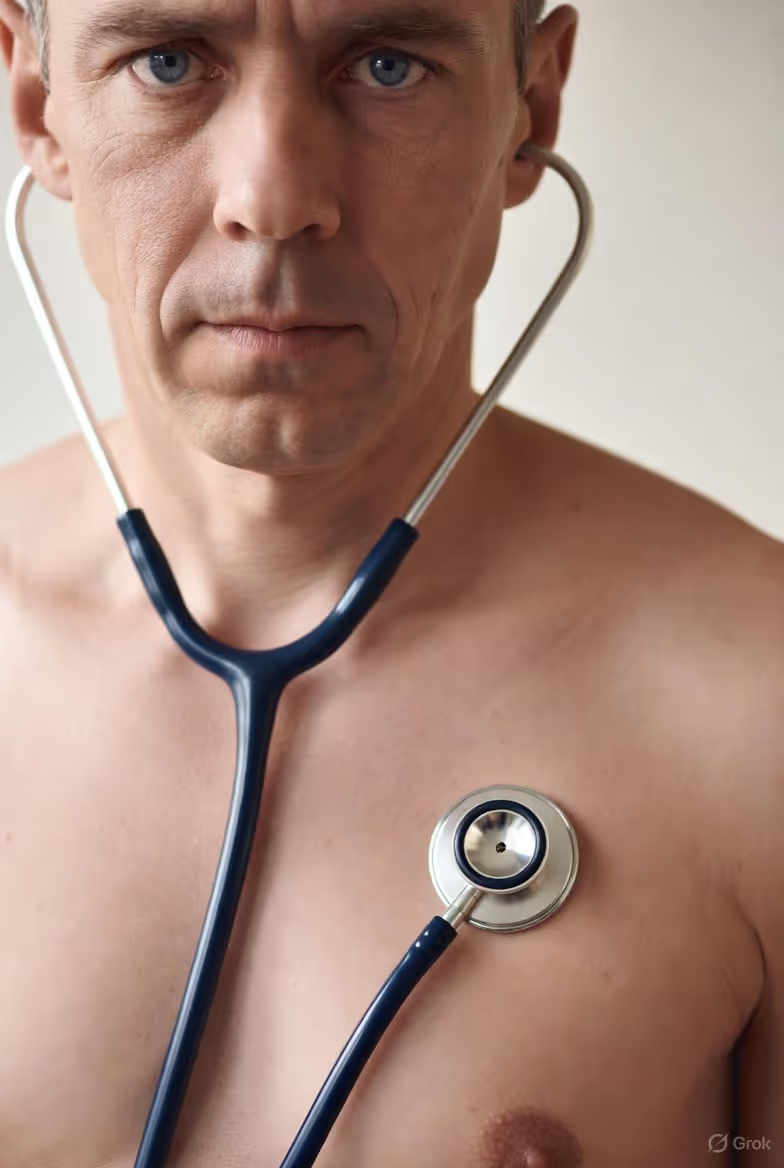
Much like HRV, your overnight Resting Heart Rate (RHR) is often reduced to a single, static number on your morning report: "Your RHR was 58 BPM." But this average hides a dynamic, story-rich graph. The pattern of your heart rate throughout the night is a direct reflection of your sleep architecture and autonomic nervous system activity.
In a state of perfect, undisturbed recovery, your heart rate follows a predictable "U-shaped" or "L-shaped" curve:
When your nightly heart rate graph looks more like a mountain range than a smooth valley, it's a sign of disturbance.
Your overnight RHR trend is one of the most accessible and powerful longevity metrics. A consistently low RHR is associated with better cardiovascular health and fitness. More importantly, acute changes are incredibly informative:
By looking beyond the average to the graph itself, you gain a cinematic view of your night, rather than a single snapshot. It answers the question, "Was my sleep physiologically calm and restorative, or was it a night of hidden storms?"
Every sleep tracker counts your movements. Most condense this into a simplistic metric: "You were 'restless' 12 times." This label is both judgmental and unhelpful. It frames natural movement as a failure. In reality, detailed movement analysis is a rich diagnostic tool that, when correlated with other data, reveals the causes of sleep disruption.
It is normal and healthy to shift positions 20-40 times per night. These movements prevent pressure sores, aid circulation, and may be part of transitioning between sleep cycles. Pathological movement is characterized by its frequency, intensity, timing, and correlation.
This is where the analytical power of a multi-sensor device becomes critical. A movement in isolation is noise. A movement in context is data.
Scenario Analysis:
A Practical Case: Elena noticed her sleep scores were highly variable. Some nights she'd score 88, others 72, with no clear pattern in her routine. Digging into her data, she filtered nights with high "toss/turn" counts. On those nights, she saw a clear pattern: clusters of small movements every 25-30 seconds in her first two sleep cycles, each preceded by a tiny heart rate blip. This pointed towards probable Periodic Limb Movements. Armed with this data pattern, she spoke to her doctor, who suggested a ferritin (iron stores) test. It was low. With iron supplementation, the movement clusters reduced significantly, and her sleep consistency improved. The "restlessness" was not a character flaw; it was a physiological clue.
By analyzing movement intelligently, you stop blaming yourself for being a "toss-and-turner" and start investigating the underlying triggers—be it caffeine timing, hydration, electrolyte balance, stress, or an underlying condition.
These two metrics are often displayed but rarely understood in their full context. They are the critical bookends that measure how effectively you enter and utilize your time in bed.
Sleep Onset Latency (SOL): The time from "lights out"/attempting to sleep to the onset of actual sleep. The ideal range is typically 10-20 minutes.
Sleep Efficiency: The percentage of time in bed actually spent asleep. (Total Sleep Time / Time in Bed) x 100. Above 85% is generally considered good, above 90% excellent.
Conventional wisdom says a short SOL is good. But falling asleep in less than 5 minutes can be a red flag for significant sleep deprivation or a sleep disorder like narcolepsy. It indicates an extreme sleep pressure that overwhelms the normal wind-down process. If you're consistently "crashing" into sleep, your body may be running a severe recovery deficit.
A very long SOL (consistently >30 minutes) is the more common problem, pointing to:
This metric ruthlessly exposes bad habits. Spending 9 hours in bed to get 7 hours of sleep yields a 78% efficiency. This means you spent over 2 hours awake in bed—a recipe for conditioning your brain to be awake in that environment.
Why low sleep efficiency sabotages your score and your sleep:
These metrics are wonderfully actionable.
Mastering these bookends creates a solid, efficient container for your sleep. It ensures the time you dedicate to rest is used purposefully, not spent in a twilight zone of frustration. For more strategies on building an effective wind-down routine, our collection of expert articles on the Oxyzen blog offers a wealth of practical tips.
While your smart ring doesn't have a built-in thermometer or sound meter, it is a brilliant bio-sensor that reflects the impact of your environment. By reading your body's reactions, it can infer external conditions with surprising accuracy. This turns your biometric data into an environmental audit tool.
As discussed, your distal skin temperature rhythm has an expected pattern. Significant deviations from this pattern can point to environmental issues.
Your ring can't measure light hitting your retina, but it can measure the consequence of mistimed light exposure: a disrupted circadian rhythm.
Unexplained micro-awakenings—seen as brief heart rate spikes, movement bursts, or shifts in HRV—often have an external trigger. While you can't tag "garbage truck at 4 AM" in your app, you can see its signature.
Real-World Detective Work: Sam lived in a relatively quiet suburb. His sleep was generally good, but every few nights, his score would be inexplicably lower. Reviewing his data on those nights, he noticed a consistent pattern: a cluster of 2-3 brief heart rate spikes and small movements between 3:15 and 3:30 AM. There was no SpO2 dip, ruling out apnea. The timing was precise. He realized this was when his neighbor's ultra-quiet, but perceptible, HVAC system kicked on for its early morning cycle. The low-frequency hum or vibration was just enough to disturb his sleep without waking him. He started using a white noise machine, and those clusters disappeared.
By treating your biometrics as a response system, you can become a sleuth for your sleep environment. The data provides the "effect," and you are left to identify the "cause," leading to highly personalized optimizations that generic sleep tips could never provide.
Your sleep does not begin at bedtime. It is the final act of a play that started when you woke up. Two of the most powerful, yet externally determined, components influencing your sleep score are your daytime activity levels and stress exposure. Modern algorithms are increasingly using daytime biometrics to weight or interpret the night's data.
There is a well-established, inverted-U relationship between daytime exertion and sleep quality.
Advanced systems use your daytime activity data and resting heart rate to contextualize your sleep. A high-activity day followed by a night with elevated RHR and great deep sleep is a perfect recovery response. The same high activity followed by a night of high RHR, low HRV, and little deep sleep is a sign of overreaching.
Psychological stress activates the hypothalamic-pituitary-adrenal (HPA) axis, releasing cortisol. Ideally, cortisol is high in the morning to help you wake and declines throughout the day to a low at bedtime.
The Integrative Insight: This is why the most holistic wellness platforms don't silo sleep data. They integrate it with daytime readiness scores, which are derived from HRV, RHR, and sleep data, to advise on daily activity. For example, a low readiness score after a poor sleep might suggest a gentle day or focused recovery, not a intense training session. This creates a virtuous cycle where your sleep informs your day, and your day prepares you for your next sleep. Understanding this interconnected philosophy is at the heart of our mission at Oxyzen, which is to provide a complete, 24/7 picture of your wellness, not just nighttime snippets.
By acknowledging the profound impact of your daytime life on your night, you take responsibility for the entire cycle of recovery. You start to see sleep not as an isolated event, but as the dependent variable in a 24-hour equation of living.
Perhaps the most profound, socially ingrained oversight in sleep health is the systematic disregard for individual chronotype. Your chronotype is your genetically predisposed natural inclination to sleep and be active at certain times. It’s not a lifestyle choice; it’s a biological imperative, dictated by the unique length and sensitivity of your internal circadian clock.
Most sleep scores are calculated against a generic, "society-approved" 10 PM - 6 AM template. If you’re a natural night owl who falls asleep at 1 AM and wakes at 9 AM, consistently achieving 8 hours of high-quality sleep, many algorithms will still penalize you for "late" bedtimes and wake times. This creates a cruel paradox: you are biologically achieving great sleep, but your score tells you it’s subpar because it conflicts with an arbitrary societal norm.
While the spectrum is continuous, chronotypes are often grouped:
Forcing a Wolf onto a Lion’s schedule is a recipe for social jet lag—a chronic misalignment between your biological and social clocks. This condition is linked to increased risks for obesity, diabetes, depression, and cardiovascular disease, independent of sleep duration.
The solution isn’t to ignore the data, but to reinterpret it through the lens of your biology.
Your chronotype isn’t a flaw; it’s a feature. By understanding it, you stop chasing a score designed for someone else’s biology and start optimizing for your own innate rhythm. The true measure of sleep quality is not when you get it, but how well it aligns with your internal clock. For real stories of how individuals have used personalized data to improve their lives, the experiences shared on our testimonials page highlight this journey of self-discovery.
The standard sleep cycle analysis treats all periods of the night with equal weight. But emerging research and advanced biometric analysis suggest that the bookend periods of your sleep—the first 90 minutes after onset and the last 90 minutes before waking—are disproportionately important. They serve unique, critical functions that are often glossed over in a composite score.
This initial period is when you typically get your longest, most consolidated bout of slow-wave sleep (SWS), or deep sleep. The brain prioritizes this.
This final phase is dominated by REM sleep. As the night progresses, REM periods get longer. Your final REM period before waking can be 30-60 minutes long.
By shifting your focus to these critical windows, you move from managing bulk sleep to curating sleep architecture. You understand that not all hours are created equal, and that protecting the bookends is the master key to waking up physically restored and mentally clear.
Here is a counterintuitive insight that often confuses diligent trackers: Sometimes, your best sleep scores come after your most demanding days. You might have a day of intense physical exertion, high cognitive load, or significant stress, and that night, you crash into a deep, long sleep with excellent scores. Conversely, after a lazy, relaxing day, your sleep might be shallow and fragmented.
This is not an error. It is the Recovery Paradox, and understanding it is key to interpreting your data over the long term.
Your body responds very differently to an acute, resolved stressor and a chronic, unresolved one.
The danger lies in seeing that great sleep score after a brutal day and thinking, "My body can handle this! I’ll just push harder every day." This ignores the cycle of supercompensation.
Recovery is a cycle: Stress → Recovery → Adaptation. The great sleep is the recovery phase. If you introduce a new stress before adaptation is complete, you begin to accumulate fatigue. Over time, the acute stress becomes chronic, and the great recovery sleeps will vanish. You’ll be left in a state of perpetual drain, where even after a rest day, your sleep is poor because your system is overloaded.
By understanding the Recovery Paradox, you become a strategic manager of your own resilience. You learn to differentiate between the healthy fatigue that leads to growth and the systemic fatigue that leads to breakdown. This wisdom turns your sleep data from a daily report card into a longitudinal map of your adaptation and health.
We have now journeyed through nine of the most critical, yet frequently overlooked, components that shape your sleep and its algorithmic score. But data in isolation is merely trivia. The transformative power lies in integration—weaving these disparate threads into a single, coherent narrative about your nightly recovery.
This is the difference between having a toolbox and being a master craftsman. Anyone can see that their HRV was low. A master interpreter asks: Was it low in conjunction with a high RHR and frequent SpO2 dips? Or was it low alongside a stable temperature curve and minimal movement? The first pattern points to respiratory or systemic stress; the second might point to psychological stress or nervous system fatigue with otherwise stable sleep.
When you review your sleep data, move beyond the headline score. Conduct a brief, systematic review:
The goal is to create a closed feedback loop: Life Choices → Biometric Data → Insight → Adjusted Choices.
This process demystifies your body’s responses. It replaces guilt and confusion with clarity and agency. You are no longer a passive recipient of poor sleep; you are an active investigator and optimizer of your own biology. For those seeking to delve deeper into creating their own personalized wellness feedback loops, our blog features extensive guides on correlating lifestyle with biometric data.
The culmination of this integrated understanding is a state of empowered wellness. You are not a slave to a score, but a master of the symphony of signals that create it. You begin to feel the subtle shifts in your body that the data later confirms, developing an intuitive sense of your own needs that is grounded in empirical evidence.
This is the promise of modern wearable technology at its best: not to replace self-awareness, but to deepen and validate it, creating a partnership between human intuition and machine precision that is greater than the sum of its parts. As we continue to explore the final dimensions of the sleep score, remember that this integrated, narrative-based approach is the key to unlocking its true value.
We have explored the architecture of the night itself, but to fully grasp the overlooked components of your sleep score, we must zoom out to the 24-hour canvas. The most significant factor determining the quality of your sleep is the state of your autonomic nervous system (ANS) as you approach the bed. Your sleep score is often a direct reflection of the ANS battle fought in the hours before you close your eyes.
The ANS isn't a switch that flips from "stress" to "rest" the moment your head hits the pillow. It’s a sliding scale, and its position at bedtime is the launchpad for your entire night.
The 2-3 hours before sleep are a biological loading dock. What you load onto your system during this period determines the cargo your sleep will carry. This is where the most common and correctable sleep mistakes are made.
Advanced wearables are now capturing "Daytime Stress" or "Body Battery" metrics. These are primarily derived from heart rate and HRV data throughout the day. A high "daytime stress" score means your sympathetic nervous system was dominant for large portions of the day. Even if you manage to fall asleep, entering that state is like trying to park a speeding car—it takes time and leaves skid marks.
The skid marks appear in your sleep data as:
Your goal is to build a parasympathetic bridge from your day into your night. This isn't about being lazy; it's about being strategic.
When you successfully load the parasympathetic dock, you don't just fall asleep faster. You grant your body permission to access the deepest, most restorative levels of sleep from the very first cycle. Your tracker will see this in a smooth, quick drop in heart rate, a stable HRV, and a long, unbroken first period of deep sleep. This single behavioral shift often has a more dramatic impact on sleep quality than any other factor. To explore more about the science behind the body's stress-recovery cycles and how our technology is designed to track them, you can learn about our foundational philosophy at Oxyzen.
What you eat, and when you eat it, may be the most under-analyzed variable in the sleep equation. The gut is often called the "second brain," and it communicates with the actual brain via the vagus nerve, hormones, and immune signaling. This gut-brain axis has a profound, bidirectional relationship with sleep.
Your wearable can't (yet) measure your blood glucose directly, but it can see the physiological consequences:
By viewing your dinner plate as a pre-sleep supplement, you take direct control over one of the most powerful environmental inputs to your sleep architecture. The data will show you the truth: a light, early, balanced meal is often the ticket to a lower RHR, higher HRV, and a sleep score that truly reflects how you feel in the morning.
In our quest for the perfect night's sleep, we often chase extremes: the ideal 8.5 hours, the perfect 25% deep sleep, the flawless 90% sleep efficiency. But the data from longitudinal studies and millions of user nights reveals a surprising truth: Consistency is often more powerful than perfection.
Your circadian rhythm is a rhythm. It thrives on predictability. It uses environmental cues (light, food, activity) to synchronize its internal, roughly 24-hour cycle. When those cues come at wildly different times each day, the rhythm becomes weak and chaotic—a condition known as circadian arrhythmia.
Sleep consistency—the regularity of your bed and wake times—is a component in almost every sleep algorithm. But its importance is often understated. The penalty for irregularity is multifaceted:
Consistency does not mean rigidity. It means a tight window.
When you stabilize your schedule, magical things happen in your data:
This component is overlooked because it's behavioral, not technological. No gadget can force you to be consistent. It requires discipline. But the payoff, as revealed in your own biometric data, is arguably the largest of any single sleep intervention. It is the foundation upon which all other optimizations are built. For individuals who have made this shift, the results speak for themselves, as echoed in the transformative user experiences shared by our community.
We must address the psychological elephant in the room: the profound impact that seeing the sleep score itself has on your perception and subsequent behavior. This is a meta-component, often completely overlooked, that interacts with every piece of data we've discussed.
Sometimes, the score is misleading. As we've explored, it may penalize your chronotype or miss the context of the Recovery Paradox. But if you unquestioningly accept a low score as truth, you initiate the nocebo cascade.
Conversely, you might feel awful but see a high score. This "score-feel mismatch" can be frustrating, but it's a critical learning opportunity. It forces you to look deeper at the overlooked components we've covered. "My score is 85, but I feel drained. Let me check my HRV trend... Ah, it's been dropping for three days. Let me check my temperature curve... It's erratic. My body is under stress the score isn't fully capturing."
The goal is to reach data-confidence, not data-dependency.
By acknowledging the psychological power of the score, you disarm it. You use it as a tool for curiosity, not as a source of affirmation or condemnation. This mental framework is the final, crucial piece in becoming truly literate in the language of your own sleep data.
As we reach the culmination of this first deep exploration, you now possess a new lens through which to view your sleep. You are no longer a passenger on a nightly journey you don't understand. You are the navigator, equipped with a detailed map of the hidden terrain.
Let’s briefly recap the transformed blueprint:
This knowledge moves you from generic advice to personalized protocol. You don't just "avoid caffeine late in the day"; you observe how a 2 PM coffee specifically truncates your deep sleep on your personal graph. You don't just "keep the room cool"; you adjust your bedding until your skin temperature curve is a smooth, stable plateau.
The path forward is one of empowered experimentation. Use your wearable not as a oracle, but as a biofeedback lab. Make one small, deliberate change—be it your dinner time, your wind-down routine, or your weekend wake time—and observe the effect across this entire suite of overlooked metrics. The truth of what works for you will emerge from the data.
This is the beginning of a smarter relationship with your rest, your recovery, and your technology. It is a journey towards not just better sleep scores, but towards a more resilient, responsive, and vibrant state of being. Your sleep is the ultimate mirror of your lifestyle; you now have the tools to understand everything it reflects. For those ready to take the next step with technology designed for this depth of insight, you can discover how Oxyzen approaches this holistic tracking.
Your Trusted Sleep Advocate: Sleep Foundation — https://www.sleepfoundation.org
Discover a digital archive of scholarly articles: NIH — https://www.ncbi.nlm.nih.gov/
39 million citations for biomedical literature :PubMed — https://pubmed.ncbi.nlm.nih.gov/
Experts at Harvard Health Publishing covering a variety of health topics — https://www.health.harvard.edu/blog/
Every life deserves world class care :Cleveland Clinic - https://my.clevelandclinic.org/health
Wearable technology and the future of predictive health monitoring :MIT Technology Review — https://www.technologyreview.com/
Dedicated to the well-being of all people and guided by science :World Health Organization — https://www.who.int/news-room/
Psychological science and knowledge to benefit society and improve lives. :APA — https://www.apa.org/monitor/
Cutting-edge insights on human longevity and peak performance:
Lifespan Research — https://www.lifespan.io/
Global authority on exercise physiology, sports performance, and human recovery:
American College of Sports Medicine — https://www.acsm.org/
Neuroscience-driven guidance for better focus, sleep, and mental clarity:
Stanford Human Performance Lab — https://humanperformance.stanford.edu/
Evidence-based psychology and mind–body wellness resources:
Mayo Clinic — https://www.mayoclinic.org/healthy-lifestyle/
Data-backed research on emotional wellbeing, stress biology, and resilience:
American Institute of Stress — https://www.stress.org/


