


Calm Mind Walking: Movement Meditation for Daily Peace
Calm mind walking is moving slowly and mindfully, paying full attention to the sensations of walking and the environment.
Calm mind walking is moving slowly and mindfully, paying full attention to the sensations of walking and the environment.
%402x.svg)
In the quiet hum of the modern world, where our thoughts often race faster than our hearts, a profound need for stillness emerges. Yet, for many, the traditional image of meditation—cross-legged on a cushion, eyes closed, striving to empty the mind—feels inaccessible, even frustrating. What if the path to peace wasn't about sitting still, but about moving with intention? What if your daily walk, the simple act of putting one foot in front of the other, could be transformed into a deeply restorative practice that quiets mental chatter, dissolves stress, and cultivates a resilient calm that lasts all day?
Welcome to Calm Mind Walking. This is not about distance, speed, or calorie burn. It is a form of movement meditation, a conscious fusion of mindful awareness and gentle physical motion. It’s a practice that meets you where you are, turning the ordinary sidewalk, park path, or even your living room floor into a sanctuary for the mind. In an era where wearable technology like the advanced smart rings from Oxyzen provides unprecedented insight into our stress and recovery states, we have both the ancient wisdom of mindfulness and modern data to guide us toward equilibrium. This practice bridges that gap, offering a tangible, somatic way to hack into your nervous system and command a state of peace.
The science is compelling. Studies show that rhythmic, deliberate movement like walking can synchronize brain waves, reduce activity in the amygdala (the brain’s fear center), and stimulate the release of endorphins. When paired with mindful attention, this combination becomes a powerful tool for neuroplasticity—literally rewiring your brain for greater calm and focus. For users of holistic wellness tech, such as those who share their experiences in our testimonials, practices like Calm Mind Walking provide the behavioral key to improving the very metrics—heart rate variability, sleep quality, stress scores—their devices track.
This guide is your comprehensive journey into making Calm Mind Walking a seamless part of your life. We will explore its philosophical roots, its neuroscience-backed benefits, and provide you with a rich toolkit of techniques. You’ll learn how to begin, how to deepen your practice, and how to integrate it into even the busiest days. We’ll also examine how pairing this ancient practice with modern technology can create a powerful feedback loop for personal growth. So, lace up your shoes—or don’t—and take the first step. A calmer mind is waiting for you, just a walk away.

To understand Calm Mind Walking, we must first dismantle the false dichotomy between motion and meditation. For centuries, spiritual and philosophical traditions worldwide have recognized walking not merely as transport, but as a sacred vehicle for presence.
In Buddhist traditions, kinhin is the practice of walking meditation between long periods of seated zazen. The pace is slow, deliberate, each step taken with full awareness of the foot making contact with and leaving the earth. The Chinese practice of Tai Chi, often described as “meditation in motion,” emphasizes flowing, mindful movement to cultivate qi (life force). Similarly, the contemplative walks of Christian monks along cloister paths, known as ambulatio, were used for prayer and theological discussion, linking physical rhythm to spiritual inquiry.
The unifying thread is intentionality. The philosopher Frédéric Gros, in his book A Philosophy of Walking, posits that walking fundamentally frees the mind from the tyranny of urgency and productivity. “The rhythm of walking generates a kind of rhythm of thinking,” he writes, “and the passage through a landscape echoes or stimulates the passage through a series of thoughts.” When we walk without a desperate goal, the mind is allowed to wander, to process, to settle.
This philosophy stands in stark contrast to our typical “achievement-oriented” walking—power-walking for fitness, marching toward a destination while scrolling a phone. Calm Mind Walking reclaims the act as an end in itself. It’s a rebellion against the compulsive “doing” that defines modern life, in favor of a profound state of “being in motion.”
It aligns perfectly with a holistic wellness ethos, where well-being is an integrated state of mind and body. At Oxyzen, our vision is rooted in this integration, leveraging technology not to push you to do more, but to help you be more attuned—a principle you can explore in our story. The smart ring doesn’t just track steps; it tracks your body’s subtle signals of stress and recovery, providing a mirror to the benefits your mindful movement creates. The philosophy is simple: movement is not the opposite of peace; it can be its very engine.
While philosophy paints the “why,” neuroscience provides the compelling “how.” Calm Mind Walking isn’t just poetic; it’s a physiological reset button for your entire nervous system. Let’s break down what happens inside your brain and body when you engage in this practice.
1. Bilateral Stimulation & Brain Wave Synchronization: The left-right, left-right rhythm of walking creates what’s known as bilateral stimulation. This rhythmic, alternating activity has been shown to help synchronize the two hemispheres of the brain. This harmony is associated with improved cognitive function, emotional regulation, and a reduction in the “brain fog” of stress. It’s the same mechanism underlying therapies like EMDR (Eye Movement Desensitization and Reprocessing), which uses bilateral stimulation to help process trauma.
2. Amygdala Downregulation and Prefrontal Cortex Engagement: Stress and anxiety are often driven by an overactive amygdala. Neuroimaging studies show that mindful movement, including walking, can decrease activity in this primal fear center while increasing activity in the prefrontal cortex—the area responsible for executive function, decision-making, and rational thought. Essentially, you are physically walking your brain from a state of reaction to a state of reasoned response.
3. The Generation of Neurochemicals: Walking triggers a beneficial cocktail of neurochemicals. It boosts endorphins (natural painkillers and mood elevators), serotonin (which regulates mood, sleep, and appetite), and Brain-Derived Neurotrophic Factor (BDNF), a protein that acts like fertilizer for brain cells, promoting neuroplasticity—the brain’s ability to adapt and form new, healthier neural pathways.
4. The Relaxation Response: By combining rhythmic movement with mindful breathing, you actively engage the parasympathetic nervous system—your body’s “rest and digest” counter to the “fight or flight” stress response. This lowers heart rate, blood pressure, and cortisol levels. This is where technology becomes a powerful ally. A device like the Oxyzen smart ring provides real-time, objective feedback on this shift, allowing you to see your heart rate variability (HRV) improve as you practice, a tangible data point proving the internal calm you feel. For those curious about how such technology supports this journey, our FAQ page offers deeper insights.
This neurobiological blueprint reveals that Calm Mind Walking is a form of active self-regulation. You are not passively hoping for calm; you are initiating a series of biological processes that manufacture it. Each step becomes a deliberate signal to your nervous system: safety, presence, and peace are here.

The beauty of Calm Mind Walking is its simplicity—it requires no special equipment or membership. However, a small amount of conscious preparation can significantly deepen the experience, transforming it from a simple stroll into a sacred ritual.
Setting Intention: Before you move, pause. Stand still for a moment. Close your eyes if it feels comfortable. Ask yourself: “What is my intention for this walk?” It could be as simple as “to arrive in my body,” “to release the tension of the morning,” or “to be open to the world around me.” This intention acts as your psychological anchor, gently guiding your attention back when it drifts into planning or worrying.
Attire and Environment: Wear comfortable, non-restrictive clothing and supportive shoes. The goal is to forget your body’s wrapper and tune into its mechanics. Choose your environment wisely for your early practices. While you can do this anywhere, beginning in a relatively tranquil space—a quiet park, a residential street, a forest trail—minimizes aggressive sensory input. Over time, you can practice amid urban bustle, using the chaos as the very object of your mindful observation.
Time and Duration: Release any pressure around time. Start with just 10-15 minutes. Consistency is far more valuable than marathon sessions. It’s better to have a deeply present 10-minute walk daily than an hour-long, distracted one once a month. Consider linking it to an existing habit—after your morning coffee, during your lunch break, or as an evening transition from work to home.
Tech Setup: If you use a wellness tracker, this is a prime opportunity to engage with its deeper functions. Instead of setting a step goal, set a “mindful session” or note the activity as “walking meditation.” Silence non-essential notifications on your phone. The point is to use technology as a supportive witness, not a distracting intruder. To understand how a device can be designed with this intentional, non-intrusive philosophy, you can learn more about our approach.
The Pre-Walk Pause: Perform a quick body scan. Standing tall, feel the soles of your feet on the ground. Notice any points of holding—jaw, shoulders, hands. Take three conscious breaths, inhaling through the nose, exhaling slowly through the mouth. Then, with your intention held lightly in mind, begin.
Now, we move to the core practice. Sensory Anchoring is the fundamental technique of Calm Mind Walking. It involves deliberately placing your attention on the myriad physical sensations of walking, using them as an anchor to tether you to the present moment. When your mind wanders (and it will), you gently return to these sensations. Here’s how to build this skill, layer by layer.
1. The Anchor of the Feet: Begin by walking at a natural, relaxed pace. Direct all your attention to your feet. Feel the mechanical cycle: Heel strike, roll through the arch, push-off with the ball and toes. Notice the pressure shifting from the right foot to the left. Feel the texture of the ground through your shoes—is it firm, soft, uneven? The complexity of sensation here is immense if you pay attention. Think: “Lifting, moving, placing. Lifting, moving, placing.”
2. Expanding to the Whole Body: After a few minutes with the feet, widen your awareness. Feel the swing of your legs from the hips. Notice the gentle counter-rotation of your torso and the soft swing of your arms. Be aware of your head balanced atop your spine. Don’t analyze; just feel. You are inhabiting your body as a complete, moving system.
3. Integrating the Breath: Now, sync your movement with your breath. There’s no rigid rule. Simply observe the natural rhythm. You might find you take three steps per inhale, four per exhale. Let it be organic. The breath becomes a unifying rhythm, connecting the inner landscape to the outer movement.
4. The Anchor of Sound: Temporarily shift your anchor from touch to hearing. Open your awareness to the symphony of sound around you—birdsong, wind in leaves, distant traffic, the crunch of your own steps. Hear it all without labeling or judging. Let sounds arise and pass away, like waves on a shore.
Handling Distractions: Your mind will inevitably wander to a work problem, a grocery list, a memory. This is not failure; it is the practice. The moment you realize you’ve been lost in thought is a moment of mindfulness. Acknowledge the thought with a neutral label like “thinking,” and then gently, without self-criticism, guide your attention back to your chosen sensory anchor—the feeling of your foot on the ground, the sound of your breath.
This repetitive act of noticing, drifting, and returning is like a bicep curl for your attention muscle. It cultivates what psychologists call “meta-awareness”—the ability to observe your own thoughts without being enslaved by them. For more techniques on cultivating mindfulness in daily life, our blog offers a wealth of resources.
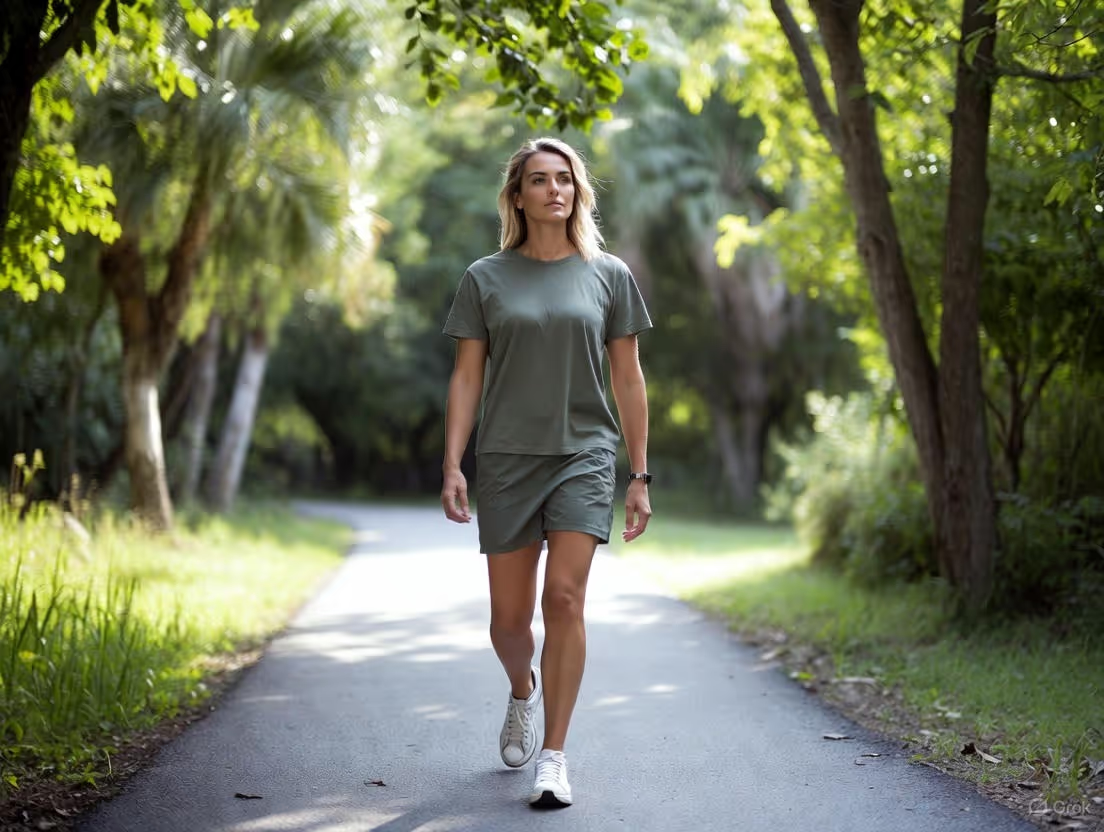
Once you are comfortable with Sensory Anchoring, you can bring more depth and variety to your walks by introducing specific thematic focuses. These themes provide a structured lens for your awareness, exploring different facets of the mind-body connection.
The Gratitude Walk: As you walk, consciously direct your attention to things you appreciate. This isn’t just a mental list. See the gratitude. Feel it in your body. The sturdy ground beneath you, the dappled sunlight, the strength in your legs, the simple gift of this moment of freedom. With each step, you can mentally note “thank you.”
The Walking Body Scan: Move through the body slowly with your mind’s eye, starting from the soles of the feet. With each few steps, bring warm, attentive awareness to a different part: ankles, calves, knees, thighs, hips, abdomen, chest, back, shoulders, arms, hands, neck, face, scalp. Feel each part as alive, tingling, and participating in the miracle of movement.
The Loving-Kindness (Metta) Walk: This is a powerful practice for cultivating compassion. With each phase of your stride, mentally repeat traditional or personalized phrases, directing them outward.
The Curiosity Walk: Adopt the mind of a scientist or a child experiencing the world for the first time. Look at the fractal patterns in a leaf, the incredible variety of greens, the architecture of clouds, the play of shadow and light. Notice sensations without assuming you know what they are. This theme actively counters habitual, dull perception and reignites wonder.
The Release Walk: This is a somatic practice for letting go of stress. As you walk, visualize or feel tension draining from your body with each exhalation. Imagine it flowing down through your legs and out through the soles of your feet into the earth. With each step, you might mentally note “release” or “let go.” Physically shake out your hands or roll your shoulders periodically to enhance the effect.
These themed walks show that Calm Mind Walking is a versatile framework. It can be a tool for joy, for healing, for connection, or for creative problem-solving. It becomes a moving canvas upon which you can paint the state of mind you wish to cultivate.
A common objection is, “I live in a noisy city. I can’t find peace walking there.” The urban environment, with its cacophony and rush, is not an obstacle to Calm Mind Walking; it is the ultimate training ground. The practice here transforms from an escape from the world to a deep engagement with it, exactly as it is.
Reframing Distractions as Dharma: In mindfulness traditions, “dharma” can mean the truth of the moment. The blaring horn, the jostling crowd, the snippets of conversation—these are not interruptions to your peace. They are the content of your present-moment awareness. Your practice becomes noticing these stimuli without the secondary layer of irritation (“This shouldn’t be happening!”). You observe the sound, then observe your mind’s reaction to it, and return to the sensation of walking. This builds incredible emotional resilience.
The Micro-Practice: You don’t need a dedicated 30-minute block. Calm Mind Walking can be atomized. The 3-minute walk from your car to the office. The walk down the supermarket aisle. The trip from your desk to the bathroom. Use these as “micro-walks.” For 30 seconds, you drop fully into sensory anchoring. Feel your feet, sync a breath or two. It’s a reset button you can press a dozen times a day.
Using Urban Rhythm: Sync your pace with the pulse of the city in a mindful way. Instead of fighting the flow of pedestrian traffic, move with it, maintaining your inner focus. The repetitive visual stream of storefronts, traffic lights, and crosswalks can become a gaze-softening practice, where you see without staring, taking in the visual field as a whole.
Finding Oases: Even in concrete jungles, oases exist. A courtyard with a single tree, a quiet block, a riverfront path. Use these for your longer, more contemplative walks. The contrast can make the practice even more potent. The key is flexibility—your practice adapts to your environment, not the other way around.
This integration is the heart of sustainable wellness. It’s about building a calm center that travels with you, a concept we deeply believe in at Oxyzen. The technology in our smart ring is designed to be your companion in this very endeavor, offering insights whether you’re on a mountain trail or a subway platform, helping you understand your body’s responses to different environments. For user stories on how people integrate tech with urban mindfulness, our testimonials page provides real-world inspiration.

Calm Mind Walking creates a powerful dialogue between conscious intention and autonomic physiology. By understanding and leveraging this feedback loop, you can deepen your practice from a subjective feeling to an objectively measurable skill.
Heart Rate Variability (HRV) – The Metric of Resilience: HRV, the subtle variation in time between heartbeats, is a key indicator of nervous system balance. High HRV is associated with good recovery, resilience, and adaptability to stress. The slow, rhythmic breathing and mindful awareness of Calm Mind Walking directly stimulate the vagus nerve, which increases HRV. Practicing while wearing a device that tracks HRV provides immediate feedback. You can literally see your nervous system calm down in real-time, reinforcing the behavior. It turns an internal feeling into an external, validating data point.
Respiratory Coherence: This is the state where heart rate, breath rate, and blood pressure waves become synchronized in a smooth, harmonious pattern. It’s a peak state for self-regulation. The paced breathing often adopted during mindful walking naturally induces coherence. The resulting feeling is one of smooth, effortless flow—both in movement and mind.
Using Biofeedback Informally: You don’t need a screen in front of you. Your body gives constant biofeedback. Notice: Is your jaw clenched? That’s feedback—soften it. Are your shoulders up by your ears? Feedback—release them down. Is your breath shallow and high in the chest? Feedback—lengthen it, draw it down into the belly. Calm Mind Walking turns you into a keen observer of this internal dashboard.
Post-Walk Reflection: After your walk, pause for a minute. Stand still and scan your inner state. How does your mind feel compared to before? Lighter? Clearer? How does your body feel? More relaxed? More energized? This conscious reflection solidifies the connection between the practice and its benefits, making you more likely to return to it.
This scientific, data-informed approach demystifies meditation. It shows you that calm is a physiological state you can actively cultivate and measure. It empowers you to become the expert on your own nervous system. For those interested in the technology that makes this feedback loop accessible, a visit to the Oxyzen homepage can show how design and purpose align to support this very journey.
Like any meaningful practice, Calm Mind Walking will present challenges. Anticipating these and having strategies to meet them is crucial for long-term adherence.
“My Mind Won’t Stop Racing!” This is the universal experience. Remember, the goal is not to stop thoughts but to change your relationship to them. Instead of fighting the mental noise, try “noting.” Silently label the category of thought: “planning,” “worrying,” “remembering.” Then, treat the thought like a passing cloud in the sky of your awareness. Acknowledge it, and let it drift on by as you return to the feeling of your foot on the earth.
Boredom and Impatience: Boredom is often resistance to the simplicity of the present. When boredom arises, see it as an opportunity to investigate with fresh curiosity. Drop into a more minute level of sensation: Exactly how does the big toe feel as it pushes off? What are the micro-sounds at the very edge of your hearing? Boredom is a sign your mind is craving novelty—give it the profound novelty of truly experiencing this single step.
Physical Discomfort: Adjust your practice. Walk slower. Walk for a shorter duration. Focus on the most comfortable parts of the movement. The practice is about kind awareness, not endurance through pain. Discomfort can also be an object of mindfulness—observing the sensation itself, without the story of “I can’t stand this.”
Feeling “It’s Not Working”: Release expectations of instant, dramatic bliss. Some days your walk will feel choppy and distracted. That’s okay. The value is in the committed return, not in the perfect session. The days it feels hardest are often the days you train your resilience muscle most strongly. Track consistency, not euphoria.
The Plateau of Autopilot: After a few weeks, the practice might feel routine. This is a sign to deepen, not abandon. Introduce one of the themed walks from a previous section. Change your route. Walk at a different time of day. Try walking barefoot on safe, natural ground (known as “earthing”) to introduce a powerful new sensory input.
For additional support and answers to specific questions about integrating mindfulness with daily tech use, our comprehensive FAQ resource is always available. The path is never linear, and every challenge is part of the terrain you’re learning to navigate with grace.
The transformative power of Calm Mind Walking is unlocked through regular practice, not sporadic effort. The goal is to move it from a “practice” you do to a “way” you walk through life. Here’s how to build that ritual.
Habit Stacking: Attach your walk to an existing, non-negotiable daily habit. The strongest anchors are “after” triggers. After I pour my morning coffee, I step outside for a 10-minute walk. After I close my laptop at lunch, I walk for 15 minutes before eating. After I arrive home from work, I take a 5-minute walk around the block before entering the house. This method leverages the established neural pathway of the existing habit.
The “Non-Negotiable” Minimum: Define a laughably small minimum version of the practice. “I will walk mindfully for just 60 seconds each day.” On days of immense resistance, you do the 60 seconds. This preserves the identity of “I am someone who does this practice,” and you’ll often find once you start, you continue. The barrier to entry is virtually zero.
Environment Design: Make it easy. Keep comfortable walking shoes by the door. Have a dedicated playlist (or silence plan) ready on your phone. If you use a smart ring or tracker, keep it charged and on your finger. Reduce friction at every turn.
The Accountability of Insight: Use your wellness data not as a judge, but as a compassionate coach. Notice on the days you practice, how do your sleep scores look? Your stress graph? Your readiness score? Let this positive reinforcement motivate you. Seeing the correlation between a 15-minute mindful walk and a deeper night’s sleep is a powerful incentive. Exploring the Oxyzen blog can provide further reading on building sustainable wellness rituals supported by data.
Weekly Reflection: Once a week, perhaps on a Sunday evening, take two minutes to reflect. When did my walks feel best this week? What got in the way? No guilt, just observation. Tweak your plan for the coming week based on what you learn.
A ritual is sacred not because it’s grandiose, but because it’s recurring. It’s the repeated touchpoint that re-centers you. Your daily Calm Mind Walking ritual becomes a movable sanctuary, a touchstone of peace you carry within your own two feet.
The ultimate purpose of Calm Mind Walking is not to create a peaceful 20 minutes, but to cultivate a calm that leaches into the fabric of your entire day. This is about spillover—training your mind in motion so that the stability becomes portable.
The Anchoring Sensation: Develop a “trigger” sensation from your walk that you can recall instantly. It might be the feeling of your heel meeting the ground with certainty, or the swing of your arms. When you feel stress rising in a meeting, while waiting in line, or during a difficult conversation, pause for one breath and recall that precise physical sensation. It serves as a neuro-associative anchor, bringing a whisper of the walk’s calm into the stressful moment.
Walking Mindfully… While Not Walking: The qualities you cultivate—presence, sensory awareness, non-reactive observation—are transferable. Practice “Calm Mind Standing” while waiting. Practice “Calm Mind Breathing” at your desk. The formal walk is the dedicated training session; the rest of your life is the application game.
Responding vs. Reacting: The prefrontal cortex strengthening you do on your walk builds a buffer between stimulus and response. You begin to notice the space where a choice exists. The email doesn’t make you angry; you feel anger arise, and in the space cultivated by your practice, you can choose how to respond. This is perhaps the most powerful real-world benefit.
Integrating with Technology Breaks: Use the principles to create conscious transitions with your devices. After a period of focused screen work, instead of mindlessly switching to another tab, get up and do a 2-minute micro-walk. Let your eyes rest on the horizon, your mind rest on your steps. This resets your attention and prevents digital fatigue.
This seamless integration is the hallmark of a mature practice. The walk is no longer an isolated event, but the foundational training that upgrades your entire operating system. It’s about creating a life where, as the saying goes, you “arrive everywhere you go.” To see how this principle of integrated, mindful living connects to a broader vision for wellness technology, you can delve into our story and mission. The journey continues beyond the path, into every moment of your day.
To fully harness Calm Mind Walking, it's valuable to understand the precise physiological cascade it initiates, moving beyond generalities to the specific mechanisms of stress dissolution. This isn't just relaxation; it's a targeted biological intervention.
The Cortisol Clearance Effect: Cortisol, the primary stress hormone, follows a natural diurnal rhythm—peaking in the morning to help us wake and gradually declining throughout the day. Chronic stress flattens this curve, leading to elevated evening cortisol, which sabotages sleep and recovery. Research published in journals like Psychoneuroendocrinology shows that moderate, mindful movement like walking accelerates the clearance of cortisol from the bloodstream. The rhythmic muscular activity and improved circulation literally help "wash out" excess stress hormones, while the mindful component prevents the mental rehearsal of stress that would trigger more cortisol release. This creates a virtuous cycle: lower cortisol from the walk leads to better sleep, which improves next-day stress resilience, making mindful walking easier.
Vagus Nerve Stimulation – The Calm Superhighway: The vagus nerve is the longest cranial nerve, forming the core of the parasympathetic nervous system. It's your body's built-in calming circuit. Calm Mind Walking is a potent vagus nerve stimulant through three pathways:
A stronger vagal tone translates to a faster recovery from stressful events—your heart rate spikes less and returns to baseline more quickly. For those tracking this with a device like an Oxyzen ring, this is visible as an improving HRV trend and a faster "stress recovery" metric after daily challenges.
The Inflammatory Response: Chronic, low-grade inflammation is now recognized as a root cause of many modern ailments, heavily influenced by psychological stress. The cytokine proteins that drive inflammation are sensitive to both movement and mental state. Studies indicate that mindful physical activity can reduce pro-inflammatory markers like interleukin-6 (IL-6) and C-reactive protein (CRP). The combination of moderate exercise and mindfulness appears to have a synergistic effect in dialing down the body's inflammatory alarms, contributing to long-term physical health as much as mental calm.
Neurogenesis in the Hippocampus: The hippocampus, vital for memory and emotional regulation, is highly sensitive to stress and cortisol, which can inhibit the birth of new neurons. Here, BDNF (Brain-Derived Neurotrophic Factor), stimulated by walking, plays a starring role. BDNF promotes neurogenesis—the growth of new neurons—in the hippocampus. This is crucial: it means Calm Mind Walking doesn't just calm you down today; it can help repair and grow the brain regions damaged by chronic stress, improving memory and emotional stability over time.
This scientific backbone empowers your practice. You are not just "taking a walk." With each step, you are:
This profound understanding transforms the practice from a nice idea into a non-negotiable pillar of preventive health. For more on how modern tools can help you visualize these internal shifts, the research and insights shared on our blog often explore this intersection of behavior and biometrics.
Once sensory anchoring is established, the practice deepens by turning toward the mind itself. This stage involves using the stable platform of walking and bodily awareness to observe the flow of thoughts and emotions with detachment and curiosity. This is where true emotional agility is forged.
Sky-Mind Walking: This visualization is powerful. As you walk, imagine your awareness as the vast, open sky—limitless, clear, and unchanging. Your thoughts and emotions are like weather patterns passing through this sky: clouds of worry, sunshine of joy, rain of sadness, lightning bolts of anger. The practice is to identify with the sky, not the weather. Notice a thought ("I'm not good enough at this"), acknowledge it as a passing cloud ("Ah, there's a judging cloud"), and watch it drift on by, returning your focus to the sensation of movement and the expanse of sky-mind. This creates profound psychological distance from reactive patterns.
The Walking Labeling Practice: This is a more active form of noting. As you walk, silently and neutrally label the predominant activity of your mind every minute or so. Use broad, simple categories:
Walking with Emotional Sensations: When a strong emotion arises—frustration, anxiety, excitement—don't try to walk it off or suppress it. Instead, bring your walk to it. Slow your pace slightly. Feel where this emotion lives in your body as you move. Is anxiety a clenching in the stomach? Is frustration a heat in the chest? Walk directly into those physical sensations with gentle, investigative awareness. Breathe into them. Often, the emotion, held in this open, moving awareness, will shift, dissolve, or simply be held more spaciously without driving reactive behavior.
The Steps as Mantras: For a busy mind, use the steps themselves as a grounding mantra. Sync a short, meaningful phrase to your stride. For example:
These advanced techniques move the practice from stress reduction to insight development. You begin to see the impersonal, conditioned nature of your mental content. This is liberation in motion. As you develop this skill, you may find your relationship to your own biometric data changes as well; a high stress score becomes not a failure, but useful information—an "emotional weather report" to be observed with the same Sky-Mind awareness. This nuanced approach to personal data is part of the philosophy you can learn more about at Oxyzen.
A lifelong practice must be adaptable. Calm Mind Walking is not a rigid technique but a flexible principle that can and should morph with changing environments, seasons, and life circumstances. This ensures it remains a source of vitality, not a stale obligation.
Winter Walking: The Practice of Introspection and Fortitude. The cold, stark landscape invites a different quality. The pace may slow. Sensations become sharp and clear: the crunch of frost, the bite of air in the lungs, the feeling of bundled layers. This is a time for Walking with Introspection. The inward pull of the season mirrors the practice. Your gaze may turn inward more readily. It's an excellent time for a "Release Walk," imagining exhaling the old year and any stagnant energy into the crisp air. The challenge of the cold builds mental fortitude; showing up for your walk becomes an act of inner strength. Safety is key—mindful attention to icy patches is itself a potent meditation in micro-awareness.
Spring Walking: The Practice of Renewal and Curiosity. As the world reawakens, let your practice follow. This is the time for the Curiosity Walk par excellence. Walk with the explicit goal of noticing new life—the first buds, returning birdsong, the smell of thawing earth. Let your pace be light, playful. Practice "Beginner's Mind" with every sensory input. Sync your breath with a sense of expansion, inhaling renewal, exhaling any lingering winter heaviness. The increasing daylight and vitality can infuse your practice with a contagious energy.
Summer Walking: The Practice of Abundance and Ease. The fullness of summer invites spaciousness. Walk in the early morning or late evening to avoid heat. Practice Walking with Gratitude under the generous sun. Feel the abundance of light and life. Your walk can become slower, more leisurely—a saunter. This is a good time to experiment with barefoot walking (earthing) on safe, warm grass, deeply connecting the soles of your feet to the earth, a practice studies suggest can reduce inflammation and improve sleep.
Fall Walking: The Practice of Letting Go and Impermanence. The falling leaves are a perfect teacher. Practice Walking with Non-Attachment. Observe the brilliant colors and the letting go. With each step through fallen leaves, mentally release something you no longer need—an old grievance, a self-limiting belief, a completed project. The crisp air is clarifying. This season mirrors the core truth of mindfulness: all things arise and pass away, including thoughts and emotions.
Adapting to Life Transitions: During periods of grief, walk with tenderness, allowing the movement to process emotion somatically. During times of creative blocks, use Walking with Open Awareness, inviting insights without force. During family stress, a short Calm Mind Walk can be the circuit breaker that allows you to respond, not react. The practice's shape shifts, but its core—intentional movement anchored in present-moment awareness—remains the constant through all of life's seasons. For stories of how individuals have adapted wellness practices through life's changes, the narratives shared in our testimonials often reflect this principle of personal evolution.
While often a solitary practice, Calm Mind Walking has a rich social dimension that can deepen connection—both with others and with your community. Understanding when to walk alone and when to walk together enhances the practice's utility.
The Sanctuary of Solitary Walking: This is the foundational mode. Solitary walking provides uninterrupted space for self-inquiry, emotional processing, and deep sensory immersion. It's where you do the core "work" of training attention and regulating your nervous system without external influence. This is non-negotiable self-care, a time to recharge your social and emotional batteries. In a world of constant connection, claiming this solitary time is a radical act of self-preservation. It allows you to return to your relationships from a place of fullness, not depletion.
Walking in Tandem: The Shared Silence Practice. This is a profoundly connective practice with a partner, friend, or family member. The agreement is simple: you walk together in silence, both practicing Calm Mind Walking. You might agree on a loose anchor, like the sound of your footsteps in unison or the shared visual field. There's no pressure to talk or perform. This shared, mindful presence creates a unique bond—a wordless companionship that often feels deeper than conversation. It’s a practice in mutual respect and shared space. Afterwards, you may choose to share brief reflections, but often, the shared experience is communication enough.
The Mindful Conversational Walk: Here, walking becomes the container for dialogue. Set an intention for the conversation—to listen deeply, to brainstorm creatively, to resolve a light conflict. The bilateral stimulation of walking can facilitate smoother cognitive flow and reduce the confrontational posture of face-to-face sitting. The shared forward motion symbolizes progress. Pauses in conversation are filled with the rhythm of steps and the environment, reducing the pressure to fill silence. This can transform difficult conversations and deepen empathetic listening.
Community Walking Meditations: Some wellness centers, meditation groups, or eco-villages offer group walking meditations. These are typically led, with a guide offering prompts or anchors at intervals. The collective energy of a group moving in mindful silence can be powerful, amplifying the sense of peace and interconnectedness. It’s a tangible experience of moving in harmony with others.
The Ripple Effect: Your consistent solitary practice inevitably influences your social world. The calm, responsiveness, and presence you cultivate spill over into all interactions. You become less reactive, a better listener, more emotionally available. This is perhaps the greatest social contribution of the practice: you become a node of stability in your network. Exploring the broader vision of how individual wellness contributes to collective well-being is part of the story behind Oxyzen, which aims to support this very ripple effect through thoughtful technology.
Whether alone or together, Calm Mind Walking strengthens the most important relationship—the one with yourself—which in turn enriches every other relationship you have.
To crystallize the insights and patterns that arise during Calm Mind Walking, integrating a brief journaling practice can be transformative. This bridges the non-conceptual, somatic experience of walking with the conceptual mind, allowing for integration and clarity. It turns movement meditation into a source of conscious personal growth.
The Post-Walk Pause & Jot: Keep a small notebook or use a notes app on your phone. Immediately after your walk, before diving back into activity, sit for two minutes. Don't force profound thoughts. Simply jot down:
This 2-minute log creates a timeline of your inner landscape, revealing patterns over days and weeks.
The Weekly Review for Pattern Recognition: Once a week, skim your entries. Look for connections you might miss day-to-day.
Walking-Inspired Problem Solving: Often, during a walk, a solution to a stuck problem will surface seemingly out of nowhere. This is the "incubation" effect of mindful walking, where the subconscious mind works freely. When this happens, note it in your journal. Over time, you'll build trust in this process. You can even initiate it by holding a light question in mind at the start of a walk (e.g., "How might I approach X?"), then letting it go into the rhythm of your steps, knowing an insight may arise.
Integrating with Biometric Data: If you use a wellness tracker, correlate your subjective journal notes with objective data. Note: "Felt incredibly peaceful today—HRV was my highest all week." Or, "Mind was scattered—see the elevated stress graph from 10-11 AM." This doesn't invalidate feelings; it deepens self-understanding. You learn that a "bad" subjective feeling might correspond with a poor sleep score, offering compassion instead of criticism. For those who geek out on this synthesis of qualitative and quantitative data, our blog frequently explores these synergies.
The walking journal is the keystone habit that turns episodic mindfulness into a continuous thread of self-awareness. It ensures the clarity and peace cultivated on the path don't evaporate but are woven into the narrative of your life.
While the general practice yields broad benefits, you can tailor Calm Mind Walking with precision to support specific life goals. This functional application makes it an indispensable, versatile tool in your wellness toolkit.
For Enhanced Creativity & Problem-Solving: This leverages the brain's default mode network (DMN), active during mind-wandering and incubation.
For Emotional Regulation & Processing Grief: Walking provides a somatic container for big emotions that can feel overwhelming when still.
For Pre-Performance Calm (Before Presentations, Competitions, Difficult Conversations): This uses walking to regulate arousal and focus intention.
For Improving Sleep Quality: An evening walk can be a powerful sleep signal, especially when done mindfully.
For Building Mindful Leadership & Presence: Leaders need to be centered and non-reactive.
By tailoring the practice, you affirm that mindfulness is not a one-size-fits-all escape from life, but a customizable framework for engaging with life's specific demands more skillfully and peacefully. For more ideas on personalizing wellness practices, the resources at our FAQ can offer additional guidance.
Understanding the psychology of habit formation is key to making Calm Mind Walking an effortless, automatic part of your life. Relying on willpower alone is a recipe for failure; instead, we must design an environment and sequence that makes the practice the obvious, easy, and satisfying thing to do. This is about behavioral architecture.
The Habit Loop, Deconstructed:
Every habit consists of a Cue, a Routine, and a Reward. For Calm Mind Walking:
Identity-Based Habits: The most profound shift occurs when you move from outcome-based goals ("I want to be calm") to identity-based habits. The focus isn't on doing something, but on becoming someone.
Handling Habit Disruptions (Travel, Illness, Bad Weather): Disruptions are inevitable. The key is to have a "minimum viable practice" (MVP) ready.
By engineering your habit loop, designing your environment, and adopting an identity-first mindset, you build a practice that withstands the fluctuations of daily life and mood. It becomes as natural and non-negotiable as brushing your teeth.
In the modern wellness landscape, we have a unique advantage: the marriage of ancient contemplative practices with cutting-edge biometric technology. This isn't about replacing intuition with data; it's about creating an informed, holistic feedback loop that deepens self-knowledge and optimizes your practice. Here’s how to use technology as a wise guide, not a demanding coach.
From Subjective Feeling to Objective Insight: Your feeling after a walk—"I feel calmer"—is valid and primary. Biometric data provides a complementary, objective lens. For instance:
Identifying Your Personal Patterns: Over weeks and months, data reveals patterns invisible to daily perception.
Avoiding Data Anxiety: The pitfall of any tracking is turning it into a source of stress—obsessing over scores, feeling like a "failure" when a metric dips. The mindset is crucial:
The Tech-Enabled Ritual: Integrate the device seamlessly into your practice ritual. Putting on your smart ring in the morning can be a cue in itself—a physical reminder of your intention to be aware. The act of starting a "Mindful Session" on the app sets a formal container for your walk. This intentional use of tech supports, rather than interrupts, the traditional aim of presence. For those curious about how a device is designed to facilitate this supportive, non-intrusive role, you can learn more about Oxyzen's philosophy.
This synergy empowers you. You are no longer guessing. You are engaging in a conscious collaboration with your own physiology, using millennia-old wisdom informed by real-time personal science. It makes the path to peace not just aspirational, but intelligently navigable.
The universal principle of Calm Mind Walking is intentional movement paired with present-moment awareness. This principle is beautifully inclusive and can be adapted to every body, ability, and mobility level. The form changes; the essence remains. It is critical to move beyond a one-size-fits-all image of "walking."
Adaptations for Mobility Aids (Wheelchairs, Walkers, Canes): For those who use mobility aids, the practice transforms into Calm Mind Rolling or Calm Mind Moving.
Seated and Chair-Based "Walking" (For chronic pain, fatigue, or limited mobility): This is Calm Mind Movement in Place.
For Larger Bodies: The focus is on comfort, joy of movement, and dismantling any internalized stigma.
For the Highly Athletic or Restless: The challenge is to slow down enough to be mindful.
The fundamental message is one of radical inclusivity: the peace of movement meditation is available to you in the form that your body can engage with today. It honors where you are, not where you think you should be. This ethos of accessible, personalized wellness is central to the vision you can explore in Oxyzen's story. Your practice is yours alone, shaped by your unique vessel.
Beyond stress reduction and mental clarity, Calm Mind Walking can touch upon a deeper, spiritual dimension. It can become a form of micro-pilgrimage, a practice of sacred connection to oneself, to the earth, and to the mystery of being alive. This layer isn't about dogma, but about experiencing the profound within the ordinary.
Walking as Pilgrimage: A pilgrimage is a journey undertaken with sacred intention. You can bring this mindset to your daily walk.
Connection to the Earth (Earthing & Ecopsychology): This practice naturally fosters ecological awareness, a sense of being part of, not separate from, the natural world.
Walking with the Question: Spiritual traditions often use koans or contemplative questions. You can incorporate this.
The Walk of Awe: Actively seek and soak in experiences of awe—the vastness of a sky, the intricate pattern of a spiderweb, the profound age of a rock. Research shows awe shrinks the ego and expands one's sense of time and connection. Make your walk a hunt for awe. This is a direct gateway to a spiritual experience of wonder and humility.
This dimension reminds us that Calm Mind Walking is more than a wellness hack; it is a pathway to remembering our wholeness. It aligns with a holistic view of health that encompasses mind, body, and spirit, a perspective that informs much of the content and community found on our blog. The simple act of walking, infused with sacred attention, becomes a portal to the infinite.
Calm Mind Walking is not a project with an end date. It is a companion for life, a practice that will mature, deepen, and change form as you do. Viewing it through the lens of a lifelong journey removes pressure and invites curiosity about its unfolding phases.
The Early Years: Skill Acquisition and Habit Formation (Months 0-6). This is the launch phase, covered in earlier sections. The focus is on:
The Middle Years: Integration and Deepening (Year 1-5+). The practice becomes woven into your identity. The focus shifts:
The Later Years: Simplicity and Embodied Wisdom (Decades onward). As the practice matures over many years, it often simplifies and becomes more somatic.
Passing It On: A natural outgrowth of a lifelong practice is the desire to share its essence, not as an expert, but as a fellow traveler. You might:
This lifelong perspective is liberating. There is no finish line, only a path that unfolds with you. Each day's walk is both a complete practice in itself and a single step in a grand, beautiful, lifelong journey toward peace. It's a journey that aligns with the enduring mission to support sustained well-being, a principle you can explore further in the narrative of Oxyzen's own journey. The path is endless, and it begins anew with every single step you take.
Your Trusted Sleep Advocate: Sleep Foundation — https://www.sleepfoundation.org
Discover a digital archive of scholarly articles: NIH — https://www.ncbi.nlm.nih.gov/
39 million citations for biomedical literature :PubMed — https://pubmed.ncbi.nlm.nih.gov/
Experts at Harvard Health Publishing covering a variety of health topics — https://www.health.harvard.edu/blog/
Every life deserves world class care :Cleveland Clinic - https://my.clevelandclinic.org/health
Wearable technology and the future of predictive health monitoring :MIT Technology Review — https://www.technologyreview.com/
Dedicated to the well-being of all people and guided by science :World Health Organization — https://www.who.int/news-room/
Psychological science and knowledge to benefit society and improve lives. :APA — https://www.apa.org/monitor/
Cutting-edge insights on human longevity and peak performance:
Lifespan Research — https://www.lifespan.io/
Global authority on exercise physiology, sports performance, and human recovery:
American College of Sports Medicine — https://www.acsm.org/
Neuroscience-driven guidance for better focus, sleep, and mental clarity:
Stanford Human Performance Lab — https://humanperformance.stanford.edu/
Evidence-based psychology and mind–body wellness resources:
Mayo Clinic — https://www.mayoclinic.org/healthy-lifestyle/
Data-backed research on emotional wellbeing, stress biology, and resilience:
American Institute of Stress — https://www.stress.org/


