


The Dialectical Approach: Accepting and Changing Emotions Simultaneously
Healthy dynamics involve mutual respect, the ability to repair after conflict, and supporting each other's emotional regulation.
Healthy dynamics involve mutual respect, the ability to repair after conflict, and supporting each other's emotional regulation.
%402x.svg)
Imagine you’re standing on a riverbank, caught in a storm of your own feelings. On one shore lies the serene, often difficult practice of total acceptance—allowing every emotion to be, without judgment. On the opposite bank stands the powerful drive for change—the urge to fix, improve, and transform painful states into peaceful ones. Most of us find ourselves stranded in the turbulent current between these two lands, torn between surrendering to our sadness or fighting it, between embracing anxiety or trying to vanquish it. We are taught these are opposites: you either accept your reality or you work to change it. But what if this binary is the very source of our emotional struggle? What if the path to true emotional agility isn’t choosing a side, but learning to dwell in the creative, transformative tension between them?
This is the heart of the Dialectical Approach. It is a sophisticated psychological framework, most notably operationalized in Dialectical Behavior Therapy (DBT), which posits that profound healing and growth occur not through choosing between acceptance and change, but through the synthesis of both. It’s the emotional equivalent of a pianist holding a chord—the stability of the root note (acceptance) and the tension of the seventh (change) creating something rich, complex, and moving. For the modern individual navigating a world of constant stress, digital overload, and performance pressure, this isn’t just a therapeutic concept; it’s an essential life skill.
The consequences of ignoring this dialectic are all around us. The relentless pursuit of "positive vibes only"—a pure change agenda—leads to burnout, self-criticism, and emotional exhaustion. Conversely, passive resignation—a distorted form of acceptance—can lead to helplessness and stagnation. We see this in our wellness culture: the pressure to "optimize" our mood with supplements and biohacks clashes with the mindfulness mantra to "just observe." The result is often confusion and a sense of failing at both.
But here lies the revolutionary promise: By learning to validate our present-moment experience and skillfully move toward our valued goals, we build a resilient, flexible self. This article will serve as your comprehensive guide to mastering this dialectical dance. We will deconstruct the philosophy, explore its neuroscientific underpinnings, and provide actionable strategies for applying it to anxiety, relationships, and self-concept. Furthermore, we will examine how cutting-edge technology, like the advanced biometric tracking of the Oxyzen smart ring, can provide the objective, real-time data necessary to practice this approach with precision, moving it from abstract theory to lived reality. The journey begins with understanding the fundamental poles of this dynamic: the profound necessity of acceptance and the empowered drive for change.

To navigate the dialectical path, we must first understand the distinct territories of its two core components. They are not vague ideas but specific, trainable skill sets.
Acceptance is Radical Validation. It is the willing, open, and non-judgmental acknowledgment of reality as it is in this moment—including internal reality (thoughts, feelings, sensations) and external circumstances. It is important to clarify what acceptance is not. It is not approval, resignation, or liking the situation. You can accept the reality of a sharp pain in your knee without approving of the injury. You can accept feeling furious at a colleague without resigning yourself to a hostile workplace.
Psychologically, acceptance involves turning toward your experience with curiosity. It’s saying, “Ah, here is anxiety. It feels like a tightness in my chest and a whirlwind of ‘what if’ thoughts.” This simple act of naming and allowing disarms the secondary struggle—the “I shouldn’t feel this way!” panic that amplifies primary pain. Research in mindfulness-based therapies consistently shows that acceptance reduces the amygdala’s (the brain’s threat center) hyperactivity, lowering the emotional volume of distress. It creates a stable foundation of self-compassion from which all other action can spring.
Change is Committed Action. This is the set of skills focused on modifying thoughts, behaviors, emotional responses, and environments to reduce suffering and build a life worth living. Change strategies are the toolbox of traditional psychology and self-help: cognitive restructuring, exposure therapy, behavioral activation, communication skills, and problem-solving.
The change pole is driven by values. It asks, “What do I want to stand for? What kind of person do I want to be in this pain? What action, however small, would move me one step toward my chosen direction?” While acceptance is about being, change is about doing. Neuroscientifically, change strategies often engage the prefrontal cortex—the brain’s executive center—to regulate limbic system impulses and forge new neural pathways through repeated practice.
The human dilemma is that each pole, in isolation, fails us. Pure change without acceptance is like building a skyscraper on sand; it’s a rigid, effortful fight against reality that often collapses. Pure acceptance without change can become a prison of passivity. The dialectical view sees them as interdependent opposites. Acceptance provides the clarity and calm needed to enact effective change. Effective change often requires first accepting the starting point. The tension between them is not a problem to be solved, but the engine of growth. As you explore the science behind emotional regulation on our blog, you’ll find that the most effective techniques always balance these forces.
Dialectics is a philosophy with ancient roots, from Eastern traditions like Taoism (the interplay of yin and yang) to Western thinkers like Hegel, who described the process of thesis, antithesis, and synthesis. In psychology, Marsha M. Linehan brilliantly applied this to treat Borderline Personality Disorder, and its utility has since expanded to virtually all areas of human suffering. The core dialectical principle is that reality is not static but composed of opposing forces (thesis and antithesis), and that truth, growth, and resolution are found in the synthesis that arises from their tension.
Think of a great debate. One side presents a compelling argument (thesis). The other side presents a counter-argument (antithesis). The most valuable outcome isn’t the victory of one side, but the new, more nuanced understanding (synthesis) that emerges from the clash of ideas. Our emotional life is a constant, internal debate.
How does this engine run in daily life? Consider a person with social anxiety.
The synthesis is not a lukewarm average. It’s a higher-order resolution that holds the truth of both sides. It validates the present experience while affirming agency toward a valued future. This process builds psychological flexibility—the ability to contact the present moment fully and change or persist in behavior when doing so serves your values. It is the antithesis of rigidity, which is a hallmark of most psychological disorders.
This engine is powered by a key dialectical assumption: You are doing the best you can in this moment, and you need to do better. This statement, seemingly contradictory, is profoundly liberating. The first part infuses self-compassion, removing the shame whip. The second part infuses responsibility and hope. It creates a middle path between self-flagellation and self-pity. For a deeper look at how this philosophy shapes our mission, you can explore our story and the values that drive our approach to wellness technology.
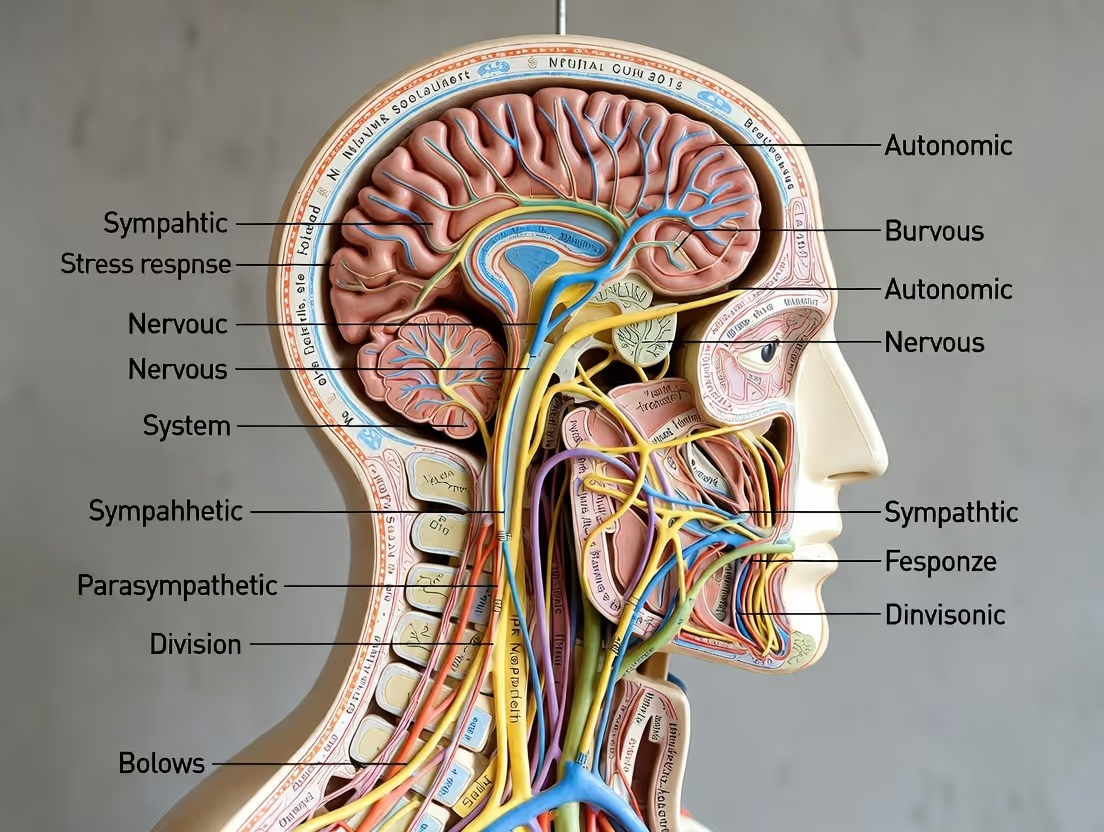
The dialectical approach isn’t just philosophically elegant; it is neurologically coherent. Modern brain imaging reveals that acceptance and change strategies engage different, but complementary, neural networks. Learning to integrate them is literally a workout for a more integrated brain.
The Acceptance Network: When we practice mindful acceptance—observing an emotion without trying to escape it—we activate the insula (interoceptive awareness of body states) and the anterior cingulate cortex (ACC) (which plays a role in attention and error detection). Crucially, we see a modulation of the amygdala. Instead of the prefrontal cortex trying to “downregulate” the amygdala through force (a pure change strategy that can backfire), acceptance appears to change our relationship to the amygdala’s signal. The threat label is removed. It’s like hearing a fire alarm and calmly checking for a fire instead of instantly panicking. This process is associated with decreased physiological arousal and subjective distress.
The Change Network: Purposeful change strategies, like cognitive reappraisal (“This isn’t a catastrophe, it’s a challenge”), heavily recruit the prefrontal cortex (PFC), particularly the dorsolateral and ventromedial regions. These areas are responsible for executive functions: planning, inhibition, and evaluating long-term consequences. They act as the brain’s conductor, orchestrating a more measured response from the emotional limbic system.
The Dialectical Synthesis in the Brain: The most resilient brains show high functional connectivity between these networks. The PFC isn’t tyrannically suppressing the amygdala; it’s in communication with it, informed by the nuanced data from the insula and ACC. This is the neural correlate of wisdom: using emotional information (acceptance) to guide thoughtful action (change).
When we fail dialectically, we often see neural rigidity. In chronic anxiety, the PFC may be chronically overworked in a futile suppression battle. In depression, connectivity between these networks may be diminished, leading to passive rumination (a distorted acceptance) or no motivation for change.
The exciting implication is that practicing dialectical strategies strengthens these neural pathways. It’s brain training for emotional complexity. And this is where precise biofeedback becomes invaluable. Understanding your body’s signals is the first step toward accepting them. A device like the Oxyzen smart ring provides an objective window into this neurobiological dance—tracking heart rate variability (HRV), a key marker of nervous system flexibility that reflects the balance between acceptance (rest/digest) and change (fight/flight) states. By correlating subjective feelings with objective data, you learn to trust your internal experience and identify what moves you toward synthesis. For technical details on how this tracking works, our FAQ page offers comprehensive insights.
If dialectics is the overarching philosophy, “Wise Mind” is its essential, experiential core. Marsha Linehan conceptualized three states of mind: Emotion Mind, Reasonable Mind, and Wise Mind.
Most people oscillate between these two, feeling torn between heart and head. Wise Mind is the synthesis. It is the integrative state that honors the wisdom of both emotion and reason. It’s the intuitive, “gut knowing” that emerges when you listen to your feelings as information and analyze that information with your intellect.
Accessing Wise Mind is a practice, not a trait. It’s not about being wise all the time, but about creating the internal conditions for wisdom to arise. Techniques include:
For example, you feel jealous (Emotion Mind) seeing a friend’s success. Reasonable Mind says, “Jealousy is petty; you should be happy for them.” The conflict causes guilt. Wise Mind synthesizes: “I feel a pang of jealousy—that’s a signal that their success touches on my own insecurities and goals. The fact is I care about this friend and value our relationship. Therefore, I will acknowledge my feeling to myself with compassion, and I will genuinely congratulate them, using my discomfort as a catalyst to clarify my own goals.” This outcome is radically different from either suppressing the feeling or acting on it with a snide remark.
Cultivating Wise Mind is the daily practice of emotional alchemy. It transforms raw, reactive states into guided, purposeful responses. Many users of the Oxyzen ring report that seeing their stress responses quantified helps them step back from Emotion Mind, while the recovery data from sleep and activity grounds them in the reasonable facts of their physiology, facilitating access to this wiser, middle ground.
Theoretical understanding is one thing; applying it to the fire of acute emotion is another. Let’s see how the dialectical engine works on three common, challenging states.
Dialectics with Anxiety: Anxiety is future-oriented fear. The pure change agenda is avoidance or frantic control. The pure acceptance distortion is capitulation: “I’m too anxious, so I just won’t go.” The dialectical synthesis is courageous engagement.
Dialectics with Anger: Anger signals a perceived violation or injustice. Pure change can be destructive rage or passive-aggression. Pure acceptance can be toxic tolerance. The synthesis is assertive validation.
Dialectics with Sadness/Loss: Sadness responds to loss. Pure change is denial, forced positivity, or numbing. Pure acceptance is wallowing, defined by getting stuck in the emotion. The synthesis is compassionate movement.
In each case, the emotion is neither the enemy nor the boss. It is a messenger that you listen to (acceptance) and then respond to with agency (change). This nuanced approach to emotional health is a frequent topic of discussion and shared experiences in our community of users, whose journeys you can discover through real customer testimonials.

Our most painful dialectical struggles often play out with other people. The classic relational dilemma is the tension between our need for closeness (connection, dependency) and our need for autonomy (independence, self-definition). Mature, healthy relationships are a constant, living synthesis of these needs.
The Dance of Validation and Change: This is the interpersonal application. To validate is to accept and communicate understanding of another person’s internal experience as valid and understandable. It does not mean you agree with them. To ask for change is to request different behavior. Dialectical relationships skillfully do both.
This “I understand… and…” structure is a powerful dialectical tool. It de-escalates conflict by removing the threat of invalidation, making the other person much more receptive to a request.
Dialectical Thinking in Conflict: In a disagreement, we often dig into our own position (thesis). The dialectical move is to actively seek the kernel of truth in the other person’s position (antithesis). You are not abandoning your view, but expanding it to include their perspective. The goal shifts from “winning” to “finding a synthesis that honors both of our core needs.” This might look like a compromise, or more powerfully, a creative new solution neither had initially considered.
Practicing this requires letting go of black-and-white, all-or-nothing thinking (“You always…” / “You never…”). It embraces the “both-and” nature of people: “My partner can be deeply caring and sometimes overlookful.” “My friend can be a great supporter and need a lot of support themselves.” Holding these contradictory truths about others, as we learn to do with ourselves, fosters empathy, reduces frustration, and builds more durable bonds. For more on building healthier relationship dynamics through self-awareness, our blog features ongoing series that blend psychological insight with practical tech applications.
Emotions are not abstract; they are physiological events. The dialectic between acceptance and change is fought—and resolved—in the theater of the body. Ignoring the body makes the practice purely cognitive and less potent. Honoring it grounds the approach in reality.
Interoception: The Foundation of Acceptance. Interoception is your sense of the internal state of your body—your heartbeat, breath, muscle tension, gut sensations. Poor interoception is linked to emotional dysregulation; you might feel a sudden, unexplained panic attack that is actually the culmination of unnoticed tension and a rising heart rate. Acceptance begins with accurate interoceptive awareness: “I am feeling this sensation, in this location, with this intensity.”
Biofeedback: The Bridge to Change. Once you can sense a state, you can influence it. This is biofeedback—using information about a physiological process to learn to consciously regulate it. You cannot simply will your Heart Rate Variability (HRV) to rise, but by practicing slow, diaphragmatic breathing (a change action) while observing your HRV increase on a screen (feedback), you learn the somatic pathway to calm.
The Dialectical Loop: This creates a powerful, embodied dialectical loop:
Technology like the Oxyzen smart ring supercharges this loop. It provides continuous, passive interoceptive feedback you might miss. You might think you’re “fine,” but your ring shows a low HRV and elevated resting heart rate, indicating accumulated stress. This objective data prompts you to accept that your body is under strain. You then engage in a change skill—a 10-minute breathing exercise—and can see your HRV respond in real-time, validating the efficacy of your action and closing the loop. This turns abstract practice into a tangible, learnable science. It moves you from guessing to knowing. To see how this technology integrates into a holistic health philosophy, you can learn more about Oxyzen and its foundational principles.
The dialectical approach transcends clinical therapy; it is a meta-skill for high performance in any complex domain. The most effective leaders, artists, and athletes intuitively grasp this synthesis.
Dialectical Leadership: The modern leader faces the tension between stability (process, predictability, execution) and disruption (innovation, agility, change). A leader stuck in stability breeds stagnation. One obsessed with disruption creates chaos. The dialectical leader creates a container of psychological safety (acceptance: where diverse opinions and even failures are validated) within which radical innovation and accountability (change) can flourish. They hold the vision (future-oriented change) while being radically present and listening to current reality (acceptance). They synthesize empathy and decisiveness.
Dialectical Creativity: The creative process is inherently dialectical. It is the tension between generation (the wild, uncensored flow of ideas—Emotion Mind unleashed) and editing (the critical, structured refinement of ideas—Reasonable Mind at work). A writer who only generates produces incoherent drafts. One who only edits stares at a blank page. The creative synthesis is to allow messy, imperfect generation and then apply disciplined editing, moving fluidly between the poles. Acceptance here is permission to create “bad” first drafts. Change is the rigorous craft of making them good.
Dialectical Athletic Performance: Peak performance is not about relentless, aggressive pushing (change-only) nor passive “going with the flow” (acceptance-only). It is the synthesis of extreme effort and effortless acceptance. An athlete must accept their current physical limits, pain, and race-day conditions while simultaneously committing to a change action that pushes just beyond perceived limits. The “zone” or “flow state” is the ultimate dialectical experience: intense focus (change) coupled with a loss of self-conscious striving (acceptance). Recovery (acceptance of the body’s need to rest) is seen as integral to the change process of training.
In each case, the dialectical thinker rejects false choices. They ask: “How can I be both compassionate and demanding? How can I be utterly spontaneous and rigorously prepared? How can I fully accept this moment and dedicate myself to transforming the next?” This mindset is the hallmark of adaptive excellence. Exploring the stories of those who embody this in various fields is part of the rich content we share to inspire our community, which you can find as part of our broader mission to fuse well-being with human potential.
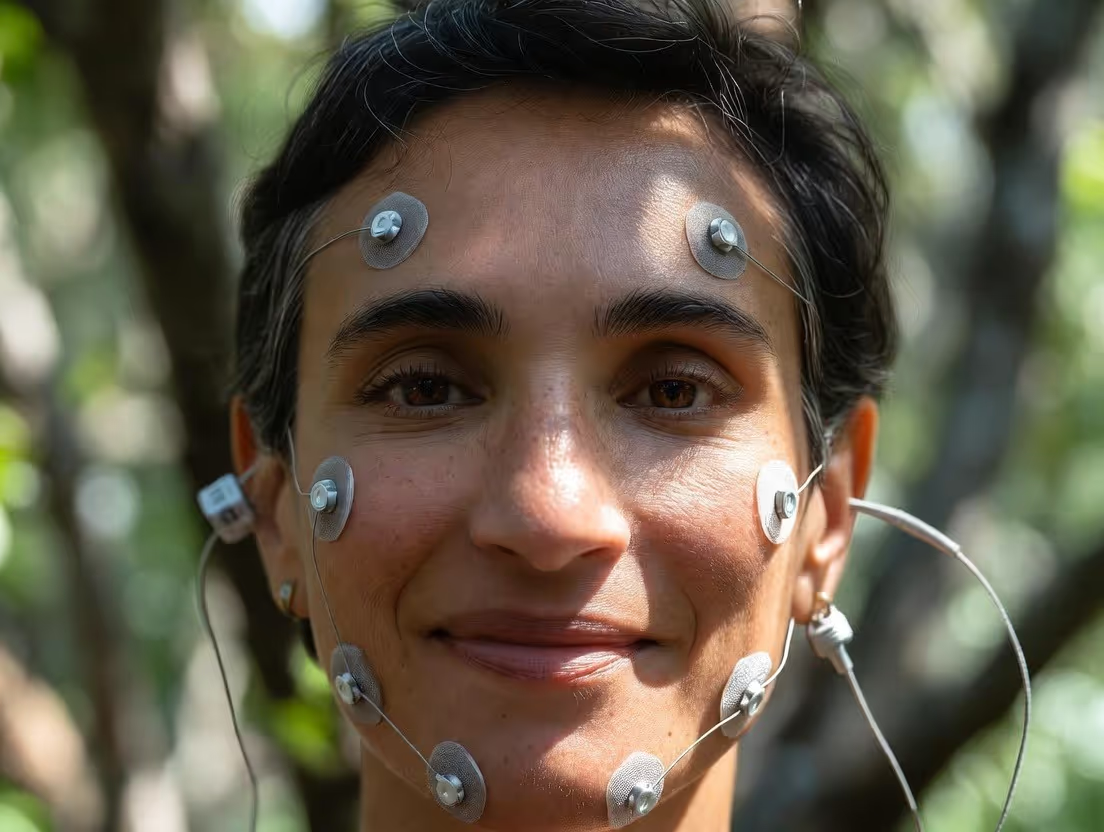
As with any powerful framework, the dialectical approach can be misunderstood and misapplied. Recognizing these pitfalls is crucial for staying on the genuine middle path.
The Corruption of Acceptance: Passive Resignation and Spiritual Bypassing.
The Corruption of Change: Perfectionistic Control and Aggressive "Fix-It" Mode.
The litmus test for a genuine dialectical stance is the presence of both compassion and agency. If your “acceptance” feels heavy, hopeless, or dishonest, it’s likely a pitfall. If your “change” feels frantic, harsh, or dismissive, it’s likely a pitfall. The true path feels centered, even if difficult—a sense of being grounded in reality while leaning toward growth. Navigating these nuances often requires support and community, which is why we’ve built resources and direct channels for our users; if you have questions about applying these concepts, our support and FAQ portal is a great place to start.
Mastering the dialectical approach requires moving it from an interesting concept to a lived, daily reality. This happens through deliberate practice, building rituals that train the mind and nervous system in this integrated pattern.
1. The Dialectical Journal: A simple, powerful practice. Divide your page or note into two columns: “Acceptance” and “Change.”
2. The "And" Meditation: In your seated practice, instead of focusing solely on breath, introduce a dialectical mantra. On the inhale, mentally note “Accepting what is.” On the exhale, note “Changing what can be.” Or use a phrase like “I am enough as I am, and I am growing.” This builds the neural pathway of conjunction, not disjunction.
3. The Pre- and Post-Event Dialectical Review:
4. Embodied Dialectics with Technology: Use your biometric data as a practice trigger. When your Oxyzen ring alerts you to a significant stress spike or low recovery score:
5. Dialectical Communication Drills: Practice the “I understand… and…” structure in low-stakes conversations. Make it a game to validate a colleague’s perspective before adding your own, or to acknowledge your child’s frustration before setting a limit. The muscle memory built here will be available in high-stakes conflicts.
By weaving these practices into the fabric of your day, you stop thinking about dialectics and start living from it. The goal is not to achieve a perfect balance every moment, but to make the dialectical move your default response to life’s inherent tensions. For a continuous stream of such practical rituals and the science behind them, we invite you to explore our blog, where we bridge timeless wisdom with modern, data-informed practice.
The journey of mastering the dialectical approach—simultaneously accepting and changing your emotional landscape—can sometimes feel abstract, like navigating a vast ocean without instruments. You might ask, “Am I truly accepting, or am I just resigned?” or “Is this change strategy working, or am I just spinning my wheels?” This is where modern wellness technology, specifically a sophisticated biometric device like the Oxyzen smart ring, transitions from a luxury gadget to an essential dialectical tool. It serves as a non-judgmental, objective witness to your internal state, providing the concrete data needed to ground your practice in reality.
The core challenge of dialectical practice is objectivity. Our minds are subject to cognitive distortions: we might minimize our stress (“I’m fine”) or catastrophize our arousal (“I’m having a panic attack!”). The body, however, tells an unvarnished truth. The Oxyzen ring, worn continuously, captures this physiological truth through a constellation of metrics:
How does this transform your dialectical practice? Consider the process. You wake up feeling vaguely “off”—irritable and foggy. A purely mental approach might lead to self-criticism (“Why can’t I just start the day happy?”). With your Oxyzen data, you engage in a dialectical investigation.
First, you Accept the data as valid information, not a verdict. You open the app and see your Sleep Score was low due to elevated nighttime heart rate and poor HRV. You note: “My body had a restless night. The data validates my feeling of being off.” This is radical validation, removing the layer of subjective shame.
Then, you move to Change. Instead of forcing yourself into a high-intensity morning routine, you let the data guide a values-based adjustment. “Because I value being present with my family today, I will change my plan. I will do 10 minutes of gentle yoga instead of a hard run, and I will schedule a 20-minute afternoon recovery break.” You’ve used objective feedback to craft a skillful, compassionate change.
Later, when a work stressor hits, you feel the familiar tension. You check your real-time stress graph and see a sharp spike. This serves as a mindfulness bell, pulling you from Emotion Mind (“This is unbearable!”) into Wise Mind. You accept the spike: “My body is reacting strongly.” You then deploy a change skill, like paced breathing, and watch the graph descend in real-time. This biofeedback loop powerfully reinforces the connection between your internal choice (acceptance + skillful action) and a measurable physiological outcome. It turns the dialectical theory into a tangible, learnable science.
This technology acts as the perfect bridge between the ancient wisdom of mindfulness and the modern science of biohacking. It answers the crucial dialectical question, “How do I know?” For more on how this seamless integration works from a technical perspective, our FAQ page dives into the details of sensor technology and data accuracy, helping you become an informed partner in your own well-being.
While we often apply dialectics to acute emotions, its most profound impact may be on the foundational pillars of health: sleep, recovery, and physical wellness. Here, the tension between acceptance and change plays out in our daily habits and long-term lifestyle choices. The “push” of disciplined training and the “pull” of deep rest are a classic dialectic that, when unbalanced, leads to burnout or deconditioning.
The Dialectics of Sleep: Our culture often treats sleep with a change-only mentality: optimize it, hack it, force it with supplements. The acceptance pole is neglected. A dialectical approach to sleep involves:
The Oxyzen ring provides the synthesis. Its detailed sleep staging and recovery metrics show you the impact of both your acceptance and change efforts. If you accept a late night without anxiety, you might see your deep sleep is still efficient. If you change your routine by limiting evening screens, you can track the correlated improvement in sleep latency and HRV dip. This data-driven feedback helps you find your personal formula—the balance between accepting imperfect nights and proactively cultivating optimal conditions.
The Dialectics of Physical Training and Recovery: The fitness world is rife with extremes: the “no pain, no gain” change fanatic versus the “listen to your body” acceptance purist. The dialectical athlete knows that growth happens at the synthesis.
Here, biometrics are indispensable. A consistently depressed HRV and elevated RHR might be your body’s signal to accept a need for a deload week (prioritizing recovery). Conversely, strong recovery metrics might signal it’s time to change by increasing intensity (seeking growth). The ring turns subjective feelings of “tired” into an objective conversation with your nervous system, allowing you to dance skillfully between exertion and ease. This principle of intelligent adaptation is at the core of our product philosophy, which you can explore further by learning about Oxyzen’s mission.
The Dialectics of Chronic Pain and Illness: This is perhaps one of the most challenging applications. The pure change agenda—a war on the pain—often increases suffering through tension and frustration. The pure acceptance distortion—total identification with the illness—can lead to helplessness.
By applying “both-and” thinking to these physical domains, we move away from a punitive, perfectionistic health model and toward a compassionate, intelligent, and sustainable practice of well-being.
Committing to a dialectical life is not a linear ascent to wisdom. It is a path strewn with internal resistance. Your mind, accustomed to its old, polarized habits, will rebel. Recognizing these forms of resistance is the first step to working with them dialectically.
The “Yes, But…” Mind: This is the most common saboteur. It pays lip service to one pole while sabotaging the other. “Yes, I accept that I’m anxious, but it’s completely ruining my life!” (Here, ‘acceptance’ is just a preface for more catastrophizing). Or, “Yes, I should change and exercise, but I’m too tired/don’t have time/ it won’t work.” This thought pattern preserves the status quo. The dialectical intervention is to call it out and reframe: “I notice my mind is giving me a ‘yes, but.’ Can I find a genuine ‘and’? ‘I am feeling anxious and I have gotten through this feeling before.’ ‘I am tired and I can take a 5-minute walk.’”
Emotional Avoidance Dressed as Acceptance: We may use the language of acceptance to bypass difficult but necessary change. “I accept that I’m just a procrastinator,” while avoiding the painful work of starting a project. True acceptance would involve feeling the fear of failure or inadequacy that drives procrastination. The change action would be to commit to a 10-minute starting ritual. Ask yourself: “Is my ‘acceptance’ allowing me to avoid a feared emotion or a valued action?”
Perfectionistic Strangling of Acceptance: Conversely, the change-drive can become so tyrannical that it refuses to allow any acceptance. Any dip in performance, any negative emotion, is seen as a failure to be eliminated. This creates a brittle, joyless existence. The antidote is to deliberately practice “good enough” acceptance. Schedule it: “For the next hour, I will accept my productivity level exactly as it is, without trying to optimize it.” Use your Oxyzen data not as a scorecard, but as a curiosity prompt. A low recovery score isn’t an “F”; it’s an invitation to ask, “What does my body need me to accept today?”
How Technology Can Highlight Resistance: Your biometric data can be a powerful mirror for these shadows. If you see a pattern of late-night high stress readings but tell yourself you’re “winding down,” the data contradicts your story, revealing avoidance of daytime stressors. If you log a perfect week of sleep and activity but your HRV remains low, it might point to an unaccepted emotional burden or perfectionistic tension. The ring doesn’t judge; it shows you the gap between your story and your physiology, inviting you to investigate with compassionate curiosity. This process of guided self-discovery is central to the resources we provide on our blog, where we tackle common hurdles on the path to integrated health.
Ultimately, working with resistance is itself a dialectical act. You accept the presence of the resistance with compassion (“Of course part of me is scared to change”), and you gently change your behavior by taking a tiny step forward anyway. This builds self-trust, the bedrock of the dialectical life.
The dialectical approach reaches its full potential when it moves beyond personal psychology and into the collective sphere. Our polarized world—politically, socially, culturally—is a stark monument to the failure of dialectical thinking. We are drowning in thesis and antithesis, with little capacity for synthesis. Applying these principles to how we engage with our communities and society is not just personally liberating; it is a civic imperative.
Dialectical Communication in a Polarized Age: Social media and news media thrive on conflict and certainty. The dialectical communicator practices both-and in public discourse. This means:
This doesn’t mean becoming a passive centrist. It means building your arguments on a foundation that acknowledges reality’s complexity, making them more robust, persuasive, and humane.
Building Dialectical Communities: A healthy community, whether a family, a team, or an online group, cultivates a culture that holds the tension between individuality and collectivity, between tradition and innovation. A dialectical community leader creates containers where:
The synthesis is a group where people feel safe to be themselves and are inspired to grow together. In our own community at Oxyzen, we strive to foster this by sharing not just successes, but honest struggles and data-backed learnings, which you can glimpse in our story and user experiences.
The Societal Dialectic: Justice and Mercy, Progress and Stability: At the largest scale, our societal institutions grapple with eternal dialectics. The justice system balances punishment (change) and rehabilitation (acceptance/ integration). Environmental policy balances economic development (change) and preservation (acceptance of ecological limits). A dialectical society is one that can argue fiercely about these balances while maintaining a fundamental respect for the process and for each other.
As individuals, we contribute to a more dialectical society by first cultivating the skill within ourselves. When we learn to hold our own contradictions with grace, we become less threatened by the contradictions in others and in the world. We become advocates for nuance, for process, and for the hard, creative work of synthesis over the easy satisfaction of demolition. This broader vision of wellness—connecting inner peace to outer harmony—is integral to our vision, detailed further on our about page.
It is crucial to internalize that the dialectical approach is not a set of techniques you master and then shelve. It is a way of being in the world—a lens through which to view every challenge, joy, and mundane moment. Like physical fitness, it requires maintenance. Like a relationship, it requires ongoing attention. There is no finish line where you become a “perfectly dialectical person.” The path itself is the goal.
Embracing the Spiral, Not the Line: Growth is not linear. You will have weeks where you skillfully navigate intense emotions with grace, and days where you fall back into old, polarized patterns—snapping in anger or wallowing in helplessness. This is not failure; it is data. The dialectical response to “backsliding” is to accept the lapse with self-compassion (“This is hard, and I’m learning”) and to change by recommitting to your very next choice. Progress is a spiral: you circle back to similar challenges, but from a slightly higher vantage point each time, with more tools and more self-trust.
The Role of Continuous Learning: A dialectical life is a curious life. It involves continuously updating your understanding of both poles. Deepen your acceptance skills through advanced mindfulness or compassion practices. Refine your change skills by learning new modalities like CBT, ACT, or somatic therapies. Stay informed about the science of well-being, such as how biometric tracking can evolve your practice. This blog, for instance, is a resource for that very purpose—to provide ongoing, in-depth exploration, and we welcome you to explore our blog for continual learning.
Your Biometric Data as a Long-Term Narrative: Over months and years, your data from a device like the Oxyzen ring ceases to be just daily feedback and becomes a longitudinal story of your resilience. You can look back and see how your baseline HRV has gradually increased, reflecting a more flexible nervous system. You can see how your sleep stabilized after implementing a dialectical wind-down routine. You can observe how your body’s stress response to certain triggers diminished over time as you applied acceptance and change strategies. This long-view is incredibly empowering. It provides irrefutable evidence of your growth, turning abstract feelings of progress into a concrete, visual narrative. It’s a modern journal of your embodied journey.
Passing It On: Ultimately, the deepest integration of this practice comes from sharing it. It might be modeling dialectical communication for your children (“I’m feeling really frustrated right now, and I love you, so I’m going to take a minute to calm down”). It might be mentoring a colleague with a “both-and” perspective. It’s about creating ripples of nuance and compassion in your immediate circles. The stories of how our users have transformed not just their own health but their relationships and work environments are some of the most powerful testaments we see, collected in our user testimonials.
The dialectical path invites you to a lifelong adventure in emotional and existential agility. It asks you to give up the false comfort of black-and-white answers for the vibrant, challenging, and ultimately more fulfilling reality of the full-color spectrum. It is a practice of becoming fully human—capable of profound softness and formidable strength, of clear-eyed acceptance and courageous change. As you continue this journey, remember that every moment of tension is an invitation to create a new synthesis, and every step, no matter how small, taken with this awareness, is a step toward a life of profound integration and peace.
The dialectical framework, once internalized, becomes a versatile lens for navigating the most complex human endeavors: raising children, facilitating learning, and birthing creative work. In these domains, the push-and-pull between structure and freedom, guidance and autonomy, discipline and play, reaches its peak intensity. A dialectical approach provides a sustainable, humane, and effective path through these tensions.
The Dialectical Parent: Balancing Nurturance and Demands
Parenting is perhaps the ultimate dialectical training ground. The core tension lies between validation (acceptance of the child's emotional world) and limit-setting (change-oriented guidance toward socialization and safety).
This "Feelings are okay, behaviors have limits" synthesis teaches children the very dialectic we are exploring: they learn to accept and name their internal states while developing the skills to manage their actions. A parent might use their own biofeedback from a device like the Oxyzen ring to practice this—noticing their own rising stress during a tantrum, accepting it internally to avoid an emotional reaction, and then calmly enforcing the limit. For parents seeking to model emotional regulation, understanding their own physiological stress patterns is a game-changer, a topic often covered in resources on our blog.
The Dialectical Educator: Fostering Rigor and Wonder
In education, the dialectic is between mastery (the change agenda of acquiring skills and knowledge) and exploration (the acceptance of curiosity, failure, and open-ended inquiry).
The dialectical teacher might say, "I love the creative hypothesis you've proposed for this experiment. And, for it to be scientifically valid, we need to learn how to control variables. Let's build that skill together." This approach cultivates resilient, engaged learners who are not afraid to try and are equipped to improve. It mirrors the journey of using wellness technology: accepting your current sleep data without shame, while actively learning and applying the skills to change it—a process of empowered education about one's own body.
The Dialectical Creative: Dancing Between Genius and Craft
The creative process is inherently a dialectical storm between the generative, chaotic force of inspiration (acceptance of what wants to emerge) and the critical, discerning force of editing (change toward coherence and quality).
The creative individual learns to switch hats and, eventually, to let Wise Mind—which holds both passion and precision—guide the final integrations. This is analogous to interpreting wellness data. The raw data stream (heart rate, HRV) is the generative phase—it just is. The analysis and creation of an action plan is the curatorial phase. The synthesis is the insightful connection: "My creativity plummets when my sleep score is below 80. Therefore, to honor my creative work, I must accept the priority of sleep and change my schedule to protect it." Understanding these personal patterns is part of the deeper self-knowledge we aim to facilitate, a journey you can read about in our story.
Theory illuminates, but stories convince. Let’s examine detailed narratives of individuals applying the dialectical approach, augmented by biometric awareness, to transform specific areas of their lives. These composites are drawn from common, powerful patterns observed in clinical and coaching settings.
Case Study 1: Elena – The High-Achieving Burnout
Case Study 2: Marcus – The Conflict-Avoider
Case Study 3: Chloe – The Creative Blocked by Anxiety
These cases illustrate that the dialectical approach, especially when grounded in objective biometric feedback, provides a clear, staged path out of suffering. It moves individuals from being victims of their patterns to being skilled navigators of their inner and outer worlds.
To fully leverage the dialectical approach, a deeper understanding of its biological substrate is essential. At the heart of this practice lies the autonomic nervous system (ANS)—and its most telling metric, Heart Rate Variability (HRV). HRV is not your heart rate; it is the subtle, millisecond variation in the time intervals between consecutive heartbeats. It is a direct window into the ANS's dynamic conversation.
The ANS Dialectic: Sympathetic vs. Parasympathetic
The ANS itself is a dialectical system:
HRV as the Measure of Synthesis: A high HRV indicates a healthy, responsive system that can smoothly transition between SNS arousal and PNS calming—it can mobilize for a challenge and then recover effectively. This is physiological flexibility, the bodily correlate of psychological flexibility. A low HRV indicates a system that is either stuck on high (chronic stress, anxiety) or stuck on low (depression, fatigue) and struggles to adapt. It is rigid.
How Dialectical Practice Increases HRV:
Using Your Data Strategically: With a tool like the Oxyzen ring, you move from guessing to knowing.
Understanding this science transforms the dialectical approach from a philosophy into a biological imperative. You are literally retraining your nervous system to be more flexible, resilient, and wise. For those eager to dive into the technical nuances of these metrics and their interpretation, our FAQ page provides a detailed resource.
Knowledge and stories inspire, but implementation creates change. This section provides a scaffold for building your personalized Dialectical Life Integration Plan (DLIP). Think of it as a living document, a contract with your Wise Mind.
Step 1: The Dialectical Audit – Where Are You Polarized?
Take a week for compassionate observation. Use a journal or notes app. Track key life domains (Work, Relationships, Health, Self-Talk) and note instances where you feel stuck, stressed, or conflicted. For each, ask:
Step 2: Defining Your Core Values & Wise Mind Vision
Dialectical change must be guided by what matters to you, not by arbitrary "shoulds."
Step 3: Skill Stacking – Building Your Dialectical Toolkit
Assign specific practices to build your capacity for each pole.
Step 4: Creating Dialectical Routines & Triggers
Weave your skills into the fabric of your day using "If-Then" planning.
Step 5: The Weekly Synthesis Review
Once a week, conduct a 20-minute review.
This DLIP is not a rigid program but a flexible framework. It leverages intention, skill, and objective feedback to systematically cultivate the dialectical muscle. It makes the abstract profoundly practical. To see how this integrated approach to life planning is part of a larger ecosystem of support, you can explore the full scope of what Oxyzen offers.
The path of synthesis is not paved with continuous victories. Setbacks, relapse into old polarized patterns, and periods of profound confusion are not only possible—they are guaranteed. How you meet these moments determines whether your dialectical practice is a fragile facade or a resilient core. The dialectical approach, beautifully, contains the tools for its own maintenance.
The Dialectical View of Setbacks: A setback is not evidence that the approach "doesn't work." It is crucial data about your triggers, your blind spots, and the limits of your current skills under duress. It is an invitation to a deeper level of synthesis. The moment you notice a setback ("I completely lost my temper," "I've been avoiding the gym for two weeks") is the most important moment in your practice.
The PRACTICE Protocol for Setbacks: Use this acronym to navigate breakdowns dialectically.
Building Self-Trust: Each time you use this PRACTICE protocol, you do something profound: you prove to yourself that you can handle your own darkest moments. You don't need to be saved from your emotions; you can be with them and guide yourself through. This repeated experience builds unshakeable self-trust. The Oxyzen ring aids this by providing an objective record that you can survive stress spikes—you can see them rise and fall. You have a visual history of your own resilience.
This self-trust becomes the bedrock of your life. You stop looking for external fixes or validation and start relying on your internal compass—your Wise Mind, informed by your values and your body's intelligence. For ongoing support and community stories of navigating these very challenges, our blog serves as a continual source of encouragement and strategy.
Your Trusted Sleep Advocate: Sleep Foundation — https://www.sleepfoundation.org
Discover a digital archive of scholarly articles: NIH — https://www.ncbi.nlm.nih.gov/
39 million citations for biomedical literature :PubMed — https://pubmed.ncbi.nlm.nih.gov/
Experts at Harvard Health Publishing covering a variety of health topics — https://www.health.harvard.edu/blog/
Every life deserves world class care :Cleveland Clinic - https://my.clevelandclinic.org/health
Wearable technology and the future of predictive health monitoring :MIT Technology Review — https://www.technologyreview.com/
Dedicated to the well-being of all people and guided by science :World Health Organization — https://www.who.int/news-room/
Psychological science and knowledge to benefit society and improve lives. :APA — https://www.apa.org/monitor/
Cutting-edge insights on human longevity and peak performance:
Lifespan Research — https://www.lifespan.io/
Global authority on exercise physiology, sports performance, and human recovery:
American College of Sports Medicine — https://www.acsm.org/
Neuroscience-driven guidance for better focus, sleep, and mental clarity:
Stanford Human Performance Lab — https://humanperformance.stanford.edu/
Evidence-based psychology and mind–body wellness resources:
Mayo Clinic — https://www.mayoclinic.org/healthy-lifestyle/
Data-backed research on emotional wellbeing, stress biology, and resilience:
American Institute of Stress — https://www.stress.org/


