


How to Balance Productivity With Restful Living
Balance is achieved by scheduling rest with the same importance as work tasks and recognizing it enhances productivity.
Balance is achieved by scheduling rest with the same importance as work tasks and recognizing it enhances productivity.
%402x.svg)
In a world that glorifies burnout as a badge of honor and equates busyness with worth, the pursuit of productivity has become a cultural obsession. We track our output in hours logged, emails answered, and tasks crossed off infinite lists, often at the colossal expense of our well-being. Yet, a quiet revolution is brewing. A growing body of neuroscience and performance psychology reveals a profound, counterintuitive truth: the most productive people are not those who grind the longest, but those who rest the deepest.
This is not about lazy living. It’s about strategic, intentional living. It’s about recognizing that human beings are not machines, and that our capacity for creativity, focus, and innovation is directly fueled by cycles of genuine recovery. The old model of linear effort—push harder, get more—is fundamentally broken. It leads to diminishing returns, chronic stress, and a hollow feeling of accomplishment.
True productivity is a rhythm, a dance between focused effort and profound rest. It’s about managing your energy, not just your time. This comprehensive guide will deconstruct the myths of hustle culture and provide you with a science-backed, actionable framework for building a life where high achievement and deep restoration are not opposing forces, but essential partners. We’ll explore how modern technology, like advanced wellness trackers from innovators such as Oxyzen, can provide the personal data needed to master this balance, moving you from guesswork to precision in managing your human performance.
Welcome to the art and science of restful productivity. Let’s begin by understanding the foundational flaw in our current approach.
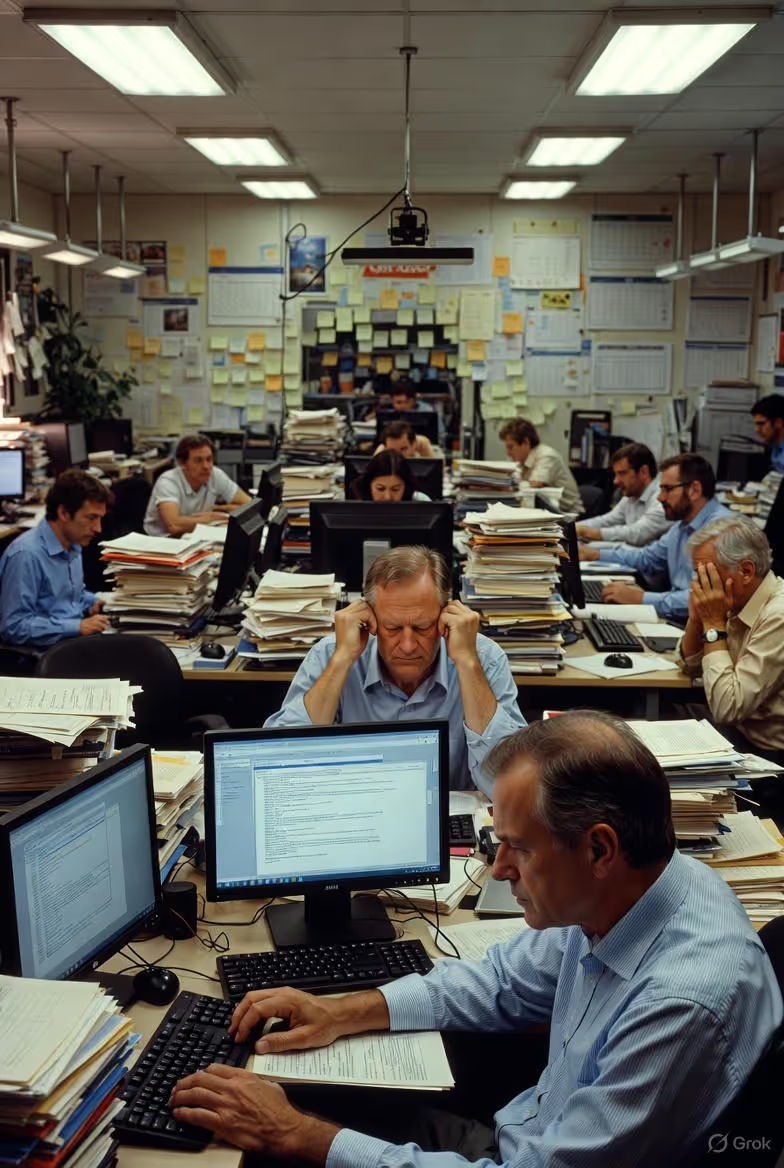
For decades, the narrative of success has been intertwined with sacrifice—sleep sacrificed for work, weekends sacrificed for projects, peace sacrificed for progress. Hustle culture, perpetuated by sensationalized founder stories and a 24/7 digital workplace, has sold us a dangerous lie: that if we’re not perpetually exhausted, we’re not trying hard enough.
This mentality is not just unhealthy; it’s inefficient. Dr. Emily Nagoski, author of Burnout, clarifies the endpoint of this path: "Burnout is not a sign that you are weak or that you are not trying hard enough. It is a sign that the system you are working in is broken." When we operate in a constant state of sympathetic nervous system activation ("fight or flight"), we impair the very cognitive functions required for meaningful work.
The first step toward balance is a radical reframing: Rest is not the reward for productivity. It is the prerequisite. It’s the necessary period where your body repairs tissues, your brain consolidates memories and skills, and your nervous system resets. Companies that understand this, like those championing a true people-first culture (you can read about one such mission at Oxyzen's About Us page), are leading the charge in sustainable performance.
Shifting away from hustle culture requires more than just intention; it requires a new way of measuring what matters. We must move from tracking time to tracking energy and outcomes.

The industrial-age model of productivity—measuring value by time spent at a station—is hopelessly outdated for the knowledge economy. What matters is not the 60 hours you’re at work, but the 3 hours of intense, focused, creative output you generate during work. The goal is to maximize the quality and impact of your work hours, not their quantity.
This is where the concept of "Energy Management" supersedes time management. You have four primary types of energy:
True productivity systems optimize for renewing and strategically spending these energy reservoirs. For instance, tackling your most demanding cognitive task (mental energy) right after a workout and a healthy meal (physical energy) when you feel positive and motivated (emotional energy) leads to exponentially better results than forcing the same task at 4 PM after a poor night's sleep and three cups of coffee.
Instead of setting goals like "work on project X for 4 hours," reframe them to be outcome-oriented: "Complete the first draft of the project proposal." This shifts your focus from filling time to achieving a result. It liberates you—if you accomplish the outcome in 90 minutes of deep work, you’ve "been productive" and can use the reclaimed time for restorative activity without guilt.
To master this, you need insight. This is where the fusion of ancient wisdom and modern technology becomes powerful. Just as an athlete uses a heart rate monitor to train optimally, knowledge workers can now use biometric data to work optimally. Devices like smart rings provide a continuous, passive stream of data on your physical readiness—your sleep quality, heart rate variability (HRV), resting heart rate, and body temperature. This data moves you from guessing how you "feel" to knowing how you are. You can learn more about how this technology empowers personal insight on the Oxyzen blog, which features deep dives on wellness optimization.
Armed with this redefinition, we can now explore the biological imperative that makes rest non-negotiable: your body’s natural rhythms.
Your body doesn’t operate on a 24-hour clock alone. Within that circadian rhythm, you cycle through ultradian rhythms—shorter biological cycles that govern your alertness, focus, and need for rest throughout the day. These rhythms, typically lasting 90-120 minutes, are the master key to unlocking sustainable productivity.
The cycle is simple yet profound:
Ignoring this dip—by pushing through with caffeine, sugar, or willpower—is like ignoring a fuel gauge on empty. You force the system, but performance plummets, stress hormones rise, and you accumulate a recovery debt.
The strategic approach is to align your work with these natural cycles, a practice sometimes called "ultradian sprinting."
This isn't a luxury; it's a biological reset that allows you to enter the next 90-minute sprint at a high level again. Over an 8-hour day, four such sprints yield far greater output than 8 hours of fragmented, low-focus busywork.
Tuning into these rhythms requires self-awareness. Many find that technology can act as a mirror. A wellness tracker that monitors physiological markers of stress and recovery can help you identify your personal ultradian patterns and pinpoint the times of day you are naturally primed for deep work. For those curious about the practical applications of such data, the Oxyzen FAQ offers insights into how this feedback loop works in daily life.
Understanding these internal cycles is half the battle. The other half is structuring our external environment and behavior to support them, which begins with the most fundamental restoration tool we have: sleep.

If you seek one single lever to pull that will improve every aspect of your productivity, creativity, and health, it is sleep. Period. The science is unequivocal: sleep is not passive downtime. It is a highly active, essential process for brain maintenance and memory consolidation.
During sleep, particularly during deep (Slow-Wave) sleep and REM sleep, your brain:
Chronic sleep deprivation (less than 7 hours for most adults) is cognitive and performance sabotage. It impairs attention, working memory, mathematical capacity, and logical reasoning. A study from the University of Pennsylvania found that getting only 4-5 hours of sleep per night for just one week created cognitive impairments equivalent to a blood alcohol level of 0.1%—legally drunk.
It’s not just about logging hours in bed. Sleep architecture—the structure and quality of your sleep cycles—is critical.
You can improve both sleep duration and quality through sleep hygiene:
For the data-driven individual, quantifying sleep is a powerful motivator. Using a device that tracks sleep stages, heart rate, and HRV overnight provides objective feedback. You can see the direct impact of that late-night coffee or the benefit of your new wind-down routine. Many users report that this tangible data, like the kind discussed in Oxyzen customer testimonials, was the final push they needed to prioritize and optimize their sleep, transforming their waking hours.
With a solid sleep foundation, we can build more sophisticated restorative practices into our waking lives, starting with the most accessible one: strategic movement.
The dichotomy between "work" and "exercise" is another false divide. Movement is not separate from productive living; it is a core enabler of it. Physical activity is perhaps the most potent and underutilized performance-enhancing drug available—with no side effects when used appropriately.
The benefits for cognitive function and stress resilience are immediate and long-term:
The key is to weave movement into your day in a way that serves your energy cycles, not depletes them.
Listen to your body’s signals. Sometimes, a high-intensity interval training (HIIT) session is exactly what you need. Other times, your body may be signaling a need for rest, indicated by a low HRV score or elevated resting heart rate. The most advanced wellness ecosystems help you understand these signals, guiding you to move in a way that balances stress with recovery. The journey to creating such intuitive technology is often a fascinating one, as you can discover in Oxyzen's Our Story.
Movement clears the physical and mental static. But to truly tap into our highest levels of insight and calm, we must train the mind itself.
If your mind is a browser with 100 tabs open, meditation is the process of closing them one by one. In the context of productivity, mindfulness is not about achieving blissful detachment; it’s a practical meta-skill for managing attention and emotional response. It’s the training that allows you to notice you’ve been scrolling mindlessly for 10 minutes and gently return to your work, or to observe a surge of stress without being hijacked by it.
At its core, mindfulness strengthens the prefrontal cortex and dampens the reactivity of the amygdala. This directly translates to better focus, reduced procrastination, and improved emotional regulation in high-pressure situations.
You don’t need to sit on a cushion for an hour. The goal is to introduce brief, regular "mindful pauses" to interrupt autopilot.
The data from wellness technology can reinforce this practice. You might notice that on days you meditate, your nighttime HRV is higher or your sleep is deeper, creating a positive feedback loop. This quantifiable connection between mental practice and physiological outcome is a powerful motivator. For more resources on building these science-backed habits, explore the Oxyzen blog for curated content.
A calm, focused mind is essential for making clear decisions about what truly matters—which is the next frontier in restful productivity: ruthless prioritization.
You cannot balance productivity and rest if your commitments are infinite. The modern disease is not a lack of opportunities, but an overabundance of them. Every "yes" is, implicitly, a "no" to something else—often your own focused work or recovery time. Therefore, the single most important skill for sustainable productivity is the ability to say "no" strategically.
This is "strategic neglect"—the intentional decision to ignore or decline tasks, projects, and requests that do not align with your core priorities or optimal energy use. It’s not about being irresponsible; it’s about being responsible to your mission and well-being.
Saying no requires clarity and often, courage. It helps to have a prepared, graceful script: "Thank you for thinking of me. That sounds interesting, but my plate is completely full with my current priorities, so I'll have to pass this time." Your priorities must be non-negotiable, like a doctor's appointment. You wouldn't cancel surgery to take an extra meeting; treat your deep work blocks and recovery rituals with the same reverence.
Mastering your time and commitments creates the container. But what you put into that container—the fuel for your brain and body—is equally critical.
Your brain, which constitutes about 2% of your body weight, consumes roughly 20% of your daily energy. The quality of that energy is directly determined by what you eat. The standard modern diet—high in refined sugars, processed carbs, and industrial seed oils—creates a cycle of energy spikes and crashes, brain fog, and inflammation that sabotages consistent performance.
Eating for productivity and rest is about stabilizing blood sugar and reducing inflammation to provide a steady stream of clean fuel to both brain and body.
Your body’s response to food is highly individual. Some people thrive on three square meals, others on more frequent, smaller snacks. Paying attention to how different foods make you feel and perform is key. Some find that biometric data adds another layer of insight—noticing, for example, that a high-sugar meal correlates with a spike in resting heart rate or a dip in HRV, indicating a stress response. This turns nutrition from a vague concept into a personal science experiment.
With our physical engine properly fueled, we must turn to the environment we operate in. The spaces we inhabit profoundly shape our ability to focus and recover.
Your environment is not a passive backdrop; it’s an active participant in your cognitive and emotional state. A cluttered, noisy, distraction-filled space creates a cluttered, noisy, distracted mind. Conversely, an intentionally designed environment can cue focus, calm, and creativity.
This design applies to both your workspace (for productivity) and your rest spaces (for recovery), and the principle is the same: create clear boundaries and intentional cues.
Your environment extends to your digital world. The companies and tools you choose to integrate into your life should reflect these same values of clarity and intentionality. Choosing technology that serves you—that provides insight without obsession, that empowers rather than enslaves—is part of this environmental design. To see how one company approaches this philosophy of human-centric technology, you can learn more about Oxyzen's vision.
We’ve touched upon ultradian rhythms, but there’s a broader, more personal biological clock at play: your chronotype. This is your genetically predisposed natural inclination to sleep and be active at certain times of day. Ignoring your chronotype is like trying to run a marathon in shoes that don’t fit—you might finish, but it will be painful and inefficient.
Commonly simplified into "early birds" and "night owls," chronotypes are more nuanced, but they dictate your ideal windows for cognitive work, collaborative tasks, and rest. Society often rewards the early bird schedule, but forcing a night owl to perform complex analysis at 7 AM is a recipe for poor output and frustration.
The first step is simple observation. When do you naturally wake without an alarm? When do you feel most alert and capable of tackling difficult problems? When does your energy dip? For a week, track your energy, focus, and mood on the hour. You’ll likely see a pattern.
The productivity imperative here is to schedule your most demanding cognitive tasks during your personal biological peak. For a Wolf, this might mean blocking 2 PM - 5 PM for deep work, not 8 AM - 11 AM. It means scheduling routine, administrative tasks for your lower-energy periods. This isn’t self-indulgence; it’s biohacking for maximum output and minimum strain.
Modern wearable technology can accelerate this discovery process. By correlating your self-reported energy with objective data like body temperature fluctuations and heart rate patterns, you can get a remarkably clear picture of your personal circadian rhythm. This data-driven self-knowledge is transformative, a theme often echoed by users who share their experiences with Oxyzen.
Syncing with your chronotype is a masterclass in working with your nature, not against it. It naturally creates a more respectful relationship with your own body’s needs. The next step is to apply that same respect to the boundaries between your work and the rest of your life.
The greatest thief of both productivity and peace in the modern era is unmanaged digital connectivity. The smartphone is a miracle of technology that has become, for many, a portable slot machine of distraction and anxiety. The constant ping of notifications fragments attention, creates a false sense of urgency, and blurs the lines between work and life until rest becomes impossible.
A digital detox isn’t about becoming a Luddite; it’s about becoming intentional. It’s about transforming your devices from masters of your attention into tools that serve your priorities.
The goal is to create friction for distraction and fluidity for focus. Every time you mindlessly reach for your phone, that moment of friction—having to walk to another room, disable a blocker—gives your prefrontal cortex a chance to re-engage and ask, "Is this what I truly want to be doing right now?"
This intentional disconnection is a form of radical self-respect. It declares that your attention, your creative output, and your personal time have value. For more tactical advice on managing the digital overwhelm in the pursuit of wellness, a wealth of resources can be found on the Oxyzen blog.
With our boundaries fortified, we can now explore the most profound level of integration: where our work and our rest are not in conflict because they are both expressions of a coherent, purposeful life.
Ultimately, the tension between productivity and rest often stems from a deeper schism: a feeling that our work is separate from, or even antithetical to, our well-being and values. We "grind" at a job we tolerate to afford vacations we need to recover from the grind. This cycle is soul-crushing.
The solution is not better time management, but better meaning management. Restful productivity finds its most sustainable form when your work, in some meaningful way, aligns with your core values, strengths, and sense of purpose. When you are engaged in work that matters to you, effort can feel like expression, not depletion. And rest becomes a cherished part of the cycle that enables that expression, not an escape from it.
When your work has purpose, rest is not a guilty pleasure; it’s stewardship of the instrument—you—that does the work. This philosophy is often at the heart of mission-driven companies. For instance, understanding Oxyzen's mission reveals a focus on empowering individuals with knowledge to live more intentional lives, a purpose that aligns the effort of creation with the value of well-being.
This sense of unified purpose is the bedrock. Upon it, we can build the final, master skill: the gentle, consistent practice of listening and adapting to the ever-changing needs of the human system that is you.
All the frameworks, data, and optimal schedules in the world are useless if you respond to your own humanity with harshness and rigidity. The final, and perhaps most important, component of balancing productivity with rest is self-compassion—the ability to treat yourself with the same kindness and understanding you would offer a struggling friend.
This means:
This is where the true power of biometric feedback shines. When viewed through a lens of curiosity rather than judgment, data from a wellness tracker becomes a conversation with your body, not a report card.
This compassionate, responsive approach is the antithesis of the rigid, punishing hustle mentality. It creates resilience. For common questions on how to interpret this data with a healthy, balanced mindset, resources like the Oxyzen FAQ can provide helpful guidance.
You have now been equipped with a comprehensive framework for dismantling the false dichotomy between productivity and rest. We have journeyed from the macro—rejecting toxic hustle culture and redefining success—to the micro—honoring your ultradian rhythms and nutritional needs. We have explored the importance of your environment, your unique biology, and your digital hygiene. Finally, we have anchored it all in purpose and self-compassion.
This is not a quick fix. It is a practice, a lifelong series of adjustments and recalibrations. You are a dynamic human being, not a static machine. Some seasons will demand more output; others will demand more recovery. The skill is in navigating those seasons with awareness and grace, using both internal wisdom and external tools to guide you.
The ultimate goal is a life where achievement and well-being are not traded, but synergized. Where you can produce exceptional work because you are deeply rested, and you can rest without guilt because you have been meaningfully productive. It is a life of rhythm, intention, and profound fulfillment.
In our quest for balance, technology is often cast as the villain—the source of endless notifications and the thief of our time. Yet, when used with intention, technology transforms from a foe into the most powerful ally in our pursuit of restful productivity. The key lies in shifting from being a passive consumer of technology to becoming its active architect, designing a digital ecosystem that actively supports your goals for focus and restoration.
This isn't about adding more apps to your life; it's about a strategic curation and automation that offloads cognitive overhead, provides invaluable self-knowledge, and creates guardrails for your attention.
1. The Insight Layer: Quantified Self for Qualitative Living
This is where biometric wearables, like advanced smart rings, play a revolutionary role. They move you from subjective feeling ("I'm tired") to objective data ("My resting heart rate is 10 bpm higher than my baseline and my HRV has dropped 30%, indicating high stress load"). This layer isn't about generating more anxiety over numbers; it's about creating an objective feedback loop for your lifestyle choices.
This data empowers you to make decisions aligned with your body’s actual state, not just your ambitious mind’s wishes. For a deeper look at how this technology translates into daily wisdom, you can explore related articles on our blog.
2. The Automation Layer: Designing Friction and Flow
Use technology to automatically create an environment conducive to focus and rest.
3. The Synthesis Layer: Centralizing for Clarity
A scattered system is a stressful system. Use a primary digital hub to bring your intentions, tasks, and schedules into one coherent view.
By building this three-layered system, you turn your technology from a leaky sieve draining your attention into a fortified dam, channeling your energy toward what you've deliberately decided is important. The founding vision behind many such integrative tools is to create this seamless support, a journey you can read about in Oxyzen's Our Story.
With our external systems optimized, we must turn inward to a subtle but powerful force that shapes our reality more than we often acknowledge: our personal narrative.
Our behavior is ultimately driven by our identity—the stories we tell ourselves about who we are and what we value. The hustle culture trap is so potent because it sells a compelling identity: "I am a hard worker. I am committed. My busyness proves my worth." To choose rest, then, can feel like an identity threat. It risks the story becoming: "I am lazy. I am not dedicated. I am falling behind."
Therefore, lasting change requires an identity shift. You must consciously rewrite the internal narrative that links your self-worth exclusively to your output and begin to craft a new, more holistic story.
Start by identifying and challenging the toxic productivity stories you currently believe.
The words you use, both internally and externally, reinforce your identity. Banish phrases like "I'm so busy" from your vocabulary. Replace them with more precise and empowered language:
This isn't semantic games; it's cognitive reframing. It moves you from a passive victim of circumstances to an active author of your life. Every time you choose the new language, you strengthen the neural pathways of your new identity.
This narrative work is deeply personal and requires constant reinforcement. Sometimes, seeing how others have navigated this shift can provide powerful validation and inspiration. Reading real user testimonials about reclaiming time and energy can solidify your belief that a different way is not only possible but profoundly better.
A new narrative creates the psychological permission slip for a new way of being. The most practical expression of this new being is found in the deliberate design of our daily and weekly containers—our rituals and routines.
Routines are sequences of actions. Rituals are routines imbued with meaning and intention. The difference is everything. Brushing your teeth is a routine. A morning ritual of meditation, journaling, and a mindful cup of tea while watching the sunrise is a sacred practice that sets the tone for your day. Rituals act as cognitive "bookends," creating clear psychological transitions between different modes of being: from sleep to wakefulness, from work to rest, from family time to personal time.
Without these transitions, life becomes a blur, and stress from one domain bleeds incessantly into another. Rituals build the walls that contain our energy, allowing us to be fully present in each segment of our lives.
1. The Morning Anchor (A Launch Ritual)
This is not about a 5 AM, 20-step productivity hack. It's about a consistent, gentle practice that connects you to your intentions before the world's demands come knocking.
2. The Work Start-Up (A Focus Ritual)
Don't just dive into your inbox. That is letting other people's agendas dictate your day. Create a deliberate ritual to start work.
3. The Shutdown Ritual (A Release Ritual)
This is arguably the most important ritual for preventing work stress from polluting your personal life. A proper shutdown signals to your brain that work is done.
These rituals create structure with soul. They are the practical enactment of the self-compassion and boundary-setting we've discussed. For those seeking to deepen their ritual practice with data on how their body best responds, guidance is often available through support resources like our FAQ.
Rituals structure our days. To avoid the burnout of a perpetual sprint, we must also structure our years with a concept borrowed from the world of athletics: periodization.
Elite athletes don't train at peak intensity year-round. They follow a periodized plan: phases of intense building (macrocycles), focused competition (mesocycles), and essential recovery (microcycles). This is the only sustainable model for high performance. Why would we expect our cognitive and creative work to be any different?
Applying periodization to your professional and personal life means intentionally planning seasons of intense output and expansion, followed by seasons of integration, learning, and rest. It moves you from a linear, always-on mindset to a cyclical, rhythmic one.
You can apply this on a smaller scale as well. Your week might have 3-4 days of Focus, 1 day of Integration (admin, planning, learning), and 2 days of Rejuvenation. Your day follows the ultradian pattern of sprints and breaks.
This model eliminates the guilt of rest because rest is part of the plan, the crucial phase that ensures the next season of effort is successful. It reframes downtime as strategic reinvestment in your capacity.
Embracing a cyclical view of productivity requires a long-term perspective and trust in the process. It aligns with a holistic vision of human performance, a philosophy that guides the development of tools designed for sustainability, not just peak output. You can learn more about this long-term vision here.
With our time structured from the micro to the macro level, we must address a silent saboteur that thrives in the gap between intention and action: procrastination.
We often think of procrastination as putting off hard work. But in a culture obsessed with productivity, we also engage in "rest procrastination"—the avoidance of true, guilt-free downtime. You see it when you finally have a free hour and fill it with mindless scrolling instead of the novel you wanted to read, or when you can't sit through a movie without checking your work email.
This happens because unstructured rest can feel uncomfortable. Our anxious minds, conditioned for constant stimulation and achievement, interpret stillness as a threat. So, we choose a pseudo-rest that is distracting enough to quiet the anxiety but not restorative enough to actually refill our energy tanks. This creates a vicious cycle: we're too depleted from work to enjoy real rest, so we choose draining pseudo-rest, which leaves us even more depleted for work, requiring more intense pseudo-rest to cope.
When you stop procrastinating rest and start practicing it with intention, you break the cycle. You begin to experience the profound renewal that makes focused work not only possible but enjoyable again. For more ideas on intentional, restorative activities, the Oxyzen blog regularly explores this vital topic.
Having tackled the mental blocks to rest, we arrive at the culmination of all these practices: the ability to be fully present, whether in a state of flow at work or in a state of peace at rest.
At the intersection of peak productivity and profound rest lies a single state: presence—the ability to fully engage with the task, person, or experience in front of you, without the mental noise of the past or future.
When you are truly present in deep work, you enter a flow state. Distractions fall away, time distorts, and the quality of your output soars. When you are truly present in rest—whether in conversation, in nature, or in silence—you experience a depth of fulfillment that actually restores you. The anxious mind that multitasks and half-listens is the mind that is never productive or rested.
This state of presence is the ultimate goal. All the previous frameworks—the rituals, the periodization, the boundary setting—are simply the scaffolding we build to create the conditions where presence can flourish. It is in presence that we do our best work and experience our deepest peace. They become, finally, the same thing.
You now possess a complete, interconnected system for a life of restful productivity. We have built this system from the ground up: from the biological foundations of sleep and rhythm, through the practical layers of environment and technology, into the psychological realms of narrative and identity, and finally to the spiritual practice of presence.
This is not a rigid doctrine but a flexible philosophy. Some days, you will lean more on the productivity pillars. Other days, the restful practices will take precedence. The tools and data you choose to incorporate, like those developed with a deep understanding of human performance, are meant to serve this flexibility, not hinder it. The real testimonials of change, which you can find in user stories, are a testament to this adaptable, human-centric approach.
The journey toward balance is the journey toward becoming more fully, resiliently, and joyfully human. It is the recognition that we are not designed for endless output, but for rhythmic creation. By honoring both sides of that rhythm—the effort and the ease—we don't just achieve more. We become more.
Elite athletes don't train at peak intensity year-round. They follow a periodized plan: phases of intense building (macrocycles), focused competition (mesocycles), and essential recovery (microcycles). This is the only sustainable model for high performance. Why would we expect our cognitive and creative work to be any different?
Applying periodization to your professional and personal life means intentionally planning seasons of intense output and expansion, followed by seasons of integration, learning, and rest. It moves you from a linear, always-on mindset to a cyclical, rhythmic one.
You can apply this on a smaller scale as well. Your week might have 3-4 days of Focus, 1 day of Integration (admin, planning, learning), and 2 days of Rejuvenation. Your day follows the ultradian pattern of sprints and breaks.
This model eliminates the guilt of rest because rest is part of the plan, the crucial phase that ensures the next season of effort is successful. It reframes downtime as strategic reinvestment in your capacity.
Embracing a cyclical view of productivity requires a long-term perspective and trust in the process. It aligns with a holistic vision of human performance, a philosophy that guides the development of tools designed for sustainability, not just peak output. You can learn more about this long-term vision here.
With our time structured from the micro to the macro level, we must address a silent saboteur that thrives in the gap between intention and action: procrastination.
We often think of procrastination as putting off hard work. But in a culture obsessed with productivity, we also engage in "rest procrastination"—the avoidance of true, guilt-free downtime. You see it when you finally have a free hour and fill it with mindless scrolling instead of the novel you wanted to read, or when you can't sit through a movie without checking your work email.
This happens because unstructured rest can feel uncomfortable. Our anxious minds, conditioned for constant stimulation and achievement, interpret stillness as a threat. So, we choose a pseudo-rest that is distracting enough to quiet the anxiety but not restorative enough to actually refill our energy tanks. This creates a vicious cycle: we're too depleted from work to enjoy real rest, so we choose draining pseudo-rest, which leaves us even more depleted for work, requiring more intense pseudo-rest to cope.
When you stop procrastinating rest and start practicing it with intention, you break the cycle. You begin to experience the profound renewal that makes focused work not only possible but enjoyable again. For more ideas on intentional, restorative activities, the Oxyzen blog regularly explores this vital topic.
Having tackled the mental blocks to rest, we arrive at the culmination of all these practices: the ability to be fully present, whether in a state of flow at work or in a state of peace at rest.
At the intersection of peak productivity and profound rest lies a single state: presence—the ability to fully engage with the task, person, or experience in front of you, without the mental noise of the past or future.
When you are truly present in deep work, you enter a flow state. Distractions fall away, time distorts, and the quality of your output soars. When you are truly present in rest—whether in conversation, in nature, or in silence—you experience a depth of fulfillment that actually restores you. The anxious mind that multitasks and half-listens is the mind that is never productive or rested.
This state of presence is the ultimate goal. All the previous frameworks—the rituals, the periodization, the boundary setting—are simply the scaffolding we build to create the conditions where presence can flourish. It is in presence that we do our best work and experience our deepest peace. They become, finally, the same thing.
Your Trusted Sleep Advocate: Sleep Foundation — https://www.sleepfoundation.org
Discover a digital archive of scholarly articles: NIH — https://www.ncbi.nlm.nih.gov/
39 million citations for biomedical literature :PubMed — https://pubmed.ncbi.nlm.nih.gov/
Experts at Harvard Health Publishing covering a variety of health topics — https://www.health.harvard.edu/blog/
Every life deserves world class care :Cleveland Clinic - https://my.clevelandclinic.org/health
Wearable technology and the future of predictive health monitoring :MIT Technology Review — https://www.technologyreview.com/
Dedicated to the well-being of all people and guided by science :World Health Organization — https://www.who.int/news-room/
Psychological science and knowledge to benefit society and improve lives. :APA — https://www.apa.org/monitor/
Cutting-edge insights on human longevity and peak performance:
Lifespan Research — https://www.lifespan.io/
Global authority on exercise physiology, sports performance, and human recovery:
American College of Sports Medicine — https://www.acsm.org/
Neuroscience-driven guidance for better focus, sleep, and mental clarity:
Stanford Human Performance Lab — https://humanperformance.stanford.edu/
Evidence-based psychology and mind–body wellness resources:
Mayo Clinic — https://www.mayoclinic.org/healthy-lifestyle/
Data-backed research on emotional wellbeing, stress biology, and resilience:
American Institute of Stress — https://www.stress.org/


