


How to Explain Sleep Health to Friends and Family
Explain that sleep is a pillar of health, like nutrition and exercise, essential for feeling and functioning your best.
Explain that sleep is a pillar of health, like nutrition and exercise, essential for feeling and functioning your best.
%402x.svg)
We’ve all been there. You drag yourself through the day, powered by sheer will and caffeine, your brain wrapped in a familiar fog. When a colleague asks how you are, you offer a tired smile and the universal disclaimer: “Just tired. Didn’t sleep well.” It’s a common currency in our modern exchange, a badge of busyness we wear with a strange mix of shame and pride. But what if we’ve been framing this all wrong? What if “sleep health” isn’t about the hours you didn’t get, but the foundational biology you’re either building or breaking every single night?
Sleep health is the silent superpower influencing everything from your mood at the breakfast table to your long-term risk for chronic disease, yet it remains one of the most misunderstood and poorly discussed aspects of our wellbeing. We meticulously count calories, track our steps, and meditate for ten minutes, but we leave our sleep—a process that consumes a third of our lives—to chance, often viewing it as an inconvenient interruption to productivity.
The challenge is that sleep is invisible and complex. You can’t hold it in your hand, you can’t easily measure its quality without technology, and its consequences are often delayed, making the cause-and-effect difficult to grasp. This makes explaining its importance to friends and family who might dismiss it as “just sleep” a uniquely difficult task. How do you convey the intricate ballet of sleep cycles, the vital housekeeping of the glymphatic system, or the hormonal symphony orchestrated in the dark to someone who believes they “function fine on five hours”?
This article is your comprehensive guide to bridging that gap. We’ll move beyond the simplistic “you should get more sleep” admonishment and equip you with the knowledge, metaphors, and compelling narratives to make the invisible, visible. You’ll learn how to articulate the profound impact of sleep on memory, immunity, emotional resilience, and metabolic health in ways that resonate. We’ll also explore how modern tools, like advanced wellness wearables, are turning subjective feelings of tiredness into objective, shareable data, creating a common language for a conversation that has been stuck in the dark for too long. By the end, you’ll be able to explain sleep health not as a luxury, but as the non-negotiable bedrock of a thriving life—and inspire your loved ones to see it the same way.
Let’s begin by rebuilding the very foundation of how we talk about this essential pillar of health.

When we say “sleep health,” most people’s minds jump directly to duration: the mythical eight-hour goal. While quantity matters, this single-minded focus is like describing a gourmet meal solely by its calorie count. You’re missing the ingredients, the preparation, the nutrients, and the entire experience. True sleep health is a multi-dimensional construct, and understanding these dimensions is the first step in explaining it effectively.
Sleep health is defined by several interlocking pillars:
To make this tangible, use this analogy: Think of sleep as a nightly renovation project for your brain and body. Regularity is the work schedule the crew expects. Timing is doing the noisy demolition (deep sleep) and delicate painting (REM sleep) at the right phases of the night. Efficiency means the crew is working the whole shift, not taking three-hour coffee breaks. Duration is the length of the shift—too short, and the job is left half-finished. Satisfaction and Alertness are how you feel walking into your newly renovated “self” the next morning.
The consequences of poor sleep health ripple outward. It’s not just about yawns. When sleep is fragmented or short, critical processes are interrupted. The brain’s “clean-up crew,” the glymphatic system, which flushes out neurotoxins like beta-amyloid (linked to Alzheimer’s), is most active during deep sleep. Miss that, and you’re leaving metabolic trash lying around. Growth hormone, essential for tissue repair and muscle growth, is predominantly released during deep sleep. Your immune system releases proteins called cytokines during sleep; skimping on sleep means you produce fewer of these infection-fighting warriors.
Explaining this to a friend, you might say: “It’s not about chasing a random number of hours. It’s about giving your body a consistent, efficient, well-timed window every night to do its essential life-support maintenance. Would you only let a mechanic work on your car for 20 minutes when it needs a full hour? That’s what we do with sleep.” For those intrigued by how technology can help measure these pillars beyond just hours in bed, discover how Oxyzen works to track these very metrics, turning the abstract concept of “sleep quality” into a clear, actionable picture.
To motivate change, people need to understand the stakes. But “you’ll be tired” is not a compelling deterrent in a culture that glorifies burnout. We must frame the cost of sleep neglect in terms of tangible, valued outcomes: mental sharpness, emotional balance, physical health, and even appearance.
The Cognitive Tax: Sleep is fundamentally linked to how we think and learn. During sleep, specifically during the rapid eye movement (REM) stage, the brain consolidates memories—transferring them from short-term storage to long-term. Pull an all-nighter to cram for a test, and you might hold the information just long enough to pass, but it won’t become durable knowledge. Furthermore, a sleep-deprived brain has an impaired prefrontal cortex, the region responsible for executive functions like decision-making, problem-solving, and emotional control. You become more impulsive, less creative, and prone to poor judgment. Explain it as: “Sleep is the fee your brain charges to file away the day’s memories and reboot its decision-making software. Without paying that fee, your mental desktop becomes cluttered and unresponsive.”
The Emotional Toll: There’s a reason everything feels worse when you’re exhausted. The amygdala, the brain’s emotional alarm center, becomes hyper-reactive on poor sleep, while its connection to the rational prefrontal cortex weakens. This means you’re more likely to overreact to minor stressors, experience heightened anxiety, and have a lower threshold for frustration. A study from the University of California, Berkeley found that sleep deprivation can make us essentially "lonelier" and less socially attractive, creating a vicious cycle. You can tell a family member: “Think of sleep as your emotional reset button. Without it, your brain’s emotional volume gets stuck on ‘max,’ and every little thing feels like a crisis.”
The Physical Bill Comes Due: This is where the long-term, serious health implications lie, and they are profound. Chronic sleep deprivation (consistently getting less than 7 hours) is decisively linked to:
Frame this for a health-conscious friend: “Prioritizing sleep is like making a daily deposit into your long-term health savings account. Neglecting it is like taking out high-interest loans against your future wellbeing—the debt (inflammation, hormonal chaos, metabolic stress) accumulates silently until it demands a major payout.” For a deeper dive into the science connecting sleep to holistic wellness, you can always explore our blog for more wellness tips.

One of the biggest hurdles in discussing sleep health is a deeply ingrained cultural belief: that sleep is the enemy of achievement. We praise the “hustle” and the “grind,” often using our sleep deprivation as a perverse proof of our dedication. To shift this narrative, we must actively reframe sleep not as downtime, but as strategic performance enhancement—the ultimate biohack.
This requires challenging the “Laziness Lie.” The idea that needing or prioritizing sleep is a sign of weakness or lack of ambition is not just false; it’s counterproductive. History is replete with top performers who guarded their sleep zealously. From champion athletes like LeBron James and Roger Federer, who prioritize 10-12 hours of sleep as part of their training, to visionary CEOs like Jeff Bezos and Arianna Huffington, who famously champion 8-hour sleep for decision-making, the elite understand that sleep is a competitive edge.
The science backs this up. Research from the University of Pennsylvania and Harvard Medical School demonstrated that sleep deprivation impairs cognitive performance to a degree equivalent to alcohol intoxication. Would we brag about showing up to work legally drunk? Of course not. Yet we wear our exhaustion like a badge of honor, despite it having a similar effect on our judgment and motor skills.
Here’s how to reframe the conversation:
Share stories of high achievers who sleep well. Point to the data on workplace accidents and errors, which peak during circadian low points. The goal is to create a new association: Strategic Sleep = Enhanced Performance. For a powerful look at how a commitment to holistic wellness, starting with foundational elements like sleep, can drive innovation and purpose, you can read about our own journey in our story.
Neuroscience and sleep physiology are full of jargon—circadian rhythms, sleep spindles, REM atonia, glymphatic clearance. This language, while precise, is a barrier to understanding for most people. To be an effective evangelist for sleep health, you need a translator’s toolkit: a set of simple, relatable metaphors that make the invisible processes feel concrete and important.
Here are powerful metaphors you can use:
1. The Brain’s “Nightly Clean-Up Crew” (Glymphatic System):
2. The Memory “Filing Clerk” (Memory Consolidation):
3. The Body’s “Software Update” (Cellular Repair & Hormone Regulation):
4. The Emotional “Reset Button” (Amygdala & Prefrontal Cortex):
Using these stories transforms the conversation from a lecture into an “aha!” moment. It gives people a mental model to understand why they feel the way they do after a bad night. For those who are curious about seeing this “clean-up crew” or “filing system” in action through their own data, the insights provided by a detailed tracker can be revelatory. You can learn more about smart ring technology and how it captures the proxies of these very biological processes.
Facts and metaphors are essential, but personal experience is the engine of persuasion. Before you can effectively advocate for sleep health, you need to understand and articulate your own relationship with sleep. What has your journey been? This isn’t about being perfect; it’s about being authentic. Your story creates credibility and relatability.
Start by reflecting on these questions:
Craft your narrative. For example: “I used to burn the candle at both ends, bragging about my 5-hour nights. I thought sleep was for the unmotivated. Then, I hit a wall. I was making dumb mistakes at work, my gym progress stalled, and I felt like I was constantly on the verge of tears over nothing. My turning point was tracking my sleep for two weeks and seeing the direct correlation between my ‘good days’ and my ‘good nights.’ I started by just getting sunlight first thing in the morning and banning my laptop from the bedroom. Within a month, the brain fog lifted. I’m not perfect, but I now see sleep as my secret weapon, not my enemy.”
Sharing this story does several things: It makes you human, it demonstrates cause and effect in a real-life context, and it provides a hopeful template for change. It shows that improvement is possible, often starting with one or two manageable tweaks. If you’re looking for inspiration from others who have had their own sleep health awakening, read real customer reviews and experiences to see how data and awareness have shifted perspectives.
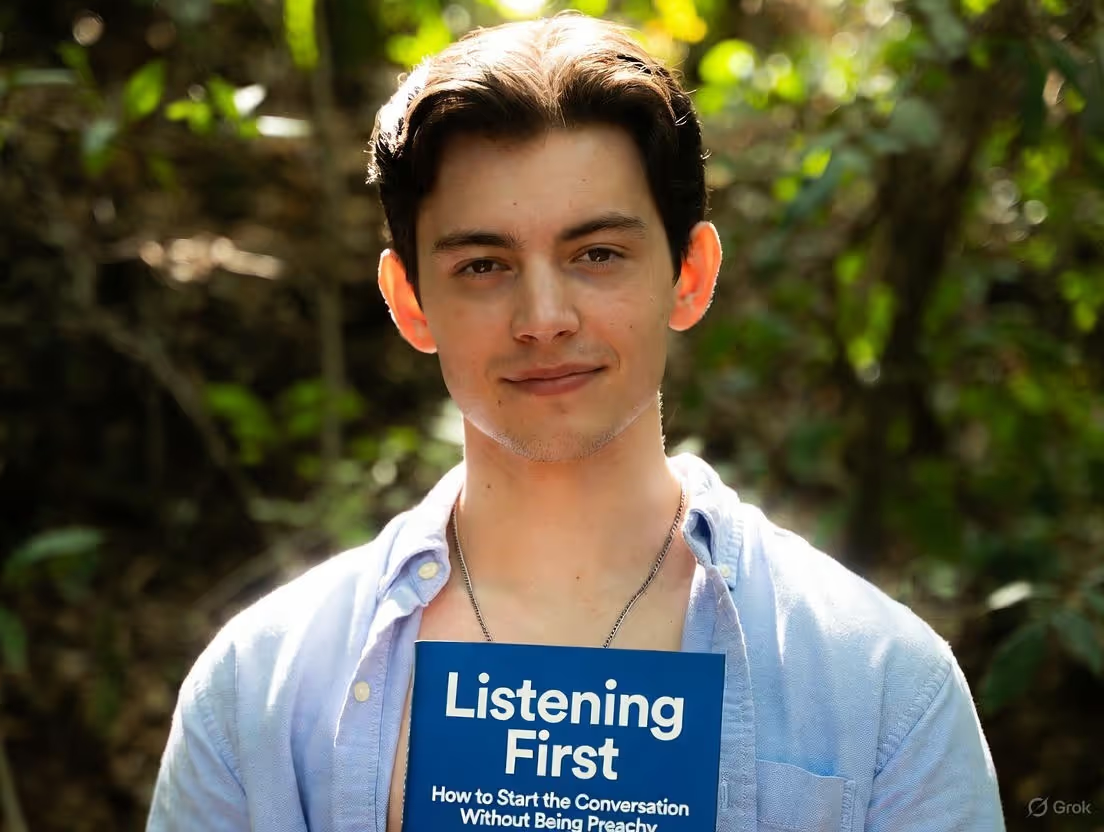
Armed with knowledge, metaphors, and your personal story, the instinct might be to launch into a full-scale educational intervention. Resist it. The quickest way to shut down a conversation about health is to lecture. The goal is dialogue, not monologue. This begins with empathetic listening and curious questioning.
Your role is not the “Sleep Police,” but the “Sleep Curious Friend.” Start by asking open-ended questions that invite reflection, not defensiveness.
Instead of: “You look tired. You really need to get more sleep.”
Try: “How have you been sleeping lately?” or “I’ve been thinking a lot about sleep lately—how’s your energy been holding up?”
Instead of: “Staying up that late is so bad for you.”
Try: “What’s your wind-down routine like at the end of the day? I’ve been trying to figure mine out.”
Listen to their answers without immediately jumping to solutions. Often, people just want to be heard. They might say, “I’m just a terrible sleeper,” or “I have too much to do to sleep more.” These are beliefs and constraints, not immutable facts. Your job in this phase is to understand their unique landscape.
This approach builds trust. It signals that you are coming from a place of support, not judgment. You are exploring the topic with them, not preaching at them. Once you understand their specific challenges and mindset, you can later tailor the information (the metaphors, the science) to directly address their unique situation. For someone with common, specific questions about how to improve sleep or how tracking works, you might eventually point them to a great resource where they can find support and answers to frequent questions.
A one-size-fits-all message on sleep fails because a night-shift nurse, a new parent, a college student, and a CEO face fundamentally different obstacles. Effective explanation requires tailoring the core principles of sleep health to resonate with specific lifestyles and core concerns.
For the New Parent (Survival Mode):
For the Shift Worker (Fighting Biology):
For the Stressed Professional (Mind Won’t Shut Off):
For the Fitness Enthusiast (Focused on Gains):
By customizing your explanation, you show that you understand their world and that sleep health isn’t an abstract ideal, but a flexible set of principles that can be adapted to improve their specific life. To see how different people from various walks of life integrate sleep awareness into their unique routines, the real customer reviews and experiences can offer powerful, relatable examples.

A major point of friction in sleep discussions is subjectivity. One person’s “I slept fine” is another person’s “I feel wrecked.” This discrepancy can lead to dismissal: “You’re just being sensitive,” or “I function fine on less.” This is where objective data becomes a transformative tool for communication. It moves the conversation from debatable feelings to indisputable facts.
Wearable technology, like advanced smart rings, measures proxies for sleep stages (light, deep, REM), heart rate variability (HRV—a key marker of recovery and nervous system balance), resting heart rate, and sleep onset latency. This data creates a shared, neutral ground.
Imagine showing a family member a graph from your own tracking:
The power of data lies in its ability to:
When explaining this, you can say: “It’s like having a coach for your nervous system. I used to just guess about my sleep, but now I have a report card that shows me exactly what’s working and what’s sabotaging my recovery. It’s removed all the guesswork.” For anyone curious about the specifics of how such technology gathers and interprets this vital data, you can invite them to discover how Oxyzen works to demystify the process.
As you start these conversations, you’ll encounter entrenched myths. Your ability to disarm these with grace, science, and empathy will determine your effectiveness. Here’s how to tackle common pushbacks.
Objection 1: “I’m just a short sleeper. I only need 5-6 hours.”
Objection 2: “I can catch up on sleep on the weekends.”
Objection 3: “I’m too stressed/anxious to sleep.”
Objection 4: “It’s just not a priority with everything else I have to do.”
Always lead with curiosity, not correction. “That’s an interesting point, where did you hear that?” can open a more productive dialogue than “That’s wrong.”
After laying the conceptual groundwork, people need practical, actionable steps. Offer them a “starter kit” of low-lift, high-impact strategies to improve their sleep hygiene. Frame these not as rigid rules, but as experiments to see what works for them.
The Non-Negotiables (The Big Levers):
The Game Changers (Behavioral Tweaks):
Suggest they pick one or two of these to focus on for two weeks. Overwhelm is the enemy of change. For a continuously updated repository of practical strategies and deeper explorations of each of these tips, you can direct them to explore our blog for more wellness tips.
It’s crucial to know the line between poor sleep hygiene and a potential clinical sleep disorder. As you advocate for sleep health, you should be able to recognize red flags that warrant a conversation with a doctor. This positions you as a responsible guide, not just a cheerleader.
Encourage someone to seek professional evaluation if they regularly experience any of the following, despite good sleep habits:
How to broach this sensitively: “You’ve been working so hard on your sleep routine, and you’re still struggling with [snoring/daytime sleepiness]. That must be so frustrating. What you’re describing sounds like it could be more than just habits—it might be worth talking to your doctor or a sleep specialist. There are really effective treatments for things like sleep apnea now that can be life-changing.” Normalize seeking help—it’s a sign of prioritizing health, not a failure.
Our role as advocates is to provide knowledge, support, and resources, and to know when to pass the baton to a medical professional. For more information on the team and mission behind creating tools for better health awareness, you can learn about our company information and mission.
Understanding sleep health personally is one thing; integrating that awareness into your closest relationships is another. This is where the journey transforms from a solitary pursuit into a shared value—a powerful bonding agent that can improve not just individual wellbeing, but the health of your partnerships, friendships, and family dynamics. The goal is to move from "my sleep" to "our rest," creating an environment where everyone's need for recovery is respected and supported.
The Power of Shared Goals: Just as couples or friends might train for a race or commit to a cooking challenge together, making sleep health a collaborative project can be transformative. It’s not about policing each other, but about becoming allies. You could propose a "30-Day Sleep Reset Challenge" where you each choose one sleep hygiene habit to focus on and share weekly non-scale victories: "I woke up without an alarm three days this week," or "I didn’t crave afternoon sugar because I slept better."
Creating a Household Sleep Culture: This involves aligning your environments and routines.
The Empathy Multiplier: When both people in a relationship understand the science of sleep, it reduces conflict. Instead of interpreting a partner’s short temper as a personal slight, you can view it through the lens of “They had terrible sleep latency last night; their nervous system is fried.” This fosters patience and supportive language: “You seem like you had a rough night. What can I do to help today?” instead of “Why are you so grumpy?”
Modeling for the Next Generation: For parents, this is perhaps the most critical application. Children learn health behaviors by observation. By prioritizing your own sleep and creating consistent family routines (regular dinner times, calming pre-bed rituals, consistent lights-out), you are imparting a lifelong skill. Explaining sleep to kids using the metaphors we’ve discussed (“Your brain needs to take out the trash!”) can make it fun and foundational.
This shift from an individual to a collective mindset turns sleep from a private chore into a pillar of a healthy, compassionate home life. It builds a team where everyone is invested in each other’s restoration. For more on how shared wellness goals can strengthen bonds and create positive change, the stories behind brands often reflect this communal philosophy—you can read about our brand journey, vision & values for one perspective on building with community in mind.
Introducing a device like a smart ring into a relationship requires careful framing. If presented poorly, it can feel like surveillance or create a competitive, stressful dynamic. But when introduced thoughtfully, it can become a powerful tool for mutual understanding, empathy, and teamwork.
Framing the “Why” Together: Don’t just show up wearing a new tracker. Initiate a conversation. “I’ve been reading a lot about how sleep impacts our health and even how we communicate. I found this tool that can give us some objective data on our recovery. Would you be interested in exploring it with me? Not to judge, but to understand our patterns better as a team.” This positions it as a shared exploration, not a solo audit.
Focus on Patterns, Not Daily Scores: The daily sleep score can be fickle and lead to unproductive fixation. Instead, focus on the longitudinal patterns the data reveals.
This shifts the conversation from “You got a bad score” to “We’ve discovered a pattern that’s working against us. How can we solve it together?”
Using Data for Empathetic Support: The data can tell a story your partner might not articulate. Seeing a sustained period of low HRV and high resting heart rate can be a clear, non-verbal signal of prolonged stress. You can approach them with care: “I’ve noticed your metrics have been in the ‘high stress’ zone for a couple of weeks. Is everything okay? What can we do to help you get more restorative time?” This turns data into a catalyst for a supportive conversation, not a criticism.
Creating Shared Accountability for Positive Habits: Use the data to reinforce positive changes. “Ever since we started our evening walks, both our sleep efficiency scores have gone up! Let’s keep that going.” Or, “The data really shows how much better we sleep when we stick to our device curfew. It’s hard, but seeing this graph makes it worth it.”
The key principle is that the technology serves the relationship, not the other way around. It provides a neutral, third-party perspective that can depersonalize challenges and highlight opportunities for mutual support. For anyone curious about how such technology can be integrated into a partnership without creating friction, hearing from other users can provide great insight—you can read real customer reviews and user experiences to see how others have navigated this.
One of the biggest practical challenges in prioritizing sleep health is the social pressure to sacrifice it. The late-night party, the early brunch, the “one more episode” marathon with friends, the work email sent at midnight expecting a reply. Protecting your sleep in these moments requires tact, clear communication, and sometimes, a bit of reframing.
The Art of the Graceful Exit: You don’t need to give a lecture on sleep science to leave a gathering. Have a few graceful, pre-prepared lines that are positive and firm.
Reframing “FOMO” (Fear of Missing Out) to “JOMO” (Joy of Missing Out): This mental shift is crucial. Instead of dreading what you’ll miss by going home, actively anticipate the joy of waking up refreshed, without a hangover or sleep-deprivation haze. JOMO is the satisfaction of honoring your commitment to your wellbeing. You’re not missing the end of the party; you’re securing a great start to tomorrow.
Setting Communicative Boundaries (Especially for Work): For after-hours work communication, a proactive approach is best. If your culture permits, you can set an email signature or Slack status: “My working day ends at 6 PM. I will respond during my next working hours.” This manages expectations without needing to reply in real-time. With friends and family who text or call late, a simple “Heading to bed now, talk to you tomorrow!” suffices.
Being a Trendsetter, Not a Spoilsport: You can often influence the group dynamic positively. Suggest meeting for an early morning hike or a sunrise coffee instead of a late-night drink. Propose a dinner party that starts (and thus ends) earlier. You might be surprised how many people are secretly craving more rest and will appreciate the alternative. By confidently owning your choices, you give others permission to do the same.
Handling the “You’re No Fun” Comment: If someone teases you, have a light but clear response ready.
These statements uphold your boundary without creating conflict. Over time, your consistency will teach people to respect your rhythm, and they may even come to admire the benefits they see in you. For more strategies on balancing wellness with a busy, social life, you can always explore our blog for more wellness tips.
Sleep needs and challenges are not static. They evolve with age, lifestyle changes, stress levels, and health status. Explaining sleep health means acknowledging this fluidity and preparing for the long-term maintenance of good sleep habits, not just a one-time fix.
Adapting to Life Stages:
Managing Periodic Stress & Setbacks: Travel, illness, work deadlines, and grief will disrupt sleep. The goal isn’t perfection, but resilience.
The Role of Periodic Check-Ins: Just as you might get an annual physical, make a habit of an annual “sleep review.” Has your satisfaction changed? Are you snoring more? Are you relying on sleep aids? Use data from a wearable, if you have one, to look at year-over-year trends. This proactive approach allows you to catch emerging issues before they become entrenched problems.
Understanding that sleep health is a lifelong practice, not a destination, makes the journey more sustainable and less stressful. It’s about cultivating a flexible, responsive relationship with your own need for rest. For support in navigating the specific questions that arise during different life stages, a dedicated resource can be invaluable—you can often find support and answers to frequent questions in a well-maintained knowledge base.
When you begin to prioritize and understand your sleep, and then successfully communicate its importance within your inner circle, something remarkable happens: the benefits begin to ripple outward. You become a micro-influencer for public health, modeling a behavior that has profound societal implications.
The Cumulative Impact on Public Health: If sleep were a medication improving heart health, metabolic function, mental resilience, and cognitive performance while reducing accident risk, it would be hailed as a miracle drug. Widespread sleep health literacy could reduce the burden on healthcare systems, improve workplace safety and productivity, and enhance overall quality of life on a massive scale. Your personal advocacy is a small but vital part of this cultural shift.
Modeling Behavior in the Workplace: Your changed behavior can influence your professional environment. By not glorifying all-nighters, by blocking your calendar for a consistent lunch break, by not responding to emails at midnight, you silently set a new standard. You might casually share (when appropriate) that you’ve been focusing on sleep and have noticed improved focus. This can make it safer for colleagues to also prioritize rest without fear of being seen as uncommitted.
Inspiring Through Results, Not Lectures: People are more likely to be inspired by observable outcomes than by advice. As you become more emotionally regulated, energetic, and focused, people will notice. When they ask, “You seem great lately—what’s different?” you have a powerful opening. “Thanks! I’ve been really focused on improving my sleep hygiene, and it’s made a bigger difference than I expected.” This is an invitation, not an imposition.
Creating a Supportive Peer Network: As you find others who share this value, you can form a small, supportive community. This could be a friend you check in with about your sleep goals, a online group focused on wellness, or even just a pact with your partner. This network provides accountability, normalizes the struggle, and celebrates the wins, making the journey more sustainable and enjoyable.
Your personal journey contributes to destigmatizing sleep as a pillar of health. It challenges the outdated notion that exhaustion equals dedication. Every conversation you have, every boundary you set, and every time you choose JOMO over FOMO, you cast a vote for a more rested, resilient, and healthy society. To see how a company can build its mission around fostering this wider community of wellness, you can learn about our company information and mission.
We have traversed from the intricate biology of sleep to the social dynamics of defending it. Now, let’s synthesize this into a cohesive, actionable toolkit you can carry into any conversation about sleep health. Think of this as your mental checklist for effective, empathetic advocacy.
The Core Pillars of Your Explanation (The “What”):
Your Communication Strategy (The “How”):
Your Mindset as an Advocate:
With this toolkit, you are no longer just someone who “wants more sleep.” You are a knowledgeable, compassionate communicator equipped to guide your friends and family toward one of the most significant upgrades to their quality of life they will ever make. For a continuous stream of information, new research breakdowns, and practical advice to keep your toolkit updated, remember to explore our blog for more wellness tips.
We began this exploration with a simple, common scene: the weary admission of "I didn't sleep well." We've journeyed through the intricate science that makes that statement so profound, unpacked the cultural myths that discourage us from taking it seriously, and armed ourselves with the language and strategies to change the conversation. The ultimate goal has never been to turn you into a sleep zealot, armed with data to bludgeon your loved ones into an earlier bedtime. Rather, it has been to equip you with the empathy, knowledge, and practical tools to build bridges of understanding.
Sleep health is the silent, foundational layer upon which every other aspect of our wellbeing is built. When it is strong, our mental, emotional, and physical health has the stability to flourish. When it is cracked, everything built upon it becomes unstable. Explaining this to friends and family is therefore one of the most caring and impactful acts you can undertake. You are not just giving them a tip for better rest; you are offering them a new lens through which to view their energy, their mood, their health, and their potential.
Remember, the most persuasive argument you will ever make is the one you live. As you prioritize your own sleep, you become a walking testament to its benefits. The increased patience, the clearer thinking, the resilient calm—these are the qualities that will spark curiosity. When someone asks you, "How do you handle so much?" or "You seem so even-keeled lately," you have your opening. That is the moment to share not just what you do, but why you do it, using the stories and metaphors that make the science come alive.
This journey from personal practice to shared understanding creates a beautiful ripple effect. It starts in your own nervous system, extends to the peace of your bedroom, strengthens the bonds in your home, and slowly influences your wider social and professional circles. You become part of a quiet revolution that seeks to redefine success not by how little we can sleep, but by how fully we can live when we are awake.
Knowledge is power, but action is transformation. To move from reading to doing, here is a simple, three-phase plan to launch your role as a compassionate sleep health advocate.
Phase 1: Fortify Your Foundation (The Next 2 Weeks)
Phase 2: Initiate Gentle Conversations (Weeks 3-4)
Phase 3: Build a Supportive Ecosystem (Ongoing)
You are not starting this journey alone. A growing community of individuals is recognizing that true wellness is not just about optimization, but about restoration. They are choosing to view sleep not as a concession, but as a conquest—a reclaiming of their fundamental biology from the demands of a 24/7 world.
This community shares stories, celebrates small wins, and understands that the path to better sleep is non-linear. They use tools not for self-judgment, but for self-knowledge, understanding that data is a conversation starter with their own body. They are parents, professionals, athletes, artists, and retirees—united by the understanding that how they spend the night defines how they live the day.
We invite you to be part of this shift. Start by taking one step tonight that honors your need for rest. Then, when you're ready, extend that understanding outward with empathy and patience. Share what you've learned. Listen to the experiences of others. Celebrate the collective victory of a culture that no longer wears exhaustion as a badge of honor, but instead treasures the quiet, powerful superpower of truly restorative sleep.
The conversation begins with you. But its echo—in the improved health, happiness, and harmony of your circle—will be your lasting legacy.
Your Trusted Sleep Advocate: Sleep Foundation — https://www.sleepfoundation.org
Discover a digital archive of scholarly articles: NIH — https://www.ncbi.nlm.nih.gov/
39 million citations for biomedical literature :PubMed — https://pubmed.ncbi.nlm.nih.gov/
Experts at Harvard Health Publishing covering a variety of health topics — https://www.health.harvard.edu/blog/
Every life deserves world class care :Cleveland Clinic - https://my.clevelandclinic.org/health
Wearable technology and the future of predictive health monitoring :MIT Technology Review — https://www.technologyreview.com/
Dedicated to the well-being of all people and guided by science :World Health Organization — https://www.who.int/news-room/
Psychological science and knowledge to benefit society and improve lives. :APA — https://www.apa.org/monitor/
Cutting-edge insights on human longevity and peak performance:
Lifespan Research — https://www.lifespan.io/
Global authority on exercise physiology, sports performance, and human recovery:
American College of Sports Medicine — https://www.acsm.org/
Neuroscience-driven guidance for better focus, sleep, and mental clarity:
Stanford Human Performance Lab — https://humanperformance.stanford.edu/
Evidence-based psychology and mind–body wellness resources:
Mayo Clinic — https://www.mayoclinic.org/healthy-lifestyle/
Data-backed research on emotional wellbeing, stress biology, and resilience:
American Institute of Stress — https://www.stress.org/


