


How Your Sleep Score Reflects Total Body Recovery
Your sleep score is ultimately a proxy measurement for how well your body and mind recovered overnight.
Your sleep score is ultimately a proxy measurement for how well your body and mind recovered overnight.
%402x.svg)
You know that feeling. The alarm blares, and instead of springing out of bed, you feel like you’ve been hit by a truck. Your brain is foggy, your body aches, and your mood is hovering somewhere between "grumpy" and "despondent." You technically slept for eight hours, so why do you feel so unrested?
For decades, we’ve measured sleep with a single, crude metric: time. But time spent in bed is not the same as time spent recovering. The true measure of a good night’s sleep isn’t just duration—it’s quality. This is where the modern concept of a Sleep Score transforms from a simple number on an app into a profound, data-rich reflection of your total body recovery.
Think of your Sleep Score as your nightly vital sign. Just as a doctor uses blood pressure or heart rate to gauge cardiovascular health, your Sleep Score deciphers the complex, restorative processes that occur while you’re unconscious. It’s the decoded message from your body, telling you not just if you slept, but how effectively that sleep repaired your muscles, consolidated your memories, regulated your hormones, and recharged your nervous system.
In our always-on, high-stress world, understanding this score is no longer a luxury for biohackers; it’s a necessity for anyone wanting to optimize performance, health, and well-being. This deep dive will unravel the science behind the number. We’ll explore how the metrics that build your score—from heart rate variability and resting heart rate to sleep stages and disturbances—are direct windows into your physical, cognitive, and emotional recovery. By the end, you won’t just see a digit between 1 and 100. You’ll see a comprehensive report card on your body’s nightly renewal process.

We begin by dismantling the dashboard. A Sleep Score, generated by advanced wearable technology like the Oxyzen smart ring, is a composite index. It’s not a single measurement but a sophisticated algorithm that synthesizes multiple biometric data streams into one actionable, easy-to-understand grade.
At its core, a robust Sleep Score typically evaluates several pillars:
The algorithm weighs these factors, often considering your personal baselines, to generate your score. A night with 8 hours of sleep but low deep sleep, a high resting heart rate, and frequent wake-ups will yield a middling score, explaining why you felt exhausted despite the clock saying you "should" be rested.
Understanding this deconstruction is the first step to empowerment. It moves you from passive frustration ("I'm tired") to active inquiry ("My score is low because my deep sleep was poor and my HRV dropped. What caused that?"). To learn more about the specific technology that powers these insights, you can discover how Oxyzen works to capture this precise biometric data seamlessly.
To appreciate what your Sleep Score is reflecting, we must journey inside the body during its nightly overhaul. Sleep is not a state of passive inactivity; it is a period of intense, organized biological activity. It’s the body's designated maintenance window, and different "crews" come to work in different shifts.
The Physical Repair Shift: Deep Sleep
When you descend into deep sleep (also known as slow-wave sleep), your body initiates its most intense physical restoration. Growth hormone, essential for tissue repair, muscle growth, and cell regeneration, is predominantly secreted during this stage. Blood flow to muscles increases, delivering oxygen and nutrients that mend the micro-tears caused by daily activity and exercise. The immune system is also hyperactive, producing cytokines—proteins that help fight infection and inflammation. A high proportion of deep sleep, reflected positively in your Sleep Score, means this repair shift was well-staffed and productive.
The Cognitive & Emotional Cleanup Crew: REM Sleep
Following the deep sleep shift, your brain enters the vivid, dream-intensive state of REM sleep. Here, the brain is almost as active as when you’re awake. This stage is crucial for cognitive functions. The brain processes and consolidates memories, transferring them from short-term storage in the hippocampus to long-term storage in the neocortex, essentially "saving" the important learnings of the day. It also prunes irrelevant neural connections, optimizing brain network efficiency.
Emotionally, REM sleep helps regulate mood by processing emotional experiences. It’s akin to a nightly therapy session for the brain. Disrupted REM sleep is strongly linked to poorer emotional regulation, increased anxiety, and difficulty with learning and memory recall.
The Regulatory System Reboot
Throughout the night, sleep recalibrates your entire endocrine (hormone) system. It balances appetite hormones like ghrelin and leptin—poor sleep leads to more ghrelin (hunger) and less leptin (fullness), a recipe for cravings. It enhances insulin sensitivity, helping to regulate blood sugar. Crucially, sleep is when the brain’s glymphatic system becomes most active, clearing out metabolic waste products like beta-amyloid, which is associated with neurodegenerative diseases. Think of it as taking out the brain’s trash.
Your Sleep Score, through its analysis of sleep stages and restoration metrics, is essentially reporting on the efficiency of this entire overnight operation. A high score suggests all systems performed their duties without interruption. A low score indicates a shift that was cut short, a crew that couldn’t get to work, or a night filled with disruptive "alarms" that halted the vital processes. For a deeper look at the science of sleep stages, our blog features detailed articles on this topic.
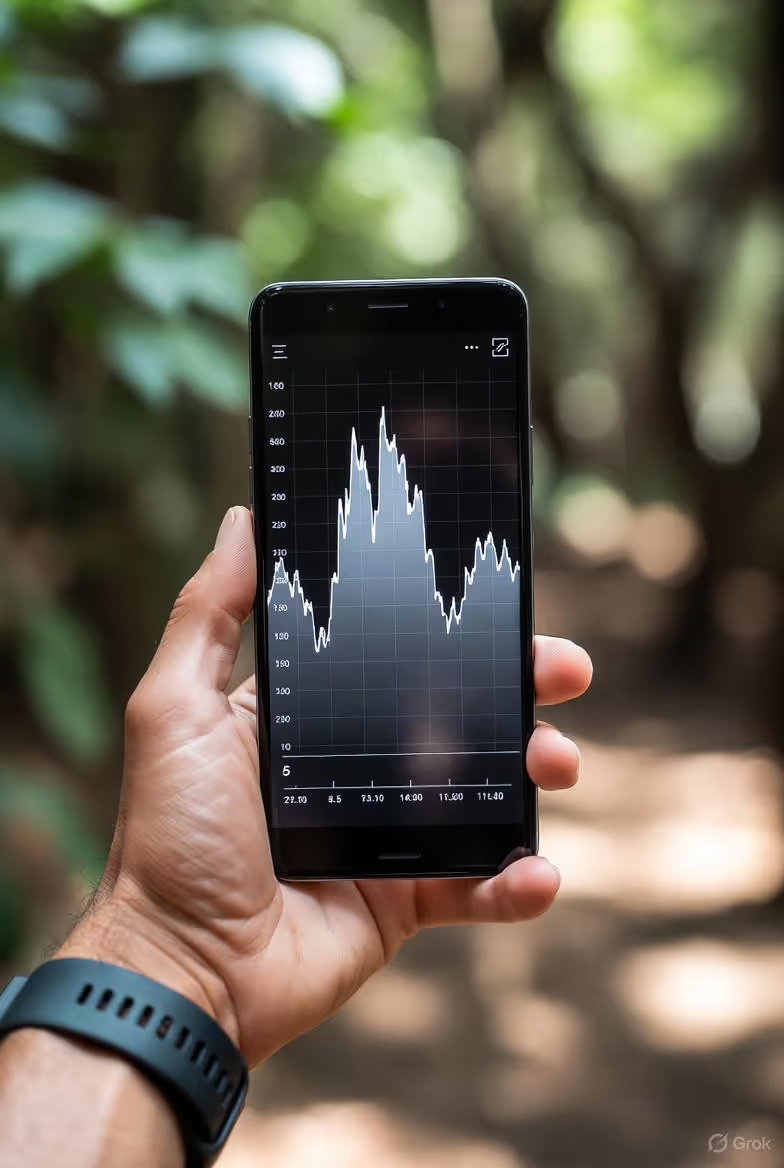
If one biometric could be crowned the most telling indicator of recovery, it would be Heart Rate Variability. While your Sleep Score is the overall grade, HRV is often the star pupil that heavily influences the final mark.
Let's demystify it. Your heart does not beat with the metronomic regularity of a drum machine. The time interval between successive heartbeats varies by milliseconds. This variation is controlled by your autonomic nervous system (ANS)—the unconscious regulator of bodily functions. The ANS has two main branches:
A higher HRV indicates a strong, responsive parasympathetic tone and a resilient nervous system that can easily adapt to stress and then return to a calm state. It means your body has the resources and capacity to recover. A lower HRV suggests your sympathetic system is overworked—your body is under stress (physical, mental, or emotional) and is stuck in a state of heightened alert, leaving fewer resources for repair.
During sleep, you ideally want to see your HRV rise and remain elevated, signaling a deep dive into parasympathetic-driven recovery. Your Sleep Score algorithm interprets this. A night with high HRV will significantly boost your score, as it’s a direct biomarker of effective nervous system recovery.
Why tracking HRV is revolutionary: It provides a quantifiable measure of your internal stress load before it manifests as fatigue, illness, or burnout. A downward trend in your nighttime HRV over several days is a clear, early warning sign from your body to pull back—maybe skip the intense workout, prioritize sleep, or manage stress. It turns subjective feelings of "being run down" into an objective data point you can act upon. This proactive insight is at the heart of what makes a detailed Sleep Score so powerful for modern wellness.
Working in concert with HRV is your Resting Heart Rate—the number of times your heart beats per minute while you are completely at rest, typically during sleep. While HRV measures the variability between beats, RHR measures the average rate itself.
A lower sleeping RHR is generally a sign of good cardiovascular health and efficient heart function. A strong, fit heart can pump more blood with each beat (higher stroke volume), so it doesn’t need to beat as often to supply the body with oxygen. As you fall asleep and descend into deep sleep, your RHR should drop to its lowest point of the 24-hour cycle.
Your Sleep Score monitors this nocturnal dip. A significant, sustained drop in RHR during the night is a positive signal of relaxation and recovery. Conversely, an elevated nighttime RHR can be a red flag. It suggests your body is working harder than it should be while trying to rest. This can be caused by numerous factors that hinder total body recovery:
Therefore, a Sleep Score that accounts for RHR is giving you direct feedback on your cardiovascular system’s workload during its repair cycle. It answers the question: "Was my heart able to truly rest, or was it still on duty?" Tracking this metric over time can reveal the impact of lifestyle changes, training regimens, and stress management techniques. Many users find this data invaluable, as shared in the real customer experiences on our testimonials page.

Imagine a construction project where the foundation crew, the framing team, and the interior finishers all showed up at random times, constantly interrupted, and never completed their phases. The building would be a dysfunctional mess. Your sleep operates on a similar principle of ordered phases. The "architecture" of your sleep—the structure and proportion of Light, Deep, and REM stages—is fundamental to its restorative power.
A healthy adult cycles through these stages roughly every 90 minutes, repeating the sequence 4-6 times per night. However, the composition of each cycle changes as the night progresses.
The Disruption of Fragmentation: The problem isn't just getting some deep and REM sleep; it's getting uninterrupted periods of it. Each time you are awakened by noise, light, discomfort, or a sleep disorder like apnea, your brain must often start a new cycle, potentially backtracking to light sleep before progressing to deep or REM again. This fragmentation means you may never reach the sustained, high-quality periods of the most restorative stages.
Your Sleep Score’s analysis of "time in each stage" and "awakenings" is a direct assessment of your sleep architecture’s integrity. A high score indicates a well-built, sturdy structure with solid "foundations" of deep sleep and ample "finishing work" in REM. A low score often points to a fragmented, unstable architecture that failed to complete the essential phases of the recovery project.
Your Sleep Score is not random. It is a precise reaction to the inputs of your day and evening. Understanding these levers allows you to move from being a passive observer of your score to an active architect of it. The factors influencing your score fall into two categories: external/environmental and internal/behavioral.
External & Environmental Factors:
Internal & Behavioral Factors:
Your Sleep Score is the mirror reflecting these choices. A sudden drop in your score is a diagnostic tool. You can review your day and ask: "Was it the late espresso? The stressful meeting I replayed in bed? The overheated room?" This feedback loop is where wearables provide immense value, turning abstract wellness advice into personalized, cause-and-effect insights. For common questions on optimizing these factors, our FAQ section offers practical guidance.
When your Sleep Score is consistently low, it’s not an isolated nightly event. It initiates a cascade of negative effects that permeate every aspect of your waking life. The poor recovery becomes a liability you carry into your day.
Cognitive & Performance Dominoes:
Physical Health & Metabolic Dominoes:
Emotional & Mental Well-being Dominoes:
In essence, a low Sleep Score is an early indicator that these dominoes are lined up and starting to fall. It’s a signal that your body’s fundamental recovery process is failing, and the deficits are spilling over into your health, work, and relationships. This holistic impact is why we are so passionate about our mission at Oxyzen, which you can read more about on our about page.
The true power of tracking your Sleep Score is realized when you stop viewing it as a daily judgment and start using it as a continuous feedback loop for your lifestyle. It becomes a personal bio-feedback tool, helping you experiment and learn what uniquely works for your biology.
This process turns intuition into data. You might feel like alcohol helps you sleep, but your score may reveal it decimates your REM sleep and lowers your HRV. You might think that late workout energizes you, but the data could show it elevates your nighttime RHR for hours. Conversely, you can confirm positive changes: "My score improved by 15 points after I started using blackout curtains and stopped eating after 8 PM."
The Practice of Correlations: The most advanced users of sleep data don't just look at the score in isolation. They correlate it with other life metrics.
By establishing these personal cause-and-effect relationships, you gain agency. You can make informed, preventative choices: "I have an important presentation tomorrow, so I'll skip the wine tonight to protect my REM sleep and cognitive sharpness." Or, "My HRV has been trending down for three days; I'll swap my intense interval training for a gentle walk or yoga today."
This is the frontier of personalized wellness—using objective data from your body to guide your decisions, optimize your health, and preempt burnout. It’s a journey of self-discovery that extends far beyond the bedroom. For those interested in this holistic approach, we share more resources and stories on our blog dedicated to integrated wellness.

We have journeyed from the simple alarm-clock groan to the complex, beautiful biology of nightly renewal. We’ve seen that your Sleep Score is not a mere digital badge; it is a rich, multi-dimensional reflection of your total body recovery. It synthesizes the silent language of your heart (through HRV and RHR), the structured rhythm of your brain (through sleep stages), and the impact of your daily life into a single, comprehensible insight.
This number, when understood, becomes your Recovery Compass. It points toward the habits that nourish you and away from those that deplete you. It offers an objective ground truth in a world filled with subjective feelings and often-contradictory health advice. In a society that frequently prizes busyness over rest, your Sleep Score stands as a scientifically-grounded advocate for the profound, non-negotiable necessity of recovery.
In the sections that follow, we will build upon this foundational knowledge. We will delve into actionable strategies for improving each component of your score, explore advanced topics like circadian rhythm alignment and sleep environment engineering, and examine how sleep interplays with nutrition, fitness, and mental performance. The goal is to equip you with not just the understanding of your Sleep Score, but the mastery of it—turning data into a better, more recovered, and more vibrant life. This journey of innovation is part of our ongoing story to redefine personal health.
Understanding your Sleep Score is the crucial first step, but knowledge without action is merely trivia. The real transformation begins when you use that nightly feedback to engineer better days and more restorative nights. This journey is personal, experimental, and empowering. It's about moving from being a passive recipient of a score to an active architect of your own recovery.
The cornerstone of this approach is the Correlation Journal—not necessarily a physical notebook, but a mindful practice of connecting your lifestyle inputs to your sleep outputs. For one week, alongside noting your Sleep Score, make brief logs of:
After a week, look for patterns. Does a post-dinner dessert consistently correlate with a dip in your deep sleep? Does a 30-minute afternoon walk seem to boost your next-morning HRV? Does a stressful workday manifest as a higher nighttime resting heart rate? These personal correlations are more valuable than any generic sleep tip, as they are tailored to your unique biology and life.
The Principle of Gradual Experimentation: Armed with these insights, begin to experiment. Introduce one small, positive change at a time and observe its impact on your score over 3-5 nights. This methodical approach prevents overwhelm and clearly shows you what works. For instance, you might decide: "This week, I will stop consuming caffeine after 2 PM." Monitor your sleep latency and overall score. If it improves, the change sticks. If not, you can rule out afternoon caffeine as a primary disruptor for you and test something else.
This data-driven, iterative process transforms sleep optimization from a guessing game into a science. It empowers you to become the expert on your own body, using the objective data from your wearable as your guide. This philosophy of personalized, actionable insight is central to everything we do, which you can learn more about in our company's vision.
Your bedroom should be a sanctuary designed for a single purpose: facilitating deep, restorative sleep. Environmental factors have a profound and direct impact on the metrics that comprise your Sleep Score. Optimizing your sleep cave is one of the most effective, immediate actions you can take.
1. The Darkness Imperative:
Light exposure at night is a primary disruptor of melatonin production and sleep architecture. Even small amounts of ambient light from streetlamps, electronics, or hallway cracks can fragment sleep. To combat this:
2. The Coolness Factor:
The drop in core body temperature is a key sleep signal. A room that's too warm stifles this natural process.
3. The Sound of Silence (or Consistency):
Unexpected noises cause micro-arousals, pulling you into lighter sleep stages without you even remembering waking up.
4. The Sanctuary Mindset:
Reserve your bed for sleep and intimacy only. Working, watching stressful news, or scrolling social media in bed creates a psychological association between your sleep space and alertness/anxiety. This can increase sleep latency as your brain no longer sees the bed as a clear trigger for winding down.
By methodically optimizing these four environmental pillars, you remove external barriers to a high Sleep Score. You create conditions where your body's natural sleep processes can unfold without interference. For more practical tips and user-tested ideas on crafting the perfect sleep environment, our blog is a continually updated resource.
Your body’s transition from the sympathetic-dominant "go" mode of the day to the parasympathetic "grow and recover" mode of the night doesn't happen with a light switch. It requires a gradual dimmer. A consistent, deliberate evening wind-down routine acts as a series of signals to your nervous system, telling it that the workday is over and it's safe to shift into deep recovery. This directly improves sleep latency, increases the likelihood of high HRV, and sets the stage for balanced sleep architecture.
The Digital Sunset: The single most impactful ritual is instituting a strict digital curfew. The blue light emitted by phones, tablets, and computers suppresses melatonin for hours. Aim to power down all screens 60-90 minutes before your target bedtime. This is non-negotiable for serious sleep optimization. If this feels impossible, start with 30 minutes and use device settings to activate the warmest "night shift" mode possible in the evening.
The Ritual of Dim Light: After your digital sunset, engage in activities under warm, dim lighting. Use lamps instead of overhead lights. This supports your natural circadian rhythm by mimicking the setting sun. Consider smart bulbs that can be programmed to automatically dim and shift to warmer hues in the evening.
Mindfulness & The Release of the Day: The anxious, ruminating mind is the enemy of sleep. A wind-down ritual must include a practice to process and release the day's mental chatter.
The Power of Consistency: Perhaps more important than the specific activity is the consistency of the routine itself. Performing the same sequence of calming actions every night—e.g., tea, light reading, brushing teeth, meditation—creates powerful classical conditioning. Your brain begins to associate these steps with the impending state of sleep, making the transition faster and more seamless. This directly translates to a lower sleep latency and a higher initial Sleep Score component. For inspiration from others who have built transformative routines, explore the real-world stories shared by our community.
What you eat and drink, and when you do it, acts as a direct chemical instruction to your body’s recovery systems. Your evening nutrition can either be a powerful sleep aid or a potent disruptor of the very metrics your Sleep Score tracks.
The Culprits: Caffeine and Alcohol Revisited
The Timing and Composition of Your Last Meal:
Sleep-Supportive Nutrients:
Certain nutrients can positively influence sleep physiology:
Hydration: Being dehydrated can raise your resting heart rate and cause cramps or discomfort. However, drinking a large volume of water right before bed guarantees disruptive bathroom trips. The key is consistent hydration throughout the day, tapering off in the last 60-90 minutes before sleep.
By viewing your evening plate and glass as part of your sleep protocol, you make choices that directly support a higher HRV, a lower RHR, and more stable sleep cycles. For more detailed explorations on the science of nutrition and recovery, our wellness blog dives deeper into these topics.
Physical activity is one of the most potent, scientifically-validated promoters of sleep quality and duration. It increases sleep drive (through adenosine buildup), helps regulate circadian rhythms, reduces anxiety, and promotes the physical fatigue that deep sleep loves to repair. However, its impact on your Sleep Score is heavily influenced by timing and intensity.
The Overall Benefit:
Regular exercisers consistently show higher sleep efficiency, more slow-wave (deep) sleep, and better subjective sleep quality. The metabolic and hormonal adaptations from exercise—like improved insulin sensitivity and better temperature regulation—create a body that is more primed for efficient recovery at night.
The Nuance of Timing:
This is where personal correlation via your Sleep Score is essential.
Using Your Data to Find Your Sweet Spot:
Let your Sleep Score and restoration metrics be your guide. After an evening workout, check your data:
You cannot out-sleep chronic stress. Mental and emotional strain is perhaps the most insidious thief of recovery, and it leaves clear fingerprints on your Sleep Score: elevated resting heart rate, suppressed heart rate variability, increased sleep latency, and fragmented sleep. Managing daytime stress is therefore not separate from sleep hygiene—it is a fundamental component of it.
The Stress-Sleep Vicious Cycle: Stress activates the hypothalamic-pituitary-adrenal (HPA) axis, flooding your system with cortisol and adrenaline. This is adaptive in the short term, but chronic activation keeps your sympathetic nervous system on "high alert." At night, this means your body is physiologically resistant to entering the deep, parasympathetic-dominant state required for recovery. The result is poor sleep. Poor sleep, in turn, impairs prefrontal cortex function and elevates amygdala reactivity the next day, making you more emotionally volatile and less capable of managing stress effectively. The cycle reinforces itself.
Breaking the Cycle with Daily Practices:
The goal is to introduce "parasympathetic taps" throughout your day to counteract accumulated stress, making it easier to fully relax at night.
By actively managing stress during the day, you arrive at your evening wind-down with a nervous system that is already closer to a state of equilibrium. You've lowered the "stress debt" that must be repaid during the night. This makes the transition to sleep smoother and allows your body to dedicate more resources to deep, restorative processes rather than just calming down. This holistic approach to wellness is core to our philosophy, which you can explore further in our brand's story.
Even with perfect habits, life inevitably throws curveballs that disrupt sleep. Business travel across time zones, shift work, or even late weekends that differ from your weekday schedule ("social jet lag") can demolish your Sleep Score. The key is not to avoid these disruptions entirely, but to manage them strategically to minimize their impact on your total body recovery.
Conquering Jet Lag with Light Strategy:
Jet lag is primarily a mismatch between your internal circadian clock and the external light-dark cycle. You can use light exposure as your most powerful tool to reset it.
The Shift Worker's Challenge:
For those working nights or rotating shifts, sleep is an uphill battle against biology. The goal is to create consistency in an inconsistent schedule.
Mitigating Social Jet Lag:
The tendency to stay up late and sleep in on weekends creates a mini jet lag every Monday morning. To soften this:
During these disruptive periods, pay extra attention to your Sleep Score's restoration metrics (HRV, RHR). They will tell you how well your body is coping with the strain. You might need to prioritize other recovery tools like exceptional nutrition, hydration, and gentle movement. For specific questions on managing sleep during travel or unusual schedules, our FAQ section has targeted advice.
The ultimate validation of your Sleep Score's meaning comes when you connect it to objective and subjective outcomes in your waking life. This advanced practice creates a closed-loop system: Sleep data informs behavior, and daytime performance data validates (or questions) the sleep data's importance. This turns abstract wellness into a tangible performance optimization strategy.
Physical Performance Correlations:
Cognitive & Emotional Correlations:
The Power of the Dashboard View:
When you view these correlations together—seeing that a night of high HRV and balanced sleep stages predicts a day of peak cognitive performance, emotional balance, and physical vigor—the importance of sleep shifts in your mind. It is no longer just about avoiding tiredness. It becomes the foundational input for your highest-functioning self. This integrated view of data is what modern wellness technology is all about, a principle you can discover more about through Oxyzen's approach.
A single night’s Sleep Score is a snapshot. A month or year of data, however, is a panoramic film revealing the overarching story of your health and resilience. Tracking your score over time moves you from reactive daily management to proactive, strategic health optimization. These long-term trends are where the most profound insights—and warnings—are hidden.
Identifying Your Personal Baselines and Ranges:
The first step is to move beyond the generic "good" or "bad" score. What is a good score for you? By observing your data over several weeks, you’ll establish your personal baseline and natural range. Perhaps your typical HRV sits between 45-65 ms, your resting heart rate between 52-58 BPM, and your Sleep Score averages 78. These are your numbers. This personalization is critical because comparing your HRV of 55 to a friend’s 85 is meaningless; the trend within your own physiology is what matters.
The Three Critical Long-Term Trend Analyses:
Using Trends for Proactive Health Interventions:
This historical data empowers you to be proactive, not reactive.
Your Sleep Score history is a dynamic map of your well-being. It tells you not just where you are, but the direction you’re heading. Learning to read this map is a superpower for lifelong health. For more on interpreting long-term biometric data, our blog offers ongoing analysis and guides.
We’ve explored how physical habits affect sleep, but the highway between the mind and sleep is a two-way superhighway. Your psychological state is perhaps the most powerful dictator of your Sleep Score, particularly the restoration metrics of HRV and sleep latency. Anxiety, depression, chronic worry, and unresolved emotional trauma don’t just keep you awake—they fundamentally alter the quality of your recovery biology.
The Anxiety-Insomnia Feedback Loop:
Anxiety triggers hyperarousal of the sympathetic nervous system, flooding the body with cortisol and adrenaline. This chemical state is the physiological opposite of what’s required for sleep onset and deep recovery. The result? High sleep latency, frequent awakenings, and low HRV. The frustration of not sleeping then fuels more anxiety about sleep itself (“I’ll be a wreck tomorrow if I don’t sleep NOW”), creating a self-perpetuating cycle. Your Sleep Score becomes a numeric reflection of this anxious loop.
Depression and Sleep Architecture:
The relationship between depression and sleep is particularly revealing. While insomnia is a common symptom, depression is also strongly linked to specific alterations in sleep architecture observable in Sleep Score data:
The Grief and Emotional Processing Load:
Acute grief or emotional shock places a massive burden on the nervous system. During such times, it’s common to see Sleep Scores plummet for an extended period. The mind is working overtime to process the loss, and this intense cognitive-emotional labor consumes recovery resources. Seeing a low score during grief can, paradoxically, be validating—it’s objective proof of the heavy internal work being done, giving you permission to prioritize extreme self-care and seek support.
Action Steps for the Mind-Body Pathway:
Understanding this deep connection reframes sleep not as a separate pillar of health, but as the nightly report card on your emotional and psychological well-being. Honoring this link is essential for true holistic recovery, a value embedded in our company's mission and vision.
For millions, poor sleep isn’t a lifestyle issue—it’s a medical one. While a smart ring is not a medical device and cannot diagnose, the anomalies it detects in your Sleep Score can serve as powerful clues that prompt a crucial conversation with a sleep specialist. The patterns are often distinct enough to signal that something beyond poor sleep hygiene is at play.
Obstructive Sleep Apnea (OSA): The Signature Pattern
OSA, characterized by repeated breathing interruptions during sleep, leaves a clear fingerprint on sleep data:
Insomnia: The Profile of Hyperarousal
Chronic insomnia often shows up clearly in the data:
Restless Legs Syndrome (RLS):
RLS can cause an increase in movement and restlessness data, particularly in the first half of the night as you try to fall asleep, impacting sleep latency and initial sleep cycles.
Circadian Rhythm Disorders:
Disorders like Delayed Sleep Phase Syndrome (night owls who can’t sleep until very late) show a persistent mismatch. Your Sleep Score might be excellent—if measured from 4 AM to 12 PM. But when forced to sleep on a socially conventional schedule, the scores are perpetually poor, with long sleep latency and short duration.
The Critical Next Step: From Data to Diagnosis
If you observe persistent, unexplained patterns like these—especially the sawtooth heart rate of potential apnea—it is vital to seek professional evaluation. A sleep study (polysomnography) is the diagnostic tool. Presenting your long-term Sleep Score trends to your doctor can provide compelling evidence for why you’re seeking a referral. Early diagnosis of conditions like sleep apnea is critical, as it is a major risk factor for hypertension, heart disease, and stroke. Your wearable data can be the catalyst that gets you the help you need. For support on this journey and understanding device capabilities, our FAQ addresses common questions on this topic.
Your body’s recovery demands are not static. They evolve dramatically through different decades and life stages. What constitutes an “optimal” Sleep Score and the strategies to achieve it must adapt accordingly. Understanding these shifts allows for self-compassion and smarter, age-appropriate sleep optimization.
The Twenties & Thirties: The Performance & Resilience Era
The Forties & Fifties: The Midlife Recalibration
The Sixties and Beyond: The Quality & Preservation Era
By aligning your expectations and strategies with your life stage, you work with your biology, not against it. This nuanced approach is a hallmark of sophisticated wellness, a topic we explore in various contexts on our blog dedicated to lifelong health.
To trust and effectively use your Sleep Score, a basic understanding of the technology capturing it is invaluable. Modern smart rings and wearables are feats of miniaturized engineering, packing clinical-grade sensor principles into a sleek, consumer-friendly device.
The Core Sensor Suite:
From Raw Data to Your Sleep Score: The Algorithmic Magic
The sensors collect raw signals—light reflectance data and motion data. This is where sophisticated proprietary algorithms come in. They clean the data (removing noise from sudden movements) and synthesize the multiple streams:
Understanding Limitations Builds Trust:
No consumer wearable is 100% accurate for sleep staging compared to a lab polysomnogram (which uses brain wave EEGs). However, for tracking trends in your own data—your HRV direction, your RHR changes, your relative amounts of deep sleep—they are exceptionally reliable and actionable. The goal is not medical diagnosis, but consistent, personalized feedback to guide behavior. This commitment to meaningful, user-centric technology is part of the story behind our product development.
Your Sleep Score reaches its maximum potential when it stops living in isolation and becomes part of a holistic health dashboard. Integrating it with other streams of health and lifestyle data creates a unified picture of your well-being, revealing interdependencies and multipliers you would otherwise miss.
The Synergy of Connected Data:
Creating Your Personal Health Command Center:
The goal is to use platforms (like Apple Health or Google Fit) that act as aggregators, pulling data from your smart ring, your nutrition app, your fitness tracker, and your calendar. In one glance, you might see: *Low Sleep Score (62) -> correlated with high-stress workday on calendar -> followed by poor workout performance logged in fitness app -> and high-sugar food choices logged in nutrition app.*
This integrated view stops you from optimizing in silos. You realize that to improve your sleep, you might need to manage work stress. To improve your workouts, you might need to prioritize sleep. To improve your food choices, you might need to get better sleep to regulate hunger hormones. It’s all connected.
This holistic, ecosystem-based approach is the future of personalized health. By making your Sleep Score a central, talking component of this system, you elevate it from a simple metric to the foundational pillar of your daily operating system for life. For inspiration on how others are building these integrated systems, read the experiences shared in our user testimonials.
Your Trusted Sleep Advocate: Sleep Foundation — https://www.sleepfoundation.org
Discover a digital archive of scholarly articles: NIH — https://www.ncbi.nlm.nih.gov/
39 million citations for biomedical literature :PubMed — https://pubmed.ncbi.nlm.nih.gov/
Experts at Harvard Health Publishing covering a variety of health topics — https://www.health.harvard.edu/blog/
Every life deserves world class care :Cleveland Clinic - https://my.clevelandclinic.org/health
Wearable technology and the future of predictive health monitoring :MIT Technology Review — https://www.technologyreview.com/
Dedicated to the well-being of all people and guided by science :World Health Organization — https://www.who.int/news-room/
Psychological science and knowledge to benefit society and improve lives. :APA — https://www.apa.org/monitor/
Cutting-edge insights on human longevity and peak performance:
Lifespan Research — https://www.lifespan.io/
Global authority on exercise physiology, sports performance, and human recovery:
American College of Sports Medicine — https://www.acsm.org/
Neuroscience-driven guidance for better focus, sleep, and mental clarity:
Stanford Human Performance Lab — https://humanperformance.stanford.edu/
Evidence-based psychology and mind–body wellness resources:
Mayo Clinic — https://www.mayoclinic.org/healthy-lifestyle/
Data-backed research on emotional wellbeing, stress biology, and resilience:
American Institute of Stress — https://www.stress.org/


