


How to Identify Your Natural Sleep Pattern (Chronotype Quiz)
You can identify your natural sleep-wake preference (chronotype) by taking a quiz that assesses when you feel most alert and when you naturally get tired.
You can identify your natural sleep-wake preference (chronotype) by taking a quiz that assesses when you feel most alert and when you naturally get tired.
%402x.svg)
Have you ever wondered why some people spring out of bed at 5 AM with enviable energy while others hit their peak productivity long after sunset? It’s not a matter of discipline or virtue. It’s biology. Deep within your genetic code lies your personal sleep-wake blueprint: your chronotype.
Your chronotype dictates your natural preference for sleep and wake times, governs your daily energy peaks and troughs, and influences everything from your ideal workout window to your most profound creative moments. Fighting against it is like swimming against a relentless current—exhausting and ultimately futile. Aligning with it, however, is the key to unlocking sustained energy, sharper focus, and a profound sense of well-being.
In our modern world of rigid 9-to-5 schedules and constant connectivity, we’re often forced to live in a state of “social jetlag,” where our internal body clock is out of sync with our external demands. The cost? Chronic fatigue, brain fog, compromised immunity, and long-term health risks. But what if you could pinpoint your unique biological rhythm and design a life that flows with it, not against it?
This comprehensive guide is your first step on that transformative journey. We’ll delve into the science of chronotypes, help you identify your own through insightful self-assessment and a detailed quiz, and provide actionable strategies to harmonize your life with your innate rhythm. We’ll also explore how modern technology, like the advanced biometric tracking from Oxyzen.ai, can provide objective, personalized data to move you from guesswork to precision in optimizing your sleep and daily performance.
Stop fighting your nature. It’s time to discover the rhythm you were born to follow and finally live in sync with your true self.
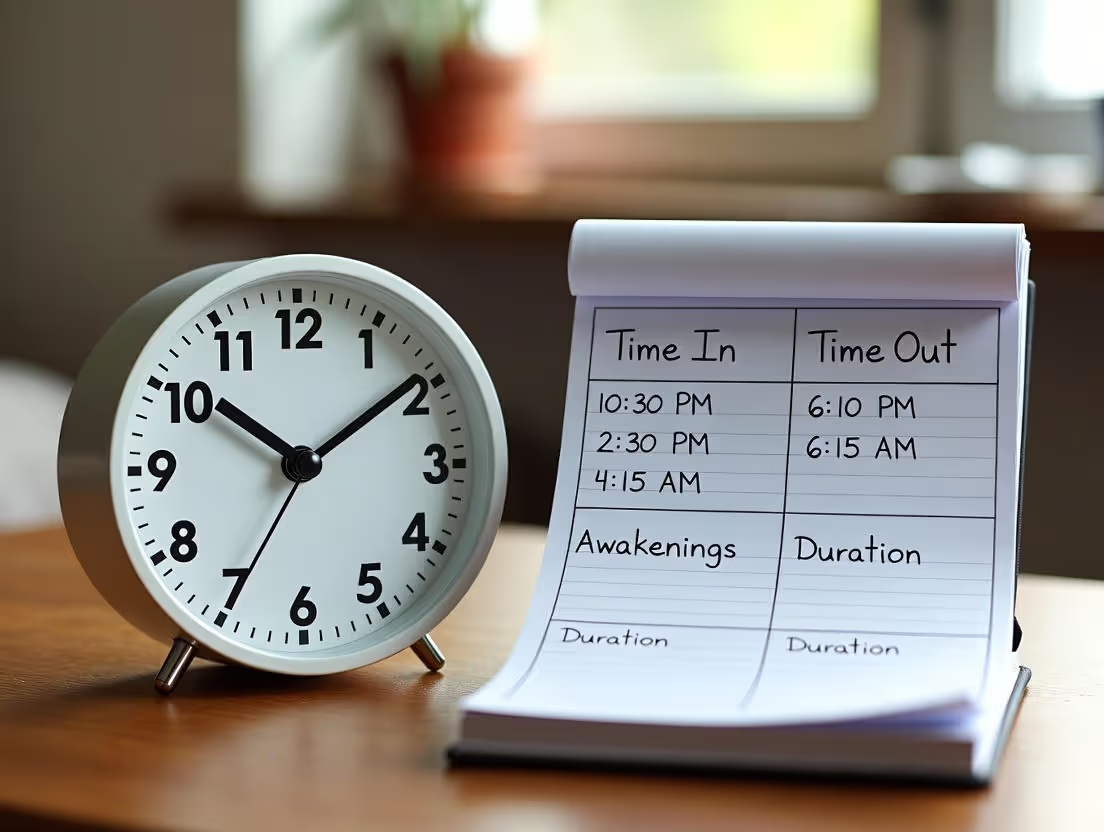
To understand your chronotype, you must first meet the conductor of your body’s entire orchestra: your circadian rhythm. This term, derived from the Latin circa diem (“about a day”), refers to the roughly 24-hour internal clock that regulates not just sleep, but a vast array of physiological processes.
Nestled in the hypothalamus of your brain is a tiny region called the suprachiasmatic nucleus (SCN). This is your master clock. It responds primarily to light cues received through your eyes. When morning light hits your retina, a signal is sent to the SCN, which then instructs your body to suppress melatonin (the sleep hormone) and increase cortisol and other alertness-promoting hormones. As daylight fades, the SCN triggers the pineal gland to release melatonin, gently preparing your body for sleep.
But this rhythm isn’t just about sleep and wakefulness. It’s a pervasive biological program that influences:
Your chronotype is essentially your personal expression of this master clock. It determines where your unique 24-hour cycle shifts relative to clock time. Are your peaks and troughs advanced, delayed, or somewhere in between? The variance in this timing is what creates the spectrum of chronotypes, from the early-rising Lark to the late-night Owl.
Understanding this foundational science is crucial because it moves chronotypes from a personality quirk to a hardwired, biological fact. You can’t permanently change your chronotype through willpower any more than you can change your height. But you can, with knowledge and the right tools, create an environment and schedule that respects it. For a deeper dive into how technology interprets these biological signals, our blog explores the science behind biometric tracking.
While the terms “morning lark” and “night owl” are a good starting point, modern chronobiology reveals a much richer and more nuanced picture. Your chronotype is a multifaceted biological trait influencing your entire day’s architecture.
Think of it as your body’s natural schedule for three key domains:
1. Sleep-Wake Preference: This is the most obvious component. When does your body naturally want to fall asleep and wake up, absent alarms, social obligations, or caffeine? This isn’t about when you do sleep, but when you would sleep in a free, responsibility-less environment.
2. Peak Performance & Alertness: Your cognitive and physical abilities are not constant throughout the day. Your chronotype dictates your “golden hours.” For some, complex analytical work is best tackled before lunch. For others, creativity and flow state only emerge in the evening quiet.
3. The Timing of Physiological Functions: As mentioned, your core temperature minimum, hormone release, and even bowel movements are timed to your internal clock. An Owl eating breakfast at 7 AM may have a digestive system that’s still functionally “asleep,” while a Lark eating dinner at 9 PM might struggle with digestion and sleep quality.
This is why forcing an Owl into a Lark’s schedule is so detrimental. It’s not just about being groggy in the morning; it’s about having your metabolic processes, cognitive sharpness, and hormonal cues misaligned with your behavior all day long—a state scientists call circadian misalignment.
This misalignment has been linked in numerous studies to increased risks for obesity, type 2 diabetes, cardiovascular disease, depression, and even certain cancers. Conversely, living in chronotype alignment is associated with better mental health, healthier weight, improved immune function, and higher life satisfaction.
Your chronotype is your personal operating system. Identifying it isn’t about labeling yourself; it’s about gaining the user manual to run your life—your health, your work, and your happiness—at its optimal capacity. As the team at Oxyzen.ai about-us often notes, the goal of personalized wellness tech is to make this invisible biology visible and actionable.

While scientists often use continuous scales, one of the most accessible and popular frameworks for understanding chronotypes comes from sleep specialist Dr. Michael Breus, who categorized them into four memorable animal archetypes. This model helps translate complex biology into relatable patterns.
Let’s meet the four chronotypes:

Identifying with one of these archetypes provides an immediate, intuitive understanding of your basic rhythm. But to move from archetype to actionable insight, a more personalized assessment is needed.
Ignoring your chronotype isn’t just inconvenient; it’s a legitimate health hazard with cascading effects on every aspect of your life. Let’s break down the critical reasons why this knowledge is essential.
1. Optimized Sleep Quality & Quantity: When you align your sleep schedule with your chronotype, you work with your melatonin curve, not against it. Falling asleep when your body is biologically prepared for it leads to faster sleep onset, deeper, more restorative sleep cycles, and waking up naturally refreshed. This is the cornerstone of all other benefits.
2. Peak Cognitive and Physical Performance: Schedule your most demanding mental tasks during your chronotype’s alertness window, and you’ll work smarter, not harder. Lions should tackle complex projects first thing. Wolves should save deep work for the evening. This alignment leads to better problem-solving, enhanced creativity, and improved memory. Similarly, timing your workouts to your body temperature peak (typically late afternoon for most) can improve performance and reduce injury risk.
3. Metabolic Health and Weight Management: Circadian misalignment disrupts the hormones leptin (satiety) and ghrelin (hunger). An Owl forced onto an early schedule often experiences increased cravings for high-carb, sugary foods in the evening. Their body may also be less efficient at metabolizing a large breakfast. Aligning meal timing with your chronotype can support healthier eating patterns and metabolic function.
4. Emotional Regulation and Mental Health: Living out of sync is a chronic stressor on the body and mind. Studies consistently link evening types on early schedules with higher rates of depression, anxiety, and burnout. Honoring your rhythm reduces this internal conflict, leading to greater emotional stability and resilience.
5. Longevity and Disease Prevention: Chronic circadian disruption is classified as a probable carcinogen by the World Health Organization, due to its link to increased cancer risk in shift workers. It’s also a key player in the development of metabolic syndrome, heart disease, and neurodegenerative disorders. Living in alignment is a profound long-term investment in your healthspan.
In essence, knowing your chronotype allows you to practice circadian hygiene—the art of structuring your daily habits to support, rather than sabotage, your internal clock. It transforms your approach to health from a generic one-size-fits-all model to a truly personalized strategy. For ongoing support and questions on implementing this, our FAQ resource is always available.
The existence of chronotypes isn’t a pop-psychology trend; it’s a deeply rooted evolutionary adaptation with a firm genetic basis. Understanding the “why” behind your type can be incredibly empowering.
The Evolutionary Hypothesis: Anthropologists suggest that variation in sleep-wake timing within a tribal group offered a survival advantage. While the majority (the Bears) slept through the night, the early-rising Lions could stand guard at dawn, and the late-retiring Wolves could keep watch into the deeper night. This “sentinel theory” meant the group was protected for a longer portion of the 24-hour cycle.
The Genetic Blueprint: Your propensity to be a Lion, Bear, Wolf, or Dolphin is heavily influenced by your genes. Specific “clock genes” like PER1, PER2, PER3, CLOCK, and BMAL1 have variants (polymorphisms) that shift the timing of your circadian rhythm. For instance, certain variations in the PER3 gene are associated with morningness, while others are linked to eveningness. This genetic component is why you can’t fundamentally change your chronotype, though you can nudge its expression within a range.
The Age Factor: Chronotype also changes predictably over our lifespan. Children tend to be early risers. With the onset of puberty, there is a dramatic shift towards eveningness, peaking in the late teens and early twenties—explaining the classic struggle of teenagers and early morning classes. This shift then gradually moves back towards morningness as we age, with many older adults returning to an early schedule.
The Role of Light (and Modern Sabotage): While genetics set your baseline, environmental cues, especially light, are the primary “zeitgebers” (time-givers) that entrain your rhythm. Here lies the modern dilemma: our ancestors’ light exposure was dominated by the bright, blue-rich light of the sun during the day and near-total darkness at night. Today, we live in dim, artificial light during the day (in offices) and are bombarded by bright, blue light from screens at night. This constant, chaotic light signaling confuses the SCN, blurring the lines between chronotypes and exacerbating misalignment, particularly for Wolves and Dolphins.
This scientific backdrop underscores a critical point: your sleep struggles are rarely a personal failing. They are often a mismatch between your innate biology and a world not designed for its diversity. The mission behind brands like Oxyzen, as detailed in their founding story, is to bridge this gap by providing personalized, data-driven insights that honor this biological individuality.
Before you take a formal quiz, you can gain powerful insights by simply observing your own natural tendencies. This mindfulness exercise is about stripping away the influence of alarms, coffee, and obligations to listen to your body’s whispers.
For one week, if possible, try to follow these observational guidelines:
1. Track Your Free-Day Sleep: On a morning after a day with no early obligations (like a weekend or vacation), note:
2. Monitor Your Energy & Focus Peaks: At various points in the day, rate your energy and mental clarity on a scale of 1-10. Be honest.
3. Observe Your Eating & Exercise Cravings:
4. Assess Your “Second Wind” Phenomenon: Many evening types experience a sudden surge of energy and alertness just as the rest of the household is winding down. Does this sound familiar?
Common Clues by Archetype:
This self-assessment builds body awareness. It’s the qualitative story that will give context to the quantitative data you’ll gather from the formal quiz and, potentially, from a biometric device. For more techniques on cultivating this kind of mindful self-awareness, explore the resources on our blog.
Based on the established science and animal archetype model, the following quiz will help you pinpoint your dominant chronotype. Answer each question honestly, choosing the response that best reflects your natural inclination in an ideal, obligation-free world.
Instructions: For each question, select the answer that most accurately describes you. Keep a tally of your choices (A, B, C, D).
1. If you had no work, family, or social commitments the next day, what time would you naturally go to sleep?
A) Between 8:30 PM and 10:00 PM
B) Between 10:00 PM and 11:30 PM
C) Between 11:30 PM and 1:00 AM
D) It’s highly variable; I often have trouble falling asleep at a consistent time.
2. Under the same free conditions, what time would you naturally wake up feeling rested?
A) Between 5:00 AM and 6:30 AM
B) Between 6:30 AM and 8:00 AM
C) After 8:30 AM, often closer to 9:30 AM or 10:00 AM
D) Erratic; I might wake up early but not feel rested, or sleep late and still be tired.
3. How do you feel for the first 60 minutes after waking on a typical day?
A) Alert and ready to go. I’m often thinking about my to-do list.
B) A bit groggy, but I can get moving with a little time or a coffee.
C) Groggy, irritable, and mentally foggy. It takes me hours to feel human.
D) Anxious or tired, regardless of how long I slept.
4. When do you feel at your physical and mental peak for demanding work?
A) In the first few hours after waking.
B) Late morning through early afternoon (10 AM - 2 PM).
C) Late afternoon or evening (4 PM - 10 PM).
D) I have a short, sharp peak in late morning, but my energy is inconsistent.
5. You need to prepare for an important exam or presentation. You have a free day to study. When would you schedule your most intense focus sessions?
A) Early morning blocks (7 AM - 12 PM).
B) Morning and early afternoon blocks (9 AM - 3 PM).
C) Afternoon and evening blocks (2 PM - 10 PM).
D) I’d procrastinate and end up cramming in sporadic bursts whenever I could focus.
6. How would you describe your relationship with a standard 8 AM or 9 AM work start time?
A) Ideal. I’m often early and prepared before others arrive.
B) Manageable. It’s fine, though an 8:30 AM start might be nicer.
C) A constant struggle. I’m perpetually tired and playing catch-up.
D) Stressful. Even if I make it on time, my performance is poor until later.
7. When do you typically feel the need for a nap or experience a significant energy dip?
A) Early to mid-afternoon (2 PM - 4 PM). I may power through, but I feel it.
B) Mid-afternoon (3 PM - 5 PM). A short nap would be great if possible.
C) I rarely nap. If I do, it’s very late at night instead of sleeping.
D) My energy is up and down all day. I might feel a dip mid-morning or mid-afternoon.
8. You’re planning a heavy gym session or a long run. When would you feel strongest and most motivated?
A) First thing in the morning, before other obligations.
B) Late morning or around lunchtime.
C) In the evening, after 6 PM.
D) It depends entirely on the day; I have no consistent pattern.
Scoring & Results:
Remember, this is a spectrum. You may be a “Late Bear” or an “Early Wolf.” The archetype is a guide, not a prison. Use it to understand your tendencies. To see how others have used this knowledge to transform their routines, check out some real-world experiences in our testimonials.
Scoring the quiz gives you a label, but the real value lies in the nuances. Let’s dive deeper into what your result means and how to interpret potential overlaps or confusion.
If You Scored a Clear Lion, Bear, Wolf, or Dolphin:
Consider this your foundational operating system. The recommendations in the coming sections will be tailored to this type. A clear result is a gift—it provides a straightforward framework for redesigning your day. For example, a clear Wolf now has biological justification to renegotiate work start times or to structure their day with administrative tasks in the morning and deep work blocks in the evening.
If Your Answers Were Mixed (e.g., Equal A’s and B’s):
You likely fall on the border between two types. The most common is the “Late Lion” or “Early Bear.” This is an advantageous spot, as you can often adapt to standard schedules more easily than a pure Wolf while still benefiting from some early-riser advantages. Look at your most extreme answers. Which questions yielded the definitive A or C? Also, revisit your self-assessment observations. Your natural wake time on free days is the single strongest indicator.
The Impact of Lifestyle & “Social Jetlag”:
If you’ve been forcing yourself into an early schedule for decades as a Wolf, you may have answered questions based on your current adapted state, not your true nature. This is why the “ideal, obligation-free” premise is critical. Ask yourself: “If I won the lottery and had no schedule for a month, what would emerge?” That’s your true chronotype.
Chronotype vs. Sleep Need:
A crucial distinction! Your chronotype is about timing. Your sleep need (typically 7-9 hours for adults) is about duration. A Lion who needs 8 hours will sleep from 9 PM to 5 AM. A Wolf with the same 8-hour need will sleep from 1 AM to 9 AM. Both are healthy if aligned. Don’t confuse an evening chronotype with “needing more sleep”; they just need it at a different time.
When to Suspect a Sleep Disorder:
The Dolphin chronotype shares symptoms with insomnia. If your quiz result is Dolphin and you consistently struggle with falling asleep, staying asleep, or waking unrefreshed despite adequate opportunity, it’s important to consult a healthcare professional or sleep specialist. A tool like the Oxyzen ring can provide valuable objective sleep data to bring to such a consultation, as it tracks sleep stages and disturbances throughout the night. For more on this, our FAQ covers common sleep tracking questions.
Interpreting your results is the first step of acceptance. It’s not about finding an excuse but finding an explanation—a powerful one that allows you to move from frustration to strategy.
While quizzes and self-observation are invaluable, we live in an age where we can move beyond subjective feeling to objective data. This is where modern wellness technology becomes a game-changer. Biometric devices like the Oxyzen smart ring offer a powerful way to validate and refine your chronotype understanding.
How Technology Captures Your Rhythm:
A advanced wellness ring tracks key biomarkers 24/7, including:
The “Free-Sleep” Experiment:
Use your device over a vacation or long weekend where you can sleep and wake without alarms. The data from these nights is pure gold. It shows your body’s uninhibited preference. You may think you’re a Bear, but if the data shows you consistently fall asleep after midnight and get your best sleep after 6 AM, you have strong evidence of a Wolf tendency.
Comparing “Forced” vs. “Free” Days:
The difference between your sleep data on a workday (with an alarm) and a free day quantifies your social jetlag. A three-hour difference is significant and stressful on the body. This metric alone can be a compelling reason to seek schedule adjustments.
Longitudinal Tracking for Confidence:
A single night’s data can be an outlier. Tracking over weeks and months reveals your true, persistent pattern. It also shows you how specific behaviors—like evening screen use, late caffeine, or alcohol—disrupt your rhythm, regardless of your chronotype.
This validation step transforms chronotype from an interesting idea into a data-driven personal fact. It removes doubt and provides the confidence needed to make meaningful, sometimes difficult, changes to your lifestyle. It’s the difference between believing you might be an evening person and knowing you are one, with charts to prove it. This ethos of data-driven clarity is central to the mission behind Oxyzen.
Living opposed to your chronotype creates a state of chronic internal desynchronization. The most pervasive form of this is social jetlag—the mismatch between your biological clock and your social clock (work, school, etc.). If your body clock says it’s 6 AM when your alarm goes off at 7 AM, you’re in a permanent state of jetlag equivalent to living in a time zone one hour east.
The consequences are systemic and severe:
Cognitive & Performance Deficits: Reaction times slow, working memory suffers, and the ability to focus diminishes. This isn’t just about feeling tired; it’s about operating with impaired cognitive function, increasing errors at work and risk while driving. A Wolf taking a critical exam at 8 AM is at a measurable disadvantage compared to a Lion.
Metabolic Disruption & Weight Gain: Shift work, the extreme form of social jetlag, is a well-known risk factor for obesity and diabetes. Evening types on early schedules show similar patterns: they have a higher propensity for evening eating, poorer insulin response to morning meals, and disrupted hunger hormones. The body is primed to store calories at the wrong time.
Compromised Mental Health: The link is strong and consistent. Evening types, particularly adolescents and young adults forced onto early schedules, show significantly higher rates of depression, anxiety, and substance use. The constant struggle against one’s own biology is a profound psychological stressor.
Weakened Immune Function: Circadian rhythms regulate immune cell activity and inflammatory responses. Misalignment leads to a state of chronic, low-grade inflammation and a less effective immune response, making you more susceptible to infections and potentially worsening autoimmune conditions.
The Vicious Cycle for Dolphins: For Dolphins (light sleepers), the anxiety about sleep creates a state of hyper-arousal that further prevents sleep, trapping them in a cycle of fatigue and stress. Ignoring this pattern means never addressing the root cause of their sleep fragmentation.
Long-Term Disease Risk: As highlighted earlier, the World Health Organization has classified circadian disruption as “probably carcinogenic to humans.” Long-term misalignment is associated with increased risks for breast cancer, prostate cancer, colorectal cancer, heart disease, and stroke.
Understanding these risks frames chronotype alignment not as a luxury or productivity hack, but as a critical component of preventative medicine. It’s a non-negotiable pillar of health, as fundamental as nutrition and exercise. By honoring your rhythm, you are directly investing in your long-term well-being. For more resources on building a holistic wellness strategy that includes sleep, our blog is a great place to start.
Now that you have identified and validated your chronotype, the transformative work begins: aligning your daily life with this innate rhythm. This isn’t about a rigid, restrictive regimen, but about creating a flexible, compassionate framework that allows you to flow with your natural energy, not against it.
Think of it as curating your personal environment and schedule to become a sanctuary for your biology. The goal is to minimize social jetlag, optimize your performance windows, and enhance your overall well-being by making strategic choices about light, food, activity, and work. The following sections provide tailored, actionable strategies for each chronotype archetype. Remember, these are guides. Your individual expression may require some blending and personal experimentation.
For Wolves and Dolphins especially, who often struggle the most in a standard world, this alignment can feel revolutionary. It’s a reclaiming of your natural state. As many users have shared in Oxyzen.ai testimonials, having the data to back up their need for a different schedule gave them the confidence and evidence to make meaningful changes in their careers and personal lives.
Let’s explore how each type can design their ideal day.
Lions are the architects of the morning. Their power is front-loaded in the day, and their strategy should focus on capitalizing on this early surge while managing the inevitable afternoon energy decline gracefully.
Ideal Daily Schedule Framework:
Critical Lifestyle Adjustments for Lions:
Potential Pitfalls & Solutions:
Lions thrive on structure and accomplishment. By designing a day that respects their rapid energy expenditure, they can achieve tremendous productivity without burnout. For more on creating structured wellness routines, our blog has several relevant guides.
Bears are the rhythm keepers, most naturally aligned with the solar day and standard societal schedules. Their challenge is not a major misalignment, but optimizing within the 9-to-5 framework to maintain steady energy and avoid the classic afternoon slump.
Ideal Daily Schedule Framework:
Critical Lifestyle Adjustments for Bears:
Potential Pitfalls & Solutions:
Bears have the gift of adaptability, but with intentionality, they can transform from simply “getting by” on the standard schedule to truly thriving within it. For Bears looking to optimize their already good habits, tracking recovery metrics with a device like the Oxyzen ring can provide fine-tuning insights, as discussed in our comprehensive FAQ.
Wolves face the greatest societal mismatch. Their blueprint requires creativity, negotiation, and a steadfast commitment to honoring their delayed rhythm. Success lies in restructuring the day to start later and peak when the world is quieting down.
Ideal Daily Schedule Framework (Flexible/Vision):
Critical Lifestyle Adjustments for Wolves:
Potential Pitfalls & Solutions:
For Wolves, technology that provides objective sleep data is not just helpful; it’s empowering. It turns a subjective feeling into a tangible report, useful for self-advocacy and tracking the impact of interventions like light therapy. The journey of understanding this need for personalization is part of the Oxyzen story.
Dolphins have the most sensitive and irregular rhythm. Their blueprint is less about rigid timing and more about creating the conditions for sleep to occur—reducing hyper-arousal and building a powerful, consistent wind-down ritual to soothe a nervous system that struggles to shut off.
Ideal Daily Schedule Framework (Focus on Ritual):
Critical Lifestyle Adjustments for Dolphins:
Potential Pitfalls & Solutions:
For Dolphins, data is a double-edged sword—it can either fuel anxiety or provide reassuring patterns. The key is to use a tracker like the Oxyzen ring not for nightly scrutiny, but for weekly trend review. Seeing that your deep sleep increased on nights you took a bath, for example, provides positive reinforcement for your rituals. For support in interpreting such data, our FAQ offers guidance.
Your digestive system, enzyme secretion, and metabolic hormones all follow a circadian rhythm. Aligning your food intake with your chronotype can improve energy, body composition, and sleep quality.
General Principles for All Types:
Tailored Nutritional Strategies:
For Lions:
For Bears:
For Wolves:
For Dolphins:
Micronutrients & Chronotype:
The goal is to use food as a synchronizing signal, not just fuel. Eating at times when your body is primed to digest and metabolize efficiently reduces stress on the system and promotes better energy distribution. For more on the intersection of nutrition, timing, and biometric feedback, our blog covers emerging research.
Your chronotype is your ultimate productivity hack. By scheduling tasks according to your innate cognitive rhythms, you can achieve more with less effort and frustration.
The Chronotype-Based Task Matrix:
1. Strategic/Deep Work (High Cognitive Load, Requires Focus):
2. Administrative/Shallow Work (Low Cognitive Load, Routine):
3. Collaborative Work/Meetings (Requires Social Energy):
4. Creative/Ideation Work (Requires Divergent Thinking):
Workplace Negotiation Strategies:
The Home Office Advantage:
If you have flexibility, structure your day around your blueprint. Take breaks aligned with your dips—a walk for a Bear at 3 PM, a nap for a Lion at 2 PM. Your environment should support your type: Lions need bright morning workspaces; Wolves need excellent evening lighting and blackout curtains for sleep.
Ultimately, productivity is not about hours logged; it’s about output during quality hours. Respecting your chronotype is the most effective way to maximize that quality. This principle of personalized optimization is at the core of why tools like those from Oxyzen.ai are developed—to provide the individual insights needed to make these powerful adjustments.
One of the most practical challenges of living by your chronotype is harmonizing it with the people in your life, who likely have different rhythms. This requires communication, compromise, and creativity.
Communication is Key:
Strategies for Mixed-Chronotype Relationships:
Social Events & Friendships:
Family Life, Especially with Kids:
Children have their own evolving chronotypes, often becoming extreme Wolves in the teen years.
Living according to your chronotype within a social world is an exercise in assertiveness and empathy. You assert your biological needs while empathizing with others who have different needs. The result is more authentic, sustainable relationships where no one is chronically exhausted or resentful. It’s a lesson in honoring diversity at the most fundamental, biological level—a value that resonates with the inclusive vision shared in Oxyzen’s story.
In our journey to sync with our natural sleep pattern, technology often wears the villain's hat. The blue glow of screens is Public Enemy Number One for the circadian rhythm. Yet, when harnessed intentionally, technology transforms into our most powerful ally. The key lies in shifting from passive consumption to active, mindful use. This section explores how to turn tech from a circadian disruptor into a precision tool for chronotype harmony.
The Disruptor: How Modern Tech Hijacks Your Rhythm
The mechanism is well-understood: short-wavelength blue light emitted by LEDs, smartphones, tablets, and computers directly suppresses melatonin production by stimulating intrinsically photosensitive retinal ganglion cells (ipRGCs) in the eyes. For a Wolf, evening screen use simply reinforces their natural delay. For a Lion or Bear, it can create a state of "social jetlag," pushing their effective bedtime later while the alarm remains fixed, truncating their sleep. Beyond light, the stimulating content—social media notifications, urgent emails, thrilling shows—activates the sympathetic nervous system, raising cortisol and pushing the body into a state of alertness antithetical to sleep.
The Ally: Tech Designed for Synchronization
This is where intentional technology comes in. We can use tech not to distract or stimulate, but to measure, guide, and protect our biological rhythm.
1. Measurement & Awareness (The Diagnostic Layer):
This is the foundational use of ally-tech. You cannot manage what you do not measure.
2. Guidance & Environmental Control (The Intervention Layer):
Once aware, tech can help you create a circadian-supportive environment.
3. Protection & Boundary Setting (The Behavioral Layer):
Tech can help you enforce the boundaries your chronotype needs.
Creating Your Personalized Tech Protocol:
Technology, when consciously curated, stops being a source of leakage and becomes a scaffold for your chronotype-aligned life. It provides the external structure to support your internal, biological structure. The mission of companies like Oxyzen is to pioneer this ally-tech, a vision you can explore further in their story. By leveraging these tools, you move from being a victim of the digital age to an architect of your own biological harmony.
Even with a perfect chronotype-aligned routine, life happens. Time zone travel, mandatory shift work, caring for a newborn, or periods of high stress can throw your rhythm into disarray. The goal here is not perfection, but resilience and strategic recovery. By understanding the principles of circadian adjustment, you can minimize the damage and return to equilibrium faster.
Strategies for Jet Lag (The Ultimate Chronotype Disruption):
Jet lag is essentially forced, rapid change to your circadian phase. Your strategy should depend on the direction of travel and your chronotype.
The Shift Work Dilemma:
Shift work, especially rotating or night shifts, is a severe and chronic assault on circadian health. If you must work nights, your goal is to create a complete and consistent inversion of your environment.
Life’s Temporary Disruptions (Newborns, Illness, Stress):
During these periods, the goal is damage control, not optimization.
The Recovery Protocol (After a Disruption):
Once the disruptive event is over, don't just jump back to your old schedule.
Life is not a lab. Disruptions are inevitable. The power of knowing your chronotype is that it gives you a "home base" to return to and a set of principles to navigate the storm. For more tactical advice on managing sleep during stressful periods, our blog offers a repository of practical tips.
Once you've established a basic chronotype-aligned lifestyle, the journey shifts from macro-adjustments to micro-optimizations. This is where the marriage of self-knowledge and precise biometric data creates a powerful feedback loop for peak performance and well-being. Advanced optimization is about listening to the subtle daily variations in your body and responding intelligently.
Moving from Archetype to Individual Blueprint:
Your quiz result (Lion, Bear, etc.) is a starting point. Data reveals your unique expression within that type.
Key Metrics for Fine-Tuning:
The Experimentation & Iteration Process:
Use your data to run personal experiments.
Track these changes in a note alongside your biometric data. Over weeks, you'll build a personalized encyclopedia of what works for your specific biology.
Integrating Subjective Feelings: The data is objective, but your feelings are the context. Use a simple daily note: "Felt great today, focused afternoon." Cross-reference that with a high HRV and good sleep scores. Or, "Felt foggy and irritable," and see a low HRV despite 8 hours of sleep—perhaps pointing to an unseen stressor or impending illness.
This advanced stage is where you become the expert on you. Technology provides the numbers, but you provide the narrative. This synergy is the ultimate goal of personalized wellness—a concept central to the vision at Oxyzen.ai. By fine-tuning, you move beyond generic health advice into a truly bespoke life design, where every choice is informed by a deep conversation between you and your body's unique rhythm.
Your Trusted Sleep Advocate: Sleep Foundation — https://www.sleepfoundation.org
Discover a digital archive of scholarly articles: NIH — https://www.ncbi.nlm.nih.gov/
39 million citations for biomedical literature :PubMed — https://pubmed.ncbi.nlm.nih.gov/
Experts at Harvard Health Publishing covering a variety of health topics — https://www.health.harvard.edu/blog/
Every life deserves world class care :Cleveland Clinic - https://my.clevelandclinic.org/health
Wearable technology and the future of predictive health monitoring :MIT Technology Review — https://www.technologyreview.com/
Dedicated to the well-being of all people and guided by science :World Health Organization — https://www.who.int/news-room/
Psychological science and knowledge to benefit society and improve lives. :APA — https://www.apa.org/monitor/
Cutting-edge insights on human longevity and peak performance:
Lifespan Research — https://www.lifespan.io/
Global authority on exercise physiology, sports performance, and human recovery:
American College of Sports Medicine — https://www.acsm.org/
Neuroscience-driven guidance for better focus, sleep, and mental clarity:
Stanford Human Performance Lab — https://humanperformance.stanford.edu/
Evidence-based psychology and mind–body wellness resources:
Mayo Clinic — https://www.mayoclinic.org/healthy-lifestyle/
Data-backed research on emotional wellbeing, stress biology, and resilience:
American Institute of Stress — https://www.stress.org/


