


How to Manage Daily Stress When You Have No Time
When time is limited, focus on the most efficient stress relievers: breathwork and brief mindfulness, which can be done anywhere.
When time is limited, focus on the most efficient stress relievers: breathwork and brief mindfulness, which can be done anywhere.
%402x.svg)
It hits you in the quiet moments. The pause between back-to-back meetings. The red light on your commute. The second your head touches the pillow. A low, humming dread that tomorrow is just today, repeated. Your to-do list is a living organism, mutating faster than you can check items off. Your calendar has no white space, only collisions. You’ve Googled “five-minute meditation,” but who has five uninterrupted minutes? You’re told to “prioritize self-care,” but the irony is you’d need a time machine to find the time to learn how.
This is the paradox of modern stress: it’s most acute for those with the least capacity to address it. Chronic stress is no longer just a feeling; it’s a physiological tax levied on your body 24/7. It rewires your nervous system, clouds your decision-making, steals your sleep, and quietly undermines your health. Yet the traditional prescriptions—long yoga sessions, journaling marathons, weekend getaways—feel like a cruel joke when you’re drowning in the daily.
But what if managing stress isn’t about adding more to your plate, but about instrumentalizing the plate you already have? What if the very minutes and moments you consider “too busy” are your most powerful, untapped resources? This guide is not about creating a parallel, stress-free fantasy life. It’s about engineering resilience into the life you’re already living. It’s about moving from being a passive victim of your schedule to becoming an active architect of your nervous system. We’ll explore how cutting-edge science and smart technology, including discreet tools like the Oxyzen smart ring, can provide the real-time data and micro-interventions you need to reclaim calm without clearing your calendar.
Let’s begin by understanding the enemy. Not as a vague feeling of being overwhelmed, but as a measurable, biological event.

You’re late. The project deadline got moved up. Your phone is buzzing with a family concern. In this moment, you’re not just having a bad day; you’re hosting a sophisticated, ancient biochemical cascade. Your amygdala, the brain’s threat detector, sounds the alarm. In milliseconds, your hypothalamus signals your pituitary gland, which in turn tells your adrenal glands: “Release the hormones.” Cortisol and adrenaline flood your system.
Your heart rate accelerates, pumping blood to your muscles. Your breath shallowens. Digestion halts. Your prefrontal cortex—the seat of rational thought, planning, and emotional regulation—goes offline. This is the sympathetic nervous system in full “fight-or-flight” mode. It’s brilliant for escaping a saber-toothed tiger. It’s catastrophic for drafting a coherent email.
For our ancestors, this state was acute and short-lived. The threat passed, the hormones metabolized, and the body returned to a state of “rest-and-digest” (parasympathetic nervous system dominance). But in the modern world, the “tigers” are perpetual: the pinging Slack message, the mounting bills, the endless news cycle. The stress response becomes chronic, a constant low-grade fever of existence.
The Time-Poor Trap: When you have no margin in your day, this cycle becomes self-reinforcing. The stress impairs your cognitive function, making you less efficient. Inefficiency creates more time pressure, which triggers more stress. You skip lunch to work, causing blood sugar crashes that mimic anxiety. You sacrifice sleep to catch up, depriving your brain of its critical recovery phase, making you more reactive the next day. You exist in a state of chronic sympathetic arousal, where calm isn’t just elusive; it’s physiologically suppressed.
“We are not designed to run perpetually on emergency fuel. The body’s stress response is a high-octane, short-burst system. Running it continuously is like driving a Formula 1 car in city traffic—it leads to breakdowns,” explains a neuroscientist focusing on modern burnout.
The first step to breaking the cycle is measurement. You cannot manage what you do not measure. This is where modern wellness technology transitions from a luxury to a necessity for the busy professional. A device like a smart ring from Oxyzen works silently in the background, quantifying what you can’t always feel: your heart rate variability (HRV)—a key marker of your nervous system balance—your sleep stages, your body temperature trends, and your stress load. It turns the vague sense of “I’m stressed” into a data point: “My nighttime HRV has dropped 30% this week, indicating accumulated strain.” This objective feedback is the foundational break in the cycle. It moves you from being a passenger to being the pilot, with a working instrument panel. For a deeper dive into the science behind these metrics, our blog features several detailed articles on interpreting HRV and sleep data.
Before we can build new habits, we must ruthlessly audit the hidden architecture of our current stress.
Your time is finite. Your cognitive and emotional bandwidth—the mental energy required to process information, make decisions, and regulate emotions—is even more so. We meticulously schedule meetings, but we never schedule our bandwidth. We end each day mystified by our exhaustion, not realizing we’ve been performing continuous, invisible labor.
This “Invisible Load” consists of:
When bandwidth is depleted, your brain’s threat detection becomes hypersensitive. Minor irritants feel like major threats, triggering disproportionate stress responses. This is why you might snap at a colleague after a day of back-to-back decisions, or feel paralyzed by choosing a dinner recipe.
Conducting a Bandwidth Audit: For three days, carry a notepad (digital or physical). Don’t track tasks; track cognitive and emotional events.
The goal is not to judge, but to observe. You will likely discover that your “no time” is actually “no focused attention.” Your day is a series of fragmented mental sprints. The cost of this fragmentation is immense. A study from the University of California, Irvine, found that it takes an average of 23 minutes and 15 seconds to fully regain focus after a single interruption.
The solution lies not in working harder, but in thinking smarter about how you allocate your most precious resource: your focus. This audit is the crucial pre-work for the systems we’ll build next—systems designed to protect your bandwidth as fiercely as you protect your time. Understanding your own patterns is part of our core philosophy at Oxyzen, which you can read more about in our story.

You don’t need an hour-long massage. You need a dozen five-second interventions. The key to managing stress with no time is to embed tiny, potent resets into the existing scaffolding of your day—the spaces between the things. These are Micro-Sanctuaries: deliberate, ultra-brief practices that cue your nervous system to downshift from “fight-or-flight” toward “rest-and-digest.”
The science is clear: even momentary pauses can lower cortisol, improve heart rate variability, and reset cognitive function. The goal is frequency, not duration.
Implementing Micro-Sanctuaries:
The Oxyzen smart ring can be a powerful partner here. You can set it to give a subtle vibration when it detects a sustained period of elevated stress (via heart rate and HRV data). This isn’t a scolding; it’s a biofeedback-informed cue—a nudge from your own body, saying, “Now is a good time for one of your Micro-Sanctuaries.” It transforms the ring from a tracker into an active stress-intervention system. Many users share how this feature created a profound shift in their daily awareness; you can read their experiences in their own words.
These tiny resets are the first line of defense. To build a stronger fortress, we must next examine the fuel that powers—or sabotages—your entire system: your nutrition.
You are a biological system, not just a cognitive one. Your brain, which orchestrates your stress response, consumes about 20% of your body’s energy. It is profoundly sensitive to the fuel you provide. The standard “busy person’s diet”—skipped meals, sugary snacks, caffeine overdoses, and late-night convenience foods—is a recipe for metabolic chaos that mimics and exacerbates psychological stress.
When your blood sugar resembles a rollercoaster, your mood and energy follow. A crash triggers a release of cortisol and adrenaline as your body panics to mobilize energy, creating feelings of anxiety, shakiness, and irritability. This is often mistaken for “being stressed about work,” when it’s actually a direct biochemical event.
The Principles of Stress-Proof Nutrition (No Cooking Required):
This isn’t about a perfect diet. It’s about damage control and strategic fueling. By stabilizing your blood sugar, you remove a major, hidden physiological stressor, freeing up your body’s resources to handle the psychological ones. Your smart ring data can provide fascinating feedback here. Notice how your sleep quality and nighttime resting heart rate change on days you eat earlier, avoid sugar late, or stay hydrated. It turns your body into a biofeedback lab, showing you what “metabolic calm” feels like in hard data. For common questions on how device data correlates with lifestyle, our FAQ page offers clear explanations.
With your body better fueled, we can now address the epicenter of recovery: the sleep you’re probably sacrificing.

In the calculus of a time-poor life, sleep is often the first negotiable item. “I’ll just get by on six hours tonight and catch up later.” This is a catastrophic financial error in the currency of energy and resilience. Sleep is not a passive state; it is an active, intensive maintenance period for your brain and body. Skimping on sleep doesn’t just make you tired; it directly manufactures stress.
The Stress-Sleep Vicious Cycle:
Breaking this cycle is the single highest-leverage action for stress management. You cannot “power through” a sleep deficit. The goal is not necessarily 8 hours every night (though that’s ideal), but sleep quality and consistency.
Tactics for the Time-Poor to Protect Sleep:
Protecting sleep is the ultimate act of strategic selfishness. It is the foundation upon which all other stress-management techniques are built. Without it, you are trying to build a fortress on sand. As we understand more about the human need for recovery, it fuels our mission at Oxyzen, which you can explore more about here.
Now, let’s address the engine of your busy life: your attention, and how to direct it with intention instead of letting it be hijacked.
Your attention is not just focused or unfocused. In the modern workplace, it exists in a state of continuous partial attention—a superficial awareness of multiple channels, waiting for the next “important” thing to react to. This state is profoundly stressful. It keeps your brain in a perpetual state of low-grade alert, mimicking a threat-scanning mode.
The alternative is monotasking or deep work: prolonged periods of focused, uninterrupted concentration on a single cognitively demanding task. This state is not only more productive (producing high-value output), but it is also less stressful for the brain. The challenge is constructing these focus blocks in a world designed to shatter them.
Designing Your Attention Architecture:
The result of this architecture is not just more output, but a greater sense of agency and control—a key antidote to stress. You move from being in a reactive stance (things happen to you) to a creative stance (you make things happen). This sense of control is perhaps the single most important psychological buffer against chronic stress.
As you implement these blocks, you can use your wellness tracker to observe the physiological difference. Compare your average stress load (or HRV) during a day of fragmented reactivity versus a day of structured focus blocks. The data provides undeniable proof that the method is working, not just for your output, but for your nervous system. For more strategies on integrating focus with holistic wellness, our blog is a growing resource.
With your attention under better management, we must now confront a major source of modern anxiety: the digital environment itself.
Your smartphone is not a tool; it is an environment. And for the chronically busy, it’s a hostile one—a slot machine of stressors in your pocket. Every notification is a potential demand, a piece of bad news, or a social comparison. The constant availability it creates erases the boundary between work and life, between urgent and trivial, between self and world.
Managing digital stress isn’t about quitting technology; it’s about engineering humane interfaces with it. It’s about making your devices serve you, not your brain’s craving for dopamine hits that often translate to stress hits.
Actionable Digital Hygiene for the Hyper-Connected:
The goal is to reintroduce friction. The digital world is designed for zero friction—infinite scrolling, one-click buying, instant messaging. By adding small friction points (having to open an app instead of seeing a notification, having to walk to another room to get your phone), you re-engage your prefrontal cortex. You make choice possible, instead of being led by impulse.
This practice of creating boundaries is a direct expression of self-respect. It declares that your attention and your peace are valuable and non-negotiable. It’s a principle that extends beyond technology into every aspect of a purpose-driven life, a value we hold central to our work, as detailed in our company’s journey and vision.
Next, we move from the external environment to the internal narrative: the stories you tell yourself that can either amplify stress or build resilience.
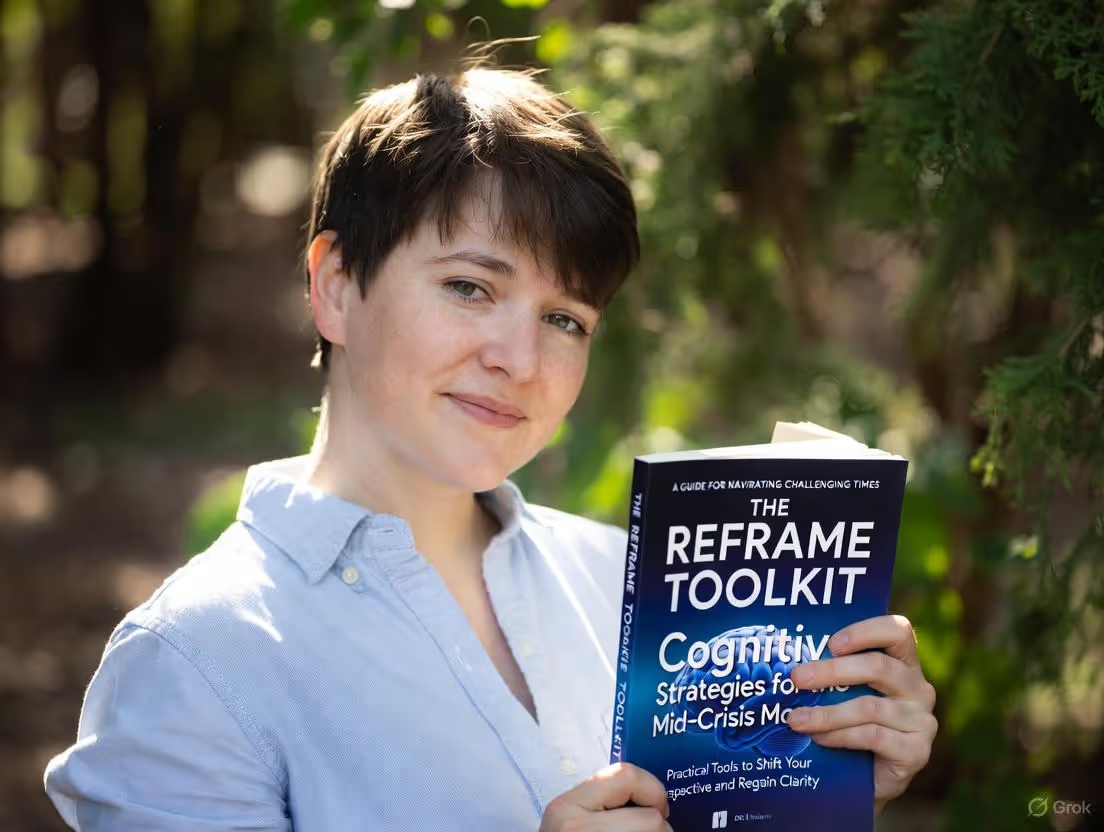
Stress is not just an event; it’s your perception of the event. Two people can face the same tight deadline: one sees it as a threatening impossibility, the other as a challenging but manageable puzzle. The difference is not the deadline; it’s the cognitive appraisal.
When time is short, you don’t have the luxury of lengthy therapy sessions. You need quick, effective mental tools to reframe a stress spiral in real-time. These are not positive thinking clichés. They are evidence-based cognitive behavioral techniques designed to short-circuit catastrophic thinking.
Your On-the-Spot Reframe Toolkit:
These tools are mental Micro-Sanctuaries. They take seconds to deploy but can change the entire trajectory of a stressful hour. The more you practice them in low-stakes moments, the more automatically they’ll appear in high-stakes ones. You are building cognitive calluses.
Pairing this internal work with external data creates a powerful feedback loop. After using a reframing tool, glance at your smart ring’s stress metric or heart rate reading. Did it come down? This biofeedback reinforces the technique, proving to your logical brain that changing your thoughts can literally change your body’s state. It turns psychology into a tangible, measurable skill.
Having equipped you with immediate mental tools, let’s look at a more foundational, physical practice that can systematically train your nervous system for calm.
Breathing is the only autonomic function you can also consciously control. It is the remote control for your nervous system. The way you breathe directly signals your brain about your state of safety or threat. Short, shallow chest breathing = “Danger!” Long, slow, diaphragmatic breathing = “All is well.”
You don’t need to stop and meditate for 20 minutes. You can use specific breathing patterns as precise tools to achieve specific states: to calm panic, to boost energy, to focus.
The Busy Person’s Breathing Toolkit:
Integration: Attach these patterns to your daily anchors. Do 4-7-8 at every red light. Practice box breathing for one minute before opening your inbox. Use the physiological sigh the moment you get into bed.
The beauty of breathwork is its immediacy and invisibility. You can be in a tense meeting, practicing 4-7-8 under the table, and no one will know. Yet you are actively shifting your physiology out of reaction and into response. This is the epitome of managing stress with no time—using the tool you always have with you. To see how others integrate these biohacks with wearable tech, the testimonials from Oxyzen users provide real-world inspiration.
Finally, we arrive at the ultimate stress-management strategy for the perpetually busy: the art of intentional surrender, of finding pockets of effortless being in a world of constant doing.
The final, most counterintuitive strategy is this: to manage stress with no time, you must schedule doing nothing. We call this White Space—blocks of time with zero agenda, zero productivity goal, and zero digital consumption. This is not time for “errands” or “catching up.” It is time for genuine, open-ended disengagement.
For the high-achiever, this feels like heresy. It feels like wasting time. In reality, it is the most productive thing you can do for your long-term resilience and creativity. White Space is where your subconscious mind integrates information, where novel connections are formed, and where your nervous system completes its stress cycles.
Implementing White Space in a Packed Life:
The resistance you feel to this idea is the exact proof you need it. Your identity is tied to doing. White Space challenges you to practice being. It is in these spaces of quiet boredom that your brain’s default mode network activates—the network responsible for self-reflection, contextual thinking, and creative insight. You are not losing time; you are investing in the clarity that will make all your other time more effective.
This principle of balancing effort with recovery, of honoring the need for true rest, is woven into the fabric of our approach at Oxyzen. The technology is designed not to make you optimize yourself into the ground, but to help you find a sustainable, healthier rhythm.
By now, you have a comprehensive toolkit—from biological hacks to digital hygiene to cognitive reframes and philosophical shifts. In the final section of this portion, we’ll address the most common obstacle: how to start when you’re already at capacity.
You’ve read this far, and the overwhelm might be creeping back. “This is a lot. I don’t have time to audit my bandwidth, build focus blocks, do breathing exercises, and schedule white space!” This is the final, critical reframe: You do not have to do everything at once. In fact, trying to will guarantee failure.
The goal is marginal gains—the 1% improvements championed in performance science. If you improve ten different areas of your stress management by just 1%, the cumulative effect is transformative. You start not by adding, but by substituting.
Your 1-Week Compound Start Plan:
At the end of the week, you haven’t revolutionized your life. You’ve made four tiny, sustainable changes. The following week, you keep those four and add one more—perhaps the 4-7-8 breath at red lights. This is the compound effect. Small, consistent actions, stacked over time, create a new default state.
Remember, the objective data from a device like the Oxyzen ring is your ally here. You might not feel dramatically different after one week of 1% shifts, but the data may show a 5% improvement in your sleep score or a 10% increase in your average nightly HRV. This objective proof is the fuel for your motivation. It shows you that the tiny changes are working on a biological level, long before your conscious mind catches up. For any technical questions on getting started with such a device, our support FAQ is a great first stop.
You are not trying to build a separate “wellness life.” You are engineering wellness into your existing life. You are learning to be the calm within your own storm, not by waiting for the storm to pass, but by adjusting your sails in real-time. This is the art of managing daily stress when you have no time: it’s the art of skillful living.
You’ve learned to respond to stress in the moment. Now, let’s explore how to raise your entire stress threshold—to make your default state one of greater calm and recovery. This is the realm of personalized biohacking: using quantified self-data to run experiments on your own biology and discover what uniquely works for you. It transforms wellness from a set of generic tips into a precise, personal science.
Your body constantly broadcasts signals about its state. Heart Rate Variability (HRV) is the North Star metric here. It measures the subtle variations in time between your heartbeats. A higher, less variable HRV generally indicates a more resilient, adaptable nervous system with strong parasympathetic (rest-and-digest) tone. A low or dropping HRV is a clear flag of accumulated stress, poor recovery, or impending illness.
Conducting Your Own N=1 Experiments:
The goal is to move from guessing to knowing. When you see a direct correlation on your Oxyzen dashboard between an early dinner and a higher HRV, that knowledge is more motivating than any generic health article. You become the expert on your own body. For those curious about the deeper technology enabling these insights, you can learn more about how Oxyzen works.
This data-driven self-knowledge empowers you to make micro-adjustments with macro impacts, systematically raising your resilience baseline day by day.
Stress is not experienced in a vacuum. Our social connections are either powerful amplifiers or essential buffers against pressure. For the time-poor, relationships often become transactional or neglected, ironically when we need them most. Building a Stress-Proof Support System isn’t about having a vast network; it’s about cultivating a few high-quality connections that function as psychological airbags.
The wrong social interactions—energy vampires, chronic complainers, or hyper-competitive peers—can drain your bandwidth. The right ones can co-regulate your nervous system. Simply being in the presence of someone you feel safe with can lower your cortisol and increase feelings of safety.
Strategies for the Time-Constrained Social Architect:
Your support system also includes professional and community resources. Sometimes, the most efficient use of time is to delegate a stressor to an expert. This is part of building a smart, external scaffolding for your well-being. If questions arise about how technology can complement this without replacing human connection, our community and support resources often address this balance.
By strategically nurturing your social ecosystem, you build a living, breathing buffer against life’s pressures. Next, we examine the physical container of your life: your environment, and how to shape it into a sanctuary.
Your environment is not a neutral backdrop; it’s an active participant in your nervous system’s state. From lighting to clutter to sound, environmental cues directly trigger stress or calm reflexes, often below the level of conscious awareness. Environmental Engineering is the practice of deliberately shaping your physical spaces to passively support your psychological state, saving you the energy of constant self-regulation.
You can’t control the world, but you can exert profound influence over your immediate domains: your workspace, your home, and your digital interfaces.
The Stress-Reduction Home & Office Edit:
The principle is passive reduction of friction and threat. Every time your environment forces you to search for something, flinch at a noise, or cringe at chaos, it’s making a tiny withdrawal from your stress-resilience bank account. A well-engineered environment makes consistent, small deposits. It works for you silently, 24/7, freeing up your conscious mind for the things that truly require your focus. This philosophy of seamless, supportive design is core to our approach, which you can read more about in our story.
Now, let’s integrate movement—not as another burdensome workout to schedule, but as a seamless, non-negotiable component of a functional day.
The link between physical movement and stress reduction is unequivocal. Exercise boosts endorphins, improves sleep, and enhances self-efficacy. But for the time-poor, “exercise” conjures images of hour-long gym sessions—another impossible demand. The key is to decouple “movement” from “exercise.” Your goal is not athletic performance; it’s nervous system regulation. You need movement snacks throughout the day, not a single movement feast you can’t find time for.
Prolonged sitting is a physiological stressor. It impairs circulation, promotes stiffness, and is correlated with low mood. Breaking up sedentary time is more critical for metabolic and mental health than a single daily workout.
The All-Day Movement Integration Protocol:
Track the effect. After a day of consistent movement snacks, check your wellness data. You’ll likely see a lower average resting heart rate and a less “spiky” stress graph. The movement has literally helped your body process the biochemical byproducts of stress. It’s a direct, measurable intervention.
This approach reframes movement from being another item on your to-do list to being the very medium through which you live your day. It becomes intrinsic, not extrinsic. For more ideas on integrating wellness tracking with an active lifestyle, our blog has plenty of inspiration.
With your body actively engaged, we turn to mastering the ultimate time-stress challenge: the overwhelming tide of tasks and decisions.
Every decision you make, from what to wear to which strategic initiative to prioritize, depletes a finite pool of mental energy. This is decision fatigue. By late afternoon, with this reservoir drained, your willpower wanes, your ability to make sound choices deteriorates, and you become more impulsive and more likely to default to the path of least resistance—which is often the stressful, reactive path.
For the perpetually busy, decision fatigue is a primary stealth stressor. The key to managing it is not better decision-making, but fewer decisions. You must become a master of strategic neglect—automating, eliminating, and delegating choices to preserve your cognitive capital for what truly matters.
Systems to Minimize Decision Load:
By systematically offloading trivial decisions, you protect the mental energy required for the profound, creative, and strategic choices that define your work and life. You combat stress by creating cognitive margin. This strategic mindset is essential for sustainable performance, a topic we explore in various contexts on our company blog.
Having cleared the cognitive clutter, we can focus on a powerful, yet often overlooked, source of resilience: the stories and beliefs that shape our identity.
Beyond immediate thoughts lie deeper narratives—the unconscious stories you tell yourself about who you are, what you’re capable of, and how the world works. These narratives act as filters, shaping your perception of events. A stressful event layered with a disempowering narrative (“I always mess things up under pressure”) becomes catastrophic. The same event viewed through an empowered narrative (“This is a challenge I can learn from”) becomes manageable.
Building Narrative Immunity means identifying and consciously rewriting the stress-inducing stories that run on autopilot in your mind.
Common Stress-Inducing Narratives & Their Antidotes:
How to Practice Narrative Rewriting:
This practice builds psychological flexibility—the ability to adapt your thinking to reality, rather than forcing reality to conform to your rigid, often stressful, stories. It is the mental equivalent of building an immune system. For real-world examples of people shifting their mindset alongside their habits, the stories from our users can be remarkably insightful.
With a more resilient internal narrative, we are prepared for the inevitable setbacks. The final piece is not about preventing stress, but about mastering the art of the comeback.
Resilience isn’t a trait you’re born with; it’s a skill you build through practice. It’s the ability to recover quickly from stress, not avoid it. For the chronically busy, resilience must be built in a daily, time-efficient ritual. Think of it as brushing your teeth for your psychological immune system.
This 10-Minute Resilience Ritual combines several evidence-based practices into a single, potent sequence. Do it at any consistent time—first thing in the morning, during your lunch break, or as part of your wind-down.
The 10-Minute Protocol:
The power of this ritual is in its compounding consistency. It’s not a one-time fix. Done daily, it rewires your brain’s default setting away from threat vigilance and toward grounded agency. It integrates gratitude (past), visualization (future), and breathwork (present) into a holistic resilience-building tool.
You can use your Oxyzen data to observe the long-term effects of this practice. Over weeks and months, you might see a gradual upward trend in your baseline HRV or a reduction in your sleep latency. The ritual becomes a non-negotiable keystone habit that supports every other strategy in this guide. For those wondering how to start such a practice, our FAQ covers common beginner questions.
You now possess a complete, multi-layered framework for managing daily stress when time is your scarcest resource. We’ve moved from understanding the biology of stress to hacking your physiology, from clearing cognitive clutter to rewriting disempowering stories, and from building micro-sanctuaries to establishing a foundational resilience ritual.
This is not a rigid prescription, but a toolkit for self-experimentation. Your journey is unique. Start with one 1% shift. Measure what happens. Iterate. The goal is not a stress-free life—that is an impossibility and, in many ways, an undesirability. Stress is a signal. The goal is to develop the capacity to hear that signal clearly, respond to it skillfully, and recover from it swiftly. It is to build a life where stress is a manageable component of a meaningful journey, not the defining feature of your existence.
The final integration is up to you. You have the science, the strategies, and the potential to become the calm, resilient architect of your days. To continue exploring advanced topics on performance, recovery, and the intersection of technology and well-being, we invite you to explore the full range of articles on our blog. Your journey toward sustainable mastery has just begun.
Even the best systems need maintenance. For the time-poor, a lengthy weekly review is a fantasy. Instead, you need a triage system—a rapid, surgical assessment that identifies leaks in your resilience bucket and patches them before you run dry. This 15-minute weekly ritual, done ideally on a Sunday evening or Monday morning, is your operational command center.
The 15-Minute Weekly Triage Protocol:
This triage transforms you from passive victim of the week to active strategist. It connects your physiological data to your logistical reality, creating a closed feedback loop for continuous improvement. It makes your wellness tangible and actionable. For support on interpreting your data to fuel this triage, our comprehensive FAQ is always available.
With your weekly plan set, let’s address the Everest of modern stress: the overwhelming, endless task list. We need a system that goes beyond prioritization to ruthless, values-driven filtration.
The classic Eisenhower Matrix (Urgent/Important) is a start, but it fails to account for two critical factors for the stressed individual: your personal energy cycles and the compound impact of tasks. A task can be important but drain you for hours, leaving you depleted for higher-impact work. We need an evolved filter.
The Energy-Impact Matrix:
Create a simple 2x2 grid. On the vertical axis is Impact (High/Low: contribution to your core goals). On the horizontal axis is Personal Energy Cost (High/Low: how cognitively or emotionally draining it is for you).
Weekly Application: During your Weekly Triage, quickly slot your major tasks for the week into this matrix. Your goal is to maximize time in Quadrant 1, schedule deliberately for Quadrant 2, contain Quadrant 3, and eradicate Quadrant 4. This framework makes decision-making faster and aligns your effort with your energy, preventing the common burnout scenario of spending all day in Quadrant 4 quicksand.
This strategic approach to work is a cornerstone of building something meaningful without self-destruction, a principle that guided the creation of Oxyzen from the very beginning.
Now, let’s scale these principles from daily tactics to a lifelong philosophy.
The quest for “work-life balance” is often a trap for the ambitious. It implies a perfect, static equilibrium that doesn’t exist in a dynamic life. A more powerful model is Sustainable Performance. Think of an elite endurance athlete. They don’t seek a “balance” between training and rest; they seek a strategic rhythm of intense stress (training) followed by intentional recovery, all in service of a long-term goal. They periodize. Your life and career require the same mindset.
You are not a machine meant for constant, flat-line output. You are a human organism designed for cycles.
Principles of Sustainable Performance:
This paradigm shift liberates you from the guilt of not being “balanced” every single day. It allows for passionate immersion in work and for deep, guilt-free disengagement. The Oxyzen ring becomes an essential tool here, providing an objective measure of your “recovery score” and telling you if your planned recovery is actually working, or if you’re still carrying residual stress. Seeing that data can give you the permission you might not give yourself to truly switch off. Many of our users share how this data-driven permission changed their relationship with rest; you can read about their journeys.
With this philosophical foundation, let’s examine the ultimate test of your system: navigating acute crises.
No system can prevent all storms. A family emergency, a critical project failure, a personal health scare—these events will flood your buffers. This is not the time for subtle micro-habits. You need a clear, pre-programmed crisis protocol to prevent total derailment and make effective decisions under extreme pressure.
The S.T.O.R.M. Protocol:
Having this protocol mentally filed away is like having a fire extinguisher. You hope you never need it, but its presence reduces your background anxiety about potential crises. You know you have a plan.
Having weathered the storm, let’s look at how to cultivate a state that makes you less susceptible to crisis in the first place: the state of flow.
Ironically, one of the most powerful antidotes to stressful strain is a state of intense, enjoyable focus: flow. In flow, time distorts, self-consciousness vanishes, and you perform at your peak with a sense of ease. It’s the opposite of the fragmented, anxious state of chronic stress. You cannot force flow, but you can design conditions that make it vastly more likely.
Designing for Flow:
When you regularly enter flow, you accomplish more in less time and you finish feeling energized, not drained. It is the epitome of sustainable performance. Your stress management system, by protecting your focus and energy, actively creates more opportunities for flow. For more on the science of focus and performance, our blog delves into these topics regularly.
This journey culminates in a shift not just in what you do, but in who you are being. Let’s define that ultimate stance.
After mastering tactics, systems, and philosophies, the final stage is integration. The practices are no longer “things you do to manage stress”; they become expressions of who you are—a person who respects their biology, honors their attention, and directs their energy toward what matters.
This Integrated Self operates from a core of non-negotiable self-respect. It looks like:
In this state, stress management becomes values-in-action. The value of health manifests as protecting sleep. The value of mastery manifests as defending focus time. The value of connection manifests as being fully present during micro-connections. Every choice, from what you eat for lunch to how you handle an interruption, becomes a small vote for the person you want to be.
This is the ultimate goal: a life where you are not constantly battling stress, but are so aligned with your own rhythms and priorities that stress becomes a manageable, integrated part of a vibrant, purposeful existence. This vision of empowered, holistic well-being is what drives our entire mission at Oxyzen, a story you can explore more deeply here.
To solidify this integration, let’s walk through a day in the life of someone living these principles.
6:45 AM - Wake. No alarm blast. The Oxyzen ring’s gentle vibration wakes her in a light sleep phase. She feels rested. She checks the app: Sleep Score 88, HRV trending in her personal “green” zone. Data point: System is primed.
7:00 AM - Micro-Sanctuary & Intention. While the coffee brews, she stands at the window for 90 seconds, practicing the physiological sigh (double inhale, long exhale) three times. She sets her daily intention: “Flow and Presence.”
7:30 AM - Weekly Triage & Priority Matrix. Over coffee, she spends 15 minutes. Data shows a mild stress spike yesterday afternoon. Calendar shows a big client presentation at 3 PM today. Her One-Thing Focus: “Pre-hydrate and use box breathing before the 3 PM presentation.” She slots her tasks into her Energy-Impact Matrix, identifying the presentation prep as High-Impact/High-Energy (Quadrant 2) and schedules it for her peak focus block.
9:00 AM - 11:30 AM - Protected Focus Block. Phone in Do Not Disturb, website blocker on. She wears noise-canceling headphones. She works on the presentation (her Quadrant 2 task). She works in 90-minute sprints. At 10:30, the timer goes off. She takes a true 15-minute break: makes tea, walks outside without her phone.
1:00 PM - Fuel & Connection. She eats her pre-planned protein-anchored lunch (canned salmon salad). During lunch, she calls her sister for a 12-minute catch-up—a micro-connection that fuels emotional recovery.
2:45 PM - Crisis Protocol (Mini). Pre-presentation nerves spike. She feels it. She Stops. At her desk, she puts a hand on her chest. She takes three 4-7-8 breaths. She has already Triaged—her immediate next step is to review her opening notes. She Time-boxes it to 10 minutes. She feels her physiology calm.
3:00 PM - Flow State. The presentation begins. Because she is prepared and has regulated her nerves, she hits the challenge-skill balance. She enters a state of flow, engaged and responsive. The presentation is a success.
5:30 PM - Digital Boundary & White Space. She closes her laptop and enforces her “phone bedtime,” placing it on the charger in the kitchen. For 20 minutes, she sits on the porch with a book—scheduled White Space. This is her non-negotiable disengagement.
9:45 PM - Wind-Down Ritual. A warm shower, followed by 5 minutes of gentle stretching. She takes her magnesium supplement. In bed, she does her 10-Minute Resilience Ritual (Gratitude, Visualization, Breath). The Oxyzen ring tracks her sleep architecture, providing the data for tomorrow’s feedback loop.
This day isn’t perfect or rigid. It’s intentional. Every element is a thread in the tapestry of her Integrated Self.
You have journeyed from understanding the biology of stress to envisioning a life of integrated, purposeful action. This is not a finish line, but a starting point equipped with a sophisticated map and a full toolkit.
Your Final Integration Steps:
The modern world will not slow down. But you can become more resilient, more adaptive, and more purposeful within it. Stress when you have no time is not a life sentence; it is a design problem. And you are now the designer.
You have the knowledge. You have the strategies. You have the permission to build a life that works for you, not against you. The journey toward mastering daily stress is, ultimately, the journey toward mastering yourself. Begin.
For continued support, deeper dives into any of these concepts, and a community focused on sustainable performance, we invite you to make our blog a regular resource. Your story of resilience is the next one waiting to be written.
Your Trusted Sleep Advocate: Sleep Foundation — https://www.sleepfoundation.org
Discover a digital archive of scholarly articles: NIH — https://www.ncbi.nlm.nih.gov/
39 million citations for biomedical literature :PubMed — https://pubmed.ncbi.nlm.nih.gov/
Experts at Harvard Health Publishing covering a variety of health topics — https://www.health.harvard.edu/blog/
Every life deserves world class care :Cleveland Clinic - https://my.clevelandclinic.org/health
Wearable technology and the future of predictive health monitoring :MIT Technology Review — https://www.technologyreview.com/
Dedicated to the well-being of all people and guided by science :World Health Organization — https://www.who.int/news-room/
Psychological science and knowledge to benefit society and improve lives. :APA — https://www.apa.org/monitor/
Cutting-edge insights on human longevity and peak performance:
Lifespan Research — https://www.lifespan.io/
Global authority on exercise physiology, sports performance, and human recovery:
American College of Sports Medicine — https://www.acsm.org/
Neuroscience-driven guidance for better focus, sleep, and mental clarity:
Stanford Human Performance Lab — https://humanperformance.stanford.edu/
Evidence-based psychology and mind–body wellness resources:
Mayo Clinic — https://www.mayoclinic.org/healthy-lifestyle/
Data-backed research on emotional wellbeing, stress biology, and resilience:
American Institute of Stress — https://www.stress.org/


