


How to Manage Emotional Stress in Real-Time (Practical Crisis Tools)
Manage emotional stress in real-time by naming the emotion, using grounding techniques, and postponing intense reactions if needed.
Manage emotional stress in real-time by naming the emotion, using grounding techniques, and postponing intense reactions if needed.
%402x.svg)
The alert chimes. Your heart skips a beat. It’s that email—the one that derails your morning, tightens your chest, and sends your thoughts spiraling. Or maybe it’s a tense conversation, a sudden change in plans, or a wave of worry about an uncertain future. Emotional stress doesn’t wait for a convenient time; it ambushes us in the middle of meetings, during family dinners, and in the quiet moments before sleep.
For decades, stress management has been sold to us as a lifestyle overhaul: meditate for 20 minutes daily, exercise regularly, maintain a perfect diet. But what about in the moment? What about the crisis happening right now, when your breath is shallow, your palms are sweating, and you need to regain composure before your next sentence? The modern world demands a new toolkit—not just for long-term resilience, but for real-time triage.
This is where the convergence of ancient wisdom and cutting-edge technology creates a revolution. We’re no longer guessing about our inner state. Imagine having a personal, objective observer on your finger, tracking the subtle physiological whispers of stress—heart rate variability, skin temperature, sleep patterns—before they become screams. Devices like the advanced smart rings from innovators like Oxyzen are making this a tangible reality, providing real-time biofeedback that empowers us to intervene precisely when it matters most.
This article is your master guide to managing emotional stress as it happens. We will move beyond theory into actionable, practical crisis tools you can use in real-time, supported by an understanding of the science of stress and the emerging tech that illuminates it. We’ll explore how to recognize your unique stress signature, deploy immediate physiological hacks, cognitively reframe crises, and build an environment that supports calm. This is not about eliminating stress—an impossible goal—but about becoming the skilled pilot of your own nervous system, navigating turbulence with grace and emerging stronger on the other side.
Let’s begin.

Before you can manage stress, you must recognize it in its earliest stages. Stress isn't just a feeling; it's a full-bodied, physiological event with a clear evolutionary purpose: survival. When your brain perceives a threat—be it a looming deadline or a sudden financial worry—it triggers the sympathetic nervous system, launching the famous "fight-or-flight" response. This is orchestrated by a cascade of hormones, primarily cortisol and adrenaline.
In real-time, here’s what’s happening:
This system is brilliant for escaping a predator. It’s less helpful for navigating a hostile email. The problem in modern life is that this acute response can become chronic, simmering below the surface and constantly priming the body for alarms that never come. This is where wearables change the game. A device like the Oxyzen smart ring passively monitors key biomarkers like Heart Rate Variability (HRV)—a profound indicator of your nervous system's balance. A dipping HRV can be an early warning sign of accumulating stress, often before your conscious mind acknowledges it. By checking your data on the Oxyzen app, you move from subjective guesswork ("I think I'm stressed") to objective awareness ("My body is showing signs of strain"). This awareness is the critical first step in real-time management. For a deeper dive into the science behind these measurements, the team at Oxyzen has compiled extensive resources on their blog.
Our physiology is ancient, but our stressors are novel and persistent. We face "phycological" threats—financial insecurity, social media comparison, information overload—that trigger the same biological response as a physical attack, but with no physical outlet. This mismatch leaves the stress cycle incomplete; the energy mobilized has nowhere to go, flooding the system and leading to burnout, anxiety, and physical ailments.
Everyone’s stress manifests uniquely. Some people experience "hot" stress (anger, irritation, flushing), while others experience "cold" stress (withdrawal, numbness, fatigue). Some feel it first in their gut, others in their shoulders or as a headache. A crucial real-time tool is to identify your personal "stress signature." The next time you feel overwhelmed, pause for a 10-second scan:
Recognizing this signature is like seeing the first lightning flash of a storm. It gives you the precious seconds needed to deploy your tools before the downpour begins.
You cannot make a withdrawal from an empty bank account. Real-time crisis management is infinitely more effective when you have built up reserves of resilience during non-crisis times. Think of this as training for the marathon of modern life, so when you hit a hill, you have the strength to keep going.
Resilience isn't an innate trait; it's a set of skills and habits that buffer your nervous system. A core component is sleep—the ultimate system reboot. During deep sleep, your brain clears metabolic waste, memories are processed, and stress hormones are regulated. Chronic sleep deprivation is like starting every day with a depleted stress tolerance battery. This is where holistic tracking becomes invaluable. By using a tool like the Oxyzen ring to monitor not just sleep duration, but sleep stages, resting heart rate, and respiratory rate, you get a true picture of your recovery quality. The data can reveal how late meals, evening screen time, or caffeine affect your restorative sleep, allowing you to make informed adjustments. Many users find that this objective feedback is the motivation needed to prioritize sleep hygiene, as seen in the transformative stories shared on the Oxyzen testimonials page.
By investing in these pillars, you raise your baseline. The stressors that once tipped you over become manageable bumps in the road. You create a larger container for your experiences. The mission at the heart of Oxyzen aligns perfectly with this philosophy: to provide the actionable data that empowers these foundational lifestyle investments, turning guesswork into a guided journey toward sustainable wellness.

When stress strikes, the most immediate and powerful lever you have is your breath. Breathing is unique—it’s an automatic function we can also consciously control, making it a direct dial to our nervous system. The right breathing pattern can switch your body from "fight-or-flight" (sympathetic) to "rest-and-digest" (parasympathetic) in under a minute.
Shallow, chest-heavy breathing signals danger to the brain, perpetuating the stress cycle. Deep, diaphragmatic breathing does the opposite. It stimulates the vagus nerve, the main component of the parasympathetic nervous system, triggering a relaxation response that slows the heart, lowers blood pressure, and promotes calm.
Discovered by researchers at Stanford, the physiological sigh is arguably the most efficient real-time de-stressor. It mimics the body’s natural pattern to reset breathing and alleviate stress.
This double-inhale fully reinflates the tiny alveoli (air sacs) in your lungs that can collapse during stress, improving oxygen exchange. The long exhale directly stimulates vagal tone. You can do this silently at your desk, in your car, or even mid-conversation.
Used by Navy SEALs to stay calm under fire, box breathing is excellent for moments when you need to regain cognitive control and focus.
This technique creates a rhythmic, predictable pattern that soothes an anxious amygdala (the brain's alarm center) and brings prefrontal cortex—responsible for rational thought—back online.
Integrating with Tech: This is where biofeedback becomes magical. As you practice these breaths, you can literally watch your body calm down on a device like the Oxyzen ring. Seeing your heart rate drop and your HRV improve in real-time provides immediate positive reinforcement, turning an abstract exercise into a tangible, rewarding skill. It answers the question, "Is this even working?" with clear, physiological data.
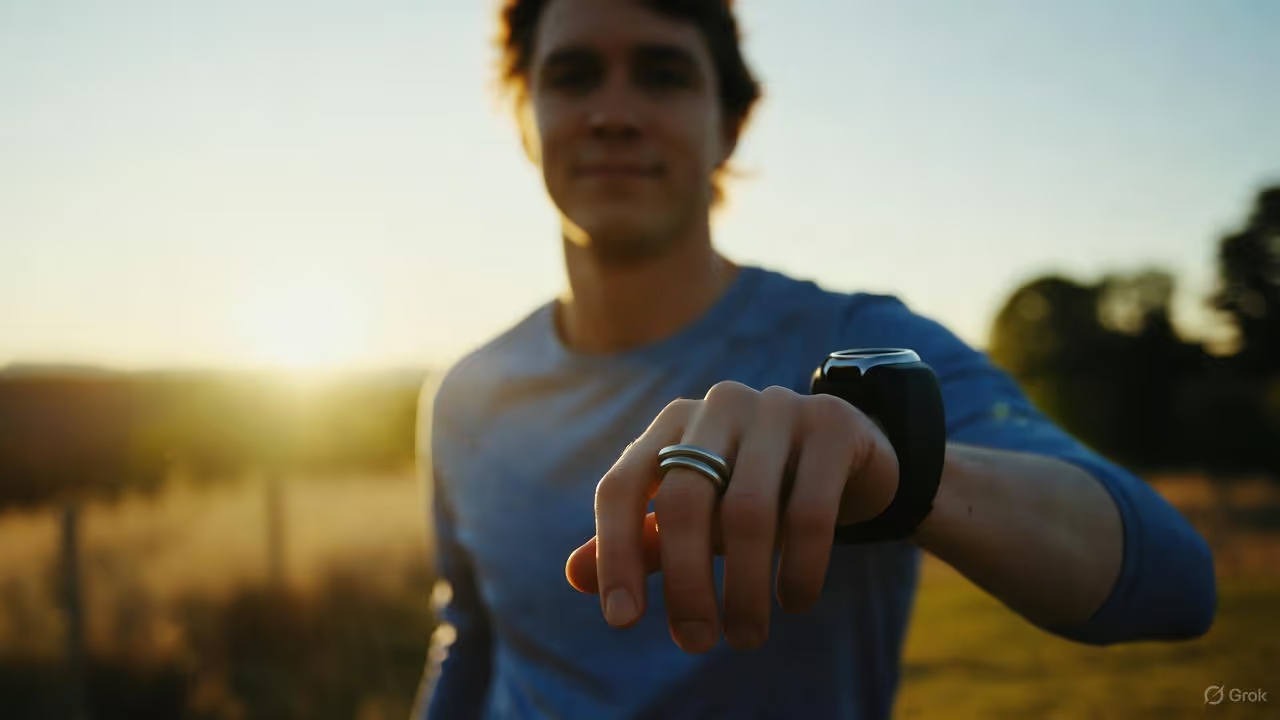
When emotional stress hits, the mind can detach from the present and become trapped in a vortex of catastrophic "what-if" future scenarios or painful past memories. This is called cognitive dissociation. The fastest way to break this cycle is to forcibly reconnect with the present moment through your five senses. Grounding techniques anchor you in the "here and now," using physical reality to override psychological distress.
Grounding works because it engages the brain's sensory processing systems, which are difficult to activate at the same time as the emotional fear centers. It's a neurological interrupt switch.
This is a structured, sequential exercise you can do anywhere.
By the end of this exercise, your attention has been systematically pulled away from internal chaos and into external, neutral sensory input.
Sudden, extreme temperature changes have a profound effect on the nervous system. It's why splashing cold water on your face works.
Keep a small, textured object in your pocket or bag—a smooth stone, a piece of soft fabric, a worry stone, or a "tactile ring." When you feel anxiety rising, discretely focus all your attention on the feeling of that object. Describe it to yourself in detail: "It's smooth, cool, slightly uneven here, heavy for its size." This single-pointed focus is a form of moving meditation that halts the thought spiral.
These tools are emergency stops. They don't solve the underlying problem, but they create the calm, present-minded space from which you can then address it effectively. For more techniques on managing overwhelming thoughts, the curated content on the Oxyzen blog offers a wealth of practical, science-backed strategies.
Once you've used breath and grounding to stabilize your physiology and attention, you can address the cognitive component of stress: your thoughts. Cognitive reframing is the practice of identifying and altering distorted, unhelpful thought patterns in real-time. It's not about positive thinking; it's about accurate and flexible thinking.
In a stress crisis, our thoughts often fall into predictable traps known as "cognitive distortions": catastrophizing ("This mistake will ruin everything"), black-and-white thinking ("I'm a total failure"), or mind-reading ("They all think I'm incompetent"). These thoughts feel like absolute truth, but they are interpretations, not facts.
Combine these two potent mindfulness-based frameworks:
S.T.O.P.
R.A.I.N. (to be used during the "Observe" step)
Language shapes reality. When we're stressed, we often say, "I'm overwhelmed, but I have to get this done." The word "but" negates the first clause, invalidating your experience. Try replacing it with "and."
This simple linguistic shift creates space for multiple truths to coexist. It acknowledges your emotional reality without letting it veto your capabilities. It's a profound practice in self-validation, a cornerstone of emotional resilience that companies like Oxyzen champion in their holistic approach to wellness, as reflected in their core vision & values.
The body and mind are in a constant feedback loop. Just as anxious thoughts can create a hunched posture and shallow breath, deliberately changing your posture and movement can directly alter your emotional state. In a crisis, you may not have time for a workout, but you can use "micro-movements" to discharge stress energy and signal safety to your brain.
Social psychologist Amy Cuddy's research on "power poses" highlights this connection. Adopting expansive, open postures (hands on hips, standing tall, arms open) for just two minutes can decrease cortisol and increase testosterone, leading to increased feelings of confidence and reduced stress.
Stress prepares the body for action. If you don't use that energy, it stagnates, increasing tension and anxiety.
Even your facial expression influences emotion. The simple act of forcing a half-smile—not a fake grin, but a gentle upturn of the lips—can trigger subtle neurochemical shifts associated with calm and safety. It’s a gentle nudge to your nervous system saying, "All is well."
Integrating this with wearable data is powerful. After a short movement break, you can check your device to see the objective impact. Did your heart rate variability improve? Did your stress score decrease? This turns behavioral experiments into a personalized science, helping you learn which specific movements work best for your body in real-time. It’s a key part of the personalized insight that a tool from Oxyzen is designed to provide.
In high-stakes moments, the pressure to respond instantly can be overwhelming. We often believe that immediacy equals competence, but this is a dangerous trap. The most powerful real-time tool you have may be the deliberate decision to not act in real-time. Creating a strategic pause—a deliberate "time out"—prevents reactive damage and creates space for a wise response.
A pause is not passive; it's an active, strategic choice to disengage from the stimulus to regain your center. It's the difference between sending the incendiary email and sleeping on it.
During your pause, employ this mental model from author Suzy Welch. Ask yourself:
This framework instantly expands your temporal perspective, shrinking the apparent size of the immediate crisis and helping you make a decision aligned with your long-term values, not just short-term emotion.
Mastering the strategic pause is a hallmark of emotional maturity. It communicates that you are in control of your reactions. For leaders, parents, or anyone in high-pressure roles, it’s an indispensable tool. It’s a principle that aligns with thoughtful, human-centric design—the kind of philosophy that drives companies focused on sustainable well-being, like the team behind Oxyzen, whose journey you can explore in their our story section.
The sound of your own voice—both internal and external—is a potent yet often overlooked real-time stress modulator. Under stress, our vocal cords tighten, raising pitch and speeding up speech. This creates a feedback loop: the sound of our own strained voice signals "danger" back to the brain, escalating anxiety. Conversely, consciously slowing and lowering your voice can induce calm for both you and those around you.
In a stressful interaction, your vocal tone can de-escalate the entire system.
The chatter in your head during a crisis is crucial. Stress often activates a harsh, critical inner critic. Real-time management involves changing your relationship with that voice.
This internal work is where long-term tracking can reveal profound insights. By correlating periods of high self-criticism with dips in your physiological markers like sleep quality or HRV on your wellness dashboard, you get undeniable proof of the mind-body connection. It reinforces why changing your internal dialogue isn't just "positive thinking"—it's a physiological necessity. For those curious about how technology can support this level of self-awareness, the FAQ at Oxyzen provides clear answers on how data translates to personal insight.
Preparedness is paramount. You don't want to be searching for stress tools in the middle of a crisis. A "Stress First-Aid Kit" is a curated collection of physical, digital, and mental resources you assemble in advance, ensuring the right tool is always at hand. It’s personalized, portable, and immediately actionable.
Keep a small pouch (or even a dedicated notes app folder) with:
This is the most critical part. Using implementation intentions, create specific plans for your most common stress triggers.
By pre-deciding your response, you conserve precious willpower and cognitive resources in the moment. The action becomes automatic. Building this kind of intentional, prepared approach to wellness is at the core of what modern health technology enables, a principle deeply understood by the experts at Oxyzen.
When external circumstances are volatile, internal structure becomes your sanctuary. Routines and rituals are not about rigid control; they are about creating islands of predictability in a sea of uncertainty. In a stress crisis, falling back on a simple, familiar sequence of actions can provide a profound sense of agency and calm. It tells your brain, "Even if I can't control that, I can control this."
A ritual differs from a routine in its intentionality and meaning. A routine is brushing your teeth; a ritual is brewing your morning tea with focused attention on the sound of the kettle, the scent of the leaves, and the warmth of the cup. In a moment of stress, a 2-minute ritual can serve as a powerful "pattern interrupt" and a transitional bridge back to stability.
These are tiny, deliberate actions you can insert into any stressful moment to re-center.
Identify one simple, healthy activity that you do every single day, no matter what—even for just five minutes. This becomes your touchstone. It could be:
On a catastrophic day, completing this one small anchor activity provides a victory. It reinforces the identity of someone who keeps promises to themselves, which is a core component of resilience. The data from a wellness tracker can support this by showing you the tangible benefits of consistency—like how your resting heart rate is lower on days you complete your anchor ritual. Seeing this connection, as many users report in their testimonials, transforms the ritual from a "should-do" to a "want-to-do."
Humans are wired for connection; our nervous systems are designed to co-regulate—to calm each other through presence, voice, and touch. In a moment of intense stress, reaching out is not a sign of weakness; it's a biologically savvy strategy. However, the key is to connect strategically. Not every conversation is calming; venting to the wrong person can amplify stress.
If you're alone or can't reach out, you can still tap into the power of connection in other ways.
Connection is a fundamental pillar of wellness, a truth that resonates deeply with teams building human-centric technology. Understanding that data is not an end in itself, but a tool to foster better self-connection and, by extension, better connection with others, is a principle embedded in the philosophy behind Oxyzen's approach.
Your environment is not just a backdrop to your stress; it's an active participant. Clutter, noise, poor lighting, and digital overload can constantly stimulate your nervous system at a low level, depleting your reserves for acute stressors. Real-time stress management often involves a quick environmental intervention.
When feeling overwhelmed, immediately change your sensory input.
Digital stressors are constant and insidious. Real-time management requires ruthless triage.
Your environment includes what's on your body. A wellness wearable like the Oxyzen ring is a passive, positive environmental cue. Unlike a phone that buzzes with demands, it quietly gathers data for you. It’s a piece of your environment dedicated to self-awareness, not external stimulation. Checking it becomes a mindful moment of checking in, rather than the frantic checking out that characterizes most of our digital interactions. For more ideas on creating a low-stress digital and physical ecosystem, the Oxyzen blog offers ongoing insights and tips.
Real-time management doesn't end when the acute stress passes. The final, crucial tool is the Post-Crisis Review. This is a short, structured reflection done within a few hours of the stressful event, once you are calm. Its purpose is not to relive the stress, but to learn from it, integrating the experience into your growing body of wisdom. This turns a crisis from a mere setback into a data point for your personal growth algorithm.
Without this step, we often just "get over" stress and move on, missing the opportunity to understand our triggers and refine our tools. With it, we build resilience iteratively.
Ask yourself these three questions:
This is where quantified self-knowledge becomes extraordinary. If you use a device like the Oxyzen ring, you can review the physiological story of the event.
This data removes guesswork and emotional storytelling. You might feel like you "fell apart," but the data might show a sharp 10-minute stress spike followed by a quick recovery—evidence of effective real-time management! Conversely, you might feel "fine," but see a depressed HRV for hours, indicating your body is still carrying the burden. This feedback loop is invaluable for honest assessment and motivation.
This practice of mindful review and integration is the essence of sustainable wellness. It aligns with the core mission of providing not just data, but actionable insight—a journey you can learn more about through Oxyzen's story and their comprehensive FAQ.
We stand at a unique point in human history. For millennia, we've had to rely on subjective feeling and hindsight to understand our inner states. Now, for the first time, we have the ability to get an objective, real-time window into our physiology. This isn't about replacing intuition but informing it. It's the marriage of ancient practices—breathwork, mindfulness, connection—with modern, personalized biofeedback.
A smart ring like Oxyzen's represents this synergy. It’s not a magic cure for stress. It is, however, a powerful compass. It doesn't tell you where to go, but it shows you your true north—your baseline of calm—and alerts you when you've begun to drift, often before you consciously feel lost. It turns abstract concepts like "self-care" and "listening to your body" into concrete, actionable insights.
By combining all the tools explored—from breath resets and grounding to cognitive reframing, strategic pauses, and post-crisis reviews—you move from having a scattered toolbox to possessing a coordinated protocol. With the added layer of physiological data, this protocol becomes personalized and adaptive.
Your protocol might look like this:
This is the art and science of modern emotional resilience. It is proactive, not reactive. It is empowered, not victimized. It acknowledges stress as a part of life but refuses to let it be the director of your life.
The journey to mastering real-time emotional stress is just that—a journey. It requires practice, patience, and often, a little guidance. Whether that guidance comes from a trusted mentor, a insightful article on a wellness blog, or a piece of technology that helps you see yourself more clearly, the goal is the same: to live with more agency, calm, and presence, no matter what storms arise.
Stress rarely exists in a vacuum. More often than not, our most acute emotional crises are triggered by, or play out within, our relationships—a heated argument with a partner, a tense negotiation with a colleague, a frustrating interaction with a child. Real-time stress management must, therefore, include tools for navigating the volatile space between people. This is the art of staying regulated while someone else is dysregulated, a skill known as staying "in your own window of tolerance."
When someone else's stress activates our own, we face a critical choice: to escalate (match their energy, leading to conflict), withdraw (shut down, leading to disconnection), or co-regulate (remain grounded to help bring the system back to calm). The latter is the goal, and it requires intentional practice.
You must secure your own mask before assisting others. In a stressful interaction, your first duty is to your own nervous system.
Specific linguistic tools can defuse tension instantly.
Mastering interpersonal stress dynamics transforms relationships from being sources of anxiety into sources of support. It’s a challenging but rewarding application of all your personal tools, and one that benefits greatly from the self-awareness that consistent biofeedback can provide. Understanding your own triggers through data—like seeing your stress score spike during certain types of conflicts—allows you to prepare and respond more skillfully. For more on building resilient relationships through self-awareness, the resources at Oxyzen's blog offer valuable perspectives.
While long-term diet is a pillar of resilience, specific nutritional and hydration choices can serve as acute, real-time stress modulators. The brain and gut are in constant communication via the gut-brain axis. What you consume in a crisis can either pour fuel on the fire or help dampen the flames.
If you have 5 minutes, turn a snack into a powerful grounding exercise. Use the RAIN of Eating:
This transforms a mindless stress-eating moment into a deliberate act of self-care. Tracking your nutrition alongside your physiological data can reveal powerful personal insights. You might notice, for instance, that on days you skip breakfast, your afternoon stress reactivity is higher. This objective feedback, visible on a platform like Oxyzen's, makes the connection between fuel and feel undeniable, moving nutrition from abstract advice to personal truth.
The most elegant real-time stress tool is to prevent unnecessary stress from igniting in the first place. This goes beyond a quick space reset (Tool 10) to the strategic design of your daily routines, digital spaces, and physical environments to minimize friction and decision fatigue. Think of it as building a life with guardrails.
Conduct a weekly review of what consistently causes small, annoying stresses—the "pebbles in your shoe."
Chronic stress often comes from living without margins. Build buffers into your day to absorb the unexpected shock without breaking your system.
By engineering a lower-friction life, you preserve your cognitive and emotional resources for the unavoidable, meaningful stresses. This proactive design mindset is reflected in the best wellness technology—it should integrate seamlessly, provide insight without intrusion, and ultimately, create more space for calm. It's a design philosophy that guides companies like Oxyzen, whose entire story is built around creating elegant solutions for modern well-being.
It is crucial to acknowledge that while real-time tools are powerful for managing the symptoms of stress in acute moments, they are not a substitute for addressing underlying causes. If you find yourself in a constant state of crisis management, if the tools stop working, or if your stress is rooted in trauma, chronic illness, or clinical anxiety/depression, it is time to seek deeper support. This is not a failure of your toolkit; it is wisdom.
Think of support as having multiple tiers:
Using a wellness device can provide compelling, objective data to take to a professional. Being able to say, "My sleep data shows I'm getting 2 hours of deep sleep but my heart rate is still elevated all night," gives a clinician a concrete starting point. It moves the conversation from "I feel bad" to "Here's what my body is doing." For those exploring how technology can complement therapeutic journeys, the Oxyzen FAQ addresses common questions about data privacy and clinical integration.
Real-time crisis tools are the tactical maneuvers in the broader campaign of building emotional agility—the ability to be with your emotions with curiosity, compassion, and then to choose values-aligned actions. Over time, the consistent practice of these micro-interventions creates a compound effect. You are not just stopping stress; you are rewiring your brain's default pathways.
Each time you use a breath reset instead of spiraling, you strengthen the neural pathway for that calm response. Each time you pause before reacting, you thicken the prefrontal cortex's connection to the amygdala. This is neuroplasticity in action. The tools feel clumsy at first, but with repetition, they become automatic—your new, healthier default.
With sustained practice, you may notice a profound shift:
This journey is deeply personal. Seeing your progress quantified—watching your average daily stress score trend downward, or your nightly HRV trend upward over months—provires unparalleled motivation. It's the difference between hoping you're getting better and knowing you are. This visible proof of growth is one of the most powerful rewards reported by users who share their testimonials.
We have traversed from understanding the biology of stress to deploying immediate tools, managing interpersonal dynamics, and designing a resilient life. Let's now synthesize this into a single, flowing protocol you can adapt. This is your master algorithm for emotional stress.
Phase 1: NOTICE (The 10-Second Scan)
Phase 2: ANCHOR (Immediate Physiological Intervention)
Phase 3: REFRAME (Cognitive & Linguistic Shift)
Phase 4: ACT or PAUSE (Strategic Choice)
Phase 5: INTEGRATE (Post-Crisis)
This protocol is not a rigid checklist but a flexible flow. Some crises may only need Phase 1 and 2. Others will require the full sequence. The goal is to have the components at the ready, so you can mix and match as needed. To explore how others are building and adapting their personal protocols, the community insights on the Oxyzen blog can be a rich source of inspiration.
Managing emotional stress in real-time is the practice of becoming the author of your experience, not just the character buffeted by the plot. It is the ultimate form of self-efficacy. It acknowledges that while we cannot control the waves of life, we can learn to surf them with increasing skill.
The tools outlined here—from the biological hack of the physiological sigh to the cognitive mastery of reframing, and from the environmental design of friction audits to the wisdom of seeking support—are your surfboard. Technology like advanced smart rings serves as your weather report and wave analysis, giving you the data to understand the ocean of your own physiology.
This is not about achieving a state of perpetual zen. It is about building robustness—the capacity to withstand disruption—and antifragility—the capacity to grow stronger from it. Each time you successfully navigate a stressful moment, you are not just surviving; you are accumulating wisdom and resilience that compounds over a lifetime.
The journey begins with a single, conscious breath. It deepens with every mindful pause. It is supported by the communities we build and the tools we choose. As you move forward, remember that the goal is not to eliminate stress, but to develop a relationship with it where you are in dialogue, not in chains. Where you can say, "I feel you, stress. I hear the message. Now, I'll choose my response."
To continue exploring the frontiers of personalized well-being and the technology that empowers it, we invite you to learn more about the holistic approach at the heart of Oxyzen.
What if the very sensation we label as “stress” or “crisis” is not merely a problem to be eliminated, but a sophisticated, albeit uncomfortable, communication from our deepest self? This paradigm shift—from seeing stress as an enemy to viewing it as a messenger—fundamentally changes how we engage with it in real-time. Instead of a reflex to suppress or escape the feeling, we can learn to pause and ask, “What is this trying to tell me?”
Stress often signals a violation of a boundary, a mismatch between our values and our actions, or a need that is going unmet. The tight chest before a meeting might not just be “anxiety”; it might be your integrity signaling that you’re about to agree to something you don’t believe in. The simmering irritation at a family member might be a signal that your need for respect or autonomy is being trampled. Learning to decode these signals in the moment transforms stress from a chaotic noise into valuable data for living a more aligned life.
When you feel the acute rise of stress, after deploying your initial calming tool, ask this rapid series of questions:
Once you’ve identified the signal, you can choose a response that addresses the root cause, not just the symptom.
This reframe empowers you. The stress crisis becomes a pivotal moment of self-discovery and course-correction. It aligns with the core philosophy of using data not for self-judgment, but for self-understanding—a principle that guides the development of insightful tools at companies like Oxyzen, whose mission you can explore in their about us section.
When stress becomes chronic or traumatic, it doesn’t just live in the mind; it gets stored in the body as tension, pain, or numbness. Cognitive tools alone may not reach it. Somatic Tracking is an advanced, body-based mindfulness practice for processing stress in real-time. It involves observing bodily sensations with neutral curiosity, allowing them to complete their natural cycle without being suppressed or exaggerated.
Developed from therapies like Somatic Experiencing, this practice is based on the idea that animals in the wild naturally discharge stress energy through shaking, running, or deep breaths. Humans often interrupt this cycle, leaving the energy trapped.
Why This Works: It teaches your nervous system that the sensation of stress is not an endless threat, but a wave of energy that can be experienced and released. It builds tolerance for intense emotion without dissociation or panic. Pairing this practice with a heart rate tracker can be profound. You can literally watch your heart rate settle as you track and release a somatic sensation, providing powerful biofeedback that the process is working. For individuals on a deep healing journey, reading about others’ experiences with integrating body and data can be encouraging, as shared in some user testimonials.
A master carpenter doesn’t use a hammer for every job. Similarly, emotional stress mastery requires contextual intelligence—the discernment to know which tool to deploy based on the specific situation, your personal state, and the constraints you’re under. Using a power pose in the middle of a funeral would be inappropriate; using a silent, compassionate self-talk would be skillful. This is the art that evolves from practicing the science.
Developing this intelligence is a lifelong practice. It’s where the data from a consistent wearable becomes a coach. By reviewing your daily and weekly reports on a platform like Oxyzen’s, you can start to see patterns: “My stress spikes every Tuesday afternoon in long meetings,” or “My recovery is poor on days I don’t take a lunch walk.” This allows you to proactively select the right tool before the predictable stressor hits, moving from reactive crisis management to predictive stress mastery. For more on pattern recognition and personal data, the Oxyzen blog offers ongoing analysis and tips.
Your Trusted Sleep Advocate: Sleep Foundation — https://www.sleepfoundation.org
Discover a digital archive of scholarly articles: NIH — https://www.ncbi.nlm.nih.gov/
39 million citations for biomedical literature :PubMed — https://pubmed.ncbi.nlm.nih.gov/
Experts at Harvard Health Publishing covering a variety of health topics — https://www.health.harvard.edu/blog/
Every life deserves world class care :Cleveland Clinic - https://my.clevelandclinic.org/health
Wearable technology and the future of predictive health monitoring :MIT Technology Review — https://www.technologyreview.com/
Dedicated to the well-being of all people and guided by science :World Health Organization — https://www.who.int/news-room/
Psychological science and knowledge to benefit society and improve lives. :APA — https://www.apa.org/monitor/
Cutting-edge insights on human longevity and peak performance:
Lifespan Research — https://www.lifespan.io/
Global authority on exercise physiology, sports performance, and human recovery:
American College of Sports Medicine — https://www.acsm.org/
Neuroscience-driven guidance for better focus, sleep, and mental clarity:
Stanford Human Performance Lab — https://humanperformance.stanford.edu/
Evidence-based psychology and mind–body wellness resources:
Mayo Clinic — https://www.mayoclinic.org/healthy-lifestyle/
Data-backed research on emotional wellbeing, stress biology, and resilience:
American Institute of Stress — https://www.stress.org/


