


How to Manage Multiple Stressors Simultaneously (The Priority Matrix)
Use a priority matrix to categorize stressors by urgency/importance, allowing you to address multiple pressures systematically without overwhelm.
Use a priority matrix to categorize stressors by urgency/importance, allowing you to address multiple pressures systematically without overwhelm.
%402x.svg)
You’re sitting at your desk, or maybe on your couch, phone in hand. A notification pings—a work email marked “URGENT.” Your smartwatch vibrates almost simultaneously, reminding you your heart rate is elevated. You glance at the news headline on your screen, feel a pang of anxiety about the world, and then remember the unanswered text from a friend, the unpaid bill on the counter, and the low-grade guilt that you haven’t worked out today. Your mind doesn’t process these as individual items. Instead, they merge into a single, heavy wave of pressure—a silent avalanche burying your focus, your energy, and your peace.
This isn't just a bad day; it's the new normal. We aren't dealing with single, identifiable stressors we can tackle one-by-one. We are living in an era of simultaneous stress multipliers, where work, health, digital noise, relationships, and global uncertainty converge into a constant, low-frequency hum of overwhelm. The old advice of "make a to-do list" or "take a deep breath" feels like using a teacup to bail out a flooding ship.
But what if you could see the avalanche before it hits? What if you had a system, not just to survive these converging pressures, but to navigate through them with clarity and control? This article introduces a powerful, evidence-based framework called The Priority Matrix—a dynamic method for managing multiple, overlapping stressors not as a chaotic mess, but as a structured map you can command.
The journey to mastering stress in the 21st century begins with understanding its new architecture and ends with deploying a personal, data-informed strategy. Along the way, we’ll explore how modern tools, like the advanced biometric tracking from Oxyzen smart rings, provide the real-time feedback necessary to turn theory into lasting change. Let’s begin by decoding the unique nature of the stress that defines our time.

For generations, stress had a clearer face. It was a looming deadline, a difficult conversation, a financial setback—discrete events with a beginning and an end. Our biological stress response, the famous "fight-or-flight" mechanism, evolved for these precise moments: a short, sharp burst of cortisol and adrenaline to handle an acute threat, followed by a period of recovery.
Modern life has hijacked this system. The threats are no longer just physical and acute; they are psychological, chronic, and simultaneous. You are not being chased by a saber-toothed tiger; you are being nibbled to death by a hundred digital ducks, each one a tiny stressor vying for your cognitive bandwidth.
The key difference is the multiplier effect. A single work stressor might be manageable. But combine it with sleep deprivation (tracked by your Oxyzen ring showing poor sleep continuity), compounded by the ambient anxiety of a 24/7 news cycle, and layered with the social pressure of maintaining a curated online persona. Now, that work stressor isn't a standalone problem; it’s the final straw on a back already burdened by invisible weight.
Neuroscience reveals that this constant, low-grade stress impairs the prefrontal cortex—the brain's executive command center responsible for decision-making, prioritization, and emotional regulation. In essence, the very tool you need to solve the problem is being disabled by the problem itself. You’re stuck in a cognitive trap, feeling busy but ineffective, reacting instead of acting.
This is why traditional time management often fails. It assumes you have a calm, executive brain capable of logically ordering tasks. But under the fog of simultaneous stressors, that brain is offline. We need a system that does the heavy cognitive lifting for us, cutting through the noise and providing immediate visual and tactical clarity. That system is the Priority Matrix, a framework designed not for a peaceful mind, but to create a peaceful mind from chaos.
For decades, the to-do list has been the universal symbol of getting things done. It’s simple, satisfying to check off, and gives an illusion of control. But when facing multiple stressors, the to-do list isn't just ineffective; it can be actively harmful. It contributes to what psychologists call the "urgency trap," where we prioritize what's loudest (the buzzing phone, the angry email) over what's truly important (strategic planning, deep relationships, restorative sleep).
Let's expose the core flaws:
The alternative is a system that forces discrimination. It requires you to make one critical judgment about every demand on your time and psyche: Importance vs. Urgency. This Eisenhower Decision Matrix, popularized by Stephen Covey, is the bedrock of our Priority Matrix. Importance relates to your long-term values, goals, and well-being. Urgency is about time-sensitivity and external pressure.
Most of us spend our lives in the "Urgent but Not Important" quadrant—putting out other people’s fires, responding to interruptions, and managing crises that don't align with our goals. The path to mastering multiple stressors lies in deliberately expanding the "Important but Not Urgent" quadrant—the home of planning, prevention, relationship-building, and true strategic work. The Priority Matrix we build upon this foundation adds a crucial third dimension: your personal capacity, guided by objective data.
The Priority Matrix is not a static grid you fill out once a week. It is a dynamic, living system for managing your cognitive and emotional load. It integrates the classic importance/urgency paradigm with two revolutionary layers: biometric feedback and energy-aware scheduling.
Imagine a simple 2x2 grid:
The goal is not to eliminate Q1, but to minimize it by spending more time in Q2. Q2 activities are the stress preventers. Better planning (Q2) prevents last-minute crises (Q1). Investing in health (Q2) prevents burnout (Q1).
Here’s where it becomes dynamic. You don't just place tasks in these quadrants based on a hunch. You use data to ask: "Do I have the capacity to tackle this right now?"
This is where technology bridges the gap between intention and action. A device like the Oxyzen smart ring provides an objective read on your nervous system. By tracking metrics like heart rate variability (HRV), resting heart rate, and sleep stages, it tells you if your body is in a state of recovery (ready for focused Q2 work or challenging Q1 tasks) or stress (where you might need to delegate, defer, or only handle Q3 minutiae).
The Priority Matrix, therefore, becomes your command center. You map your tasks onto it, but you consult your personal biometric dashboard before launching your assault on the day. This prevents the classic mistake of scheduling a demanding, important task for a time when your body is already running on fumes. For a deeper dive into how biometrics inform personal performance, our blog features extensive research on this topic.
You cannot manage what you do not see. The first, non-negotiable step in deploying the Priority Matrix is to conduct a full audit of every stressor, task, and commitment currently occupying mental real estate. This isn't about judging; it's about observing. We use a technique called the "Brain Dump."
The Brain Dump Protocol:
This process achieves two critical things. First, it externalizes your mental load. You’ve moved swirling, abstract anxieties out of your limited working memory and onto a page, where they become concrete items you can process. Second, it reveals the true scale and scope of your simultaneous stressors. Often, the list is shorter than the anxiety suggested, which is empowering. Other times, seeing it all in one place is the catalyst for realizing you need to make serious changes.
Once your Brain Dump is complete, do not attempt to organize it yet. Simply acknowledge you have captured the raw material. The next step is to apply the first filter of the Priority Matrix: distinguishing between what is truly a Stress Source (an anxiety, a problem without a clear action) and an Actionable Task (something you can actually do). This separation is the first major victory in moving from feeling overwhelmed to being operational.

Your Brain Dump list is a mixture of two fundamentally different things: stressors (vague worries, problems, feelings) and actionable tasks (concrete next steps). A primary reason we feel overwhelmed is that we treat worries as if they are tasks, and we let tasks accumulate as persistent worries. The Priority Matrix requires us to separate them.
Your job now is to go through your Brain Dump and, for every item, ask: "Is this something I can take a physical, concrete action on right now?"
If the answer is yes, it becomes a task. Write it down on a separate "Master Task List." If the answer is no, it is a stress source. For these, you must apply a second question: "Can I convert this worry into a single, small, actionable next step?"
Often, you can. "Worried about mom's health" becomes "Call mom on Sunday to check in and ask if she's had her check-up." The anxiety isn't solved, but it is contained by a defined action, moving it from a nebulous stress cloud to a manageable task.
Items that remain as pure stressors—things you truly cannot act upon, like "worry about global politics"—must be consciously compartmentalized. Acknowledge the worry, then deliberately decide to set it aside. Techniques like scheduling a "worry time" (e.g., 5 PM each day) can contain these non-actionables so they don't infect your entire day.
Now, with a purified list of actionable tasks, you are ready for the core of the matrix: the sorting. This is where you move from feeling busy to being strategic, a transition that countless users have documented in their personal wellness journeys with Oxyzen.
With your Master Task List in hand, you now perform the most powerful exercise in this entire system: you will judge and place each task into one of the four quadrants of the Priority Matrix. This requires ruthless honesty and a commitment to your own values. Remember:
Go through your list, task by task. Ask these two questions in order:
Your answers dictate the quadrant:
This sorting process is transformative. It moves you from a state of reaction (where everything feels urgent) to a state of intentional action. You will likely find that a staggering number of tasks migrate to Q3 and Q4, revealing how much of your energy is spent on things that don't truly matter. Freeing up that energy is the key to handling the remaining, meaningful stressors.
You now have a sorted, rational plan. But a plan made in a vacuum can still fail if it doesn't account for the state of the most important tool: you. This is the revolutionary third dimension of the modern Priority Matrix: integrating your real-time physiological capacity.
Your willpower and cognitive function are not constants; they are variables deeply influenced by sleep, recovery, nutrition, and cumulative stress. Pushing a high-priority Q2 task (like writing a proposal) when your body is signaling distress is a recipe for poor quality, frustration, and increased stress. It's like ignoring the fuel gauge and trying to win a race.
This is where objective data becomes your co-pilot. Advanced wearable technology, like the Oxyzen smart ring, tracks key biomarkers that serve as a proxy for your nervous system's readiness:
How to Integrate This Data:
This integration turns stress management from a guessing game into a strategic science. It aligns your best energy with your most important work and gives you permission to pull back when your body demands it—preventing burnout before it starts. To understand the science behind these biomarkers in more detail, you can explore the research and explanations on our FAQ page.
One of the greatest barriers to managing multiple stressors is the inability to let go. We feel guilty saying no, anxious about dropping a ball, and tied to a misplaced sense of duty. The Priority Matrix provides the logical and ethical framework for strategic neglect—the conscious, deliberate decision to ignore or defer lower-priority items so that higher-priority ones can thrive.
Strategic neglect is not laziness; it is the highest form of prioritization. It’s the gardener pruning the weak branches so the strong ones can bear more fruit.
How to Practice Strategic Neglect on Each Quadrant:
The guilt associated with neglect dissipates when you see it as an investment in your Q2 priorities—your health, your key relationships, your deepest work. You are not neglecting your responsibilities; you are neglecting distractions in service of your highest responsibilities. This philosophy is core to the vision behind tools designed for sustainable performance, a principle you can learn more about in our brand's story.
A common mistake is to sort tasks into the matrix and then return to a chronological, hour-by-hour schedule. This ignores your energy rhythms. The final step in constructing your daily plan is energy-aware time blocking.
This means assigning specific blocks of time on your calendar not just for what you'll do, but for what type of work you'll do, aligned with your natural energy flow and biometric data.
A Sample Energy-Aware Blocked Day:
Your biometric data fine-tunes this. If your morning readiness score is low, you might swap Block 1 and Block 2, doing admin first and attempting deep work later when you've warmed up. The schedule serves you, not the other way around.
This method ensures that your most valuable energy is spent on your most valuable work. It creates a rhythm to your day that respects your human limitations, dramatically reducing the friction and stress of constant task-switching. It turns your calendar from a list of demands into a blueprint for a sustainable, productive, and balanced day.
Tomorrow is the test. Today, you have done the prep work: Brain Dump, categorization, sorting into the Matrix, and energy-aware blocking. Now, it's time to execute. The launch protocol ensures you start strong and stay on track.
The Night Before:
The Morning of:
Throughout the Day:
Your first Matrix-driven day will not be perfect. Interruptions will happen. But the difference is you now have a framework to return to, a map to reorient yourself. You are no longer adrift in a sea of stress; you are navigating it with a compass and a rudder. The sense of agency this creates is the most powerful stress-reducer of all. For ongoing support and tips on maintaining this system, the Oxyzen blog is a continually updated resource.
The Priority Matrix is not a one-time fix; it is a practice. Like any skill, it requires review and refinement. The system's true power is revealed in the weekly iteration loop—a dedicated Q2 session where you step back, learn, and improve the process.
The Weekly Review (Schedule 60 minutes every Friday or Sunday):
This weekly loop builds resilience—the ability to withstand and adapt to stress. You are no longer passively experiencing stress; you are actively engaging with it, learning from it, and designing your life around it. You become more antifragile, gaining strength from the volatility. This journey of continuous improvement is one we are deeply committed to supporting, as it aligns perfectly with our company's mission to empower personal potential through intelligent technology.
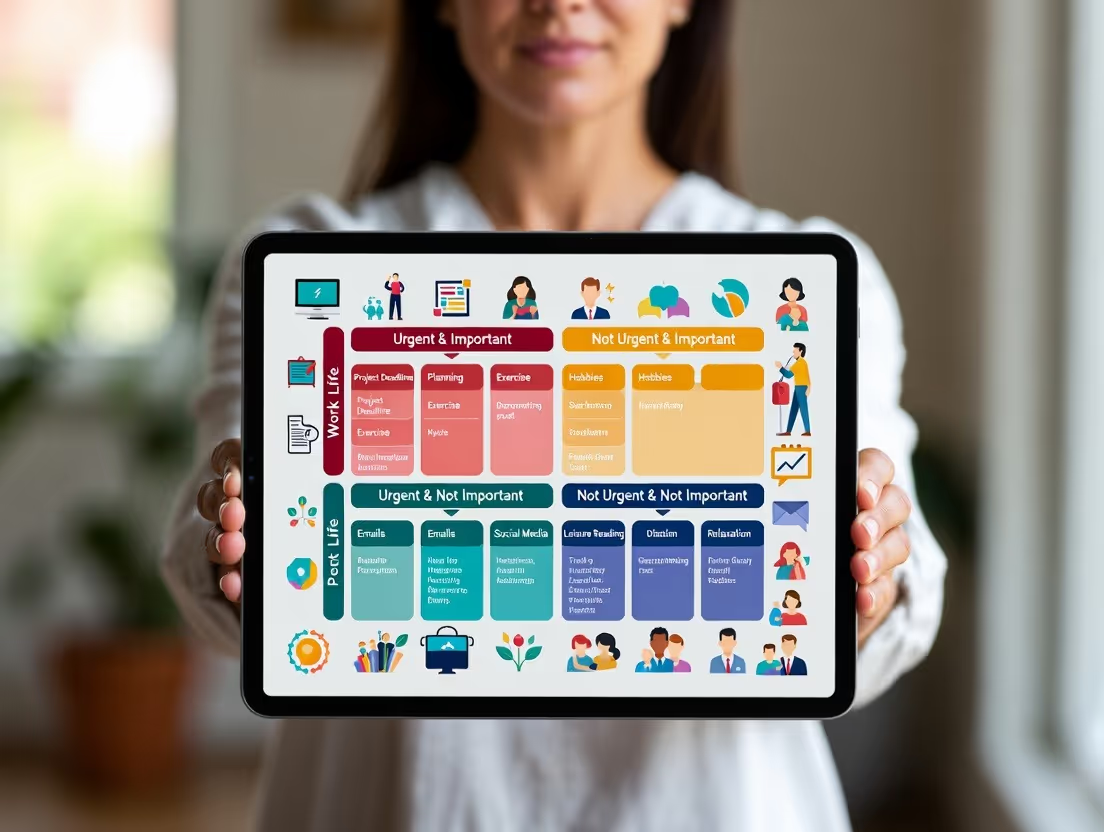
Having established the Priority Matrix as your foundational operating system, it's time to explore its advanced applications. This framework is not confined to your desk; it's a universal lens through which you can view every domain of your life, transforming the way you lead teams, nurture relationships, and care for your physical self. The true mastery of managing simultaneous stressors lies in applying this single, consistent logic across all fronts, creating a harmonious and efficient ecosystem for your energy.
In a professional setting, the avalanche of simultaneous stressors is often at its peak. Multiple projects, shifting deadlines, constant communication, and team dynamics create a perfect storm. Using the Priority Matrix at an individual level is powerful, but scaling it to your projects and team creates collective clarity and reduces systemic stress.
Applying the Matrix to a Project:
Break down any project into its constituent tasks and place each on a shared matrix (using a whiteboard or digital tool like a shared spreadsheet).
Leading with the Matrix:
As a leader, you model the behavior. Share your own Priority Matrix (at a high level) with your team. In one-on-ones, ask not just "What are you working on?" but "Which quadrant is consuming most of your energy this week?" This opens conversations about delegation (moving tasks from their Q3 to someone else's Q2), resource allocation, and burnout prevention. It shifts team language from "everything is urgent" to a strategic discussion about importance. This leadership approach mirrors the ethos behind creating supportive technology—focusing on what truly enhances human performance, a philosophy detailed in our company's journey.
Our most important relationships often reside in Q2—deeply Important, but rarely Urgent. There's no screaming deadline for "deepen emotional connection with partner" or "have a playfully silly afternoon with your child." Consequently, under stress, these are the first items to be sacrificed on the altar of Q1 crises and Q3 noise, leading to loneliness and disconnection even when surrounded by people.
The Priority Matrix offers a proactive antidote. It requires you to schedule importance.
Practical Applications for Key Relationships:
By making relationships a scheduled, non-negotiable part of your matrix, you invest in the support system that will sustain you through all other stressors. For inspiration on how others have balanced technology and human connection, explore the real-world experiences shared by our community.
Your mind can lie to you. It can insist you're "fine" while pushing through exhaustion. Your body, however, keeps an objective score. Physical symptoms are often the first and most honest indicators that your Priority Matrix is out of alignment or that you're ignoring its signals.
Learn to treat these sensations not as nuisances, but as crucial data points:
By correlating these physical signals with your Quadrant activity and your objective biometric data from a tool like an Oxyzen ring, you build profound self-awareness. You begin to notice: "Every time I have back-to-back meetings (Q3), my neck tenses." Or, "On days I get my morning walk (Q2), my afternoon focus is sharper." This creates a powerful feedback loop where your body's wisdom validates and refines the logic of your Priority Matrix, moving you from intellectual understanding to embodied practice. For more on interpreting your body's signals, our FAQ section covers common questions on biometric feedback.
Our digital environments are engineered stress multipliers. Every app, newsletter, and social platform is competing for your attention, injecting micro-stressors into your day. Your digital life needs its own Priority Matrix audit. This isn't about deleting everything; it's about curating for importance.
The Digital Quadrant Sort:
Implementation Protocol:
This digital declutter dramatically reduces the number of simultaneous "pings" on your nervous system, freeing up enormous cognitive bandwidth for your real-world matrix. It creates a digital environment that supports your priorities instead of sabotaging them.
Shift your mindset from "stress management" to capacity building. Imagine you have a Resilience Account. Every stressor is a withdrawal. Every Q2 activity is a deposit. Burnout occurs when you make continuous withdrawals without making deposits.
Q2 Activities Are Your Primary Deposits:
The Priority Matrix helps you schedule these deposits. You wouldn't skip depositing your paycheck; don't skip depositing into your resilience. On days when Q1 demands are high (big withdrawals), it's even more critical to protect your small Q2 deposits—the 10-minute walk, the 5 minutes of deep breathing, the commitment to a bedtime.
When you view life through this accounting lens, saying "no" to a Q3 distraction (like an unnecessary meeting) is easy. You're not being uncooperative; you're protecting the capital needed to handle your important work. You're investing in your long-term operational sustainability. This principle of sustainable performance is central to our vision at Oxyzen, which you can read more about here.
There are inevitable periods when life delivers a perfect storm: a family emergency hits during a major work deadline amidst personal illness. In these times, the matrix can seem to collapse—everything feels urgent and important. This is when you need the Triage Protocol, a specialized version of the matrix for true crisis management.
The Triage Protocol Steps:
The Triage Protocol prevents you from wasting precious crisis energy on sorting tasks that aren't truly critical. It provides a clear, calm sequence when the world feels chaotic.
A technically perfect Priority Matrix is useless if it's built on someone else's priorities. The ultimate defense against the stress of competing demands is deep clarity on what matters most to you. Your matrix must be anchored in your Core Values—the 3-5 non-negotiable principles that define your life.
If one of your values is "Health," but you never schedule Q2 time for meal prep or exercise, you create internal conflict and stress. If "Family" is a value, but your evenings are consumed by Q3 work emails, you experience guilt and dissonance.
The Values-Matrix Alignment Exercise:
When your daily and weekly matrix is a direct expression of your values, the act of prioritization becomes effortless. Saying "no" to a Q3 request that conflicts with a values-based Q2 block feels right, not guilty. This alignment is the deepest source of resilience, making you impervious to the stress of conflicting demands because your compass is always true. Exploring this concept of values-driven living is a frequent topic on our blog, where we discuss holistic wellness strategies.

The Priority Matrix provides the framework. Your values provide the direction. Biometric technology provides the fuel gauge. The synergy of these three elements creates a closed-loop system for managing human performance in the face of stress.
A device like the Oxyzen smart ring is not just a tracker; it's an objective feedback mechanism for your matrix.
Practical Synergies:
This is the future of personal development: a logical framework (Matrix), powered by a moral compass (Values), and informed by real-time physiology (Data). It moves you from guessing about your capacity to knowing it, from reacting to stressors to designing your life around them. To see how this synergy works in a product built for this purpose, learn more about Oxyzen's approach.
Theory must lead to a tangible tool. Your personalized dashboard is your mission control. It doesn't need to be complex; it needs to be yours and visible.
Physical Dashboard Components:
Digital Dashboard Components:
The Daily Flow:
This dashboard makes the system real. It takes the concepts out of your head and into your environment, creating constant, gentle reminders of how you've chosen to operate. For resources and templates that can help you build this system, our online resource hub is a great place to start.
You began this journey under the weight of the silent avalanche—the feeling of being crushed by invisible, simultaneous multipliers. You are now equipped with something far more powerful than simple coping mechanisms. You have an operating system for modern life.
The Priority Matrix is not about doing more. It is about doing more of what matters with less wear and tear. It is the art of making conscious, strategic choices about where your life energy flows, informed by both your highest values and your body's honest signals.
This is not the end of stress. Stress is a feature of an engaged life. This is the end of being controlled by stress. The difference is agency. When a new stressor appears, you no longer feel a knot in your stomach; you feel a question in your mind: "Which quadrant does this belong to, and do I have the capacity for it now?" That question is the sound of regaining control.
The path forward is one of practice, not perfection. Some days your matrix will be a masterpiece of balance. Other days, a crisis will tear it up. The system's strength is that you can always redraw the map. Use your weekly review to learn, not to judge. Let your biometric data be a compassionate guide, not a harsh critic.
You are now building resilience—not as a rigid shield, but as a flexible, adaptive strength. You are moving from merely surviving the avalanche to learning to ski down the mountain, using its very energy to propel you toward a life of clarity, purpose, and sustainable performance. The tools, like the insights from your Oxyzen ring and the strategies from this framework, are your gear. The mountain is your life. It's time to enjoy the ride.
The foundational and applied layers of the Priority Matrix have equipped you with a robust system to navigate daily demands. Yet, true mastery lies in transcending mere task management and weaving these principles into the very fabric of your psychology, your communication, and your long-term vision. This final portion explores the advanced, integrative practices that transform the Matrix from a productivity tool into a philosophy for a resilient and intentional life.
Our minds are masterful storytellers, especially under stress. It crafts compelling narratives that amplify urgency: "If I don't answer this email right now, the client will leave," or "If I don't finish this report tonight, my career is over." This phenomenon, known in Acceptance and Commitment Therapy (ACT) as "cognitive fusion," is where we become glued to our thoughts, treating them as absolute truth rather than passing mental events.
The Priority Matrix provides the logical counterpoint to this emotional hijacking. It acts as a tool for cognitive de-fusion—the practice of stepping back and observing your thoughts without being ruled by them.
The De-fusion Protocol for Stressors:
For example, the 2 AM thought, "I forgot to send that follow-up!" feels like a Q1 crisis. De-fusion allows you to note the thought, place it in Q3 (it's not important or urgent enough to wreck sleep, a critical Q2 activity), and schedule it for the morning. This protects your recovery capacity and trains your brain to respond to stressors with discernment, not drama. This mental discipline is a cornerstone of sustained high performance, a topic often explored through the lens of biometric feedback in resources like the Oxyzen blog.
Delegation is not dumping; it is strategic empowerment. A major source of stress for leaders and high-performers is the failure to effectively delegate, keeping them mired in Q3 tasks that others could handle. The Delegation Matrix is a specialized tool to make this process clear, respectful, and effective.
When considering a task, use this 2x2 grid based on Competence and Importance:
The Delegation Conversation Framework:
When delegating from your Q3, use the Priority Matrix language: "This task is a Q3 for me—it's urgent for the system but not the best use of my focus. It could be a great Q2 development opportunity for you in [skill area]. Here's the context on why it's important. What support do you need from me to own it?"
This reframes delegation from a top-down order to a developmental investment, reducing resistance and building team capacity. It systematically clears your Q3, allowing you to focus on your unique Q2 contributions. This philosophy of empowering through clarity is reflective of the collaborative spirit we value, as seen in our company's approach to teamwork and innovation.
A rigid schedule is fragile; it shatters under the first unexpected stressor. An antifragile schedule, inspired by Nassim Taleb's concept, actually gains from volatility. It has buffers and flexibility built-in, turning disruptions into opportunities for micro-recovery or opportunistic Q2 work.
Principles of Antifragile Scheduling:
This approach ends the tyranny of the "perfect plan." You expect the unexpected and have resources allocated to handle it gracefully, reducing the psychological stress of interruptions. Your schedule becomes a resilient, adaptive system.
Beyond the basic morning/afternoon energy split, each person has a 90-120 minute Ultradian Rhythm—a natural cycle of peak focus followed by a physiological dip. Forcing work through these dips is a primary source of stress and inefficiency. Pairing your Priority Matrix with your personal energy map is a profound advancement.
Conducting a Personal Energy Audit:
By scheduling your matrix according to your biological blueprint, you work with your nature, not against it. This drastically reduces the internal friction of task execution and makes high-focus work feel more effortless. Understanding these personal rhythms is a key benefit of consistent biometric tracking, a feature central to devices like the Oxyzen smart ring.
A significant portion of adult stress originates from miscommunication, unclear expectations, and unresolved conflicts. You can apply the Priority Matrix logic to your communication inputs and outputs to dramatically reduce this relational friction.
The Input Filter (What You Consume):
Consciously choose to engage with Q2, minimally process Q1, limit exposure to Q3, and block Q4.
The Output Filter (What You Express):
Before speaking or sending a message, do a quick internal check:
This filter prevents you from being a source of Q3 stress for others and helps you attract more Q2 interactions, creating a healthier communication ecosystem around you.
The true power of the Priority Matrix is revealed when you zoom out from daily firefighting to the panorama of your life. What does the matrix look like at the scale of a year, a decade, or a lifetime? This is where you ensure your daily Q2 deposits are building toward a meaningful legacy.
The Annual Matrix Review:
The Life Matrix Exercise:
Imagine your life divided into major domains: Health, Work, Relationships, Personal Growth, Community, Finance. Sketch a matrix for each. Are you spending your years in the Important quadrants? Is your career all Q1 (crisis) and Q3 (busywork) with no Q2 (strategic skill-building)? Are your relationships stuck in Q3 (logistics) with no Q2 (adventure, depth)?
This macro-view provides the ultimate guidance for your daily decisions. Saying "yes" to a new project that aligns with your Life Q2 is easy. Saying "no" to an opportunity that falls into your Life Q3 or Q4, no matter how prestigious, becomes clear. This long-term alignment is the ultimate antidote to the stress of feeling lost or off-purpose. For stories of how others have pursued purposeful alignment, our testimonials page shares such transformative journeys.
Mindfulness and the Priority Matrix are perfect partners. Mindfulness cultivates the awareness needed to notice stress arising, and the Matrix provides the structured response. Combine them into a simple, potent daily practice.
The "Pause and Place" Protocol:
This practice breaks the autopilot of stress reactivity. It inserts moments of conscious choice throughout the day, reinforcing that you are the operator of the matrix, not its subject. Over time, this builds the neural pathways for self-regulation.
Burnout is not a sign of failure; it's a sign of a system out of balance for too long. It occurs when Q1 and Q3 consistently cannibalize Q2 and Q4 becomes the only "recovery," which is ineffective. The Priority Matrix, monitored with biometric data, is an early-warning and recovery system.
The Burnout Prevention Dashboard:
The Prescribed Recovery Matrix:
If you are in or near burnout, you need a temporary, therapeutic matrix:
This prescribed period, guided by the clear goal of raising biometric recovery metrics, allows you to rebuild your capacity. It uses the matrix not for productivity, but for healing. Understanding these recovery needs is a critical part of our support, as detailed in our comprehensive FAQ on health and wellness tracking.
Stress is contagious, but so is resilience. Implementing the Priority Matrix within a team, family, or friend group creates a shared language and supportive ecosystem. It transforms stress from a private struggle into a navigable challenge the group can tackle together.
Creating a Shared Matrix Culture:
When everyone operates with the same framework, communication becomes clearer ("That's a Q3 for me, can we batch it later?"), empathy increases ("I see you're in a Q1 crunch, how can I help?"), and collective bandwidth expands. This mirrors the community we strive to build around wellness technology—one focused on shared growth and support.
The final, most critical insight is this: Your Priority Matrix is a living system, not a stone tablet. Your values evolve. Your capacities change. Your goals shift. A system that cannot adapt will become a source of stress itself. The ultimate skill is the meta-skill of recalibration.
Your Recalibration Triggers:
Embrace the quarterly "Life Architecture Review," where you take a full day to revisit your Annual Matrix, your Life Domains, your values, and your system's effectiveness. This is the highest-level Q2 activity, ensuring your operating system never becomes obsolete.
You began with the feeling of an avalanche—a passive victim of external forces. You now possess the tools of a geologist, an architect, and a guide. You can analyze the terrain of your stressors, design a life structure that can withstand pressure, and navigate the path with confidence, guided by the internal compass of your values and the objective dashboard of your physiology.
The goal was never to create a stress-free life. It was to build a you that is stress-resilient, capable of engaging meaningfully with life's inevitable challenges without being diminished by them. The Priority Matrix, especially when integrated with the deep self-knowledge that comes from tools like your Oxyzen smart ring, is your blueprint for that resilient self. This is not the end of a process. It is the beginning of a practiced, intentional, and thriving way of living.
Your Trusted Sleep Advocate: Sleep Foundation — https://www.sleepfoundation.org
Discover a digital archive of scholarly articles: NIH — https://www.ncbi.nlm.nih.gov/
39 million citations for biomedical literature :PubMed — https://pubmed.ncbi.nlm.nih.gov/
Experts at Harvard Health Publishing covering a variety of health topics — https://www.health.harvard.edu/blog/
Every life deserves world class care :Cleveland Clinic - https://my.clevelandclinic.org/health
Wearable technology and the future of predictive health monitoring :MIT Technology Review — https://www.technologyreview.com/
Dedicated to the well-being of all people and guided by science :World Health Organization — https://www.who.int/news-room/
Psychological science and knowledge to benefit society and improve lives. :APA — https://www.apa.org/monitor/
Cutting-edge insights on human longevity and peak performance:
Lifespan Research — https://www.lifespan.io/
Global authority on exercise physiology, sports performance, and human recovery:
American College of Sports Medicine — https://www.acsm.org/
Neuroscience-driven guidance for better focus, sleep, and mental clarity:
Stanford Human Performance Lab — https://humanperformance.stanford.edu/
Evidence-based psychology and mind–body wellness resources:
Mayo Clinic — https://www.mayoclinic.org/healthy-lifestyle/
Data-backed research on emotional wellbeing, stress biology, and resilience:
American Institute of Stress — https://www.stress.org/


