


How to Manage Unpredictable Daily Stress (Building Adaptive Resilience)
Build adaptive resilience by practicing flexibility, maintaining a support network, and developing a mindset that expects and adapts to change.
Build adaptive resilience by practicing flexibility, maintaining a support network, and developing a mindset that expects and adapts to change.
%402x.svg)
Have you ever noticed how some days feel like a gentle stream, while others resemble a raging white-water rapid—and the transition happens in a single email? Modern life isn’t just stressful; it’s unpredictably stressful. The morning traffic, the last-minute meeting, the sudden school closure, the unexpected feedback—these micro-storms bombard our nervous systems not with their sheer magnitude, but with their sheer randomness. We’re left in a state of low-grade alarm, perpetually braced for the next unseen wave.
For decades, stress management has been sold to us as a set of static tools: meditate for 20 minutes, exercise three times a week, get eight hours of sleep. While these pillars are invaluable, they operate under an old assumption—that stress is a predictable load we can schedule around. But what about the stress that defies the calendar? The kind that flickers in your chest during a tense call, tightens your shoulders as you juggle deadlines, or steals your sleep with a whirlwind of "what-ifs"? This is the domain of unpredictable daily stress, and combating it requires something more dynamic than a static toolkit. It demands Adaptive Resilience.
Adaptive Resilience isn’t about building an impenetrable wall against stress. Walls crack under constant, shifting pressure. Instead, it’s about cultivating the properties of bamboo: deeply rooted yet flexible, able to bend with violent winds and spring back, stronger for the experience. It’s a real-time, responsive capacity to meet flux with flexibility, to perceive challenge without panic, and to recover more swiftly.
This article is your comprehensive guide to building that capacity. We will move beyond generic advice and into the science and practice of neuroplastic resilience—training your brain and body to handle unpredictability as its default setting. We’ll explore how your biology responds to sudden stressors, deconstruct the myths of "stress-free" living, and provide a layered framework of cognitive, physiological, and behavioral strategies you can weave into the fabric of your day.
Crucially, we’ll also examine the role of modern technology as a catalyst for self-awareness. Just as a sailor needs instruments to navigate shifting seas, we now have access to biometric tools that translate our internal weather into understandable data. Devices like the OxyZen smart ring offer a revolutionary window into your stress response, measuring heart rate variability (HRV), sleep quality, and physiological arousal in real-time. This isn’t about more data for data’s sake; it’s about turning your subjective feeling of "being frazzled" into an objective insight, allowing you to apply the right resilience technique at the right moment. To understand how this technology personalizes the journey, you can learn more about smart ring technology.
The goal is not to eliminate stress. Stress is an inevitable and sometimes useful part of a life fully lived. The goal is to transform your relationship with the unpredictable, building a system within yourself that is not surprised by chaos but is equipped to dance with it. Let’s begin by understanding the very nature of the beast we’re dealing with.

To manage unpredictable stress, we must first understand why our ancient wiring finds it so uniquely taxing. Your stress response isn’t a flaw; it’s a masterpiece of evolutionary engineering, designed for acute, physical threats—the sabertooth tiger. This system, centered on the HPA axis (Hypothalamic-Pituitary-Adrenal), floods your body with cortisol and adrenaline, sharpening focus, mobilizing energy, and preparing you to fight or flee. It’s brilliant for short bursts.
Modern unpredictable stress, however, turns this brilliant system against us. It’s not one tiger; it’s a hundred tiny paper cuts delivered randomly throughout the day. Each ping of a stressful email, each ambiguous text message, each looming deadline acts as a "micro-stressor," triggering a mini-version of the fight-or-flight cascade. The problem is frequency and lack of resolution.
When stress is predictable, your nervous system can anticipate and brace. The predictable 9 AM Monday meeting causes a stress spike, but your system learns the pattern and begins to modulate its response. Unpredictable stress offers no such courtesy. The brain’s amygdala, your threat radar, remains on high alert, perpetually scanning for danger because it cannot discern a pattern. This leads to a state of allostatic load—the cumulative wear and tear on the body from chronic overactivation of stress systems.
Consider the physiological difference:
The key insight here is that it’s not the stressors themselves, but the perceived lack of control and predictability that does the deepest damage. A study from the University of California, San Francisco, demonstrated that rats experiencing unpredictable electric shocks showed significantly more severe stress pathologies (like gastric ulcers) than rats receiving the same total number of shocks predictably.
For us, this translates to a critical mission: to reintroduce a sense of perceived control and pattern recognition into the seemingly chaotic. This is where Adaptive Resilience begins—not by removing the shocks, but by changing our internal response to randomness. The first step in that change is building a profound awareness of your own unique stress signature, a task where modern wellness technology becomes indispensable. For a deeper look at how data can inform personal wellness strategies, explore our blog for more wellness tips.
Walk into any bookstore or scroll through wellness blogs, and you’ll find a universal prescription for stress: meditate, exercise, sleep, eat well. This advice is not wrong; it’s foundational. But it’s also profoundly incomplete, creating what we term the Resilience Gap—the chasm between knowing what’s generically good for you and knowing what specifically works for you, right now, in the midst of chaos.
The standard advice suffers from three critical failures when applied to unpredictable daily stress:
This gap is where the paradigm shifts from guesswork to precision. Imagine if, instead of guessing you’re stressed, you could see a dip in your HRV—a key biomarker of nervous system resilience—on your wearable device after a difficult conversation. That data point transforms a vague feeling into a defined event. It tells you, objectively, that your system was taxed. You can then correlate it with the trigger and choose a targeted recovery strategy.
Furthermore, you can track which interventions actually work. Does the 4-7-8 breathing exercise bring your HRV back to baseline faster than a 5-minute walk? Does that late-night doomscrolling actually trash your sleep readiness score, making you more vulnerable to stress tomorrow? This closed-loop feedback is revolutionary. It turns you into a scientist of your own nervous system, experimenting and learning what builds your unique adaptive resilience. This journey of self-discovery is at the heart of our mission, which you can read more about in our founding story.
Bridging the Resilience Gap requires a new framework. It’s about pairing timeless wisdom with real-time intelligence, building a layered defense that includes not only daily foundational habits (the "slow medicine") but also a quiver of rapid-response techniques (the "fast medicine"), all informed by a clearer understanding of your personal biology.
Adaptive Resilience is not a single skill but an interconnected system—a personal operating system designed for volatility. Think of it as having three interconnected layers of defense: Foundational, Responsive, and Restorative. Mastering all three creates a robust capacity to handle life’s unpredictability.
This is your baseline wellness—the non-negotiable practices that raise your resilience "floor" and give you more bandwidth to handle spikes. It’s what you do around the stress to make yourself less reactive to the stress.
This is your collection of rapid-acting techniques to deploy as stress is happening. These are the tools that stop the amygdala hijack in its tracks and bring your physiology back toward balance within seconds or minutes. We will explore these in great depth in subsequent sections, but they include:
This is what you do after a stress spike to ensure complete recovery and prevent allostatic load. It’s about actively signaling safety to your nervous system. This includes:
The magic happens in the synergy of these layers. A strong Foundation gives you more resources. Effective Responsive tools prevent acute spikes from becoming chronic states. Diligent Restoration ensures you start each day at your peak capacity. And weaving through all three layers is the thread of awareness—the ability to know which layer needs attention at any given moment. To see how real users have integrated this framework into their lives, you can read their stories and reviews.
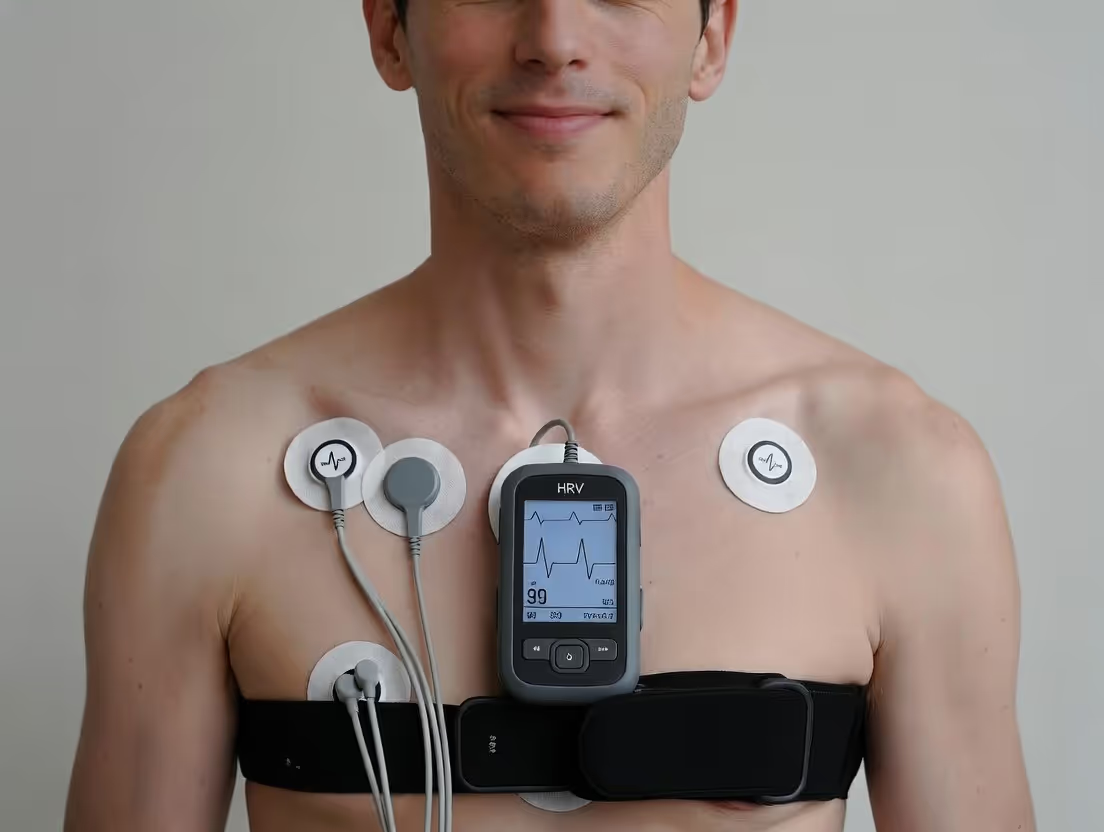
To navigate the path of Adaptive Resilience with precision, you need reliable instrumentation. This is where biometrics transition from fitness curiosities to essential resilience tools. The most critical metric in this endeavor is Heart Rate Variability (HRV).
HRV is not your heart rate. While heart rate measures the average number of beats per minute, HRV measures the tiny variations in time between each successive heartbeat. These variations, measured in milliseconds, are controlled by your autonomic nervous system (ANS). A higher, more variable HRV generally indicates a healthy, resilient ANS—one that can fluidly switch between sympathetic (stress, action) and parasympathetic (rest, digest) states. A low, less variable HRV suggests a nervous system that is stuck, fatigued, or chronically stressed, struggling to adapt to changing demands.
Think of it this way:
For managing unpredictable stress, HRV is your North Star:
Beyond HRV, a holistic view includes:
By learning to read this dashboard—not obsessively, but informatively—you graduate from being a passenger in your stress response to becoming its pilot. You gain the ability to say, "My data shows I’m still in recovery mode, so I’ll postpone that difficult conversation until tomorrow," or "I can see that meeting spiked my stress, so I’ll take five minutes for breathing now." This empowerment is at the core of what modern wellness technology aims to provide, and if you have questions about how it works, our FAQ page offers detailed support.
If Adaptive Resilience is a fortress, sleep is its deepest, most vital foundation. We often think of sleep as a time of nothingness, a blank period between days. In reality, it is a period of intense, active neurological and physiological reconstruction critical for managing unpredictability.
During sleep, especially deep (Slow-Wave) sleep, your brain clears metabolic waste via the glymphatic system, including beta-amyloid proteins linked to stress-induced cognitive decline. Your body repairs tissues and regulates hormones. During REM sleep, your brain processes emotional experiences, essentially "defragging" the emotional hard drive of the day. It’s where the sharp edges of daily stressors are softened and integrated. Skimp on sleep, and you wake up with a "dirty brain"—clogged, reactive, and primed to perceive minor threats as major ones.
For the unpredictably stressed, sleep is often the first casualty. The problem isn't just insomnia; it's poor sleep quality caused by a hyper-aroused nervous system. You might be asleep, but your sleep stages are shallow and fragmented, offering little restorative benefit.
Here’s how to transform sleep from a passive state into a strategic resilience tool:
When you prioritize sleep as strategic recovery, you don’t just wake up less tired. You wake up with a higher stress threshold, greater emotional equilibrium, and a sharper prefrontal cortex—all essential for adaptive decision-making in the face of the day’s unknowns. For more on creating a holistic wellness environment, discover how our integrated approach works.
The connection between your gut and your brain—the gut-brain axis—is a two-way superhighway, and the traffic is heavily influenced by what you eat. Unpredictable stress disrupts digestion and drives cravings for high-sugar, high-fat "comfort foods," which in turn create blood sugar rollercoasters that further destabilize mood and energy. To build resilience, you must view food not just as calories, but as information that either calms or ignites your internal stress systems.
The goal is metabolic stability: providing your brain and body with a steady, reliable source of energy to prevent the internal stress of hypoglycemia (low blood sugar), which feels strikingly similar to anxiety—shakiness, poor focus, and irritability.
By establishing nutritional rhythms, you create internal predictability. Your body learns it can trust a steady fuel supply, freeing up cognitive and emotional resources to deal with external unpredictability. You’re not reacting to the world on an empty tank; you’re navigating it from a place of metabolic abundance.
Exercise is often prescribed for stress as a way to "blow off steam." While that cathartic effect is real, its role in Adaptive Resilience is more nuanced and continuous. Movement is a primary tool for teaching your nervous system the full range of its capacity—from intense exertion to deep calm. It builds a system that can handle spikes because it’s regularly practiced in rising to and recovering from challenge.
The key is consistency and variety. A resilient body is an adaptable body. Don’t just grind at one thing. Mix endurance, strength, and flexibility. Even on your most chaotic days, a 10-minute walk outside can serve as a powerful responsive tool to reset your nervous system and clear your head, reinforcing the habit of using movement as regulation. For insights on how tracking activity influences overall wellness, our blog features related articles and research.
When unpredictable stress hits, cognition often fails first. You can’t "think" your way out of a amygdala hijack. This is where your breath becomes your most powerful and accessible rapid-response tool. Breathing is unique—it’s an automatic function you can also consciously control, making it a direct remote control for your autonomic nervous system (ANS).
By altering your breathing pattern, you send immediate signals to your brainstem to shift from sympathetic (fight-or-flight) dominance to parasympathetic (rest-and-digest) dominance. Here are the most effective evidence-based techniques:
Practice these techniques in calm moments so they become familiar tools. Then, when unpredictability strikes, you can reach for your "breath remote" and change your physiological channel from "panic" to "presence" in under a minute.
While breathwork calms the body, cognitive reframing calms the mind’s interpretation of events. Unpredictable stress is often amplified not by the event itself, but by the catastrophic, personal, and permanent story we tell ourselves about it. Cognitive reframing is the practice of intercepting that automatic story and consciously crafting a more adaptive, accurate narrative.
This is based on the principles of Cognitive Behavioral Therapy (CBT) and involves catching your Automatic Negative Thoughts (ANTs).
The 3-Step Reframe Process:
Key Reframing Lenses for Unpredictability:
This isn’t about naive positivity; it’s about accurate realism. The catastrophic story is usually less accurate than a balanced one. By practicing this mental pivot, you reduce the secondary suffering—the anxiety about your anxiety—and free up mental energy to actually solve the problem at hand.

When stress makes your thoughts spiral into the catastrophic future, the most effective antidote is to forcibly bring your attention into the safety of the present moment. Your senses only operate in the now. Sensory grounding is a way to "hack" into this present-moment awareness, providing an anchor in the storm.
This technique is exceptionally powerful for acute anxiety, panic, or overwhelming feelings triggered by unexpected news or events.
The 5-4-3-2-1 Grounding Technique:
Pause. Then, deliberately find:
This exercise, which takes less than a minute, accomplishes two critical things: 1) It disrupts the runaway train of stressful thoughts by demanding sensory attention. 2) It proves to your amygdala, through direct sensory evidence, that you are here, in this room, and you are safe in this immediate moment. There is no tiger.
The Strategic Pause: Grounding is part of a larger responsive skill: The Pause. Between an unpredictable stressor and your reaction, there is a tiny space. In that space lies your freedom to choose your response. The Pause is the intentional widening of that space. It can be a single deep breath, a sip of water, or stating, "Let me think about that for a moment." This simple act prevents knee-jerk, stress-driven reactions you might regret and allows your higher brain (prefrontal cortex) to come back online.
Mastering these responsive tools—breath, reframe, and grounding—gives you a Swiss Army knife for acute stress. They are your first line of defense in the moment, preventing the spark of unpredictability from turning into a wildfire of chronic distress. To continue exploring techniques for building a resilient life, we invite you to discover more resources and guides.

Stress is not a purely intellectual or physiological event; it is an emotional one. Unpredictability often triggers a whirlwind of difficult emotions—frustration, anxiety, overwhelm, anger, or a vague sense of dread. Our cultural conditioning often tells us to suppress these emotions ("Keep it professional") or to let them spiral out of control. Adaptive Resilience requires a third path: Emotional Agility.
Coined by psychologist Dr. Susan David, emotional agility is the ability to be with your emotions with curiosity, compassion, and acceptance, and then to choose values-aligned actions in spite of them. It’s about making emotions data, not directives.
The core strategy for developing emotional agility in the face of sudden stress is the neuroscience-backed technique, "Name It to Tame It." Developed by Dr. Dan Siegel, this practice is disarmingly simple yet profoundly effective. When you feel a surge of difficult emotion, you consciously name it. "This is anxiety." "I'm feeling a deep sense of frustration." "This is shame."
The act of labeling an emotion with a specific word does something remarkable in the brain. It engages the prefrontal cortex (your thinking center) and decreases activity in the amygdala (your fear center). It creates a slight distance between you and the emotion. You are not "angry"; you are experiencing anger. This cognitive shift is the essence of agility.
How to Practice "Name It to Tame It" in Real-Time:
This process prevents emotional flooding and builds what psychologists call distress tolerance—the capacity to withstand emotional storms without being capsized by them. When you can name the waves, you learn you can ride them out.
Our culture glorifies the "grind" and misunderstands resilience as the capacity to endure non-stop pressure. True Adaptive Resilience, however, is rooted in rhythm—the constant, intelligent oscillation between effort and recovery. For unpredictable stress, which doesn't grant us long breaks, we must master the art of Micro-Rest.
Micro-rests are intentional, brief (30-second to 5-minute) pauses taken throughout the day to reset the nervous system and prevent stress accumulation. They are not about "doing nothing" in a distracted way (like scrolling social media, which is cognitively taxing), but about actively engaging a restorative state.
Science of the Micro-Rest: The human ultradian rhythm suggests our bodies naturally crave a rest period after about 90 minutes of focused work. Ignoring these signals leads to diminishing returns, increased errors, and heightened stress reactivity. Micro-rests honor this biology, offering a "system reset" that restores focus and emotional regulation.
Effective Micro-Rest Protocols:
The cumulative effect of 5-6 micro-rests scattered across a chaotic day is transformative. It prevents the sense of being "on" from 9 to 5 without reprieve. It inserts small pockets of predictability and control into an unpredictable flow, teaching your nervous system that stress is not a perpetual state, but an event that is followed by safety. To see how integrating small, smart habits can lead to significant change, you can read real customer reviews and experiences.
Much of our suffering from unpredictability stems not from the events themselves, but from our rigid attachment to how we believed the day "should" go. The cancelled plan, the changed deadline, the unexpected critique—all violate a silent expectation. Building Adaptive Resilience requires trading rigid expectations for Adaptive Neutrality.
Adaptive Neutrality is a mental stance of open, non-judgmental awareness toward reality as it unfolds. It’s the practice of meeting the unpredictable not with "This shouldn't be happening!" but with "This is what's happening. Now, what are my options?"
This is rooted in two key psychological concepts:
How to Build a More Flexible Mindset:
A flexible mindset turns you into a surfer instead of a rock in the waves. The surfer doesn't control the ocean, but through skill, balance, and attention, they navigate its changing power. They expect the wave to change, and their readiness is their resilience.
Resilience is not built in isolation. We are social creatures, and our nervous systems are deeply intertwined with those around us—a process called co-regulation. In times of unpredictable stress, a supportive social ecosystem acts as both a buffer and a recovery accelerator. Conversely, toxic or unsupportive relationships can be major stressors themselves.
Building Adaptive Resilience, therefore, requires auditing and cultivating your social portfolio.
Your social ecosystem should be a source of energy renewal, not depletion. Investing in these relationships creates a web of support that catches you during unexpected falls and amplifies your joy during unexpected wins. This community-focused philosophy is central to our brand's vision and values.
In our quest to manage stress, technology can be a double-edged sword. It is often the source of our unpredictability (incessant notifications, information overload) yet also holds the key to mastering it. The difference lies in moving from passive consumption to active, intentional use. The right technology shouldn't add to your cognitive load; it should clarify it.
This is where purpose-built wellness technology, like advanced smart rings, transitions from a fitness gadget to an essential resilience co-pilot. The goal is to create a feedback loop: Action -> Data -> Insight -> Informed Action.
How to Use Biometric Technology Strategically for Adaptive Resilience:
When used wisely, technology like the OxyZen ring provides something ancient wisdom couldn't: an objective, quantifiable mirror of your inner state. It closes the awareness gap, allowing you to apply the timeless principles of resilience with modern precision. For technical details on how this is achieved, our FAQ page provides comprehensive answers.
Knowledge alone is not resilience. Resilience is embodied, practiced, and habitual. The final step in building Adaptive Resilience is to synthesize the foundational, responsive, and restorative layers into Personal Resilience Rituals—consistent, daily practices that automate your care, so you don't have to decide when you're too stressed to decide.
A ritual is more than a routine; it has a mindful, intentional quality. It’s a dedicated time to connect with and strengthen your system.
Sample Daily Resilience Ritual Framework:
The power of these rituals lies in their consistency. On calm days, they build capacity. On chaotic days, they provide an anchor—a series of predictable, grounding touchpoints that you can cling to when everything else feels uncertain. They become the drumbeat your nervous system can sync to, no matter how discordant the external music becomes. To continue your learning and find rituals that work for you, our blog is a library of curated wellness resources.
We have now laid the essential groundwork for mastering unpredictable daily stress. You’ve moved from understanding the corrosive biology of randomness to building a multi-layered defense system. You are no longer a passive recipient of stress but an active architect of your response.
You now possess:
This journey is not about achieving a state of perpetual calm—an impossible and perhaps undesirable goal. It is about building Adaptive Resilience: the dynamic, flexible, and recoverable strength of a system that expects change and is equipped to meet it. It’s about knowing that you can be stressed without being defeated, challenged without being overwhelmed.
The true measure of this resilience won’t be a stress-free life, but a life where stress loses its power to derail you. You will notice the unpredictable event, feel the physiological and emotional surge, and then watch as your trained system engages—a breath here, a reframe there, a moment of micro-recovery—guiding you back to your center. You will become fluent in the language of your own nervous system.
Remember, this is a practice, not a perfection. Start small. Choose one foundational habit to strengthen. Master one responsive tool. Review your biometric data with curiosity, not criticism. Each small step reinforces the neural pathways of resilience.
In the next portion of this guide, we will dive even deeper. We will explore advanced techniques for navigating specific high-stress domains—the unpredictable workplace, family dynamics, and social anxiety. We will examine the role of purpose and values as an ultimate compass during storms, and provide advanced recovery protocols for when stress has left you truly depleted. We’ll also tackle common obstacles and how to sustain your practice for a lifetime of greater ease and effectiveness.
The path to Adaptive Resilience continues. To learn more about the technology that can support this entire journey, from first awareness to advanced integration, discover how Oxyzen works on our homepage. Your capacity to meet life’s beautiful, chaotic unpredictability with grace and strength is growing with every informed choice you make.
The modern workplace is often Ground Zero for unpredictable stress. Fluctuating deadlines, shifting priorities, ambiguous feedback, and the constant hum of digital communication create a perfect storm for our nervous systems. Building Adaptive Resilience here requires moving beyond general techniques to develop domain-specific strategies that address the unique contours of professional chaos.
The core challenge in the workplace is the interplay between high demands and low perceived control—a combination research consistently links to burnout. Your goal is not to control the uncontrollable, but to systematically expand your spheres of influence and craft psychological safety within them.
Strategy 1: Master the Art of the "Containment Ritual"
Unpredictable work stress has a notorious tendency to bleed into personal life. A "Containment Ritual" is a deliberate practice to psychologically and physically compartmentalize work, creating a clear boundary between "on" and "off" modes.
Strategy 2: Tame the Notification Beast
The quintessential source of workplace unpredictability is the asynchronous notification—the email, Slack message, or Teams ping that can arrive at any moment with any level of urgency. To reclaim cognitive control, you must move from a reactive to a proactive communication stance.
Strategy 3: Reframe "Unpredictability" as "Problem-Solving"
The mindset you bring to workplace flux is everything. Viewing unexpected changes as threats activates the stress cascade. Viewing them as problems to be solved engages the prefrontal cortex—the part of your brain responsible for executive function, creativity, and calm analysis.
By implementing these domain-specific strategies, you transform the workplace from a minefield of stressors into a dynamic environment where you can exercise your growing Adaptive Resilience muscles. Your sense of agency will grow, directly countering the most toxic element of unpredictable stress: helplessness.
If the workplace is unpredictable due to external demands, family and intimate relationships are unpredictable due to deep emotional stakes and intertwined lives. A partner's bad mood, a child's sudden meltdown, a family member's crisis—these events hit closer to home and trigger more primal attachment systems. Here, resilience is less about boundary-setting and more about emotional regulation within connection.
The core challenge in relationships is managing your reactivity while staying open-hearted and present. The goal is to respond from your values (e.g., kindness, patience) rather than react from your stress.
Strategy 1: Implement the "Pause-Breathe-Connect" Protocol
When a loved one's behavior or words trigger a stress surge, the old brain wants to fight, flee, or freeze. This protocol creates space for your wiser self to step in.
Strategy 2: Differentiate Between "Their Stress" and "Your Stress"
In close quarters, we easily absorb the emotional states of others—a phenomenon called emotional contagion. A key skill is to recognize when your stress is yours (e.g., from work) and when you've "caught" it from a family member, all while maintaining empathy.
Strategy 3: Build "Connection Micro-Moments"
Resilience in relationships isn't just about weathering storms; it's about building a reservoir of positive connection that you can draw from during difficult times. These are small, consistent investments.
In the domain of relationships, Adaptive Resilience looks like staying soft without being a doormat, being strong without being rigid, and loving even when—especially when—you can't predict what the next moment will bring.
For many, the greatest source of unpredictable stress lies in social terrain: the party where you know few people, the work networking event, the unexpected run-in with an acquaintance, or even the group chat that pings with a potential conflict. Social anxiety is fundamentally a fear of unpredictable social evaluation. Building resilience here means reducing the perceived threat of the social unknown.
The core mechanism of social anxiety is a self-reinforcing cycle: fear of negative evaluation leads to self-focused attention and safety behaviors (e.g., avoiding eye contact, rehearsing sentences), which ironically makes interactions more awkward, seemingly confirming the fear.
Strategy 1: Shift from Self-Focus to Outward Curiosity
The antidote to the paralyzing self-consciousness of social anxiety is deliberate other-focused attention. This moves cognitive resources away from your internal "threat monitor" and into the external world.
Strategy 2: Embrace the "Good Enough" Interaction
Socially anxious minds often hold an idealized, perfectly smooth script for how an interaction "should" go. Unpredictable stutters, pauses, or topic changes are seen as failures. Resilience is built by redefining success as "good enough."
Strategy 3: Pre-Game and Post-Game with Compassion
Use structured rituals before and after challenging social events to frame the experience constructively.
By applying these strategies, you gradually teach your amygdala that social unpredictability is not life-threatening, but simply a part of the rich, messy tapestry of human connection. You build the resilience to tolerate ambiguity in others' reactions, which is, in essence, the resilience to be yourself in an unpredictable social world.
When daily stress is random and chaotic, it’s easy to get lost in the noise, reacting to each new demand without a sense of direction. This reactive mode is inherently draining. Adaptive Resilience finds its most powerful sustainer not in a technique, but in a foundation of meaning. Your core values and sense of purpose act as an internal North Star, providing direction and stability when external conditions are foggy and turbulent.
Purpose is your "why"—the overarching contribution or quality you want your life to embody. Values are your "how"—the principles you want to guide your actions, such as integrity, curiosity, kindness, or growth. Under stress, we often disconnect from these, operating on autopilot. Reconnecting is an act of resilience.
How Purpose and Values Buffer Stress:
Practices to Anchor in Your Values:
When unpredictable stress makes you feel like a leaf in the wind, your values are your roots. They allow you to bend without breaking, because your stability comes from within. This internal compass is a cornerstone of the philosophy behind tools designed for lasting wellness, a journey you can learn more about here.
Even with the best responsive tools and foundational habits, life will occasionally deliver a knockout punch—a perfect storm of unpredictable stressors that leaves you profoundly depleted. This isn't failure; it's reality. Adaptive Resilience includes having Advanced Recovery Protocols for these times. These are not daily routines, but intensive, short-term "reset" procedures designed to signal profound safety to your nervous system and accelerate your return to baseline.
Recognizing Major Depletion:
Signs include persistent low HRV despite rest, emotional numbness or fragility, inability to concentrate, cynicism, and feeling "wired but tired." Your biometric data will often show a consistent "Readiness" or "Recovery" score in the red.
Protocol 1: The 24-Hour Sensory Reset
This is a radical but temporary simplification of inputs.
Protocol 2: The "Compensation" Day
If you cannot get a full 24 hours, use data to guide a compensation day after a major stress event. If your device shows poor recovery, treat the next day as a "maintenance day."
Protocol 3: The "Body-Up" Reset (When the Mind is Racing)
Sometimes depletion manifests as mental anxiety that won't quiet. When cognitive tools fail, go purely physiological.
These protocols are emergency medicine for your nervous system. Using them intentionally after major depletion prevents a single storm from triggering a prolonged season of burnout. They are the ultimate expression of self-compassion in your resilience practice. For support in tailoring these protocols to your life, our community and resources can help.
The path to Adaptive Resilience is not linear. You will encounter internal resistance, life disruptions, and periods where it all feels too hard. These obstacles are not signs you're doing it wrong; they are part of the process. Anticipating and planning for them is itself a resilient act.
Obstacle 1: "I don't have time for any of this."
This is the most common and most pernicious objection. It confuses "I don't have time" with "This isn't a priority right now." Stress steals time by making you inefficient, distracted, and prone to error. Resilience practices create time by restoring cognitive function.
Obstacle 2: "I forget to use my tools in the moment."
Under stress, we revert to well-worn neural pathways (panic, rumination). The new, resilient pathway is still a faint trail in the forest.
Obstacle 3: "I'm too exhausted to even think about recovery."
This is the burnout paradox. When you most need restorative practices, you have the least motivation to do them.
Obstacle 4: "My data just makes me more anxious."
For some, biometric feedback can become a source of performance anxiety, creating a new stressor.
By expecting these obstacles and having compassionate, practical workarounds ready, you ensure that your resilience practice is robust enough to survive the very conditions it's designed for. It becomes antifragile—strengthened by the setbacks. This practical, problem-solving approach is what we champion, as shared in real user experiences and testimonials.
Adaptive Resilience is not a 30-day challenge with a defined finish line. It is a lifelong practice of tuning and caring for the most complex system you'll ever manage: your own mind-body continuum. The final stage of mastery is moving from conscious effort to integrated habit, and developing the wisdom to evolve your practice with the changing seasons of your life.
Sustaining the Practice:
The Ultimate Goal: Post-Traumatic Growth
While we focus on daily stress, the highest expression of Adaptive Resilience is the potential for Post-Traumatic Growth (PTG). PTG is the phenomenon whereby individuals, after navigating significant adversity, report positive psychological changes: a deepened sense of personal strength, a greater appreciation for life, improved relationships, new possibilities, and spiritual development.
The daily practice of managing unpredictable stress is the training ground for this capacity. By repeatedly facing small uncertainties with flexibility and recovery, you build the neural and psychological "muscle" to face larger life adversities not with mere survival, but with transformation. You learn that you can be shaped by chaos without being shattered by it.
This journey—from reactive stress to adaptive resilience to potential growth—is the heart of a life well-lived. It is a commitment to showing up for your one precious life with as much presence, vitality, and grace as you can muster, no matter what the day unpredictably brings.
Your toolkit is now extensive. You have the science, the framework, the specific tools for various domains, the advanced protocols, and the strategies for overcoming obstacles. The work now is integration. Return to this guide. Choose one strategy at a time. Be patient and compassionate with yourself. Observe, learn, and adapt. This is how you build not just resilience for today, but a resilient self for all your tomorrows.
To continue exploring the intersection of technology, data, and lifelong wellness, a wealth of evolving knowledge awaits you in our curated blog and resource library. Your journey to mastering unpredictable stress is a testament to your commitment to living fully, and we are here to support that path every step of the way.
Your Trusted Sleep Advocate: Sleep Foundation — https://www.sleepfoundation.org
Discover a digital archive of scholarly articles: NIH — https://www.ncbi.nlm.nih.gov/
39 million citations for biomedical literature :PubMed — https://pubmed.ncbi.nlm.nih.gov/
Experts at Harvard Health Publishing covering a variety of health topics — https://www.health.harvard.edu/blog/
Every life deserves world class care :Cleveland Clinic - https://my.clevelandclinic.org/health
Wearable technology and the future of predictive health monitoring :MIT Technology Review — https://www.technologyreview.com/
Dedicated to the well-being of all people and guided by science :World Health Organization — https://www.who.int/news-room/
Psychological science and knowledge to benefit society and improve lives. :APA — https://www.apa.org/monitor/
Cutting-edge insights on human longevity and peak performance:
Lifespan Research — https://www.lifespan.io/
Global authority on exercise physiology, sports performance, and human recovery:
American College of Sports Medicine — https://www.acsm.org/
Neuroscience-driven guidance for better focus, sleep, and mental clarity:
Stanford Human Performance Lab — https://humanperformance.stanford.edu/
Evidence-based psychology and mind–body wellness resources:
Mayo Clinic — https://www.mayoclinic.org/healthy-lifestyle/
Data-backed research on emotional wellbeing, stress biology, and resilience:
American Institute of Stress — https://www.stress.org/


