


The Mindful Walking Practice: Movement With Awareness
Free practices include mindful breathing, observing nature, body scans, and mindful listening—all requiring no special equipment.
Free practices include mindful breathing, observing nature, body scans, and mindful listening—all requiring no special equipment.
%402x.svg)
In a world that demands constant speed, where notifications fragment our attention and productivity is measured in clicks per minute, a quiet revolution is taking place. It’s a revolution happening at three miles per hour. It requires no special equipment, no subscription fee, and no advanced degree. It is the ancient, profoundly simple act of walking, re-imagined not as a means to an end, but as the end itself. This is mindful walking.
Mindful walking is the practice of bringing full, non-judgmental awareness to the experience of moving through space. It is meditation in motion, a bridge between the stillness of seated practice and the dynamism of daily life. It’s not about where you’re going, but how you are being while you get there. When you walk mindfully, the journey isn't across the park or around the block; it’s into the rich, textured landscape of the present moment—the feeling of your foot meeting the earth, the rhythm of your breath, the symphony of sounds around you, the play of light and shadow.
This practice is more than a wellness trend; it’s a neurological reset. Neuroscientists have found that rhythmic, mindful movement like walking can synchronize brain waves, calm the amygdala (our brain’s fear center), and stimulate neuroplasticity. It combines the proven benefits of physical exercise—improved cardiovascular health, boosted mood, reduced anxiety—with the profound, evidence-based benefits of mindfulness: sharper focus, emotional regulation, and a deep-seated sense of calm.
For the modern seeker of well-being, mindful walking offers a pragmatic solution. It fits into the cracks of a busy day. It transforms the walk from your car to the office, the midday stretch, or the evening stroll with the dog from “lost time” into “found time”—a pocket of peace and presence.
And now, technology is meeting this ancient practice in a fascinating synergy. Wearables, particularly sophisticated devices like the Oxyzen smart ring, are providing a new layer of insight. They allow us to quantify the previously unquantifiable, observing in real-time how a mindful walking practice lowers our heart rate variability (HRV), steadies our breathing, and brings our nervous system into a state of coherence. This biofeedback loop doesn’t replace the internal awareness; it enhances it, offering a mirror to our inner state and helping us cultivate the very awareness that defines the practice.
In this comprehensive guide, we will journey deep into the art and science of mindful walking. We’ll explore its roots, decode its mechanisms, and provide you with a practical, step-by-step framework to make it an integral part of your life. We’ll see how it connects to broader wellness principles and how tools from Oxyzen.ai can support your path. This is an invitation to slow down, to feel the ground beneath your feet, and to discover that every step can be a step toward greater peace, clarity, and vitality.

Walking is our first great physical achievement as humans. Before we run, before we climb, we walk. It is the fundamental human gesture, a defining characteristic of our species that allowed us to migrate, explore, and connect. For millennia, walking was not just exercise; it was transportation, pilgrimage, contemplation, and conversation. Philosophers from Aristotle to Nietzsche were renowned walkers, believing that the rhythm of their steps unlocked the rhythm of their thoughts. Poets like Wordsworth famously composed verse during miles-long rambles through the Lake District.
Yet, in the span of just a few generations, we have engineered walking out of our lives. The 20th century’s love affair with the automobile and the 21st century’s digital revolution have conspired to make us profoundly sedentary. We now “commute” from bedroom to home office, order groceries to our doorstep, and conduct social lives through screens. Walking has been relegated, for many, to a purposeful, often rushed, activity logged in a fitness app—measured in steps, calories, and miles, stripped of all context and joy.
This shift has cost us dearly on multiple levels:
Rediscovering mindful walking is about reclaiming this lost heritage. It’s not about adding another “workout” to your regimen. It’s about restoring walking to its rightful place as a core human behavior for integration, health, and insight. It is a gentle rebellion against the culture of speed and distraction—a way to move through the world on your own terms, with awareness as your compass. To understand how this reclamation fits into a modern wellness ecosystem, you can explore resources on holistic health at the Oxyzen.ai blog, where movement is often discussed as a pillar of well-being.
At its core, mindful walking is the application of mindfulness principles to the act of walking. Mindfulness, rooted in ancient Buddhist traditions but now widely secularized, is the practice of paying attention to the present moment, on purpose, and without judgment. When we apply this to walking, the simple act becomes a rich field of observation.
Mindful walking is not:
Mindful walking is:
The formal practice often starts very slowly, sometimes called “walking meditation.” You might take a step with each full breath, focusing intensely on the micro-sensations of balance, weight shift, and touch. This isn’t practical for a walk to the store, which is where the beauty of the practice unfolds.
Informal mindful walking is the seamless integration of this awareness into any walk, at any pace. It’s the conscious choice to put your phone away for the first five minutes of your lunchtime stroll and just feel your body move. It’s noticing the tension in your shoulders as you rush to a meeting and consciously relaxing them with your next few steps. It’s hearing a bird sing and pausing for a full breath to truly listen.
This practice aligns perfectly with a data-informed approach to wellness. By using a device like the Oxyzen smart ring, you can observe the direct physiological impact of shifting from distracted to mindful walking. You might see your heart rate settle into a smoother, more coherent rhythm, or your stress markers decrease—tangible validation of the inner shift you’re cultivating. For those curious about how technology can illuminate such mind-body connections, the team behind Oxyzen.ai/about-us has built a platform dedicated to this very synergy.
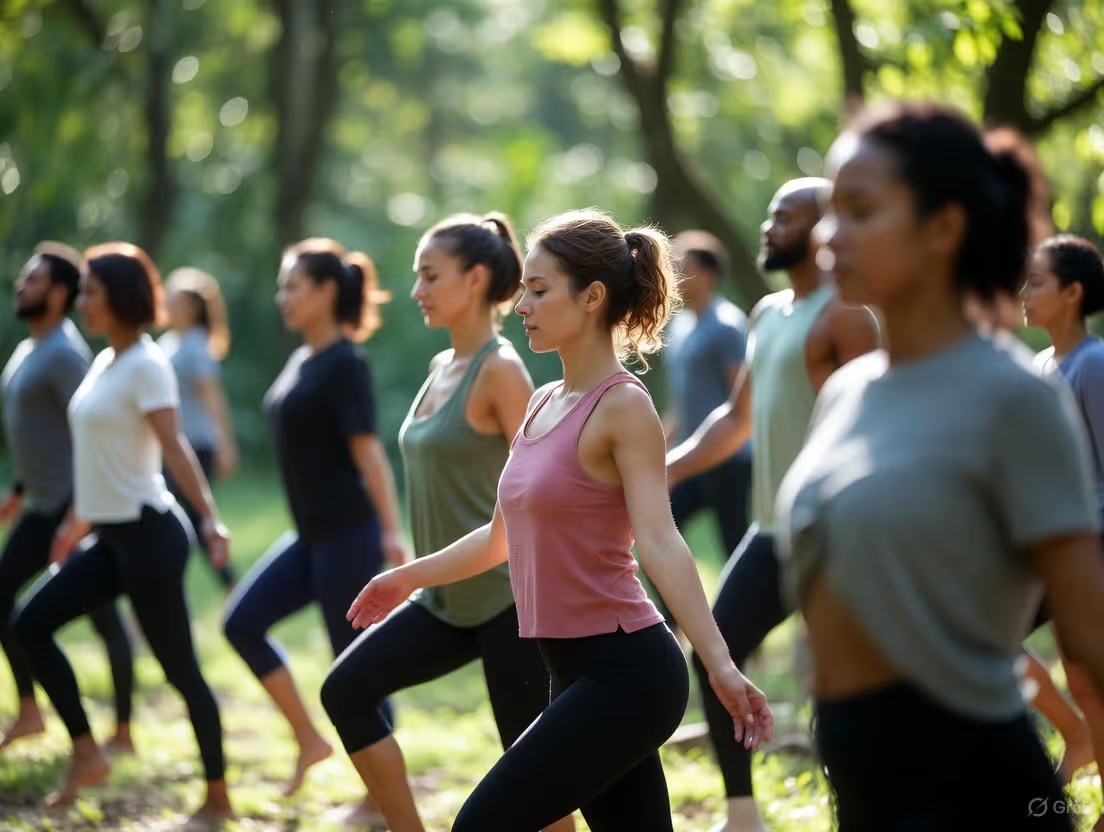
The benefits of mindful walking are not just poetic; they are grounded in robust and growing scientific evidence. This practice creates a powerful “mind-body feedback loop” that enhances physical and mental health simultaneously.
Neurological Rewiring:
When you walk mindfully, you engage in what psychologists call “attentional control.” You are consciously directing your focus away from ruminative thoughts (often centered in the brain’s Default Mode Network, or DMN, associated with mind-wandering and self-referential thinking) and towards sensory input. This act:
Physiological Harmony:
The slow, deliberate pace and focused breathing of mindful walking activate the parasympathetic nervous system—your body’s “rest and digest” mode. This leads to:
Psychological & Emotional Benefits:
The combination of movement and awareness is a potent antidote to modern mental health challenges:
The data from a wearable device can make this invisible process visible. After a mindful walking session, reviewing your physiological metrics on a platform like Oxyzen.ai can show you the concrete shift from sympathetic (stress) to parasympathetic (calm) dominance, reinforcing the value of your practice and motivating consistency.
Before you take your first mindful step, a small amount of preparation can make a significant difference. This isn’t about buying special gear; it’s about cultivating the right mindset and removing trivial barriers.
1. Shift from Goal-Oriented to Process-Oriented:
Forget distance, step counts, and pace for this practice. Your “goal” is simply to be present for as many steps as you can. If you notice your mind has wandered 100 times in ten minutes, and you gently bring it back 100 times, that is not failure—that is the practice. It is a successful session.
2. Choose Your Path Wisely (For Beginners):
3. Dress for Comfort (Not Performance):
Wear comfortable shoes and clothing that doesn’t restrict movement or demand your attention. You want to forget what you’re wearing.
4. Leave Your Devices (With One Exception):
Put your phone on silent and in your pocket or bag. The point is to disconnect from external digital input. The potential exception is if you are using a wearable like a smart ring to passively gather bio-data, which requires no interaction. Setting it beforehand to track a “mindfulness” or “meditation” session can provide fascinating post-walk insights without interrupting your flow. For questions on how to best use technology in this way, Oxyzen.ai/faq offers helpful guidance.
5. Set a Gentle Intention:
Before you begin, pause for a moment. Stand still. Take two deep breaths. Set a simple intention: “For the next ten minutes, I am just walking. My only task is to notice.”
This preparatory stage is about creating a container for your practice. It signals to your brain that you are entering a different mode of being—one of receptivity rather than productivity. It’s the same thoughtful approach that the founders took when building their wellness philosophy, a story you can find at Oxyzen.ai/our-story, where intention meets innovation.
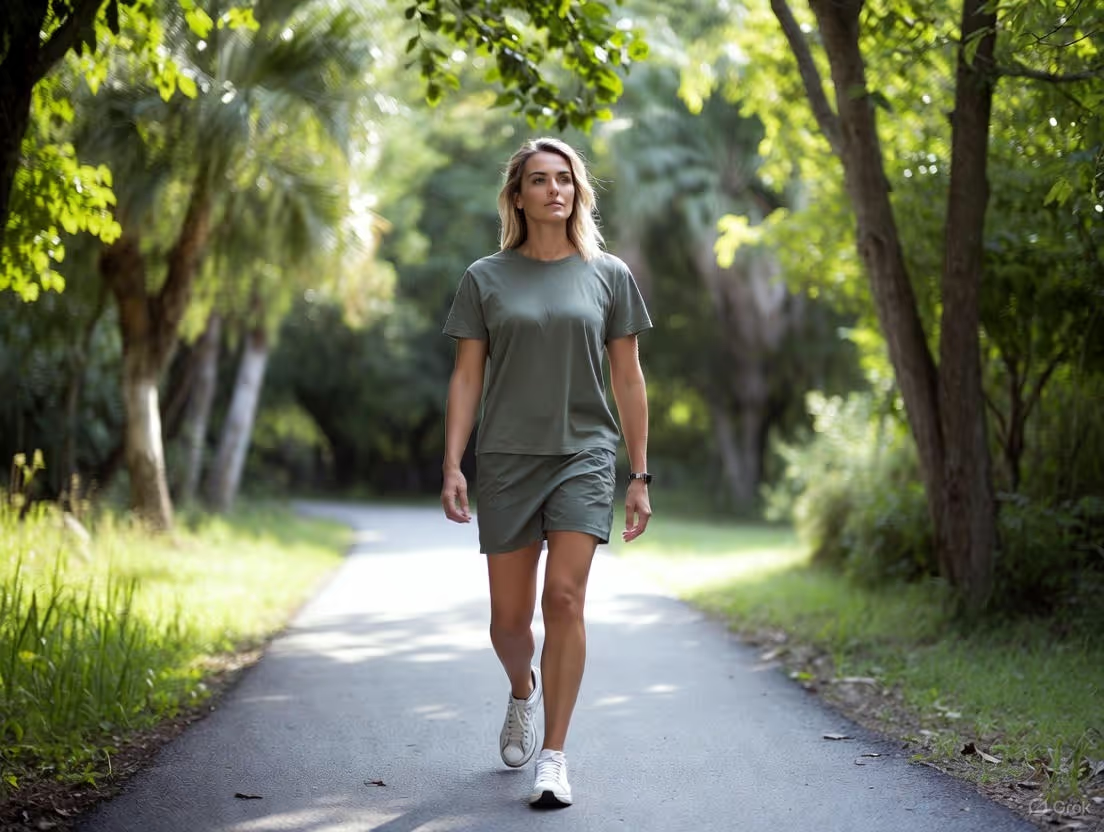
Here is a simple, structured guide to begin. You can think of it as a "slow dance" with your own experience.
Step 1: The Standing Start
Begin not by walking, but by standing still. Plant your feet firmly on the ground, hip-width apart. Let your arms hang loosely by your sides. Close your eyes if it feels safe.
Step 2: The Weight Shift (In Place)
Very slowly, begin to shift your weight onto your right foot. Feel the muscles in that leg and foot engage as they take more load. Feel your left foot lighten. Then, slowly shift back to center, and over to your left foot. Do this a few times, like a slow, silent rocking. This builds awareness of the fundamental mechanism of walking: balance and transfer.
Step 3: The Micro-Step
Now, with your weight on your right foot, slowly lift the heel of your left foot, then the ball, until only your toes are touching. Notice the subtle sensations in your calf and foot. Slowly swing the left foot a few inches forward and gently place the heel down. Roll through the foot until it is flat. Now, shift your weight onto this left foot. You have taken one slow, conscious step.
Step 4: The Walking Cycle
Begin to walk at this extremely slow pace. With each step, you can mentally note the phases, not as a rigid command, but as a gentle guide to focus:
Step 5: Integrating the Breath
Let your breath find its own natural rhythm. You might notice that your breath syncs with your steps—an inhale over two steps, an exhale over three. Don’t force it. Just observe the duet between your breath and your movement.
Step 6: Expanding Awareness
After a few minutes of focusing on the feet, allow your awareness to expand. Feel the movement in your ankles, calves, knees, thighs, and hips. Notice the swing of your arms. Feel the air on your skin. Listen to the sounds around you. See colors and shapes without labeling them. Hold it all in a soft, open awareness.
Step 7: Handling Distractions
Your mind will wander. You’ll start thinking about your to-do list, a conversation, or judging how you’re doing. This is normal. The moment you realize you’ve drifted, simply acknowledge it ("Ah, there’s thinking") and gently return your attention to the sensation of your feet touching the ground. This act of noticing and returning is the core strength training of mindfulness.
Practice this formal, slow walking for just 5-10 minutes at first. It is the training ground for the awareness you will later bring to all your movement.
Once you’ve acquainted yourself with the formal practice, the real magic happens when you weave mindful awareness into the walking you already do. This is where it stops being a separate “practice” and starts becoming a way of life.
The Commute Walk: Instead of charging from your car or the train to the office while mentally rehearsing your day, use this transition as a reset. For the first two minutes, commit to sensory awareness. Feel your feet on the pavement. Notice the temperature of the air. See the sky. Let the walk be a buffer zone, leaving home concerns behind and arriving at work more present.
The Dog Walk: Rather than being pulled along while on your phone, walk with your dog. Notice their curiosity. Match their pace for a moment. Feel the tug of the leash as a point of connection, not an annoyance. Use their natural pauses to take a deep breath and look around.
The Errand Walk: Walking to the coffee shop or mailbox? Leave your phone behind. Use the time to check in with your body. Are you holding tension in your jaw or shoulders? Consciously relax with an exhale. Notice the architecture of the buildings you pass, the faces of people (with a soft gaze, not staring), the rhythm of your stride.
The "I Need a Break" Walk: When work feels overwhelming, instead of scrolling social media, take a five-minute walk. Don’t problem-solve. Just walk. Feel the movement. Often, stepping away with awareness creates the mental space for a solution to emerge on its own.
Tips for Integration:
This integration is the ultimate goal—to live a more embodied, present life. It’s a philosophy that resonates with the real-world applications our users value, as seen in the experiences shared at Oxyzen.ai/testimonials, where data and daily habit meet.

As your foundational awareness grows, you can deepen your practice by introducing specific themes or guided explorations. These turn your walk into a moving inquiry.
1. Sensory Spotlight Walks: Dedicate a walk to one sense at a time.
2. Loving-Kindness (Metta) Walking: As you walk, silently offer phrases of goodwill.
3. Gratitude Walk: With each step, notice something you can be grateful for. It can be macro (your health, a loving relationship) or micro (the shade of a tree, the strength in your legs, the cool water you drank earlier). Feel the gratitude in your body as you walk.
4. Elemental Walk: Connect with the classical elements.
These thematic walks prevent the practice from becoming rote and engage different parts of your cognitive and emotional landscape, creating a richer, more holistic experience.
In a practice centered on internal awareness, what role does external technology play? When used wisely, it can be a powerful ally, not a distraction. The key is passive biofeedback—using a device that gathers data without requiring your active input during the practice.
How a Smart Ring like Oxyzen Can Support Your Practice:
This creates a beautiful synergy: subjective awareness meets objective data. You cultivate the inner knowing of calm, and the device reflects that knowing in the language of physiology. It turns an introspective practice into a feedback loop for learning and growth. To discover more about how this seamless integration of design and data works, you can learn more about smart ring technology at the core of this approach.
Every practitioner encounters hurdles. Anticipating them normalizes the experience and equips you to continue.
The path of practice is not linear. Some days will feel effortless and deeply connected; others will feel like a struggle. This is part of the journey. For additional support and answers to common wellness practice questions, a great resource is Oxyzen.ai/faq.
To move from a sporadic experiment to a life-enriching habit, strategy is helpful. Here’s how to build consistency.
1. Stack Your Habit: Use an existing, non-negotiable daily walk as your anchor. "After I let the dog out in the morning, I will walk mindfully for the first three minutes." This technique, called habit stacking, leverages existing neural pathways.
2. Schedule It (Loosely): Put a recurring, gentle reminder in your calendar: "3 PM Mindful Reset Walk - 5 min." Treat it with the same importance as a meeting.
3. Start Embarrassingly Small: James Clear’s "Atomic Habits" principle applies perfectly. Commit to just putting on your shoes and stepping outside for 30 seconds. The momentum of starting is often enough to continue for a longer, fruitful walk. The goal is to make the habit infinitesimally easy to begin.
4. Create a Supportive Environment:
5. Focus on Identity, Not Outcomes: Instead of "I need to walk mindfully to reduce stress," try "I am the kind of person who values presence and connects with movement." This identity-based motivation is more resilient than outcome-based motivation, which can wax and wane.
6. Practice Self-Compassion on "Missed" Days: If you miss a day, or a week, simply begin again. No guilt, no drama. The next step is always available. The path is made by walking, not by perfection.
Building this routine is about honoring your well-being as a non-negotiable part of your life. It’s a commitment echoed in the mission of holistic wellness platforms, whose foundational principles you can explore by visiting Oxyzen.ai/about-us.
Having established the foundational practice, we now explore its expansive potential. Mindful walking is not a closed loop that ends with your footsteps; it is a gateway that opens into deeper states of being, creative insight, and a profound reconnection with the natural world. This is where movement with awareness transcends exercise and becomes a form of active contemplation and creative incubation.
While mindful walking can be done anywhere, its effects are profoundly amplified in natural settings. This synergy forms the basis of the Japanese practice of Shinrin-Yoku, or "forest bathing"—the conscious and contemplative immersion in a forest atmosphere.
The Multi-Sensory Reset: In a forest, park, or even a tree-lined street, mindful walking becomes a full-sensory immersion. Instead of just focusing on your feet, you allow nature’s tapestry to become the object of your soft, open awareness.
Practicing Nature-Based Mindful Walking:
This deep nature connection is a core tenet of holistic wellness, a principle that guides the integration of technology and natural well-being at Oxyzen.ai, where data helps us understand our harmonious place within natural systems.
History is filled with anecdotes of great thinkers who were obsessive walkers. Charles Darwin had a "thinking path" on his property. Steve Jobs was known for holding walking meetings. There is a neurological reason why mindful walking is a catalyst for creativity and insight.
The Incubation Effect: Creative problem-solving often follows a pattern: intense focus (preparation), a step away (incubation), and a sudden "Aha!" moment (illumination). Mindful walking is the perfect incubation activity.
A Walking Meditation for Creative Insight:
The clarity gained from such practices is something users often report when they engage with tools that track their wellness, noting how moments of mindful movement lead to better decision-making, a theme echoed in some Oxyzen.ai testimonials.
Beyond creativity lies the pinnacle of optimal experience: the flow state. Coined by psychologist Mihaly Csikszentmihalyi, flow is characterized by complete immersion in an activity, a loss of self-consciousness, a distorted sense of time, and a perfect match between your skills and the challenge at hand. While often associated with athletes or artists, mindful walking can be a direct path to a gentle, accessible form of flow.
Walking as a Flow-Conducive Activity:
How to Cultivate Flow in Your Walk:
This state of unified awareness is the essence of mindful movement. It represents a harmony between mind and body that advanced wellness technology seeks to illuminate, offering a glimpse into our optimal state of being, a journey you can read more about in our blog.
Our emotions are not just mental events; they are full-body experiences. Anxiety can feel like a clenched stomach and tight shoulders. Grief can feel like a physical weight. Joy can feel like buoyant energy. Mindful walking provides a dynamic container to process, regulate, and move through difficult emotions.
Anxiety is often future-oriented—a racing mind projecting "what if" scenarios. Mindful walking powerfully anchors you in the now, using the body as an anchor to counteract mental spiraling.
The Physiology of Calm: The rhythmic, predictable movement signals safety to the primitive brain. The bilateral stimulation (left-right steps) can help process fragmented thoughts and reduce the intensity of anxious feelings. The increased oxygenation from gentle movement also helps calm a jittery nervous system.
A Practice for Anxious Moments:
Grief can be heavy and paralyzing. Mindful walking offers a way to "carry" the grief with you, to let the movement prevent stagnation, both physically and emotionally.
Walking as Ritual: Many cultures use procession or pilgrimage to honor loss. A mindful walk can be a private ritual—a dedicated time and space to be with your sorrow, to let it move through you as you move through the world.
A Compassionate Walking Meditation for Grief:
Mindful walking is not only for difficult emotions; it is a powerful amplifier of positive states. It can turn a neutral mood into a state of appreciative joy (mudita).
Savoring Walk: This is a practice of deliberately amplifying positive experiences.
Using a device like the Oxyzen smart ring during these emotional-regulation walks can provide profound post-walk insights. You might literally see the graph of your heart rate settle from a jagged, anxious pattern into a smooth, coherent wave as you move from acknowledging anxiety into grounded awareness—a powerful visual testament to the practice’s efficacy. For support on interpreting such data for emotional well-being, Oxyzen.ai/faq provides useful context.
The beauty of mindful walking lies in its universal adaptability. It is not a one-size-fits-all practice but a flexible principle that can be tailored to every stage of life and every type of body.
For children, mindful walking is less a "practice" and more a game—a way to channel their natural curiosity and energy into present-moment awareness.
Games to Play:
Benefits: These games help children develop proprioception, emotional regulation, and a foundational capacity for focused attention, all while connecting them to their environment.
For older adults, mindful walking offers immense benefits for physical and cognitive health, transforming a necessary activity for maintenance into a rich practice for well-being.
Adapted Practices:
Key Benefits: Improves balance and reduces fall risk through enhanced proprioception. Supports joint health with gentle movement. Maintains cognitive function by combining physical exercise with focused attention. Fosters a sense of purpose and engagement.
Mindful walking principles can be adapted for wheelchair users, those using walkers, or individuals managing pain. The core tenet—bringing loving awareness to movement—remains unchanged.
Adapting the Anchor:
The Philosophy of Kindness: In all adaptations, the "non-judgmental" aspect is paramount. The practice is not about achieving a distance or a pace; it is about meeting your body and its current capabilities with acceptance and curious awareness, moment by moment. This approach aligns with the inclusive vision of wellness technology, which aims to provide insights for every body, a mission detailed at Oxyzen.ai/our-story.
While often a solitary practice, mindful walking has a powerful social dimension that can deepen connections and transform communication.
Replacing a sit-down meeting with a walking meeting (where appropriate) combines the cognitive benefits of walking with the focused intent of a discussion.
How to Conduct a Mindful Walking Meeting:
Benefits: Enhances creativity in problem-solving, improves mood and reduces meeting fatigue, and incorporates gentle movement into the sedentary workday.
Organizing or joining a silent group walk is a profoundly connecting experience. Walking together in intentional silence creates a unique bond—a shared journey without the need for words.
The Structure of a Silent Walk:
Benefits: Reduces social anxiety (no pressure to make conversation). Fosters a deep sense of community and belonging. Provides accountability and motivation for one's practice.
From local "Mindful Walking Meetup" groups to online communities where people share routes and experiences, finding others on this path can be enriching.
Online & Offline Connection: Sharing data from wellness wearables can add an interesting layer to community discussion. Comparing how a mindful walk in the park versus an urban setting affects your physiological metrics can lead to shared learning and discovery. For those looking to connect their practice with a community focused on data-informed well-being, exploring the Oxyzen.ai blog can be a starting point for finding shared stories and insights.
This social weaving reminds us that the path to awareness, while personal, need not be lonely. We walk alone, but we also walk together, sharing the same ground and the same intention to live more awake, more embodied lives.
Having explored the philosophy, techniques, and varied applications of mindful walking, the final step is integration. This section is your practical blueprint for designing a sustainable, personalized practice that evolves with you. A mindful walking plan is not a rigid training schedule; it is a flexible framework for weaving awareness into the fabric of your life.
Before mapping your route, know your starting point. This assessment is qualitative, not judgmental.
1. The "Why" Discovery:
2. The Logistics & Lifestyle Audit:
3. The Body & Mind Baseline:
This self-inquiry is the cornerstone of a practice that lasts. It mirrors the personalized approach of modern wellness technology, where understanding your unique baseline—like the physiological metrics gathered by a device from Oxyzen.ai—allows for truly customized insight and growth.
Use this adaptable framework to structure your first month. Think of it as a menu, not a mandate.
Week 1: The Foundation of Sensation
Week 2: Expanding the Field of Awareness
Week 3: Working with the Inner Landscape
Week 4: Theming Your Practice
Tracking Progress: Consider using a simple journal or the note-taking function on a wellness app. Note not distance, but quality: "Felt very scattered but kept returning," "Felt a beautiful moment of unity with the autumn leaves," "Noticed how much tension I hold in my shoulders." If using a smart ring, you can tag these sessions and later look for correlations with sleep quality or daily stress scores, adding a layer of objective insight. For ideas on correlating practice with data, the Oxyzen.ai blog offers related explorations.
Once the foundation is stable, you can explore these deeper, more nuanced techniques to enrich your practice.
1. Walking with Koans or Inquiries:
A koan is a paradoxical question used in Zen to transcend logical thinking. You can use a simple inquiry as a walking companion.
2. Variable Pace Walking:
Play with speed to investigate different states of mind.
3. The "Non-Walking" Walk:
This is a practice in intention and attention, perfect for confined spaces or when standing in line.
4. Integrating Pauses (Standing Meditation):
Incorporate moments of complete stillness into your walk.
These advanced methods prevent automaticity and keep the practice fresh and engaging, continually revealing new layers of experience. They are a testament to the lifelong depth available in this simple act.
Even with a strong plan, you will encounter challenges and periods where the practice feels flat. This is a normal part of the journey.
The Plateau of "Automatic Practice": This happens when mindful walking becomes just another routine. You go through the motions, but the vividness is gone.
Dealing with Extreme Mental Chatter:
When Motivation Crashes:
Physical Discomfort Dominating:
Feeling "Too Busy":
Remember, the plateau is the path. Wrestling with these challenges is the practice of mindfulness—meeting resistance with awareness and kindness. For persistent questions on maintaining a wellness habit, resources like Oxyzen.ai/faq can offer supportive guidance.
Mindful walking does not exist in a vacuum. It is most powerful as part of an integrated ecosystem of practices that cultivate awareness.
The Synergy with Seated Meditation: Seated meditation is like strength training for your attention muscle. Mindful walking is like taking that strong muscle out for a functional movement in the world. They inform each other. The calm focus from sitting can deepen your walking. The embodied, dynamic awareness from walking can make sitting feel more grounded and alive.
Connection to Yoga & Tai Chi: These are also moving meditations with a focus on breath, alignment, and flow. Mindful walking can be seen as the most fundamental yoga or tai chi—the primal posture and movement. Principles from these practices, like moving from your center or maintaining a relaxed yet alert posture (Mountain Pose), can enrich your walking.
Informing Mindful Eating & Communication: The skill of present-moment, non-judgmental attention is transferable. Practicing noticing the sensations of walking trains you to notice the flavors of food more deeply or to truly listen to a speaking partner without immediately formulating your response.
The Role of Technology as a Integrative Tool: A device like the Oxyzen smart ring can sit at the center of this ecosystem, providing a unifying thread of data. It can show you how your seated meditation prepares your body for a mindful walk, how the walk impacts your subsequent stress resilience, and how that improved state might lead to better sleep. It turns disparate practices into a coherent, feedback-driven wellness loop. To understand how such integration is designed with purpose, you can explore the company's vision at Oxyzen.ai/about-us.
To support your ongoing journey, here is a curated toolkit of resources, reflections, and inspirations.
Bookmark these for when you need a specific focus:
Deepen your understanding with these thinkers and writers:
We began this guide by speaking of a revolution at three miles per hour. That revolution is an internal one. Mindful walking is not about reaching a destination in the landscape, but about arriving fully in the landscape of this moment—this step, this breath, this heartbeat.
It is a practice of radical reclamation. You reclaim your body from being a mere transport vehicle for your head. You reclaim your time from being mere filler between tasks. You reclaim your senses from the blur of busyness. You reclaim your mind from the tyranny of past regrets and future anxieties.
There is no perfect way to do this. There is only the honest, repeated return to the felt experience of moving through the world. Some days it will feel like grace; other days it will feel like work. Both are valid. Both are part of the path.
Let your smart ring or journal show you the data—the lowered stress, the improved sleep. But let your lived experience be the ultimate metric: the sense of calm that lingers after a walk, the unexpected idea that bubbles up, the deepened color of the sky you finally noticed, the feeling of being, quite simply, at home in your own skin and in the world.
This practice is a lifelong companion. It will meet you wherever you are—in grief or joy, in energy or fatigue, in the city or the forest. The invitation is always open. The path is right beneath your feet.
Take the next step. Begin where you are. Use what you have. Walk on.
Your Trusted Sleep Advocate: Sleep Foundation — https://www.sleepfoundation.org
Discover a digital archive of scholarly articles: NIH — https://www.ncbi.nlm.nih.gov/
39 million citations for biomedical literature :PubMed — https://pubmed.ncbi.nlm.nih.gov/
Experts at Harvard Health Publishing covering a variety of health topics — https://www.health.harvard.edu/blog/
Every life deserves world class care :Cleveland Clinic - https://my.clevelandclinic.org/health
Wearable technology and the future of predictive health monitoring :MIT Technology Review — https://www.technologyreview.com/
Dedicated to the well-being of all people and guided by science :World Health Organization — https://www.who.int/news-room/
Psychological science and knowledge to benefit society and improve lives. :APA — https://www.apa.org/monitor/
Cutting-edge insights on human longevity and peak performance:
Lifespan Research — https://www.lifespan.io/
Global authority on exercise physiology, sports performance, and human recovery:
American College of Sports Medicine — https://www.acsm.org/
Neuroscience-driven guidance for better focus, sleep, and mental clarity:
Stanford Human Performance Lab — https://humanperformance.stanford.edu/
Evidence-based psychology and mind–body wellness resources:
Mayo Clinic — https://www.mayoclinic.org/healthy-lifestyle/
Data-backed research on emotional wellbeing, stress biology, and resilience:
American Institute of Stress — https://www.stress.org/


