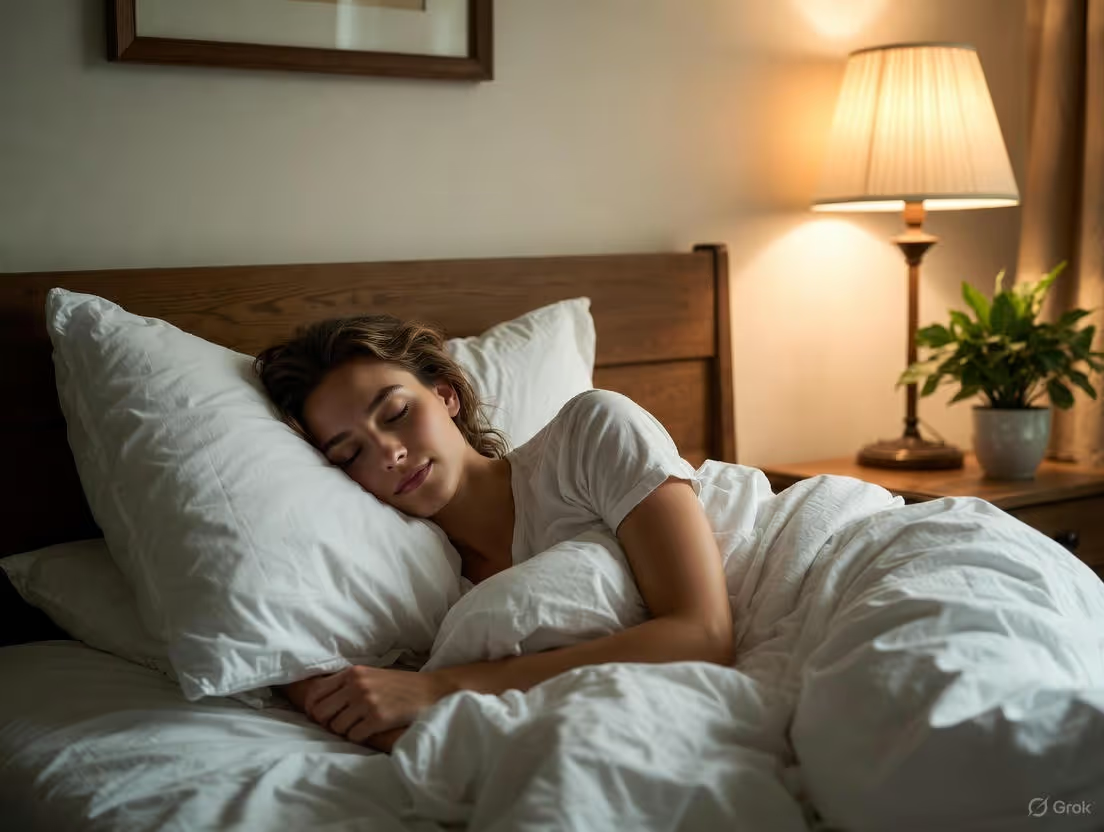
Nighttime Wellness Routine for Students During Exam Season
During exams, students must fiercely protect their wind-down time to ensure sleep quality, which is critical for memory consolidation.
The Exam Season Survival Blueprint: Why Your Night Holds the Key to Peak Performance
The library is a ghost town at 2 AM. The glow of a laptop screen is the only light in a dorm room, illuminating a face etched with fatigue and highlighter streaks. Empty coffee cups form a precarious tower on the desk, a monument to hours spent wrestling with textbooks. This is the universal portrait of the student during exam season: a cycle of caffeine-fueled cramming, anxiety-induced insomnia, and the desperate hope that sheer hours logged will translate to a passing grade.
But what if this frantic, sleepless grind is the very thing sabotaging your success? Neuroscience and performance psychology present a compelling, counterintuitive truth: the path to academic excellence isn’t paved with all-nighters. It’s built during the hours you aren’t studying—specifically, in the quiet, intentional rituals of your night.
Welcome to the new paradigm of exam preparation: the Nighttime Wellness Routine. This isn’t about adding more to your to-do list; it’s about strategically engineering your evening to optimize your brain’s most powerful performance-enhancing tool: recovery. Sleep isn’t downtime. It’s uptime for your memory. During deep sleep, your brain actively consolidates the day’s learning, moving information from the fragile short-term hippocampus to the robust long-term cortex—a process literally called memory consolidation. Skimp on sleep, and you’re not just tired; you’re preventing the very learning you’re fighting so hard to achieve.
Furthermore, exam season is a holistic stress test. It attacks your mental clarity, emotional resilience, and physical health simultaneously. A reactive approach—panicking when burnout hits—leaves you vulnerable. A proactive, nighttime wellness routine is your armor. It transforms the period from your last study session to the moment you fall asleep into a deliberate wind-down protocol, priming your nervous system for restoration rather than spiraling into a vortex of stress and blue light.
In this comprehensive guide, we will deconstruct the science of nighttime optimization and build a practical, personalized framework for your exam season nights. We’ll move beyond generic “get more sleep” advice and into the realm of actionable rituals, environmental hacks, and biometric insights that turn your evening into a launchpad for next-day brilliance. We’ll explore how technology, particularly subtle, data-driven devices like the Oxyzen smart ring, can move you from guessing about your sleep to knowing—and improving—it with precision.
Forget surviving exam season. It’s time to thrive through it. Let’s begin by understanding the profound enemy of your potential: the all-nighter myth itself.
The Science of Sleep & Memory: Why Your Brain Studies While You Rest
To appreciate the power of a nighttime routine, you must first understand the spectacular biological drama unfolding in your brain after you close your books. The notion that learning stops when studying stops is a fundamental misconception. In reality, the most critical phase of learning—the filing, strengthening, and connecting of new information—begins in earnest once you enter the theater of sleep.
The Overnight Filing System: Memory Consolidation Explained
Imagine your brain’s hippocampus as a busy, temporary desk in a cluttered office. Throughout your day of studying, every fact, equation, and concept you review is placed as a scribbled note on this desk. The desk has limited space. By evening, it’s overflowing. Sleep, specifically deep Non-REM sleep, is the administrative assistant that arrives at night. It takes these scattered, fragile notes from the hippocampal "desk" and systematically files them away into the vast, organized library of your cerebral cortex—your brain’s long-term storage.
This process, memory consolidation, isn’t passive. It’s an active, neural replay. Researchers using EEG and fMRI scans have observed that the patterns of brain activity that occurred while you learned a new skill or information are replayed during sleep, but at a much faster rate. This replay strengthens the synaptic connections between neurons, literally etching the day’s lessons into the physical architecture of your brain. A study from the University of Lübeck in Germany demonstrated this elegantly: participants who slept after learning word pairs retained 85% of them, while those who stayed awake retained only 60%.
Sleep Stages and Their Academic Superpowers
Not all sleep is created equal. Your sleep architecture is a cyclical journey through distinct stages, each with a specialized role in cognitive recovery:
NREM Stage 1 & 2 (Light Sleep): The gateway to sleep. Here, your body begins to disengage, heart rate slows, and body temperature drops. This stage is crucial for processing motor memories and simple facts.
NREM Stage 3 (Deep Sleep): The physical and mental restoration powerhouse. This is the most critical phase for memory consolidation of declarative information—the facts, dates, formulas, and vocabulary you’ve been cramming. Growth hormone is released, repairing tissues and strengthening the immune system, which is often besieged by exam stress. Disrupting deep sleep is akin to shredding your study notes before the test.
REM Sleep (Dream Sleep): The creative synthesizer. REM sleep is associated with processing emotional memories, making abstract connections, and integrating new knowledge with old. It’s where you might "sleep on a problem" and wake with a novel solution. REM sleep enhances procedural memory—the "how-to" of solving complex physics problems or writing a compelling essay.
A full 7-9 hour sleep cycle allows you to pass through these stages multiple times, with deep sleep dominating the earlier cycles and REM sleep lengthening toward morning. Cutting your sleep short disproportionately robs you of this later, REM-rich sleep, stifling creativity and complex problem-solving—skills essential for tackling higher-order exam questions.
The High Cost of Sleep Debt on GPA
The consequences of neglecting this nightly brain maintenance are quantifiable and severe. Sleep deprivation:
Impairs Focus & Attention: It reduces activity in the prefrontal cortex, the brain’s CEO, responsible for decision-making, focus, and inhibiting distraction. In an exam hall, this means zoning out, rereading questions, and making careless errors.
Sabotages Recall: It leaves the "filing" incomplete. You might recognize information (feeling of familiarity) but be unable to actively recall it (free recall), leading to the agonizing "it’s on the tip of my tongue" phenomenon mid-exam.
Increases Stress Reactivity: The amygdala, your brain’s fear center, becomes hyperactive with poor sleep, while its connection to the rational prefrontal cortex weakens. This means a difficult question isn’t just a challenge; it feels like a catastrophic threat, triggering panic and blocking cognitive pathways.
The equation is simple: More waking study hours ≠ more learning. In fact, beyond a point, it creates sharply diminishing returns. An extra hour of quality sleep will do more for your test performance than an extra bleary-eyed hour of review. Your brain’s most productive study session happens after you’ve turned out the light. For a deeper dive into how biometric tracking can illuminate your personal sleep architecture, our blog features several case studies on using data to optimize sleep for cognitive performance.
Dismantling the All-Nighter: The True Cost of Cram Culture
Despite the overwhelming evidence, the allure of the all-nighter persists. It’s worn as a badge of honor, a symbol of dedication. But this cultural myth is not just ineffective; it’s actively destructive. Let’s dismantle it piece by piece and expose the true, steep cost of cram culture on your mind and body.
The Biochemistry of Burnout: Cortisol, Adenosine, and a Brain in Panic
When you force yourself to stay awake, especially under stress, you initiate a cascade of counterproductive biochemical reactions:
Cortisol Spikes: Stress and sleep deprivation cause cortisol, your primary stress hormone, to remain elevated. While useful for short-term alertness, chronic high cortisol is neurotoxic. It impairs hippocampal function—the very region you need for forming new memories. It’s like trying to save files on a corrupted hard drive.
Adenosine Flood: The chemical adenosine builds up in your brain the longer you’re awake, creating "sleep pressure." Caffeine works by blocking adenosine receptors. During an all-nighter, adenosine levels soar. When the caffeine eventually wears off, you experience an "adenosine crash"—a wave of crushing fatigue that can hit you during your exam, not after.
Prefrontal Cortex Shutdown: As mentioned, the CEO of your brain goes offline. This leads to poor judgment (e.g., deciding to focus on one obscure topic for hours), reduced impulse control (easy distraction by phones, snacks, anything), and an inability to think strategically—a disaster for exams requiring critical analysis.
The Illusion of Productivity and the Reality of Next-Day Deficit
The all-nighter trades a perceived short-term gain for a guaranteed long-term loss. You might feel a frantic sense of accomplishment as you "cover" material at 4 AM, but the quality of this learning is shallow and fragile. Studies show that sleep-deprived individuals consistently overestimate their own performance. You leave your study session thinking you’ve mastered the content, only to sit in the exam hall with a mind that feels like Swiss cheese—full of holes.
The deficit extends to the next day. Even if you manage to stay awake for the test, your cognitive abilities are operating at a severe handicap. Reaction times slow, equivalent to being legally drunk. Logical reasoning and complex thought become arduous. You’ve effectively chosen to take your exam while intellectually impaired.
A Sustainable Alternative: Spaced Repetition & Sleep
The powerful alternative to cramming isn’t simply "studying earlier." It’s a method called spaced repetition, and it’s perfectly married to proper sleep. This technique involves reviewing information at strategically increasing intervals (e.g., 1 day, 3 days, 1 week later). Each review session, especially when followed by sleep, powerfully reinforces the memory trace.
A nighttime routine enables this method. Your schedule could look like this:
Evening Study Session (7-9 PM): Active review of today’s and yesterday’s material.
Quality Sleep (10 PM - 6 AM): The brain consolidates that reviewed material.
Morning Brief Review (7-8 AM): A quick 20-minute quiz on last night’s topics. Thanks to overnight consolidation, recall will be stronger, efficiently locking the information in place.
This approach turns the synergy between study and sleep into a systematic, unstoppable learning engine. It respects your biology rather than fighting it. To understand how tools can help you build such consistent, data-informed habits, you can explore the principles behind Oxyzen’s holistic tracking approach.
Crafting Your Sanctuary: The Pre-Bed Environment Detox
Your environment is not a passive backdrop to your sleep; it’s an active participant. The sensory inputs in your bedroom directly signal to your primal nervous system whether it’s time for vigilant wakefulness or safe slumber. For students, bedrooms often double as war rooms—covered in textbooks, lit by harsh screens, and buzzing with notifications. To reclaim your sleep, you must first reclaim your sanctuary.
The #1 Sleep Saboteur: Conquering Blue Light
Smartphones, laptops, and tablets emit high levels of blue-wavelength light. This light is particularly effective at suppressing melatonin, the hormone your pineal gland releases to signal sleepiness. When you scroll through notes on a screen at 11 PM, you’re essentially telling your brain, "It’s high noon! Be alert!"
Actionable Detox Steps:
The Digital Curfew: Institute a mandatory screen shutdown 60-90 minutes before your target bedtime. This is non-negotiable. Use this time for the analog wind-down rituals we’ll discuss later.
Embrace Night Shift & Flux, But Don’t Rely Solely on Them: Tools like f.lux or built-in "Night Shift" modes are helpful by reducing blue light in the evening, but they don’t eliminate the stimulating content or the mental engagement. The goal is disconnection.
Go Analog for Final Review: If you must review, do it from printed notes or books under a warm, non-LED lamp in the final hour. The tactile act of turning pages is also less stimulating than scrolling.
Engineering the Ideal Sleep Cave: Temperature, Sound, and Darkness
Temperature: Your core body temperature needs to drop by about 1-2 degrees Fahrenheit to initiate sleep. A cool room (around 65°F or 18°C) facilitates this. Ditch heavy, synthetic comforters for breathable layers like cotton or linen.
Sound: Silence can be golden, but for dorms or noisy apartments, it can also be fragile. Consistent, low-volume white noise or pink noise is superior to unpredictable silence. It masks disruptive sounds (doors slamming, chatter) with a steady, non-stimulating auditory blanket. Use a dedicated machine or a simple smartphone app (placed across the room, on Do Not Disturb mode).
Darkness: Melatonin production is inhibited by even small amounts of light. Invest in blackout curtains or a quality sleep mask. Cover or remove every tiny LED light from chargers, smoke detectors, or electronics. Your room should be pitch black.
The Psychology of Space: Creating a "Study-Free" Zone
This is a mental hack as much as a physical one. If your bed is where you study, eat, watch Netflix, and sleep, your brain loses the strong association between "bed" and "sleep." This can lead to conditioned arousal—lying in bed but feeling wide awake.
The Bed is for Sleep (and Sex) Only: Stop studying in bed. If possible, don’t even do it in your bedroom. Create a physical separation. This reinforces the Pavlovian response: Bed = Sleep.
The Pre-Bed "Buffer Zone": Create a small, dedicated area for your pre-sleep routine—a comfortable chair with a reading lamp, a yoga mat on the floor. This becomes your transitional space from the wakeful world to the world of rest.
By detoxifying your environment, you remove the external obstacles to sleep. You send a clear, unambiguous signal to your brain and body: the workday is over; the restoration shift has begun. For students curious about how their own environment is impacting their sleep metrics, checking Oxyzen’s FAQ can provide insights on how its sensors interpret environmental factors.
The Wind-Down Protocol: Rituals to Signal Safety to Your Nervous System
With your sanctuary prepared, the next step is transitioning your internal state from "sympathetic" (fight-or-flight, alert) to "parasympathetic" (rest-and-digest, calm). You cannot sprint mentally until 10 PM and expect to fall asleep by 10:05. Your nervous system needs a bridge. A consistent, sensory-rich wind-down protocol of 60-90 minutes is that bridge.
The Power of Consistency: Anchoring Your Circadian Rhythm
Your body thrives on predictability. A consistent pre-sleep ritual, performed at roughly the same time each night, acts as a powerful zeitgeber (time-giver) for your circadian rhythm. It tells your internal clock, "In 60 minutes, we begin the sleep sequence." Over time, simply starting this ritual will trigger physiological changes—a slight drop in heart rate, a release of melatonin—preparing you for sleep.
Sensory Rituals for a Modern Student
Choose 3-4 of these rituals to build your personalized protocol:
Tactile: The Warm Bath or Shower Paradox. A warm bath 60-90 minutes before bed isn’t just relaxing. It deliberately raises your core temperature. When you step out, your body’s cooling mechanism kicks in, rapidly dropping your temperature. This accelerated cooling mimics the natural pre-sleep temperature drop, signaling powerfully that it’s time for sleep.
Olfactory: Harnessing Calm with Scents. The limbic system, your brain’s emotion and memory center, is directly connected to your olfactory bulb. Use this. Diffuse calming essential oils like lavender, chamomile, or cedarwood. Apply a few drops of diluted lavender oil to your temples or wrists. The scent becomes a conditioned cue for relaxation.
Gustatory: The Sleep-Promoting Nightcap. Avoid heavy meals, caffeine, and alcohol close to bed. Instead, opt for a small, warm, non-caffeinated beverage. Chamomile or passionflower tea contains apigenin, an antioxidant that binds to GABA receptors, promoting calm. A small glass of tart cherry juice is a natural source of melatonin.
Auditory: Ditching Stimulation for Soothing Sound. Replace podcasts, news, or upbeat music with something deliberately non-cognitive. This could be:
Guided Sleep Meditations or Body Scans: Apps like Calm or Insight Timer offer short sessions designed to pull awareness away from racing thoughts and into the body.
Ambient or Drone Music: Soundscapes without a melody or rhythm to follow.
Audiobooks (of familiar, low-stakes content): Re-listening to a favorite, comforting book can be ideal, as there’s no suspense to keep you engaged.
Visual: Feast Your Eyes on the Boring. After screens are off, avoid mentally taxing reading. Instead, browse a physical coffee table book of nature photography, do some very light doodling in a journal, or simply watch the flame of a candle (safely). The goal is to let your eyes relax their focus.
The Journaling Dump: Getting It Out of Your Head
This is arguably the most powerful ritual for the anxious student mind. "The Journaling Dump" has one goal: to externalize the swirling thoughts that prevent sleep.
The Brain Dump: Set a timer for 10 minutes. Write down everything in your head. To-do lists, worries about the exam, a conversation you had, a random song lyric. Don’t edit, don’t judge, just download.
The Gratitude & Wins Log: After the dump, write down 3 specific things you are grateful for that day and 1 "win"—something you accomplished, no matter how small ("I understood that one tricky concept"). This ends your conscious day on a note of positivity and accomplishment, not anxiety.
This protocol isn’t a luxury; it’s a systematic shutdown sequence for a high-performance mind. It transitions you from being a student to being a human being who is about to recharge.
Digital Downtime & The Mindful Unplug: Reclaiming Your Attention
In the age of the infinite scroll, our most precious cognitive resource—sustained attention—is under constant assault. For students, this is a double-edged sword: the same devices that provide access to knowledge also host the greatest distractions. A mindful unplug isn’t just about reducing blue light; it’s about reclaiming the deep, linear focus that learning demands and then allowing that hyper-attentive state to dissolve before sleep.
The Myth of Multitasking and Its Fatigue Cost
Your brain does not multitask; it task-switches. Every time you toggle from a textbook to a WhatsApp notification to Instagram and back, you incur a "switch cost"—a lag in performance and a drain on your finite cognitive energy. Studies show that so-called multitasking can reduce productivity by up to 40% and increase stress hormones. By evening, your attentional muscles are not just tired; they’re sprained from constant, frantic switching. An unplugged wind-down allows these muscles to finally relax.
Implementing a "Phones-Out-of-Sight" Policy
Willpower is a depleted resource by nighttime. Relying on it to ignore a buzzing phone next to your bed is a losing battle. You must change your environment:
Designate a Charging Station: Choose a location outside your bedroom—the kitchen, a hallway desk. This is where your phone and laptop live after your digital curfew.
Invest in a Traditional Alarm Clock: The number one excuse for keeping a phone in the room is the alarm function. A $15 digital clock removes this excuse entirely, eliminating the temptation to "just check one thing" in the dark.
Use "Do Not Disturb" Strategically: In the hours leading up to your unplug, activate "Do Not Disturb" with exceptions only for true emergencies (e.g., calls from family). This reduces the intermittent reinforcement of notifications that keeps you hooked.
The Art of the Analog Evening
What fills the void left by your devices? This is where you rediscover slow, satisfying activities that have a natural endpoint and don’t hijack your dopamine system:
Read Fiction (Physical Books): Fiction, unlike studying, engages the brain in narrative and empathy, which uses different neural pathways and promotes a gentler cognitive state. A physical book provides a clear endpoint—a chapter, a number of pages.
Gentle Stretching or Yoga Nidra: Unlike intense evening workouts, gentle, restorative yoga or a practice like Yoga Nidra ("yogic sleep") focuses on release and body awareness, directly activating the parasympathetic nervous system.
Simple Crafts or Puzzles: Knitting, adult coloring books, or a small jigsaw puzzle provide focused attention without digital glare or high stakes. The repetitive, rhythmic nature of these acts can be meditative.
Nutrition for Nocturnal Recovery: Fueling Sleep & Cognitive Repair
You are not just what you eat; you are when and how you eat, especially in relation to sleep. Exam season drives many students toward a diet of quick sugars, excessive caffeine, and late-night snacking—a recipe for disrupted sleep and next-day brain fog. Strategic evening nutrition supports stable blood sugar, provides the raw materials for sleep hormones and neural repair, and avoids digestive drama that can keep you awake.
The Trio of Sleep-Supportive Nutrients
Certain nutrients act as direct co-factors for sleep-related biochemistry:
Magnesium: Often called the "relaxation mineral," magnesium plays a role in over 300 enzymatic reactions, including regulating GABA (a calming neurotransmitter) and melatonin. It helps relax muscles and quiet the nervous system. Sources: Dark leafy greens, nuts (especially almonds and cashews), seeds (pumpkin, sunflower), bananas, dark chocolate (in moderation, earlier in the evening).
Tryptophan: This essential amino acid is the precursor to serotonin, which is then converted into melatonin. It’s famously found in turkey, but pairing it with carbohydrates is key. Carbs trigger insulin release, which helps clear other competing amino acids from the bloodstream, allowing tryptophan to cross the blood-brain barrier more effectively. Smart Pairing: A small bowl of oatmeal with sliced almonds, whole-grain crackers with a thin slice of cheese, a banana with a tablespoon of nut butter.
Glycine: This amino acid has been shown in studies to improve subjective sleep quality and reduce daytime sleepiness. It acts as an inhibitory neurotransmitter, lowering core body temperature. Sources: Bone broth, collagen peptides (stirred into a warm drink), skin-on chicken, fish.
The 3-Hour Rule: Timing Your Last Meal
Aim to finish your last substantial meal 2-3 hours before bedtime. This allows your body to complete the bulk of digestion (which requires energy and can disrupt sleep) before you attempt to rest. Going to bed overly full can cause discomfort, acid reflux, and fragmented sleep. Conversely, going to bed starving can also keep you awake, as low blood sugar can trigger cortisol release.
Ideal Evening Meal Composition: A balanced plate with complex carbohydrates (sweet potato, quinoa, brown rice), a moderate portion of lean protein (chicken, fish, tofu, legumes), and plenty of non-starchy vegetables. This provides sustained energy release and the necessary nutrients without a heavy digestive load.
The Smart Snack: What to Eat If You’re Truly Hungry Before Bed
If you need a small snack within 60-90 minutes of bed, choose something that combines a bit of protein with a complex carb or healthy fat to stabilize blood sugar:
A small apple with a tablespoon of almond butter.
A handful of tart cherries (fresh, frozen, or a small glass of 100% juice).
A small cup of plain Greek yogurt with a sprinkle of chia seeds.
A few whole-grain crackers with a slice of turkey or a swipe of hummus.
A cup of caffeine-free herbal tea (chamomile, valerian root, passionflower).
Hydration: The Goldilocks Principle
Dehydration can lead to waking up with a dry mouth or headaches. Overhydration, especially right before bed, guarantees disruptive bathroom trips. The key is front-loading your hydration during the day. Slow down your fluid intake 60-90 minutes before bed, having just a small sip if needed with your evening supplement or tea. This allows your body to process fluids without interrupting your precious sleep cycles.
By viewing your evening food as "recovery fuel," you move from mindless consumption to strategic nourishment, directly supporting the physical repair and memory consolidation that happens after lights out.
Movement & Stillness: Using Your Body to Quiet Your Mind
The relationship between physical activity and sleep is profound, yet nuanced. While regular exercise is one of the most reliable promoters of sleep quality, the timing and type of movement in the evening are critical. The goal is not to exhaust yourself into collapse, but to use deliberate movement—and its counterpart, deliberate stillness—to release physical tension and expel residual mental energy.
The Evening Exercise Window: Energize vs. Sedate
Vigorous, heart-pumping exercise (HIIT, running, competitive sports) is fantastic for sleep—when done earlier in the day. It raises core temperature and releases stimulants like adrenaline and cortisol, which can take several hours to dissipate. For most people, finishing intense exercise at least 3-4 hours before bedtime is wise.
The evening window (within 2-3 hours of bed) is the domain of moderate, rhythmic, and mindful movement. This type of activity promotes sleep by:
Reducing physical tension accumulated from hours hunched over a desk.
Providing a gentle release of anxiety and nervous energy.
Focusing the mind on bodily sensations, breaking the cycle of ruminative thoughts.
Ideal Pre-Sleep Movement Practices
Walking: A simple, 20-30 minute walk outside after dinner is arguably perfect. The gentle, rhythmic motion is calming, and exposure to the fading natural light helps reinforce circadian rhythms. It aids digestion and provides a mental separation between "study day" and "evening."
Restorative or Yin Yoga: Unlike the vigorous flows of a vinyasa class, these practices involve holding passive, supported poses for 3-5 minutes each. They target the connective tissues (fascia) and deeply stimulate the parasympathetic nervous system. Poses like Legs-Up-The-Wall (Viparita Karani) or Supported Child’s Pose are potent signals for relaxation.
Tai Chi or Qigong: These ancient "moving meditations" combine slow, deliberate movements with deep, rhythmic breathing. They are exceptional for cultivating a state of calm, present-moment awareness and are explicitly designed to balance the body's energy (qi).
Gentle Stretching or Foam Rolling: A focused 10-15 minute session targeting tight areas—hips from sitting, shoulders, chest, and hamstrings—can relieve physical discomfort that might otherwise keep you awake. Pair it with deep, diaphragmatic breathing.
The Bridge to Stillness: Diaphragmatic Breathing
After movement, a direct practice of stillness is the final key. When stress hits, breathing becomes shallow and rapid, centered in the chest. This sustains the fight-or-flight state. Diaphragmatic (belly) breathing is the physiological override switch.
The 4-7-8 Technique (Dr. Andrew Weil): A simple, potent practice to do in bed.
Exhale completely through your mouth.
Inhale quietly through your nose for a count of 4.
Hold your breath for a count of 7.
Exhale completely through your mouth, making a gentle "whoosh" sound, for a count of 8.
This is one breath. Repeat for 4 cycles.
This technique acts as a mild natural tranquilizer for the nervous system, slowing the heart rate and promoting a state of calm. It’s a tool you can use anytime you feel anxiety creeping in, effectively bridging the gap between an active day and restorative sleep. Understanding your body’s unique response to these practices is part of a personalized wellness journey, something we delve into in our story about creating technology that respects the subtlety of human biology.
Mastering the Mental Shutdown: Anxiety-Busting Techniques for the Pre-Exam Mind
For all the environmental and physiological optimization, the most formidable obstacle to sleep remains the student's own mind. It’s the racing, repetitive loop: "Did I study enough? What if I forget everything? What if it’s all essay questions?" This cognitive hyperactivity, often a symptom of generalized anxiety, is the final boss of the nighttime routine. To defeat it, you need cognitive and psychological tools designed for the task.
Cognitive Distancing: You Are Not Your Thoughts
The first principle is learning to observe your anxious thoughts without becoming entangled in them. Imagine your thoughts as leaves floating down a stream, or as ticker tape scrolling by on a screen. You see them, acknowledge them ("Ah, there's the 'I'm going to fail' thought again"), but you don't have to jump into the stream or argue with the ticker tape. This is mindfulness in action. It creates a small but crucial space between the thought and your emotional reaction, diminishing its power.
Applied Relaxation Techniques
These are active practices to engage when you feel anxiety building or when you're lying in bed with a busy mind.
Progressive Muscle Relaxation (PMR): Systematically tense and then relax each major muscle group in your body, starting from your toes and moving up to your forehead. The intense contrast between tension and release teaches your body what true relaxation feels like and pulls focus away from mental chatter and into physical sensation.
The "Worry Period" Technique: If worries are persistent, schedule a designated 15-minute "Worry Period" earlier in the evening, during your wind-down but well before bed. During this time, you are allowed—even encouraged—to write down all your fears and anxieties in detail. When the time is up, you close the notebook and tell yourself, "I've addressed my worries for today. If they come back at bedtime, I will acknowledge them and remind myself I have a plan to handle them tomorrow." This contains anxiety to a specific time, preventing it from hijacking your entire night.
Reframing the Narrative: From Fear to Readiness
Anxiety often stems from a narrative of helplessness ("I'm not in control"). Reframing is the practice of consciously changing that story.
Evidence-Based Reassurance: Ask yourself: "What is the evidence that I am prepared?" List the hours you studied, the practice problems you solved, the lectures you attended. This counters the emotional, catastrophic thinking with facts.
Process vs. Outcome Focus: Your anxiety is likely fixated on the outcome (the grade). Shift your self-talk to the process, over which you do have control. "My job tonight is not to guarantee an A+. My job is to follow my routine, give my brain the rest it needs to consolidate what I've learned, and walk into that exam hall as restored and focused as possible." This is empowering and reduces the overwhelming pressure.
The "Worst-Case" Reality Check: Sometimes, you need to face the fear head-on. Ask: "If the worst happens and I fail this exam, what then?" Walk yourself through the realistic consequences. You would speak to the professor, you would have a chance to retake it, you would learn and adapt. This exercise often reveals that the catastrophic fantasy is far worse than the manageable reality, deflating the anxiety.
By mastering these mental shutdown techniques, you move from being a passive victim of your pre-exam thoughts to an active director of your mental state. You don't eliminate stress; you learn to manage its volume, turning down the noise so your brain can access the quiet it needs to recharge. For ongoing support and community stories about managing academic stress, our blog is a dedicated resource for evidence-based wellness strategies.
Leveraging Technology: How a Smart Ring Can Be Your Secret Sleep Coach
In a guide advocating digital detox, this may seem contradictory. But the key is mindful technology use. Not all tech is created equal. The right technology should work for you passively, providing insights without demanding attention, and should be aimed at enhancing your self-awareness, not distracting from it. This is where a discreet, data-driven wearable like a smart ring shifts from being a gadget to being a fundamental tool in your nighttime wellness arsenal.
From Guesswork to Knowledge: The Power of Biometric Data
Until recently, understanding your sleep was guesswork. "I think I slept okay." "I tossed and turned a lot." A advanced smart ring changes that by providing objective, night-long biometric data, including:
Heart Rate (HR) & Heart Rate Variability (HRV): Your nightly HRV—the variation in time between heartbeats—is one of the single best non-invasive measures of your nervous system's recovery capacity. A higher HRV generally indicates a more resilient, relaxed parasympathetic state. Watching your HRV trend upward as you implement your nighttime routine is powerful positive reinforcement.
Resting Heart Rate (RHR): Your RHR naturally drops during sleep. A smart ring tracks your true sleeping RHR, which is often lower than your waking RHR. A consistently elevated sleeping RHR can be an early indicator of illness, excessive stress, or poor recovery.
Blood Oxygen (SpO2): While you sleep, it’s useful to ensure your blood oxygen levels remain in a healthy range. Significant, frequent dips could indicate sleep disturbances like sleep apnea (rare but possible in students, especially those with certain risk factors) or simply poor sleep posture.
Body Temperature: Tracking subtle changes in your skin temperature across the night can reveal insights into your circadian rhythm and sleep quality.
The Sleep Stage Breakdown: Understanding Your Architecture
Beyond just "time asleep," a sophisticated device analyzes your sleep stages—Light, Deep, and REM—based on your movement and heart rate patterns. This is transformative. You can see, for example:
"My deep sleep was very low last night. Did I have caffeine too late or stress too much before bed?"
"My REM sleep was high—great for creative synthesis—so tomorrow might be a good day for writing or problem-solving."
"It took me 45 minutes to reach my first deep sleep cycle. I need to work on my wind-down efficiency."
This feedback loop is what turns routine into true optimization. You move from blindly following advice to conducting personal experiments: *"If I do a 15-minute meditation tonight instead of scrolling, how does it affect my deep sleep percentage?"*
The Morning Readiness Score: Your Objective Guide for the Day Ahead
Perhaps the most valuable feature for a student is a synthesized Readiness or Recovery Score. By combining your sleep data, HRV, RHR, and sometimes activity balance, the device provides a single, easy-to-understand metric each morning. This isn't about judgment; it's about guidance.
A High Readiness Score (e.g., 85+): Your system is recovered. This is a green light for a heavy study day, intense practice exams, or tackling your most challenging subject.
A Moderate Score (e.g., 70-84): You're okay, but not at your peak. Plan for steady, focused work but perhaps avoid mentally draining marathons. Prioritize a strict nighttime routine tonight.
A Low Score (e.g., <70): Your body is signaling fatigue or stress. This is a day for lighter review, administrative tasks, and extra emphasis on nourishment, gentle movement, and an early, impeccable wind-down. Pushing hard on a low-score day often leads to diminishing returns and deeper burnout.
This objective data cuts through your subjective feelings ("I feel tired but I should push through") and provides a science-backed reason to prioritize recovery. It teaches you to listen to your body's signals with precision, making you the CEO of your own health and performance. To see how this technology integrates into a holistic view of wellness, you can learn more about Oxyzen's approach to personalized data on our main site.
Building Your Personalized Nighttime Routine: A 7-Day Implementation Plan
Knowledge is useless without implementation. Now that we’ve explored the pillars—from sleep science and environment to nutrition, movement, mindset, and data—it’s time to build your routine. Perfection is the enemy of progress. Start small, be consistent, and use the following flexible, modular 7-day plan to experiment and discover what works uniquely for you.
The Modular Approach: Mix, Match, and Personalize
Think of the following elements as building blocks. Your goal this week is not to do all of them every night, but to test them and assemble a 60-90 minute sequence that feels sustainable and effective.
Core Blocks (Choose 4-5 to form your nightly routine):
Digital Sunset (Block all screens 90 min before bed)
Environment Prep (Dim lights, cool room, white noise)
Light Movement (20-min walk, 15-min gentle stretch)
The 7-Day Personalized Nighttime Routine Blueprint
Knowledge is useless without implementation. Now that we’ve explored the pillars—from sleep science and environment to nutrition, movement, mindset, and data—it’s time to build your routine. Perfection is the enemy of progress. Start small, be consistent, and use the following flexible, modular 7-day plan to experiment and discover what works uniquely for you.
The Modular Approach: Mix, Match, and Personalize
Think of the following elements as building blocks. Your goal this week is not to do all of them every night, but to test them and assemble a 60-90 minute sequence that feels sustainable and effective.
Core Blocks (Choose 4-5 to form your nightly routine):
Digital Sunset (Block all screens 90 min before bed)
Environment Prep (Dim lights, cool room, white noise)
Light Movement (20-min walk, 15-min gentle stretch)
Mindful Nourishment (Sleep-supportive snack 60+ min before bed)
Focused Relaxation (Guided meditation, deep breathing, reading fiction)
Biometric Check-In (Brief review of previous night’s sleep data, if using a tracker)
Your 7-Day Implementation Journey
Day 1: The Audit & Foundation
Tonight’s Focus: No major changes. Simply observe your current routine. What time do you actually stop studying? When do you look at your last screen? What’s your pre-sleep mental state? Jot down notes without judgment.
One Small Shift: Choose ONE foundational block to implement. For most, the highest-impact starting point is the Digital Sunset. Set a firm, non-negotiable time 90 minutes before your target bedtime to shut down all laptops, tablets, and phones. Charge them outside your room. Experience the quiet.
Day 2: Environment & Sensation
Build On: Maintain your Digital Sunset.
Tonight’s Focus: Environment Prep and Hygiene & Thermal Ritual. 60 minutes before bed, adjust your space: dim overhead lights, turn on a salt lamp or warm-light lamp, set your white noise, and crack a window for cool air. Then, take a warm (not hot) shower or bath. Focus on the sensory experience—the scent of soap, the feel of warm water, the cool air afterward.
Note: How did the temperature shift make you feel?
Day 3: Move & Release
Build On: Maintain Digital Sunset and Environment/Hygiene rituals.
Tonight’s Focus: Light Movement. After dinner or about 2 hours before bed, engage in 20 minutes of non-strenuous movement. This could be a leisurely walk outside (exposing you to fading natural light), a short series of yoga stretches (think Cat-Cow, Child’s Pose, Legs-Up-The-Wall), or gentle foam rolling. The goal is release, not exertion.
Note: Did movement quiet your mind or energize you? Adjust timing or intensity tomorrow accordingly.
Day 4: Nourish & Note
Build On: Maintain your previous blocks.
Tonight’s Focus: Mindful Nourishment and Mental Download. If hungry 60-90 minutes before bed, consciously choose a sleep-supportive snack (e.g., banana with almond butter, chamomile tea). Then, sit with a notebook for 10 minutes. Do a pure Brain Dump of every swirling thought for 7 minutes. For the final 3, list 3 specific things you were grateful for today.
Note: Did getting thoughts on paper create mental space?
Day 5: Dive into Stillness
Build On: Maintain your chosen blocks.
Tonight’s Focus: Focused Relaxation. Tonight, after your hygiene ritual, dedicate 10-15 minutes to a formal practice. Try a guided sleep meditation from an app (using a device in airplane mode, placed across the room), or practice the 4-7-8 breathing technique for 4 cycles while lying in bed. Alternatively, read a physical fiction book for 20 minutes.
Note: Which practice felt most natural and calming? This is a key to personalization.
Day 6: Integrate & Refine
Tonight’s Focus: Assemble your ideal sequence. Based on your experiments, choose the 4-5 blocks that felt most impactful and natural. Write down your official, personalized 60-minute pre-bed routine. For example:
T-90 min: Digital Sunset. Phone to kitchen charger.
T-45 min: Brain dump & gratitude journaling with a cup of passionflower tea.
T-30 min: Read fiction in comfortable chair.
T-10 min: In bed, 4-7-8 breathing.
Lights out.
Execute this sequence precisely tonight.
Day 7: Observe & Tweak with Data
Build On: Execute your personalized routine.
Tonight’s Focus: Biometric Check-In. If you have access to a wearable like the Oxyzen ring, spend 5 minutes in the morning reviewing last night’s data. Don’t obsess over single numbers; look for trends. Did your sleep latency (time to fall asleep) decrease? Did your deep sleep or HRV improve compared to Day 1? Use this objective feedback to make one final tweak to your routine. For instance, if you see a low HRV score, you might decide to add 5 minutes of meditation or move your snack earlier.
By the end of this week, you will have moved from having no plan to possessing a researched, tested, and personalized nighttime protocol. This routine becomes your non-negotiable anchor during exam season—a sacred space of recovery that you own and control.
Beyond the Basics: Advanced Sleep Optimization for Peak Performance
Once your foundational routine is solid, you can explore advanced, evidence-based strategies to fine-tune your sleep for even greater cognitive and physical resilience. These are the "pro tips" that can help you gain an extra edge when the academic pressure is at its peak.
Temperature Manipulation for Faster Sleep Onset
We’ve discussed a cool room, but you can be more proactive. Research from the University of Pittsburgh School of Medicine suggests that warming your distal skin areas (hands and feet) while keeping your core cool facilitates rapid sleep onset. This is why some people sleep with socks on—it dilates blood vessels in the feet, releasing heat and lowering core temperature.
Advanced Tactic: If you have trouble falling asleep, try wearing a pair of light, breathable socks to bed after your warm shower. Conversely, ensure your torso isn’t over-bundled.
While food-first is always best, certain supplements have robust research for sleep support. Crucially, you should consult with a healthcare professional before starting any supplement regimen, especially to check for interactions with medications or conditions.
Magnesium Glycinate or L-Threonate: These highly bioavailable forms of magnesium are particularly effective for relaxation and cognitive function, respectively. A dose of 200-400 mg about 30-60 minutes before bed can support muscle relaxation and GABA activity.
L-Theanine: An amino acid found in green tea, L-Theanine (100-200 mg) promotes alpha brain waves (associated with relaxed alertness) and can reduce anxiety without causing drowsiness, making it useful for calming pre-sleep mental chatter.
Adaptogens for Stress Resilience: Herbs like Ashwagandha and Rhodiola Rosea (taken earlier in the day, not at night) can help modulate the body’s stress response over time, leading to a calmer baseline state by evening. The cumulative effect can be a quieter nervous system at bedtime.
Strategic Caffeine & Light Cycling
This is about managing your entire day to serve your night.
Caffeine Curfew: Caffeine has a half-life of 5-6 hours. For a 10 PM bedtime, your last caffeinated drink should be no later than 2-4 PM. Be mindful of hidden sources: green tea, chocolate, some medications.
Morning Light Anchor: The most powerful signal for your circadian rhythm is bright morning light. Getting 10-15 minutes of outdoor sunlight (without sunglasses) within 30-60 minutes of waking massively strengthens your internal clock. This makes you more alert in the morning and increases sleep pressure at the right time in the evening. On cloudy days, a bright light therapy lamp (10,000 lux) for 20-30 minutes can mimic this effect.
The Power of Napping (The Right Way)
A well-executed nap can be a performance-enhancing tool, but a poorly timed one can sabotage nighttime sleep.
The 20-Minute "Power Nap": This short nap is primarily Stage 2 sleep, which boosts alertness, motor learning, and memory consolidation without entering deep sleep. You wake up refreshed, not groggy.
The 90-Minute "Full Cycle" Nap: This allows you to complete a full sleep cycle (Light, Deep, REM). It is excellent for creative problem-solving and emotional processing, but it requires more time and can lead to sleep inertia (grogginess) upon waking.
Golden Rule: Never nap after 3 PM if you have a standard bedtime. Keep it early, keep it short, and use it strategically after a poor night’s sleep or before a long evening study session. For more insights on how sleep structure impacts daytime function, our blog has a detailed analysis of nap science.
By layering these advanced strategies onto your solid routine, you transform sleep from a passive state into an active, optimized component of your academic training regimen. You’re not just sleeping; you’re engaging in targeted neural maintenance.
Troubleshooting Common Sleep Disruptors During Exams
Even with the best routine, real-life challenges arise. Exam stress has a way of breaking through our best-laid plans. Here’s how to troubleshoot the most common sleep disruptors when you’re in the thick of it.
"My Mind Won’t Stop Racing About the Exam"
This is the #1 issue. When cognitive techniques alone aren’t enough, combine them with a sensory anchor.
The 5-4-3-2-1 Grounding Technique: Engage your senses to pull you into the present.
Name 5 things you can see in the room.
Name 4 things you can feel (the pillow under your head, the texture of the sheets).
Name 3 things you can hear (the white noise, distant traffic, your breath).
Name 2 things you can smell (the laundry detergent on your pillow, the faint scent of lavender).
Name 1 thing you can taste (the lingering mint from toothpaste).
The "Not My Problem Until" Mantra: Tell yourself, "Worrying about this exam right now will not change the outcome. It is not my problem until 8 AM tomorrow when I walk into the hall. My only job right now is to rest my brain so it can perform at 8 AM." Repeat this as a calm, factual statement.
"I Woke Up in the Middle of the Night and Can’t Get Back to Sleep"
This is normal, but how you handle it is critical. The worst thing you can do is look at the clock and start calculating lost sleep.
The 20-Minute Rule: If you’re awake for more than 20 minutes, get out of bed. Go to your pre-defined "buffer zone" chair. Do something mindless and calm in very dim light: read a boring textbook (not a novel you’ll get hooked on), listen to a dull audiobook, or do a repetitive, simple puzzle. No screens. Only return to bed when you feel drowsy. This preserves the "bed = sleep" association.
Acceptance & Rest: Remember that even quiet rest in bed with your eyes closed provides significant neurological benefits. Shift your goal from "I must be asleep" to "I will rest my body and mind peacefully." This reduction in performance anxiety about sleep itself can often allow sleep to return.
"My Sleep Schedule is Totally Inverted (Nocturnal)"
Fixing this requires a gradual reset, not a sudden change.
Phase Advance Method: Go to bed 15 minutes earlier each night and wake up 15 minutes earlier each morning. Use bright light immediately upon waking to anchor the new time. This gentle shift is more sustainable than trying to jump back 2 hours at once.
Leverage Hunger & Light: On the day you start the reset, get bright morning light, have a protein-rich breakfast at your new "morning" time even if you’re not hungry, and avoid eating late at night. This helps reset peripheral circadian clocks in your organs.
"I Have a Practical/Oral Exam Early, and I’m Too Nervous to Sleep"
For high-stakes performance events, the priority is deep, restorative sleep the night before the night before. That’s when your body stores most of the deep sleep you’ll need.
Night -2 Strategy: Prioritize a flawless, extended sleep routine two nights before the exam. This builds a cognitive buffer.
Exam Eve Strategy: Focus on your wind-down routine and accept that sleep might be lighter. Use all your relaxation tools. Even if you sleep less, the quality from Night -2 will carry you. Trust that your adrenaline on the day will provide alertness, and a calm, restored nervous system will provide the fine motor control and clarity you need.
Having these troubleshooting tools at your ready ensures that a single rough night doesn’t spiral into a cycle of sleep anxiety. It allows you to adapt, recover, and stay on track. For additional support and to see how others have navigated these challenges, our community’s testimonials often highlight real-world strategies for overcoming sleep disruptions.
Measuring Success: Beyond Feeling "Less Tired"
How do you know your nighttime wellness routine is actually working? The metric of success isn’t just "I feel less tired" (though that’s great). It’s a multi-dimensional improvement in your daily function, academic performance, and overall well-being. Here are the tangible signs to look for, proving your investment in rest is paying dividends.
Cognitive & Academic Metrics
Improved Focus: You find yourself entering "flow state" more easily during study sessions. You can read a dense paragraph once and comprehend it, rather than your mind wandering and requiring re-reads.
Enhanced Recall: Information comes to mind more fluidly during self-quizzing and discussions. You experience fewer frustrating mental blocks.
Efficient Studying: You cover the same amount of material in less time because your working memory and processing speed are optimized. The quality of your study hours increases.
Better Problem-Solving: You approach practice questions and past papers with more flexibility and creativity, seeing alternative solutions or connections you previously missed.
Reduced Test Anxiety: While some nerves remain, they feel more like focused excitement rather than debilitating panic. You can access what you know under pressure.
Physical & Emotional Indicators
Consistent Energy: You experience stable energy levels throughout the day, without the drastic post-lag slumps or 3 PM crashes. You wake up feeling refreshed, not groggy.
Emotional Regulation: You’re less reactive to minor stressors. A disappointing practice test score feels like feedback, not a catastrophe. You can navigate group study tensions with more patience.
Resilience to Illness: You notice you’re not catching every cold that goes around the dorm. Your immune system, bolstered by quality sleep, is holding strong.
Faster Physical Recovery: Muscle soreness from that stress-relief workout fades quicker. Your body simply bounces back faster.
The Data Doesn’t Lie: Biometric Validation
If you’re using a tracking device, success is visible in your trends over 2-3 weeks:
Increased Sleep Consistency: Your bedtime and wake time graphs show a tight, regular pattern.
Higher Sleep Scores: Your overall sleep score shows a positive trend, with improvements in duration and quality.
Improved HRV Trend: Your Heart Rate Variability shows a gradual upward slope, indicating better autonomic nervous system balance and resilience.
Lower Sleeping Resting Heart Rate: Your heart is working less hard to maintain you overnight, a sign of efficient recovery.
Optimized Sleep Stages: You see a healthy balance of Deep and REM sleep, with less time spent tossing and turning (awake/light sleep).
This holistic evidence confirms you’re not just "getting by." You are operating at a fundamentally higher level of human performance because you are honoring your biology’s need for recovery. The nighttime routine ceases to be a chore and becomes the cornerstone of your success identity. To understand the philosophy behind creating technology that measures what matters for true wellness, you can read about our mission and values here.
Conclusion of This Portion: Your Nighttime Advantage
We have journeyed from the cellular-level drama of memory consolidation to the practical art of building a wind-down ritual. We’ve dismantled the destructive myth of the all-nighter and replaced it with the scientifically-robust framework of strategic recovery. You now understand that the silent hours of the night are not empty space to be filled with more frantic studying, but are, in fact, the most productive study hours of all—conducted by the most sophisticated learning machine in the known universe: your sleeping brain.
This first portion of the guide has equipped you with the foundational knowledge and actionable steps to claim your Nighttime Advantage. You have learned to:
Respect the non-negotiable science of sleep and memory.
Detoxify your sleep environment into a true sanctuary.
Construct a personalized wind-down protocol using sensory rituals.
Master the mindful unplug and mental shutdown techniques to quiet exam anxiety.
Fuel your recovery with strategic evening nutrition and movement.
Leverage technology as a passive coach, not a distraction.
Build, test, and refine your own 7-day routine.
Troubleshoot common disruptions and measure success beyond fatigue.
This is not a list of tips; it is an integrated operating system for your exam season life. It shifts you from being reactive—studying until you collapse—to being proactive, where every evening is a deliberate performance strategy for the following day.
In the next portion of this comprehensive guide, we will expand this foundation outward. We will explore how to integrate your newfound nighttime mastery with daytime performance protocols, creating a seamless 24-hour cycle of energy and focus. We’ll delve into strategic study scheduling that works in harmony with your circadian rhythms, stress-management techniques for the daytime, the role of social connection and breaks, and how to maintain this system through the entire exam period without burnout.
Your journey to mastering exam season—not just surviving it—has begun. Tonight is not just another night before a study day. It is the first night of your new routine, the first investment in the clear, confident, and capable mind that will walk into your next exam. Start small, be consistent, and trust the process. Your brain—and your GPA—will thank you.
Part Two: Optimizing Your 24-Hour Cycle for Unstoppable Focus
Welcome back to the second part of your comprehensive guide to thriving during exam season. If the first portion was about mastering the night, this installment is about engineering your day to create a seamless, high-performance 24-hour cycle. The ultimate goal is synergy: your nighttime routine primes you for a focused, resilient day, and your daytime habits, in turn, ensure you are perfectly prepared for deep, restorative sleep. This is the flywheel of academic excellence.
Think of your energy not as a finite tank to be depleted, but as a river that can be channeled, renewed, and even expanded. We’ll move beyond simply "studying more" and into the realm of cognitive ergonomics—designing your day to align with your brain's natural rhythms, managing stress proactively, and using strategic recovery to build stamina, not burn it out.
This section will cover the daytime counterpart to your nighttime sanctuary. We will explore how to structure your study sessions for maximum retention with minimum fatigue, how to harness the power of ultradian rhythms, how to manage the unique stressors of exam season without letting them hijack your nervous system, and how to build a supportive daily framework that makes your evening wind-down not just a necessity, but a natural, effortless transition. Let's begin by looking at the most important hour of your day—the one that sets the tone for all that follows.
The First Hour: A Morning Ritual for Mental Clarity
How you start your day doesn't just influence your morning; it programs your nervous system's trajectory for the next 16 hours. A reactive, chaotic morning—jolted awake by a blaring alarm, immediately checking emails and news, rushing out the door—sets a baseline of anxiety and reactivity. A intentional, mindful morning ritual, however, establishes a baseline of calm, focus, and control. For a student facing a day of intense mental work, this first hour is your strategic launchpad.
Why You Must Ditch the Snooze Button
The snooze button is the arch-nemesis of a restful nervous system. When your alarm goes off and you fall back asleep for 9-minute increments, you are fragmenting the tail end of your sleep cycle, often plunging yourself into a new cycle of deep sleep that is then abruptly interrupted. This results in sleep inertia—that thick, groggy, disoriented feeling that can last for hours. You are essentially giving yourself a controlled brain injury every morning. The first step to a better day is committing to a consistent wake time and getting upright with your first alarm.
Components of an Exam-Season Morning Power Hour (60 Minutes)
This isn't about adding more work; it's about a sequence that prioritizes state-setting. Adapt this to your schedule, but protect at least 30-45 minutes of it fiercely.
Phase 1: Hydration & Light Anchor (Minutes 0-15)
Upon Waking: Before you check your phone, before you think about your to-do list, drink a large glass of water. Your body is dehydrated from 7-9 hours of metabolic processes. Rehydrating kickstarts your metabolism and cognitive function.
Light Exposure: Get bright light into your eyes within 30 minutes of waking. If possible, go outside for 5-10 minutes. Sunlight is the most powerful signal to your suprachiasmatic nucleus (your brain's master clock) that the day has begun. It suppresses melatonin, boosts cortisol (in a healthy, alerting curve), and sets your circadian rhythm for the day. On overcast days or if you wake before sunrise, use a 10,000-lux light therapy lamp for 20-30 minutes.
Phase 2: Movement & Mindfulness (Minutes 15-35)
Gentle Activation: You don't need a full workout. 5-10 minutes of movement is enough to elevate your heart rate, increase blood flow to your brain, and release endorphins. This could be a short yoga flow (Sun Salutations), a set of bodyweight exercises (push-ups, squats, planks), or even just some dynamic stretching.
Mindfulness Practice: Spend 5-10 minutes in meditation, breathwork, or mindful journaling. This practice is the antithesis of exam anxiety. It trains your prefrontal cortex—the part of your brain responsible for focus and emotional regulation. It says, "I am in control of my attention." An app-guided meditation or simply focusing on your breath for 5 minutes can dramatically lower your baseline stress for the day.
Phase 3: Nourishment & Intention (Minutes 35-60)
Protein-Rich Breakfast: Do not skip breakfast. Your brain runs on glucose, but a sugary cereal or pastry will cause a spike and crash. Prioritize protein (eggs, Greek yogurt, tofu, protein smoothie) combined with healthy fats (avocado, nuts) and fiber (vegetables, whole grains). This provides a steady stream of energy and the amino acids necessary for neurotransmitter production.
Top 3 Prioritization: Instead of looking at a daunting, monolithic to-do list, write down the three most important tasks (MITs) for the day. For exam season, these are likely your key study goals. This act of prioritization forces clarity and prevents the feeling of being overwhelmed before you've even begun.
By the end of this hour, you have:
Reset your circadian rhythm (Light).
Rehydrated and fueled your brain (Water & Food).
Calmed your nervous system (Mindfulness).
Activated your body (Movement).
Gained clarity and direction (Intention).
You are now primed for deep work, not in a state of frantic reactivity. This ritual is the perfect complement to your evening wind-down, creating a "bookend" structure to your day that supports your central mission: effective learning.
Strategic Study Scheduling: Aligning with Your Biological Prime Time
Not all study hours are created equal. Your cognitive abilities—focus, memory, analytical thinking—fluctuate in predictable waves throughout the day, governed by your circadian rhythm and shorter ultradian rhythms. Studying against this current is draining and inefficient. Studying with it is like catching a wave. The goal is to map your most demanding intellectual work onto your personal periods of peak alertness.
Identifying Your Chronotype: Are You a Lion, Bear, Wolf, or Dolphin?
While the classic "morning lark" and "night owl" dichotomy exists, a more nuanced model by sleep specialist Dr. Michael Breus categorizes people into four chronotypes based on animal behavior:
Lion (The Early Riser): Wakes early, full of energy. Peak productivity is before noon. Energy dips in the late afternoon. Best to tackle the hardest subjects first thing in the morning.
Bear (The Follow-the-Sun): Aligned with the solar cycle. Peak productivity is mid-morning to early afternoon. This is the most common chronotype. Best for a standard 9-5 study schedule with a post-lunch dip.
Wolf (The Night Owl): Wakes later, slow to start. Peak productivity is late morning and again in the evening (often after 6 PM). Forcing a Wolf to do intense studying at 8 AM is a recipe for frustration.
Dolphin (The Light Sleeper): Often has irregular sleep, wakes easily. Peak productivity is in bursts throughout the day, often mid- to late-morning.
Your Action Step: Observe yourself for three days. When do you feel most alert, focused, and clear-headed without caffeine? When do you naturally feel drowsy or distracted? That’s your prime time.
The Ultradian Rhythm: The 90-Minute Focus Sprint
Within your daily circadian wave, your brain operates on 90-120 minute cycles called ultradian rhythms. In each cycle, you move from high alertness down into a physiological trough. This is why you can focus intensely for about 90 minutes before hitting a wall.
The Strategic Application: Structure your study sessions as 90-minute focused sprints. Use a timer. During this time, you are in "deep work" mode: phone on Do Not Disturb, email closed, single task on a single subject. This is when you tackle active recall (self-testing with flashcards, practice problems) and elaborative interrogation (explaining concepts in your own words, connecting new ideas to old ones).
The Non-Negotiable Recovery: After 90 minutes, you must take a 20-30 minute break. This is not a break to check social media. It is a true cognitive break: get up, walk around, look out a window at distant objects (to relax eye muscles), have a snack, or do a few stretches. This break allows your brain to process the information you just absorbed and replenish its neurochemical resources for the next sprint.
Designing Your Daily Study Map
Using your chronotype and ultradian rhythms, create a template for your ideal study day. Here’s an example for a Bear chronotype:
9:00 - 10:30 AM: PRIME TIME SPRINT 1. Tackle your most difficult subject or the topic requiring the highest concentration.
10:30 - 11:00 AM: Break. Walk, snack, hydrate.
11:00 AM - 12:30 PM: SPRINT 2. Second-most difficult subject.
12:30 - 1:30 PM: Lunch break (away from your desk!).
1:30 - 3:00 PM: SPRINT 3. This is often a lower-energy period. Good for administrative tasks: organizing notes, making flashcards, scheduling, or lighter reading.
3:00 - 3:30 PM: Break.
3:30 - 5:00 PM: SPRINT 4. Review session. Go over material from Sprints 1 & 2. Spaced repetition is key.
5:00 PM onward: Wind-down begins. Exercise, social time, dinner, relaxation.
A Wolf might shift this entire schedule 2-3 hours later, with Prime Time Sprints happening in the late morning and evening. The principle remains: match task difficulty to energy levels, and respect the 90-minute rhythm. For more on structuring a high-performance day, our blog features several posts on productivity systems that complement wellness tracking.
The Art of the Deep Work Session: Maximizing Retention, Minimizing Time
With your schedule mapped, the next layer is optimizing what happens inside each 90-minute sprint. Studying effectively is a skill, distinct from just "putting in the hours." Passive reading and re-reading are low-yield activities that create an illusion of competence. Active learning strategies, while more mentally demanding, create durable, flexible knowledge that you can access under exam pressure.
From Passive Review to Active Engagement
Your goal in every session is to retrieve information from your brain, not just recognize it. Here are the highest-yield techniques to incorporate:
The Feynman Technique: Named for the Nobel physicist, this is the ultimate test of understanding. Choose a concept. Explain it out loud or in writing, as if to a 12-year-old. Use simple language and analogies. Where you get stuck, fuzzy, or resort to jargon, you've identified a gap in your understanding. Return to your source material to clarify it, then try again.
Active Recall with Spaced Repetition Software (SRS): Tools like Anki are game-changers. You create digital flashcards that test you. The algorithm schedules reviews at optimal intervals—just as you're about to forget. This forces your brain to retrieve the information, powerfully strengthening the memory trace. 20-30 minutes of Anki review per day can be more effective than hours of re-reading.
Practice Testing: This is the gold standard. Do past exam papers, end-of-chapter problems, or create your own test questions. The act of generating an answer in a test-like environment is a uniquely powerful form of learning. It also reduces test anxiety by making the exam format familiar.
Interleaving: Instead of blocking your time by subject (e.g., 3 hours of Chemistry), interleave different topics or types of problems within a subject. Study a chemistry concept, then work on a physics problem, then return to a different chemistry concept. This feels harder and more frustrating in the moment, but it leads to better long-term retention and an improved ability to discriminate between concepts—a key skill for multiple-choice exams.



%402x.svg)