


How to Practice Mental Calm While Multitasking (Yes, It's Possible)
Practice calm while multitasking by periodically returning your focus to your breath or body, creating moments of mindfulness within activity.
Practice calm while multitasking by periodically returning your focus to your breath or body, creating moments of mindfulness within activity.
%402x.svg)
The modern world doesn’t just ask you to juggle; it demands you keep three chainsaws, a flaming torch, and a priceless vase in the air, all while answering emails and planning dinner. Multitasking is often hailed as a necessary skill for productivity, yet it’s also the very thing that leaves us feeling fractured, frazzled, and mentally drained. The conventional wisdom is clear: multitasking kills focus, diminishes the quality of our work, and spikes our stress levels. So, are we doomed to choose between being productive and being peaceful?
What if that’s a false choice? What if the secret isn’t in avoiding multitasking—an impossible feat for most—but in fundamentally transforming how we engage with it? This article is your guide to doing just that. We will dismantle the myth of chaotic juggling and rebuild a practice of what we’ll call “Calm Tasking.” This is not about doing more things poorly. It’s about cultivating a core of unshakable mental calm that you carry into and through your multiple obligations. It’s about making your mind a serene command center, not a chaotic switchboard.
The journey to calm amidst complexity begins with understanding the enemy: cognitive overload. But it ends with a set of tangible, trainable skills supported by both ancient mindfulness practices and cutting-edge biometric feedback from tools like the Oxyzen smart ring. Imagine having a personal guide on your finger, one that whispers insights about your stress and focus levels in real-time, helping you navigate your day with intention instead of reaction. This is the new frontier of personal wellness, where technology doesn’t distract us but helps us return to our center. For a deeper look at how this technology integrates into a holistic wellness lifestyle, you can explore our blog for more foundational guides.
Prepare to redefine productivity. Mental calm while multitasking isn’t an oxymoron; it’s an achievable state of flow. Let’s begin.
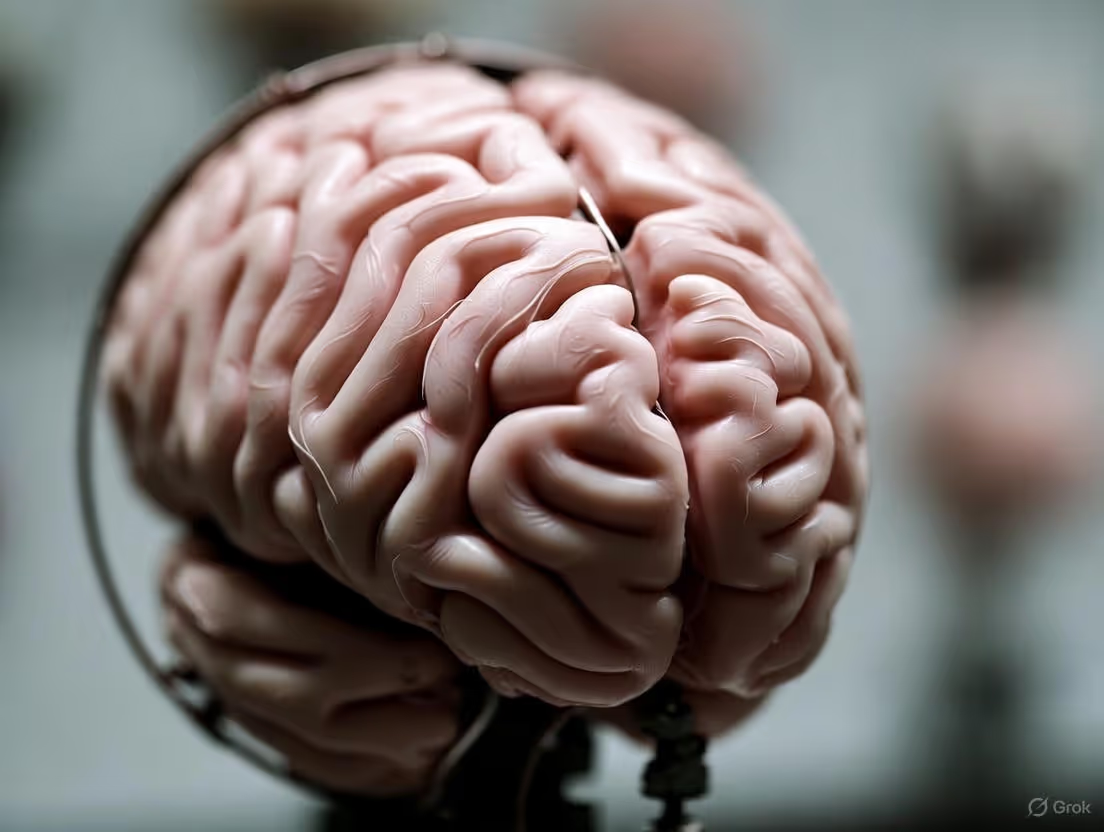
We wear our ability to multitask like a badge of honor, believing it signals competence and efficiency. Yet, neuroscience paints a starkly different picture: your brain cannot truly focus on two cognitive tasks simultaneously. What we experience as multitasking is, in reality, "task-switching"—a rapid, energy-guzzling toggling between foci that comes at a significant cost.
Think of your brain’s attentional resources not as a spotlight, but as a director on a movie set. When you single-task, the director is fully focused on one scene, ensuring every detail is perfect. When you attempt to multitask, that director is now frantically sprinting between two soundstages, yelling directions for a split second before running to the other. The result? Both productions suffer. There are delays, mistakes are made, and the director is left exhausted.
Every time you switch from writing a report to checking a Slack message and back again, your brain must:
Research indicates this switching can cost as much as 40% of someone’s productive time. More alarmingly, a study from the University of London found that participants who multitasked during cognitive tasks experienced IQ score declines similar to those who had missed a night of sleep or smoked marijuana.

This constant shifting doesn't just slow you down; it stresses you out. The prefrontal cortex, responsible for executive function and focus, becomes overtaxed. This triggers a low-grade fight-or-flight response, releasing cortisol and adrenaline. Over time, this chronic stress state impairs memory, hinders creativity, and burns you out.
Furthermore, the quality of your work plummets. You become prone to superficial thinking and errors. As author and professor Cal Newport argues in Deep Work, "To produce at your peak level you need to work for extended periods with full concentration on a single task free from distraction." True, valuable output is almost always the child of monotasking.
So, if our brains are wired for focus, why does multitasking feel so pervasive and necessary? The answer lies in our environment. The digital age is an engine of interruption. Notifications, open-plan offices, and a culture of instant responsiveness have hijacked our attention. The first step toward calm, therefore, is a radical reframe: Stop glorifying multitasking as a skill and start seeing it for what it is—a costly compromise often forced upon us by poor systems and boundaries.
The goal of Calm Tasking is not to optimize chaotic switching, but to build a fortress of focus so strong that when you must handle multiple streams, you do so from a place of intentional choice and regulated calm, not reactive panic. This begins with understanding your own unique stress signatures, which is where modern tools provide an incredible advantage. By tracking physiological markers like heart rate variability (HRV), a device like the Oxyzen ring can show you, in real data, the exact moment your nervous system starts paying the price for that chaotic switching, making the invisible cost suddenly very visible. For those curious about the science behind such tracking, our FAQ section details how these measurements work.
To build calm, we must first understand its biological blueprint. Your nervous system operates on a spectrum, with two key states defining the extremes: the sympathetic ("frazzle") and the parasympathetic ("flow") systems. Mastering multitasking with calm is essentially the practice of inviting more parasympathetic influence into a sympathetic-dominant modern world.

When you’re frantically tab-switching, reacting to pings, and feeling the pressure of deadlines, you’ve activated your sympathetic nervous system. This is your body’s ancient "fight, flight, or freeze" response. While essential for genuine danger, it’s triggered relentlessly by modern psychological stressors.
On the other end lies the state of "flow"—a term coined by psychologist Mihaly Csikszentmihalyi to describe a state of complete immersion and energized focus. Neurologically, flow is associated with a harmonious state where the prefrontal cortex (your “CEO”) temporarily dials down its hyper-vigilant, self-critical function—a process called "transient hypofrontality." This allows other brain networks to sync up seamlessly.
The maestro conducting this symphony between frazzle and flow is the vagus nerve, the longest cranial nerve and the command center of your parasympathetic system. A "high vagal tone" means your body can quickly return to calm after stress—this is the holy grail for resilient multitasking.
The best measurable proxy for vagal tone is Heart Rate Variability (HRV). Contrary to what you might think, a healthy heart doesn’t tick like a metronome; the time between beats varies slightly. Higher HRV indicates a heart that is responsive and resilient, a sign of a nervous system ready for challenge but anchored in calm.
This is where the fusion of ancient wisdom and modern technology becomes powerful. Mindfulness practices directly stimulate the vagus nerve, increasing HRV. Meanwhile, a wearable like the Oxyzen smart ring provides real-time, objective feedback on your HRV and stress levels. It turns an abstract concept like "nervous system state" into a tangible metric. You can see on your phone how a frantic morning of switching tasks craters your HRV, while a 5-minute focused breathing exercise restores it. This biofeedback loop is revolutionary—it allows you to move from guessing about your calm to training it with precision. Many of our users share how this insight transformed their relationship with work; you can read their stories in our testimonials.
Understanding this neuroscience empowers you. You are no longer a victim of your stress response but a trainee of your relaxation response. The following sections provide the practical tools to become that master.
Before we can manage multiple tasks with calm, we must reclaim our ability to dwell deeply with one. Think of single-task focus not as a rare luxury, but as the daily strength training for your attention muscle. It is the foundational ritual that makes everything else possible. Without it, attempts at calm multitasking are like building a skyscraper on sand.

Author Cal Newport’s concept of "Deep Work" is your operational blueprint. It is professional activity performed in a state of distraction-free concentration that pushes your cognitive capabilities to their limit. To integrate this:
Your mind will rebel. It will itch to check the news, remember a sudden "urgent" task, or simply wander. This is normal. The practice is in the gentle return.
This is where knowledge becomes power. By wearing a device like the Oxyzen ring during your focus blocks, you move from subjective feeling to objective insight.
By making single-task focus a non-negotiable daily ritual, you are doing more than producing better work. You are literally retraining your nervous system to tolerate and thrive in sustained concentration. You are building a home base of calm. From this secure base, you can then venture out to manage the necessary complexities of your day, returning to this centered state as needed. For more techniques on building sustainable productivity rituals, our blog offers a wealth of complementary strategies.
Armed with a strong focus muscle, we now approach the reality of multiple responsibilities. Calm tasking is not random reactivity; it is the strategic architecture of your workload. The goal is to group and order tasks in a way that minimizes destructive mental switching and maximizes momentum and calm. This is the art of Intelligent Chunking and Sequencing.
Not all task switches are created equal. Going from writing a strategic report to designing a graphic to having a sensitive conversation with a colleague is a cognitive rollercoaster. Each requires a different "brain mode." Chunking involves batching tasks that use similar modes.
The order in which you tackle your chunks is critical for maintaining mental calm. A poor sequence can leave you mentally fragmented before your day even begins.
Your brain is for having ideas, not holding them. Use a digital task manager or even a simple spreadsheet to visually map out your chunks for the week or day. The act of planning this architecture in advance is itself a calming practice—it externalizes the chaos and creates a map you can trust.
Furthermore, use technology to protect your sequence. Set your communication apps to "Do Not Disturb" during your focus chunks. Use website blockers if necessary. The integrity of your sequence depends on your ability to defend its boundaries. Remember, the story of our company, Oxyzen, was born from a similar desire to use technology to protect human focus and well-being, not undermine it.
By chunking and sequencing intelligently, you transform a chaotic to-do list into a curated workflow. You move from being at the mercy of incoming demands to conducting your cognitive resources with the calm precision of a maestro.
If Intelligent Sequencing is the blueprint for your day, then Mindful Transitions are the essential mortar holding it all together. This is arguably the most potent, yet most neglected, practice for maintaining calm while moving between tasks. A transition is any moment you shift attention: from one meeting to another, from work to a break, from a deep work block to checking email. Without a conscious transition, you carry the residual cognitive load and emotional state of the previous activity into the next—a recipe for accumulated stress and frayed focus.
When you finish a tense Zoom call and immediately alt-tab to start writing, your brain is still in "social evaluation" mode. Your nervous system is likely humming with sympathetic arousal. Jumping into a cognitive task from this state forces your brain to perform a high-stress context switch under load. The result is poor performance on the new task and a nervous system that never gets a chance to reset, leading to chronic fatigue.
The solution is to insert a deliberate, brief buffer. This is not wasted time; it is an investment in the quality and calm of your next activity.
1. The Breath Reset (1 Minute):
Simply stop. Set a timer for 60 seconds. Inhale deeply for a count of 4, hold for 2, and exhale slowly for a count of 6. This extended exhale is key—it directly stimulates the vagus nerve, triggering the parasympathetic "brake" on your nervous system. Feel your feet on the floor. This is the fastest hard reset you can perform.
2. The Sensory Grounding (2 Minutes):
Step away from your screen. Stand up.
3. The Intentional Closure & Opening (2 Minutes):
This is a mental bookending practice.
This is where a wellness tracker transcends being a simple step-counter. Perform one of these transition rituals while wearing your Oxyzen ring. Check your stress level or HRV reading before and after the 5-minute reset. You will likely see a tangible, quantifiable shift toward calm in your physiological data. This positive feedback loop is incredibly motivating. It proves that these small pauses aren't "doing nothing"—they are actively repairing your nervous system and boosting your cognitive readiness. It turns a wellness concept into a visible, trainable skill. Users often report this as a game-changer; see how others have integrated these resets into their workflow.
By making Mindful Transitions a non-negotiable habit, you create psychological airlocks between the different compartments of your day. You exit one space, cleanse your mental palate, and enter the next with clarity and purpose. This is the micro-practice that makes macro calm possible.
Your capacity for calm, focused work is not constant throughout the day. It ebbs and flows in predictable cycles dictated by your circadian rhythm and ultradian rhythms. Fighting these natural tides is a surefire path to frustration and mental fatigue. The master of calm tasking, however, learns to surf them.
Your body’s master clock influences alertness, temperature, and hormone release. For most adults (the "morning lark" or "third bird" types), the general pattern is:
Within the larger circadian day operates a shorter cycle: the Ultradian Rhythm. Your brain can only maintain high-focus alertness for approximately 90 minutes before it needs a short break. Pushing beyond this leads to diminishing returns, increased errors, and stress.
While general rhythms are a guide, your personal biology is unique. This is the power of objective tracking. The Oxyzen ring measures key markers like body temperature trends, resting heart rate, and HRV—all of which are outputs of your circadian rhythm.
By aligning your task architecture with your biological blueprint, you stop wrestling with your own nature. You work from a place of flow and support, which is the very definition of calm productivity. For a deeper exploration of how chronobiology intersects with performance, our blog features dedicated articles on the subject.
Your mind does not exist in a vacuum. It is constantly in dialogue with your environment, and the most influential—and often most toxic—part of that environment today is your digital workspace. Calm tasking is impossible in a digital space engineered to hijack your attention. Therefore, you must become the architect of your own digital environment, deliberately designing it to support focus, not fracture it.
Your goal is to reduce cognitive friction (unnecessary effort to start or maintain focus) and eliminate attention traps (unscheduled demands on your focus).
1. The Browser Tab Purge:
2. The Notification Apocalypse:
3. Application Hygiene:
Your digital detox must extend to your physical setup.
Your biometric data can serve as a brilliant distraction detector. While working, notice what happens when you do get an interruption or feel the impulse to check something off-task.
By detoxifying your digital environment, you remove the external hooks that snag your attention. You create a sanctuary for your mind to work, which is the essential foundation for maintaining calm amidst any number of tasks you have chosen to undertake. This philosophy of intentional design is core to who we are; learn more about our mission to create technology that serves human well-being.
When the wheels feel like they’re coming off—when deadlines converge, interruptions pile up, and mental static reaches a fever pitch—you need tools that work in seconds, not minutes. Your most accessible, powerful, and always-available tool is your breath. Breathing is unique: it is an automatic function you can consciously control, making it a direct lever on your autonomic nervous system. Mastering a few key breathing techniques equips you with an "instant calm" switch you can flip amidst any multitasking storm.
The critical physiological lever is the extended exhale. Inhaling naturally slightly accelerates your heart rate (sympathetic nudge), while a long, slow exhale stimulates the vagus nerve, prompting your heart rate to slow and your body to relax (parasympathetic boost). By elongating your exhale, you directly dial down the stress response.
1. The 4-7-8 Breath (The "Natural Tranquilizer"):
Developed by Dr. Andrew Weil, this is perfect for acute moments of overwhelm or before starting a stressful task.
2. Box Breathing (The "Navy SEAL Calm"):
Used by elite performers to remain calm and focused under extreme pressure. It’s excellent for regaining focus during a chaotic work period.
3. Physiological Sigh (The "Two-Minute Reset"):
Discovered by Stanford neuroscientist Dr. Andrew Huberman, this is arguably the fastest, most effective way to reduce acute stress.
Don’t wait for a crisis. Proactively sprinkle these techniques throughout your day:
This is where the magic of a device like the Oxyzen ring amplifies your practice. Perform a 60-second round of 4-7-8 breathing. Then, look at the real-time stress graph or HRV reading in the app.
Your breath is your built-in biofeedback mechanism and stress regulator. By learning to use it with intention, you ensure that no matter how chaotic the external multitasking environment becomes, you retain an internal oasis of calm that you can access with a single, conscious breath. For visual guides and further exploration of breathwork science, our resource library offers additional support.
We often treat focus as a purely mental game, fought from the neck up. This is a critical mistake. Your mind and body are one integrated system. Chronic stress and mental fragmentation manifest physically as tension, shallow breathing, and stagnant energy. Conversely, calming and focusing the body has an immediate, direct effect on the state of your mind. To maintain calm while task-switching, you must enlist your body as an ally.
When you're mentally juggling tasks while sitting frozen at a desk, your body often enters a "low-grade freeze" state. Muscles (especially in the shoulders, jaw, and hips) contract. Breathing becomes thoracic (chest-based) instead of diaphragmatic. Blood flow slows. This physical state feeds back to the brain, reinforcing signals of threat and anxiety, making calm focus biologically impossible.
You don’t need a 30-minute workout to break this cycle. The goal is frequent, tiny movement "snacks" that disrupt physical stagnation and reset your nervous system.
1. The 90-Second Desk Reset (Every 30-60 Minutes):
2. Power Poses for Psychological Calm:
Amy Cuddy’s research on "power posing" highlights how posture influences neurochemistry. Before a demanding task or after a stressful one, take two minutes to:
3. Walking Transitions:
If possible, make your 5-minute transition ritual a walking one. Even a brief lap around your home or office does wonders. Walking is bilateral stimulation (left-right, left-right) which has a natural calming, integrating effect on the brain, and it literally gets your blood—and ideas—flowing.
All of this starts with how you sit. A slumped posture physically crushes your diaphragm, forcing shallow, stress-promoting breaths.
Your Oxyzen ring provides the crucial link between these physical interventions and your mental state.
By consciously integrating your body into your work practice, you stop fighting your biology and start leveraging it. You use physical action as a tool to purge accumulated stress and create the somatic conditions for a calm, clear, and capable mind, ready to handle whatever tasks come next. The journey to integrated well-being is a holistic one, a principle you can learn more about in our company's story and values.
Your mind is a powerful prediction engine, constantly scanning your environment for clues about what to expect and how to behave. The spaces you inhabit and the routines you perform send potent signals to your nervous system, priming it for either chaos or calm. To master mental tranquility while managing multiple tasks, you must become the architect of these signals, intentionally designing your surroundings and rituals to foster a default state of focused serenity.
Look around your workspace. What does it tell your subconscious? A cluttered desk strewn with unfinished projects whispers of overload and insufficiency. The constant, low hum of a TV or the visual noise of a busy room keeps your brain in a state of low-grade alert. Conversely, a clean, ordered space with intentional cues communicates control, clarity, and purpose. Your environment is not a passive backdrop; it is an active participant in your cognitive and emotional state.
You don't need a minimalist Zen studio. You need intentionality. Transform your workspace into a cue for calm focus with these principles:
1. The Visual Field Reset:
2. The Auditory Atmosphere:
Sound is one of the most disruptive or supportive environmental factors.
3. The Ritual of Beginning and Ending:
Rituals are sequences of actions performed with intention. They create powerful psychological bookends.
Your physiological data is the ultimate report card on your environmental design. Your Oxyzen ring provides objective feedback on what your "calm" environment truly is.
By consciously crafting your environment and rituals, you build a fortress against chaos. You create external stability that fosters internal stability. When you sit down in your intentionally designed space and perform your ritual, you are not just "starting work"—you are summoning a specific, calm, and capable version of yourself. This level of self-knowledge and environmental mastery is a journey, one you can explore further through the resources and community stories we've collected.
At the heart of stress during multitasking often lies a story of burden. The internal narrative sounds like: "I have to finish this report, have to answer those emails, have to make that call..." This language of obligation activates the brain's aversion circuits, framing tasks as threats to your autonomy, energy, and time. This triggers a low-grade resistance and the release of stress chemicals. The practice of cognitive reframing is the deliberate, powerful act of changing this story, thereby changing your body's physiological response to your workload.
The stories you tell yourself are not just thoughts; they are instructions for your nervous system. A "threat" narrative (I have to) engages the amygdala and sympathetic system. A "challenge" or "opportunity" narrative (I get to) engages the prefrontal cortex and can elicit a more positive, engaging neurochemical mix, including dopamine. Reframing is not naive positivity; it's a strategic cognitive tool to access a more resourceful state.
1. The "Get To" Reframe:
This is the simplest and most profound shift. Pause before starting a task chunk and consciously change your internal language.
This reframe connects the task to a larger value—autonomy, contribution, mastery, or purpose. It transforms a drain into a potential source of meaning.
2. The "Curiosity" Reframe:
When faced with a complex or tedious task, switch from a performance mindset ("I must do this perfectly") to a learning mindset ("I wonder what I can discover here?").
Curiosity is incompatible with anxiety. It triggers the release of dopamine, the motivation and learning chemical, making engagement more likely and stressful avoidance less likely.
3. The "Time-Boundary" Reframe:
Overwhelm often comes from the feeling that a task will consume you indefinitely. Place a definitive container around it.
This reframe leverages the psychological principle of temporal boundaries, making a daunting task feel manageable and finite, which reduces anticipatory stress.
The moment of transition is a critical point for reframing. As you finish one chunk and look at your plan for the next, don't just see the task name. Articulate the reframe.
This 10-second mental step reshapes your entire orientation to the upcoming work.
Your body's data provides undeniable proof of the power of your thoughts. This is where a tool like the Oxyzen ring moves reframing from a "nice idea" to a trainable skill.
By mastering cognitive reframing, you take back authorship of your experience. The tasks may be mandated, but your interpretation of them is not. You learn to navigate your multiple responsibilities not as a victim of circumstance, but as an active agent choosing your perspective. This shift is fundamental to sustained mental calm. It aligns with a core belief in empowering individuals through insight, a principle you can discover at the heart of our mission.
We have discussed detoxifying your digital environment. Now, let's flip the script: how can you proactively wield technology not as a source of fragmentation, but as the very conductor of your calm, multitasking orchestra? When used with intention, the right tools can automate decisions, protect your focus, and provide the insights needed to continuously refine your practice. The goal is to make technology your ally in building cognitive serenity.
Your technology should serve your priorities, not the other way around. Build a minimalist stack designed for one purpose: to support your intentional workflow.
1. The Centralized Command Center (A Task Manager):
Chaos lives in scattered lists—sticky notes, random emails to self, multiple app reminders. Your first move is centralization. Use a robust digital task manager (like Todoist, Things, or ClickUp). This becomes your externalized brain for "open loops."
2. The Time-Block Architect (Your Calendar):
Your calendar is not just for meetings; it is the blueprint for your day. This is where you enact the Intelligent Sequencing from earlier.
3. The Focus Fortress (Website & App Blockers):
Willpower is a finite resource. Don't use it to fight distraction; use technology to remove the option.
4. The Ambient Sound Conductor (Focus Sound Apps):
As mentioned, sound is key. Use apps like Brain.fm, Noisli, or even YouTube channels dedicated to focus music to create your auditory sanctuary on demand.
This is where a device like the Oxyzen ring evolves from a tracker to a true conductor. It doesn't manage your tasks; it manages your state, providing the feedback necessary to conduct all your other tools more effectively.
The magic happens when these tools talk to each other and you develop a simple, recurring workflow:
Technology, when chosen and used with this level of intention, ceases to be a source of multitasking madness and becomes the very scaffold upon which you build a calm, focused, and profoundly productive work life. For answers to common questions on integrating technology with wellness practices, our comprehensive FAQ is a valuable resource.
The capacity for calm, effective multitasking is not built solely during work hours. It is forged in the crucible of your recovery. Your performance during demanding, multi-threaded days is directly proportional to the quality of your rest, nutrition, movement, and sleep. Think of it as an athlete's training: the game-day performance depends on the conditioning done off the field. To sustain mental calm amidst complexity, you must master the art of strategic recovery.
1. Sleep: The Ultimate Neural Reset
Sleep is not passive downtime; it is an active, vital process for cognitive function and emotional regulation.
2. Nutrition: Fueling the Focused Brain
Your brain is 2% of your body weight but consumes 20% of its energy. What you eat directly impacts neurotransmitter production, inflammation, and blood sugar stability—all key players in focus and stress.
3. Movement: The Stress Buffer
Exercise is the most potent, scientifically-proven stress-reliever we have. It is not just for the body.
4. Digital Sunset: Protecting Your Nervous System from Perpetual Day
The blue light from screens after sundown is a direct signal to your brain's pineal gland to suppress melatonin production, delaying sleep onset and degrading sleep quality. More insidiously, the content itself—emails, news, social media—keeps your mind in a state of cognitive and emotional engagement, preventing the necessary wind-down.
Your Oxyzen ring transitions from a workday tool to a 24/7 resilience coach, providing unparalleled insight into how your off-hours choices fuel your on-hours performance.
Building long-term resilience means shifting from seeing recovery as a luxury to recognizing it as the essential foundation of all performance. By honoring your sleep, nourishing your brain, moving your body, and protecting your downtime, you are not just "resting." You are building a deeper, more stable well of calm from which to draw during even the most demanding, multitasking-heavy days. This holistic view of well-being is central to our vision, which you can learn more about in our founding story.
Your Trusted Sleep Advocate: Sleep Foundation — https://www.sleepfoundation.org
Discover a digital archive of scholarly articles: NIH — https://www.ncbi.nlm.nih.gov/
39 million citations for biomedical literature :PubMed — https://pubmed.ncbi.nlm.nih.gov/
Experts at Harvard Health Publishing covering a variety of health topics — https://www.health.harvard.edu/blog/
Every life deserves world class care :Cleveland Clinic - https://my.clevelandclinic.org/health
Wearable technology and the future of predictive health monitoring :MIT Technology Review — https://www.technologyreview.com/
Dedicated to the well-being of all people and guided by science :World Health Organization — https://www.who.int/news-room/
Psychological science and knowledge to benefit society and improve lives. :APA — https://www.apa.org/monitor/
Cutting-edge insights on human longevity and peak performance:
Lifespan Research — https://www.lifespan.io/
Global authority on exercise physiology, sports performance, and human recovery:
American College of Sports Medicine — https://www.acsm.org/
Neuroscience-driven guidance for better focus, sleep, and mental clarity:
Stanford Human Performance Lab — https://humanperformance.stanford.edu/
Evidence-based psychology and mind–body wellness resources:
Mayo Clinic — https://www.mayoclinic.org/healthy-lifestyle/
Data-backed research on emotional wellbeing, stress biology, and resilience:
American Institute of Stress — https://www.stress.org/


