


The Self-Compassion Method: Stress Relief Through Kindness
Progressive exposure involves gradually and safely facing manageable stressors to build tolerance and reduce fear over time.
Progressive exposure involves gradually and safely facing manageable stressors to build tolerance and reduce fear over time.
%402x.svg)
We live in an age of relentless optimization. Our phones track our steps, our apps monitor our sleep, and our watches buzz to remind us to breathe. We are more data-rich about our bodies than any generation in history, yet we are drowning in a parallel epidemic of stress, anxiety, and burnout. We have mastered the art of external measurement but have neglected the most critical internal metric of all: the quality of our relationship with ourselves.
When stress strikes—a missed deadline, a harsh word, a personal failure—what is your instinctive response? For most, it’s a familiar, brutal chorus: “You should have known better.” “Why can’t you keep up?” “Everyone else manages just fine.” This inner critic, often mistaken for a motivator, is in fact a primary source of our suffering. It amplifies stress, paralyzes progress, and drains our emotional reserves.
But what if there was a different way? A method not of harsh critique, but of kind, clear-eyed support. A practice scientifically proven to lower cortisol, increase resilience, and rewire the brain for emotional balance. This is the promise of The Self-Compassion Method.
Self-compassion is not self-pity, self-indulgence, or letting yourself off the hook. It is the courageous practice of treating yourself with the same warmth, understanding, and support you would readily offer a struggling friend. It involves recognizing your suffering (“This is hard right now”), connecting it to our shared human experience (“I’m not alone in feeling this”), and offering yourself kindness (“What do I need to care for myself in this moment?”).
This article is your comprehensive guide to building that skill. We will dismantle the myths, explore the robust neuroscience behind it, and provide a practical, step-by-step framework to transform your relationship with stress. We’ll also examine how modern tools, like the advanced biometric tracking from Oxyzen smart rings, can provide objective feedback, showing you in real-time how a kinder internal dialogue directly calms your nervous system. This isn’t just theory; it’s a trainable skill with measurable, physiological outcomes.
The journey from relentless self-criticism to grounded self-compassion is perhaps the most impactful wellness shift you can make. It turns the volume down on the noise of stress and turns up your capacity for clarity, connection, and genuine well-being. Let’s begin.

The term "self-compassion" has drifted into the wellness lexicon, often diluted to mean simply "being nice to yourself." In reality, it is a precise, multifaceted psychological construct, pioneered and rigorously researched by Dr. Kristin Neff, a pioneering academic in the field. According to Neff’s model, self-compassion consists of three core components that operate together like a supportive ecosystem within your own mind.
The Three Pillars of Self-Compassion:
Think of it this way: If a close friend calls you after a devastating job rejection, you wouldn’t likely say, “Well, you probably deserved it because you’re not that talented.” You would offer kindness (“I’m so sorry, that’s really tough”). You would connect (“So many people go through this; it doesn’t define you”). You would help them see the situation clearly without drowning in it (“This is one setback; it hurts, but it’s not the end of your story”). Self-compassion is simply the decision to become that friend to yourself.
Dispelling the Major Myths:
Understanding this framework is the essential first step. It moves us from a vague intention to be “nicer” to a structured practice we can deliberately cultivate. As we explore the profound impact this has on stress, having a tangible way to see that impact can be revolutionary. This is where cutting-edge personal technology, like the kind developed by Oxyzen, enters the picture, offering a window into how our inner dialogue shapes our body’s most fundamental rhythms.
To understand why self-compassion is so potent, we must first understand the enemy it so effectively counters: chronic stress. Stress is not just a feeling; it is a full-body, biochemical cascade with profound long-term consequences.
When your brain perceives a threat—whether it’s a looming deadline (psychological) or a near-miss car accident (physical)—it triggers the hypothalamus-pituitary-adrenal (HPA) axis. This is your body’s central stress response system. The end result is the release of cortisol, the primary “stress hormone.” In acute, short-term situations, this is life-saving. Cortisol increases glucose in the bloodstream, enhances brain alertness, and curbs non-essential functions like digestion and reproduction—preparing you to fight or flee.
The problem in modern life is that our threats are seldom physical and rarely short-term. They are psychological, persistent, and often self-generated: an endless to-do list, financial worries, social comparison, and that relentless inner critic. This leads to a state of chronic, low-grade stress, where the HPA axis is constantly subtly activated.
The physiological toll is extensive:
Enter Self-Compassion: The Physiological Antidote
Groundbreaking research using fMRI technology shows that practicing self-compassion activates specific neural circuits. When people engage in self-compassionate thinking, there is increased activity in the insula and anterior cingulate cortex—brain regions associated with empathy, emotional regulation, and caregiving. Simultaneously, there is a deactivation of the amygdala, the brain’s fear and threat alarm center.
In simple terms, self-compassion shifts your brain from a state of threat-defense to a state of safety-and-connection. This neurological shift has direct, measurable downstream effects on the body:
This is the true power of the method: it is a psychological intervention with a direct biological passport. Your kind thoughts literally change your body’s chemistry. For the modern wellness enthusiast, this bridge between mind and body is no longer abstract. With a device like an Oxyzen ring, which tracks HRV, sleep disturbances, and stress biomarkers continuously, you can begin to see a direct correlation. You can observe how a session of self-compassionate meditation might lead to a calmer afternoon HRV reading, or how noticing and soothing self-critical thoughts before bed might contribute to more restorative deep sleep. To see real-world examples of how individuals use such data to transform their stress, you can explore Oxyzen testimonials. The data provides objective proof that your inner work is creating outer, physiological change.

If self-compassion is the medicine, then the inner critic is the pathogen. But to effectively treat it, we must understand its origins. This harsh, punitive voice isn’t a personal flaw or a mark of failure. In evolutionary terms, it’s a misfired—but originally well-intentioned—safety mechanism.
Our ancestors survived by belonging to a tribe. Exclusion meant almost certain death. Therefore, the brain evolved a powerful threat-detection system focused on social standing: “Am I good enough? Will I be accepted? Could I be cast out?” The inner critic likely developed as a preemptive strike mechanism. By criticizing ourselves before others could, we could theoretically correct our behavior to ensure belonging. “Don’t say that, it’s stupid,” is the brain’s clunky attempt to protect you from social ridicule.
In the modern world, this system is catastrophically overactive. The “tribe” is now our social media followers, our professional network, our perceived societal benchmarks. The critic now berates us for a minor typo in an email as if it were a life-threatening tribal breach. It has become a source of chronic internal threat, perpetually activating the stress response we just detailed.
Common Masks of the Inner Critic:
The critic is cunning and adapts to different situations. You might recognize it as:
The High Cost of Self-Criticism
Listening to this voice comes at a steep price:
Disidentifying from the Voice
The first step in disarming the critic is to realize: You are not the voice. You are the one who hears it. This is a subtle but profound shift from being the thought to observing the thought. This is where mindfulness, the third pillar of self-compassion, is essential.
Practice: Next time the critic pipes up, pause. Instead of getting into an argument with it (“No, I’m not stupid!”), simply notice it with curiosity. You might mentally label it: “Ah, there’s the Perfectionist critic.” Or, “That’s the old ‘not good enough’ story.” This creates psychological distance. You see the critic as a passing mental event, like a cloud in the sky of your awareness, rather than the truth of who you are. This space is where your power lies—in that gap between stimulus (the critical thought) and your response. From this place of observation, you can consciously choose a different, more compassionate response. For more techniques on navigating internal dialogues and building emotional awareness, our blog offers a wealth of related resources.
Before we can effectively offer ourselves kindness, we must first know what we are feeling. You cannot soothe a wound you refuse to acknowledge. This is why Mindful Awareness is the non-negotiable bedrock of the Self-Compassion Method. It is the skill of turning toward your experience with open, accepting curiosity, even—especially—when that experience is painful.
Mindfulness, in the context of self-compassion, is not about achieving a blank mind or a state of blissful calm. It is about clear seeing. It is the courageous act of saying, “This is what is present for me right now,” without immediately trying to fix it, change it, or make it go away.
Why We Avoid Our Feelings (And Why It Backfires)
Our default mode when confronted with emotional pain—shame, anxiety, sadness—is often aversion. We employ a variety of strategies to avoid the discomfort:
These strategies are exhausting and ultimately futile. As psychologist Carl Jung famously said, “What you resist, persists.” Avoided emotions don’t disappear; they go underground, gaining power and often manifesting as physical tension, illness, or explosive outbursts later. Mindfulness offers a third way: neither suppression nor indulgence, but simple, compassionate acknowledgment.
A Simple Practice: The Name It to Tame It Technique
Neuroscience research from Dr. Dan Siegel shows that the simple act of naming an emotion can reduce activity in the amygdala. This is the basis of “Name it to Tame it.”
This practice does not magically dissolve the feeling, but it changes your relationship to it. You are no longer fused with the anxiety; you are a mindful observer feeling anxiety. This small shift is the gateway to self-compassion, because now you know exactly what needs your care. This level of somatic awareness is a skill that deepens over time. Many users of biometric wearables find that the objective data from their device, like a sudden dip in HRV or a spike in skin temperature, serves as an external cue to pause and check in, building this mindful habit faster. To understand how technology is designed to support this very journey of awareness, you can learn more about the Oxyzen philosophy.
With mindful awareness as our foundation, we can now actively apply the balm. Self-kindness is the deliberate practice of responding to your own suffering with warmth, comfort, and understanding. It moves from passive observation (“I am feeling pain”) to active care (“Let me offer care to this pain”).
For many, this is the most challenging component. The pathways for criticizing ourselves are well-worn superhighways; the paths for kindness are often overgrown footpaths. We must consciously build them.
Practical Tools for Cultivating Self-Kindness:
Overcoming the Awkwardness:
It is perfectly normal to feel silly, awkward, or even resistant when you first try these practices. The inner critic may immediately pipe up: “This is self-indulgent nonsense.” That’s okay. Acknowledge that resistance with mindfulness (“I’m feeling resistant”) and then proceed gently anyway. Start small. You are literally building new neural networks. Consistency, not perfection, is the goal. As you practice, you might start to notice physical shifts—a softening in the shoulders, a deeper breath. This is the kindness taking root.

When we fail or suffer, our perception shrinks. We feel utterly alone, as if our experience is a unique and isolating flaw. The pillar of Common Humanity is the radical act of widening that lens, of reconnecting our personal pain to the vast tapestry of shared human experience.
This is not about minimizing your pain (“Others have it worse, so stop complaining”). That is just another form of invalidation. Instead, it’s about contextualizing it. It’s the profound realization that the very things that make you feel most isolated—your fears of inadequacy, your grief, your mistakes—are, in fact, universal. They are the price of admission to a human life.
The Antidote to Shame
Shame, researcher Brené Brown defines, is the intensely painful feeling that we are flawed and therefore unworthy of love and belonging. It thrives in secrecy and isolation. The moment we whisper, “Me too,” shame loses its power. Common humanity is the direct, researched antidote to shame. It transforms “I am a mess” (shame) into “I am a human being having a messy human experience” (self-compassion).
How to Practice Finding Common Humanity:
This component is what elevates self-compassion from self-care to a form of spiritual and psychological wisdom. It dissolves the illusion of separation. Your personal stress is not just your own; it is a reflection of the challenges inherent in the human condition. This understanding is core to the vision behind many wellness-focused missions, including the belief at Oxyzen that true well-being is about reconnecting with our own rhythms and, by extension, our shared human experience. Caring for yourself with this understanding becomes an act of solidarity, not selfishness.
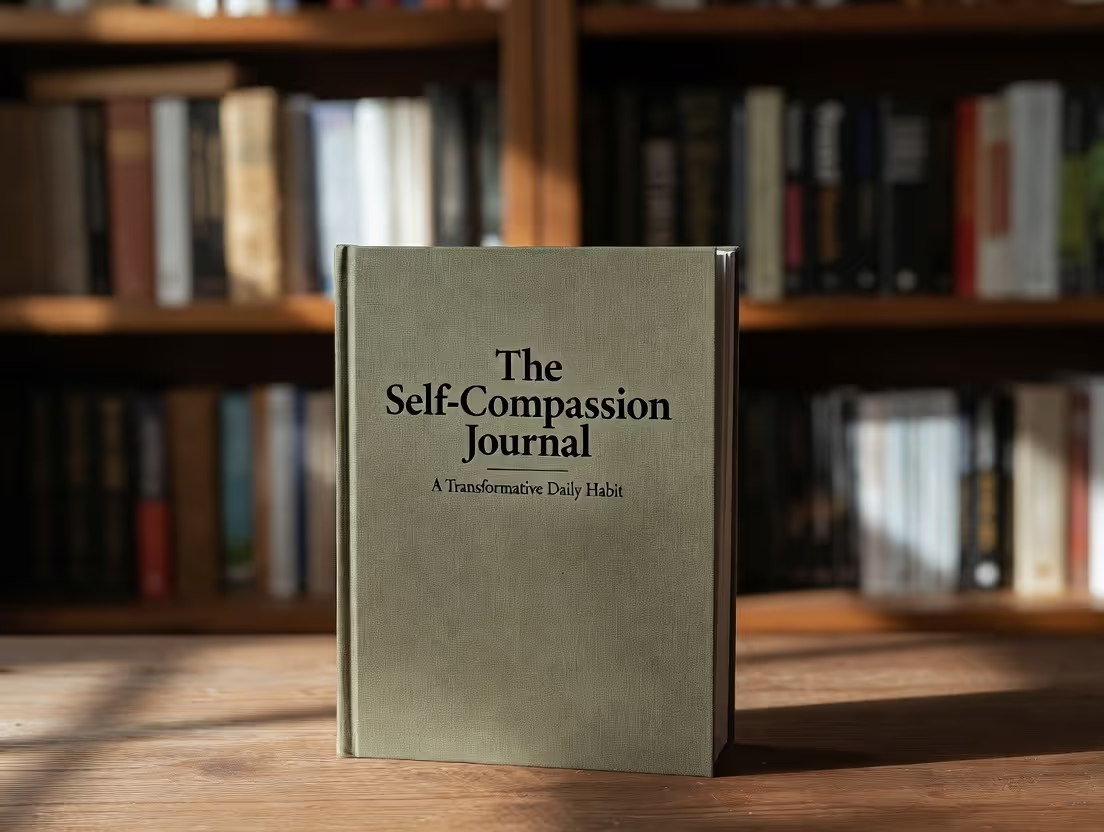
Knowledge must be translated into consistent action to rewire deep-seated patterns. While in-the-moment practices like the Self-Compassion Break are vital, a dedicated daily journaling practice provides a structured space for deeper reflection and integration. It’s a gym for your self-compassion muscle.
Journaling moves the process from your head to the page, making abstract concepts concrete. It allows you to witness your own patterns, celebrate small shifts, and consciously reframe experiences with kindness. Research shows that expressive writing of this nature can improve immune function, reduce distress, and enhance emotional well-being.
A Simple, Powerful Journaling Framework:
Spend 10-15 minutes daily, perhaps in the evening, with the following three prompts. Write freely, without editing or judging your words.
Going Deeper: Uncovering Core Wounds
Over time, your journal will reveal recurring themes—situations that trigger disproportionate stress or self-criticism. These often point to deeper “core wounds” or beliefs, such as “I am not safe unless I am perfect,” or “My needs are a burden.” When you identify one:
This daily practice builds a new, compassionate inner narrative brick by brick. For those who love to see progress mapped, combining this subjective journaling with objective data from a wellness tracker can be profoundly validating. You might note in your journal a week of consistent self-kindness practice and then see the corresponding trend of improved sleep scores or higher average HRV in your app. This creates a powerful feedback loop of positive reinforcement. For individuals curious about starting this integrative journey, our FAQ page addresses many common questions on combining mindful practice with technology.
For many, the most acute battlefield for self-criticism is the body. We criticize its appearance, its appetites, its need for rest, and its inevitable signs of aging. We wage a silent war against our own physiology, treating it as an enemy to be controlled rather than a wise partner to be cared for. True self-compassion must extend to the physical vessel that carries us through life.
This war is a profound source of stress. Body shame and constant negative self-talk keep the body in a state of threat, exacerbating inflammation, disrupting digestion, and harming metabolic health. Compassion for the body is about shifting from objectification (“This body must look a certain way”) to subjectification (“This is the living, feeling body that allows me to experience life”).
Practices for Embodied Self-Compassion:
This compassionate approach to the body aligns perfectly with the ethos of holistic wellness technology. A device like a smart ring isn’t meant to be a harsh critic, judging your sleep or activity scores. At its best, as intended by teams focused on holistic well-being like those at Oxyzen, it’s a compassionate informant. It provides neutral data—like a low resting heart rate or a good night’s sleep score—as feedback, not verdicts. The data becomes a tool for listening more closely to your body’s needs, allowing you to respond with more precise and effective kindness, transforming the relationship from adversarial to collaborative.
Progress in self-compassion is not linear. There will be days when the inner critic roars back to life, when you react harshly to yourself or others, or when difficult emotions like anger, grief, or jealousy feel overwhelming. This is not failure; it is part of the practice. In fact, these moments are the most fertile ground for deepening self-compassion.
The goal is not to never feel negative emotions. The goal is to change your relationship with them—to learn how to be with them compassionately until they pass, as all emotions do.
A Framework for Difficult Emotions: RAIN
A beloved mindfulness practice adapted by therapist Michele McDonald, RAIN is perfect for handling intense emotional experiences.
Compassion for “Compassion Failure”
What happens when you lose your temper, say something cruel, or fall back into old, critical patterns? This is a critical test.
This ability to hold your own imperfections with kindness is the cornerstone of resilience. It prevents a single setback from spiraling into a narrative of total failure. It allows you to repair relationships—with yourself and others—from a place of humble humanity rather than defensive shame. Exploring stories of resilience and growth can be incredibly supportive; reading about others’ journeys through challenges, such as those shared in Oxyzen testimonials, can reinforce this sense of shared humanity and possibility.
The workplace is often the arena where our self-critical scripts are loudest and most rewarded (under the guise of “high standards” or “ambition”). We fear that self-compassion will make us soft, uncompetitive, or unproductive. Yet, as the science shows, the opposite is true. Integrating self-compassion into your professional life is a strategic advantage for sustainable performance and innovation.
How Self-Compassion Fuels Professional Excellence:
Practical Applications for the Workday:
By bringing self-compassion to work, you replace a cycle of chronic stress and depletion with a cycle of sustainable effort, learning, and renewal. This aligns with a modern understanding of peak performance, which is increasingly explored in resources dedicated to holistic well-being and productivity, like those found on our blog.
The journey of self-compassion is often viewed as an inward one, but its most beautiful impact may be outward. When you are no longer at war with yourself, you have more emotional resources, patience, and genuine presence to offer others. You stop seeing relationships as arenas to prove your worth and start experiencing them as connections between two inherently flawed, inherently worthy human beings.
The Drain of Self-Criticism on Relationships:
How Self-Compassion Transforms Connections:
Practicing Compassion in Conflict:
Next time you have a disagreement, try this:
By filling your own cup with compassion, you not only stop draining the cups of others, but you also have an abundance to share. This creates a positive feedback loop of healthier, more resilient, and more satisfying relationships in every domain of your life. This vision of interconnected well-being is at the heart of a holistic approach to health, a principle that guides the development of tools and communities focused on true wellness, such as the team behind Oxyzen.
Building self-compassion is not a destination; it is the gradual cultivation of a new inner climate. It’s moving from a mindset of conditional self-worth—where your value depends on success, appearance, or approval—to one of inherent self-worth—where your value is a given, simply because you exist. This shift doesn’t happen overnight. It requires patience, persistence, and a commitment to playing the long game.
This section focuses on the meta-skills: the attitudes and perspectives that support your daily practice and help you stay the course when progress feels invisible.
The Pillars of a Self-Compassionate Mindset:
Navigating Resistance and the "Worthy" Block:
A common, deep-seated block is the belief: “I don’t deserve this kindness.” This belief is the critic’s final fortress. To approach it:
Developing this mindset is the work of a lifetime, but it is work that fundamentally changes the texture of your life. It’s about moving from a life spent trying to earn love and worth to one lived from the unshakable knowing that you are already enough. For more on building sustainable wellness habits that last, our blog offers continuous exploration and support.
Understanding how self-compassion creates change requires a look at neuroplasticity—the brain’s ability to reorganize itself by forming new neural connections throughout life. Every thought, feeling, and behavior you repeat strengthens a specific neural pathway. Your inner critic is a superhighway because you’ve traveled that road countless times. Self-compassion begins as a faint deer trail. The practice is the conscious work of walking the new path until it becomes the default route.
The Habit Loop and Self-Criticism:
Every habit, including mental ones, follows a loop:
To change a habit, you must keep the same Cue and Reward, but insert a new Routine.
Building the Self-Compassion Habit Loop:
The Role of Repetition and "Tiny Habits":
Stanford behavior expert BJ Fogg emphasizes starting with “Tiny Habits” that are easy to accomplish. For self-compassion, this could be:
These tiny actions build the identity: “I am someone who practices self-compassion.” They create repetition without overwhelm.
Leveraging Technology for Habit Formation:
This is where a smart wellness device becomes a powerful habit ally. It provides objective, external cues and reinforcement.
By understanding the habit science behind self-compassion, you move from hoping for change to engineering it. You become the architect of your own inner landscape, deliberately strengthening the pathways of kindness, one repetition at a time.
Once the foundational practices of mindful awareness and self-kindness feel more accessible, you can deepen your practice with formal meditations specifically designed to cultivate boundless kindness and compassion. The most well-known of these is Loving-Kindness (Metta) meditation, an ancient Buddhist practice that systematically directs well-wishes toward yourself and others.
These are not passive relaxations; they are active workouts for your heart and mind, proven to increase gray matter in brain regions associated with empathy and emotional regulation.
The Traditional Metta Progression:
The practice traditionally moves through a sequence of recipients, starting with yourself. This order is crucial—you cannot offer from an empty cup.
A Simplified Daily Metta Practice:
If the full progression feels long, a condensed version is immensely powerful. Spend 5 minutes focusing only on two points:
Compassion (Karuna) Meditation:
While Metta focuses on general well-wishing (“May you be happy”), Compassion meditation specifically focuses on the alleviation of suffering.
Integrating These Practices:
You don’t need to sit for an hour. Weave phrases into your day. While waiting in line, silently offer Metta to the people around you. When you hear an ambulance siren, offer a moment of compassion to those involved. This transforms idle moments into training grounds for boundless kindness.
These advanced practices expand the container of your heart. They move self-compassion from a personal stress-relief tool into a philosophical stance toward life itself—a commitment to meeting pain, both yours and the world’s, with a courageous, open heart. This journey of expansion often starts with a simple commitment to self-awareness, a value that guides holistic wellness approaches from the ground up, including the mission and vision of companies like Oxyzen.
The principles of self-compassion are universal, but applying them to specific, acute life challenges requires tailored approaches. Here’s how to bring the method to some of life’s most common, yet difficult, arenas.
Grief can feel like a terrifying ocean of pain. The instinct may be to numb it or criticize yourself for how you’re grieving (“I should be over this by now”).
When your body is the source of ongoing suffering, anger and frustration toward it are natural. This adversarial relationship adds mental suffering to physical pain.
Parenting is a relentless gauntlet of self-doubt. The critic shouts, “You’re doing it all wrong!”
Identity is often tied to work. Losing a job or changing paths can trigger an existential crisis and intense self-criticism.
The trap of comparing your internal reality to others’ external highlights is a major source of modern suffering.
In each challenge, the framework remains: Acknowledge the pain with mindfulness, connect it to shared humanity, and respond with active self-kindness. This doesn’t remove the challenge, but it removes the layer of unnecessary, self-inflicted suffering, allowing you to meet the difficulty with greater resilience and clarity. For more targeted resources on navigating life’s stressors with a balanced approach, you can always search our blog for deeper dives.
While spontaneous practices are vital, a dedicated personal ritual creates a sacred, non-negotiable space for your self-compassion practice to deepen. This ritual is a loving commitment to your own well-being, a daily or weekly touchpoint that nourishes you at a core level. It doesn’t need to be long or elaborate; it needs to be meaningful and consistent.
Elements of a Powerful Self-Compassion Ritual:
Weekly or Monthly Deep-Dive Ritual:
Once a week or month, consider a longer ritual (30-60 minutes). This could include:
Your ritual is a living practice. Let it evolve with your needs. The key is the consistent message it sends to your deepest self: You matter. Your inner world is worthy of time, attention, and tenderness.
As we stand at the intersection of ancient wisdom and modern technology, the future of personal wellness is unmistakably integrative. It is a future where the subjective, qualitative art of self-compassion meets the objective, quantitative science of biometrics. This synergy doesn’t reduce the human experience to data points; it uses data to deepen our understanding and embodiment of that experience.
The Biofeedback Loop of Compassion:
Imagine a continuous, compassionate feedback loop:
This loop transforms self-awareness from a vague concept into a tangible skill. It provides external validation for internal work, which can be crucial for motivation, especially for those who are analytically minded or skeptical of “soft” practices.
Ethical and Compassionate Use of Technology:
For this future to be truly wellness-oriented, the technology itself must be designed with a compassionate ethos. This means:
This human-centric approach to tech is at the core of forward-thinking wellness companies. The story behind Oxyzen, for instance, is rooted in the vision of creating tools that foster deeper connection to oneself, not just more data for data’s sake. It’s about providing a mirror that reflects not just your physiology, but the possibility of a kinder relationship with it.
The Broader Impact:
On a societal scale, this integration points toward a new paradigm of health. A healthcare system informed by compassion science and supported by personalized data could shift from merely treating disease to actively cultivating well-being. It could help validate mind-body practices for a wider audience and reduce the stigma around mental and emotional health.
The journey of self-compassion, therefore, is not a solitary retreat from the world. It is a foundational practice for engaging with the world—and with the technology that mediates it—in a wiser, kinder, and more resilient way. It ensures that as we advance, we do not lose sight of the most important metric of all: the quality of our humanity.
We have traversed a considerable landscape—from deconstructing the physiology of stress and the inner critic, to building the practical skills of mindfulness, self-kindness, and common humanity. We’ve explored how to apply this method to work, relationships, and specific life challenges, and how to sustain it through rituals and a compassionate mindset. We’ve even looked ahead to how this inner work synergizes with the outer tools of modern wellness.
The core truth that underpins every section is this: Your relationship with yourself is the foundation of every other experience in your life. When that relationship is rooted in criticism and conditional worth, your world feels threatening, exhausting, and scarce. When it is rooted in compassion and inherent worth, your world—even with all its very real challenges—feels more manageable, connected, and abundant.
You now hold a robust map. But a map is not the territory. The territory is your own lived experience, moment by moment. The real work begins not in perfect understanding, but in imperfect practice.
Your First Step:
Don’t try to overhaul your entire inner dialogue today. That is the voice of the perfectionist critic, disguised as ambition. Start tiny.
This method is not about adding another “should” to your list. It is about gently removing the burden of the “shoulds” you already carry. It is the ultimate act of rebellion in a culture that prizes relentless self-improvement: the choice to treat yourself not as a project to be fixed, but as a person to be cherished.
The path of self-compassion is a homecoming. It is the journey back to the simple, profound truth that you, in this moment—flawed, struggling, magnificent—are enough. And from that place of enoughness, you can meet your life, your stress, and your world with a kindness that changes everything.
Your Trusted Sleep Advocate: Sleep Foundation — https://www.sleepfoundation.org
Discover a digital archive of scholarly articles: NIH — https://www.ncbi.nlm.nih.gov/
39 million citations for biomedical literature :PubMed — https://pubmed.ncbi.nlm.nih.gov/
Experts at Harvard Health Publishing covering a variety of health topics — https://www.health.harvard.edu/blog/
Every life deserves world class care :Cleveland Clinic - https://my.clevelandclinic.org/health
Wearable technology and the future of predictive health monitoring :MIT Technology Review — https://www.technologyreview.com/
Dedicated to the well-being of all people and guided by science :World Health Organization — https://www.who.int/news-room/
Psychological science and knowledge to benefit society and improve lives. :APA — https://www.apa.org/monitor/
Cutting-edge insights on human longevity and peak performance:
Lifespan Research — https://www.lifespan.io/
Global authority on exercise physiology, sports performance, and human recovery:
American College of Sports Medicine — https://www.acsm.org/
Neuroscience-driven guidance for better focus, sleep, and mental clarity:
Stanford Human Performance Lab — https://humanperformance.stanford.edu/
Evidence-based psychology and mind–body wellness resources:
Mayo Clinic — https://www.mayoclinic.org/healthy-lifestyle/
Data-backed research on emotional wellbeing, stress biology, and resilience:
American Institute of Stress — https://www.stress.org/


