


Sleep Pattern Flexibility: Can You Really Change Your Type?
While you can modestly adjust your sleep timing with light exposure and consistency, your fundamental chronotype has a strong genetic component.
While you can modestly adjust your sleep timing with light exposure and consistency, your fundamental chronotype has a strong genetic component.
%402x.svg)
You’ve heard the labels, worn them like an identity, and perhaps even felt a quiet resentment toward them. “I’m a night owl,” you say with a shrug, as you scroll through your phone at 2 a.m., while your “early bird” partner snores peacefully. “It’s just who I am.” For generations, we’ve accepted our sleep chronotype—whether lark, owl, or something in between—as a fixed, unchangeable trait, written into our genetic code as indelibly as eye color. This belief shapes our lives: dictating our work schedules, social plans, and even our self-perception. The night owl bemoans the 9-to-5 world as a cruel mismatch; the early riser fades by dusk, missing evening life. We resign ourselves, believing our biology is our destiny.
But what if this fundamental assumption is, in fact, a myth? What if the rigid walls of your sleep type are more malleable than you’ve been led to believe? Emerging science from the frontiers of circadian neuroscience, genetics, and behavioral psychology is challenging the old dogma. It suggests that while we each have a genetic predisposition, our sleep patterns exist within a dynamic landscape of flexibility. They are shaped, sometimes profoundly, by a constant conversation between our DNA and our environment—our light exposure, meal times, social commitments, stress levels, and even the technology on our fingers.
This is not merely an academic question. In our 24/7, always-on global society, the ability to understand and potentially modulate your sleep-wake rhythm is a critical form of modern wellness capital. It can mean the difference between chronic fatigue and sustained energy, between poor health and vibrant longevity, between feeling out-of-sync with the world and finding your optimal flow. The promise is tantalizing: you may not be forever chained to a type you didn’t choose.
This exploration begins here. We will dismantle the old stereotypes, dive deep into the molecular machinery of your body clock, and uncover the powerful levers—both internal and external—that can nudge your rhythm. We’ll examine the compelling evidence for change, the realistic limits set by your genes, and the practical, step-by-step strategies that can guide a sustainable shift. Furthermore, we will explore how modern tools, like advanced wellness wearables from innovators like Oxyzen, are providing unprecedented personal data, turning abstract science into a personalized roadmap for transformation. The journey to understanding your sleep is not about fighting your nature, but about partnering with it intelligently. It starts with a single, revolutionary question: Can you really change your type? Let’s find out.

For decades, the concept of the chronotype has been neatly packaged into a simple, binary choice: you are either a morning person or an evening person. This tidy classification springs from observable reality—the obvious differences in when people feel most alert or sleepy. However, in its popular form, this idea has hardened into a deterministic cage. We speak of our sleep type with the same finality as our height, accepting it as a life sentence that dictates our productivity, social compatibility, and health. This belief is not just disempowering; it’s scientifically incomplete.
The origin of the “lark vs. owl” paradigm can be traced to early chronobiology studies in the 1970s. Researchers like Dr. Olov Östberg and Dr. James Horne developed the “Morningness-Eveningness Questionnaire” (MEQ), a tool that placed individuals on a spectrum. While revolutionary for its time, this spectrum was often collapsed in public discourse into two opposing camps. The media, self-help books, and even workplace culture ran with this simplified dichotomy, creating stereotypes: the proactive, virtuous early riser versus the lazy, undisciplined night owl. These labels carry moral and professional weight, influencing hiring decisions, school start times, and personal relationships.
But human biology resists binaries. The rigid chronotype model ignores a critical third, and arguably largest, group: the intermediates, or “hummingbirds.” Research suggests that perhaps 60-70% of the population falls into this flexible middle ground, exhibiting neither strong morning nor strong evening preference. Their rhythms are more readily shaped by schedule demands and environmental cues. Even for those at the extremes, the predisposition is a starting point, not a finish line. The genetic components—like variations in the PER3 gene—set a baseline tendency, but they do not operate in a vacuum. They are constantly interacting with a barrage of external time-givers, or zeitgebers.
The danger of the fixed-chronotype myth is twofold. First, it fosters a sense of helplessness. The night owl struggling in an early-start job may blame their “unchangeable” biology, leading to resignation and chronic sleep debt, rather than seeking adaptive strategies. Second, it can become a self-fulfilling prophecy. Believing you “can’t function” in the morning may lead you to hit snooze repeatedly, skip morning light exposure, and reinforce the very pattern you lament. You live into the label.
Moving beyond this myth requires a paradigm shift: from seeing your chronotype as a fixed state to understanding it as a dynamic equilibrium. It is a point of balance between your internal clock and the world you create around it. This perspective is liberating. It replaces “This is who I am” with “This is my current rhythm, and I have tools to influence it.” To begin this shift, we must first understand the master clock itself—the elegant, ancient timekeeper buried deep within your brain. For a deeper dive into the science of wellness and personalized tracking, our blog features a wealth of resources on circadian health.
At the very center of your sleep pattern story lies a tiny, powerful structure: the suprachiasmatic nucleus (SCN). No larger than a grain of rice, this cluster of about 20,000 neurons resides in the hypothalamus, just above the spot where your optic nerves cross. Don’t let its size fool you; this is the conductor of your body’s vast circadian orchestra. The SCN is your endogenous, self-sustaining master clock, generating a rhythm that runs on a cycle of approximately—but not exactly—24 hours.
The genius of the SCN lies in its autonomy and its receptiveness. In total isolation, devoid of any external cues like light or temperature, it will continue to “tick” with remarkable precision. This intrinsic rhythm is driven by a feedback loop of “clock genes.” Genes like CLOCK and BMAL1 activate the production of proteins (PER and CRY), which, once they reach a certain concentration, feedback to inhibit their own production. As protein levels fall, the inhibition lifts, and the cycle begins anew—a process that takes roughly a day. This molecular pendulum swing is the foundational beat to which your body dances.
However, a clock that runs on “approximately” 24 hours would quickly fall out of sync with the precise 24-hour solar day. This is where the SCN’s other critical function comes in: entrainment. To stay on schedule, the master clock must be reset daily by external cues. The most powerful of these zeitgebers is light. Specialized photoreceptive cells in your retina, entirely separate from those used for vision, detect ambient light levels and send a direct signal via the retinohypothalamic tract straight to the SCN. Morning light, rich in blue wavelengths, acts as a potent “reset” button. It signals the SCN to halt melatonin production (the sleepiness hormone), promote cortisol release (for alertness), and shift the entire cycle earlier. Conversely, evening darkness allows melatonin to rise, priming the body for sleep.
The SCN doesn’t just manage sleep. It orchestrates a symphony of circadian processes, sending signals to slave clocks in virtually every organ and tissue in your body—your liver, gut, heart, and muscles. It governs the daily ebb and flow of your core body temperature (which dips at night), hormone secretion (cortisol, melatonin, growth hormone), metabolism, and even gene expression. When your SCN is well-entrained to a consistent light-dark cycle, these processes harmonize, leading to restorative sleep, optimal daytime energy, and robust health. When it is disrupted—by irregular light exposure, jet lag, or shift work—the orchestra falls into cacophony. This state, known as circadian misalignment, is linked to a host of issues, from insomnia and metabolic disorders to increased risk for cardiovascular disease and certain cancers.
Understanding the SCN demystifies your sleep pattern. Your perceived “type” is largely the expression of your SCN’s current phase relative to the local clock time. A night owl’s SCN cycle is running late; their temperature minimum and melatonin onset occur later than an early bird’s. The question of change, therefore, becomes a question of phase-shifting this master clock. Can we deliberately reset the SCN? The answer lies in wielding the very tools it uses to entrain: light, darkness, and other behavioral zeitgebers. At Oxyzen, our mission is rooted in empowering this kind of precise self-knowledge. You can learn more about our mission and the science we leverage on our about page.

If your chronotype were a pie chart, genetics would be a significant slice—but far from the whole pie. The science is clear: while your DNA loads the gun, your environment and behavior pull the trigger. Three of the most powerful modifiers of your expressed sleep pattern are light exposure, daily habits, and the natural arc of aging. Ignoring these is like trying to understand a plant’s growth by only studying its seed, while ignoring sunlight, water, and soil.
Light: The Prime Zeitgeber
Light is the single most potent reset button for your SCN. Yet, in the modern world, our light environment is chronically distorted. We spend our days indoors under relatively dim, static lighting and our evenings bathed in the melatonin-suppressing blue glow of screens. For a developing night owl, this pattern is a perfect storm: weak morning light fails to provide a strong phase-advancing signal, while excessive evening light actively delays the clock further. Studies show that controlled light therapy can induce substantial shifts. For example, receiving bright light exposure upon waking (or using a light therapy box) can shift an owl’s rhythm earlier by up to an hour per day. Conversely, wearing blue-light-blocking glasses in the evening can prevent further delay. Your light habits aren’t just reflecting your type; they are actively sculpting it.
Behavior and Schedule: The Power of Routine
Your daily schedule is a collection of secondary zeitgebers that reinforce or conflict with your light cues. These include:
The Age Factor: Your Chronotype’s Natural Journey
Perhaps the most compelling evidence for flexibility is the predictable way our chronotype changes across the lifespan. Teenagers are notoriously owlish—a shift driven by both hormonal changes and social pressures. Yet, as people move into their mid-20s and beyond, there is a steady drift toward morningness. The peak of “eveningness” occurs around age 20, with a gradual transition until most people become more morning-oriented by age 60. This lifelong trajectory proves that our circadian phase is not static. It is a fluid characteristic, responsive to both internal biological programming and external life demands. The 50-year-old who was a night owl in college may find themselves naturally waking at dawn, not solely due to discipline, but because their biological rhythm has migrated.
Recognizing these influences shifts the narrative from passive acceptance to active management. You are not a prisoner of your genes but a gardener of your environment. The next step is to explore the concrete evidence that deliberate, sustained change is not only possible but measurable.
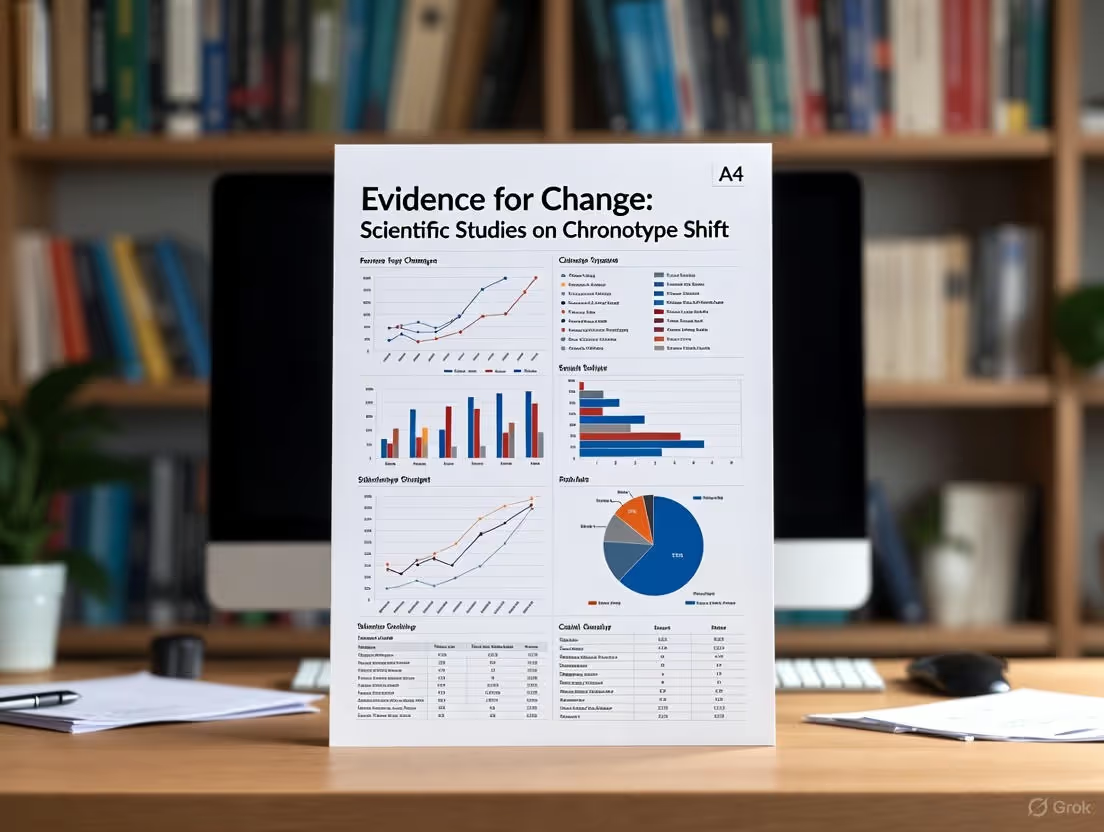
The theoretical possibility of changing your sleep pattern is one thing; concrete, peer-reviewed evidence is another. Fortunately, a growing body of research from sleep labs, shift-work studies, and clinical trials provides robust proof that chronotype is malleable. These studies move beyond anecdote, showing measurable shifts in core markers like dim-light melatonin onset (DLMO—the gold standard for assessing circadian phase) and sleep-wake timing.
1. Light Therapy Interventions: Clinical studies are perhaps the most direct. In one seminal study, participants with Delayed Sleep-Wake Phase Disorder (DSWPD—essentially extreme night owls) underwent a regimen of morning bright light therapy combined with strict sleep schedule adherence and avoidance of evening light. The results were striking: significant phase advances of over two hours were achieved, moving melatonin onset and sleep times earlier. Crucially, these changes were not just behavioral; they reflected a true shift in the underlying circadian rhythm, as measured in the lab.
2. Shift Work and Jet Lag Research: The human capacity for adjustment is starkly revealed in shift work and transmeridian travel. When a nurse moves from day shift to night shift, their entire circadian system must undergo a massive 12-hour flip. While challenging and often incomplete (leading to health risks), this shift does occur—driven overwhelmingly by changes in light exposure and schedule. Similarly, after flying across multiple time zones, your body clock eventually adjusts to local time, a process that relies on the strategic timing of light and darkness. These are extreme examples, but they prove the SCN’s plasticity.
3. Controlled Laboratory “Forced Desynchrony” Protocols: In highly controlled laboratory settings, scientists use protocols that uncouple participants from all 24-hour time cues, placing them on artificially long or short days (e.g., a 28-hour “day”). By observing how the internal clock free-runs and then re-entrains, researchers can precisely quantify its responsiveness. These studies confirm that the clock can be systematically shifted using timed light exposure, with the size and direction of the shift depending on when the light is administered (forming a “phase response curve”).
4. Behavioral and Lifestyle Studies: Beyond the lab, real-world interventions show promise. Studies examining combined lifestyle packages—including fixed wake times, morning light, evening light restriction, consistent meal times, and regulated exercise—demonstrate significant improvements in morning alertness and earlier sleep timing for self-proclaimed night owls. A 2019 study published in Sleep Medicine Reviews concluded that such multimodal interventions are effective for mild to moderate circadian misalignment, improving both subjective and objective sleep measures.
The takeaway from this evidence is empowering: chronotype is not a destiny, but a tendency. With intentional, consistent application of the right cues, you can guide your rhythm toward a more desirable alignment. The changes are physiological, measurable, and real. However, this science also introduces a note of realism. The shifts are gradual, measured in minutes per day, not hours. They require consistency and an understanding of personal limits. This naturally leads to the critical question: where do those limits come from? To understand that, we must unpack the genetic bedrock.
As we champion flexibility, we must also acknowledge the anchor: your genetic blueprint. This is not to discourage, but to ground your expectations in reality and foster self-compassion. Your DNA sets the baseline sensitivity and range of your circadian system. It influences how strongly your SCN responds to light, how long your intrinsic period is, and ultimately, the outer boundaries of how much you can shift your natural rhythm.
The primary genetic players are variations in the “clock genes” that constitute the SCN’s feedback loop. The most studied in relation to chronotype is a repeating segment of the PER3 gene. Individuals with a longer version of this gene (*PER3^5/5*) are overwhelmingly morning types. They show earlier melatonin release, peak alertness earlier in the day, and struggle more with sleep deprivation and night shifts. Those with the shorter variant (*PER3^4/4*) are more likely to be evening types, with a higher tolerance for sleep disruption but a greater propensity for delay. Other genes, like CLOCK and ARNTL, also contribute to the complex polygenic landscape of your sleep-wake preference.
These genes influence your intrinsic circadian period (tau). While the human average is about 24 hours and 15 minutes, individual variation exists. Someone with an intrinsic period of 24.5 hours has a clock that naturally runs slower, predisposing them to a later phase (eveningness). Someone with a period of 23.8 hours has a faster clock, leaning toward morningness. Light’s job is to compress or stretch this period to match the 24-hour day. If your tau is far from 24 hours, you may require more robust daily cues to stay entrained, making you more sensitive to schedule disruptions.
So, what does this mean for change? It establishes a range of flexibility. You can think of your genetic predisposition as your “set point.” You can operate within a range around that point—perhaps a window of several hours—through behavioral and environmental manipulation. An extreme night owl may never become a joyful 5 a.m. riser without considerable ongoing effort, but they can likely become a comfortable 11 p.m. to 7 a.m. sleeper. The goal is not to fight your biology into an arbitrary mold, but to optimize within your feasible range to support your health and life goals.
This understanding reframes the journey. It’s not about “changing who you are,” but about optimizing your expression. It’s the difference between a sailboat and its anchor. The anchor (genetics) determines where you can’t go, but the sail (your habits and environment) determines where you do go within that viable area. With this balanced perspective, we can now turn to the practical toolkit for setting sail.
Armed with the knowledge that change is possible yet bounded, we arrive at the practical core: the levers you can pull. Lasting chronotype adjustment isn’t about willpower alone; it’s about intelligent, consistent environmental engineering. Here is your primary toolkit, ranked by potency.
1. Master the Light-Dark Cycle:
This is your most powerful tool. The strategy differs based on your goal.
2. Engineer a Consistent Schedule:
Your clock craves predictability. Inconsistency is the enemy of entrainment.
3. Optimize Your Sleep Sanctuary:
Make your bedroom a cave for sleep—dark, quiet, and cool.
4. Mind Your Intake:
Implementing these tools requires patience. Shifts happen at a rate of about 15-30 minutes per day at best. Trying to force a two-hour change overnight will lead to frustration. The key is incremental, consistent adjustment. For many, navigating this process blind is challenging. This is where modern technology, specifically advanced wearable devices, becomes a game-changer, offering the data and feedback needed to personalize this toolkit effectively. If you have questions about implementing these strategies, our comprehensive FAQ page is a great resource for support.

In the quest to modulate your sleep pattern, guesswork is your enemy. Feelings are subjective and unreliable; “I feel tired” doesn’t tell you if your circadian rhythm is early, late, or simply misaligned. This is where the silent revolution of consumer-grade biometric wearables, particularly the advent of the smart ring, transforms the journey from a shot in the dark to a data-informed science.
Devices like the Oura Ring, and those developed with similar precision, are uniquely positioned for circadian tracking. Worn on the finger, they provide continuous, non-invasive monitoring of key physiological signals that are direct outputs of your SCN’s orchestration:
How This Data Empowers Change:
This technological partnership removes the blindness. It turns the abstract principles of chronobiology into a personalized, visible dashboard. For anyone serious about understanding and optimizing their sleep pattern flexibility, a high-fidelity wearable is not just a gadget; it’s an essential compass. The story of wellness technology is one of rapid innovation, a journey you can explore further in our brand’s own story.
To see the principles of chronotype flexibility and its limits tested under extreme pressure, we need look no further than the modern shift worker. Nurses, factory workers, first responders, and countless others live in a state of perpetual circadian challenge. Their experience is a powerful, real-world case study in forced adaptation, resilience, and the stark health consequences of chronic misalignment.
The Forced “Change”: A nurse rotating from day shift (7a-3p) to night shift (11p-7a) must attempt a 12-hour flip of her entire circadian system. Her adaptation toolkit is critical:
The Incomplete Adaptation and The Health Toll: Despite these efforts, complete adaptation is rare. The conflicting cues of a daytime world on days off, social obligations, and family life often create a state of permanent “social jetlag.” This chronic circadian misalignment has a devastating, well-documented health impact, including:
The Takeaway: The shift worker’s story illuminates two crucial truths. First, it demonstrates the remarkable, if painful, plasticity of the human circadian system. With extreme diligence, significant shifts can be achieved. Second, it highlights the severe cost of living against a strong genetic predisposition or in a state of constant misalignment. For the shift worker, the goal is often damage mitigation, not optimization.
For the non-shift worker, the lesson is one of respect. It underscores why consistent, gentle entrainment is preferable to drastic, frequent shifts. Your body can adapt, but there is a metabolic and neurological price for constant change. The goal is sustainable harmony, not just forced compliance.
Even with the perfect scientific toolkit and cutting-edge technology, the journey to shift your sleep pattern often founders not on biological rocks, but on social and psychological shores. Understanding these non-physiological barriers is essential for crafting a realistic and resilient change plan. Willpower alone cannot overcome a conflicting world.
The Social Schedule Mismatch:
Your sleep pattern does not exist in a vacuum. It is entangled with the lives of partners, family, friends, and the demands of work and culture.
Psychological Identity and Habit:
Strategies for Navigating These Barriers:
Acknowledging these barriers normalizes the struggle. Success is not just about managing light; it’s about managing life. The most perfect circadian protocol will fail if it makes you feel lonely, resentful, or deprived. A sustainable shift must integrate with, and be supported by, your social and psychological landscape.
Understanding the theory is one thing; executing a deliberate, phased shift in your sleep-wake rhythm is another. This is a practical, step-by-step guide designed for two primary scenarios: the night owl seeking an earlier schedule (phase advance) and the extreme early riser or shift worker needing to delay their clock (phase delay). Remember, patience and consistency are your most important tools. Physiological shifts occur at a rate of about 15-30 minutes per day at best.
This protocol is for the person who naturally falls asleep after midnight and struggles with morning obligations, aiming to gradually move their sleep and wake times earlier.
Week 1-2: The Foundation & Baseline
Week 3-4: The Gradual Pull
Week 5+: Iteration and Consolidation
This is less common but crucial for early risers who fade by evening or for someone preparing for night shift work. The principles are the mirror image.
The Strategy:
Critical Note for All: This process is not linear. Stress, illness, a single late night, or changes in season can cause setbacks. The goal is not perfection, but a clear trajectory and the tools to correct course. Technology is invaluable here, providing the objective feedback to see your progress in resting heart rate trends, sleep timing consistency, and HRV, even when you feel it's not working. For more detailed guides on sleep optimization and other wellness topics, our blog is continually updated with expert insights.
Successfully shifting your sleep pattern is a monumental achievement, but the journey doesn't end there. Like maintaining physical fitness or a healthy diet, preserving your new circadian alignment is an ongoing practice. Life will inevitably throw curveballs—a late-night work project, a vacation across time zones, a period of high stress, or simply the changing seasons. Understanding how to maintain, recover from setbacks, and adapt to natural cycles is key to long-term circadian health.
The Art of Maintenance:
Once you’ve reached your target schedule, the protocol shifts from induction to maintenance. The principles are the same, but the rigidity can often relax slightly.
Navigating Setbacks Gracefully:
A setback is not a failure; it's data. A week of insomnia during a stressful period, or a vacation that completely upends your schedule, will happen.
The Influence of Seasonality:
Your circadian rhythm is inherently tied to the solar year. Photoperiod (day length) changes provide a powerful environmental cue.
The long-term view is one of dynamic stewardship, not static achievement. It’s about building a resilient rhythm that can withstand life’s disruptions and flow with the Earth’s seasons. This philosophy of working with your biology, rather than against it, is at the heart of modern, personalized wellness. It’s a journey that our company was founded to support—you can learn more about our vision and values on our story page.
The impact of your sleep pattern extends far beyond feeling alert or drowsy. It reaches into the fundamental metabolic processes that govern your weight, hormone balance, and cellular energy. When your circadian rhythm is misaligned—whether from being a forced "owl" in a "lark's" world or from erratic sleep habits—you disrupt the meticulously timed symphony of your metabolism, with tangible consequences for your health.
The Circadian Metabolism: A Finely Tuned Schedule
Your liver, pancreas, fat cells, and muscles all contain their own peripheral clocks, synchronized by the SCN. These clocks regulate the ebb and flow of metabolic functions on a 24-hour schedule.
When Timing Goes Awry: The Consequences of Eating at the "Wrong" Time
Night owls and shift workers often eat a significant portion of their calories in the evening and night, a time when their biology is preparing for sleep and fasting.
The Cortisol-Melatonin Seesaw: A Hormonal Balancing Act
Your stress and sleep hormones are in a delicate, inverse dance.
Practical Metabolic Alignment:
The goal is to align your feeding window with your circadian rhythm—a concept known as Time-Restricted Eating (TRE).
By shifting your sleep pattern earlier, you naturally create a metabolic environment that favors efficient energy use and storage. The data from a smart ring can be revealing here, showing how improvements in sleep consistency correlate with lower nighttime resting heart rate (an indicator of metabolic recovery) and more stable HRV. It turns the abstract concept of "metabolic health" into a daily, manageable practice of timing. For those navigating these complex changes, our FAQ section addresses common questions on integrating sleep and diet.
Your chronotype doesn't just dictate when you feel sleepy; it governs the daily fluctuations in your cognitive abilities—your attention, memory, critical thinking, and creativity. Understanding your personal cognitive rhythm is the key to intellectual productivity and mental clarity. The question isn't "Are you a morning person?" but rather, "When are you a person for analytical thought? For creative insight? For focused detail work?"
The Circadian Rhythm of Cognition:
Core cognitive functions follow a predictable daily pattern linked to core body temperature and arousal levels.
The High Cost of Misalignment:
Forcing complex analytical work during your circadian trough is an exercise in frustration and inefficiency. A night owl taking a high-stakes exam at 8 a.m. is at a measurable disadvantage compared to their peak afternoon performance. Conversely, a morning type trying to brainstorm innovative solutions at a 10 p.m. meeting will likely draw a mental blank. This misalignment leads to:
Leveraging Your Pattern (or Your New One):
The goal is to schedule tasks to match your cognitive rhythm.
By aligning your work with your cognitive chronotype, you move from fighting your biology to harnessing it. You achieve more with less strain. This is the essence of true productivity—working smarter, not just harder or longer. It’s a principle that applies to all forms of performance, which is why understanding your personal rhythm is so central to our approach at Oxyzen. To see how others have applied these principles to transform their daily output, you can read about real user experiences in their own words.
The connection between sleep and mental health is profound and bidirectional. While chronic sleep disruption is a known risk factor for disorders like depression and anxiety, your underlying sleep pattern—the alignment or misalignment of your circadian rhythm—plays an equally critical, yet often overlooked, role in daily emotional regulation, stress resilience, and overall psychological well-being.
Circadian Rhythm and Emotional Brain Centers:
The SCN has direct and indirect neural pathways to brain regions central to mood, including the amygdala (fear and emotional reactivity), the prefrontal cortex (emotional regulation), and the ventral tegmental area (reward and motivation). When your circadian rhythm is stable, these pathways facilitate balanced emotional responses. When it is disrupted, the system becomes dysregulated.
The Night Owl's Vulnerability:
Evening types have a statistically higher prevalence of depression, anxiety, and substance use. This isn't necessarily because staying up late is inherently depressing, but because of the chronic social jetlag and circadian misalignment they experience.
The Impact of Shift Work:
Shift workers provide the most extreme example, facing significantly higher rates of mood disorders. The constant flipping of the circadian clock prevents the brain's emotional centers from ever establishing a stable, predictable rhythm, leaving individuals in a state of perpetual biological dissonance.
How Phase Shifting Can Foster Mental Resilience:
Deliberately aligning your sleep pattern with your life demands can be a powerful non-pharmacological intervention for mood.
The act of taking control of your sleep pattern is, in itself, an empowering psychological intervention. It moves you from a state of helpless victimhood ("I'm just a night owl, I can't handle mornings") to one of agency. This sense of mastery over one's own biology is a potent antidote to anxiety and a cornerstone of building mental resilience. The journey to such mastery is personal and unique, much like the journey our own company has taken to understand and serve this need.
Our sleep patterns are not private affairs; they are relational forces that shape our closest bonds and are shaped by the cultural waters we swim in. The friction between different chronotypes within a household can be a source of daily conflict, while societal structures often glorify one pattern and marginalize another. Navigating this landscape is essential for holistic well-being.
The Chronotype Couple: Negotiating Shared Time and Space
When a "lark" pairs with an "owl," the differences extend far beyond bedtime.
Strategies for Harmonious Coexistence and Co-Shifting:
Parenting and Family Rhythms:
Children have their own evolving chronotypes. Teenagers are biologically driven owls, yet face punishingly early school start times. A parent trying to shift their own pattern must also manage these external schedules, making consistency challenging. The key is to lead by example with household rhythms (consistent meal times, reducing screen dominance in evenings) while respecting the biological realities of different developmental stages.
The Cultural Zeitgeber: The Tyranny of the "Early Bird"
Western culture, particularly in professional spheres, has long valorized the early riser as more virtuous, disciplined, and successful. This "morning morality" imposes a social penalty on evening types. However, the rise of remote work and flexible hours is slowly challenging this norm, allowing individuals to design workdays around their cognitive peaks rather than an arbitrary industrial clock.
This cultural shift points toward a future of greater chronotype diversity acceptance. The ideal is not a world where everyone becomes a lark, but one where social structures—school start times, work hours, community activities—become more flexible, allowing each chronotype to thrive in their optimal zone. Embracing this diversity starts at home, with understanding and adapting to the natural rhythms of those we love. For more perspectives on building a lifestyle that honors individual biology, our blog explores these topics in depth.
We stand at the precipice of a revolution in sleep and circadian health. The convergence of advanced biometric sensing, artificial intelligence, and a deepening understanding of circadian medicine is moving us from generic sleep advice toward truly personalized chronotherapy—the use of timing as a therapeutic intervention. This future promises not just better sleep, but a fundamental optimization of human health and performance.
From Tracking to Predicting and Prescribing:
Current wearables are brilliant historians. The next generation, powered by sophisticated AI, will become proactive partners.
Chronotherapy as Standard Medical Practice:
We will see the formal integration of circadian principles into treatment plans.
The Role of Companies like Oxyzen in This Future:
The mission evolves from providing data to providing actionable, personalized insight. It involves building platforms that don't just collect biometrics, but synthesize them into a coherent, evolving model of your unique circadian biology. The goal is to close the loop between measurement and meaningful change, making the complex science of chronobiology accessible, actionable, and automatically integrated into daily life. This future is not about more gadgets, but about more wisdom—the wisdom to live in harmony with your internal time. This commitment to pioneering this personalized future is at the core of our company's vision and ongoing journey.
Our exploration began with a question of identity: "Can you really change your type?" We have traveled through the neuroscience of the master clock, the tug-of-war between genes and environment, the metabolic and mental costs of misalignment, and the practical toolkit for change. The answer that emerges is nuanced, hopeful, and empowering.
Yes, you can change—but not in the way you might have initially thought.
You cannot overwrite your genetic predisposition. The anchor of your intrinsic period will always be there. But within the wide harbor defined by that anchor, you have tremendous navigational control. You can, through deliberate and consistent management of light, schedule, and behavior, shift your expressed sleep-wake rhythm by hours. You can move from a point of chronic conflict with your world to a point of sustainable alignment. This is not about becoming someone else; it is about optimizing the expression of your biology to serve your health, your relationships, and your aspirations.
The journey requires reframing core beliefs. It asks you to move:
This process is fundamentally an act of self-respect. It is listening to the ancient, intelligent clock within and creating an external environment that allows it to sing in tune. It recognizes that time is not just something we measure on a clock, but something we are. Owning your sleep pattern is, therefore, a profound way of owning your time—and by extension, your life.
The tools have never been better. From the timeless power of morning sunlight to the cutting-edge insights from a device on your finger, you have an unprecedented ability to see, understand, and guide your internal rhythm. This isn't just about sleep hygiene; it's about circadian citizenship—taking responsibility for your biological relationship with the 24-hour day.
So, can you change your type? The truest answer is this: You can discover its flexibility, master its leverage points, and collaborate with it to design a life of greater energy, health, and harmony. The journey starts not with a dramatic overhaul, but with a single, consistent wake time and a step into the morning light. Your time, in every sense of the word, is now.
Your Trusted Sleep Advocate: Sleep Foundation — https://www.sleepfoundation.org
Discover a digital archive of scholarly articles: NIH — https://www.ncbi.nlm.nih.gov/
39 million citations for biomedical literature :PubMed — https://pubmed.ncbi.nlm.nih.gov/
Experts at Harvard Health Publishing covering a variety of health topics — https://www.health.harvard.edu/blog/
Every life deserves world class care :Cleveland Clinic - https://my.clevelandclinic.org/health
Wearable technology and the future of predictive health monitoring :MIT Technology Review — https://www.technologyreview.com/
Dedicated to the well-being of all people and guided by science :World Health Organization — https://www.who.int/news-room/
Psychological science and knowledge to benefit society and improve lives. :APA — https://www.apa.org/monitor/
Cutting-edge insights on human longevity and peak performance:
Lifespan Research — https://www.lifespan.io/
Global authority on exercise physiology, sports performance, and human recovery:
American College of Sports Medicine — https://www.acsm.org/
Neuroscience-driven guidance for better focus, sleep, and mental clarity:
Stanford Human Performance Lab — https://humanperformance.stanford.edu/
Evidence-based psychology and mind–body wellness resources:
Mayo Clinic — https://www.mayoclinic.org/healthy-lifestyle/
Data-backed research on emotional wellbeing, stress biology, and resilience:
American Institute of Stress — https://www.stress.org/


