


The Sleep Pattern Spectrum: From Early Birds to Night Owls
Chronotypes exist on a spectrum from extreme early birds to extreme night owls, with most people falling somewhere in the middle.
Chronotypes exist on a spectrum from extreme early birds to extreme night owls, with most people falling somewhere in the middle.
%402x.svg)
For centuries, society has operated on a simple, unspoken assumption: the early morning is for productivity, and late nights are for rest or revelry. The early bird gets the worm, we’re told, while the night owl is lazily sleeping the day away. But what if this pervasive idea is not just oversimplified, but fundamentally flawed? What if your burning midnight oil or your predawn jog isn’t a lifestyle choice, but a biological mandate written into your very DNA?
Welcome to the fascinating and often misunderstood world of chronobiology—the science of our internal body clocks. Our natural sleep-wake preferences, known as our chronotype, exist on a broad and beautiful spectrum. This isn't a binary division of "morning people" and "evening people," but a continuous range of physiological programming that influences everything from our peak cognitive performance and hormone release to our risk for certain health conditions and even our social compatibility.
In this deep exploration, we will dismantle the myths and uncover the science behind why you are who you are when the sun rises and sets. We'll journey from the genetic underpinnings of your sleep schedule to the societal structures that glorify one chronotype over another, often at a cost to collective well-being. We’ll also examine how modern technology, specifically the advent of discreet, powerful wellness wearables like smart rings, is revolutionizing our ability to understand and harmonize with our innate rhythms, rather than fight against them. For a foundational look at how such technology tracks these biological patterns, you can discover how Oxyzen works.
Understanding your place on the sleep pattern spectrum is more than a curiosity—it’s a key to unlocking optimized health, heightened productivity, and profound self-acceptance. It’s time to stop judging your rhythm and start listening to it.
At the core of your sleep pattern lies a master biological clock, a microscopic cluster of about 20,000 neurons in the hypothalamus called the suprachiasmatic nucleus (SCN). This tiny timekeeper, no larger than a grain of rice, orchestrates your circadian rhythm—a roughly 24-hour cycle that regulates not just sleep and wakefulness, but a symphony of bodily functions.
Think of your SCN as the conductor of a grand orchestra. It doesn't play the instruments itself, but it cues every section to ensure perfect harmony. It signals your pineal gland to release melatonin as darkness falls, lowering your core body temperature and preparing you for sleep. As dawn approaches, it suppresses melatonin and triggers a cortisol awakening response, elevating your heart rate and blood pressure to prepare you for the day. It influences the timing of hormone secretion (like growth hormone and testosterone), digestive enzymes, immune system activity, and even the repair cycles of your cells.
This rhythm is endogenous, meaning it generates itself, but it is exquisitely tuned by external cues known as zeitgebers (German for "time-givers"). The most powerful zeitgeber is light, especially the blue-wavelength light from the sun. Light hitting the retina sends direct signals to the SCN, resetting the clock each day to align with the Earth's 24-hour rotation. Other zeitgebers include temperature, food intake, social interaction, and physical activity.
However, our internal clocks are not all set to the same time. Genetic variations in "clock genes" such as PER, CLOCK, and CRY cause natural differences in the speed and timing of our circadian cycles. Some people have a cycle that runs slightly shorter than 24 hours, making them prone to waking early. Others have a longer cycle, predisposing them to later nights and mornings. This genetic predisposition forms the bedrock of your chronotype. It’s not a preference you develop in college; it’s a fundamental part of your biological blueprint, evident even in childhood.
While "early bird" and "night owl" are useful shorthand, they barely scratch the surface of human chronodiversity. Sleep researcher Dr. Michael Breus popularized a more nuanced model, categorizing chronotypes into four animal archetypes that reflect distinct energy peaks and troughs throughout the day.
The Lion (The Early Riser): Making up about 15-20% of the population, Lions are the classic early birds. They wake up alert and energetic, often before sunrise, and achieve peak productivity in the morning. Their focus and willpower are highest before noon. Lions tend to fade in the late afternoon and evening, preferring early dinners and early bedtimes. They are optimists and leaders, but can struggle with evening social events.
The Bear (The Sun-Follower): The most common chronotype, representing about 50-55% of people, Bears follow the solar cycle. They wake easily with light, have steady energy throughout the day, and experience a mild dip in the early afternoon (the post-lunch slump). Their productivity is reliable and consistent across standard 9-to-5 hours. Bears are sociable, team-oriented, and have a well-rounded sleep drive, but may lack the extreme morning peak of the Lion or the late-night surge of the Wolf.
The Wolf (The Night Owl): Wolves, comprising 15-20% of the population, are the true night owls. They struggle with early mornings, often hitting the snooze button repeatedly. Their energy and creativity surge in the late afternoon and evening. They are most innovative, insightful, and socially vibrant when the sun goes down. Wolves have a hard time "switching off" at night and are prone to social jet lag in a morning-oriented world. They are often introspective, creative, and moody.
The Dolphin (The Light, Anxious Sleeper): This rarer type, named for the unihemispheric sleep pattern of aquatic mammals, represents about 10% of people, often with insomnia tendencies. Dolphins are light sleepers, easily awakened by noise or stress. They are most productive in mid-morning to early afternoon bursts. Intelligent and neurotic, they may have irregular sleep patterns and feel perpetually tired, as if they are never fully asleep nor fully awake.
Understanding which animal you most closely align with provides a powerful framework for structuring your day, from scheduling demanding cognitive work to planning workouts and social engagements. It’s the first step toward working with your biology, not against it. To delve deeper into how your daily habits interact with your chronotype, our blog offers a wealth of related articles on optimizing your routine.
The frustration of a night owl trying to become a morning person, or vice versa, often stems from a critical misunderstanding: chronotype is not a habit. It is a deeply ingrained, genetically determined trait. Twin studies have shown that chronotype heritability is around 40-50%, meaning a significant portion of your sleep-wake preference is inherited.
The molecular machinery is complex. Variations in genes like PER3 are strongly linked to morningness. People with a longer version of this gene are overwhelmingly early risers. Conversely, a variant in the CRY1 gene can delay the circadian clock by 30 minutes to 2.5 hours, creating a pronounced evening preference. These genes influence the stability and period length of your circadian cycle, affecting how quickly you feel sleepy after waking and how alert you are at night.
This genetic basis explains why forcing a change is so difficult and often detrimental. Asking a Wolf to perform complex analytical tasks at 8 AM is akin to asking a Lion to run a sprint at 10 PM—their physiological systems are simply not primed for it. The mismatch leads to poorer performance, higher stress, and a sense of constant internal friction.
Furthermore, chronotype changes predictably across the lifespan. Children are generally early risers. The shift toward eveningness peaks in adolescence and young adulthood—a phenomenon driven by both biology (hormonal changes delaying the circadian phase) and social factors. This is why the classic college student schedule is a cultural trope. As we age, our chronotype gradually advances again, leading many older adults back to an earlier schedule. This lifelong journey along the spectrum is a normal part of human development, not a personal failing.
We live in a world built by and for Bears, with a heavy bias toward Lions. The standard 9-to-5 workday, the 8 AM meeting, the school start time before sunrise for teenagers—these are societal constructs that often violently clash with individual circadian biology. This chronic misalignment is called social jet lag.
Social jet lag is the difference between your biological clock (when your body wants to sleep) and your social clock (when you have to wake for work, school, or family). For a Wolf with a natural wake time of 10 AM forced to rise at 6:30 AM, they are effectively living in a time zone three and a half hours ahead of their own, every single weekday. The consequences are profound and far-reaching.
Physiologically, chronic social jet lag is a form of metabolic and psychological stress. It’s associated with:
Economically and socially, the cost is staggering. Presenteeism—being at work but functioning sub-optimally—costs businesses billions. Mistakes, accidents, and reduced innovation are more common when a significant portion of the workforce is operating at a biological disadvantage. The societal glorification of the "5 AM club" and hustle culture can create a toxic narrative of moral superiority for early risers, while painting night owls as lazy or undisciplined, compounding the stress with unfair stigma.
This mismatch is not inevitable. It is a design flaw in our social and professional architecture. Recognizing it as such is the first step toward advocating for more flexible schedules, later school start times for adolescents, and a culture that values output and quality of work over arbitrary clock-watching. Our mission at Oxyzen is rooted in bridging this very gap between human biology and modern life, a journey you can learn about on our Our Story page.
The impact of your chronotype and its alignment (or misalignment) with your life extends far beyond yawning in a morning meeting. It is intricately woven into your long-term metabolic, cardiovascular, and mental health.
Metabolic Health: Evening types are at a significantly higher risk for metabolic syndrome. The reasons are multifaceted. Later chronotypes often have misaligned eating patterns—skipping breakfast, eating larger meals later in the day, and consuming more calories at night. This is problematic because insulin sensitivity and the body's ability to process glucose decline as the day progresses. Eating a large meal at 9 PM is metabolically more challenging than eating the same meal at 1 PM. Furthermore, poor sleep quality and duration, common in night owls fighting their nature, disrupt leptin and ghrelin (the hunger hormones), increasing cravings for high-carbohydrate, sugary foods.
Cardiovascular Health: Chronic circadian disruption is a known stressor on the cardiovascular system. Shift work, the most extreme form of circadian misalignment, is a Class 2A carcinogen (probably carcinogenic to humans) according to the WHO. For night owls on a standard schedule, the constant strain of early mornings elevates blood pressure, increases heart rate variability dysregulation, and promotes systemic inflammation—all pathways to increased risk of hypertension, heart attack, and stroke.
Mental and Emotional Well-being: The link between eveningness and mood disorders is one of the most robust findings in chronobiology. Wolves have a higher prevalence of depression, anxiety, and bipolar disorder. This is likely due to a combination of factors: chronic sleep debt, the psychological stress of constant social jet lag, lower exposure to morning sunlight (which is crucial for serotonin production), and potentially a shared genetic pathway influencing both circadian timing and mood regulation. The feeling of being perpetually out-of-sync with the world can erone one's sense of self and well-being.
Understanding these risks is not meant to alarm, but to empower. It reframes "I'm not a morning person" from a character flaw to a crucial health insight, guiding targeted lifestyle interventions to mitigate risks. For instance, a Wolf knowing their metabolic vulnerability can make a conscious effort to front-load calories earlier in the day, a powerful protective step.

The era of forcing everyone into the same productivity box is ending. True peak performance comes from strategic alignment—scheduling your most demanding tasks during your biological prime time. Fighting your natural energy flow is like swimming against a riptide; you expend enormous energy to make little progress.
For the Lion (Early Riser):
For the Bear (Sun-Follower):
For the Wolf (Night Owl):
For the Dolphin (Light Sleeper):
By mapping your day to your chronotype, you transform your relationship with work. Productivity stops being a struggle and starts feeling like a natural rhythm.
Your chronotype doesn't just affect you in isolation; it plays a leading role in your relationships, from romantic partnerships to family life and friendships. The classic "morning person married to a night owl" scenario is a laboratory for both conflict and compromise.
The Couple's Chrono-Mismatch: When one partner is winding down as the other is hitting their stride, it can strain intimacy. The night owl may feel resentful of being dragged to bed early, missing their precious alone time for hobbies or work. The early bird may feel lonely in the evening and frustrated by a partner who is groggy and uncommunicative at breakfast. This mismatch can affect shared meals, social plans, and even sexual intimacy, which often has its own circadian patterns.
Strategies for Harmonious Coexistence:
Family Life: Chronotype mismatches are stark between parents and teenage children. Enforcing an early bedtime on a biologically delayed adolescent is often futile and creates conflict. Education about the science can foster understanding. Similarly, parents with different chronotypes can "split shifts" for infant care, aligning with their natural alertness periods.
Understanding that these patterns are hardwired reduces blame and opens the door to creative scheduling and mutual respect, strengthening relationships rather than letting the clock tear them apart. For families navigating these dynamics, our FAQ section addresses common questions about using data to improve household sleep harmony.
If your circadian rhythm is the orchestra, light is the master conductor's baton. It is the single most powerful environmental cue for resetting your internal clock daily. Understanding how to manipulate light exposure is the most effective non-pharmacological tool you have for managing your chronotype and sleep quality.
Morning Light: The Anchor. Exposure to bright light, ideally sunlight, within the first hour of waking is crucial for all chronotypes, but especially for Wolves and Dolphins. This light signal tells your SCN to stop producing melatonin, boost cortisol (in a healthy way), and start the 24-hour cycle. It advances your clock, making you want to go to sleep earlier that night. Even 15-20 minutes of morning sunlight, without sunglasses, can have a profound effect. On dark winter mornings, a light therapy lamp emitting 10,000 lux can be a game-changer.
Evening Darkness: The Cue for Sleep. As the sun sets, the diminishing light signals the SCN to initiate the release of melatonin. Modern life bombards us with artificial light, especially blue light from screens (phones, TVs, laptops), which mimics daylight and tricks the brain into thinking it's still daytime. This suppresses melatonin, delays sleep onset, and fragments sleep architecture.
Strategic Light Management for Your Chronotype:
By consciously curating your light diet, you take active control of your circadian health, steering your biology toward better alignment and more restorative sleep.
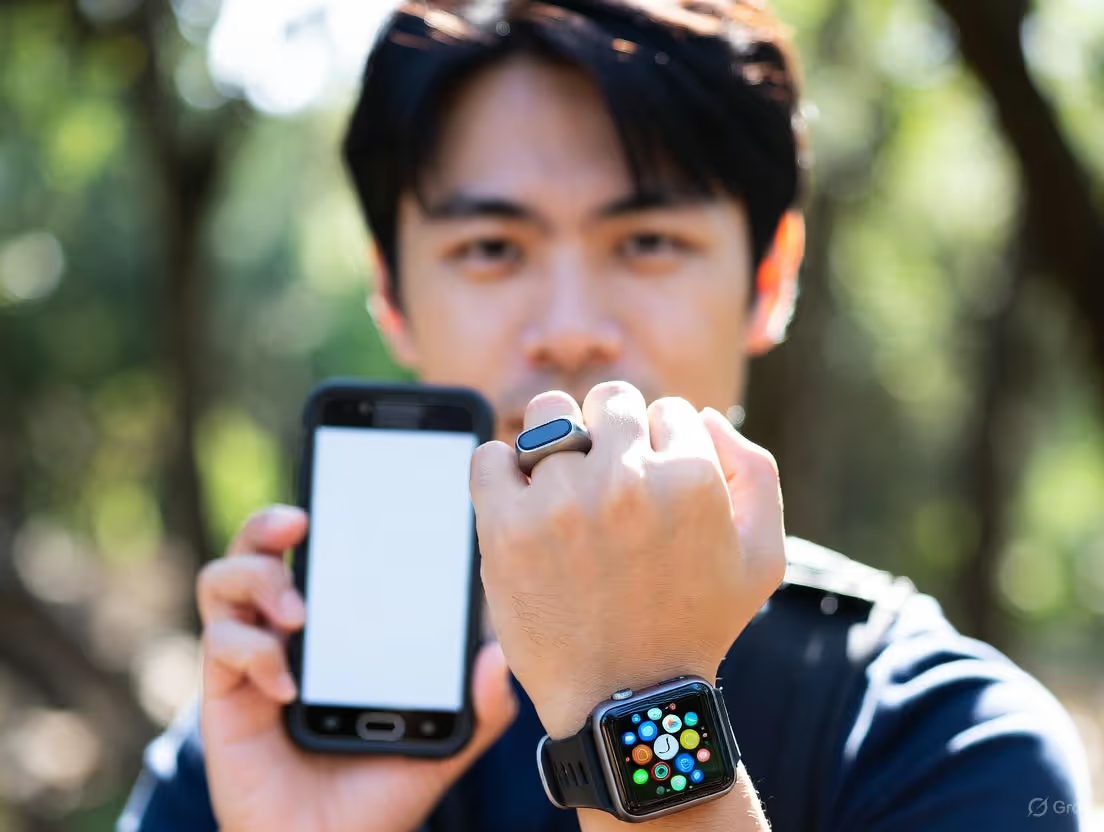
For generations, understanding our sleep was limited to subjective feeling ("I slept like a rock") or crude metrics like time in bed. The rise of consumer wearable technology has changed everything, but not all wearables are created equal. While smartwatches excel at daytime activity tracking, a new category is leading the sleep and circadian revolution: the smart ring.
Why a ring? The answer lies in physiology and practicality. The finger provides a superior signal for core biometrics critical to understanding circadian rhythms and sleep quality than the wrist.
This 24/7 data stream creates a personalized biometric dashboard. You can move beyond guessing and see, with data, how your 5 AM workout affects your Wolf chronotype's recovery, or how that late-night blue light exposure fragments your sleep architecture. It turns abstract concepts like "circadian alignment" into tangible, actionable insights. To see how real people have used this data to transform their sleep and wellness, explore our collection of real customer reviews and testimonials.
Collecting data is only the first step. The power lies in interpretation and pattern recognition over time. Here’s how to translate the key metrics from a device like a smart ring into meaningful insights about your place on the sleep spectrum.
1. Sleep Consistency vs. Sleep Duration: Society obsesses over "8 hours," but consistency is arguably more important for circadian health. Your data will show your bedtime and wake-time variability. A Wolf with a 2-hour difference between weekday and weekend schedules is experiencing significant social jet lag. The goal is to gradually reduce that variability, even if it means a slightly shorter but more consistent sleep window.
2. The HRV Trend – Your Recovery Score: Don't fixate on a single night's HRV number. Look at the trend. A consistently declining HRV trend over weeks is a red flag indicating chronic stress, overtraining, illness onset, or severe circadian misalignment. A rising trend suggests good recovery and adaptive capacity. Notice what behaviors (evening alcohol, intense late exercise, stressful workdays) correspond with dips in your personal data.
3. Temperature Rhythm – Finding Your Phase: The graph of your overnight temperature should show a clear, smooth decline to a nadir and then a rise. The time of your temperature minimum is a key circadian marker. If it's occurring at 5 AM, you're likely a Lion. If it's at 7 AM or later, you're veering into Wolf territory. A flattened, erratic temperature curve suggests circadian disruption, potentially from shift work, poor sleep hygiene, or illness.
4. Sleep Stages – The Architecture of Restoration: Look at the proportion and timing of deep (slow-wave) sleep and REM sleep. Deep sleep is predominant in the first half of the night and is crucial for physical restoration. REM sleep, vital for memory and emotion processing, dominates the later cycles. A night owl forced to wake early may be chronically cutting off their REM sleep, leading to cognitive and emotional effects. Good sleep hygiene should promote a balanced, cyclical architecture.
5. The "Readiness" or "Recovery" Score: Many platforms synthesize these metrics (sleep, HRV, temperature, activity) into a single daily score. Use this as a guide, not a gospel. A low score isn't a failure; it's feedback. It asks, "What stressed my system yesterday?" and "Do I need to prioritize recovery today?" It empowers you to make informed decisions: maybe today is for a gentle walk instead of a HIIT class, or an early dinner instead of a late work session.
By learning this language of your own body, you transition from being a passive participant in your health to an active, informed co-pilot. You can run experiments: "If I get morning light all week, does my temperature minimum shift earlier?" "If I stop caffeine after 2 PM, does my deep sleep increase?" This is the essence of biohacking—using data to make personalized, effective changes. For a deeper dive into the science behind these metrics and their application, our blog is an ongoing resource.
Armed with the knowledge of your chronotype and the data from your biometric tracking, the next step is personalization. A one-size-fits-all health recommendation is not only ineffective but can be counterproductive. Let’s explore actionable, evidence-based strategies for each archetype to maximize energy, health, and well-being.
Lions are blessed with natural alignment to the conventional world, but they risk burning out by midday if they don’t manage their energy strategically.
Morning (5 AM - 8 AM): This is your invincible zone. Capitalize on it immediately.
Midday (12 PM - 4 PM): This is your danger zone for energy decline.
Evening (6 PM - 10 PM): Your system is winding down.
Key Lion Insight: Your biggest challenge is avoiding evening stimulation that can delay your clock and erode your morning advantage. Protect your early bedtime like the most important meeting of your day.
Bears have the advantage of adaptability, but this can lead to drifting without a solid routine. Your goal is to harness the sun’s rhythm with intention.
Morning (7 AM - 10 AM): Ease into the day with structure.
Afternoon (1 PM - 3 PM): Navigate the universal slump strategically.
Evening (6 PM - 11 PM): Unwind fully to ensure restorative sleep.
Key Bear Insight: Your strength is consistency. Your vulnerability is the afternoon slump and evening screen time. Master these, and you’ll achieve steady, reliable energy and sleep.
Wolves must be strategic warriors in a morning world. Acceptance is your first weapon; intelligent design of your environment is your second.
Morning (The "Survival" Hours - 7 AM - 11 AM): The goal is to minimize damage and gently advance your clock.
Afternoon (12 PM - 5 PM): Your engine starts to turn over.
Evening (6 PM - 1 AM): This is your kingdom. Rule it wisely.
Key Wolf Insight: You cannot force yourself to be a Lion. Focus on phase advancement—gently shifting your entire cycle earlier using morning light and evening darkness—not on becoming something you’re not. Celebrate your unique creative and productive powers that emerge when the world is quiet. To learn more about how technology can support this delicate balancing act, you can explore our approach at Oxyzen.
Dolphins require precision, calm, and a hyper-consistent routine to coax their nervous system into restful sleep.
All Day: The Rhythm of Calm
Evening (The Critical Path - 8 PM onwards):
Key Dolphin Insight: Your sleep drive is fragile. Your strategy is not about forcing sleep, but about meticulously crafting an entire day and environment that makes sleep the natural, inevitable next step. Your focus should be on sleep pressure (building the need for sleep through consistent wake time and avoiding naps) and circadian timing (reinforcing the rhythm with light and routine).
The rigid 9-to-5 structure is a relic of the industrial age, ill-suited for the knowledge economy and fundamentally at odds with human biological diversity. The future of work—already unfolding—belongs to flexibility and output-based evaluation. Embracing chronodiversity isn't just a wellness perk; it's a strategic advantage for innovation, productivity, and talent retention.
The Case for Flexible and Asynchronous Work:
Implementing a Chrono-Friendly Culture:
This shift represents a move from controlling time to cultivating output and well-being. It’s a future where the Lion can lead the 7 AM strategy call, the Bear can hold team syncs at noon, and the Wolf can submit their groundbreaking analysis by 1 AM, with all contributions valued equally. This philosophy is central to how we envision technology supporting modern life, a perspective detailed in our mission and values.
Our journey through the sleep pattern spectrum reveals a fundamental truth: there is no "correct" or "optimal" chronotype. The Lion's dawn vigor is not morally superior to the Wolf's midnight muse. The Bear's reliable rhythm is not more valid than the Dolphin's sensitive pattern. Each is a natural expression of human variation, forged by genetics and evolution.
The path to better health, higher productivity, and greater life satisfaction lies not in fighting your innate rhythm, but in discovering it, honoring it, and negotiating with it. It requires tuning out the noisy chorus of "shoulds"—you should wake at 5 AM, you should be more of a morning person—and tuning in to the subtle, data-backed language of your own body.
This begins with curiosity. Observe your natural energy flows on a free day. Experiment with light. Consider your genetic heritage. And now, with the advent of precise, comfortable biometric technology like the smart ring, you can move beyond observation into insight. You can see the direct line between your 9 PM scroll through social media and a restless night, or between your morning walk and a higher daytime HRV.
Embracing your chronotype is an act of self-respect and a rejection of a one-size-fits-all world. It’s about building a life that fits you—structuring your work, your meals, your social life, and your sleep environment in harmony with your internal conductor. When you align your life with your biology, you stop wasting energy on internal conflict. That energy is then freed for what matters most: creativity, connection, and vitality.
In the next portion of this article, we will dive even deeper into advanced topics: the cutting-edge science of circadian disruption and disease; the interplay between chronotype, nutrition, and exercise timing; how to manage shift work; and a detailed guide on using biometric data to solve specific sleep challenges. We’ll equip you with everything you need to not only understand your spectrum but to thrive within it.
While social jet lag is a common stressor, more extreme forms of circadian disruption present severe, well-documented risks. Understanding these underscores why protecting our rhythm is not a luxury, but a critical component of long-term health.
Shift Work Sleep Disorder (SWSD): This is the frontline of circadian chaos. Approximately 20% of the workforce engages in shift work, often involving night shifts or rotating schedules. This forces a complete inversion or constant shifting of sleep-wake patterns against an immutable circadian rhythm set by light and darkness.
Jet Lag: This is acute circadian misalignment caused by rapid travel across time zones. Eastward travel (losing time) is typically harder than westward travel (gaining time), as it requires advancing the clock, which is a more difficult biological feat than delaying it.
The core lesson from these extreme examples is that our circadian system is robust yet vulnerable. Chronic, forced misalignment is a profound physiological stressor with systemic consequences. The principles of light management and consistent timing are our most powerful tools for defense.
The field of chrono-nutrition posits that aligning food intake with your circadian rhythm enhances metabolic health, improves energy, and can even aid in weight management. Your digestive system, liver function, and insulin sensitivity all follow robust daily cycles.
The Circadian Metabolism Cycle:
Practical Chrono-Nutrition Guidelines by Chronotype:
Intermittent Fasting (IF) and Chronotype: IF can be a powerful tool, but its timing matters. Early Time-Restricted Feeding (e.g., eating from 8 AM to 4 PM) aligns beautifully with the natural circadian metabolism and has shown excellent results for metabolic health. For a Wolf, a schedule like 12 PM to 8 PM may be more sustainable and still beneficial, as it discourages late-night eating. The key is consistency and alignment with your natural hunger cues, not just arbitrary fasting windows. For more on integrating data-backed wellness strategies, our blog features deep dives on nutrition and circadian health.
Physical activity is a potent zeitgeber. It can strengthen your circadian rhythm, but its effects on sleep and performance depend heavily on timing and intensity.
The General Principles:
Tailored Recommendations:
The golden rule: The best time to exercise is the time you can do it consistently. However, if you have performance goals or are struggling with sleep, strategically aligning your workout timing can provide a significant edge.
The bidirectional relationship between circadian rhythm and mental health is one of the most compelling areas of modern psychiatry. Disruption is not merely a symptom; it can be a contributing cause and a viable target for treatment.
Eveningness and Mood Disorders: As noted, being a Wolf is a significant risk factor for depression, anxiety, and bipolar disorder. The reasons are multifaceted:
Circadian-Based Interventions for Mental Health:
For anyone struggling with mood issues, assessing and stabilizing the "pillars" of circadian health—consistent sleep/wake times, morning light, dark evenings, and regular meal times—should be considered foundational, alongside traditional therapies. It’s a non-pharmacological way to build a more stable biological platform for well-being. Many users of detailed health tracking find that correlating mood notes with biometric data provides invaluable insights into these patterns, a topic we often explore in user experiences and testimonials.
With the complexities of chrono-nutrition, chrono-exercise, and mental health interwoven, the value of personalized, objective data becomes undeniable. A device like a smart ring transitions from a sleep tracker to a true circadian compass, guiding daily decisions.
Case Study 1: The Wolf Executive
Case Study 2: The Dolphin Entrepreneur
Case Study 3: The Bear with Rotating Shifts (Nurse)
These examples illustrate the move from generic advice to precision wellness. The ring provides the feedback loop: it tells you if your interventions are actually working on a physiological level. For technical questions on how to implement such tracking, our comprehensive FAQ resource is an excellent starting point.
Our chronotypes do not exist in a vacuum. They dynamically interact with the people around us, shaping family dynamics, friendships, and broader societal structures.
Parenting Across the Chronotype Spectrum:
Designing a Chrono-Friendly Society:
Embracing chronodiversity leads to more empathetic relationships, more effective institutions, and a society that harnesses the full potential of all its people, 24 hours a day. This vision of harmony between human biology and modern life is at the very heart of our company's founding story and vision.
The field of chronobiology is rapidly advancing, and the convergence with wearable technology is opening breathtaking new frontiers for personalized health.
Emerging Science:
The Next Generation of Wearables:
Future devices will move beyond tracking to predicting and prescribing.
This is the promise of true bio-hacking: a seamless, responsive interface between you and your biology, powered by data and guided by the ancient, intelligent rhythm within. It’s not about optimizing for productivity alone, but for resilience, longevity, and a profound sense of alignment.
Your Trusted Sleep Advocate: Sleep Foundation — https://www.sleepfoundation.org
Discover a digital archive of scholarly articles: NIH — https://www.ncbi.nlm.nih.gov/
39 million citations for biomedical literature :PubMed — https://pubmed.ncbi.nlm.nih.gov/
Experts at Harvard Health Publishing covering a variety of health topics — https://www.health.harvard.edu/blog/
Every life deserves world class care :Cleveland Clinic - https://my.clevelandclinic.org/health
Wearable technology and the future of predictive health monitoring :MIT Technology Review — https://www.technologyreview.com/
Dedicated to the well-being of all people and guided by science :World Health Organization — https://www.who.int/news-room/
Psychological science and knowledge to benefit society and improve lives. :APA — https://www.apa.org/monitor/
Cutting-edge insights on human longevity and peak performance:
Lifespan Research — https://www.lifespan.io/
Global authority on exercise physiology, sports performance, and human recovery:
American College of Sports Medicine — https://www.acsm.org/
Neuroscience-driven guidance for better focus, sleep, and mental clarity:
Stanford Human Performance Lab — https://humanperformance.stanford.edu/
Evidence-based psychology and mind–body wellness resources:
Mayo Clinic — https://www.mayoclinic.org/healthy-lifestyle/
Data-backed research on emotional wellbeing, stress biology, and resilience:
American Institute of Stress — https://www.stress.org/


