Sleep Tracking and Privacy: What You Need to Understand
Sleep tracking and privacy intersect in important ways users should understand. This security-focused guide explains data collection practices, cloud storage risks, third-party sharing, anonymization methods, and protective measures you can take to safeguard your personal sleep information.
Sleep Tracking and Privacy: What You Need to Understand
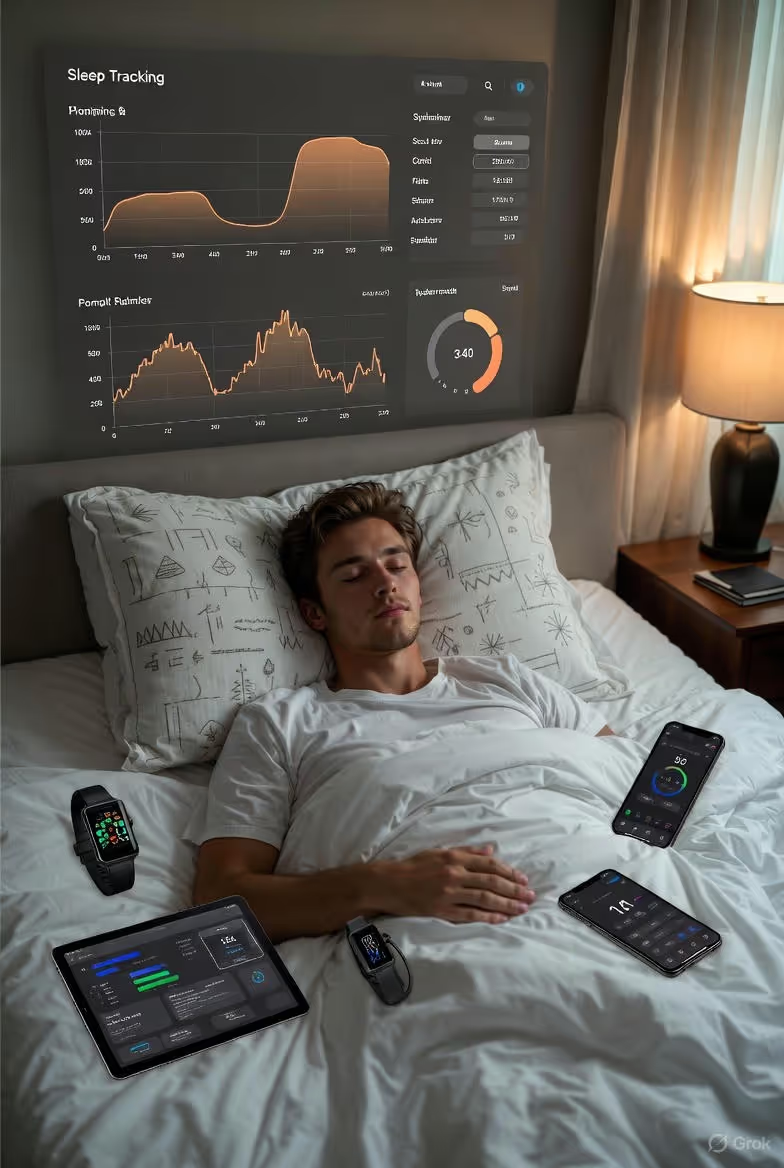
In the quiet hours of the night, a remarkable exchange is taking place. As millions of us surrender to sleep, the sleek devices on our wrists and fingers remain wide awake. They are diligently recording the intimate rhythms of our bodies—the steady beat of our hearts, the subtle rise and fall of our chests, the secret architecture of our dreams in REM and deep sleep. This constant stream of personal biometrics promises a revolution in self-understanding and wellness. More than one-third of Americans now use a wearable sleep tracker, drawn by the allure of quantified rest and better health .
But this nightly data harvest raises profound and urgent questions. Where does this deeply personal information about our vulnerable, unconscious hours ultimately go? Who else might be looking at the patterns of our rest, and for what purposes? The truth is that the sleek promise of better sleep often obscures a complex reality of data flows, privacy trade-offs, and regulatory gray areas. While devices like the OxiZen Smart Ring offer 24/7 monitoring of heart rate, blood oxygen, and sleep phases in a discreet, lightweight design, the data they collect enters an ecosystem with stakes far higher than most users realize .
The privacy of our sleep data sits at a precarious intersection. It is gathered not in a protected medical clinic, but in our own beds by consumer products. It is governed not by a single, strong law, but by a confusing patchwork of regulations that companies must navigate . As one legal analysis notes, the default assumption is that all health data is protected by HIPAA, but in reality, “health data privacy is regulated by a patchwork of federal laws, agency rules, and a maze of state regulations” . This legal landscape is shifting rapidly, with new state laws and FTC rules expanding the scope of what is protected, while high-profile data breaches remind us of the tangible risks .
This article is the beginning of a comprehensive exploration. We will pull back the curtain on how sleep tracking works, where your data travels, and the legal safeguards that may—or may not—protect it. We will examine the psychological impact of becoming “datafied” during sleep, the business models that turn your biometrics into value, and provide you with a practical guide for reclaiming control. The goal is not to foster fear, but to empower informed choice. In an age where our rest is no longer private, understanding the full picture is the first step toward securing both better sleep and true privacy.
How Sleep Trackers Work: The Science Behind the Scores
To understand the privacy implications of sleep tracking, we must first understand what data is being collected and how. Modern sleep trackers, particularly advanced smart rings, are feats of miniaturized engineering. They employ a suite of sensors to act as a proxy for the complex physiological processes of sleep, translating biological signals into the sleep scores and stage charts that appear on your smartphone each morning.
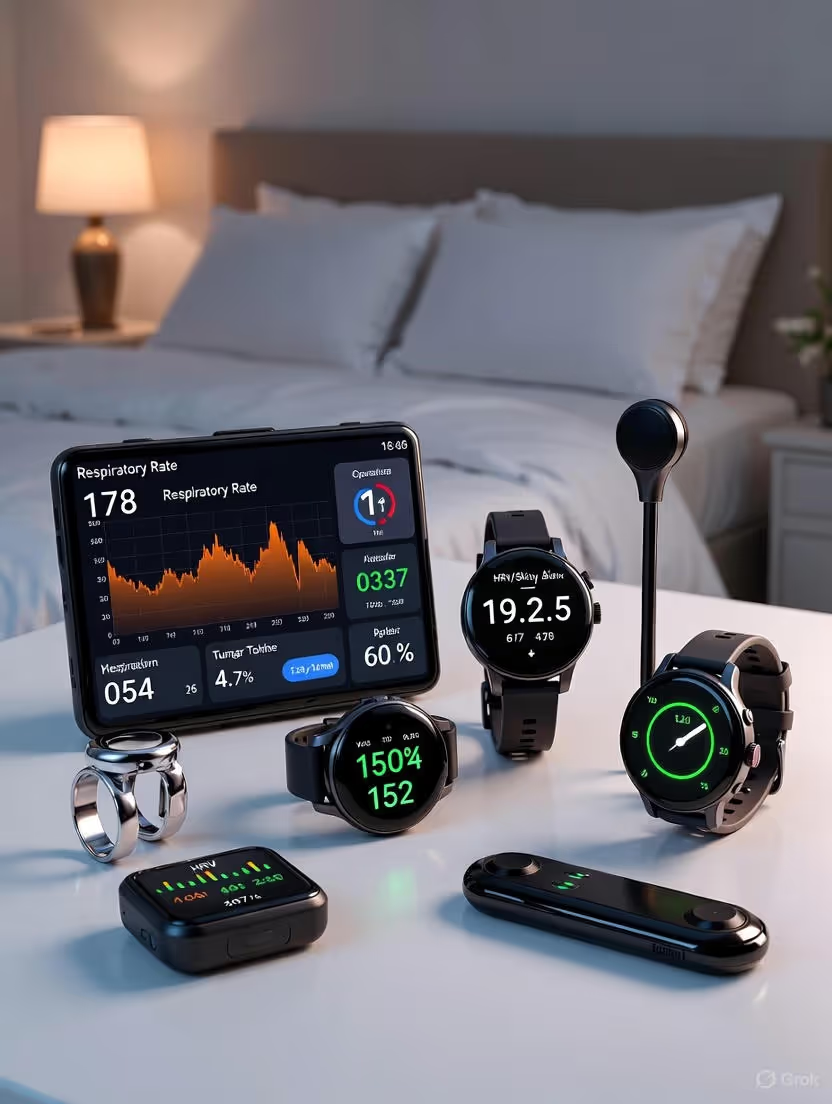
The primary data collection happens through photoplethysmography (PPG). This technology uses tiny green LED lights to shine into the capillaries in your finger or wrist. A sensor then measures the amount of light reflected back. As your heart pumps, blood volume in these capillaries changes minutely, altering the light reflection. These fluctuations allow the device to calculate your heart rate and, more importantly for sleep, your heart rate variability (HRV)—the subtle variations in time between each heartbeat. HRV is a key indicator of autonomic nervous system activity, shifting as you transition from the alertness of wakefulness to the relaxation of light sleep and the profound recovery of deep sleep.
Accelerometers are the second critical component. These microscopic motion detectors register every toss, turn, and tremor. Periods of profound stillness often correlate with deep sleep, while frequent movements can indicate light sleep or awakenings. Advanced algorithms cross-reference motion data with heart rate patterns to make more refined guesses about your sleep stage. For instance, a low, steady heart rate coupled with no motion strongly suggests deep sleep.
Many premium devices, including the top-rated Oura Ring 4, incorporate additional sensors like skin temperature thermistors and pulse oximeters. Nocturnal changes in peripheral body temperature are a core component of the body’s circadian rhythm and sleep regulation. A steady drop in skin temperature is associated with sleep onset, while a rise precedes waking. Pulse oximetry uses red and infrared light to measure blood oxygen saturation (SpO2). Significant, repeated dips in SpO2 during the night can be a signature of sleep apnea, a serious disorder where breathing repeatedly stops and starts.
The magic—and the potential source of error—lies in the algorithm. The raw sensor data (heartbeats, motion, temperature) is just a stream of numbers. It is the proprietary algorithm, often powered by machine learning, that attempts to classify this data into sleep stages: wake, light sleep, deep sleep, and REM sleep. It is crucial to recognize that these consumer device classifications are estimates, not clinical diagnoses. They are inferred from peripheral signals, not from the gold-standard measurement of brain waves (EEG) used in a sleep lab polysomnography study.
This distinction is vital. A 2021 review in a scientific journal highlighted that very few consumer sleep apps or devices have undergone rigorous validation against polysomnography. One study of a popular app found no correlation with polysomnography in measuring total sleep time or sleep latency, while another was found to overestimate total sleep time by a staggering 106 minutes. The Oura Ring has built a reputation for being one of the more accurate consumer devices, with PCMag's testing confirming its accurate activity and sleep data . However, even the best consumer tracker operates in a different league of precision than medical equipment.
Nevertheless, the profile these devices build is astonishingly detailed. Over months and years, they accumulate a longitudinal dataset of your body’s nocturnal behavior: your average resting heart rate, your typical sleep duration, your chronotype (whether you’re a natural night owl or early bird), and your vulnerability to disruptions from alcohol, stress, or late meals. It is this rich, intimate, and longitudinal biometric portrait—not just a single night’s score—that becomes so valuable and, consequently, so sensitive from a privacy perspective. For a deeper look at the technology powering these insights, you can explore our blog, where we regularly discuss the future of wearable wellness [citation:].
The Data Trail: Where Your Sleep Information Goes
When you wake up and tap your smartphone to sync your smart ring, you initiate a complex journey for your sleep data. This journey extends far beyond the comforting confines of your device and personal app. Understanding this data trail is essential to grasping the true scope of privacy concerns.
The first hop is to the manufacturer’s servers. Companies like Oura, Samsung, or the makers of the OxiZen Smart Ring maintain cloud infrastructure where your encrypted data is uploaded for processing and long-term storage . This is where the heavy algorithmic lifting happens, turning raw sensor data into interpretable scores and trends. Storing data in the cloud allows you to access your history from any device, enables the company to improve its algorithms using aggregated data, and provides a backup. However, it also creates a central repository of highly sensitive information that becomes a potential target.
The data’s journey often does not end there. A critical and frequently opaque practice is sharing with third-party partners. A systematic review cited in a 2021 academic paper found that health app user data was shared with an average of 46 “third parties” and 216 “fourth parties” (the partners of the partners) . These entities can include:
Analytics and Marketing Firms: Data may be used to “understand user behavior” or for targeted advertising. The same paper notes that 66% of third parties that receive mobile health data collect it for advertising and analytics purposes .
Research Institutions: Aggregated and anonymized data is valuable for large-scale sleep studies. While this can contribute to public health knowledge, the line between anonymized and identifiable data can be thin.
Business Partners: This could include other wellness brands, insurance wellness programs, or employers offering corporate wellness plans.
The privacy policies governing this sharing are often dense and legalistic. The 2025 living review of wearable privacy policies found that the average policy length was over 6,100 words, with the longest stretching beyond 12,000 words . It is no wonder that research consistently shows an overwhelming majority of users accept terms and conditions without reading them . Buried within these documents can be clauses like that of Sleep Number, which states user data “may be shared” with partners for “research, analysis or administering surveys” .
Furthermore, the purpose of data collection can be broad. Beyond providing your sleep score, companies may state they use data for “product development,” “personalization,” and “security.” These broad categories can be interpreted to justify a wide range of internal uses. The 2025 review identified “Transparency Reporting” as one of the highest-risk areas, with 76% of wearable companies rated High Risk for failing to clearly report on data sharing with governments or third parties .
A particularly sensitive issue is inferred data. Algorithms don’t just report what they measure; they make guesses about what it means. Your device might infer that you were “stressed” yesterday or that you have a “high sleep consistency.” Some experts have pointed out that raw data on movement and heart rate could potentially be interpreted to identify periods of sexual activity, a deeply private inference that could be used for targeted advertising without your explicit knowledge or consent .
Finally, if you choose to share your data with a healthcare provider—for example, to discuss poor sleep with your doctor—the data may enter a different regulatory realm. Once integrated into your doctor’s medical record system for treatment purposes, it may become “Protected Health Information” (PHI) under HIPAA. However, as we will explore next, this protection applies to your doctor’s system, not necessarily retroactively to the device company that originally collected it . The data trail, therefore, is not a simple path but a branching network, with your most intimate biological information flowing to destinations you likely never considered when you bought that sleek, promising device on your finger.
The Legal Landscape: HIPAA, FTC, and a Patchwork of Laws
Many consumers operate under a comforting but incorrect assumption: that their sleep data is protected by the same robust privacy laws that guard their medical records. The reality is a complex, fragmented, and evolving legal terrain that often leaves consumer-generated health data in a gray zone. As legal experts note, “The default assumption in the U.S. is that all health data is regulated by HIPAA. However, in reality, health data privacy is regulated by a patchwork of federal laws, agency rules, and a maze of state regulations” .
HIPAA’s Limited Realm The Health Insurance Portability and Accountability Act (HIPAA) is the cornerstone of medical privacy in the U.S., but its protections are specific. It applies to “covered entities”: healthcare providers, health plans, and healthcare clearinghouses. It also extends to their “business associates”—vendors who handle protected health information (PHI) on their behalf . Crucially, HIPAA generally does not apply directly to the manufacturers of consumer wearable devices. A company like Fitbit, Oura, or the maker of a smart ring is not your healthcare provider. As one analysis clarifies, “Organizations that exist outside of those categories… are not subject to HIPAA” . Your data is only covered by HIPAA if and when it is held by your doctor or hospital as part of your treatment.
The FTC Steps Into the Void With HIPAA’s limited scope, the Federal Trade Commission (FTC) has become the primary federal regulator for consumer health technology. The FTC enforces against “unfair or deceptive acts or practices” under Section 5 of the FTC Act. Its key tool here is the Health Breach Notification Rule (HBNR), which was amended and strengthened in 2024 . This rule now explicitly applies to apps and wearable devices not covered by HIPAA. If a company like a sleep tracker vendor experiences a breach of unsecured, identifiable health data, it must notify affected consumers, the FTC, and in some cases, the media, within 60 days of discovery. Failure to comply can result in significant civil penalties .
A Growing Thicket of State Laws Perhaps the most dynamic and complex layer of regulation is at the state level. Several states have enacted laws that explicitly treat biometric and health data from wearables as sensitive information, granting consumers new rights:
Washington’s My Health My Data Act (MHMDA): Effective in 2024, this landmark law has a broad definition of health data, including information “collected, derived, or inferred” from wearables. It requires opt-in consent for data collection and use, and prohibits geofencing around healthcare facilities .
California’s Privacy Rights Act (CPRA): This law classifies data like heart rate, sleep, and skin temperature from wearables as “sensitive personal information.” It gives Californians the right to limit the use of this data and requires businesses to perform Data Protection Impact Assessments .
Texas and Florida: Both states have new data privacy laws (TDPSA and FDBR) that cover biometric data. Florida’s law is notable for having no cure period for violations, meaning companies can be sued immediately for non-compliance, raising litigation risks .
The Regulatory Blind Spots This patchwork creates significant challenges. A company operating nationwide must comply with the strictest applicable state law, often leading to a complex compliance burden. There are also clear gaps. For example, while the FTC’s HBNR requires notification after a breach, comprehensive rules governing data minimization, purpose limitation, and user consent before collection are largely absent at the federal level. Furthermore, as a 2025 academic review found, enforcement and transparency are inconsistent. The study rated 59% of wearable companies as High Risk for Breach Notification practices and 76% as High Risk for Transparency Reporting, indicating widespread failure to clearly communicate how data is shared .
This legal landscape is not static. A proposed update to the HIPAA Security Rule would mandate stronger cybersecurity controls like multi-factor authentication and encryption . However, as of late 2025, this is still a proposal. For now, the protection of your sleep data depends less on a single, powerful law and more on a combination of FTC enforcement, varying state laws, and the privacy policies of the companies you trust—policies that, as we’ve seen, are often long, complex, and subject to change. Understanding this patchwork is the first step in advocating for your own privacy in a market that is still defining the rules. For more detailed information on how we navigate these regulations, you can read about our company’s mission and commitment to user privacy [citation:].
The Privacy Policies: What You’re Really Agreeing To
When you unbox your new smart ring or download a sleep tracking app, a critical moment occurs almost instantly: you must agree to the Terms of Service and Privacy Policy. With a habitual tap on “Agree,” you legally consent to a contract that dictates the fate of your most sensitive data. But what do these documents actually say, and how do they shape the privacy landscape?
The first challenge is their sheer complexity and length. The 2025 systematic review of wearable privacy policies found they average over 6,100 words—longer than many academic essays—with some, like WHOOP’s, exceeding 12,000 words . This length is a significant barrier to understanding. Researchers have consistently found that an overwhelming majority of users do not read these policies, with one study noting 91% of app users accept terms without reading them. This creates a fundamental imbalance: you are bound by a legal document you likely have not comprehended.
Within these dense texts, key clauses define your rights and the company’s powers:
Scope of Data Collection: Policies list what is collected, which is often exhaustive. Beyond sleep stages, this can include “inferred data” (like stress scores), device identifiers, and even, as with the app Sleep Cycle, your location data if you use certain features .
Purpose of Use: Look for broad, catch-all phrases like “to improve our services,” “for research and development,” “for personalization,” and “for security purposes.” These can be interpreted to justify a wide range of internal uses beyond simply displaying your sleep score.
Third-Party Sharing: This is often the most critical section. Policies will state with whom data is shared—analytics providers (like Google Analytics), cloud service hosts (like Amazon AWS), marketing partners, and “affiliates.” The 2021 review highlighted that data can travel through chains of dozens of entities .
Data Retention and Deletion: How long does the company keep your data after you stop using the device? Policies may state they retain data for as long as “necessary for business purposes” or to “comply with legal obligations.” The 2025 review found that Data Deletion was a high-risk area, with only 24% of companies providing clear, easy paths for users to have their data deleted .
Choice and Control: Do you have any real options? Some policies may allow you to opt out of certain types of data sharing, particularly for targeted advertising (a right afforded by laws like the CPRA). However, opting out of core data collection or sharing for “service functionality” is usually not an option if you wish to use the product.
The 2025 review’s evaluation framework reveals where companies most commonly fall short. The highest-risk practices across the industry were:
Transparency Reporting (76% High Risk): Most companies fail to provide clear, regular reports on how often they share data with governments or other third parties .
Vulnerability Disclosure (65% High Risk): Few have formal programs for security researchers to report software flaws, which is a best practice for preventing breaches .
Breach Notification (59% High Risk): Despite the FTC rule, many policies are vague on how and when they will notify users if a breach occurs .
Conversely, the review found most companies scored well on allowing user Data Access (71% Low Risk) and providing some Control Over Targeted Advertising (65% Low Risk) . This means you can usually get a copy of your data and turn off ad personalization, but you have far less control over its broader collection and sharing ecosystem.
Ultimately, the privacy policy is the rulebook. By agreeing to it, you are often consenting to a model where your intimate sleep data is not just a tool for your wellness, but an asset for the company’s business—an asset that may be analyzed, shared, and retained in ways that are not immediately obvious when you simply want to know how well you slept. Before you tap “Agree,” it is worth asking: do you know the rules of the game you’re about to play? For common questions on how to interpret these policies and manage your data, our FAQ resource provides further guidance [citation:].
The Business of Biodata: How Your Sleep is Monetized
The exchange in the sleep tracking market seems straightforward: you pay for a hardware device (a smart ring, watch, or tracker) and, in return, you receive insights into your health. While this is true on the surface, it obscures a more complex economic reality. For many companies in this space, the device is not the final product; the user—or more precisely, the user’s data—is a core component of the business model. Your sleep patterns have monetary value that extends far beyond your subscription fee.
The Direct-to-Consumer Model The most visible revenue stream is you, the consumer. This includes:
Hardware Sales: Premium smart rings like the Oura Ring 4 or Samsung Galaxy Ring can cost $300-$400 .
Subscription Fees: Many leading platforms, including Oura, lock their most advanced insights and historical trend analysis behind a monthly or annual membership fee. PCMag notes that the otherwise excellent Oura experience requires a $5.99/month or $69.99/year subscription for full feature access . This creates a recurring revenue model that depends on continued user engagement with their data.
The Data-Value Ecosystem The less visible, but potentially more lucrative, monetization happens with the data itself. This generally does not involve the outright “selling” of your personal data with your name attached. Instead, it operates through aggregation, analysis, and licensing:
Aggregated Data for Research: De-identified data from millions of users is a goldmine for medical and public health research. Pharmaceutical companies, academic institutions, and public health organizations may pay to access these massive datasets to study sleep patterns, disease correlates, or the effectiveness of interventions. While anonymized, the scale and detail of this data can sometimes lead to re-identification risks.
Product Development and AI Training: Your data is the fuel that improves the product. Every night of tracked sleep helps refine the algorithms that distinguish deep sleep from REM sleep. This continuous improvement loop makes the core product more accurate and valuable, attracting more users and creating a competitive advantage.
Partnerships and Cross-Marketing: Data insights can forge lucrative partnerships. A sleep company might partner with a mattress brand, a meditation app, or a nutritional supplement company. These partnerships can be fueled by insights derived from user data, enabling targeted co-marketing campaigns. For instance, if aggregated data shows users who listen to certain sounds fall asleep faster, the company might partner with a music streaming service.
Insurance and Corporate Wellness Programs: This is one of the most debated avenues. Some health and life insurance companies offer discounts or incentives for members who share wearable data that demonstrates healthy behaviors. Similarly, employers may integrate wearables into corporate wellness programs. In these cases, the wearable company may license its platform and insights to these large institutional clients. While often framed as a benefit, it raises questions about surveillance and pressure to conform to “healthy” biometric standards.
The 2025 privacy policy review highlights the commercial incentives at play, stating, “Many companies are incentivised to gather and monetise extensive amounts of user data, often concealing the scope of these practices behind dense, difficult-to-read privacy policies” . The value of this data is underscored by its attractiveness to hackers; health records can be worth up to $250 per record on the dark web due to the rich, permanent personal information they contain, compared to just a few dollars for a stolen credit card number .
Understanding this business model is crucial. It reframes the transaction. You are not just a customer buying a service; you are also a data provider contributing to an asset that has multiple avenues for value creation. This doesn’t necessarily make the practice unethical, but it does underscore the importance of transparency and choice. A company that is upfront about how it derives value—like offering a clear, subscription-only model without hidden data licensing—allows you to make a more informed choice about which ecosystem you want to support with your nocturnal biometrics. To see how one company approaches this balance, you can learn about our story and the values that guide our product development [citation:].
Risks and Consequences: From Data Breaches to Discrimination
The collection and centralization of vast pools of sensitive sleep data create tangible risks that move beyond abstract privacy concerns. These risks can have real-world consequences for your finances, opportunities, and personal safety.
Data Breaches and Cybersecurity Threats The most direct risk is a security breach. Wearable companies are high-value targets for cybercriminals. The 2025 review of privacy policies notes that “health biodata is a highly valued commodity on the Dark Web,” citing a report that healthcare records can fetch up to $250 each due to their comprehensiveness and permanence . Recent history provides stark examples: a security incident exposed over 61 million fitness tracker records, and the massive UnitedHealth breach compromised data for 100 million individuals. Once stolen, this data can be used for identity theft, financial fraud, or extortion. The intimate nature of sleep data—potentially revealing sleep disorders, irregular routines, or inferred behaviors—could make it particularly potent for personalized phishing attacks or blackmail.
Function Creep and Unintended Uses “Function creep” refers to data collected for one purpose being used for another, often unanticipated, purpose. Your sleep data, gathered to help you rest better, could be repurposed in ways you never intended:
Insurance and Employment Discrimination: While currently limited by laws like the Genetic Information Nondiscrimination Act (GINA), the potential for discrimination is a major ethical concern. Could a future where insurers have access to detailed sleep data lead to higher premiums for those with poor sleep scores or indicators of sleep apnea? Could employers making hiring or promotion decisions be influenced by data suggesting an applicant is chronically fatigued or has an “inefficient” sleep pattern? The 2025 review explicitly lists this risk, stating, “insurers might use health data to risk-profile individuals, potentially leading to higher premiums” .
Law Enforcement and Legal Proceedings: Data from wearables has already been used as evidence in criminal cases (e.g., using heart rate data to dispute claims about a state of mind). Your sleep tracker could theoretically be subpoenaed to challenge an alibi, prove you were awake at a certain time, or demonstrate a pattern of behavior.
Surveillance and Control: In the most dystopian scenario, aggregated biometric data could facilitate population-level surveillance. Governments or other powerful entities could potentially identify dissidents or vulnerable groups based on stress or sleep patterns.
Jailbreaking and Ecosystem Vulnerabilities A unique technical risk specific to connected devices is “jailbreaking”—the unauthorized modification of a device’s software to bypass manufacturer restrictions . While sometimes done by users to enable desired features (like making different brand devices work together), it seriously compromises security. Jailbreaking disables security updates, encryption, and integrity checks. As a legal analysis warns, a compromised wearable can become a gateway for attackers to access broader connected ecosystems, like home networks or even, in a medical context, clinical systems. Falsified data from a jailbroken device “could induce erroneous clinical interventions,” posing a direct threat to safety .
The Psychological and Social Impact The risks are not only external. The phenomenon of “orthosomnia”—a term coined by sleep researchers—describes the anxiety and preoccupation that can arise from an excessive focus on achieving perfect sleep scores . This obsession, fueled by constant data tracking, can ironically lead to the very insomnia the device is meant to help. Psychology Today reports that this “preoccupation with a sleep tracking device” is now recognized as a new trigger for sleep disorders, with people becoming anxious if they cannot wear their device or if their data is not “optimal” .
In sum, the risks of sleep tracking privacy are multifaceted. They range from the criminal (data theft) to the commercial (discrimination), and from the technical (cyber-attacks) to the deeply personal (increased anxiety). Acknowledging these potential consequences is not an argument against using sleep technology, but a necessary step in developing a healthier, more guarded, and more empowered relationship with the devices we invite into our beds. For insights from others who have navigated these concerns, our testimonials page shares real user experiences and how they manage their data [citation:].
Smart Rings vs. Other Trackers: A Privacy Comparison
The wearable market offers a variety of form factors, primarily smart rings (like Oura or OxiZen), smartwatches (Apple Watch, Garmin), and wristband fitness trackers (Fitbit, Whoop). While all collect similar sleep data, their design, functionality, and business models can lead to different privacy implications. Understanding these nuances can help you choose a device that aligns with your privacy preferences.
The Smart Ring: Discreet Data Collection Smart rings are the newest and most minimalist form factor. Devices like the Oura Ring 4 (our top tested pick) or the more affordable OxiZen Smart Ring are prized for their comfort and 24/7 wearability, which is crucial for continuous sleep and recovery metrics .
Privacy Advantage - Reduced Surface Data: A ring primarily collects data from the blood vessels in your finger (PPG), motion, and skin temperature. It typically lacks a screen, microphone, GPS, or camera. This inherently limits the types of data it can collect compared to a smartwatch. There’s no risk of it passively recording audio or tracking your precise location throughout the day unless connected to a phone that does so.
Consideration - Business Model: As noted, the leading ring, Oura, uses a subscription model to unlock full data insights. This can be a clearer transactional relationship: you pay a fee for a service. However, it’s essential to read its privacy policy to understand if subscription revenue is the sole monetization method or if data still plays a role in other ventures.
The Smartwatch: A Comprehensive Sensor Suite Smartwatches, like the Apple Watch or Samsung Galaxy Ring (which, despite the name, is a ring form factor from a watch maker), are multifunctional computers for your wrist .
Privacy Consideration - Data Breadth: They collect all the biometric data a ring does, plus often much more: GPS location tracks, voice commands via microphone, possibly call or message content if you interact with them, and even environmental sound levels. This creates a vastly more detailed digital footprint. Your sleep data on a smartwatch is contextualized within a minute-by-minute log of your daily movements, conversations, and activities.
Consideration - Ecosystem Lock-In: Smartwatches are often part of larger ecosystems (Apple, Google, Samsung). Your health data may be integrated into a central health platform (like Apple Health or Samsung Health), which can be both a privacy and a convenience feature. It gives you a central place to control data sharing, but it also means your data is deeply enmeshed with a tech giant’s infrastructure.
Wristband Trackers: The Established Players Brands like Fitbit (owned by Google) and Whoop represent the dedicated fitness tracker segment.
Privacy Consideration - Legacy and Integration: Companies like Fitbit have long histories of data collection and specific privacy policies that have evolved, often toward more data sharing following acquisitions. Whoop’s model is subscription-based with no upfront hardware cost, which intensely aligns its business with retaining you as a long-term data-providing member.
General Comparison Points:
Data Minimization: Does the device collect only what is necessary for its core functions? A ring has an inherent advantage here.
Transparency: Is the company clear about its data practices? The 2025 review ranked companies like Apple and Google (which now owns Fitbit) among the lowest risk, while others scored much higher . This suggests brand reputation and resources dedicated to compliance matter.
User Control: Can you easily access, export, and delete your data? Do you have clear toggles to opt out of data sharing for research or marketing?
Security Posture: Does the company have a published vulnerability disclosure program? The review found 65% of wearable companies lacked one, which is a major security red flag .
The Bottom Line No form factor is inherently “private.” A company’s data governance practices are more important than the shape of its device. However, your choice can limit the type of data collected. If your sole focus is sleep, recovery, and basic activity, a smart ring offers a minimalist data-collection profile. You get rich biometric data without the ancillary streams of location, audio, and communication that come with a smartwatch. Ultimately, the most privacy-conscious choice involves pairing a hardware form that meets your needs with a company that demonstrates transparency, strong security, and a business model you trust. For a side-by-side look at how different devices handle data, our blog features ongoing comparisons and analyses of the wearable market [citation:].
User Control and Rights: How to Take Back Your Data
In the face of complex data trails and opaque policies, you are not powerless. A growing body of regulations, combined with proactive steps, can give you significant control over your sleep data. Exercising these rights shifts you from a passive data subject to an active participant in managing your digital footprint.
Know and Exercise Your Legal Rights Your rights depend largely on where you live, but powerful frameworks exist:
California Consumer Privacy Act (CCPA/CPRA): If you are a California resident, you have the right to:
Know what personal information is collected and how it’s used and shared.
Delete personal information collected from you (with some exceptions).
Correct inaccurate personal information.
Opt-out of the “sale” or “sharing” of your personal information. (Note: Many companies interpret “sharing for targeted advertising” as a “sale.”)
Limit the use of your sensitive personal information, which includes precise geolocation and health data from wearables . Companies must provide a clear “Limit the Use of My Sensitive Personal Information” link.
Other State Laws: Similar rights are emerging in Colorado, Virginia, Utah, Connecticut, and under Washington’s powerful My Health My Data Act, which requires opt-in consent for collecting and sharing health data .
General Best Practices (Regardless of Location):
Submit a Data Access Request: Email the company’s privacy officer (address is usually in the privacy policy) and request a copy of all personal data they hold on you. Under GDPR-influenced norms, many global companies will comply. The 2025 review found 71% of companies were Low Risk for Data Access, meaning they generally provide this .
Submit a Data Deletion Request: Request that they delete your data. Be aware that they may refuse if they need it for legal compliance or fraud prevention, but they should delete it from active systems. This was a higher-risk area, with only 24% of companies rated Low Risk .
Opt-Out of Targeted Advertising: Look in your account settings within the companion app for “Privacy,” “Ads,” or “Personalization” controls. You can often toggle off “Personalized Ads” or “Allow Third-Party Targeting.”
Practical Steps for Proactive Privacy Management
Audit Your App Permissions: Go to your smartphone’s settings. Under the app for your sleep tracker, review which permissions are granted (e.g., Location, Microphone, Contacts). Disable any that are not essential for core functionality. Does a sleep tracker really need access to your contacts or your microphone while you sleep?
Use a Dedicated Email and Strong Authentication: Create an email address used solely for wellness apps and device accounts. This limits data linkage across your digital life. Always enable Multi-Factor Authentication (MFA) on the account if available, which is a key security measure proposed in upcoming HIPAA updates .
Manage Data Syncing and Aggregation:
If you use an Apple Watch or iPhone, manage what data is written to Apple Health. You can disable writing for specific data points.
Use Apple Health or Google Fit as a central hub. You can often set your sleep tracker to share data only with this hub and then disable sharing from the hub to other third-party apps. This creates a single point of control.
Regularly review connected apps and services within your tracker’s app and in your health hub. Revoke access for tools you no longer use.
Practice Selective Sharing: Be extremely cautious about participating in “research studies” or “community features” within the app. These often involve broader data sharing. Similarly, think carefully before connecting your sleep data to an employer wellness program or an insurance incentive.
The Nuclear Option: Factory Reset and Account Deletion: If you stop using a device, don’t just throw it in a drawer. Perform a factory reset on the device itself (check the manual). Then, use the company’s account deletion process to formally close your account and request data deletion, as outlined above.
Taking control is an ongoing process, not a one-time action. By understanding your rights, diligently managing settings, and making conscious choices about sharing, you can enjoy the benefits of sleep tracking while building meaningful walls around your most sensitive nocturnal data. For step-by-step guidance on adjusting these settings on your specific device, our support FAQ is a valuable resource [citation:].
The Future of Sleep Tech and Privacy: Trends to Watch
The field of sleep technology and its corresponding privacy landscape are not static. They are being shaped by rapid advancements in technology, evolving consumer awareness, and responsive (if sometimes lagging) regulation. Several key trends will define the future of what happens to our data while we sleep.
Technological Evolution: Deeper Sensing and AI Integration The next generation of devices will move beyond inference to more direct sensing. EDA (Electrodermal Activity) sensors, which measure subtle skin conductance linked to stress, are already appearing. Future rings or patches may incorporate simplified EEG (electroencephalography) to detect brain wave patterns more directly, blurring the line between consumer gadget and medical device. Furthermore, Artificial Intelligence will play a dual role. It will enable hyper-personalized insights (“Based on your 2 years of data, drinking coffee after 2 PM disrupts your deep sleep by 22%”), but it will also make data more valuable and inferences more invasive. AI could predict mental health episodes, cognitive decline, or specific diseases from sleep-wake pattern irregularities long before clinical diagnosis.
The Future of Sleep Tech and Privacy: Trends to Watch
The field of sleep technology and its corresponding privacy landscape are not static. They are being shaped by rapid advancements in technology, evolving consumer awareness, and responsive (if sometimes lagging) regulation. Several key trends will define the future of what happens to our data while we sleep.
Technological Evolution: Deeper Sensing and AI Integration The next generation of devices will move beyond inference to more direct sensing. EDA (Electrodermal Activity) sensors, which measure subtle skin conductance linked to stress, are already appearing. Future rings or patches may incorporate simplified EEG (electroencephalography) to detect brain wave patterns more directly, blurring the line between consumer gadget and medical device. Furthermore, Artificial Intelligence will play a dual role. It will enable hyper-personalized insights (“Based on your 2 years of data, drinking coffee after 2 PM disrupts your deep sleep by 22%”), but it will also make data more valuable and inferences more invasive. AI could predict mental health episodes, cognitive decline, or specific diseases from sleep-wake pattern irregularities long before clinical diagnosis.
Regulatory Convergence and Stronger Laws The current “patchwork” is likely to face pressure to consolidate. The FTC’s Health Breach Notification Rule is just the beginning. We may see a push for a comprehensive federal health privacy law that covers consumer-generated data, creating a national standard that supersedes the state-by-state approach. The proposed updates to the HIPAA Security Rule, mandating specific cybersecurity controls, signal a regulatory recognition that digital health data requires modern, robust protections. Companies will face increasing legal and consumer pressure to adopt privacy-by-design principles—building data minimization, strong encryption, and user control into products from the very first line of code, rather than as an afterthought.
The Rise of Privacy as a Premium Feature As consumers become more educated, privacy will evolve from a fine-print concern to a key differentiator in the market. We will see the emergence of clear tiers:
The Data-For-Service Model: The current standard. You get a device and insights, and your aggregated data fuels research, partnerships, and AI.
The Privacy-First Subscription Model: A higher-cost tier where you pay not just for software features, but for a contractual guarantee that your data is used solely for your personal insights and is never sold, shared, or used for research without explicit, opt-in consent for each project. Companies like Apple have built brand trust on this approach, and others will follow.
The Local-Processing Model: The most private frontier. Emerging devices may process all sensitive biometric data directly on the device (on-device AI), sending only anonymized, high-level summaries to the cloud, or nothing at all. This “data never leaves your wrist” model represents the ultimate in user control but requires significant advances in edge-computing power and battery life.
Consumer Awakening and the Demand for Transparency The era of blind trust is ending. High-profile breaches and investigative reports are making users ask harder questions. Future consumers will demand nutrition-label-style privacy disclosures—simple, standardized summaries of data practices instead of 6,000-word legalese. They will favor companies that undergo independent audits of their security and data practices and publish the results. The concept of data ownership will move from philosophy to feature, with users expecting easy tools to download, visualize, and truly own their entire historical dataset, potentially taking it from one platform to another.
This evolving landscape presents both challenges and opportunities. The same technologies that deepen surveillance can empower unprecedented self-knowledge. The regulations that burden companies can also build essential consumer trust. The future belongs to those who recognize that in the sensitive realm of sleep, the greatest innovation may not be a new sensor, but a new standard of respect for the human behind the data points. To follow this evolution as it happens, including how new technologies are integrated responsibly, our blog provides ongoing analysis and commentary [citation:].
A Practical Guide to Choosing a Private Sleep Tracker
Armed with an understanding of the risks, the business models, and the future trends, you are now equipped to make an informed decision. Choosing a sleep tracker with privacy in mind is a deliberate process. Here is a step-by-step guide to evaluating your options.
Step 1: Define Your "Why" and "What" Before looking at devices, clarify your goals. Are you a general wellness enthusiast curious about trends? An athlete optimizing recovery? Someone investigating potential sleep apnea? Your goal dictates the data you need and thus the privacy exposure you might accept. For general trends, a simpler device with fewer sensors may suffice. For medical suspicions, you may need a more advanced device (with SpO2 sensing) and should be prepared for that data to potentially enter a more regulated medical channel if shared with a doctor.
Step 2: Research the Company, Not Just the Hardware The company’s ethos is as important as the ring’s specs. Investigate:
Public Reputation: Has the company been involved in privacy scandals or notable breaches? Tech news sites and forums are good resources.
Transparency Reports: Do they publish one? This is a strong positive signal. The 2025 review rated Apple and Google among the lowest risk, largely due to their detailed transparency .
Business Model: Is revenue clearly from hardware/subscriptions, or is the model vague? A clear subscription for software suggests your data is less likely to be a product.
Mission and Values: Read their “About Us” page. Do they talk about user empowerment and data stewardship as core values, or only about features and insights? You can learn about how one company frames this commitment by reading their story [citation:].
Step 3: Decode the Privacy Policy (The 5-Minute Scan) You don’t have to read all 6,000 words. Skim for these key sections using Ctrl+F:
"Third-Party Sharing" or "How We Share Information": Look for lists of partners (analytics, marketing, cloud providers). Is it a short, necessary list or a long one?
"Data Retention": How long do they keep data? “As long as necessary” is vague; “for 30 days after account deletion” is specific and better.
"Your Rights" or "Your Choices": Look for options to access, correct, delete, and opt-out of data selling/sharing. Are the instructions clear?
"Security": Do they mention encryption (both in transit and at rest), regular audits, and a bug bounty/vulnerability disclosure program? The absence of a disclosure program was a High Risk for 65% of companies .
Step 4: Evaluate the Technical and Setting Controls Once you have a device in mind, dig into the app and ecosystem:
Data Minimization: During setup, does the app request permissions it doesn’t need (e.g., contacts, location for a sleep tracker)?
Granular Controls: In the app settings, can you disable specific data collections or opt out of research sharing independently?
Data Portability and Deletion: Is there a straightforward path in the app to download all your data and to delete your account?
Health App Integration: Does it work with Apple Health/Google Fit? This allows you to centralize data and cut off the tracker’s direct cloud sync if desired.
Step 5: Make Your Choice and Set It Up Securely After choosing, take these steps from day one:
Use a Unique Email & Strong Password: Create a new email address for this account only. Use a strong, unique password and enable Multi-Factor Authentication if offered.
Deny Unnecessary Permissions: During app installation, deny access to contacts, location, microphone, etc., unless absolutely essential.
Configure Privacy Settings Immediately: Before your first sync, go into the app’s privacy settings. Opt out of data sharing for research, marketing, and community features. Limit ad personalization.
Manage Health Hub Connections: If using Apple Health/Google Fit, be selective about which data points you allow to be written and which third-party apps you allow to read from the hub.
By following this process, you transition from a passive consumer to an active participant. You select not just a device, but a data relationship that aligns with your comfort level, ensuring that the quest for better sleep doesn’t come at the unacceptable cost of your personal privacy.
Conclusion: Reclaiming Rest in the Digital Age
We have journeyed through the intricate, often hidden, world where sleep meets data. From the green LED lights capturing your heartbeat in the dark to the complex algorithms guessing at your dreams, from the sprawling data trails across third-party servers to the patchwork of laws struggling to keep pace—it is a landscape of both remarkable promise and profound vulnerability.
The core tension is clear: sleep is our most private biological state, yet we voluntarily instrument it with devices connected to the world’s most public network. The benefits are real and compelling. For millions, sleep trackers provide the first objective mirror into a misunderstood third of their lives, fostering awareness and positive change. But as we’ve seen, this comes with a trade-off. The data that empowers you also enriches and empowers others, from marketers to researchers to hackers, in ways that are frequently opaque.
The path forward is not to reject technology, but to demand a new equilibrium. It is possible to have both insight and integrity, both personalization and privacy. This balance hinges on three pillars:
Enlightened Regulation: We need lawmakers to modernize and harmonize privacy laws, creating clear, strong protections for consumer health data that match its sensitivity. The FTC’s actions and state laws are steps, but a cohesive federal standard is the destination.
Ethical Innovation: Companies must adopt privacy as a core feature, not a compliance checkbox. This means privacy-by-design, radical transparency, and business models that don’t rely on the covert exploitation of user data. It means giving users true sovereignty—easy access, easy deletion, and easy choice.
Empowered Users: Ultimately, power resides with us. We must move beyond the reflexive “Agree” button. We must become curious, asking where our data goes and what it’s used for. We must exercise our rights and vote with our wallets, supporting companies that respect the sanctity of our personal information.
Let your sleep tracker be a tool that serves you, not a monitor that serves interests beyond your own. Configure it. Question it. Own the data it generates. The goal is restful sleep, not just a sleep score; it’s genuine wellness, not just a data stream.
As you place that ring on your finger or strap that watch to your wrist tonight, do so with intention. You are inviting a guest into your most vulnerable hours. Make sure it’s a guest you trust, one whose presence brings peace of mind, not hidden compromise. In the digital age, a good night’s sleep depends not only on what happens in your bedroom but on what happens to your data after you close your eyes. For further resources, personal stories, and support on this journey, remember that our community and help center are here to assist [citation:]. The future of private, restful sleep is ours to shape.
Beyond the Basics: Advanced Privacy Threats and the Psychology of Tracking
We have established the foundational landscape of sleep tracking privacy—how data is collected, where it travels, the legal frameworks, and practical steps for control. However, the conversation cannot end there. To fully grasp the stakes, we must venture into more complex territories: the subtle psychological impacts of constant biometric surveillance, the advanced technical threats that target interconnected systems, and the emerging ethical dilemmas that challenge our very conception of health and autonomy.
The Quantified Self and Psychological Impact: When Data Creates Anxiety
The promise of sleep tracking is empowerment through knowledge. Yet, for a significant number of users, this relentless quantification can trigger unintended psychological consequences, creating a paradoxical relationship where the tool for better sleep becomes its own obstacle.
The Rise of Orthosomnia Sleep medicine experts have coined the term “orthosomnia” to describe a new phenomenon: an unhealthy preoccupation with achieving perfect sleep data. It is not a clinical diagnosis but a descriptor of a problematic behavioral pattern. Individuals with orthosomnia become so fixated on the metrics from their wearable—the sleep score, the minutes of deep sleep, the heart rate dip—that they develop significant anxiety and insomnia driven by the tracker itself. The data becomes the absolute arbiter of a “good” night, overriding subjective feelings of rest. If the device reports poor sleep, the user feels defeated and stressed, which in turn makes sleep the next night even more elusive. Psychology Today and other wellness publications have documented cases where patients report feeling “addicted” to their sleep data, experiencing genuine distress when they cannot wear their device or when the numbers don't meet their expectations.
The Authority of the Algorithm and Erosion of Bodily Trust This phenomenon points to a deeper psychological shift: the externalization of bodily awareness. Instead of tuning into internal cues of fatigue, restfulness, or stress, users outsource this authority to an algorithm. They may ignore feeling perfectly rested if their device says they had low REM sleep, or they may feel compelled to nap because their “readiness score” is low, regardless of their actual energy levels. This can lead to a gradual erosion of trust in one’s own subjective experience. The device, with its aura of scientific objectivity, becomes the ultimate truth-teller about one’s health, a dynamic that companies often unconsciously encourage through confident, score-based feedback.
The Gamification of Rest and Performance Pressure Many apps employ gamification—badges, streaks, and comparisons with age-group averages. While motivating for some, this frames sleep as a performance metric to be optimized, another item on a daily productivity checklist. Rest becomes a competition with oneself or an anonymous cohort, stripping it of its essential nature as a passive, restorative process. The pressure to “win” at sleep or maintain a perfect streak can generate the exact type of performance anxiety that disrupts sleep’s natural onset. It transforms the bedroom from a sanctuary of rest into another arena for achievement.
Mitigating this requires a conscious psychological strategy alongside a technical one. Experts recommend:
Periodic “Data Holidays”: Taking breaks from wearing the device for a weekend or a week to reconnect with natural sleep-wake cues.
Focusing on Trends, Not Nightly Scores: Shifting attention from the daily number to longer-term patterns over weeks or months, which are more meaningful and less prone to nightly variability.
Re-embracing Subjectivity: Starting the day by asking, “How do I feel?” before checking the app, and giving that subjective feeling equal or greater weight than the data.
Understanding that our mental relationship with data is as important as our legal relationship with it is crucial. True wellness technology should enhance bodily awareness, not replace it. Companies that acknowledge these risks and design their user experience to discourage obsessive checking—perhaps by deemphasizing daily scores and highlighting long-term trends—are contributing to a healthier, more sustainable form of engagement.
Advanced Technical Threats: Interoperability, Jailbreaking, and Supply Chain Risks
Beyond data breaches and opaque policies, more sophisticated technical vulnerabilities lurk within the interconnected ecosystems of modern health tech. These threats exploit the very connectivity that makes devices useful.
The Interoperability Dilemma: Security’s Weakest Link A major selling point for wearables is interoperability—the ability to share data with other apps and services like Apple Health, Google Fit, Strava, or electronic medical records. This creates a seamless user experience but also dramatically expands the attack surface. Each connection point—each API (Application Programming Interface)—is a potential entryway for a bad actor. A vulnerability in a seemingly innocuous meditation app that has read access to your sleep data from your health hub could become a backdoor to that sensitive dataset. The security of your sleep data becomes dependent on the security practices of the least secure app in your connected ecosystem. The 2025 review of privacy policies highlighted this systemic risk, noting that complex data-sharing chains make it difficult for users to understand or control where their information ultimately resides.
Jailbreaking and Device Integrity As mentioned earlier, “jailbreaking”—altering a device’s software to remove manufacturer restrictions—poses a unique and severe threat. While some users jailbreak devices to access unsupported features or enable cross-brand compatibility, this action catastrophically compromises security. It disables encrypted boot processes, prevents critical security updates, and can allow malicious firmware to be installed. In a health context, the consequences are dire. A legal analysis has warned that data from a jailbroken wearable could be tampered with to create false health alerts or, conversely, to suppress warning signs. If such falsified data were integrated into a clinical decision-support system, it could “induce erroneous clinical interventions,” putting patient safety at direct risk. This moves the threat from privacy violation to physical harm.
Supply Chain and Third-Party Library Vulnerabilities Modern software is built using countless pieces of open-source code and third-party libraries. A vulnerability in one of these common components can affect thousands of apps and devices simultaneously. A sleep tracker’s app might inadvertently integrate a compromised library for its chart graphics or data compression, creating a hidden vulnerability that the device maker may not even be aware of until it is exploited. Furthermore, the hardware supply chain itself is a risk. Could a malicious sensor component be embedded during manufacturing? While far-fetched, it highlights the complexity of securing an entire product lifecycle, from chip fabrication to cloud analytics.
The Insecurity of “Legacy” Devices The wearable market moves quickly, with new models released every 1-2 years. Companies often stop providing security updates for older devices after a few years, relegating them to “legacy” status. A sleep tracker that functions perfectly well from a sensing perspective may become a security liability sitting on your bedside table, running outdated, unpatched software that is vulnerable to known exploits. This planned obsolescence for security creates a dilemma for consumers who are otherwise satisfied with their device’s performance.
Defending against these advanced threats requires both corporate responsibility and user vigilance. Companies must:
Conduct rigorous security audits of their entire software stack and third-party dependencies.
Maintain long-term security update commitments for older devices.
Design APIs with strict data minimization and robust authentication. Users, in turn, must:
Be extremely selective about which third-party apps they grant access to their health data hubs.
Absolutely avoid jailbreaking any health or wellness device.
Stay informed about the security update policy for their device and plan to retire it once it no longer receives support.
The quest for a seamless, connected health ecosystem must be balanced with an unwavering commitment to security integrity at every single point of connection.
Ethical Frontiers: Predictive Analytics, Insurance, and Social Scoring
The most profound privacy questions surrounding sleep data are not merely about where it is stored today, but about how it might be used to shape our lives tomorrow. The predictive power of longitudinal biometric data opens doors to ethical frontiers that society is only beginning to confront.
Predictive Health Profiling and the “Pre-Disease” State Advanced AI analyzing years of sleep, heart rate variability, and activity data could potentially identify subtle patterns indicative of future health issues—depression, anxiety disorders, hypertension, or neurodegenerative diseases—long before traditional symptoms appear. This is the concept of the “pre-disease” state. Ethically, this is a double-edged sword. On one side, it offers unprecedented potential for early intervention and prevention. On the other, it raises the specter of health determinism and psychic harm. Would you want to know your elevated statistical risk for a condition with no cure, based on an algorithm’s interpretation of your sleep? Could such a prediction become a self-fulfilling prophecy through anxiety? Furthermore, if these predictions are considered “inferred data” owned by a company, what obligations do they have to alert you?
The Insurance Paradigm: Incentive vs. Coercion The relationship between wearable data and insurance is already active but is poised to become more complex. Today, many life and health insurers offer discounts or rewards for participating in wellness programs that share step count or sleep data. This is framed as a voluntary incentive. However, the ethical line blurs when this model shifts from “opt-in rewards” to “opt-out penalties.” Could a future exist where not sharing your biometric data leads to higher baseline premiums because you are deemed a higher risk by default? The 2025 privacy review explicitly warned that “insurers might use health data to risk-profile individuals, potentially leading to higher premiums” . This creates a form of soft coercion, where the choice to maintain privacy carries a direct financial cost, disproportionately affecting those who can least afford it.
Employer Wellness Programs and the Boundaries of the Work Self Corporate wellness programs that integrate wearables introduce questions about the colonization of private life by the workplace. When your employer subsidizes a smart ring to track your sleep and recovery, where does the “work self” end and the “private self” begin? While data is typically aggregated and anonymized for group reporting, the potential for individual profiling exists. Could consistent “poor recovery” scores flag an employee for performance management discussions, even if their work output is fine? It creates a panopticon where employees may feel pressured to optimize their private lives—their sleep, their stress, their off-hours activities—to meet a biometric standard of an “ideal worker,” a concept that infringes deeply on personal autonomy.
Social Scoring and Behavioral Nudging Looking further ahead, one can imagine a scenario where biometric compliance is integrated into broader social credit or scoring systems. While this may sound dystopian, China’s social credit system already incorporates some elements of behavior tracking. A government or powerful institution could, in theory, use indicators of “irregular” sleep or “high stress” (as inferred from wearables) as negative markers of social stability or reliability. More immediately, there is the risk of manipulative behavioral nudging. A platform could use your sleep data to not only recommend a later bedtime but to manipulate your news feed, shopping suggestions, or content to reduce evening “cognitive arousal” for its own ends of keeping you engaged on the platform longer.
Navigating these ethical frontiers requires proactive dialogue and regulation. We need frameworks that:
Govern Predictive Analytics: Establish rules for when and how users must be informed of significant health predictions derived from their data, and ensure access to human counseling alongside algorithmic insights.
Protect Against Biometric Discrimination: Enact strong laws, potentially expanding on the Genetic Information Nondiscrimination Act (GINA), that prohibit the use of biometric data from wearables for insurance underwriting, employment decisions, or access to essential services.
Define Digital Personhood: Legally clarify the boundaries between an individual’s personal biometric identity and their identities as an employee, insurance customer, or citizen.
The data from our nights is not just a record of the past; it is increasingly a script for the future. Ensuring that script is written with ethical principles of autonomy, justice, and beneficence is the great challenge of the coming decade. For those interested in how forward-thinking companies are engaging with these ethical questions from the ground up, learning about a company’s founding vision and values can be revealing [citation:].
Global Perspectives: How the World Approaches Health Data Privacy
The United States’ patchwork approach is just one model. Other nations and economic blocs have taken radically different paths to regulating health and biometric data, offering instructive contrasts and potential blueprints for the future.
The European Union’s GDPR: A Rights-Based Fortress The General Data Protection Regulation (GDPR) is the world’s strongest and most influential data privacy framework. It applies to any company processing the data of EU citizens, regardless of where the company is based, giving it global reach. For health data, which GDPR classifies as a “special category of data,” the rules are exceptionally strict.
Lawful Basis: Processing health data requires explicit consent for specific purposes, or necessity for reasons of substantial public interest or health care. The broad “legitimate interest” basis used for other data is largely unavailable.
User Rights: GDPR empowers individuals with powerful rights: to access, rectify, erase (“the right to be forgotten”), restrict processing, and data portability. These are enforceable by law.
Data Protection by Design and by Default: This principle mandates that privacy safeguards are built into products from the outset and that the strictest privacy settings are the default.
Impact: For sleep trackers sold in the EU, this means clearer consent flows, easier data download/delete tools, and a higher bar for any data sharing. It forces a privacy-first design mentality.
China’s PIPL: Sovereignty and Social Management China’s Personal Information Protection Law (PIPL), effective in 2021, shares some similarities with GDPR in its strength but operates within a different philosophical and political context.
Heightened Protection for Sensitive Data: Like GDPR, it classifies health and biometric data as sensitive, requiring separate, explicit consent for processing.
Data Localization and Government Access: A key distinction is its requirement for data localization. Critical data operators must store personal information within China, and the law grants the state broad powers to access data for national security and social management purposes.
The Social Credit Context: While not directly part of PIPL, the law exists alongside China’s evolving social credit system. This raises unique questions about whether aggregated biometric data could eventually feed into systems of social scoring and behavior management by the state.
Divergent Approaches: Canada, Australia, and Beyond
Canada: Canada’s PIPEDA (Personal Information Protection and Electronic Documents Act) takes a principles-based approach, requiring meaningful consent and limiting data use to the purposes for which it was collected. Recent updates have introduced a right to data portability and stronger enforcement powers.
Australia: The Privacy Act governs health data under the umbrella of “sensitive information.” It requires consent and imposes strict obligations on data security and breach notification. A significant 2023 data breach at a health insurer sparked major reforms, including proposals for stricter penalties and expanded individual rights to sue.
Brazil: The LGPD (Lei Geral de Proteção de Dados) is heavily inspired by GDPR, granting similar strong rights and classifying health data as sensitive.
What These Models Teach Us The global landscape shows a clear trend toward stricter regulation of health data and the recognition of biometric data as uniquely sensitive. The EU’s rights-based model demonstrates that strong privacy can coexist with technological innovation, though it imposes significant compliance costs. China’s model highlights how data sovereignty and state interests can shape privacy laws. The varied responses to major breaches in Australia and elsewhere show that public pressure and catastrophic failures are powerful catalysts for legal change.
For consumers, this means:
Your privacy rights may change depending on your citizenship and location.
Global companies often design their products to meet the strictest standard (usually GDPR), which can raise the floor for all users.
Understanding these frameworks helps you understand the leverage points you have as a citizen or consumer to demand better protections.
The global trajectory is toward greater control and transparency, but the cultural and political underpinnings of that control vary dramatically. In a world where data flows across borders as effortlessly as radio waves, finding international consensus on the ethics of sleep data will be one of the great diplomatic challenges of the digital age.
The Role of Open Source and Decentralized Models
In response to the opacity of corporate data practices, a counter-movement is emerging: one that advocates for open-source software and decentralized data architectures as pathways to verifiable privacy and user sovereignty. These models represent a fundamental rethinking of the relationship between user, device, and data.
The Promise of Open-Source Firmware and Software An open-source sleep tracker would publish the complete code for its device firmware and companion app for anyone to inspect, audit, and modify. This offers transformative advantages for privacy:
Verifiable Security and Privacy Claims: Instead of trusting a company’s marketing, developers and researchers can actually read the code to see what data is collected, how it is encrypted, and where it is sent. There are no hidden backdoors or opaque data flows.
Community-Driven Security: With many eyes on the code, vulnerabilities can be found and patched quickly by a global community of developers, often faster than in a closed corporate environment.
User Empowerment and Customization: Tech-savvy users could theoretically customize their device’s behavior—for instance, disabling all cloud sync and storing data only locally, or modifying the algorithm to suit their preferences.
However, significant challenges exist. Developing reliable hardware with medical-grade sensors is capital-intensive. Ongoing software maintenance, user support, and regulatory certifications (like FCC or CE marks) are complex burdens typically shouldered by companies. Truly open-source hardware projects in the wearable space exist but are niche.
Decentralized Data Storage: Keeping Data in Your Hands This model shifts the paradigm from “your data in our cloud” to “your data in your vault.” Technologies like personal data servers or blockchain-based storage could allow your sleep tracker to encrypt data and store it only on a device you control, such as a home server or a secure personal cloud pod (like those offered by startups in the “Solid” project, inspired by web inventor Tim Berners-Lee).
User-Centric Sharing: You would grant temporary, revocable access tokens to apps or services that want to read your data. Your doctor’s portal could request your last 30 days of sleep data; you grant permission for a one-time, read-only access. The data never resides on the doctor’s server; it is streamed from your pod.
Breaking Silos: This architecture allows you to aggregate data from multiple wearables (your ring, your scale, your blood glucose monitor) in one place you own, enabling rich cross-analysis without giving it all to a single company.
The Challenges: It requires more technical setup from users, and the ecosystem of apps that can interact with such personal data pods is still in its infancy. Performance and synchronization can also be more complex than using a company’s optimized cloud.
Hybrid Approaches and the Road Ahead A more immediate future may involve hybrid models. A company could offer a standard, cloud-connected service for mainstream users while also providing an advanced, local-first mode for privacy-focused users. This mode would process all data on the device or a home computer, with cloud services used only for anonymized, opt-in contributions to research.
The open-source and decentralized movements are crucial because they provide tangible alternatives. They prove that the prevailing corporate model of centralized data harvesting is not the only way. They create competitive pressure for transparency and put the tools for ultimate privacy into the hands of users. While not for everyone, they serve as an essential north star for the industry, demonstrating that with the right architecture, it is indeed possible to have powerful health insights without surrendering your private biometric life to a remote server farm. To explore the cutting-edge ideas that may shape the next generation of private tech, our blog often delves into these emerging concepts and their practical implications [citation:].
Voices from the Front Lines: Interviews and User Stories
Beyond policies and technologies, the real-world impact of sleep tracking privacy is best understood through human experiences. Here, we share anonymized composites based on real user reports, expert interviews, and community discussions that illuminate the personal stakes of this issue.
The Data-Breach Victim: “From Sleep Scores to Identity Theft” Mark, 42, used a popular fitness tracker for 5 years. “I was the model user—tracking sleep, workouts, everything. Then I got a letter about a ‘security incident.’ I didn’t think much of it until a year later. That’s when the fraudulent loan applications started, and I found my email and personal details for sale on a dark web forum. The investigators said the source was likely that fitness app breach. They didn’t just get my name and email; they got years of my location history, my resting heart rate, my sleep patterns. It feels like they didn’t just steal my identity; they stole a digital version of my body. I don’t wear any trackers now. The anxiety isn’t worth it.”
The “Orthosomnia” Sufferer: “My Tracker Stole My Sleep” Priya, 29, a software engineer. “I bought a smart ring to optimize my recovery. At first, it was great. But slowly, my entire mood in the morning became dictated by my ‘readiness score.’ If it was low, I’d cancel plans, fearing I’d get sick. I’d lie in bed for hours trying to force more deep sleep, watching the real-time graph. I developed actual insomnia, obsessed with ‘fixing’ my data. My therapist was the one who suggested it might be the ring. I stopped wearing it, and after a few awful weeks of anxiety about not knowing, my sleep slowly returned. The tool became the problem. I wish companies had warnings about this potential psychological effect.”
The Corporate Wellness Participant: “The Pressure is Invisible” David, 38, at a tech firm with a mandatory wellness program. “We get a subsidy for a smartwatch and bonuses for hitting ‘health goals’ like sleep consistency. It’s ‘voluntary,’ but when your manager talks about ‘team vitality’ and everyone shares their sleep scores in a Slack channel, opting out feels like saying you don’t care about your health or your performance. I feel this quiet pressure to go to bed earlier, to not have a late drink, not for me, but so my numbers look good for the weekly report. It’s turned my private rest into a public, performative metric. Where does the company’s interest in a healthy workforce end and its surveillance of my private life begin?”
The Privacy Advocate Developer: “We Can Build It Better” An interview excerpt with an engineer working on open-source health tech. “The mainstream model is broken by design. It’s a data extraction model disguised as a service. We’re building a proof-of-concept sleep monitor that does all processing on-device. The raw data never leaves. You get your insights on the phone via a local Bluetooth connection. If you want to contribute to research, you can consciously export an anonymized summary and send it. It’s harder to build, and we can’t offer a shiny central cloud dashboard, but we can offer something priceless: true ownership. The technology for privacy exists; the business will to implement it widely does not… yet.”
The Healthcare Professional: “Data Without Context is Noise” Dr. Lena Chen, a sleep specialist. “Patients now come in with printouts of months of sleep data from their wearables. It can be helpful for spotting patterns, but more often, it creates confusion. They’re anxious about ‘low deep sleep’ when their device’s algorithm is just wrong. The bigger issue is privacy. When a patient integrates this data into their patient portal, it becomes part of their legal medical record, protected by HIPAA. But the path it took to get here wasn’t protected. We’re incorporating data from a completely unregulated stream into a highly regulated one. The liability and ethical gray zones are immense.”
These stories are not outliers; they are signposts. They highlight that the issues of privacy, anxiety, coercion, and trust are not abstract—they are woven into the daily lives of users. They remind us that behind every data point is a person, and that the design of our technologies must account for human vulnerability, psychology, and the fundamental right to a private life. For a collection of more diverse user experiences and how they’ve found balance, our testimonials page offers genuine perspectives [citation:].
Final Synthesis and a Call for Conscious Engagement
As we reach the end of this extensive exploration, the picture is both clear and complex. Sleep tracking privacy is a multidimensional challenge sitting at the nexus of technology, law, medicine, business, ethics, and psychology. We have moved from the basic mechanics of PPG sensors to the profound implications of predictive analytics and social scoring.
Let us synthesize the core truths that have emerged:
The Data is Uniquely Sensitive: Sleep data is a biometric diary of your unconscious life. It can reveal not just sleep disorders, but patterns of mental health, chronic disease risk, and intimate lifestyle choices. Its sensitivity warrants the highest level of protection.
The Protections are Incomplete and Fragmented: The regulatory landscape is a patchwork. HIPAA’s reach is limited, leaving consumer data to be guarded by a mix of FTC rules, evolving state laws, and corporate policies that are often lengthy, complex, and designed to maximize data utility for the company.
The Business Model is the Heart of the Issue: For many companies, user data is not a byproduct; it is a core asset. This fundamental economic incentive is the primary driver of data collection, sharing, and retention practices that conflict with user privacy.
The Risks are Multifaceted and Real: They range from criminal identity theft following a breach to psychological harm like orthosomnia, from technical risks like jailbroken devices to societal risks like biometric discrimination in insurance and employment.
Control is Possible but Requires Vigilance: You have more power than you think. Rights under laws like the CPRA and GDPR, combined with practical steps—using privacy settings, denying unnecessary permissions, conducting data audits, and making conscious choices about sharing—can establish significant barriers.
The Future is Being Written Now: Trends point towards deeper sensing, more powerful AI, and a battle between centralized data harvesting and decentralized, user-centric models. The ethical frameworks we build today will determine whether this technology primarily empowers individuals or enables new forms of control.
Therefore, this is not merely a guide for choosing a device. It is a call for a new philosophy of engagement with personal health technology.
For Consumers, this means becoming “Informed Cyborgs.” Embrace the technology, but do so with eyes wide open. Ask the hard questions before you buy. Configure for privacy first. Periodically audit your data relationships. Remember that you are a human, not a dataset; let subjective feeling sit alongside objective metrics. Support companies that demonstrate real transparency and ethical design.
For Companies, especially those like OxiZen that are building the future of wellness tech, this is a call to lead. Privacy can be your most compelling feature. Go beyond compliance. Embrace privacy-by-design. Offer clear, granular choices and local-processing options. Be transparent about your business model. Publish detailed transparency reports. Champion strong, sensible federal privacy legislation that creates a clear playing field and restores user trust. Your long-term success depends on being a steward of data, not just a collector of it.
For Policymakers and Advocates, the work is to close the gaps. Harmonize state laws into a strong federal standard for consumer health data. Explicitly prohibit biometric discrimination. Fund research into the psychological impacts of quantification. Support the development of open standards for data portability and decentralized storage.
The dream of better sleep through technology is a worthy one. But it must not be pursued in a way that sacrifices the peace of mind that comes from true privacy. The goal is to wake up feeling not only rested but also secure, knowing that the silent watch over our sleep is a guardian of our well-being, not a threat to our autonomy.
Let us move forward not with fear, but with discernment. Let us build and demand a future where our nights remain our own, even as we use the tools of the day to understand them. The path to truly restful sleep in the digital age is paved with both silicon and trust. Choose your tools, and your partners, wisely. For ongoing support, questions, and resources as you navigate this landscape, remember that our help center is designed to provide clear, actionable guidance [citation:].



%402x.svg)