


Stress Relief Techniques for Nighttime and Pre-Sleep
Stretching releases muscle tension held from stress, improves circulation, and incorporates mindful awareness of the body.
Stretching releases muscle tension held from stress, improves circulation, and incorporates mindful awareness of the body.
%402x.svg)
In the quiet hours when the world slows, a different kind of noise often takes over—the relentless hum of unfinished tasks, the echo of daily pressures, and the low-grade anxiety about tomorrow. This pre-sleep mental turbulence is the modern mind’s greatest adversary to rest. You’re not alone if you find yourself staring at the ceiling, physically exhausted but mentally wired, caught in a paradox where the need for sleep only amplifies stress about not sleeping. This cycle isn’t just frustrating; it’s detrimental to your health, cognitive function, and overall quality of life.
But what if the path to peaceful sleep isn’t about trying harder, but about understanding and redirecting the physiological and psychological processes that govern your transition from wakefulness to rest? The latest convergence of neuroscience, chronobiology, and wearable technology reveals that the hour before bed is not a passive waiting period, but a critical “transition zone” we can master. This guide dives deep into actionable, evidence-based techniques designed to lower your nervous system’s arousal, quiet mental chatter, and create the optimal internal environment for sleep to occur naturally. It’s more than just tips; it’s a transformative framework for reclaiming your nights and, by extension, your days.
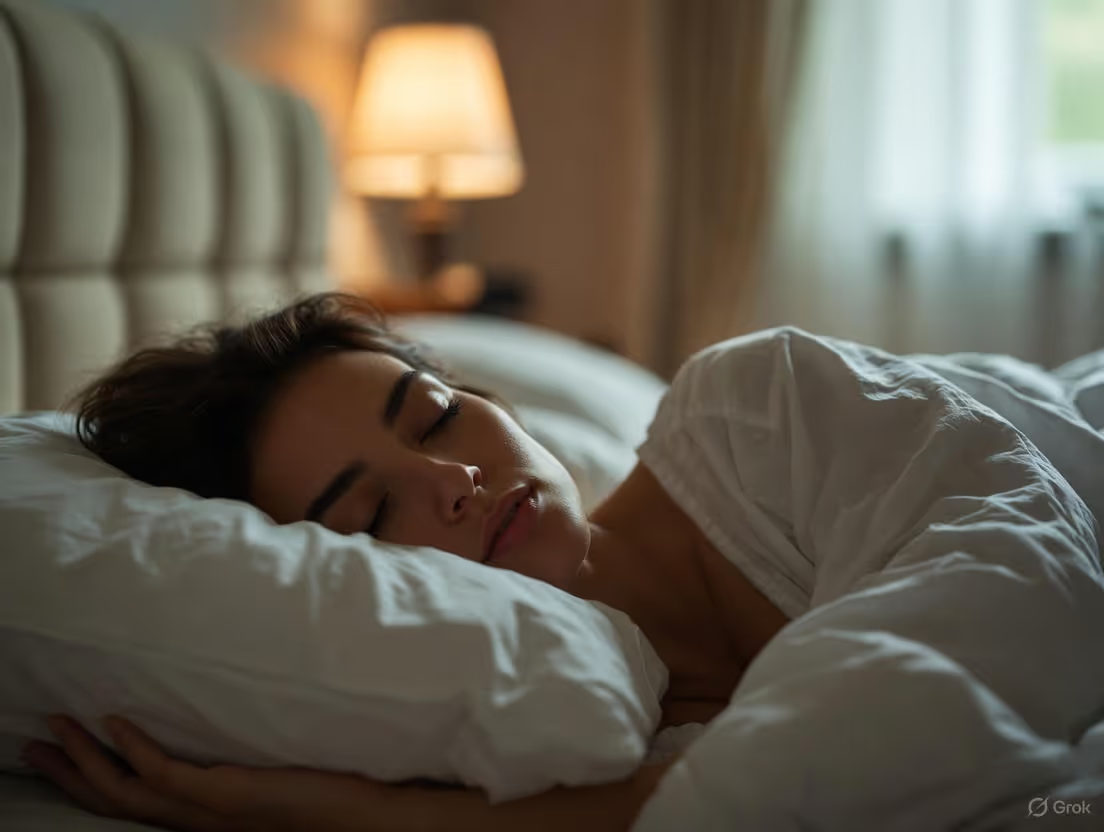
To effectively combat pre-sleep stress, we must first understand its origin. The feeling of being "tired but wired" is not a character flaw or lack of willpower; it's a biological state governed by two primary systems: the autonomic nervous system and the cognitive processes of the prefrontal cortex.
Your autonomic nervous system has two main branches: the sympathetic ("fight-or-flight") and the parasympathetic ("rest-and-digest"). Throughout a demanding day, the sympathetic system is often in a state of low-grade activation, releasing cortisol and adrenaline to help you meet deadlines, navigate social interactions, and solve problems. When evening arrives, this system is meant to disengage, allowing the parasympathetic system to initiate relaxation, lower heart rate, and promote digestion and sleep preparation. However, in our always-on culture, this transition often fails. The sympathetic nervous system, conditioned by constant stimulation from devices, work stress, and evening news, remains partially online, signaling to your body that it’s still in "daytime mode."
Simultaneously, your brain’s executive center, the prefrontal cortex, begins to downregulate as bedtime approaches. This is the part of your brain responsible for planning, worrying, and problem-solving. As it powers down, its control over the more emotional and associative limbic system weakens. This can lead to what sleep researchers call "cognitive popcorn"—random, emotional, or anxious thoughts bubbling up uncontrollably. It’s not that you’re suddenly more stressed; it’s that your brain’s usual manager has clocked out, leaving the interns in charge.
Furthermore, the hormone melatonin, which signals darkness and prepares the body for sleep, is highly sensitive to light exposure. The blue light emitted from phones, tablets, and laptops directly suppresses melatonin production, effectively telling your brain it’s midday, not midnight. This biochemical confusion directly fuels physiological arousal at a time when you need calm.
Understanding this interplay is the first step toward intervention. The techniques that follow are not random rituals but targeted tools designed to manually guide your nervous system from sympathetic to parasympathetic dominance and give your busy mind a structured, gentle task to focus on, preventing the spiral of anxious pre-sleep thoughts.
A wind-down routine is not a luxury; it is a non-negotiable signal to your brain and body that the work of the day is over and the restoration of sleep is beginning. Neuroscientists refer to this as creating a "conditioned response." Just as Pavlov’s dogs learned to salivate at the sound of a bell, you can train your physiology to initiate relaxation in response to a consistent set of evening cues. The goal is to build a buffer zone—ideally 60 minutes—between the demands of the day and the attempt to sleep.
Why Sixty Minutes? Research on heart rate variability (HRV), a key metric of nervous system balance, shows that it can take a full hour for the body to shift from a state of sympathetic arousal to parasympathetic calm after a stressful stimulus. Dedicating this time allows for a gradual, rather than abrupt, transition. Your routine should be a slow, deliberate shedding of daytime energy. Think of it as a descending staircase, with each step representing a lower level of stimulation.
The Three Pillars of an Effective Wind-Down:
The consistency of the sequence is as important as the activities themselves. Performing the same actions in the same order each night strengthens the neural pathway linking the routine to sleepiness. For those who love data, tracking the effectiveness of your routine can be incredibly motivating. By using a device like the Oxyzen smart ring, you can objectively measure how changes in your wind-down ritual affect tangible sleep metrics like time to fall asleep (sleep latency), resting heart rate, and sleep stage distribution. You can read our complete guide on building data-driven wellness habits to see how others have optimized this process.

If you could take one immediate, potent action to counter stress, it would be to harness your breath. Breathing is unique—it’s an automatic function we can also consciously control, making it a direct remote control for the autonomic nervous system. During stress, breathing becomes shallow and rapid, originating from the chest. This type of breathing activates the sympathetic nervous system. Conversely, slow, deep, diaphragmatic breathing stimulates the vagus nerve, the main highway of the parasympathetic system, triggering a cascade of calming physiological responses: lowered heart rate, reduced blood pressure, and increased digestive activity.
The Physiology of Calm Breath: When you breathe deeply into your belly, the diaphragm moves down, creating more space in the chest cavity. This massages the vagus nerve and signals the heart to slow down via the baroreceptor reflex. The increased oxygen exchange also helps balance carbon dioxide levels in the blood, which can reduce feelings of anxiety and panic.
Here are three potent pre-sleep breathing techniques, each with a slightly different focus:
1. The 4-7-8 Method (The "Relaxing Breath"):
Popularized by Dr. Andrew Weil, this technique is renowned for its simplicity and speed in inducing calm.
2. Diaphragmatic (Belly) Breathing:
This is the foundation of all calming breathwork.
3. Box Breathing (Square Breathing):
Used by Navy SEALs to remain calm under extreme pressure, this technique is excellent for creating mental focus and physiological equilibrium.
Integrating just five minutes of intentional breathing into your wind-down routine can dramatically alter your pre-sleep state. For a deeper exploration of how biometrics like heart rate and HRV respond to these practices, you can discover how Oxyzen works to provide real-time feedback on your nervous system's state.

Stress doesn’t just live in the mind; it embeds itself in the body. Often, we carry unconscious tension in our jaws, shoulders, foreheads, and backs—clenching that becomes so habitual we forget it’s there until we consciously try to let it go. This chronic muscle tension sends a continuous feedback loop to the brain: "We are under threat." Progressive Muscle Relaxation (PMR), developed by Dr. Edmund Jacobson in the 1920s, is a systematic technique for breaking this loop. It works on the principle of contrast: by deliberately and intensely tensing a muscle group, you become acutely aware of what tension feels like in that area. When you release the tension, the sensation of relaxation that follows is profound and unmistakable.
The Neuroscience of Letting Go: The act of tightening a muscle activates the muscle spindles (sensory receptors). When you suddenly release the tension, these spindles send a powerful signal to the brain that the muscle has moved from a state of contraction to a state of lengthening and relaxation. This signal contributes to an overall decrease in sympathetic nervous system activity. Furthermore, the focused, sequential attention required by PMR serves as a form of moving meditation, crowding out anxious thoughts.
A Step-by-Step PMR Sequence for Sleep:
Lie comfortably in bed, on your back if possible. Take a few deep belly breaths to begin. The pattern for each muscle group is: Tense -> Hold (5-7 seconds) -> Release -> Notice (20-30 seconds). The noticing phase is crucial; observe the feeling of warmth, heaviness, and relaxation flowing into the area.
After completing the sequence, scan your body from head to toe. If you find any residual tension, send your breath to that area and consciously soften it. You will often find your body feels significantly heavier, a precursor to the sleep state. Many users of advanced wellness trackers note that practicing PMR consistently leads to observable improvements in their sleep readiness scores and reduced nighttime movement, as documented in real customer reviews of integrated wellness systems.
When your external environment is filled with stress, you have the power to construct an internal one defined by peace. Guided imagery, or visualization, is the deliberate practice of creating sensory-rich mental images to promote relaxation. It’s more than just "thinking happy thoughts"; it’s a form of focused attention that engages the same neural networks activated during actual perception. When you vividly imagine a calm beach, your brain doesn't fully distinguish it from being there—your heart rate can drop, your breathing can slow, and stress hormones can decrease as if you were actually on vacation.
How Visualization Quells Pre-Sleep Anxiety: Anxiety is often future-oriented—worrying about what might happen. Visualization anchors you in a present, safe, and pleasurable mental experience. It gives your prefrontal cortex a positive, absorbing task (constructing the scene), preventing it from spiraling into worry. Furthermore, by engaging multiple senses (sight, sound, smell, touch), you create a immersive experience that fully occupies your cognitive bandwidth, leaving no room for intrusive thoughts.
Creating Your Personal Sleep Sanctuary:
You can use pre-recorded audio guides or create your own personalized script. The most powerful visualizations are those that resonate deeply with you.
A Simple Starter Visualization: The Meadow at Dusk
Close your eyes and take three deep breaths. Imagine yourself standing at the edge of a wide, peaceful meadow as the sun begins to set. The sky is painted in soft hues of orange, pink, and purple. Feel the cool, gentle evening breeze on your skin. Notice the scent of wildflowers and fresh-cut grass in the air. You hear the distant chirping of crickets and the soft rustle of grass. You walk slowly into the meadow, feeling the soft earth give slightly under your feet with each step. In the center, you find a perfectly comfortable place to lie down—perhaps a soft patch of clover. You lie back and watch the first stars begin to appear in the deepening blue sky. With each breath, you feel yourself sinking deeper into the earth, more relaxed, more heavy, more at peace. The quiet of the meadow surrounds you and seeps into you.
Practice this for 5-10 minutes during your wind-down. The more you visit your sanctuary, the stronger and more accessible it becomes. This technique exemplifies the philosophy behind our story of using technology not as a distraction, but as a tool to facilitate these deeper, innate human capacities for rest and restoration.

A racing mind at bedtime is often a mind trying to remember—to-dos, worries, ideas, conversations. It’s your brain’s attempt to keep important information from being lost during the "offline" period of sleep. Journaling acts as an external hard drive for your thoughts. By transferring them from the swirling, intangible space of your mind to the concrete, fixed space of paper or screen, you perform an act of cognitive closure. You are telling your brain, "It is safe to let this go. It has been captured and will be here tomorrow."
The "Brain Dump" or "5-Minute Sprint":
This is the most direct and effective pre-sleep journaling method for stress relief. Set a timer for five minutes. Write continuously about whatever is on your mind. Do not edit, judge, or worry about grammar, spelling, or coherence. The goal is not to produce literature, but to empty the contents of your mind. Write sentences like "I'm worried I forgot to send that email," "I need to call the dentist tomorrow," "I feel uneasy about that meeting," "I keep thinking about what that person said." Keep your hand moving until the timer stops. Once done, close the journal literally and metaphorically. The act is complete.
Gratitude Journaling with a Twist:
While popular, simply listing three things you're grateful for can sometimes feel rote. To deepen the impact, use the "Why" method. Don't just write "I'm grateful for my friend." Write "I'm grateful for my friend because she listened without judgment today when I was stressed, and it made me feel seen and supported." Connecting the item to a specific positive emotion and a sensory detail (the sound of her voice, the feeling of relief) engages more of your brain and creates a stronger positive emotional state, which is antagonistic to anxiety.
The "Worry Deferral" Log:
If you are a chronic worrier, this structured approach is powerful. Create a simple two-column page: "Worry" and "Next Step/Action Date." Write down the specific worry. Then, in the next column, assign it either a next physical action (e.g., "Worry: Project deadline" -> "Action: Draft outline tomorrow at 10 AM") or a date to think about it if no action is currently possible (e.g., "Worry: My son's school trip next month" -> "Date to Address: Check packing list on May 15th"). This transforms amorphous anxiety into manageable, time-bound tasks, convincing your brain the issue has a plan and is no longer an emergency.
The key to pre-sleep journaling is to make it a release, not an analysis. It’s about downloading the files, not debugging the software. For individuals who prefer structured guidance, exploring additional resources can provide prompts and frameworks to make this practice effortlessly effective.
Your bedroom is not just a room with a bed; it is a sleep sanctuary, and its environment is a primary dictator of your sleep quality. Two of the most critical, yet often overlooked, environmental factors are temperature and light. Mastering these can dramatically reduce the physiological stress that impedes sleep onset.
The Thermoregulatory Gateway to Sleep: The process of falling asleep is intrinsically linked to a drop in core body temperature. This temperature decline is a key signal for the release of melatonin. Your body achieves this by increasing blood flow to the skin, particularly your hands and feet, to release heat. If your room is too warm, this heat-dissipation process is hindered, leaving you feeling hot, restless, and alert.
Harnessing (and Banishing) Light: Light is the most powerful external cue for your circadian rhythm. Exposure to light, especially blue wavelengths, suppresses melatonin. Conversely, darkness promotes it.
Creating this optimal cave-like environment—cool, dark, and quiet—is a fundamental act of stress prevention. It removes barriers your body must otherwise fight against to find sleep. For those curious about how their body responds to environmental tweaks, personal biometric data from a wearable can be revealing. You can learn more about smart ring technology and how it helps users correlate environmental changes with objective sleep quality metrics.

Mindfulness is the practice of paying deliberate, non-judgmental attention to the present moment. For pre-sleep stress, its power is twofold: it breaks the cycle of ruminating on the past or worrying about the future, and it changes your relationship with the thoughts and sensations that do arise. Instead of getting entangled in a thought ("I'll never get to sleep, tomorrow will be ruined"), mindfulness teaches you to observe it ("I notice there is a thought about not sleeping") and let it pass, like a cloud in the sky. This mental distancing is profoundly de-escalating.
Body Scan Meditation for Sleep: This is a form of mindfulness perfectly suited for lying in bed. The goal is not to relax, but simply to notice.
Loving-Kindness (Metta) Meditation: This practice focuses on cultivating feelings of goodwill, first toward yourself and then toward others. It directly counters the negativity and self-criticism that often surface at night.
"Leaves on a Stream" Thought Detachment Exercise: This is a powerful visualization for managing racing thoughts.
Beginning a mindfulness practice requires patience. Start with just 5 minutes per night. The goal is not to empty the mind, but to become a calm, steady observer of its contents. This shift in perspective, from being in the storm to watching the storm, is the essence of pre-sleep stress relief. For a community exploring these and other techniques, the shared experiences and real customer reviews can offer both inspiration and practical insight.
What you consume in the hours before bed acts as a direct chemical instruction manual for your brain and nervous system. The wrong instructions can induce a state of physiological stress that no relaxation technique can fully override. Understanding the neurochemical impact of common substances is crucial for a low-stress pre-sleep phase.
Caffeine: The Lingering Antagonist: Caffeine works by blocking adenosine receptors in the brain. Adenosine is a neurotransmitter that accumulates throughout the day, promoting sleep pressure. By blocking its action, caffeine promotes alertness. Its half-life is 5-6 hours, meaning that 5 hours after your 2 PM coffee, half the caffeine is still active in your system. For those sensitive to caffeine or prone to anxiety, this can mean elevated heart rate, racing thoughts, and a feeling of restless energy at bedtime. Actionable Rule: Establish a caffeine curfew at least 8-10 hours before your intended bedtime. Be mindful of hidden sources like dark chocolate, some teas, and certain medications.
Alcohol: The Deceptive Sedative: While alcohol is a depressant that can induce initial drowsiness, its metabolic process is highly disruptive to sleep architecture. As your liver metabolizes alcohol, it produces aldehydes and other byproducts that act as stimulants. This often leads to fragmented sleep, waking you up in the second half of the night. Furthermore, alcohol suppresses REM sleep, the stage critical for memory consolidation and emotional processing. The result is a night that feels unrefreshing and can heighten next-day anxiety. Actionable Rule: Avoid alcohol within 3-4 hours of bedtime if sleep quality is a priority.
Heavy, Spicy, or High-Sugar Foods: A large meal close to bedtime forces your digestive system to work hard, raising core body temperature and diverting energy. Spicy foods can cause heartburn or discomfort when lying down. High-sugar foods can cause a rapid spike and subsequent crash in blood sugar, which can trigger the release of cortisol (a stress hormone) to stabilize it, potentially waking you up. Actionable Rule: Finish large meals at least 3 hours before bed. If you need a small snack, opt for a combination of complex carbohydrates and a little protein or healthy fat, such as a small bowl of oatmeal, a banana with a tablespoon of nut butter, or whole-grain crackers with cheese. These can promote stable blood sugar and provide tryptophan, a precursor to melatonin and serotonin.
Hydration Balance: Dehydration can lead to headaches and general discomfort, which are stressors. However, drinking large amounts of fluid right before bed guarantees disruptive nighttime trips to the bathroom. Actionable Rule: Focus on staying well-hydrated throughout the day and taper off fluid intake 60-90 minutes before bed, taking only small sips if needed.
Adopting a "sleep-friendly" evening nutrition protocol is a form of preventative medicine. It removes internal chemical stressors and creates a stable physiological platform for your relaxation techniques to work. For personalized insights into how your unique body responds to dietary choices, exploring the data from a comprehensive wellness tracker can be enlightening, as discussed in our FAQ on biometric tracking.
Sound is a powerful, often involuntary, gateway to your nervous system. A sudden noise can jolt you into alertness, while a consistent, soothing sound can lull you into tranquility. In the context of pre-sleep stress, sound can be used strategically to mask disruptive noises and actively guide the brain into slower, more relaxed wave states.
The Science of Sound Masking: Urban environments and even quiet homes are filled with unpredictable, stress-triggering noises: traffic, a partner snoring, a creaking house, distant sirens. These "noise events" cause micro-arousals, triggering the sympathetic nervous system even if you don't fully wake up. White noise, pink noise, and brown noise work by providing a constant, predictable auditory blanket. This steady sound raises the auditory threshold, effectively masking or softening the impact of sudden, disruptive sounds. The brain, no longer needing to be on "alert" for environmental threats, can relax more deeply.
Binaural Beats: A Direct Audio Path to Relaxation? Binaural beats are an auditory illusion created when two slightly different frequencies are played separately into each ear. The brain perceives a third, "phantom" frequency equal to the difference between the two. For example, if 300 Hz is played in the left ear and 310 Hz in the right, the brain processes a 10 Hz binaural beat. Proponents suggest this can encourage the brain to "entrain" or match its own dominant brainwave frequency to this perceived beat.
While research on binaural beats is ongoing, many users report a significant subjective calming effect. The process of focusing on the sound and allowing it to become the object of your attention is itself a meditative act that reduces mind-wandering.
Practical Application: Experiment with different soundscapes. Numerous apps and streaming services offer high-quality loops of nature sounds (rainforest, ocean waves), ambient music, and engineered binaural beat tracks. Use headphones for binaural beats to achieve the stereo effect, but for general sound masking, a simple, small speaker on your nightstand is sufficient. Integrate this into your wind-down routine, turning it on as you begin your breathing or PMR practice. The goal is to find a sound that feels like an auditory hug, not a distraction. The journey to finding what works for your unique physiology is a core part of the personalized wellness approach we champion, something you can learn more about smart ring technology and how it complements these auditory strategies.
The limbic system, the emotional center of your brain, has a direct and powerful connection to your olfactory system. Unlike other senses, smell bypasses the thalamus (the brain's relay station) and travels straight to the amygdala and hippocampus, areas deeply involved in memory, emotion, and stress response. This is why a scent can instantly evoke a vivid memory or shift your mood. You can leverage this ancient neural pathway to create an olfactory anchor for relaxation and sleep.
The Science of Soothing Scents: Certain essential oils contain volatile organic compounds that, when inhaled, interact with the limbic system to promote physiological changes. Research shows they can reduce activity in the sympathetic nervous system, lower cortisol levels, decrease blood pressure and heart rate, and increase feelings of calm.
Top Essential Oils for Pre-Sleep Stress Relief:
Safe and Effective Application Methods:
Creating a Ritual: The act of preparing your diffuser or blend can become a mindful ritual in itself, signaling to your brain that sleep time is approaching. As you inhale the calming scent during your breathing exercises or meditation, you create a powerful associative link. Over time, the scent alone can trigger a relaxation response. This holistic integration of senses—smell with breath and intention—is a cornerstone of building a resilient, low-stress sleep practice. For those tracking their wellness journey, noting which scents correlate with improved sleep metrics can be a fascinating personal experiment, adding another layer to the data you might explore with a tool like Oxyzen. You can discover how Oxyzen works to track holistic wellness patterns over time.
The single greatest environmental disruptor of modern sleep is not noise or temperature—it’s the small, glowing rectangle within arm’s reach. Smartphones, tablets, and laptops are engineered to be hyper-stimulating, delivering a rapid-fire sequence of novel information, social validation, and potential threats that hijack the brain’s reward and alert systems. Engaging with them in the pre-sleep period is akin to pouring jet fuel on the smoldering embers of daily stress.
The Multifaceted Assault of Screens on Sleep:
Implementing a Practical Digital Sunset: A full detox is the goal, but it must be achievable. Cold turkey often fails. Instead, create a phased disengagement.
The Transformative Result: Consistently adhering to a digital sunset does more than improve sleep. It reclaims a precious hour of your life for reflection, connection, and self-care. It breaks the cycle of being perpetually reactive to the external world and allows you to become centered in your internal one. Many who adopt this practice report not just better sleep, but a profound reduction in overall baseline anxiety, as documented anecdotally in communities focused on digital wellness and in real customer reviews of those using tech to foster better boundaries with tech.
Often called "psychic sleep" or "yogic sleep," Yoga Nidra is a state of consciousness between waking and sleeping. It is a systematic guided meditation that leads you into a state of profound, effortless relaxation while maintaining a trace of awareness. Unlike mindfulness meditation where you focus on the breath or a sensation, or PMR where you tense and release muscles, Yoga Nidra involves simply listening and following instructions, allowing for a complete surrender. It is arguably one of the most potent tools for eradicating pre-sleep stress and accumulated nervous system tension.
The Physiology of Yoga Nidra: Research using EEG and fMRI scans shows that during Yoga Nidra, the brain enters a unique state. It exhibits theta wave dominance (associated with deep meditation and the pre-sleep twilight zone) while also showing delta wave patches (deep sleep), all while the participant remains consciously aware. This state allows for deep rest that is several times more restorative than standard sleep, as measured by reductions in cortisol and improvements in HRV. It effectively gives the body and mind the benefits of sleep without losing consciousness.
The Structure of a Practice (Typically 20-45 minutes):
A session is usually done lying in Savasana (corpse pose), covered with a blanket for warmth. A teacher guides you through several stages:
Why It’s a Game-Changer for Sleep Stress: For the person who feels they "can't meditate" because their mind is too busy, Yoga Nidra is the answer. It requires no effort other than listening. It provides a structured container for your awareness, so the mind doesn't wander into anxiety. The deep relaxation it induces often leads directly into natural sleep, or if not, leaves the nervous system so profoundly calm that falling asleep immediately afterward is effortless. Practicing Yoga Nidra 3-4 times a week has been shown to significantly reduce insomnia, anxiety, and PTSD symptoms.
Getting Started: Numerous free guided Yoga Nidra sessions are available on apps like Insight Timer and YouTube. Start with shorter practices (10-20 minutes) and make it the centerpiece of your wind-down routine 2-3 nights a week. It is the ultimate practice in letting go, a skill that is the very antithesis of pre-sleep stress. This philosophy of deep, guided restoration aligns with the core mission of holistic wellness tools, a principle you can explore further in our story of bridging ancient wisdom with modern technology.
When stress hits, we instinctively touch tense areas—we rub our temples, our necks, our shoulders. This is the body’s intuitive knowledge of acupressure: applying pressure to specific points to release tension, improve energy flow (or "Qi" in Traditional Chinese Medicine), and promote relaxation. Unlike acupuncture, which uses needles, acupressure uses fingers, thumbs, or simple tools. You can easily integrate this into your pre-sleep routine for immediate, drug-free relief from physical and mental tension.
Key Acupressure Points for Sleep and Stress Relief:
Gentle Self-Massage Routine:
Combine acupressure with a gentle self-massage. Use a few drops of carrier oil (like almond or jojoba) with a drop of lavender essential oil if desired.
This tactile, caring attention to your own body is a profound act of self-compassion. It shifts your focus from the chaos in your mind to the sensations in your body, grounding you firmly in the present moment where sleep resides. For more on integrating body-focused practices with daily wellness tracking, you can explore our blog for more wellness tips.
While behavioral and environmental techniques are the foundation of sustainable sleep health, certain natural supplements can provide supportive, non-habit-forming assistance, especially during periods of high stress or when establishing a new routine. It is crucial to approach this area with caution: always consult with a qualified healthcare professional before starting any new supplement, especially if you are on medication or have underlying health conditions.
Understanding Adaptogens: These are a unique class of herbs that help the body "adapt" to stress by modulating the hypothalamic-pituitary-adrenal (HPA) axis—your central stress response system. They are considered biphasic, meaning they can help calm you down when you're overstimulated and boost energy when you're fatigued, working to bring the body back to balance (homeostasis).
Key Herbs for Pre-Sleep Stress and Sleep Support:
Crucial Considerations and Best Practices:
This primer is for informational purposes. The journey to finding the right supportive supplement is highly individual and should be navigated with professional guidance. For any questions on how such lifestyle integrations might interact with wellness tracking, our FAQ section can be a helpful starting point for general inquiries.
Not everyone is wired for the same sleep-wake schedule. Your chronotype is your natural propensity to sleep at a certain time; it's the biological reason you're a "night owl" or an "early bird." Fighting against your chronotype is a major, often overlooked, source of pre-sleep stress. Trying to force yourself to sleep at 9 PM when your biology says 11 PM creates a frustrating battle of wills, filled with performance anxiety about sleep. The solution is not to defeat your nature, but to work with it.
Understanding the Major Chronotypes (Based on Dr. Michael Breus's model):
Tailoring Your Wind-Down to Your Type:
The Liberation of Alignment: When you stop seeing your sleep timing as a moral failing and start seeing it as a biological trait, you remove a massive layer of psychological stress. You can then design a pre-sleep ritual that fits your energy curve, not one you have to fight against. This self-knowledge is empowering. Learning about your own unique rhythms is a core aspect of personalized wellness, a journey that tools like the Oxyzen ring are designed to support by providing individualized data, not generic advice. You can discover how Oxyzen works to help you identify and honor your personal biological patterns.
The quality of your night is largely determined by the choices you make during the day. Pre-sleep stress is often the final eruption of pressure that has been building for 16 hours. By strategically managing your energy, light exposure, and stress throughout the day, you create a lower baseline of arousal, making the evening wind-down a gentler slope rather than a steep cliff.
Critical Daytime Pillars for a Peaceful Night:
By viewing your day as a preparation for sleep, you adopt a holistic approach to stress management. You are not just putting out a fire at bedtime; you are preventing the blaze throughout the day. This proactive mindset is the hallmark of sustainable wellness, a topic we frequently delve into with additional resources on building resilient daily systems.
When pre-sleep stress has escalated into chronic insomnia—where anxiety about sleep itself becomes the primary problem—more structured psychological intervention is warranted. Cognitive Behavioral Therapy for Insomnia (CBT-I) is the gold-standard, first-line treatment, with efficacy rates often surpassing sleep medication. While full CBT-I should be administered by a trained therapist, understanding and applying its core principles can be transformative for anyone with sleep-related anxiety.
CBT-I Addresses the Three Factors Maintaining Insomnia (The 3-P Model):
Key Principles You Can Adapt:
Implementing the Mindset: The core of CBT-I is understanding that sleep effort is the enemy. The harder you try, the worse it gets. Your task is to become a passive observer who sets the stage and then lets go of the outcome. This mental shift—from active struggler to passive allower—is profound. For many, this journey is supported by objective data that shows progress even when it feels slow, a benefit highlighted in many real customer reviews of sleep and wellness tracking.
The techniques in this guide are not a quick fix but a toolkit for building a new relationship with sleep and stress—one that lasts a lifetime. The goal is to move from rigidly "doing a routine" to effortlessly "living in alignment" with your body's need for restoration. Sustainability comes from integration, flexibility, and self-compassion.
The Pillars of a Sleep-Positive Lifestyle:
Your journey to nighttime serenity is uniquely yours. It will involve experimentation, patience, and kindness. By assembling your personalized toolkit from the science-backed techniques in this guide—from breath and environment to mindset and lifestyle—you are not just learning to fall asleep. You are mastering the art of transition, the skill of letting go, and the profound practice of honoring your need for deep, restorative rest. This is the foundation upon which a vibrant, healthy, and resilient life is built, a principle that sits at the very heart of our mission and values.
Your Trusted Sleep Advocate: Sleep Foundation — https://www.sleepfoundation.org
Discover a digital archive of scholarly articles: NIH — https://www.ncbi.nlm.nih.gov/
39 million citations for biomedical literature :PubMed — https://pubmed.ncbi.nlm.nih.gov/
Experts at Harvard Health Publishing covering a variety of health topics — https://www.health.harvard.edu/blog/
Every life deserves world class care :Cleveland Clinic - https://my.clevelandclinic.org/health
Wearable technology and the future of predictive health monitoring :MIT Technology Review — https://www.technologyreview.com/
Dedicated to the well-being of all people and guided by science :World Health Organization — https://www.who.int/news-room/
Psychological science and knowledge to benefit society and improve lives. :APA — https://www.apa.org/monitor/
Cutting-edge insights on human longevity and peak performance:
Lifespan Research — https://www.lifespan.io/
Global authority on exercise physiology, sports performance, and human recovery:
American College of Sports Medicine — https://www.acsm.org/
Neuroscience-driven guidance for better focus, sleep, and mental clarity:
Stanford Human Performance Lab — https://humanperformance.stanford.edu/
Evidence-based psychology and mind–body wellness resources:
Mayo Clinic — https://www.mayoclinic.org/healthy-lifestyle/
Data-backed research on emotional wellbeing, stress biology, and resilience:
American Institute of Stress — https://www.stress.org/


