


Stress Tracking and Medication: Monitoring Treatment Effectiveness
Tracking alongside medication can show whether a treatment is effectively lowering physiological stress markers over time.
Tracking alongside medication can show whether a treatment is effectively lowering physiological stress markers over time.
%402x.svg)
It begins in the stillness of the night. The hammering heartbeat that jolts you awake, though the room is silent. It’s the clenched jaw you notice only when a headache blooms by midday. It’s the creeping exhaustion that no amount of sleep seems to cure. For millions navigating the turbulent waters of anxiety, depression, or chronic stress, this bodily dissonance isn't just a feeling—it’s a daily reality. The path to relief often leads to a prescription, a hopeful handhold in the form of medication. Yet, here lies one of modern mental healthcare's most profound paradoxes: we treat a condition deeply entwined with our physiological state with a solution whose effectiveness is often measured solely by subjective, ephemeral self-report.
"How have you been feeling?" your doctor asks. "Better, I think?" you reply, hesitating. The truth is, memory is a faulty historian for our own bodies. Was last week truly less stressful, or have you just acclimated to a new, lower-grade tension? Did the medication adjustment help, or was it the extra walk you took on Tuesday? We are left navigating a fog, relying on gut feelings and fragmented recollections to guide critical treatment decisions.
But what if the body could keep its own meticulous, unbiased ledger? What if the subtle, biological whispers of stress—the heart rate variability, the sleep architecture, the restless activity—could be translated into a clear, data-driven narrative? This is the promise of a new frontier in personalized wellness: using advanced biometric tracking, not as a wellness gadget, but as a precise clinical compass. The emerging synergy between stress tracking technology and medication management is transforming guesswork into guided insight. By moving beyond the "how do you feel" question to "let's see what your body's data shows," we are beginning to monitor treatment effectiveness with a clarity and objectivity once thought impossible.
This article explores this profound shift. We will delve into the science of stress as a measurable phenomenon, uncover the limitations of traditional medication monitoring, and reveal how continuous biometric data—particularly from accessible devices like the advanced smart rings now on the market—is creating a new standard for personalized care. This isn't about replacing the crucial human connection in therapy; it's about empowering both patient and provider with a shared, objective truth. The journey toward effective treatment is complex, but now, for the first time, we have a reliable map.

We throw the word "stress" around casually, but to our nervous system, it is a precise, all-hands-on-deck biological event. To understand why we can track it, we must first move past the concept of stress as merely a mood and recognize it as a measurable cascade of physiological changes.
The story begins with the hypothalamic-pituitary-adrenal (HPA) axis, your body's central stress response system. When your brain perceives a threat—be it a looming deadline, a difficult conversation, or chronic financial worry—it triggers the release of cortisol, the primary "stress hormone." This is not inherently bad. Cortisol mobilizes glucose for immediate energy, sharpens focus, and modulates inflammation. It’s your body’s brilliant adaptation for survival. However, in our modern world, the "threats" are often persistent and psychological, leading to a state of chronic HPA-axis activation. The system designed for short sprints is forced into a marathon, and this is where the damage is done.
This prolonged state leaves clear, quantifiable fingerprints on your physiology, which are now detectable outside a lab:
The critical insight here is that your body's stress story is being told continuously through these biomarkers, whether you consciously acknowledge it or not. You might report "feeling okay," while your HRV data shows a weeks-long decline and your deep sleep has vanished. This disconnect between subjective perception and objective physiology is the central problem that technology now solves. Before exploring the tracking tools themselves, it’s essential to see why our traditional methods for gauging treatment success so often fall into this perceptual gap.
For decades, the primary tools for assessing whether a medication for anxiety, depression, or stress-related disorders is "working" have been profoundly subjective. The process typically follows a familiar pattern:
This "Guesswork Gap" has real consequences. It can lead to:
The result is a treatment pathway that can feel frustrating, opaque, and isolating. Patients are left as the sole interpreters of their inner chaos, tasked with reporting on a storm they are desperately trying to survive. This gap cries out for an objective, continuous data stream—a physiological co-pilot to provide context and clarity. This is precisely the role that modern biometric wearables are now stepping into, moving us from retrospective guesswork to real-time guidance.
The journey of the wearable from a simple step counter to a sophisticated health monitor is one of the most significant consumer health revolutions of our time. Early fitness trackers introduced the concept of quantifying activity, but the latest generation of devices—particularly smart rings—has shifted the paradigm from fitness to full-system wellness, by focusing on the precise biomarkers of stress and recovery.
Why has the smart ring emerged as a frontrunner for this kind of intimate, clinical-grade tracking? The form factor is key. The finger is a rich vascular site, allowing for highly accurate and consistent optical heart rate and HRV measurements. Unlike a watch that may shift on the wrist during sleep or typing, a well-fitted ring maintains consistent sensor contact. This allows for unparalleled 24/7 continuity of data, especially during the critical recovery windows of sleep.
Modern smart rings like those developed by pioneering companies synthesize data from multiple sensors to paint a holistic picture of your nervous system state:
The software intelligence is where data becomes insight. Advanced algorithms process this continuous stream, identifying patterns and baselines unique to you. They don't just tell you your HRV was 42 ms last night; they show you that your 7-day average has dropped 15% since your prescription was changed, or that your deep sleep consistently increases two nights after you exercise. This transforms raw metrics into a personalized physiological narrative.
For the individual managing medication, this means moving from saying "I feel tired" to presenting a chart showing three consecutive weeks of fragmented REM sleep and elevated nighttime heart rate. It changes the conversation from the abstract to the empirical. As one user shared on our real-world user experiences page, "Taking my data to my psychiatrist was a game-changer. We could see exactly how my body was reacting to the new medication timeline, beyond just my words." This seamless, always-on tracking is what makes the technology so powerful for treatment monitoring, forming the foundation for the next critical step: establishing your personal baseline.
You cannot measure change if you do not first understand your starting point. This is the cornerstone principle of using biometrics for medication monitoring: establishing a detailed, multi-system baseline before initiating or changing a treatment. Without this, any subsequent data is just a number floating in a vacuum.
Think of it like a pre-treatment diagnostic panel. Before starting a medication for high blood pressure, a doctor takes multiple readings to establish your baseline BP. The same rigor should—and now can—be applied to the nervous system. A comprehensive physiological baseline should capture your body's unique "fingerprint" of stress and resilience across several key areas over a period of at least 2-4 weeks:
Establishing this baseline serves two vital purposes. First, it objectively quantifies the severity of your pre-treatment state. The data can validate your subjective experience, which can be incredibly affirming. Secondly, and most crucially, it becomes the controlled reference point against which all future data is compared.
Once a treatment begins, you are no longer looking at data in isolation. You are looking for deviations from your personal baseline. This allows you and your provider to ask precise questions: "Since starting Medication X, has my average nightly HRV increased by 10%, indicating better recovery? Has my resting heart rate decreased? Has my deep sleep improved, or has it been suppressed?" The baseline turns anecdote into analysis. For a deeper dive into how this technology works to establish these personal metrics, you can learn more about smart ring technology and its applications.
This foundational step transforms the wearer from a passive patient into an active participant in a personal clinical trial, with n=1 (you) as the most important subject. It sets the stage for the core mission: using this continuous data stream to track the intricate, often non-linear, journey of medication response.
With a robust baseline in place, the true power of continuous tracking is unleashed. Initiating or adjusting a psychiatric medication is not an on-off switch; it is a biological negotiation. The body adapts, side effects may emerge and recede, and therapeutic effects build slowly. Biometric data provides a real-time window into this unseen negotiation, offering clues long before conscious feelings solidify.
Let's map how key biomarkers can reflect different phases of medication response:
This real-time feedback is transformative for the patient-provider dialogue. Instead of a conversation based on hazy memories, appointments can focus on specific data points: "I see here that your deep sleep improved for two weeks but then dropped again when we increased the dose. Let's cross-reference that with your mood log." It turns treatment into a collaborative, data-informed titration process.
The implications are profound. As noted in discussions on integrating technology into modern wellness, this approach can significantly reduce the time to find an effective treatment, minimize unnecessary side-effect suffering, and provide tangible hope through visible progress. It moves the goalpost from "feeling less bad" to "achieving measurable physiological resilience." However, this data is most powerful when it captures the full 24-hour cycle, with the most critical recovery data emerging when we are least conscious: during sleep.
Sleep is the ultimate non-negotiable biological reset for the nervous system. It is when the brain clears metabolic waste, memories are consolidated, and the HPA axis is dialed down. Consequently, nocturnal biometrics are arguably the most pure, unvarnished reflection of your internal stress state and medication impact. Daytime feelings can be masked by distraction, caffeine, or willpower, but the data from your sleep does not lie.
For someone on medication affecting the central nervous system, sleep tracking provides several layers of critical intelligence:
A smart ring, worn continuously, is uniquely positioned to capture this nightly report card without the intrusion of a wristwatch. The data tells a story: "Despite feeling calmer during the day, my sleep heart rate is still 10 BPM above my baseline, and my deep sleep is fragmented. The medication is helping my conscious anxiety, but my body is still stressed underneath." This insight is invaluable, prompting a provider to explore whether an underlying issue like sleep apnea or a need for adjunctive sleep support is present.
This granular view of our most vulnerable state turns sleep into a diagnostic powerhouse. It provides evidence that can guide adjustments before daytime burnout or a mood crash becomes inevitable. For those seeking to understand the full picture of their wellness journey, explore our blog for more insights on sleep science and recovery.

Medication does not exist in a vacuum. Its effects are constantly modulated by a symphony of lifestyle and environmental factors: a stressful work project, a poor night's sleep due to neighbors, a strenuous workout, a conflict with a loved one, or even dietary changes. This is where purely subjective reporting fails spectacularly—we struggle to disentangle the effects of the pill from the effects of our lives. Biometric data, when reviewed holistically, provides this essential context.
Continuous tracking allows you to correlate physiological shifts with life events, creating a cause-and-effect map of your personal wellness. This contextualization is critical for accurate treatment assessment:
This ability to contextualize turns the treatment monitoring process from a myopic focus on a single chemical intervention into a holistic systems review. It empowers you to become a detective of your own health, understanding the unique levers—sleep, exercise, work stress, relationships—that most affect your nervous system. It also allows your provider to give more nuanced advice: "The data shows your body handles stress much better on days you take a walk. Let's make that a non-negotiable part of your treatment plan, alongside the medication."
This holistic view is at the heart of modern, personalized wellness. At Oxyzen, we believe technology should illuminate the entire ecosystem of your health, not just one slice. To understand the philosophy behind this integrated approach, you can learn more about our vision and values that guide our product development.
Arguably the most profound impact of biometric tracking in medication management is its power to democratize knowledge and reshape the therapeutic alliance. Walking into a doctor's appointment with a folder of subjective notes is one thing; walking in with clear, graphical trends of your body's objective response is another. It shifts the dynamic from a hierarchical "expert-recipient" model to a collaborative, data-informed partnership.
This transformation manifests in several key ways:
This empowerment extends beyond the clinic. It fosters a deeper sense of body literacy and self-compassion. You learn to recognize the early physiological signs of mounting stress (a dip in HRV, a restless night) and can proactively use coping skills before a full-blown anxiety attack. The technology becomes a tool for self-regulation, putting you back in the pilot's seat of your own well-being.
With great data comes great responsibility. The potential pitfall of any biometric tracking is the slide into hyper-vigilance and daily obsession. Watching your HRV score like a stock ticker, fretting over a single night of poor sleep, or misinterpreting natural fluctuations can itself become a source of stress—the very opposite of the intended goal. The key is to cultivate a healthy, informed relationship with your data by learning to interpret trends, not daily numbers.
Your physiology is not a machine; it is a dynamic, living system influenced by countless variables. A single data point is almost meaningless. The power lies in the pattern over time. Here’s how to navigate wisely:
Developing this balanced mindset is crucial for sustainable use. The goal is informed awareness, not compulsive monitoring. The technology should fade into the background of your life, quietly gathering insights, so you can live more fully in the foreground. For those new to this world, it can be helpful to review common questions and guidance on how to best integrate this tool into your wellness journey without becoming overwhelmed by the numbers.

To illustrate the concepts in action, let's follow a hypothetical—but data-realistic—journey of Alex, a 32-year-old professional beginning treatment for Generalized Anxiety Disorder (GAD).
The Baseline (Weeks -4 to 0): Before starting an SSRI, Alex wears a smart ring for a month. The baseline reveals:
This data objectively confirms the severe physiological toll of Alex's anxiety.
Initiation & Adjustment (Weeks 1-4): Alex starts a low-dose SSRI.
Therapeutic Build (Weeks 5-12):
Contextualizing a Setback (Week 14): A major work crisis hits. Alex feels a return of intense anxiety. However, the data tells a nuanced story: Sleep quality dipped for three nights, and daytime HRV dropped, but it quickly bounced back to the new, higher baseline once the crisis passed. This shows Alex that the medication is providing resilience—the dip was appropriate and recovery was swift, unlike the previous prolonged states of distress.
This data-informed narrative gave Alex and their doctor confidence through the difficult initial phase, objective proof of progress, and context for a temporary setback. It turned a frightening leap of faith into a mapped expedition. This practical application underscores why a seamless, comfortable, and accurate tracking device is so central to the process, which brings us to the unique advantages of the form factor enabling this revolution: the smart ring.
The quest for perfect biometric tracking is as much about hardware ergonomics as it is about sensor accuracy. While wrist-worn devices have dominated the market, they present significant limitations for the kind of continuous, nuanced monitoring required for medication management. The smart ring emerges not just as an alternative, but as the superior form factor for this specific, sensitive application. The rationale is rooted in physiology, consistency, and user experience.
First, consider sensor placement and vascular access. The finger, specifically the base of the finger, houses robust capillary beds. This allows photoplethysmography (PPG) sensors in a ring to capture a stronger, cleaner blood volume pulse signal with less motion artifact than the wrist, where bones and tendons can interfere. This translates to more reliable, medical-grade readings of heart rate and, critically, Heart Rate Variability (HRV)—the cornerstone stress metric.
Second, and most pivotal, is consistency of wear and data continuity. For medication monitoring, gaps in data are gaps in understanding. A watch is often removed for charging, during certain activities (like weightlifting, typing, or washing dishes), or simply because it can become uncomfortable during sleep. A well-designed smart ring, by contrast, becomes a seamless part of the body. It is:
Third, the form factor enables a more holistic measurement of stress physiology. Beyond PPG, advanced rings incorporate skin temperature sensors. Nocturnal temperature trends are a powerful, passive indicator of circadian rhythm health, which is deeply intertwined with mood disorders and stress. A dysregulated temperature rhythm can be an early sign of HPA-axis dysfunction or a side effect of medication. The ring's consistent placement provides a more stable temperature reading than a wrist device, which can be easily influenced by bedding or ambient room temperature.
Finally, there is a psychological component. For an individual already managing the stigma or self-consciousness of a mental health condition, wearing a obvious "tracker" can feel like a spotlight on their struggle. A smart ring is discreet, often resembling a piece of sleek jewelry or a simple band. It allows for private, personal monitoring without public declaration. This reduces barrier to adoption and supports the feeling of being an empowered individual, not a "patient."
In essence, the smart ring solves the core dilemma of clinical-grade tracking: the need for high-fidelity data acquired passively in real-world conditions. It is the technological equivalent of a constant, gentle, and non-judgmental observer, gathering the physiological truth without becoming a burden or a source of additional anxiety. This seamless integration is what allows the data to become a truly useful part of the treatment journey, rather than a chore. This focus on user-centric, meaningful design is part of the core philosophy behind our approach to creating effective wellness tools.
Collecting vast amounts of biometric data is one thing; translating it into a concise, actionable narrative for a time-pressed healthcare provider is another. The goal is not to hand your doctor a raw, overwhelming data dump, but to present a curated "Evidence Portfolio"—a clear, visual summary that tells the story of your treatment response and raises specific, answerable questions. This preparation turns you into an effective collaborator in your own care.
Here is a step-by-step guide to building a powerful Evidence Portfolio:
1. Establish a Timeline: The Master Framework
Create a simple timeline that marks key events:
This timeline becomes the x-axis against which all data is plotted, providing immediate context.
2. Focus on 2-3 Key Biomarker Trends
Don't show every metric. Choose the most relevant ones, almost always including:
Use the export or screenshot functions of your app to create clean graphs spanning from your baseline period to the present. Annotate them lightly with the timeline events from step one (e.g., a dotted line and note: "Dose increased to 50mg" or "Major work project began").
3. Correlate with Subjective Logs
Integrate your subjective experience. This can be a simple weekly note or a correlation with a mood/energy log (rated 1-10). Place these notes alongside the corresponding week on your graphs. The powerful revelations are in the alignments and misalignments:
4. Summarize with "Key Observations & Questions"
On a single page, bullet-point your core findings and formulate specific questions. This is the executive summary for your appointment.
5. Practice Data Literacy, Not Advocacy
Your role is to present the evidence, not to diagnose or dictate treatment. Use neutral, observational language: "The data seems to show…" or "I've noticed a correlation between…". This fosters collaborative problem-solving.
Presenting this organized portfolio fundamentally changes the dynamics of a 15-minute follow-up. It directs the conversation to what matters most, demonstrates your commitment, and provides your provider with clinical clues they would otherwise never have. It elevates the standard of care. For more practical tips on integrating technology into your health journey, our FAQ section addresses many common questions about data interpretation and sharing.
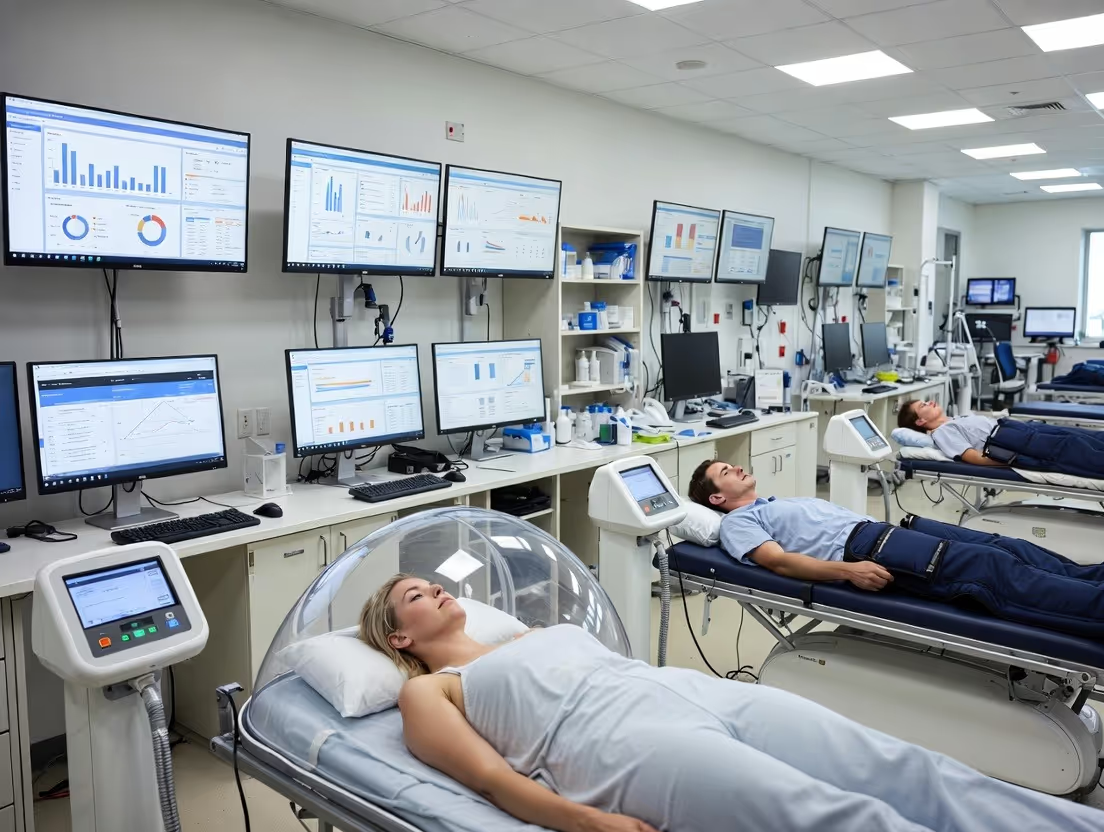
The current model—patients manually curating PDFs and screenshots—is just the first step. The true potential of biometric monitoring for mental health treatment lies in seamless, secure integration into the clinical workflow. The future points toward a world where this continuous physiological data flows directly into Electronic Health Records (EHRs) and specialized clinician dashboards, enabling a shift from reactive to proactive care.
Imagine a dashboard within your psychiatrist's or therapist's system that, with your permission, displays key de-identified trends from your wearable:
This integration offers transformative benefits:
Of course, this future hinges on rigorous data privacy, security, and patient consent frameworks. Patients must own their data and control its sharing. The technology must be built on platforms like HIPAA-compliant clouds, with transparent data-use policies. The goal is not surveillance, but supported self-management and enhanced clinical insight.
We are on the cusp of this integration. The devices exist, the clinical need is clear, and the software bridges are being built. This represents a paradigm shift towards a truly biopsychosocial model of care, where the biological dimension of mental illness is continuously measured and treated with the same precision as the psychological and social dimensions. To see how forward-thinking companies are approaching this holistic future, you can explore more about our mission to bridge personal data with actionable wellness insights.
While the potential of biometric monitoring is staggering, it is crucial to approach it with clear-eyed awareness of its limitations and ethical considerations. Technology is a powerful tool, not a panacea, and it must be wielded with wisdom alongside the irreplaceable human elements of care.
Key Limitations to Acknowledge:
The Paramount Issue of Privacy & Security:
Your biometric data is among the most personal information that exists. It can reveal your state of mind, your sleep patterns, and your stress levels. Any company in this space must prioritize:
The Irreplaceable Human Element:
Finally, and most importantly, data must serve the human connection, not replace it. The therapeutic alliance—the trust, empathy, and rapport between patient and provider—remains the bedrock of effective treatment. Data should enrich this conversation, not become a barrier. A provider should never look only at the dashboard and not at the person in front of them.
The goal is augmented care, not automated care. The tears in a therapy session, the tone of a patient's voice, the unspoken body language—these nuances will never be captured by a PPG sensor. The data provides the "what" and the "when," but the patient and provider together must explore the "why." Technology illuminates the path, but human compassion and expertise guide the walk.
By acknowledging these caveats, we can adopt this technology thoughtfully, using it to empower rather than overwhelm, to connect rather than isolate, and to enhance the profound human endeavor of healing. As we look ahead, the convergence of this data with other emerging technologies promises to deepen personalization in ways we are only beginning to imagine.
While stress biomarkers are the headline metrics for medication monitoring, they gain their true meaning from the broader narrative of your daily life. Isolating stress data is like listening to a single instrument in an orchestra; you get the melody but miss the harmony and rhythm. The most advanced applications of this technology therefore synthesize stress data with activity and recovery metrics to produce a holistic picture of your systemic "readiness"—your body's capacity to handle stress, engage in life, and heal.
This is often visualized as a daily "Readiness" or "Body Battery" score, a composite algorithm that typically weighs:
The magic of this composite score for medication management is in its predictive and prescriptive power.
The Predictive Power:
Your morning "Readiness" score can be a barometer for your day. A consistently low score, despite medication, indicates that your body is not achieving sufficient recovery. This is a critical red flag. It suggests the treatment may not be addressing the underlying physiological exhaustion, or that lifestyle factors are overwhelming the medication's benefits. It tells you, "Your system is on the back foot. Today is a day for pacing, not pushing."
The Prescriptive Power:
By observing how different activities impact your score, you can personalize your behavioral prescription. For example, the data might reveal:
This holistic view moves treatment management from a passive "is the pill working?" to an active "how can I optimize my entire system for resilience?" It empowers you to make data-informed lifestyle choices that directly support the medication's goals. You learn not just to track your illness, but to track your capacity for health.
This integrated approach is the cornerstone of modern, proactive wellness. It aligns perfectly with a treatment philosophy that views medication as one tool in a toolbox, working synergistically with sleep, movement, and stress management. For a deeper exploration of how to balance activity and recovery in a structured way, our blog features numerous guides on creating sustainable wellness routines that complement clinical treatment.
We began in the stillness of the night, with the silent, pounding heart that speaks a truth words often cannot. We have traveled through the science of stress as a measurable force, exposed the limitations of navigating treatment in the dark, and witnessed how continuous biometric illumination is changing the journey. The thread connecting each insight is a profound shift in agency—the movement from being a passive patient to an informed, empowered partner in your own care.
The integration of stress tracking into medication management is more than a technological novelty; it is a fundamental rebalancing of the therapeutic relationship. It provides a shared language—the language of data—that transcends the ambiguity of "feeling." It replaces the fog of memory with the clarity of graphs, turning subjective struggles into objective patterns that can be analyzed, understood, and addressed.
This first portion of our exploration has laid the groundwork:
The journey, however, is far from complete. In the next portion of this comprehensive guide, we will delve deeper into the practical application of this data. We will explore specific medication classes and their expected biometric fingerprints, examine complex cases like treatment-resistant depression, and guide you through making critical decisions—such as when to consider a medication change—using data as your compass. We will also investigate how this technology interfaces with therapy, mindfulness, and other non-pharmacological interventions, creating a true integrated treatment plan.
The path to mental wellness is rarely linear, but it no longer needs to be walked blindfolded. With the insights from your own body as your guide, you can move forward with greater confidence, collaboration, and clarity. You are no longer just reporting on the storm; you are learning to read its patterns, navigate its waves, and, ultimately, steer your vessel toward calmer waters.
Understanding how your body should respond, on a physiological level, to different psychiatric medications is key to interpreting your personal data. Each class of medication has a different primary mechanism of action, which in turn creates a distinct "fingerprint" or expected pattern in your biometric data. This knowledge transforms your data from a confusing array of numbers into a meaningful map of your treatment's journey.
It is crucial to remember: these are generalized patterns based on pharmacological action. Individual responses can and do vary widely. The power of your data is that it reveals your unique fingerprint within these broader expectations.
Mechanism: Selective Serotonin Reuptake Inhibitors (SSRIs) and Serotonin-Norepinephrine Reuptake Inhibitors (SNRIs) work by gradually increasing the availability of key neurotransmitters in the synaptic cleft. This is not an immediate change; it requires weeks for the brain to adapt.
Expected Biometric Fingerprint:
Mechanism: These medications, including benzodiazepines (e.g., lorazepam) and "Z-drugs" for sleep (e.g., zolpidem), work by directly enhancing the effect of GABA, the brain's primary inhibitory neurotransmitter. They are central nervous system depressants with a rapid onset.
Expected Biometric Fingerprint:
Mechanism: These medications often have complex actions. Mirtazapine, for instance, blocks specific serotonin and histamine receptors. Trazodone is a serotonin antagonist and reuptake inhibitor. They are notable for their sedating properties.
Expected Biometric Fingerprint:
Mechanism: Medications like methylphenidate or amphetamine salts increase dopamine and norepinephrine, improving focus and executive function.
Expected Biometric Fingerprint in Context of Stress:
By familiarizing yourself with these expected fingerprints, you can look at your own trends with more informed eyes. You can have a more productive conversation with your provider: "My data shows the expected initial sleep disruption from the SSRI, but I'm not seeing the subsequent rise in HRV we'd hope for after 8 weeks." This is the language of precision medicine. For those navigating the complexities of multiple conditions, the data becomes even more vital, as we will explore next.
The clean narratives of single diagnoses and first-line treatments often give way to more complex realities. Many individuals face co-occurring conditions—such as anxiety with depression, ADHD with burnout, or PTSD with insomnia. Others walk the difficult path of treatment-resistant depression (TRD), where multiple medication trials have failed. In these complex scenarios, biometric data shifts from being a helpful tool to an essential navigational instrument, cutting through the fog of overlapping symptoms.
When symptoms intertwine, subjective reporting becomes exceptionally challenging. Are you fatigued from depression, agitated from anxiety, or distracted by ADHD? Biometric data can help disentangle these threads.
For those with treatment-resistant depression, the process can feel like a demoralizing series of blind trials. Biometric monitoring introduces a objective stopping rule and a new direction for hope.
In complex cases, the wearable becomes a constant research partner in the single-subject experiment of your own care. It provides the hard evidence needed to make difficult decisions and the subtle clues that can point toward a more personalized, effective solution. This depth of personal insight is what drives our commitment to developing technology that supports even the most challenging health journeys, a story you can learn more about in our founder's vision for personalized health.
The most critical, and often most anxiety-provoking, moments in medication management are the decision points: Should we increase the dose? Should we taper off? Should we switch to something completely different? Traditionally, these decisions hinge on a fragile balance of subjective report, clinical intuition, and time. Biometric data introduces a stabilizing pillar of evidence, creating a more confident and rational decision-making framework.
The Scenario: You've been on a medication for 6-8 weeks. There's been some mild improvement, but you feel you've "plateaued" at a sub-optimal level.
The Traditional Approach: A trial of a higher dose, often followed by another 4-8 week wait to assess.
The Data-Informed Approach:
The Scenario: After a full 12-week trial, you still feel unwell. The clinician is considering a switch.
The Traditional Approach: Often based on subjective lack of improvement and patient frustration. It can feel like starting over.
The Data-Informed Approach:
Perhaps the most valuable application is guiding a safe, stable taper off a medication, whether because it has achieved its goal, isn't working, or is causing side effects.
By grounding these high-stakes decisions in data, the process becomes less emotional and more strategic. It reduces the fear of change and provides a clear, shared metric for success. It turns the treatment pathway from a blind series of turns into a mapped route with clear signposts. This application of technology to empower major life and health decisions is a topic we frequently explore in our blog, where we discuss real-world user strategies.
Medication manages chemistry; therapy and mindfulness manage cognition, emotion, and behavior. They are two sides of the same coin. Yet, their synergy is often discussed in the abstract. Biometric tracking provides the concrete, physiological proof of how these interventions work together, creating a powerful feedback loop that amplifies the benefits of both.
Therapeutic modalities like Cognitive Behavioral Therapy (CBT), Dialectical Behavior Therapy (DBT), and EMDR aim to rewire neural pathways and build coping skills. Their success should, theoretically, be reflected in a calmer nervous system. Now, we can see it.
Your Trusted Sleep Advocate: Sleep Foundation — https://www.sleepfoundation.org
Discover a digital archive of scholarly articles: NIH — https://www.ncbi.nlm.nih.gov/
39 million citations for biomedical literature :PubMed — https://pubmed.ncbi.nlm.nih.gov/
Experts at Harvard Health Publishing covering a variety of health topics — https://www.health.harvard.edu/blog/
Every life deserves world class care :Cleveland Clinic - https://my.clevelandclinic.org/health
Wearable technology and the future of predictive health monitoring :MIT Technology Review — https://www.technologyreview.com/
Dedicated to the well-being of all people and guided by science :World Health Organization — https://www.who.int/news-room/
Psychological science and knowledge to benefit society and improve lives. :APA — https://www.apa.org/monitor/
Cutting-edge insights on human longevity and peak performance:
Lifespan Research — https://www.lifespan.io/
Global authority on exercise physiology, sports performance, and human recovery:
American College of Sports Medicine — https://www.acsm.org/
Neuroscience-driven guidance for better focus, sleep, and mental clarity:
Stanford Human Performance Lab — https://humanperformance.stanford.edu/
Evidence-based psychology and mind–body wellness resources:
Mayo Clinic — https://www.mayoclinic.org/healthy-lifestyle/
Data-backed research on emotional wellbeing, stress biology, and resilience:
American Institute of Stress — https://www.stress.org/


