


Stress Tracking for Students: Academic Performance Insights
For students, tracking can link academic deadlines, social events, and sleep to stress levels, guiding better schedule management.
For students, tracking can link academic deadlines, social events, and sleep to stress levels, guiding better schedule management.
%402x.svg)
For decades, the formula for academic achievement seemed straightforward: raw intelligence plus hours of diligent study. Report cards and standardized test scores were the ultimate barometers of success, painting a picture of a student's capability in neat rows of letters and numbers. Yet, beneath this seemingly clear surface, a hidden variable has always been at play, silently warping results, derailing potential, and leaving educators, parents, and students themselves baffled by the gap between effort and outcome. That variable is stress.
Today, a silent revolution is underway in libraries, dorm rooms, and lecture halls. It’s not powered by a new teaching method or a miracle study drug, but by data—biometric data. For the modern student, the smart ring has emerged as an unobtrusive, powerful tool, transforming the intangible experience of stress into a quantifiable, understandable, and manageable metric. This isn't just about counting steps or monitoring sleep; it's about decoding the physiological language of pressure to unlock a deeper, more sustainable form of academic performance. Welcome to the era of biometric academic insight, where understanding your nervous system is becoming as crucial as understanding your syllabus.
This comprehensive exploration delves into the profound connection between student stress and academic performance, illuminated by the lens of cutting-edge wearable technology. We will journey through the science of stress, its direct impact on learning and memory, and how continuous biometric tracking provides a personalized roadmap to resilience. This is the beginning of a new conversation about student success, one that moves beyond mere outcomes to optimize the very process of learning itself.

To call student stress "common" is a profound understatement. It has become the pervasive backdrop of modern education, a constant hum underlying every assignment, exam, and extracurricular. But to truly grasp its impact, we must move beyond cliché and into the data. Studies from the American Psychological Association consistently show that teenagers report stress levels exceeding those of adults, with academic pressures being the leading cause. This isn't simply about feeling nervous before a final; it's a chronic state of activation that rewires the student experience.
The sources are multifaceted and relentless. Academic Load: The pressure to maintain a perfect GPA for college admissions, the volume of advanced placement (AP) or international baccalaureate (IB) courses, and the sheer quantity of assignments create a treadmill that’s hard to step off. Social Dynamics: Navigating friendships, social media presence, and often living away from home for the first time in university adds a complex emotional layer. Future Uncertainty: An increasingly competitive job market and concerns about student debt cast a long shadow over present-day studies. The Always-On Culture: Digital connectivity means schoolwork and social pressures can follow a student anywhere, blurring the lines between work and rest, making genuine downtime a rare commodity.
The problem is, this stress is often invisible until it manifests in crisis—burnout, anxiety disorders, plummeting grades, or withdrawal. Students are frequently told to "manage stress better" without being given the tools to first measure it. How can you manage what you don't understand? This is where the old model breaks down. Subjective feelings of being "overwhelmed" are important, but they lack the precision needed for effective intervention. They can’t tell you if your stress spiked during a specific study session, how a poor night's sleep amplified your anxiety before a presentation, or whether your "calm" exterior is masking a physiologically frazzled state.
This gap between feeling and measurable reality is what biometric tracking seeks to bridge. By quantifying the stress response, we move from vague concern to actionable insight. It allows students to see their stress not as a personal failing or an immutable fact of life, but as a set of patterns—patterns that can be analyzed, understood, and strategically modified. The journey toward better academic performance begins not with a longer study session, but with a clearer understanding of the internal environment in which that studying takes place. As we explore on our blog in articles about holistic wellness, performance is an ecosystem, and stress is its most volatile climate.
To appreciate how stress tracking can revolutionize academic performance, we must first delve into the brain. Stress isn't just a "feeling"; it's a complex cascade of neurochemical and physiological events orchestrated by the sympathetic nervous system and the HPA (hypothalamic-pituitary-adrenal) axis. When your brain perceives a threat—be it a saber-toothed tiger or a looming calculus exam—it triggers the release of hormones like cortisol and adrenaline.
In acute, short-term doses, this system is brilliantly adaptive. It's the reason you can pull an all-nighter and feel strangely focused (thanks to cortisol's role in mobilizing energy), or why you might perform brilliantly under the pressure of a tight deadline. This state narrows your attention, prioritizes immediate survival (or in this case, task completion), and can enhance memory formation for the event itself—a phenomenon known as "flashbulb memory."
However, the academic world rarely provides clean, short-term stressors. It deals in chronic stress—the persistent, low-grade activation that comes from constant deadlines, social comparisons, and future worries. This is where the system breaks down. Chronically elevated cortisol begins to wreak havoc on the very brain structures essential for learning:
A smart ring tracking physiological stress markers like heart rate variability (HRV) and skin temperature provides a window into this internal neurological drama. A chronically low HRV, for instance, is a strong biomarker of a nervous system stuck in "fight-or-flight," directly reflecting that impaired PFC and overactive amygdala. By monitoring these signals, a student doesn't just see "stress"; they see the physiological underpinning of why they can't focus, why their memory feels leaky, and why their emotional reactions seem disproportionate. It connects the dots between a week of poor sleep (visible in the ring's recovery score), a spiking stress graph during afternoon study blocks, and the inability to recall information in a seminar. Understanding this science is the first step toward using technology not just to track, but to strategically intervene and protect the brain's learning machinery. For a deeper dive into the body's signals, our FAQ page details how specific metrics are captured and interpreted.
The wearable technology market is saturated with wrist-based devices. So why is a smart ring emerging as the form factor of choice for the serious student seeking genuine academic insight? The answer lies in a powerful combination of physiological accuracy, practical usability, and psychological unobtrusiveness—factors that are critical in the dynamic life of a student.
1. The Science of Measurement: A More Direct Window.
While wrist-based optical heart rate sensors have improved, they face significant challenges. The wrist is a area of frequent movement, especially for students typing, writing, gesturing, or even just fidgeting during a lecture. This can lead to "motion artifact"—noise in the data that masks the true physiological signal. Furthermore, the blood vessels at the wrist are smaller and shallower than those at the finger.
The finger, by contrast, is a vascular-rich area with a strong, consistent pulse wave. A ring sensor, positioned on the base of the finger, can often capture cleaner, more reliable photoplethysmography (PPG) signals for heart rate and, crucially, heart rate variability (HRV). HRV, the subtle variation in time between heartbeats, is one of the single most important biomarkers for stress and nervous system balance. For a metric this sensitive, signal fidelity is everything. A cleaner signal means more accurate stress scores, more reliable sleep stage detection, and more trustworthy readiness metrics each morning.
2. Unparalleled Wearability and Compliance.
The ultimate biometric device is the one you actually wear. For a student, this is paramount. A smart ring is:
This 24/7 wearability leads to superior compliance. You get continuous, holistic data—from the stress of a morning exam to the recovery during an afternoon nap to the impact of late-night socializing—not just snapshots from when you remembered to wear a bulkier device.
3. The Psychological Advantage: Reducing Observer Effect.
In research, the "observer effect" notes that the act of observation can alter the phenomenon being studied. A large, screen-lit watch constantly notifying you of stress can, paradoxically, become a source of stress or fixation. The smart ring operates more passively in the background. It collects data without demanding constant visual engagement. The analysis happens in the app, allowing for reflective review at an appropriate time, rather than triggering a real-time anxiety spiral during an already stressful moment. This makes it a tool for mindful improvement, not for minute-to-minute neurosis.
For a student investing in their academic performance, the choice is about selecting the tool that provides the most accurate, holistic, and usable insights with the least interference in their daily life. The smart ring, by its very design, is tailored for this purpose. It's a seamless layer of insight, working quietly to map the terrain of their stress so they can navigate their education with greater intelligence. Discover the philosophy behind this seamless integration in our story, which details our journey to create technology that serves without intruding.
Stepping into the world of biometrics can feel like learning a new language. A smart ring provides a dashboard of metrics, but their true power lies in interpretation—in understanding what each one whispers about your internal state and its readiness for academic rigor. For the student, three core metrics form the foundational triad for stress and performance insight: Heart Rate Variability (HRV), Resting Heart Rate (RHR), and Sleep Staging.
Heart Rate Variability (HRV): The Master Metric of Nervous System Balance
If you only learn one metric, make it HRV. Contrary to what the name implies, a higher HRV is generally better. It represents the healthy, millisecond variations in time between your heartbeats. Think of it not as an erratic heart, but as a sign of a highly responsive, resilient system.
Resting Heart Rate (RHR): The Baseline of Cardiovascular Load
Your RHR is the number of times your heart beats per minute when you are completely at rest (typically during deep sleep). It's a fundamental indicator of cardiovascular fitness and overall physiological stress.
Sleep Architecture: Beyond Just Hours in Bed
Sleep is academic performance steroids. But it's not just about duration; it's about quality and structure. A smart ring tracks sleep stages—light, deep, and REM—each critical for different recovery and learning functions.
By learning this language, a student transforms from a passive experiencer of stress and fatigue to an active manager of their physiological capital. These metrics become the dials on their personal performance dashboard, informing decisions about when to push hard, when to rest, and how to structure their life for sustainable success. For more insights on optimizing these metrics, explore our blog for tailored advice on student wellness.
Every student has experienced it: the two-hour "study" session where you stare at pages, your eyes glazing over, retaining almost nothing. Conversely, there’s the magical 45-minute burst where concepts click and information sticks. What if you could identify the conditions that create the latter and avoid the former? With a smart ring, you can move from anecdote to experiment.
The process is simple yet profound. Before a dedicated study block, note the subject, location, time of day, and your intended method (e.g., "Active recall for Biology, library, 10 AM"). Wear your ring as normal. After the session, rate your subjective focus on a scale of 1-10. Later, in the device's app, examine the stress and heart rate data from that exact time window.
The correlations you’ll uncover can be career-changing:
This experimental approach turns every student into a researcher of their own mind. It replaces guilt ("I'm so lazy") with curiosity ("My data shows I don't focus well after lunch; let's schedule a walk then and save focused work for later"). It provides objective evidence to advocate for better study habits to parents or tutors. Most importantly, it builds metacognitive awareness—the ability to think about your own thinking. By linking internal states (biometrics) with external outcomes (focus, retention), you develop a powerful self-knowledge that allows you to design an academic life that works with your biology, not against it. This principle of self-experimentation is core to our mission at Oxyzen, as we believe in empowering individuals with personal data sovereignty.
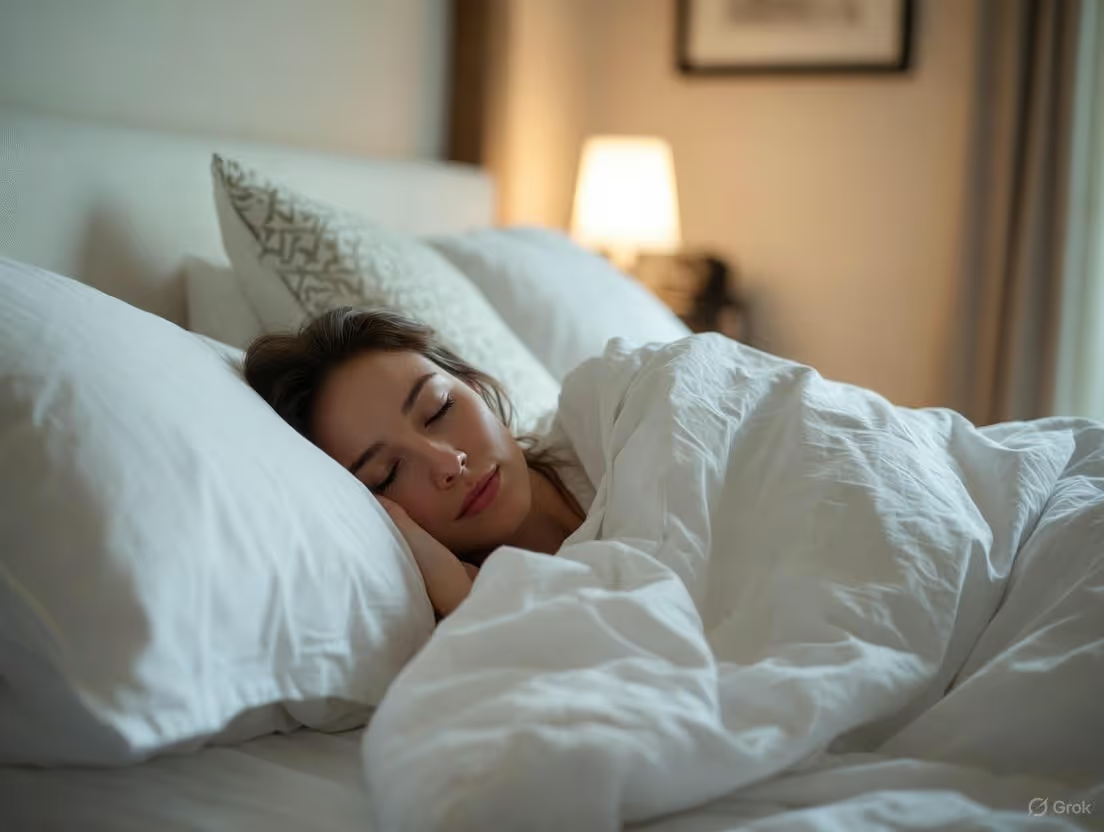
In the grind of academic life, sleep is often the first sacrifice on the altar of productivity. It's seen as downtime, a passive void between study sessions. Biometric tracking reframes sleep entirely: it is the most active, non-negotiable performance-enhancing work you do. Your smart ring’s recovery score—typically a composite of sleep quality, duration, HRV, and RHR—is your morning readiness report, telling you what kind of cognitive capital you have to invest that day.
A student using this data strategically stops planning their week in a vacuum. Instead, they plan from their recovery data.
The Strategic Framework:
Armed with this knowledge, you can make informed trades. Maybe you choose to socialize earlier on a Friday to protect Saturday's study capacity. Perhaps you move intense exercise to the morning. This isn't about living restrictively; it's about making conscious choices with full knowledge of their cognitive cost. You begin to treat sleep not as lost time, but as the foundation upon which every academic achievement is built. It becomes the core pillar of your strategy, and the recovery score is your daily intelligence briefing. To see how real users have transformed their routines with this data, visit our testimonials page for inspiring stories.
The exam period is the crescendo of academic stress—a concentrated burst of pressure where performance matters most. This is where biometric tracking shifts from being informative to being tactical. It offers a two-pronged advantage: longitudinal forecasting in the lead-up and in-the-moment regulation during the exam itself.
The Lead-Up: Forecasting Burnout and Peak Readiness
In the weeks before finals, the workload intensifies. Traditional advice is simply to "study more." Biometric wisdom is to "study smarter by recovering better." By tracking stress and recovery trends over the 2-3 week exam prep period, a student can see the warning signs of a downward spiral long before their mind acknowledges feeling overwhelmed.
The Day Of: From Panic to Regulation
On exam day, the sympathetic nervous system is primed to fire. A certain level of arousal is beneficial, but tipping into panic is catastrophic for recall. Here, the smart ring's real-time awareness (often accessed via a quick glance at the paired phone app) or its historical data can be a lifeline.
This approach transforms exam preparation from a purely intellectual marathon into an integrated mind-body performance protocol. The goal is no longer just to know the material, but to deliver that knowledge under pressure. The smart ring becomes the training partner that helps you condition your nervous system for game day, ensuring that when you sit down to perform, your biology is on your team, not working against you. For students looking for structured support on this journey, our FAQ section addresses common questions about using data during high-pressure situations.
Academic stress doesn't exist in a petri dish. For students, it is perpetually mixed and amplified by the rich, complex soup of social life, extracurricular commitments, and family dynamics. A smart ring's great honesty is that it captures total load—it doesn't differentiate between stress from a physics final and stress from a team conflict, a difficult conversation with a friend, or the pressure of an upcoming audition. This holistic view is where some of the most profound insights for sustainable performance are found.
Your biometric data will likely reveal that "downtime" isn't always down. The Wednesday night club meeting, the Friday party, the Saturday sports tournament, and the Sunday family obligation all place demands on your nervous system. This is the extracurricular load, and it draws from the same physiological recovery account as your academics.
For the student, this is training in life architecture. It moves beyond time management to energy management. You learn to see your weekly calendar not just as a grid of commitments, but as a map of physiological deposits and withdrawals. You can start to strategically sequence your week: placing a high-demand study session after a restorative activity, or buffering a known stressful social event with extra sleep and quiet time. It empowers you to make intentional choices about your social and extracurricular life based on how they truly affect your core capacity to learn and thrive. It’s about designing a holistic student experience that is not only successful, but also sustainable and enjoyable. Understanding this holistic impact is part of our vision for human-centric technology.
Data without action is merely interesting. The ultimate goal of stress tracking is to move from awareness to agency—to use your unique biometric feedback to build a personalized toolkit of practices that actively bolster your resilience. This isn't about adopting generic "wellness tips," but about scientifically validating what works for your specific nervous system. Your smart ring becomes the biofeedback device that closes the loop.
The Biofeedback Loop in Action:
Building Your Protocol:
This process of building a protocol is empowering. It turns wellness from a set of external "shoulds" into a personal science project. The student becomes the expert on their own body and mind, equipped with data to make informed decisions about their lifestyle. This self-knowledge is perhaps the most valuable lesson university can teach, extending far beyond the classroom into every future career and life challenge. It fosters a sense of ownership and competence that is the antithesis of helplessness in the face of stress. For a growing collection of science-backed methods to test in your own protocol, our blog is an ongoing resource.
As with any powerful tool, the use of biometric tracking comes with important ethical and psychological considerations, especially for young adults who are still forming their self-concept. The goal is insight, not anxiety; empowerment, not obsession. A responsible approach requires mindful boundaries.
Data Privacy and Ownership:
This is the paramount concern. Students must critically evaluate the privacy policies of any wearable company.
The Peril of Orthosomnia and Metric Obsession:
A new phenomenon dubbed "orthosomnia" has emerged—where the pursuit of perfect sleep data ironically causes anxiety and worse sleep. The same can happen with stress scores.
Using Data for Good, Not for Self-Criticism:
The narrative you build around the data is everything. The story should not be, "My HRV is low, therefore I am weak." The story should be, "My HRV is low, which suggests my system is under strain. I wonder what's contributing? How can I support myself today?" It's a shift from performance-based judgment to compassionate inquiry.
For students, educators, and parents, establishing these ethical guidelines is crucial. The technology is a servant to a healthier, more successful academic life, not its master. By fostering a balanced, privacy-conscious, and self-compassionate approach, we ensure that the journey of self-tracking leads to greater freedom and resilience, not to a new form of quantified anxiety. We encourage an open dialogue about these important considerations, which you can continue on our community and support pages.
The conversation around academic performance often focuses on short-term outcomes: the grade on the next exam, the GPA for this semester. However, the most profound impact of biometric self-awareness may be on the development of long-term character traits that define not just a successful student, but a resilient individual: namely, grit and a growth mindset.
Psychologist Angela Duckworth defines grit as "passion and perseverance for long-term goals." A growth mindset, coined by Carol Dweck, is the belief that abilities can be developed through dedication and hard work. These are not just motivational platitudes; they are psychological frameworks that can be actively trained. Stress tracking provides the unique feedback mechanism to do just that.
From Helplessness to Agency: The Biometric Foundation of a Growth Mindset.
A student with a fixed mindset sees a poor grade as evidence of inherent inability ("I'm just bad at math"). This often triggers a shame response—a potent form of stress that shuts down learning. With a smart ring, the narrative can be objectively reframed. After a poor grade, instead of spiraling into fixed-mindset statements, the student can review their data:
"Okay, my grade was low. Let me look at my stress and sleep data from the week leading up to that exam. I see my recovery scores were in the red for two days prior because I pulled all-nighters. My stress graph shows I was highly distracted during my planned study blocks. This isn't evidence that I 'can't' do it. It's evidence that my strategy failed. My biology shows I was under-recovered and unfocused. I can change my strategy."
This shifts the locus of control from an unchangeable "self" to changeable "behaviors and conditions." The stress data provides a neutral, non-judgmental reason for the setback that is squarely within the student's power to address. It transforms failure from an identity into feedback. This is the operational engine of a growth mindset: concrete, actionable data that points the way to improvement.
Building Grit Through Physiological Endurance.
Grit isn't about avoiding stress; it's about navigating through it and persisting. Chronic, overwhelming stress destroys grit. But manageable, acute stress—followed by recovery—builds it. This is the concept of stress inoculation.
A smart ring allows a student to engage in deliberate, measured stress challenges and witness their own capacity to bounce back. For example:
By tracking these cycles of challenge and recovery over a semester, a student doesn't just see a log of stressful events; they see a graph of their growing resilience. They can literally watch their nervous system become more robust. This evidence-based reinforcement is what fuels grit. It’s no longer about just "toughing it out" on blind faith; it's about having a dashboard that shows your resilience metrics improving over time, proving that the hard work of studying, practicing, and recovering is making you fundamentally stronger. This journey of growth is echoed in the experiences shared by our community, which you can find in our user testimonials.
Thus far, we've viewed stress tracking through the lens of the individual student—a powerful tool for self-optimization. But let's zoom out to a more provocative horizon: what if educational institutions themselves integrated anonymous, aggregate biometric insights to design healthier, more effective learning environments? This is not about surveillance of individuals, but about using population-level data to create systems that foster human flourishing.
Imagine a university that treats student well-being as a key performance indicator, measured not by surveys alone, but by anonymized, opt-in biometric trends.
Curriculum and Scheduling Design:
Physical and Digital Architecture:
Early Intervention and Support Systems:
This vision is one of bio-informed educational design. It shifts the paradigm from asking students to fit into a rigid, often stressful system, to asking the system to adapt to the biological realities of the humans within it. The goal is to create a learning ecosystem that minimizes unnecessary, system-induced stress, thereby freeing up students' cognitive and emotional resources for the intrinsically challenging and rewarding work of learning itself. It aligns the institution's success metrics with the holistic well-being of its students. This human-centric approach to system design is at the core of our mission at Oxyzen.
The potential of this technology is vast, but the first steps are practical. For a student ready to embark on this journey of self-discovery and optimization, here is a step-by-step guide to implementing stress tracking effectively and sustainably.
Step 1: Choose Your Tool Wisely.
As discussed, a smart ring offers distinct advantages in accuracy and wearability for the student lifestyle. When selecting a device, prioritize:
Step 2: The Baseline Phase (Weeks 1-2): Observe, Don't Judge.
Do not try to change anything immediately. Your first mission is to collect baseline data. Wear the ring consistently. Go about your normal life—your classes, your study habits, your social life, your sleep schedule. The goal is to answer one question: What is my normal?
Step 3: The Correlation Phase (Weeks 3-4): Connect the Dots.
Now, start adding context. Use the app's journal or tagging feature to log key events:
Step 4: The Experimentation Phase (Ongoing): Test and Learn.
Armed with hypotheses, begin gentle experiments.
Step 5: Build Your Protocol and Review Regularly.
As you discover what works, formalize it. Create a personal "Owner's Manual" with your non-negotiables (e.g., "I need 7 hours with 1.5h of REM to function," "I study best between 10 AM and 1 PM," "A 10-minute meditation drops my stress by 30 points"). Schedule a weekly 15-minute "data review" to check your trends, assess your recovery, and plan the week ahead based on your physiological forecast.
Crucial Reminder: This process is iterative and compassionate. Some experiments will fail, and that's valuable data too. The goal is progress, not perfection. You are building a lifelong skill of self-regulation, with technology as your guide. For a wealth of practical tips and experiment ideas tailored to student life, our blog is an ever-growing resource.

Burnout is not a dramatic event; it is a slow, insidious erosion. For students, it often masquerades as "just being really busy" until the moment they can no longer get out of bed, open a textbook, or muster concern about a failing grade. Traditional warning signs are subjective and easy to ignore: persistent fatigue, cynicism about school, feelings of inefficacy. By the time these surface consciously, the physiological groundwork has been laid for months. Biometric tracking offers the unprecedented ability to spot the objective, physiological signature of burnout in its early stages, enabling prevention rather than desperate intervention.
The Biometric Arc of Burnout:
Burnout follows a predictable, measurable path through the nervous system. A smart ring can chart this dangerous trajectory long before a student admits they're in trouble.
The Preventive Power of Data:
With continuous tracking, a student or a supportive parent/advisor can spot the Overreach Phase clearly. Seeing a two-week trend of declining HRV and poor recovery scores is an unambiguous signal to intervene. At this stage, prevention is comparatively simple:
This data-driven approach reframes burnout not as a personal failure of endurance, but as a predictable outcome of a system exceeding its capacity. It gives students the language—backed by graphs and numbers—to advocate for themselves before they crash. They can approach a professor or academic advisor and say, "My biometric data shows I'm in a prolonged state of overreach and my resilience is depleted. I need an extension on X to protect my health and ensure I can produce quality work." This is a powerful, evidence-based form of self-advocacy. For students navigating these difficult conversations, sharing anonymized data trends can be a powerful tool, and understanding one's own limits is a key part of the journey we support at Oxyzen, as reflected in our user experiences.
The fuel you provide your body is the raw material for cognitive function and stress resilience. The age-old student diet of ramen, energy drinks, and skipped meals isn't just a trope; it's a direct attack on academic potential. While a smart ring doesn't directly measure glucose or caffeine levels, it is exquisitely sensitive to their downstream effects on your autonomic nervous system. This turns your body into a real-time bioassay, revealing how your dietary choices support or sabotage your studies.
The Glycemic Rollercoaster and Cognitive Function:
A high-sugar meal or snack (e.g., soda, candy, white bread, sugary cereal) causes a rapid spike in blood glucose, followed by a sharp crash. This biochemical seesaw has a clear biometric signature.
Caffeine: The Double-Edged Neurochemical Sword:
For students, caffeine is often the engine of productivity. But its impact is highly individual and time-sensitive, and your biometrics can map your personal response curve.
Hydration: The Foundation of Cellular Function:
Even mild dehydration impairs cognitive performance, attention, and short-term memory. It also stresses the cardiovascular system, as the heart has to work harder to pump thicker blood. A dehydrated state often manifests as:
By ensuring consistent hydration and observing its stabilizing effect on these metrics, a student learns that drinking water isn't just about health; it's a direct cognitive performance strategy.
The takeaway is profound: your smart ring acts as a truth-teller for your diet. It bypasses marketing claims and subjective feelings to show you how your food and drink choices directly alter your internal learning environment. You move from guessing ("Maybe I shouldn't have that third coffee") to knowing ("My data shows that a third coffee increases my afternoon stress by 40% and reduces my deep sleep by 15 minutes"). This turns nutrition from a vague area of "wellness" into a precise tool for academic engineering. For more on building daily habits that support stable energy, our blog offers science-backed guides.
Humans are social animals with nervous systems that are inherently inter-connected. This phenomenon, known as emotional contagion or limbic resonance, means we literally "catch" the emotional and physiological states of those around us. For students living in close quarters—dormitories, shared apartments, intense study groups—this can have a massive, and previously invisible, impact on individual stress levels and academic performance. Your smart ring can reveal this social transmission of stress with startling clarity.
Mapping the Social Stress Field:
Consider these common scenarios and their potential biometric signatures:
Actionable Insights from Social Data:
Awareness of social stress contagion allows for intelligent boundary-setting and environmental design.
This understanding liberates the student. It helps them see that their stress isn't always internally generated; it can be an environmental exposure. This empowers them to curate their social and physical environments more deliberately, choosing to spend time in spaces and with people that support their physiological and academic goals. It’s a crucial lesson in self-protection and the art of building a nourishing community—a skill that extends far beyond campus life. Understanding these interpersonal dynamics is part of a holistic view of wellness that we champion, detailed further in our resources and articles.
This is the critical balancing act. The relentless stream of data—scores, graphs, trends—holds immense power for optimization, but it also carries the risk of fostering a new pathology: performance anxiety tied to one's own physiology. The ultimate goal is not to become a slave to the metrics, but to use them to develop an intuitive, embodied wisdom. The technology should be a temporary scaffold, not a permanent cage.
Cultivating a Healthy Relationship with Your Data:
The Journey from External Metrics to Internal Trust:
The ideal progression looks like this:
This final stage is the true victory. The student has not just optimized a semester; they have cultivated a lifelong skill of self-regulation. They understand the language of their body and can respond to its signals with intelligence and compassion. The technology facilitated the education of their own nervous system. This philosophy of empowerment, not dependency, is central to everything we do. For support on this journey towards balanced use, our FAQ section provides guidance on avoiding common pitfalls.
We have traversed a significant landscape, from the epidemic of unseen student stress to the neuroscience that links pressure to impaired learning, and onto the transformative potential of continuous biometric tracking. We've explored how a simple device like a smart ring can decode the hidden language of stress, turning vague feelings of overwhelm into precise, actionable maps of one's physiological terrain.
The key insights from this first portion of our exploration are foundational:
The student who embraces this approach is no longer just a passenger in their education, buffeted by deadlines and external expectations. They become the pilot, with a sophisticated dashboard providing real-time feedback on their most important asset: their own capacity to learn, create, and thrive.
This concludes the first third of our in-depth exploration. We have laid the groundwork, examining the why and the how of individual stress tracking for students. In the next portion, we will dive even deeper. We will explore advanced applications: longitudinal case studies across a full academic year, the intersection of stress tracking with specific learning disabilities like ADHD and test anxiety, the role of faculty and parents in a data-informed support system, and a critical look at the future of this technology—including AI-driven personalized recommendations and the evolving ethical landscape.
The journey from stressed to strategic is just beginning. The tools are here, and the evidence is clear. The next frontier of academic achievement isn't about studying harder; it's about studying smarter, supported by the profound wisdom of your own body's data.
To continue your learning and discover more about integrating this technology into your life, visit our comprehensive blog for the latest research and user guides, or explore our story to understand the vision behind creating tools for a more resilient generation of learners.
Your Trusted Sleep Advocate: Sleep Foundation — https://www.sleepfoundation.org
Discover a digital archive of scholarly articles: NIH — https://www.ncbi.nlm.nih.gov/
39 million citations for biomedical literature :PubMed — https://pubmed.ncbi.nlm.nih.gov/
Experts at Harvard Health Publishing covering a variety of health topics — https://www.health.harvard.edu/blog/
Every life deserves world class care :Cleveland Clinic - https://my.clevelandclinic.org/health
Wearable technology and the future of predictive health monitoring :MIT Technology Review — https://www.technologyreview.com/
Dedicated to the well-being of all people and guided by science :World Health Organization — https://www.who.int/news-room/
Psychological science and knowledge to benefit society and improve lives. :APA — https://www.apa.org/monitor/
Cutting-edge insights on human longevity and peak performance:
Lifespan Research — https://www.lifespan.io/
Global authority on exercise physiology, sports performance, and human recovery:
American College of Sports Medicine — https://www.acsm.org/
Neuroscience-driven guidance for better focus, sleep, and mental clarity:
Stanford Human Performance Lab — https://humanperformance.stanford.edu/
Evidence-based psychology and mind–body wellness resources:
Mayo Clinic — https://www.mayoclinic.org/healthy-lifestyle/
Data-backed research on emotional wellbeing, stress biology, and resilience:
American Institute of Stress — https://www.stress.org/


