


The Perfect Nightly Recovery Timeline: Bedtime to Wake
A perfect recovery timeline involves winding down 60-90 minutes before bed, sleeping 7-9 hours, and waking up at a consistent time without an alarm.
A perfect recovery timeline involves winding down 60-90 minutes before bed, sleeping 7-9 hours, and waking up at a consistent time without an alarm.
%402x.svg)
For centuries, sleep was a mystery—a passive state of unconsciousness we endured between days. Today, we know it’s anything but. Sleep is a dynamic, intensely active process, a nightly renovation project for your brain and body. It’s when memories are cemented, hormones are balanced, tissues are repaired, and the mental clutter of the day is sorted and filed away. Yet, in our quest for optimization, we often focus only on the quantity of sleep—the magical "8 hours"—while neglecting the profound importance of its quality and the critical periods that bookend it.
Welcome to the concept of the Nightly Recovery Timeline. This isn’t just about what happens between the sheets; it’s about the holistic cascade of physiological and psychological events that begin the moment you start winding down and culminate in a truly refreshed, focused, and energized awakening. It’s the difference between simply "getting sleep" and strategically recovering.
Modern technology, particularly in the form of intelligent wearables like the Oxyzen smart ring, has finally pulled back the curtain. By tracking subtle biometrics such as heart rate variability (HRV), respiratory rate, skin temperature, and blood oxygen levels, we can now map our personal recovery landscape with astonishing precision. This data transforms guesswork into a science, revealing how your evening routine, your sleep architecture, and your morning habits directly impact your readiness for the day.
In this comprehensive guide, we will deconstruct the perfect Nightly Recovery Timeline, from your first thought of bedtime to your first conscious moment after waking. We’ll explore the "why" behind every phase, grounded in the latest chronobiology and sleep science, and provide actionable strategies to architect your own perfect night. This journey will empower you to transform sleep from a mundane necessity into your most powerful performance-enhancing tool.
How a Smart Ring Illuminates the Timeline
Before we dive into the timeline, it’s worth understanding the tool that makes personalized optimization possible. A device like the Oxyzen smart ring acts as a continuous, non-intrusive biometric sensor, gathering data 24/7. Unlike wrist-based wearables that can be bulky and disrupt sleep, a ring form factor is ideal for capturing accurate nighttime metrics. This data is then synthesized into scores and insights about your sleep stages, recovery state, and readiness.
For instance, by monitoring your nocturnal dip in core body temperature—a key signal for sleep initiation—or tracking the balance between your sympathetic and parasympathetic nervous systems via HRV, the ring provides a factual report card on your recovery efficiency. You can learn more about how this technology works and the specific metrics it tracks on the Oxyzen.ai FAQ page. This objective feedback is crucial for moving from generic advice ("avoid blue light") to personalized protocol ("my data shows my sleep latency improves by 20 minutes when I stop caffeine by 1 PM").
Now, let’s begin our journey through the perfect night.

The journey to a perfect morning doesn’t begin when your head hits the pillow; it starts hours earlier. Think of your sleep like a high-performance aircraft landing. A smooth, safe landing requires a deliberate, gradual descent—not a sudden, precipitous drop from cruising altitude. The hours between sunset and bedtime are your "final approach," a critical period for initiating the complex biochemical cascade that leads to restorative sleep.
The Science of the Wind-Down
As daylight fades, a signal is sent from your eyes to your brain’s suprachiasmatic nucleus (SCN)—your master circadian clock. The SCN instructs your pineal gland to begin secreting melatonin, the "hormone of darkness." Melatonin doesn’t knock you out; rather, it whispers to your body that it’s time to prepare for sleep, triggering a drop in core body temperature and a slowing of various physiological processes.
However, this natural process is incredibly fragile. The bright, blue-wavelength light emitted by phones, laptops, and TVs directly inhibits melatonin production, tricking your brain into believing it’s still midday. Similarly, late meals, intense exercise, or stimulating conversations can spike cortisol (your awake-and-alert hormone) and raise core body temperature, directly opposing the signals for sleep.
Building Your Personalized Evening Ritual
A purposeful pre-sleep ritual is about creating external cues that reinforce your internal biology. It’s not about rigidity, but about consistency and signal.
This foundational phase sets the stage for everything that follows. By honoring your biology’s need for a gradual transition, you’re not just trying to fall asleep faster; you’re programming your nervous system for a deeper, more efficient recovery. For more ideas on building effective evening routines, you can explore our curated blog on wellness rituals.
With your internal systems beginning their descent, the final hour before bed is about optimizing your external environment to be a cocoon for recovery. Your bedroom should function as a sleep sanctuary—a place engineered for one purpose only. Every sensory input, from light and sound to temperature and texture, should be calibrated to support unconsciousness.
Light: The Master Zeitgeber
Light is the most powerful regulator of your circadian rhythm. Complete darkness is non-negotiable for optimal melatonin production and sleep maintenance. Even small amounts of light from a charging LED, a streetlamp, or a digital clock can fragment sleep.
Temperature: The Goldilocks Zone
Your core body temperature needs to drop by about 1-2 degrees Fahrenheit to initiate and maintain sleep. An overly warm room prevents this drop, leading to restlessness and more frequent awakenings. The scientific consensus points to a cool room, typically between 60-67°F (15.5-19.5°C), as ideal for most people.
Sound: Creating Auditory Consistency
Sudden, unpredictable noises—a car alarm, a barking dog—can trigger micro-arousals, pulling you out of deep sleep even if you don’t remember waking. The goal is not utter silence, but a consistent, predictable soundscape.
Comfort & Association
Your brain forms powerful associations with environments. If you use your bed for work, eating, or watching thrilling movies, it begins to associate the bed with alertness and cognitive arousal, not sleep.
The Final Check: From Tech to Tension
In this final window, make a conscious effort to disconnect. Place your phone in another room, or at the very least, enable "Do Not Disturb" mode. A device like the Oxyzen smart ring can be your exception—it operates passively, collecting data without emitting disruptive light or notifications. This is also the time for any final, calming elements of your ritual: a few minutes of deep breathing, a cup of caffeine-free herbal tea (like chamomile or valerian root), or applying a calming essential oil like lavender.
By treating this 60-minute countdown as a sacred engineering project, you remove barriers to sleep and create conditions where your body’s natural sleep drive can take over effortlessly. It’s the equivalent of clearing the runway for a perfect landing.

You’re in your optimized environment, your mind is quieting, and now you’re in bed. The period between lights-out and the onset of sleep, known as sleep latency, is a final frontier. For many, this is where anxiety strikes—watching the clock, worrying about not sleeping, which ironically fuels more wakefulness. Mastering this transition is about surrender, not force.
Understanding Sleep Onset
As you relax in the dark, several physiological shifts occur in tandem: melatonin levels peak, core temperature reaches its nadir, heart rate and breathing begin to slow and regularize. Brainwave activity starts to shift from the fast, chaotic beta waves of active thought to the slower, rhythmic alpha waves of relaxed wakefulness, and then into theta waves—the gateway to Stage 1 sleep.
Techniques to Facilitate Letting Go
If your mind is still racing, cognitive techniques are more effective than simply "trying to clear your mind."
The Role of Consistency
Your brain thrives on predictability. Going to bed and waking up at roughly the same time every day—even on weekends—fortifies your circadian rhythm. A consistent lights-out time trains your brain to initiate the sleep process at a set hour, reducing sleep latency over time.
This phase is where the data from a wearable becomes immediately valuable. By reviewing your sleep latency trends on a platform like Oxyzen.ai, you can see which evenings’ routines led to a swift, smooth transition and which led to prolonged tossing and turning. Perhaps you’ll discover that the nights you journaled showed a 15-minute faster sleep onset than the nights you watched an action movie. This turns subjective experience into an objective, adjustable variable in your recovery equation.
Crossing the threshold into sleep should feel like a gentle drift, not a struggle. By employing techniques that work with your biology, you ensure the first stage of your Nightly Recovery Timeline begins on calm, efficient footing.
Once you’re asleep, your brain and body embark on a meticulously organized, cyclical journey. Understanding this architecture—the sleep cycles—is fundamental to appreciating why both timing and continuity of sleep are irreplaceable. A night of recovery is not a monolithic block; it’s a series of distinct, vital phases that each play a unique role in restoration.
The Four Stages of Sleep
Sleep is divided into Non-Rapid Eye Movement (NREM) sleep and Rapid Eye Movement (REM) sleep. NREM is further broken into three stages (N1, N2, N3), making four stages in total.
The Cyclical Progression
These stages don’t occur in a linear fashion. They form ~90-minute cycles that repeat throughout the night. However, the composition of these cycles changes. In the first half of the night, cycles are dominated by deep N3 sleep. As the night progresses, N3 durations shorten, and REM sleep episodes become longer and more intense. This is why cutting your sleep short disproportionately robs you of precious REM sleep, impacting mood and cognitive function.
The Symphony of Recovery
Each stage conducts a different section of the recovery orchestra. Deep sleep handles physical repair and cellular cleanup. REM sleep edits and integrates the day’s emotional and cognitive experiences. Light N2 sleep supports memory and learning. Waking up frequently—due to noise, discomfort, or sleep apnea—disrupts this symphony, causing you to "reset" the cycle, often missing the deeper stages.
This is where the detailed biometrics from a smart ring are revolutionary. Instead of guessing at sleep quality, you can see a graph of your sleep stages, noting how much deep and REM sleep you achieved and how many times your sleep continuity was disrupted. By correlating this with your daily activities (e.g., evening alcohol consumption, intense late workouts, or stress levels), you can pinpoint the exact behaviors that are sabotaging your sleep architecture. The stories our users share about discovering these connections are some of the most powerful you can read in our testimonials. Seeing the data makes optimizing a tangible, personal mission.
Of all the sleep stages, Deep Sleep (N3, or Slow-Wave Sleep) holds a particular mystique. It’s the time when your body shifts its resources dramatically from cognition to corporeal repair. If you’ve ever felt physically drained after a night of poor sleep, it’s likely because you were deprived of this critical phase. Let’s delve into what makes this "delta wave" period so vital for your physical being.
The Physiology of Deep Recovery
During deep sleep, your brain is largely offline for conscious thought, but your body is humming with activity under the direction of the pituitary gland.
Maximizing Your Deep Sleep Window
Because deep sleep is prioritized in the early cycles, the first 3-4 hours of your night are non-negotiable for physical recovery. Disruptions during this window are particularly costly.
Listening to Your Body’s Signals
How do you know if you’re getting enough? Beyond feeling physically restored, biometrics provide the clearest picture. A device like the Oxyzen ring tracks markers highly correlated with deep sleep, such as profound drops in heart rate and extreme movement stillness. By reviewing your nightly data, you can answer questions like: Does my deep sleep decrease after high-stress days? Does it improve when I wear an eye mask? This empirical approach moves you beyond folklore to personalized fact.
Deep sleep is your body’s nightly renovation shift. Honoring this window is the single most important thing you can do for your long-term physical health, resilience, and vitality. It’s the foundation upon which all other recovery is built.
If deep sleep is for the body, REM sleep is for the mind. Occurring in longer, richer episodes as the night progresses, REM is a state of intense brain activity while the body lies still. It’s a paradoxical phase essential for emotional resilience, memory, and creative insight. Skimping on sleep, and therefore REM, doesn’t just make you tired—it can make you emotionally fragile, forgetful, and cognitively rigid.
The Brain’s Nighttime Workshop
During REM, your brain is almost as active as when you’re awake, but the neurotransmitter balance is completely different. The stress chemical norepinephrine is shut off, creating a "safe space" for the brain to process emotional experiences without the associated fight-or-flight response.
Nurturing Your REM Sleep
Because REM periods lengthen toward morning, the final hours of sleep are disproportionately important for cognitive and emotional recovery. Hitting the snooze button repeatedly isn’t just lazy; it’s robbing your brain of its most potent creative and integrative phase.
Dreaming as a Barometer
While not all dreams occur in REM, the most vivid, narrative-driven ones do. Paying gentle attention to your dream recall can be an informal indicator of REM health. More importantly, tracking your biometrics provides a quantitative measure. A smart ring can’t read your dreams, but it can detect the physiological hallmarks of REM: increased brainwave-like activity (via heart rate variability patterns), rapid eye movements (via subtle motion), and body paralysis. Seeing a full, healthy block of REM on your sleep graph is a sign that your brain got its essential editing time.
By valuing and protecting your REM sleep, you’re not just avoiding grogginess—you’re investing in your emotional intelligence, your capacity to learn, and your creative potential for the day ahead. It’s the final cognitive polish on the night’s recovery work. For a deeper dive into the science of sleep stages and performance, our resource library on the Oxyzen blog offers extensive reading.
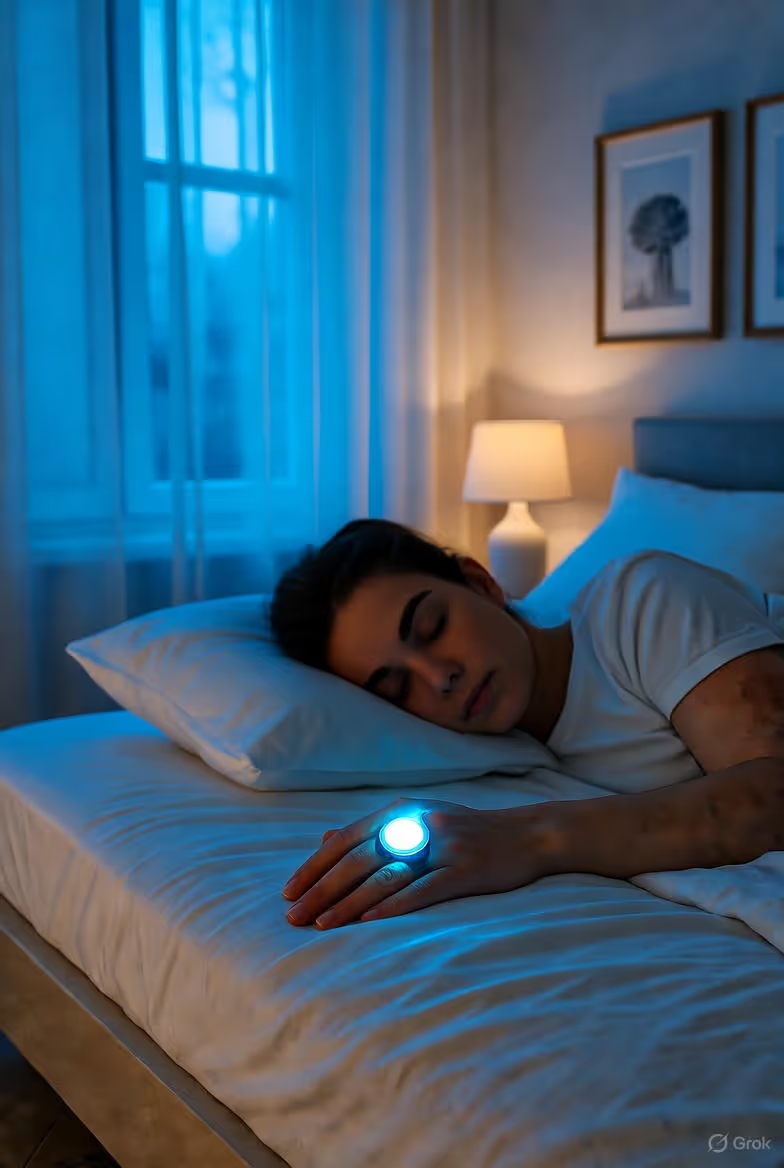
The ideal Nightly Recovery Timeline is a smooth, uninterrupted progression through cycles. In reality, the night is rarely perfectly still. Brief arousals, known as micro-awakenings, are a normal part of the sleep architecture—we typically experience several each night, often at the end of a sleep cycle, and usually don’t remember them. The problem arises when these disruptions are too frequent, too long, or caused by external or internal factors that prevent a swift return to sleep. Understanding these "sleep sentinels" is key to diagnosing why you might wake up feeling unrefreshed.
Types of Sleep Disruptions
The Cost of Fragmentation
The issue isn’t the brief awakening itself; it’s the "cycle reset." After a full arousal, you typically must journey back through lighter N1 and N2 sleep before reaching restorative deep or REM sleep again. Frequent disruptions mean you spend the night skimming the surface of sleep, never diving deep into the most restorative phases. The result is waking exhausted despite having spent adequate time in bed.
Becoming a Sleep Detective
You might be unaware of your own disruptions. This is where objective data is invaluable. A wellness tracker like the Oxyzen ring monitors key signals:
By reviewing your nightly timeline, you can see not just that you woke up, but often when and for how long. You can then cross-reference this with your behavior log: "My sleep was fragmented on the nights I had a late, heavy meal," or "My oxygen dips and movement spikes when I sleep on my back."
Taking Action
Armed with this knowledge, you can move from frustration to solution.
Addressing sleep disruptions is perhaps the highest-impact step you can take to improve recovery. It ensures the precious sleep you are getting is of the highest possible quality. If you’re curious about how others have used data to solve their sleep puzzles, the real-world stories from our community are a testament to the power of insight.
About 1-2 hours before your natural wake time, a fascinating shift begins. Your body doesn’t just suddenly "turn on" at the sound of an alarm; it orchestrates a sophisticated physiological prelude to wakefulness. Understanding and harmonizing with this pre-dawn process is the key to transitioning from groggy to graceful awakening.
The Cortisol Awakening Response (CAR)
In a healthy, well-timed sleep cycle, your body begins to secrete cortisol—often mislabeled solely as a "stress hormone." In this context, it’s your natural alarm clock. The CAR is a sharp, significant increase in cortisol levels that occurs in the final hour of sleep, peaking around 30 minutes after waking. This surge helps to increase blood sugar (providing energy), boost blood pressure (to prepare for upright posture), and enhance alertness. It’s a vital, healthy signal that your sleep cycle is concluding.
The Symphony of Sunrise Cues
Simultaneously, other systems activate:
The Problem with Artificial Alarms
When a loud, startling alarm interrupts a sleep cycle—especially deep sleep—it hijacks this natural process. It triggers a flood of adrenaline and cortisol in a stressful, jagged spike rather than the body’s prepared, gradual rise. This causes sleep inertia: that thick, disoriented, grumpy feeling that can last for hours. It’s your brain and body protesting a violent, unnatural transition.
Aligning with Your Biology
The goal is to wake up with your body’s prepared awakening, not against it.
Your wearable device provides crucial insight here. By tracking your nightly heart rate and movement, it can identify your periods of lightest sleep (usually in the final hours) and use that data in "smart alarm" features. Instead of blaring at a fixed time, it can gently vibrate or sound during a light sleep phase within a window (e.g., 20 minutes before your set time), making the awakening feel more natural. Seeing your own readiness score—which often factors in the quality of your sleep and the calmness of your wake-up—on your Oxyzen dashboard provides daily feedback on how well you’re managing this transition.
Waking up should be a gentle surfacing, not an emergency evacuation. By respecting your body’s innate pre-dawn preparation, you set the stage for a morning of calm clarity, not chaotic stress.
The moments immediately following eye-opening are disproportionately powerful. They set the neurological and hormonal tone for the next several hours. A reactive, stressful start—grabbing your phone to check emails, news, or social media—triggers a defensive, anxious state. A intentional, mindful start can anchor you in calm and purpose. This first minute is your chance to seize control of your day’s narrative.
The Perils of "Digital Dawn"
Reaching for your phone first thing is arguably the worst modern habit for morning recovery. It immediately:
Crafting an Intentional Ritual
Instead of reaching outward, spend the first 60 seconds turning inward. This doesn’t have to be a lengthy meditation; it’s about simple, sensory awareness.
The Power of a "Hard Barrier"
To make this ritual stick, you need a rule: No phones for the first 30-60 minutes of the day. This creates a "hard barrier" between your restored self and the demands of the world. It protects the calm, clear space you’ve just created through sleep.
This practice aligns perfectly with the biometric feedback from your recovery timeline. On days you start with this intentional minute, you might notice your daytime HRV remains higher (indicating better stress resilience) or your focus scores are improved. It turns a philosophical idea into a measurable personal experiment.
By mastering the first 60 seconds, you are no longer a passive passenger to the day’s events. You become the pilot, calibrating your instruments before takeoff. It’s the crucial first step in carrying the benefits of your nightly recovery into your waking life. For more strategies on building morning routines that sustain energy, our blog features numerous expert-guided approaches.
While the principles of the Nightly Recovery Timeline are universal, the timing is deeply personal. You’ve likely noticed that some people are vibrant and productive at 6 AM, while others don’t hit their stride until 10 PM. This isn’t just a preference; it’s your chronotype—your genetically influenced predisposition for sleep and wake times. Forcing a night owl onto a lark’s schedule is a recipe for poor recovery, just as making a lark stay up late degrades their sleep quality. Optimizing your timeline means syncing it with your innate biological design.
The Spectrum of Chronotypes
Popularized by sleep researcher Dr. Michael Breus, chronotypes are often categorized into four animal types:
Finding and Honoring Your Type
Your chronotype influences your ideal sleep window, your peak cognitive and physical performance times, and even when you should schedule demanding tasks versus creative ones.
Adapting the Timeline
There is no single "perfect" 10 PM bedtime. The perfect bedtime is the one that aligns with your chronotype and allows you to complete 5-6 full sleep cycles before your natural wake time.
The Social Jetlag Problem
When your social or work schedule forces you to live against your chronotype, it creates "social jetlag"—a chronic misalignment linked to obesity, mood disorders, and cardiovascular risk. While you can’t always control your schedule, you can use your knowledge to mitigate damage. A Wolf forced to wake early should prioritize absolute darkness and quiet at night to maximize sleep efficiency in the hours they do get.
Respecting your chronotype isn’t about being inflexible; it’s about working with your biology, not against it. It’s the final layer of personalization that transforms a generic sleep plan into your perfect Nightly Recovery Timeline. Understanding this intrinsic part of human variation is core to our philosophy at Oxyzen, and you can learn more about our human-centric design approach in our story.
In the quest for perfect recovery, intention is not enough. We need insight. For generations, our understanding of sleep was limited to subjective feeling—"I slept like a rock" or "I tossed and turned all night." Today, biometric technology like the Oxyzen smart ring transforms that vague impression into a detailed, objective map. This phase of the Nightly Recovery Timeline is about moving from merely following advice to becoming the lead scientist in your own personal sleep lab, using data to make precise, effective adjustments.
The Biometrics That Tell the Story
A sophisticated wearable doesn’t just track "sleep"; it decodes the physiological language of recovery through several key metrics:
The Feedback Loop: Observe, Hypothesize, Test, Refine
This is where the magic happens. Data creates a closed-loop system for self-optimization.
Real-World Application: A Case Study
Imagine a user, Alex, sees on his Oxyzen dashboard that his sleep score is consistently lower on Wednesday and Thursday nights. Reviewing the detailed graphs, he notices a pattern: his resting heart rate is 5-8 BPM higher on those nights, and his deep sleep is reduced. He checks his activity log and remembers he has a high-intensity sports league on Tuesday and Wednesday evenings. His hypothesis: Late intense exercise is overheating his body and elevating his nervous system too close to bedtime. He tests by shifting his game-day cool-down to include a longer, more deliberate routine with stretching and a cool shower, and he ensures his bedroom is extra cool. The following week, the data shows his Wednesday night RHR spike is diminished and his deep sleep recovers. The feedback loop has solved a personal puzzle no generic article could have.
This empirical approach demystifies wellness. It replaces guilt and confusion ("Why am I so tired?") with agency and clarity ("When I do X, my recovery improves by Y%"). For those looking to dive deeper into interpreting these metrics and conducting their own experiments, our blog is a growing repository of guides and case studies.
One of the most common disruptions to the Nightly Recovery Timeline is the weekend. After a week of early alarms and social obligations, the temptation to "catch up" by sleeping in late or staying out far past your usual bedtime is powerful. While occasional deviations are normal, a pattern of significant weekend rebound can create a phenomenon known as "social jet lag," which pulls the recovery process two steps back for every one step forward.
Understanding Social Jet Lag
When you sleep in on Saturday and Sunday, you are effectively traveling to a later time zone. Your circadian rhythm, which has been trained to a certain light/dark cycle, is forced to adjust. Come Sunday night, when you try to fall asleep at your "normal" weekday time, your body isn’t ready—melatonin secretion is delayed because your internal clock thinks it’s earlier. This leads to insomnia-like symptoms Sunday night and a brutal, groggy Monday morning wake-up, essentially starting your week with a recovery deficit.
The Myth of "Catch-Up" Sleep
Sleeping in on weekends does not fully reverse the cumulative effects of weekday sleep debt, especially the loss of deep and REM sleep. While you may log more total hours, the architecture is often fragmented and less efficient. Furthermore, the inconsistent schedule blunts your body’s ability to predict and prepare for sleep, making it harder to fall asleep swiftly any night of the week.
Strategies for a Recovery-Conscious Weekend
The goal isn’t to make the weekend joylessly rigid, but to find a balance that supports your timeline without sacrificing social life.
Leveraging Your Data
Your wearable is your best ally here. After a weekend with later nights, check your Monday morning readiness score and sleep data. You’ll likely see the tangible cost: higher sleep latency Sunday night, reduced deep sleep, and a lower HRV. This objective feedback makes the abstract concept of "social jet lag" viscerally real, motivating you to stick closer to your ideal schedule. Seeing the direct correlation between Saturday night’s choices and Tuesday’s energy levels is a powerful teacher. Many of our users have shared how this data-driven awareness helped them redesign their weekends for better sustained energy; you can read their experiences in their own words.
The weekend should be for recovery, not circadian chaos. By applying gentle structure, you can enjoy social freedom while ensuring Monday morning doesn’t feel like a punishment, but a seamless continuation of a well-recovered life.
The food and drink you consume in the hours before bed are not just fuel; they are direct modulators of your sleep chemistry and physiology. Every bite and sip sends instructions to your nervous system, digestive organs, and endocrine system, which can either harmonize with or sabotage your Nightly Recovery Timeline. This section moves beyond vague warnings to explore the precise mechanisms and timing of nutritional leverage.
The Three Pillars of Sleep-Supportive Nutrition: Timing, Composition, and Quantity
1. Timing: The Last Meal Countdown
Your digestive system should be in its twilight phase as you enter yours. A large meal too close to bedtime forces your body to prioritize digestion over restoration, raising core temperature and keeping your metabolism active.
2. Composition: Macro-Nutrient Magic
The Drinks That Derail and Support
Using Biometrics to Personalize Your Diet
This is where generic advice ends and personalization begins. Your unique metabolism dictates how you react to food at night.
Food is a powerful tool, not an enemy. By understanding its direct lines of communication with your sleep systems and using your personal data as a guide, you can transform your evening nutrition into a deliberate, supportive part of your recovery protocol, not a roll of the dice. For ongoing discussions on nutrition and recovery science, we regularly publish new research and insights on our blog.
The relationship between movement and sleep is a symbiotic dialogue, not a one-way street. While we’ve covered how sleep repairs the body from the day’s activity, it’s equally critical to understand how the type, intensity, and timing of your daytime movement directly programs the quality of your nighttime recovery. The right movement pattern acts as a powerful zeitgeber, reinforcing your circadian rhythm and deepening your sleep architecture.
The Exercise-Sleep Cycle: A Virtuous Loop
Regular physical activity is one of the most reliable, non-pharmaceutical ways to improve sleep. It does so through multiple mechanisms:
Timing is Everything: Aligning Movement with Your Timeline
While any exercise is better than none, when you move can enhance or impair its sleep benefits.
Listening to Your Body’s Data-Driven Feedback
This is the quintessential area for personalization through biometrics. Your wearable provides the objective truth about how your activity impacts your recovery.
By pairing your activity log with your sleep and recovery metrics, you can answer with certainty: "Is my 8 PM spin class helping or hurting my recovery?" This allows you to adjust not the exercise itself, but its placement in your daily schedule to maximize its symbiotic relationship with sleep.
Movement is the daylight partner to nocturnal recovery. When aligned correctly, it doesn’t drain you—it charges your sleep battery, ensuring your Nightly Recovery Timeline is built on a foundation of physiological strength and balance. To see how different movement philosophies integrate with holistic recovery, you can explore various approaches documented by our community.
For many, the greatest barrier to perfect recovery isn’t physical, but psychological. Anxiety about sleep itself—"Will I fall asleep?" "What if I have another bad night?"—creates a state of hyperarousal that directly prevents the very rest it craves. This creates a vicious cycle of sleeplessness and fear. Breaking this cycle requires building a "mind-bridge": a set of cognitive and behavioral tools that rebuild your confidence in your innate ability to sleep and dismantle the anxiety that blocks it.
Cognitive Behavioral Therapy for Insomnia (CBT-I) Principles
CBT-I is the gold-standard, first-line treatment for chronic insomnia. You don’t need a formal diagnosis to benefit from its core principles, which are designed to reshape unhelpful thoughts and behaviors around sleep.
Building Your Sleep Confidence Toolkit
How Biometric Feedback Reinforces Confidence
This is where technology becomes a therapeutic ally. For someone with sleep anxiety, a device like the Oxyzen ring provides objective, reassuring data.
Building the mind-bridge is about transferring trust from your anxious thoughts to your body’s innate wisdom and the objective evidence of its performance. It turns the bedroom from a battleground back into a sanctuary. The journey to this peaceful state is at the heart of our mission, and you can learn more about our human-centric philosophy in our story.
Your Trusted Sleep Advocate: Sleep Foundation — https://www.sleepfoundation.org
Discover a digital archive of scholarly articles: NIH — https://www.ncbi.nlm.nih.gov/
39 million citations for biomedical literature :PubMed — https://pubmed.ncbi.nlm.nih.gov/
Experts at Harvard Health Publishing covering a variety of health topics — https://www.health.harvard.edu/blog/
Every life deserves world class care :Cleveland Clinic - https://my.clevelandclinic.org/health
Wearable technology and the future of predictive health monitoring :MIT Technology Review — https://www.technologyreview.com/
Dedicated to the well-being of all people and guided by science :World Health Organization — https://www.who.int/news-room/
Psychological science and knowledge to benefit society and improve lives. :APA — https://www.apa.org/monitor/
Cutting-edge insights on human longevity and peak performance:
Lifespan Research — https://www.lifespan.io/
Global authority on exercise physiology, sports performance, and human recovery:
American College of Sports Medicine — https://www.acsm.org/
Neuroscience-driven guidance for better focus, sleep, and mental clarity:
Stanford Human Performance Lab — https://humanperformance.stanford.edu/
Evidence-based psychology and mind–body wellness resources:
Mayo Clinic — https://www.mayoclinic.org/healthy-lifestyle/
Data-backed research on emotional wellbeing, stress biology, and resilience:
American Institute of Stress — https://www.stress.org/


