


The Self-Compassion Approach to Anxiety Reduction
Reducing anxiety by practicing kindness and understanding toward oneself.
Reducing anxiety by practicing kindness and understanding toward oneself.
%402x.svg)
In a world that often feels like it’s running on adrenaline and algorithms, anxiety has become a familiar companion for millions. We’re told to optimize our productivity, curate our lives, and push through the discomfort. The prevailing narrative for managing anxiety often sounds like a corporate battle plan: identify, attack, conquer. We’re advised to challenge our thoughts, expose ourselves to fears, and rigidly control our responses. But what if this very mindset of combat is part of the problem? What if the path to peace isn’t through war with our own minds, but through a radical, evidence-backed practice of kindness toward ourselves?
This is the profound promise of the self-compassion approach. It’s not about surrendering to anxiety or becoming passive. It’s about changing the fundamental relationship you have with your own distress. Imagine meeting your racing heart, your spiraling thoughts, and your knot-in-the-stomach feeling not with criticism (“Here we go again, get it together!”) or panic (“This is unbearable!”), but with the same warmth, understanding, and supportive presence you would offer a dear friend in pain. This shift from internal critic to internal ally is the core of self-compassion, and a growing mountain of scientific research shows it is one of the most powerful, sustainable tools for reducing anxiety ever studied.
This article is your comprehensive guide to understanding and applying this transformative approach. We will dismantle the myth that self-compassion is self-indulgent or weak, explore the robust neuroscience behind it, and provide you with a practical, step-by-step framework to cultivate it. We'll also examine how modern technology, like the advanced biometric tracking from smart rings, can provide an objective window into your nervous system, helping you apply self-compassion with precision. By the end, you will have a new paradigm for emotional well-being—one rooted in connection, courage, and kindness.
Before we can harness self-compassion to soothe anxiety, we must first clearly define it, distinguishing it from common misconceptions. Self-compassion, as pioneered by Dr. Kristin Neff, a leading researcher in the field, is not simply positive thinking, elevated self-esteem, or reciting mantras in the mirror. It is a specific, measurable construct composed of three core components that work in tandem:
1. Self-Kindness vs. Self-Judgment: This is the active process of being warm and understanding toward ourselves when we suffer, fail, or feel inadequate, rather than ignoring our pain or flagellating ourselves with self-criticism. It means speaking to yourself in a supportive inner dialogue. For example, when anxiety strikes before a presentation, self-kindness sounds like, “This is really hard right now. It’s okay to feel nervous,” instead of, “You’re so pathetic. Everyone else is fine.”
2. Common Humanity vs. Isolation: Anxiety has a cruel way of making us feel uniquely broken and alone. The component of common humanity counters this by recognizing that suffering and personal inadequacy are part of the shared human experience—something we all go through rather than something that happens to “me” alone. It’s the realization that you are not the only person in the world who has ever felt this crushing sense of worry; you are connected to others in your vulnerability.
3. Mindfulness vs. Over-Identification: To be compassionate, we must first see the suffering clearly. Mindfulness in this context is the balanced awareness of our painful thoughts and feelings without suppressing them or being swept away by them. It allows us to observe, “I am noticing anxiety,” rather than collapsing into the fused identity of “I am anxiety.” This creates the psychological space needed to respond with kindness.
Unlike self-esteem, which is often contingent on success and social comparison (“I’m better than others”), self-compassion is unconditional. It is available to you when you fail, when you feel insecure, and especially when anxiety shows up uninvited. It’s a stable source of comfort that doesn’t fluctuate with your latest achievement or mistake.
The research is unequivocal about its benefits. A meta-analysis published in Clinical Psychology Review concluded that self-compassion is strongly associated with lower levels of anxiety and depression. Neuroscientific studies using fMRI scans show that practicing self-compassion activates the brain’s caregiving and soothing system (linked to the release of oxytocin and endorphins) and deactivates the amygdala, the brain’s threat detector that sounds the alarm for anxiety. This isn’t just “feeling better”; it’s a measurable neurological shift from a state of threat to a state of safety.
Understanding this foundation is critical. As we move forward, we’ll see how this tripartite model becomes a practical toolkit for disarming anxiety at its root. For a deeper dive into the science of emotional regulation, you can always explore our blog for more research-backed wellness insights.

To understand why self-compassion is so effective, we must first examine why our instinctive reactions to anxiety so often backfire. This is the anxiety paradox: the very strategies we use to eliminate or control anxious feelings frequently intensify them, creating a vicious, self-perpetuating cycle.
At its core, anxiety is a future-oriented state of fear. It’s the body’s ancient threat-detection system—the fight-or-flight response—being triggered by perceived psychological dangers (like embarrassment, failure, or uncertainty) rather than physical ones. Your heart races, muscles tense, and mind scans for threats because your nervous system is preparing you to survive. The problem begins with our secondary reactions to this initial alarm.
The Trifecta of Unhelpful Reactions:
These reactions create what psychologists call “dirty distress”—the original clean pain of anxiety, now muddied with layers of resistance and suffering. It’s the difference between feeling a wave of nervousness (clean pain) and feeling a wave of nervousness plus a torrent of thoughts about how you can’t handle life and everyone will notice you’re a fraud (dirty distress).
Self-compassion interrupts this entire dysfunctional sequence. By meeting anxiety with kindness, we remove the layer of self-judgment. By acknowledging it mindfully, we reduce experiential avoidance. By holding it with a sense of common humanity, we reduce the isolating fusion. We move from “fighting against” our experience to “being with” it in a way that fundamentally calms the nervous system. It transforms dirty distress back into a manageable, clean sensation that can ebb and flow naturally. Learning to recognize your own unique stress signatures is a powerful first step, and tools like a smart ring can offer unbiased feedback, a topic we explore in our FAQ about how biometric tracking supports mental wellness.
The power of self-compassion is not merely philosophical; it is biological. When you practice it, you are quite literally remodeling your brain and reprogramming your body’s automatic stress responses. Let’s look under the hood at the remarkable neuroscience that explains why being kind to yourself is a potent anxiolytic.
When you perceive a threat (be it a looming deadline or a social conflict), your body’s sympathetic nervous system (SNS) engages, triggering the classic fight-or-flight cascade: cortisol and adrenaline surge, your heart rate and breathing accelerate, and blood flows to your muscles. This is orchestrated by brain regions like the amygdala (the alarm bell) and the hypothalamus.
Self-compassion directly activates a different, opposing physiological system: the caregiving and social-safety system. This system is rooted in our mammalian evolution and is associated with bonding, attachment, and nurturance. When activated, it:
fMRI Evidence: Brain imaging studies provide a stunning visual of this shift. In one study, when participants practiced self-compassion in response to personal failure, researchers observed increased activity in the dorsomedial prefrontal cortex and anterior cingulate cortex—areas linked to empathy and emotional regulation—and decreased activity in the amygdala and posterior cingulate cortex, areas associated with threat processing and self-referential distress.
In practical terms, you are giving your body a new, healthier default setting. Instead of the one-two punch of anxiety → more anxiety about the anxiety, you create a new loop: anxiety → kind awareness → physiological soothing. You are not just thinking differently; you are changing your biology. This is why consistent self-compassion practice has been shown to lower baseline cortisol levels over time, making you less reactive to stressors from the outset.
Understanding this science empowers us to see self-compassion not as a “soft” skill, but as a rigorous form of neural and emotional training. It’s about building a resilient, responsive nervous system. At Oxyzen, our mission is to support this kind of holistic well-being, which is why we design technology to help you see and understand these physiological states, as detailed in our story about merging human-centric design with cutting-edge science.
Knowing the theory is one thing; integrating it into the heat of an anxious moment is another. Like any skill, self-compassion requires practice. It’s about building a “muscle memory” of kindness so it becomes your default response. Here, we translate the three components—mindfulness, common humanity, and self-kindness—into concrete, accessible practices you can begin today.
Before you can respond with compassion, you must recognize the suffering is present. The Mindful Pause is your circuit-breaker.
This practice directly counteracts the loneliness of anxiety by connecting you to the broader human experience.
This is where you actively offer comfort to yourself, moving from recognition to active care.
Start Small: Don’t wait for a major anxiety attack. Practice these micro-moments throughout the day. Stub your toe? Pause, acknowledge the pain, and say, “Ouch, that hurt! It’s okay.” Feel impatient in a line? Notice it, connect (“Lots of people feel rushed”), offer kindness (“May I be patient”). This builds the neural pathways so they are strong and accessible when you need them most. For more structured guides and exercises, a wealth of resources can be found on our dedicated wellness blog.
For many, the single biggest source of anxiety is not the external world, but the relentless, punishing voice of the inner critic. This is the mental commentary that critiques your every move, catastrophizes outcomes, and weaponizes your imperfections. To cultivate self-compassion, we must learn to recognize, relate to, and ultimately transform this inner voice from a tyrant into, at the very least, a neutral observer—or even a compassionate ally.
The inner critic often masquerades as motivation (“If I don’t beat myself up, I’ll become lazy”), but its fuel is fear and shame, not encouragement. It keeps you in a perpetual state of threat, which is the bedrock of chronic anxiety.

Step 1: Name and Externalize
You cannot change what you cannot see. Begin by giving your inner critic a name. It might be “The Taskmaster,” “The Perfectionist,” or “Doomsday Dan.” This simple act of externalization creates instant distance. It helps you realize, “That’s not me; that’s a fearful part of me speaking.” When you hear the critical voice, note: “Ah, there’s The Taskmaster, getting loud.”
Step 2: Understand its (Misguided) Intention
Rarely is any part of us purely malevolent. The inner critic usually developed as a misguided protector. Its job was to keep you safe by pushing you to be perfect (to avoid rejection), to anticipate every disaster (to avoid surprise), or to shame you into conformity (to avoid exclusion). Acknowledge this. You might say internally, “I see you, Critic. I know you’re trying to keep me safe from failure. Thank you for your concern.”
Step 3: Respond with Compassionate Re-framing
This is where you consciously choose a new, compassionate voice to respond to the critic. You are not trying to violently silence it (which is just another form of inner conflict), but to answer it with wisdom.
The Power of “And”: A powerful linguistic tool is to replace “but” with “and.” “I’m really anxious about this presentation, and I am capable.” The word “but” negates the first clause; “and” allows both truths to coexist, reducing internal conflict.
By consistently practicing this, you weaken the critic’s automatic authority and strengthen the neural pathways of your compassionate voice. Over time, the compassionate voice becomes the first responder to distress. This transformation is at the heart of our vision at Oxyzen—to foster a kinder relationship with oneself, a journey you can read more about in our company mission.
Social anxiety—the dread of judgment, evaluation, or rejection in social settings—is fertile ground for self-compassion practice. Here, the inner critic is often at its loudest, and the sense of isolation (“I’m the only one who doesn’t fit in”) is acute. The self-compassion framework offers a direct antidote to this specific flavor of suffering.
Social anxiety often stems from a core belief of being inherently flawed or less-than. We compare our internal, messy experience to the curated, external highlight reels of others, leading to crushing shame. Self-compassion addresses this at multiple levels.
1. Before the Event: Preparing with Kindness
Instead of mentally rehearsing everything that could go wrong (a form of anticipatory anxiety), shift your preparation.
2. During the Event: Using Anchors and Mantras
In the midst of social interaction, your cognitive resources are strained. Use simple, repeatable anchors.
3. After the Event: The Compassionate Post-Mortem
Resist the urge to engage in “post-event processing”—the obsessive replaying of every perceived awkward moment. If you must review, do it with a compassionate lens.
This approach dismantles the shame that fuels social anxiety. It replaces the goal of “being impressive” with the goal of “being human, with kindness.” The relief that comes from this shift can be profound. Many of our users at Oxyzen have shared how understanding their physiological stress signals in real-time has helped them apply these very techniques, as seen in real user testimonials about managing social stress.
When anxiety escalates into panic or acute overwhelm, it becomes a full-bodied experience. The thinking brain goes “offline,” and logic is useless. At these moments, a purely cognitive approach to self-compassion can feel impossible. This is where somatic (body-based) self-compassion becomes essential. It speaks the language of the nervous system directly, offering safety and regulation through sensation.
Anxiety is not just in your head; it’s a physiological event. Somatic practices work by interrupting the threat-response cycle at the bodily level, creating conditions of safety that the mind can later catch up to.
1. Soothing Touch & The Hand-on-Heart Practice:
This is perhaps the fastest way to activate the parasympathetic nervous system.
2. Grounding for Dissociation or Spiral:
When you feel disconnected or spinning into panic, grounding brings you back to the present, physical world.
3. Gentle Movement with Awareness:
Anxiety is trapped energy. Slow, mindful movement can help discharge it.
4. Orienting to Safety:
The amygdala is constantly scanning the environment for danger. You can consciously guide this scan toward safety.
These practices are first aid for an overwhelmed nervous system. They build what psychologist Deb Dana calls “glimmers”—small moments of felt safety that accumulate to create a more resilient system. Technology can support this by helping you recognize the early somatic signs of overwhelm before they escalate, a principle central to the design philosophy you can learn more about on our homepage.
Lasting change doesn’t happen in moments of crisis alone; it is built through consistent, daily practice. A self-compassion ritual is a dedicated time to strengthen the “compassionate mind” muscle so it’s robust and readily available when anxiety strikes. Think of it as preventive maintenance for your emotional well-being. Here is a framework for creating a sustainable, personalized ritual.
1. Find Your Anchor Moment:
Link your practice to an existing daily habit to ensure consistency. This could be:
2. Choose Your Core Practice (5-10 Minutes):
Your ritual can be simple. Choose one core practice to do during your anchor moment.
3. Incorporate Micro-Moments of Connection:
Throughout your day, sprinkle in tiny acts of self-compassion.
4. End Your Day with Gratitude for Effort, Not Outcome:
Before sleep, reflect on the day not by what you accomplished, but by how you met your experiences. “Today was hard, and I tried to be gentle with myself.” Or, “I noticed my anxiety, and I paused for a moment.” This reinforces the value of the compassionate process over any specific result.
The goal of this ritual is not to become a meditation expert, but to weave threads of conscious kindness into the fabric of your day. This constant, gentle return to a compassionate stance rewires your brain’s default setting over time. For those curious about how objective data can support and reflect the progress made through such rituals, our FAQ section addresses how biometric feedback complements mindfulness work.
In the deeply personal journey of cultivating self-compassion, a surprising ally has emerged: objective, quantifiable data. While kindness is an internal experience, our physiological states—heart rate, heart rate variability (HRV), skin temperature, and sleep patterns—are external, measurable realities. Modern wellness technology, particularly advanced smart rings, bridges this gap, offering a unique "third-person perspective" on our first-person emotional world. This isn't about outsourcing your intuition; it’s about enriching it with precise feedback.
Imagine this common scenario: You’re sitting at your desk, tackling a project. A subtle, background hum of anxiety begins—so familiar you barely register it. You might brush it off as "just stress." Meanwhile, a smart ring on your finger detects a steady climb in your heart rate, a dip in your HRV (indicating nervous system strain), and a slight increase in skin temperature. This data, viewed later, presents an undeniable truth: Your body was in a low-grade stress state for two hours.
This feedback is revolutionary for self-compassion practice for three key reasons:
1. It Validates Your Experience (Reducing Self-Doubt): For those prone to dismissing their anxiety ("I'm just overreacting"), the data provides concrete validation. Seeing a physiological correlate to your felt experience reinforces that your feelings are real, worthy of attention, and have a biological basis. This directly supports the mindfulness component—you are seeing clear evidence of "what is."
2. It Reveals Invisible Patterns (Fostering Understanding): Self-compassion requires understanding. Biometric data can uncover patterns you’re blind to. You may learn that your stress biomarkers spike predictably every day at 3 p.m. (the "afternoon crash"), or that your sleep is severely disrupted on nights after high-conflict days, even if you feel you've "shaken it off." This insight fosters a sense of common humanity with your own body's rhythms—"Ah, this is my system's predictable response to these triggers"—and replaces self-blame with curiosity.
3. It Measures the Impact of Your Practice (Reinforcing Kindness): The most powerful reinforcement is seeing that your efforts work. After a 10-minute guided self-compassion meditation during a stressful period, you can check your biometrics and see your heart rate curve downward and your HRV begin to recover. This turns an abstract practice into a tangible skill with visible results. It answers the question, "Is this kindness actually helping my body?" with a resounding, data-backed "Yes." This reinforces the self-kindness behavior, making you more likely to use it again.
Using Data Compassionately, Not Critically: The crucial caveat is to use this technology as a tool for kindness, not another yardstick for self-judgment. The goal is not to achieve a "perfect" HRV score or to obsess over every data point. That would be the antithesis of self-compassion. Instead, view the data through a compassionate lens:
This approach aligns perfectly with the ethos of companies like Oxyzen, which aim to provide insights for empowerment, not performance anxiety. You can discover how Oxyzen’s technology is designed with this compassionate philosophy at its core.
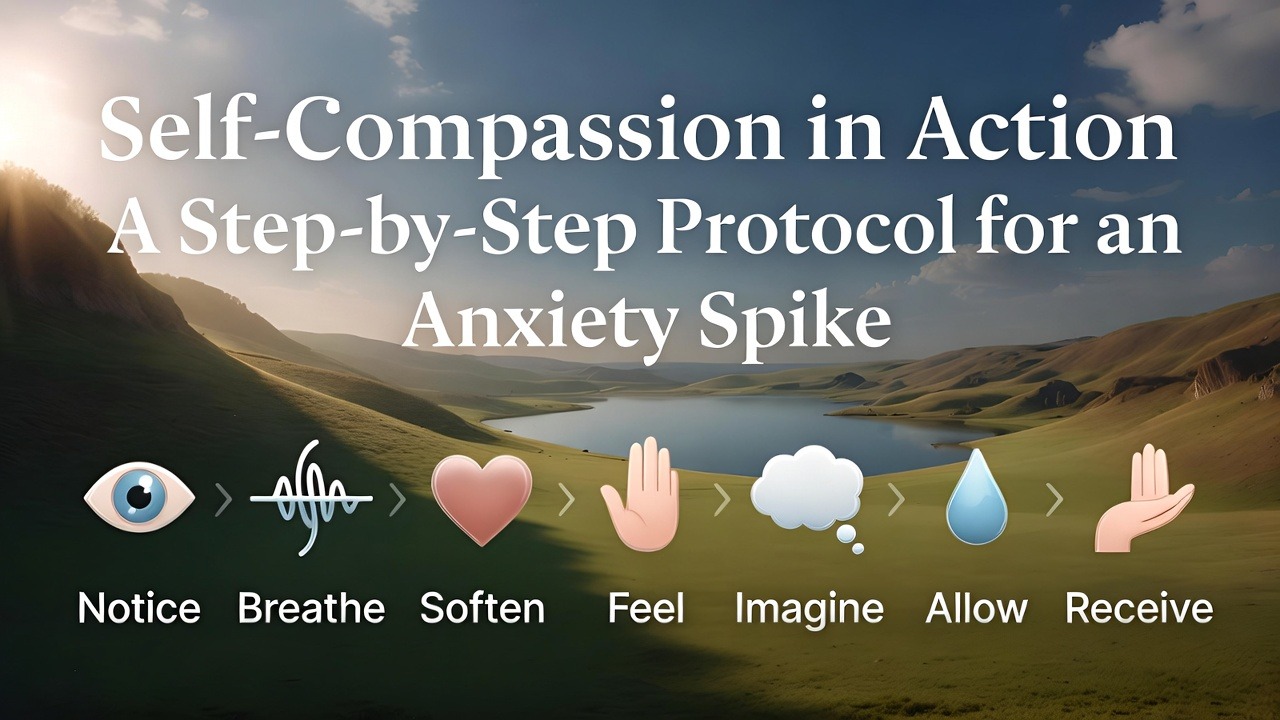
Theory and daily practice prepare the ground, but the true test comes in the storm—the moment anxiety surges from a background hum to a overwhelming wave. Having a clear, pre-rehearsed protocol can be a lifeline. This step-by-step guide integrates everything we’ve covered into a single, actionable sequence you can deploy when you feel anxiety escalating.
Phase 1: Recognition & Interruption (0-60 Seconds)
Phase 2: Application of the Core Components (1-3 Minutes)
Phase 3: Somatic Soothing & Reorientation (2-4 Minutes)
Post-Spike Integration: Once the peak has passed, take another moment. Acknowledge your effort. "That was intense, and I met it with kindness. I showed up for myself." This reinforces the new pattern. Consider journaling a few notes on what triggered it and how your response felt different.
This protocol turns self-compassion from a concept into a concrete emergency drill. Practicing it calmly when you’re not anxious makes it more accessible when you are. For more practical guides and variations on techniques like these, a library of resources awaits on our wellness blog.
There will be days—or weeks—when the concept of self-compassion feels like a cruel joke. The inner critic is roaring, your body is locked in tension, and the idea of speaking kindly to yourself provokes internal sneers of "That's stupid" or "You don't deserve it." This is not a sign of failure; it is an expected, integral part of the path. Meeting this experience with compassion is perhaps the most advanced practice of all.
1. Radical Permission to Not Feel It: The first step is to let go of the demand to "be compassionate." Instead, apply the framework to your resistance itself.
2. Shift from "Top-Down" to "Bottom-Up" Approaches: If words fail, go purely somatic. Drop the phrases and just offer pure physical care, which bypasses the resistant thinking brain.
3. Use the "Caring Intention" Loophole: If you cannot feel warmth, you can still intend to care. The conscious intention to wish yourself well, even if it feels hollow, is a powerful seed. "Even though I feel nothing, I set the intention to care for my well-being."
4. Seek External Compassion: When self-compassion is inaccessible, we need to borrow it from the outside. This is where common humanity becomes actionable.
Remember, the goal is not a perpetually blissful state of self-love. It is to change your relationship to all your states—including anger, resistance, and numbness—from one of war to one of mindful, humane allowance. A setback practiced with meta-compassion is a deeper victory than an easy day practiced with perfect technique.
While self-compassion is an internal practice, its effects ripple outward, fundamentally transforming our relationships and social ecosystems. Anxiety often breeds isolation and a sense of being a burden, leading us to withdraw or present a curated, "fine" facade. Self-compassion dismantles this by filling our own cup first, which paradoxically allows us to connect with others from a place of wholeness and genuine presence, rather than neediness or performance.
The Relational Ripple Effect:
Practicing Relational Self-Compassion:
This outward ripple transforms self-compassion from a solitary self-help technique into a force for social healing. It fosters communities where vulnerability is safe and connection is authentic. This vision of interconnected well-being is central to the values and mission we hold at Oxyzen.
The ultimate promise of self-compassion is not just the reduction of acute anxiety symptoms, but the cultivation of profound, unshakable resilience. Resilience is not an innate trait of "tough" people; it is the learned capacity to navigate adversity, to bend without breaking, and to eventually integrate difficult experiences into a stronger, wiser sense of self. Self-compassion is the engine of this process.
How Self-Compassion Builds Resilience:
From Resilience to Post-Traumatic Growth:
Research by Dr. Kristin Neff and others shows that self-compassion is a significant predictor of post-traumatic growth (PTG)—the phenomenon where individuals report positive psychological changes after struggling with highly challenging life circumstances. These changes include a greater appreciation for life, improved relationships, recognition of new possibilities, and enhanced personal strength.
Self-compassion facilitates PTG because it allows individuals to engage with their trauma narrative with openness and curiosity rather than avoidance and fear. By saying, "This happened, it was awful, and I am worthy of kindness as I carry this," you transform the relationship with the event. You are no longer defined by it; you are the compassionate witness and holder of it. This is the pinnacle of anxiety reduction: not a life free of triggers or painful memories, but an unbreakable, kind relationship with yourself that can hold all of it.
For those on this long path of healing and growth, having supportive tools can make a significant difference. Many find that objective wellness data helps them recognize their resilience in real-time, a topic explored in our blog's deeper dives on resilience and technology.

The final stage of this journey is the seamless integration of self-compassion into your identity. It shifts from being something you do (a 10-minute meditation) to something you are—the foundational lens through which you meet all of life. This doesn't mean you're perfectly kind every moment, but that the compass of compassion is your true north, and you reliably return to it. This integration is the safeguard against chronic anxiety's return.
Signs of Integration:
Practices to Foster Integration:
Integration is the fruit of sustained practice. It’s the point where the tools become invisible, and you are simply living, with greater peace, courage, and connection. For anyone supporting others on this journey—whether as a partner, friend, or coach—understanding these stages is invaluable, as discussed in our resources on community and shared well-being.
We have now laid a comprehensive foundation for the self-compassion approach to anxiety reduction. We've moved from defining its core components and neuroscience, through practical protocols for acute moments and daily life, and into its profound implications for relationships and long-term resilience. We've also explored how modern tools can provide supportive, objective feedback without undermining the deeply personal, subjective heart of the work.
You now understand that self-compassion is:
This is not a quick fix, but a lifelong orientation—a home you build within yourself that you can always return to, no matter how stormy the external weather becomes. The anxiety may still visit, but it will no longer be a landlord; it will be a guest you can meet at the door with mindful awareness, a recognition of shared humanity, and deliberate kindness.
The journey continues. In the next portion of this guide, we will delve into specialized applications, addressing topics such as self-compassion for specific anxiety disorders (like Generalized Anxiety Disorder, Social Anxiety, and OCD), the intersection of self-compassion with lifestyle factors like sleep and nutrition, and advanced meditative practices. We will also provide detailed worksheets and reflection guides to personalize your path further.
Remember, every moment of noticing your struggle with a hint of kindness is a victory. Every breath taken with the intention of self-care is a step on the path. You are not repairing something broken; you are remembering something whole. Continue this journey with patience and curiosity, and know that support and deeper insights are always available, whether through continued learning on our extensive blog or by exploring the tools designed to illuminate your path to well-being.
Your Trusted Sleep Advocate (Sleep Foundation — https://www.sleepfoundation.org/)
Discover a digital archive of scholarly articles (NIH — https://www.ncbi.nlm.nih.gov/
39 million citations for biomedical literature (PubMed — https://pubmed.ncbi.nlm.nih.gov/)
experts at Harvard Health Publishing covering a variety of health topics — https://www.health.harvard.edu/blog/)
Every life deserves world class care (Cleveland Clinic -
https://my.clevelandclinic.org/health)
Wearable technology and the future of predictive health monitoring. (MIT Technology Review — https://www.technologyreview.com/)
Dedicated to the well-being of all people and guided by science (World Health Organization — https://www.who.int/news-room/)
Psychological science and knowledge to benefit society and improve lives. (APA — https://www.apa.org/monitor/)
Cutting-edge insights on human longevity and peak performance
(Lifespan Research — https://www.lifespan.io/)
Global authority on exercise physiology, sports performance, and human recovery
(American College of Sports Medicine — https://www.acsm.org/)
Neuroscience-driven guidance for better focus, sleep, and mental clarity
(Stanford Human Performance Lab — https://humanperformance.stanford.edu/)
Evidence-based psychology and mind–body wellness resources
(Mayo Clinic — https://www.mayoclinic.org/healthy-lifestyle/)
Data-backed research on emotional wellbeing, stress biology, and resilience
(American Institute of Stress — https://www.stress.org/)


