


How to Track Emotional Stress vs Physical Stress Separately
Differentiate by noting physical symptoms (muscle tension) for physical stress and cognitive/emotional symptoms (worry, irritability) for emotional stress.
Differentiate by noting physical symptoms (muscle tension) for physical stress and cognitive/emotional symptoms (worry, irritability) for emotional stress.
%402x.svg)
Have you ever woken up feeling utterly drained, your body heavy with a fatigue that coffee can't touch, yet your fitness tracker proudly displays a "restful" sleep score? Or have you powered through an intense workout, physically spent but mentally buzzing with a clear, triumphant energy? These common experiences highlight a critical flaw in our approach to wellness: we treat all stress as a single, monolithic enemy.
For decades, we've quantified our health with steps counted, calories burned, and hours slept. We've watched our heart rates and celebrated low resting numbers. But these metrics, while valuable, tell only half the story. They capture the physics of our body—the mechanical exertion, the physiological cost of a run—but they are largely deaf to the poetry of our inner world: the simmering anxiety before a big presentation, the heartache of a personal loss, the chronic buzz of digital overload. This is the silent epidemic of our time. We are data-rich about our bodies but insight-poor about our minds, failing to recognize that a stressful commute and a strenuous hike, while both raising your heart rate, are taxing you in fundamentally different ways.
The consequence of this blind spot is profound. We misattribute emotional exhaustion to physical laziness, pushing ourselves harder in the gym when what we need is meditation. We blame a poor workout on sleep when the real culprit is a morning full of difficult decisions. This misdiagnosis leads to a cycle of ineffective interventions, burnout, and a lingering feeling that despite all our biohacking and self-tracking, true balance remains elusive.
But what if you could see the full spectrum of your stress? What if your wearable could do more than just count—what if it could comprehend? Imagine a tool that doesn't just see an elevated heart rate, but can interpret its origin, whispering, "This is your body recovering from strength training," or alerting you, "This spike is linked to emotional tension—consider a breathing exercise."
This is no longer the realm of science fiction. The frontier of personal wellness is moving beyond generic "stress scores" to a nuanced, separate tracking of emotional (psychogenic) and physical (physiogenic) stress. This distinction isn't academic; it's operational. It’s the difference between treating a symptom and addressing the root cause. It empowers you to make precise, effective decisions: to know when to push and when to pause, when to fuel your body and when to soothe your nervous system.
In this comprehensive guide, we will dismantle the monolithic concept of stress and rebuild it with clarity. You will learn the distinct biological pathways of emotional and physical strain, understand the limitations of current tracking technology, and discover how the next generation of devices—like advanced smart rings—are decoding these signals separately. We will equip you with a dual-awareness framework to finally listen to what your body and mind are truly saying, enabling a tailored, effective path to resilience and peak performance. The journey to mastering your well-being begins with a simple, revolutionary act: learning to tell your stressors apart.

To manage something, we must first name it and understand its nature. "Stress" is an overburdened term, used to describe everything from a looming deadline to a sore muscle. For true mastery over our well-being, we must bifurcate this concept into its two primary forms: Emotional (Psychogenic) Stress and Physical (Physiogenic) Stress. They are siblings in the family of strain, but with distinctly different personalities, origins, and effects.
Emotional Stress: The Storm in Your Nervous System
Emotional stress originates in the mind and the perceived challenges to our psychological well-being. It is the body's response to threats that are not necessarily physical but are interpreted as such by our brain. Think of it as the fight-or-flight response triggered by a tiger that exists only in your thoughts.
Physical Stress: The Calculated Cost of Doing
Physical stress, in contrast, is the direct, tangible strain placed on the body's tissues and systems. It is the measurable cost of physical work, essential for growth and adaptation.
The Crucial Intersection and Confusion
Where things get complex—and where most general trackers fail—is at the intersection. Physical stress can cause emotional stress (dreading a hard workout, frustration from an injury). More perniciously, chronic emotional stress manifests as physical symptoms (tension headaches, upset stomach, muscle tightness). This is why that "stress score" on your watch becomes meaningless: it sees the elevated heart rate from your morning argument and the one from your lunchtime run as identical data points.
A 2021 review in the journal Frontiers in Neuroendocrinology underscored this, stating, "Psychological and physical stressors, while sharing common output pathways, engage differentially activated neural circuits." In simpler terms, the roads to a stressed state are different, even if the destination looks similar to a basic sensor.
Understanding this duality is the foundational step. You cannot optimize what you cannot differentiate. By learning to identify whether your physiological arousal is rooted in a thought pattern or a physical act, you gain the first and most critical tool for intelligent self-management. For those seeking to dive deeper into the science of stress physiology, our resource library at https://oxyzen.ai/blog offers a wealth of detailed articles.
If emotional and physical stress are different phenomena, then our body must speak in different dialects for each. It does. While the overall symphony of the stress response involves similar instruments—heart, nerves, hormones—the melody, tempo, and duration are distinctly different. Advanced biometric tracking is learning to listen to these nuances, moving from hearing mere noise to understanding specific phrases.
Decoding the Signals of Emotional Stress
Emotional stress whispers (and sometimes shouts) through markers that reflect nervous system imbalance and hormonal shifts that aren't always tied to movement.
Decoding the Signals of Physical Stress
Physical stress declares itself through metrics of exertion, metabolic cost, and tissue breakdown.
The Converging Clues: How to Tell Them Apart
The magic of separate tracking happens in context. Alone, an elevated heart rate at 2 PM is ambiguous. But combined with other data, its story becomes clear:
It is this multi-sensor, context-aware analysis that transforms raw data into actionable insight. The journey of Oxyzen has been dedicated to solving this exact puzzle—our story details the pursuit of technology that listens to these separate languages of human strain.

The wellness tech market is flooded with devices boasting "stress tracking." From smartwatches to fitness bands, they promise a window into our internal state. Yet, users often find themselves confused, frustrated, or dismissive of these features. Why? Because the prevailing model of a single, composite "stress score" is fundamentally flawed. It's like having a weather app that only shows "Precipitation: Yes/No," without distinguishing between a life-giving rain, a destructive hail storm, or a paralyzing blizzard.
The Oversimplification Problem
Most consumer wearables calculate stress using a limited set of inputs, primarily Heart Rate Variability (HRV) and sometimes heart rate or activity data. An algorithm analyzes these, often using a method called photoplethysmography (PPG) from the wrist, and spits out a number on a scale (e.g., 1-100) or a vague descriptor ("Relaxed," "Stressed").
This approach suffers from critical shortcomings:
The "One-Size-Fits-None" Guidance
This conflation leads to generic, often irrelevant wellness prompts. Imagine pushing through a planned, tough workout. Your device, seeing your physiological signals spike, pings you: "You seem stressed. Try a mindfulness exercise." Not only is this unhelpful, it undermines trust in the technology. Conversely, after a day of high emotional tension where you've been sedentary, your device might see you've met your "calm" goal because you didn't move much, completely missing the internal hurricane.
A study in the Journal of Medical Internet Research pointed out this gap, noting that "current commercial stress measures... do not differentiate between stress reactivity to physical versus cognitive stressors, limiting their utility for personalized interventions."
The Cost of Misreading the Signals
The real-world impact is significant:
This blind spot creates a cycle of disengagement. People stop trusting the data because it doesn't reflect their lived experience. They know there's a difference between "good tired" and "bad tired," but their $400 device doesn't.
The future—and the path to truly intelligent health management—lies in devices and platforms that embrace complexity rather than avoiding it. It requires moving from a single score to a dual dashboard, offering separate, contextualized readouts. For answers to common questions on how next-gen technology aims to solve this, our FAQ page provides clear explanations on the shift from generic to granular tracking.
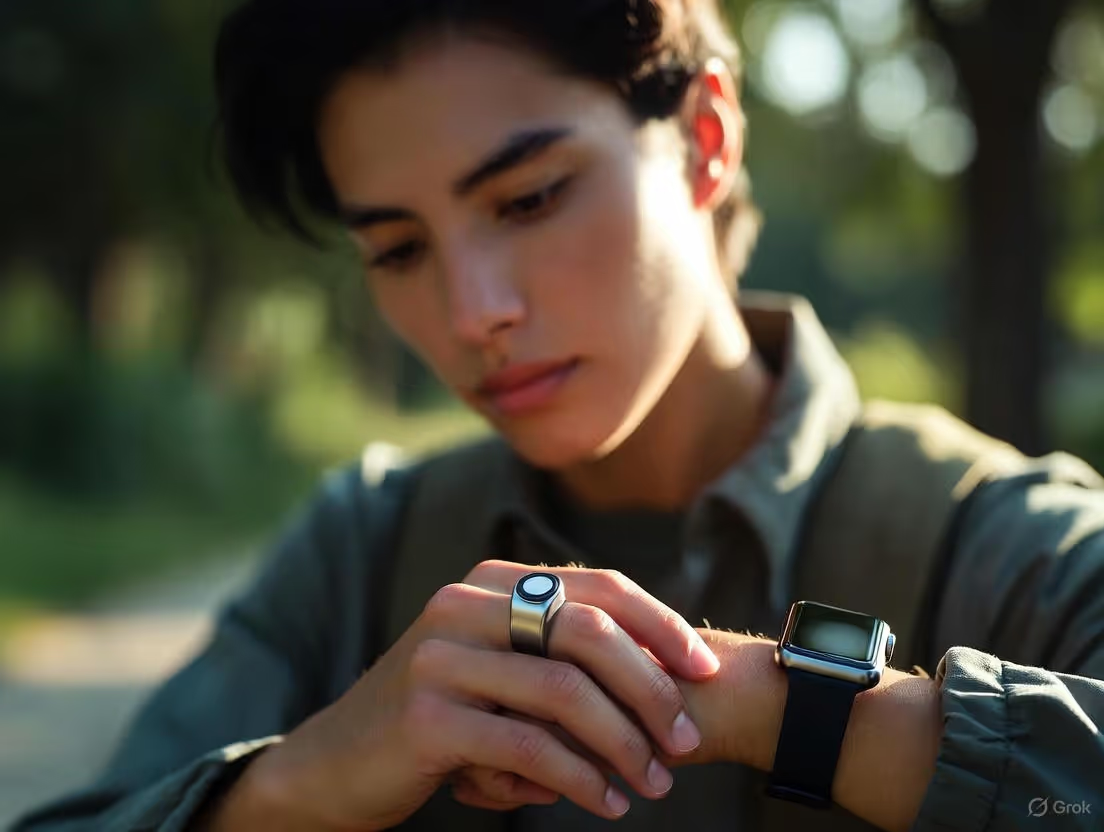
To solve the problem of separate stress tracking, we need a device that is fundamentally better at gathering clean, continuous, and contextually rich data. Enter the smart ring. This unassuming form factor is emerging not as a competitor to the smartwatch, but as its essential complement—and for nervous system and recovery tracking, it is often superior. Its design advantages directly address the core failings of wrist-based wearables.
The Power of the Finger: An Ideal Biometric Site
The finger, specifically the base of the finger, offers unique physiological and practical benefits for advanced sensing:
Multi-Sensor Fusion: Building a Complete Picture
Leading smart rings don't rely on a single sensor. They employ a sensor fusion approach, combining data streams to create a rich, multi-dimensional health portrait:
The Data Advantage: From Snapshots to a Motion Picture
A smartwatch you take off to charge becomes a device of snapshots. A smart ring you wear continuously creates a high-fidelity motion picture of your physiology. This longitudinal data is priceless. It allows algorithms to learn your personal baselines with incredible precision. Instead of comparing you to population averages, the system can detect meaningful deviations from your own normal.
For instance, it can establish your unique nighttime temperature nadir and your typical deep sleep percentage. When it sees your temperature elevated by 0.5°C for three nights and your deep sleep plummeting—even if your step count is normal—it can flag a potential systemic stressor (like an impending illness or emotional overload) long before you feel symptoms.
This continuous, clean data from an optimal anatomical position is the non-negotiable raw material needed for the next step: using artificial intelligence to perform the delicate task of separating the emotional signal from the physical noise. It is the bedrock upon which personalized well-being is built. To see how this technology translates into real-world benefits, explore the experiences of early adopters on our testimonials page.
Raw biometrics are just numbers. A heart rate of 72 bpm or an HRV of 45ms, in isolation, are meaningless. Their power is unlocked only through interpretation—through understanding the story they tell together, in context. This is where Artificial Intelligence (AI) and machine learning perform a feat impossible for simple algorithms or human intuition alone: they act as your personal, 24/7 biostatician, meticulously disentangling the intertwined threads of emotional and physical stress.
Moving Beyond Rules to Relationships
Traditional wearables use rule-based algorithms: "IF HRV is low for X minutes, THEN stress score is high." AI models, trained on vast, anonymized datasets, work differently. They don't follow preset rules; they recognize complex, non-linear patterns and relationships between multiple data streams over time.
Imagine training an AI with millions of data points from thousands of users, where each data point is labeled with context (e.g., "user was sleeping," "user was in a meditation session," "user was running," "user reported feeling anxious"). The model learns that:
Contextual Awareness: The Key to Differentiation
The AI's real genius is its growing contextual awareness. It synthesizes:
With this multidimensional view, the AI can make a probabilistic assessment: "There is an 92% likelihood that the physiological arousal detected between 10:15 AM and 10:30 AM was caused by emotional/cognitive stress, based on the concurrent EDA spikes, sedentary state, and HRV pattern."
From Reactive to Predictive Insights
This separation enables a shift from reactive to proactive well-being management.
This is the promise of AI-powered separate tracking: it doesn't just report the weather inside your body; it tells you what's causing the storm and whether you need to batten down the hatches or simply wait for it to pass. It turns data into dialogue. The team behind this intelligent approach is driven by a core mission, which you can learn about on our about us page.

With the technological foundation in place, let's translate this into your daily practice. Imagine opening your wellness app to an Emotional Stress Dashboard—a dedicated interface that tracks the load on your nervous system and psychological well-being, separate from your physical exertions. This dashboard focuses on metrics that speak the language of your mind-body connection. Here’s how to read its core gauges:
1. Heart Rate Variability (HRV) Balance & Trends
* What it is: Your HRV baseline and its daily fluctuations. Don't fixate on a single number; observe the trend over weeks and months and daily deviations.
* How to Interpret:
* A rising trendline suggests improving autonomic nervous system resilience and better emotional stress tolerance.
* A sharp, acute dip on a given day flags a significant emotional or physical stress event. The context (were you sick? did you have a conflict?) helps identify which.
* A chronically low, flat HRV is a major warning sign of sustained emotional stress or burnout. It indicates your nervous system is stuck in "fight-or-flight" and has lost its flexibility.
* Actionable Insight: Protect time for activities that boost HRV: deep, rhythmic breathing, meditation, gratitude practice, and genuine social connection. If you see a chronic low trend, it's a non-negotiable signal to audit and reduce life stressors.
2. Electrodermal Activity (EDA) Responses & Moments
* What it is: Logs of when your sympathetic nervous system sparked significantly while you were at rest or engaged in low-physical-stress activities.
* How to Interpret: Review your "EDA Moments" log. Were there clusters during your work meetings? While scrolling social media? During a difficult conversation? This is direct, objective feedback on what triggers your emotional stress response.
* Actionable Insight: Use this as a behavioral audit. Identify patterns and triggers. It provides concrete evidence to support changes, like implementing a "no phones during deep work" rule or preparing calming techniques before known trigger events.
3. Sleep Quality Breakdown (The Emotional Filter)
* What it is: Beyond total hours, focus on Sleep Latency (time to fall asleep) and REM Sleep.
* How to Interpret:
* Prolonged sleep latency is often the clearest sign of an overactive, anxious mind at bedtime.
* An increase in REM sleep percentage or density can indicate your brain is working overtime to process emotional experiences, which may lead to feeling less restored.
* Actionable Insight: A high emotional stress day will often degrade that night's sleep. Use this correlation. If your dashboard shows high daytime emotional load, double down on a strict, calming sleep hygiene routine to help your nervous system downshift.
4. Resting Heart Rate (RHR) Relative to Baseline
* What it is: How your waking, calm heart rate compares to your established personal baseline.
* How to Interpret: A resting heart rate elevated by 5-10+ bpm for several days, in the absence of heavy exercise or illness, is a strong physiological indicator of systemic emotional stress.
* Actionable Insight: Treat a sustained RHR elevation like a check-engine light. It's time for proactive recovery: prioritize relaxation, ensure you're hydrated and nourished, and consider scaling back on demanding cognitive tasks.
5. Respiratory Rate at Rest
* What it is: The number of breaths per minute during periods of inactivity.
* How to Interpret: A resting respiratory rate that is high (e.g., >17-20 bpm) or erratic can signal underlying anxiety or stress. A calm, low rate (e.g., 10-14 bpm) suggests nervous system equilibrium.
* Actionable Insight: Use this metric as real-time biofeedback. If you notice it creeping up during the day, pause for one minute of deliberate, slow diaphragmatic breathing to manually reset it.
By regularly consulting this dedicated dashboard, you train yourself to recognize the physiological fingerprint of your emotional state. You move from saying "I feel off" to understanding how you are off: "My nervous system is showing signs of overload, and my sleep was disrupted by emotional processing." This precise awareness is the first and most critical step toward targeted management. For more resources on building emotional resilience, our blog is regularly updated with science-backed strategies.
Now, let's turn to the other side of the equation: your Physical Stress Dashboard. This interface is your personal coach and recovery specialist, focused on the measurable load on your musculoskeletal, cardiovascular, and metabolic systems. It answers questions like: "Did I train effectively?" "Am I recovering properly?" and "Is my body fighting something?" Here’s how to navigate its key indicators:
1. Acute and Chronic Training Load
* What it is: This is often expressed as a ratio (e.g., Acute:Chronic Workload Ratio). Your acute load is the strain from recent activities (last 7 days), while your chronic load represents your longer-term fitness baseline (last 28 days).
* How to Interpret: The ratio between the two is crucial. A sweet spot (often ~0.8-1.3) suggests you're building fitness effectively with managed risk. A spike (e.g., >1.5) means you've significantly ramped up activity recently, increasing injury risk. A low ratio (<0.5) might indicate detraining or insufficient stimulus.
* Actionable Insight: Use this to plan your week. After a high-acute-load week (like a vacation hike-fest), plan a "deload" week with lower activity to let your chronic load catch up and mitigate injury risk.
2. Heart Rate Recovery (HRR)
* What it is: How many beats per minute your heart rate drops in the first minute after peak exertion.
* How to Interpret: A faster drop (e.g., a decrease of 25+ bpm in the first minute) indicates good cardiovascular fitness and positive recovery. A sluggish HRR that worsens over time is a classic, objective sign of physical overtraining or cumulative fatigue.
* Actionable Insight: Monitor HRR trends from similar workouts. If your HRR after your standard 5k run is getting slower, your body is asking for more recovery time or a reduction in intensity.
3. Nighttime Skin Temperature Trends
* What it is: Your core body temperature's pattern during sleep, when it should naturally dip to its lowest point.
* How to Interpret:
* A sustained elevation (>0.5°C above your baseline) across the night is a powerful early signal of physical strain from illness, intense inflammation, or severe overtraining. It often appears before other symptoms.
* For women, tracking this can also illuminate menstrual cycle phases and related inflammation.
* Actionable Insight: An elevated nighttime temperature is a red flag to prioritize rest, hydration, and anti-inflammatory nutrition. It's a clear signal to postpone a hard training session.
4. Activity Strain & Muscle Load
* What it is: A quantification of your activity, broken down by type (aerobic vs. anaerobic), intensity (moderate vs. vigorous minutes), and impact.
* How to Interpret: This dashboard section should clearly show the balance of your movement. Are you only doing low-intensity, steady-state? Are you missing strength training? Is there too much high-impact activity without variety?
* Actionable Insight: Use this to ensure a balanced, periodized training program. It provides objective proof of your workout volume, helping you avoid the "busy but not fit" trap.
5. Sleep Quality Breakdown (The Physical Repair Shop)
* What it is: Here, you focus on Deep (Slow-Wave) Sleep.
* How to Interpret: Deep sleep is when physical repair happens—human growth hormone is released, tissues are rebuilt, and the immune system is strengthened. A reduction in deep sleep percentage or duration, especially after heavy training days, means your body is being robbed of its primary repair time.
* Actionable Insight: If your physical load is high but your deep sleep is low, you are in a recovery deficit. Interventions include: optimizing sleep environment (cool, dark, quiet), avoiding alcohol and heavy meals before bed, and managing evening blue light exposure.
6. Resting Heart Rate (RHR) in a Physical Context
* How to Interpret (Differently): In this dashboard, an elevated RHR is read alongside your training load. If your RHR is up and your activity load has also been very high, it's likely a sign of physical fatigue and required recovery. If your RHR is up but you've been sedentary, it points back to the emotional stress dashboard or potential illness.
By actively engaging with your Physical Stress Dashboard, you transform from someone who "works out" to an athlete managing their own body. You make decisions based on systemic readiness, not just daily motivation. This is the essence of intelligent training and sustainable physical health. For those curious about how a single device can power such detailed dual dashboards, learn more about Oxyzen and its integrated approach.
The true magic happens not when you view these dashboards in isolation, but when you bring their insights together. This synergistic view creates a powerful decision-making framework for your daily life. You stop guessing and start strategically allocating your energy resources. Let’s walk through practical scenarios where separate tracking changes the game.
Scenario 1: The "Should I Work Out?" Dilemma
Scenario 2: Understanding Post-Workout Fatigue
Scenario 3: Optimizing Work & Cognitive Performance
Scenario 4: Preventing Illness & Burnout
This synergy turns your well-being into an intelligently managed ecosystem. You become the CEO of your own health, with two expert department heads (Emotional and Physical) providing clear, separate reports that inform your overarching strategy. The goal is no longer to just "reduce stress," but to orchestrate the right kind of stress at the right time, and facilitate the correct type of recovery.
To solidify these concepts, let's follow "Alex," a knowledge worker who trains for half-marathons, through a week using a system that tracks emotional and physical stress separately. Watch how the data informs nuanced decisions.
Alex's Baselines: Resting HR: 52 bpm. HRV (rmssd): 60ms. Deep Sleep: 1.5 hrs. Night Temp: 35.8°C.
Day 1 (Monday):
Day 2 (Tuesday):
Day 3 (Wednesday):
Day 4 (Thursday):
Day 5 (Friday):
Weekend & Reflection:
Alex uses the weekend for active recovery and social connection. By Sunday night, both dashboards are back at or above baseline levels. The week was demanding, but by responding to the separate signals, Alex:
This case study illustrates the move from brute-force wellness to elegant, data-informed self-regulation. It’s the difference between driving with a blindfold on and having a detailed GPS and engine diagnostic system. For real-world stories of this transition, the experiences shared on our testimonials page provide powerful validation.
Technology provides the objective signal, but the final, crucial step is bridging that data with your subjective reality. Your smart ring and its AI are powerful detectives, but you are the expert on the case of your own life. The highest level of separate stress mastery involves becoming a skilled self-researcher, conducting behavioral audits to find the personal lifestyle correlations that no algorithm can deduce on its own.
The Practice of Conscious Correlation
This is a simple but transformative habit. When your dashboard flags a notable event—a severe HRV dip, a cluster of EDA spikes, a poor sleep score—pause and ask: "What was happening in my life around this time?"
Don't just think in broad strokes ("work was busy"). Get specific. Maintain a simple notes section in your app or a journal. Correlate your data with:
Building Your Personal Playbook
Over weeks and months, patterns will emerge that are uniquely yours. You will build a Personal Playbook for managing your dual stress loads:
The Subjective-Objective Feedback Loop
This is where true transformation occurs. You start to notice how feelings align with data. You might feel anxious and check your dashboard to see a low HRV—validation. More powerfully, you might feel fine but see a depressed HRV trend, prompting you to investigate hidden stressors you had normalized.
This feedback loop refines your self-awareness to a remarkable degree. You begin to make choices not based on fleeting feelings or societal "shoulds," but on a deep, evidence-based understanding of what your unique organism needs to thrive. It turns wellness from a set of generic rules into a personalized, dynamic art form.
The journey to this level of self-knowledge is at the heart of what we believe in. It's more than selling a device; it's about empowering a practice. To understand the philosophy behind this empowering technology, you can read about the vision and values that guide us on our story page.
We have now equipped ourselves with the knowledge to separate emotional from physical stress and the technology to track them distinctly. But data collection is not the end goal; it is the beginning of a transformative practice. This journey leads us to the most powerful application of separate stress tracking: creating a virtuous feedback loop between mind and body. By using your distinct dashboards as a guide, you can implement targeted interventions that not only manage stress but actively build resilience, turning your insights into lasting physiological and psychological change.
From Awareness to Agency: The Intervention Framework
The core principle is simple: Match the intervention to the stress type. Throwing generic "wellness" strategies at a mixed signal is inefficient. Precision yields power.
Building Your Emotional Resilience Toolkit
When your Emotional Dashboard indicates overload, these are not "soft" options; they are direct, physiological resets for your autonomic nervous system.
Building Your Physical Recovery Toolkit
When your Physical Dashboard shows strain, your goal is to support the body's repair processes, not add more nervous system load.
The Synergistic "Prime and Recover" Cycle
The most advanced application is cycling these toolkits to prime for challenge and accelerate recovery. For example:
By consciously applying the right tool to the right stress type, you stop wasting energy and start building specific forms of capital: nervous system resilience and physical robustness. This is the essence of biohacking—using data to make precise, effective adjustments to your own biology. For a deeper exploration of specific recovery protocols and biohacks, our continually updated resource hub at https://oxyzen.ai/blog is an excellent place to dive in.
Despite our best efforts to separate them, human experience is often a tangled web. There are conditions and life circumstances where emotional and physical stress are so fundamentally intertwined that attempting to distinguish them in the moment is not just difficult—it's beside the point. The wisdom of separate tracking in these scenarios shifts from "which is which?" to "how does this interplay manifest, and what is the holistic path through?"
Chronic Pain and Illness
This is the quintessential gray area. Chronic pain conditions (e.g., fibromyalgia, lower back pain, migraines) and chronic illnesses (e.g., autoimmune disorders, long COVID) create a vicious, self-perpetuating cycle.
Burnout and Overtraining Syndrome
Burnout (primarily emotional/mental) and Overtraining Syndrome (primarily physical) are close cousins, and advanced states of either look almost identical physiologically.
Major Life Events: Grief, Parenthood, Career Change
Events like losing a loved one, having a newborn, or a demanding career transition apply total human stress. They are existential, affecting every layer of your being.
In these gray areas, separate tracking evolves from a diagnostic scalpel into a monitoring system for your entire ecosystem. It tells you the system is under total load and helps you observe, with curiosity rather than judgment, how different holistic supports affect the whole. It underscores that we are not machines with separate compartments, but integrated organisms where mind and body are in constant, profound dialogue. Understanding this complex dialogue is central to our mission at Oxyzen; you can read more about our human-centric approach on our about us page.
We stand at the precipice of a revolution in personal health. The separate tracking of emotional and physical stress is not the culmination, but the foundational dataset for what comes next: a shift from reactive and even descriptive health monitoring to truly predictive and proactive well-being systems. This is where the long-term value of your granular, dual-pathway data becomes astronomical.
From "What Happened" to "What Will Happen"
Current wearables tell you, "You had a stressful day yesterday," or "Your recovery is poor today." Predictive analytics, powered by the rich historical dataset of your separate stress trends, will begin to forecast:
The Role of Separate Data in Prediction
Why is separating emotional and physical stress so critical for these models? Because the predictors are different.
A single "stress score" lacks the resolution to power these distinct predictive algorithms. Separate, clean data streams are the essential fuel.
Personalized, Dynamic Recommendations
The ultimate goal is a closed-loop system: the device not only predicts but also prescribes hyper-personalized actions.
The Ethical and Human Framework
This future is incredibly empowering but must be navigated with care. The role of technology is not to become an authoritarian health director, but a clairvoyant advisor. The final decision must always rest with the human, informed by data but guided by intuition and lived experience. The goal is augmentation, not replacement, of self-knowledge.
We are building towards this future—a future where your wearable doesn't just track your life, but actively helps you design a healthier, more resilient one. It learns the unique language of your body and mind, anticipates storms on your horizon, and helps you build the right shelter. This proactive partnership is the logical endpoint of the journey we began by simply learning to tell our stressors apart. For those intrigued by the cutting edge of this technology and its ethical development, the narrative of our story details our commitment to this responsible future.
Understanding the theory is one thing; integrating it into your life is another. This 30-day protocol is designed to help you move from conceptual knowledge to embodied practice. You will establish baselines, form new awareness habits, and begin making your first data-informed decisions. No need for perfection—just consistent curiosity.
Days 1-7: The Baseline & Observation Week
Days 8-14: The Correlation & Curiosity Week
Days 15-21: The Experimentation Week
Days 22-30: The Integration & Decision Week
Essential Mindset Tips for the Journey:
This 30-day protocol builds the muscle of dual-awareness. It transforms separate stress tracking from a technological feature into a living, breathing practice of self-relationship. By the end, you will have begun the most important journey: the one towards becoming the world's leading expert on you. If you have questions during your start-up phase, our comprehensive FAQ is a great place to find straightforward answers and troubleshooting tips.
We have journeyed through the physiology, the technology, and the practical application of a simple yet radical idea: that not all stress is created equal. By learning to distinguish between the strain that builds our bodies and the strain that depletes our spirits, we unlock a new paradigm of self-care—one rooted in precision, compassion, and profound self-knowledge.
The path to separate tracking illuminates a fundamental truth: we are not at war with stress itself. We are in a complex negotiation with it. Physical stress, when dosed and recovered from intelligently, is the architect of strength, endurance, and vitality. Emotional stress, when acknowledged, processed, and met with resilience-building practices, can be the catalyst for growth, empathy, and depth of character. The enemy is not stress, but confusion—the chronic, muddy state where the two are entangled, leading us to treat a weary mind with more physical punishment or a recovering body with cognitive overload.
The tools we've explored—from the advanced biometrics of a smart ring to the AI that interprets its signals, from the dual dashboards to the behavioral audits—are all in service of ending that confusion. They provide a language for the silent conversations happening within us. Your elevated heart rate is no longer just a number; it is a sentence, and now you can understand its grammar. Is it saying, "I am repairing muscle," or is it whispering, "I am afraid"?
This knowledge is inherently empowering. It moves you from a passive recipient of life's pressures to an active author of your response. You gain agency. You can look at your data after a difficult day and say, "My nervous system took a hit, but my body is strong. I will choose a walk in the park over a punishing workout." Or after a great training session: "My muscles are fatigued, but my mind is calm. I will fuel my recovery and protect my sleep."
As we conclude this foundational portion of our exploration, remember that this is not about achieving a state of perpetual, data-verified calm. That is neither possible nor desirable. It is about cultivating discernment. It is about building a more intelligent, responsive, and resilient partnership between your mind and your body.
The ultimate goal is integration. By honoring the dichotomy, we move toward a more unified life—where we can push our physical limits without breaking our spirit, and care for our emotional hearts without neglecting our physical vessel. We learn to dance with stress, listening to its different rhythms, so we can move through life not just with more data, but with more grace, vitality, and peace. This is the promise of mastering the separate languages of your being.
Your Trusted Sleep Advocate: Sleep Foundation — https://www.sleepfoundation.org
Discover a digital archive of scholarly articles: NIH — https://www.ncbi.nlm.nih.gov/
39 million citations for biomedical literature :PubMed — https://pubmed.ncbi.nlm.nih.gov/
Experts at Harvard Health Publishing covering a variety of health topics — https://www.health.harvard.edu/blog/
Every life deserves world class care :Cleveland Clinic - https://my.clevelandclinic.org/health
Wearable technology and the future of predictive health monitoring :MIT Technology Review — https://www.technologyreview.com/
Dedicated to the well-being of all people and guided by science :World Health Organization — https://www.who.int/news-room/
Psychological science and knowledge to benefit society and improve lives. :APA — https://www.apa.org/monitor/
Cutting-edge insights on human longevity and peak performance:
Lifespan Research — https://www.lifespan.io/
Global authority on exercise physiology, sports performance, and human recovery:
American College of Sports Medicine — https://www.acsm.org/
Neuroscience-driven guidance for better focus, sleep, and mental clarity:
Stanford Human Performance Lab — https://humanperformance.stanford.edu/
Evidence-based psychology and mind–body wellness resources:
Mayo Clinic — https://www.mayoclinic.org/healthy-lifestyle/
Data-backed research on emotional wellbeing, stress biology, and resilience:
American Institute of Stress — https://www.stress.org/


