


How to Use Stress Tracking to Improve Time Management
Use stress data to identify when you are most overwhelmed and adjust your schedule, delegate tasks, or build in more breaks.
Use stress data to identify when you are most overwhelmed and adjust your schedule, delegate tasks, or build in more breaks.
%402x.svg)
It starts as a whisper in the morning—a low-grade hum of anxiety as you scan your overflowing calendar. It crescendos into a frantic midday scramble, a desperate race against a clock that seems to tick faster with each passing hour. By evening, you’re exhausted, yet you can’t pinpoint exactly what you’ve accomplished. The to-do list remains, and a fog of stress has settled in, making the prospect of tomorrow feel overwhelming. This is the modern professional’s paradox: we have more time-saving tools than any generation in history, yet we feel more time-poor and stressed than ever before.
What if we’ve been solving for the wrong variable? For decades, time management gurus have prescribed endless techniques: Pomodoro timers, elaborate priority matrices, and digital detoxes. We meticulously track hours and minutes, color-code our schedules, and attempt to bend our willpower to the relentless demands of productivity. Yet, a critical piece of the puzzle has been glowing quietly on our own hands, overlooked in plain sight: our physiological stress.
Emerging research from neuroscience and performance psychology reveals a profound truth: stress isn’t just a byproduct of poor time management; it is the primary architect of it. When your nervous system is in a heightened state of stress, your prefrontal cortex—the brain's CEO responsible for planning, decision-making, and focus—goes partially offline. You become reactive, distracted, and prone to poor judgments about how to spend your most precious resource: time. You might think you're managing your calendar, but in a stressed state, your biology is managing you.
This article introduces a revolutionary, data-driven approach. By flipping the script and starting with the deep, biometric tracking of your stress, you can engineer a time management system that works in harmony with your biology, not against it. This isn't about squeezing more tasks into your day; it’s about transforming the quality of your attention, energy, and decision-making so that you accomplish what matters with less friction and more fulfillment. We will explore how cutting-edge wearable technology, like the advanced smart rings from innovators such as Oxyzen, provides the missing link—a continuous, objective stream of data revealing your body's true capacity moment by moment.
The journey from time-stressed to time-empowered begins not with a new planner, but with a new understanding of yourself.

We’ve all been sold a compelling, yet fundamentally flawed, narrative. The story goes that if you just find the perfect system—be it Getting Things Done, time-blocking, or the latest app—and muster enough discipline, you will finally conquer your to-do list and achieve a state of calm, controlled productivity. Bookstores have entire sections dedicated to this promise. Yet, why do so many of us, after investing in countless planners and seminars, find ourselves back in the familiar cycle of overwhelm?
The problem lies in the foundational assumption. Traditional time management treats time as a purely external, mathematical resource to be divided and allocated. It operates on a industrial-era model of human output, assuming that eight hours of scheduled work equals eight hours of productive work. This model completely ignores the internal, biological landscape of the person executing the schedule. It fails to account for the cognitive toll of context-switching, the energy drain of unresolved anxiety, or the simple fact that a person’s mental bandwidth fluctuates dramatically throughout the day and week based on stress, sleep, and recovery.
The Willpower Fallacy: Exerting strict control over your schedule requires significant cognitive resources. When you are stressed, those very resources are depleted. Dr. Roy Baumeister’s seminal research on “ego depletion” illustrates that willpower is a finite resource that drains throughout the day. Trying to force focus when your stress biomarkers are high is like trying to drive a car with an empty gas tank while stomping on the accelerator. You might lurch forward for a moment, but you’ll quickly stall, often with negative consequences for your engine (your health).
The Planning Fallacy: Coined by psychologists Daniel Kahneman and Amos Tversky, this is our universal tendency to underestimate how long a task will take, even when we have experience with similar tasks. In a calm state, we might make a reasonable estimate. Under stress, this bias becomes catastrophic. Anxious, rushed thinking leads to hopelessly optimistic schedules, setting us up for failure, shame, and more stress—a vicious cycle that obliterates any carefully crafted plan.
This is where the paradigm must shift. Effective time management in the 21st century cannot be a top-down, calendar-centric imposition. It must be a bottom-up, human-centric practice. It begins with listening to the signals your body is constantly sending about its readiness, focus, and limits. Before you can manage your time, you must first manage your state. And to manage your state, you need objective data. This is the core promise of bio-informed productivity, a method powered by the continuous physiological insights provided by devices like the Oxyzen smart ring, which you can explore in detail here.
To use stress as a tool, we must first move beyond the vague, emotional concept of "feeling stressed." In the realm of biometric tracking, stress is not a mood; it’s a precise, measurable physiological state with clear biomarkers. Think of it as your body’s internal dashboard, with warning lights and gauges we’ve only recently learned to read.
At its core, stress is the body's nonspecific response to any demand placed upon it, known as a "stressor." This triggers the Hypothalamic-Pituitary-Adrenal (HPA) axis, culminating in the release of hormones like cortisol and adrenaline. This is the famous "fight-or-flight" response, a brilliant survival mechanism for acute threats. In our modern world, however, the "threats" are rarely physical. They are relentless: an incessant stream of emails, looming deadlines, financial pressures, and social comparisons. The result is that our stress response is chronically activated, becoming a constant, low-grade background hum rather than a short, sharp alarm.
Key Biomarkers of Stress:
A smart ring like Oxyzen’s model is uniquely positioned to track these metrics seamlessly. Worn on the finger, where pulse oximetry readings are highly accurate, it provides 24/7 insights into this physiological dashboard without the obtrusiveness of a chest strap or wristband. You can learn more about the science behind this technology on our blog. This data transforms stress from an abstract feeling into a quantifiable, manageable variable. You no longer have to guess if you’re "run down"; the data will show a depressed HRV and elevated RHR. You don't just "feel off"; you can see the disrupted sleep graph that explains why. This is the foundational knowledge required to move from being a victim of your stress to becoming an observer and, ultimately, a master of it.

Have you ever noticed that time seems to warp under pressure? An hour in a relaxing bath flies by, while sixty seconds held in a plank position feels like an eternity. This isn't just your imagination; it's a documented neurological phenomenon that stress directly manipulates, with disastrous consequences for how we manage our days.
When your body enters a stressed state, the amygdala (the brain's fear center) becomes hyperactive. To ensure survival, it commandeers resources, effectively dampening activity in the prefrontal cortex (PFC), our center for rational thought, planning, and time perception. Simultaneously, it heightens activity in the insular cortex, which processes visceral sensations and internal body states. The result is a profound shift in consciousness.
You become trapped in "The Eternal Now." Stressed perception is characterized by a shortened time horizon. Your brain, focused on immediate survival, loses its ability to calmly project into the future or learn from the past. This is why, when you're anxious about a deadline, you can't seem to think past the next hour. Long-term projects feel abstract and paralyzing. This state breeds two catastrophic time-management behaviors:
This cycle is self-perpetuating. Poor time management (procrastination, reactive work) leads to missed deadlines and growing task lists, which causes more stress. That stress further warps time perception and impairs executive function, leading to even worse time management. Breaking this cycle requires an external intervention—a source of objective data that can alert you before you are fully sucked into the vortex. By tracking your HRV and stress load, you can receive an early warning that your cognitive capacity is diminishing. This is the critical first step in intercepting the stress response before it hijacks your schedule. For many users, this objective feedback is the breakthrough they need, as shared in the real user experiences found in our testimonials.
Armed with your smart ring, the first step is not to change anything, but to simply observe. This one-week baseline period is a critical act of self-discovery. The goal is to move from subjective stories ("I'm always stressed in the mornings") to objective, personalized data. You are conducting a scientific survey of you.
How to Proceed:
What to Look For in Your Baseline Data:
After a week, you will have a goldmine of personalized information. Analyze it with curiosity, not judgment.
This baseline is your personal map. It shows you the swamps of your day (where you get stuck and drained) and the high ground (where you are clear and energized). Without this map, any time management plan is a shot in the dark. With it, you can design a schedule that navigates the terrain of your own biology. This foundational principle of knowing yourself is core to our mission at Oxyzen, which is to provide the clarity needed for meaningful change.

With your baseline map in hand, you can now move from observation to insight. This stage is about pattern recognition—connecting the dots between your internal state (the biometric data) and your external world (your notes). The goal is to crystallize two key lists: your Unique Stress Triggers and your Golden Productivity Zones.
Categorizing Your Stress Triggers:
Not all stress is created equal. Some is productive and short-lived (eustress), like the focused tension before a presentation. Some is toxic and chronic (distress). By analyzing your data spikes alongside your notes, you can classify your triggers:
Discovering Your Golden Productivity Zones:
This is the exciting part. Your data will almost certainly reveal periods where your physiology is primed for high-performance work. These are characterized by high or rising HRV, stable RHR, and a subjective sense of calm focus. Common patterns include:
The revolutionary act is to schedule your most important, cognitively demanding work only during these Golden Zones. Conversely, you schedule low-cognitive, administrative, or reactive tasks for your lower-energy or higher-stress periods. This is the antithesis of forcing work when you "should" be productive. It is the art of aligning task difficulty with biological capacity.
For instance, if your data shows you are consistently stressed and distracted between 10 AM and 12 PM due to office noise and meetings, stop trying to write your important report then. Schedule it for your identified zone, and use the 10 AM slot for meetings or clearing your inbox. This is bio-informed scheduling in action. For more strategies on aligning work with your biology, our blog offers a wealth of related articles.
This is where the magic of live data transforms daily life. A traditional calendar is a static, dumb document. It doesn't know if you slept four hours or eight, if you just had a heated argument, or if you're running on caffeine and adrenaline. A bio-informed schedule, guided by a live data stream, is dynamic and intelligent. It allows you to pivot from a reactive stance ("I'm falling behind!") to a proactive, managerial stance ("My capacity is low right now; I will adjust my plan accordingly").
Implementing the "Stress-Readiness Check":
Before launching into any major task block, develop the habit of a 60-second check-in with your data.
Example in Action: You have a critical strategic document to write at 2 PM. At 1:45 PM, you check your Oxyzen app. You see a significant stress spike from a surprise meeting that ran over and a low recovery score from a poor night's sleep. Instead of forcing yourself to write poorly for two hours, you pivot. You spend 20 minutes doing a breathing exercise and walking outside. You then reschedule the writing for your known clarity window tomorrow morning, and use the remainder of the 2 PM block to tackle the smaller, reactive tasks that piled up from the morning. You have just used data to avoid wasted time and further stress, making a strategic decision to preserve the quality of your important work.
This level of self-awareness and agile adjustment was nearly impossible before the advent of accessible, continuous biometric wearables. It represents a fundamental upgrade to personal productivity. For common questions on implementing these strategies, our comprehensive FAQ page provides detailed support.
In the old productivity paradigm, downtime was wasted time—a gap to be filled. In the bio-informed paradigm, strategic recovery is the most important item on your schedule. It is the non-negotiable investment that refills your cognitive tanks, boosts your HRV, and raises your baseline capacity for everything else. You cannot manage time effectively from a state of chronic depletion.
Your biometric data makes this brutally clear. It shows you the direct correlation between a night of poor recovery and a day of high stress, low focus, and poor time estimation. Therefore, recovery must be planned with the same seriousness as a client meeting.
Types of Strategic Recovery to Schedule:
The "Work-Recovery" Calendar Block: Literally block time in your calendar for these activities. Label them "HRV Boost," "Strategic Recharge," or "Cognitive Maintenance." Treat these blocks as immutable appointments with your future productive self. When you see a week where these blocks are being eroded by meetings, you know you are borrowing capacity from future days and must adjust.
This philosophy is deeply embedded in the vision of holistic wellness technology. It’s about sustainable performance, not burnout. To understand the deeper ethos behind building tools for this kind of balanced living, you can read about our founding story and core values.
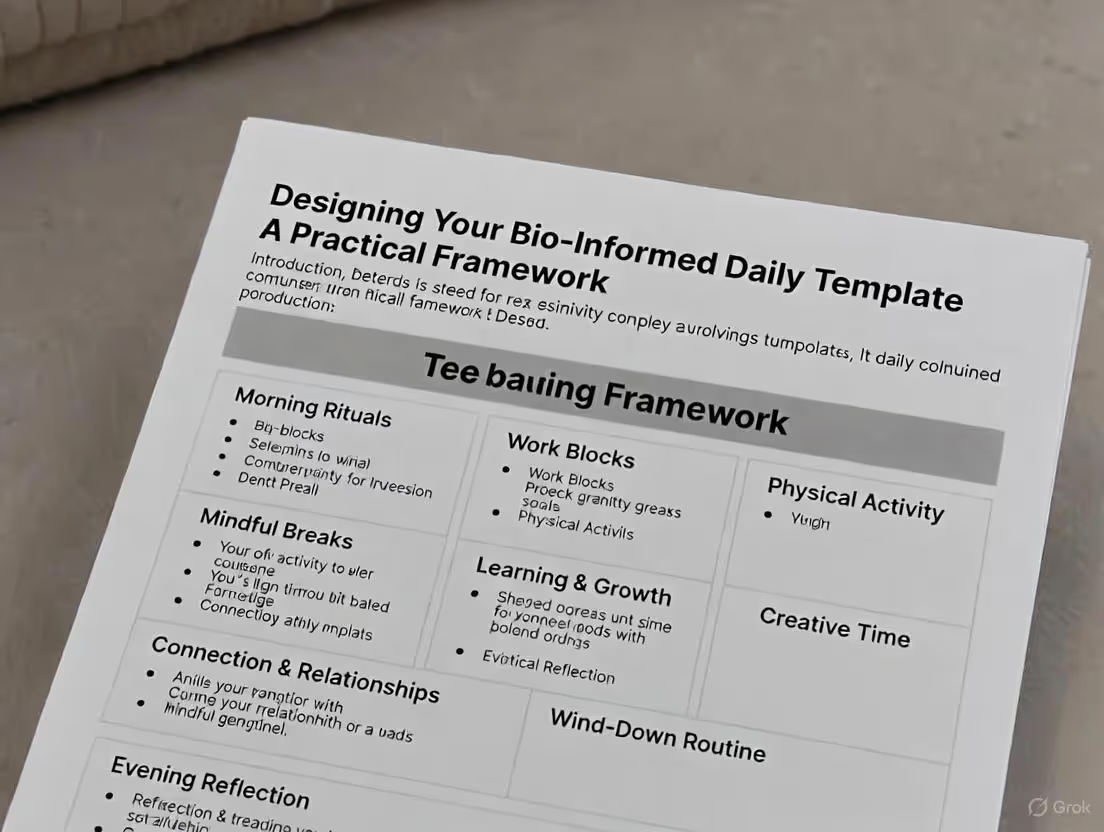
Now we synthesize everything into a practical, repeatable daily structure. This is not a rigid, minute-by-minute schedule, but a flexible template informed by your unique biological rhythm. It prioritizes task alignment over arbitrary time slots.
Step 1: Anchor Your Day in Your Golden Zones.
Look at your baseline data. Identify your 2-3 most reliable high-capacity windows. These become the "keystone" blocks of your template. Label them "Tier 1: Deep Strategic Work." Nothing gets scheduled here except your most important, creative, or complex projects. Defend these blocks ferociously.
Step 2: Allocate Tasks by Cognitive Demand, Not Urgency.
Create a simple tiering system for your work:
Step 3: Schedule Recovery Proactively.
Based on your trigger data, insert Micro-Recovery blocks before predictable stress points (e.g., a 10-minute breathing block before a weekly stressful meeting). Firmly block your Daily Recovery wind-down time in the evening.
Sample Bio-Informed Template:
This template is a starting point to be customized with your personal data. The core principle is intentional alignment, which replaces the default mode of reactive collision.
The final piece of the system is the weekly review. This is your dedicated time to step back from the daily grind and analyze the system itself. The goal is to answer one question: "Was my time spent in alignment with my energy, and did it produce the outcomes I value?"
Your Weekly Review Process (30 minutes):
This weekly audit transforms you from a passive participant in your schedule to an active designer of it. It turns time management into a personal science experiment, where you continuously test hypotheses and refine your approach based on objective feedback. This iterative process is key to building a sustainable, high-performance life, a topic we often explore in depth for those who want to dive deeper into our resources.
Your internal biology exists in an ecosystem. No amount of breathing or rescheduling can fully compensate for a toxic environment or a digital firehose of distractions. Your stress tracking data will now serve as a powerful diagnostic tool to identify and reform these external saboteurs.
The Digital Environment Audit:
Your phone and computer are likely your primary sources of cognitive fragmentation. Use your stress data to run experiments:
The Physical Workspace Audit:
By using your body's data as a guide, you can make evidence-based changes to your environment. This turns vague feelings of being "distracted" or "uncomfortable" into specific, actionable redesigns of your workspace and digital habits. The goal is to craft an external environment that supports your internal state, rather than constantly assaulting it. For communities and individuals passionate about this holistic approach, sharing our story often resonates with the quest for a more intentional relationship with technology.
The ultimate power of continuous stress tracking is revealed not in daily pivots, but in the long-term trend lines viewed over months and seasons. This macro-view enables the most profound shift: from managing your time within a fixed lifestyle to designing a lifestyle that generates more time through enhanced capacity and clarity.
What Long-Term Data Reveals:
This long-view fosters self-compassion and strategic thinking. A bad day is just a data point. A stressful week is a learning opportunity. You stop identifying as a stressed person and start seeing yourself as a complex system that you are learning to optimize. You move from fighting fires to designing a fire-resistant life.
This journey—from time-stressed to biologically-empowered—is a continuous process of learning and refinement. It represents the convergence of ancient wisdom about listening to the body with cutting-edge technology that makes that wisdom quantifiable and actionable. By starting with the foundational truth of your own physiology, you reclaim not just your schedule, but your attention, your energy, and ultimately, your sense of agency over your one precious life. The path forward is clear: track, understand, align, and optimize. Your time—and your peace of mind—depends on it.
The foundational map is drawn. You understand your baseline, your triggers, and your golden zones. You've begun the weekly audit. Now, we move into the realm of high-fidelity execution. This is where we leverage stress data not just to react, but to proactively engineer your days, weeks, and even career trajectory for optimal performance and sustainable well-being. It’s about moving from basic alignment to sophisticated calibration.
Imagine having a personal performance coach who lives in your nervous system, offering real-time, unbiased feedback on every decision about your time. That is the promise of this next phase. We will explore how to use stress data for nuanced task prioritization, boundary setting, collaborative work, and long-term planning. The goal is to make bio-informed decision-making as automatic as checking the weather—a daily habit that informs how you dress (or in this case, how you structure your efforts) for the conditions at hand.
This is not about creating a rigid, joyless system of self-surveillance. It is precisely the opposite. It’s about creating so much clarity and efficiency in your professional life that you reclaim time and energy for the things that bring you joy and meaning outside of it. It’s about working with your nature, not against it, to achieve more with less internal friction. The advanced techniques we’ll cover are the levers you can pull to transform your relationship with work from one of endurance to one of mastery.
The Eisenhower Matrix—sorting tasks by Urgent/Not Urgent and Important/Not Important—is a classic for a reason. But it has a critical blind spot: it assumes the decision-maker has a consistent, calm, and rational mind. It doesn’t account for the biological state of the person doing the prioritizing. A task that is “Important, Not Urgent” in a calm state can feel utterly paralyzing and impossible to approach in a stressed state. This is why to-do lists often fail; we create them in one state of mind and try to execute them in another.
Introducing the Bio-Informed Priority Filter:
Before you even plot a task on the Eisenhower Matrix, run it through this three-question filter informed by your stress data:
Practical Application: Let’s say your list has: A) Finalize quarterly strategy deck (Deep Focus/Creative), B) Reply to 15 client emails (Administrative/Emotional Labor), and C) Plan next week’s team agenda (Administrative).
This dynamic triage ensures you are not just prioritizing tasks logically, but match-fitting them to your physiological capacity. This dramatically increases completion rates and reduces the guilt of “not getting to” important tasks—because you have a data-backed reason for postponing them that actually serves the task’s quality. For more on navigating productivity psychology, our blog features dedicated articles on this topic.
One of the greatest sources of chronic stress and time poverty is porous boundaries. We say “yes” to requests that drain our energy and hijack our schedules, often out of guilt, obligation, or a misplaced sense of availability. Stress data provides something profound in these moments: objective, external validation.
It moves the conversation from the subjective (“I’m too busy” or “I don’t feel like it”) to the objective (“My capacity metrics show I cannot take on another high-cognitive project this week without compromising my existing commitments and health”).
How to Use Data to Defend Your Time:
The beauty of this approach is that it depersonalizes boundary setting. You are not saying “no” to the person; you are saying “yes” to your commitment to sustainable performance and the quality of your work. The data from your Oxyzen ring provides the quiet confidence needed to make these stands, as it’s not just a feeling—it’s a measurement. This principle of empowered self-management is core to the vision shared in our company’s story.
Stress and poor time management are often systemic, not just individual. A team that schedules brainstorming sessions when everyone is post-lunch fatigued, or that has a culture of after-hours communication, creates a collective drag on productivity and morale. Bio-informed principles can be carefully and respectfully scaled to a team level to create a more humane and effective work culture.
Introducing the Concept of "Team Energy Mapping":
This is not about mandating wearable use for all, but about applying general principles of chronobiology and respectful scheduling.
The Role of the Leader: A manager using a smart ring can lead by example and with empathy. If you see your own data crashing on days packed with back-to-back meetings, you can infer your team is experiencing the same. You can then advocate for meeting-free days, shorter default meeting durations (25 or 50 minutes instead of 30 or 60), and mandatory breaks between virtual calls.
This creates a culture where time is respected as the finite, biological resource it is, leading to less burnout, higher engagement, and better output. For teams looking to implement these kinds of wellness-focused practices, sharing insights from our blog’s resources can be a great starting point for discussion.
Cal Newport popularized the term “Deep Work,” defining it as professional activities performed in a state of distraction-free concentration that push your cognitive capabilities to their limit. Your stress data is the ultimate tool for both achieving and optimizing this state. It helps you answer: When am I best capable of deep work? And how do I create conditions to enter it with minimal internal resistance?
The Pre-Deep Work Capacity Check (The Launch Sequence):
This is a ritualized 5-minute process before entering a Deep Work block.
During the Deep Work Block – Using Micro-Data:
Even with the best prep, focus can waver. Instead of fighting it, use short, mindful breaks.
Post-Deep Work Recovery Ritual:
Deep work is cognitively expensive. Your data will likely show a stress spike or dip afterwards—this is normal, like the fatigue after a good workout. Have a planned recovery ritual: a short walk, a glass of water, a few minutes of stretching. This helps your nervous system transition out of intense focus and begins the recovery process, preventing a cumulative drain. Documenting what works best for you in these transitions contributes to a powerful personal knowledge base, something we encourage all users to develop, as discussed in our FAQs on optimizing device use.
The space between scheduled blocks is where days are often won or lost. The unplanned, chaotic transition—rushing from a deep work session straight into a meeting, checking your phone during a bathroom break, or ruminating on a work problem as you try to start family time—creates “stress spillover.” This contaminates your next activity, forcing you to waste the first 10-15 minutes just calming down and reorienting. Your stress graph will show these as jagged spikes and failed recovery.
Intentional transitions are the shock absorbers of your day. They are short, deliberate rituals that help your brain and body definitively conclude one context and prepare for the next.
Designing Effective Transitions:
By mastering transitions, you create clean psychological boundaries between the domains of your life. This prevents the stress of work from poisoning your personal life and vice-versa, leading to higher quality engagement in both. The result, as seen in many user testimonials, is not just better productivity, but a greater sense of presence and peace.
When you track your stress and recovery over time, you gain the ability to see your energy and focus as a finite weekly “budget,” similar to a financial budget. This “Capacity Budget” is a revolutionary tool for proactive planning and realistic negotiation.
How to Calculate Your Weekly Capacity Budget:
Using the Budget for Negotiation and Planning:
This approach brings a sobering, empowering realism to your planning. It moves you from hopeful guessing to strategic resource allocation. It’s a testament to the power of knowing yourself, a principle that guides everything we do at Oxyzen.
All the scheduling techniques in the world will fail if your fundamental biological hardware—your body—is under-fueled, deconditioned, or sleep-deprived. Stress tracking provides direct, personal feedback on how these pillars of health impact your cognitive performance and time management capabilities. It turns abstract health advice (“get good sleep”) into a personalized experiment with clear, measurable outcomes.
1. Sleep: The Non-Negotiable Foundation
Your sleep data (HRV during sleep, resting heart rate, sleep stages, disturbances) is the most direct report card on your recovery.
2. Nutrition: Fueling for Stable Energy
Blood sugar crashes are a major, yet stealthy, source of afternoon stress and cognitive fog.
3. Exercise: The Stress Inoculator
Exercise is a paradoxical stressor (eustress) that, when applied correctly, builds resilience to psychological stress.
This pillar is about using your body’s signals to build the strongest possible foundation for everything else. When your hardware is optimized, the software (your schedules and systems) runs flawlessly. For ongoing insights into the interplay of lifestyle and biometrics, our blog is continually updated with new research and tips.
After several months of successful bio-informed scheduling, you may hit a plateau. The initial dramatic improvements level off. You might even experience “data blindness”—where you stop noticing the insights because the practice has become routine. This is a natural part of the journey, not a failure. It signals the need to move from a focus on fundamentals to a mindset of continuous, iterative refinement.
Strategies to Re-Engage and Advance:
This iterative process ensures your practice evolves with you. It prevents it from becoming another rigid system to rebel against and instead keeps it a living, responsive tool for growth. The journey of self-optimization is never finished, and embracing that is key, a sentiment echoed in the ongoing development of our own technology and community.
The ultimate test of mastery is the ability to teach and guide others. As you embody these principles, you naturally begin to lead differently—whether you manage a team, collaborate with peers, or even within your family. You move from simply managing tasks and time to cultivating environments and relationships that foster sustainable high performance in others.
Key Leadership Shifts:
By leading in this way, you create a ripple effect. You build teams that are not just productive, but resilient, innovative, and loyal. You demonstrate that human sustainability is the most critical business metric of all. This philosophy of holistic, humane performance is what drives our mission, as you can read in our detailed company narrative.
We have journeyed from the foundational act of establishing a baseline to the advanced practices of budgeting capacity, engineering deep work, and leading with biological intelligence. You now possess a comprehensive toolkit:
The integration of these tools is where the transformation becomes lifestyle. It stops being something you “do” and starts being how you “are” in the world. You will find yourself automatically checking in with your energy before committing. You will feel a sense of calm authority when defending your focus time. You will experience the deep satisfaction of completing meaningful work in a state of flow, not frenzy.
The promise of using stress tracking to improve time management is not merely about getting more done. It is about redefining what “doing” means. It means accomplishing what matters with precision and calm. It means ending your days with energy left for your life, not drained by your work. It means building a career and a life that are sustainable, fulfilling, and resilient for the long term.
This journey is a profound investment in your most valuable asset: yourself. The data is merely the mirror, reflecting back the truth of your physiology so you can make choices in alignment with it. The power has always been within you; the technology simply helps you listen. To see how others have begun this transformative journey, you can explore the real-world experiences shared by our community.
You have mastered the individual application of bio-informed principles. You navigate your days with the precision of a pilot reading an advanced cockpit, your biometrics providing real-time feedback on altitude, fuel, and atmospheric conditions. But what lies on the horizon? The integration of physiological data with the modern world is accelerating, opening frontiers that move beyond personal insight into the realms of predictive analytics, environmental intelligence, and true systemic harmony.
This final portion of our exploration ventures into the emerging future. We examine how artificial intelligence, when ethically guided by human well-being data, can transition from being a source of distraction and stress to becoming a true cognitive partner. We’ll explore the concept of a fully adaptive, “living” schedule that breathes in sync with your nervous system. Finally, we’ll ascend to the highest level of integration: using the long-term trends of your stress and recovery data as a compass for life design—guiding career choices, major life decisions, and your ultimate legacy of sustainable performance.
This is not science fiction. The foundational technology exists today in smart rings like Oxyzen. The future we describe is the logical, inevitable next step in the human quest for self-understanding and optimization. It’s a future where technology doesn’t demand more of our attention, but instead protects it. Where our environments don’t assault our senses, but support our focus. Where our societies begin to value and measure well-being as a core indicator of prosperity.
Today’s AI is context-blind to our internal state. It can schedule a meeting at any open slot, regardless of whether that slot is your biological prime time or a necessary recovery period. It floods you with notifications based on its priorities, not your capacity. The next evolution is Stress-Aware or Capacity-Conscious AI—an intelligence that incorporates your real-time and historical biometric data to make decisions on your behalf that support, rather than sabotage, your cognitive performance.
Imagine an AI Assistant that:
This AI acts as an externalized, hyper-rational prefrontal cortex. It uses objective data to help you execute the intentions you set when you were calm and rational, protecting you from the poor decisions you might make under stress. The development of such empathetic technology is a core part of the vision for the future of wellness tech, a journey you can learn more about in our company’s forward-looking story.
Reactive pivoting is powerful. But what if you could predict your high-performance days and plan your most demanding projects accordingly? By analyzing long-term data trends—sleep consistency, weekly stress load, seasonal patterns, menstrual cycle phases (for those who menstruate), and training cycles—advanced algorithms can begin to forecast your capacity.
The Capacity Forecast Model:
Practical Application: A consultant sees their forecast shows a “High Capacity” week in three weeks’ time. They proactively block that week for writing a major proposal and decline other meetings. They see a “Low Capacity” week following a busy travel period and pre-schedule that week for catch-up admin and client check-ins, not new deliverables. This moves planning from a guessing game to a strategic deployment of your personal resources.
This predictive power transforms annual and quarterly planning. You can map out major deliverables to align with your predicted high-capacity seasons, creating a natural rhythm of challenge and recovery that maximizes output and minimizes burnout. For insights on how data trends influence personal planning, our blog often explores these cutting-edge concepts.
Our environment is a constant conversation with our nervous system. Harsh lighting, noise pollution, poor ergonomics, and stale air are silent, chronic stressors. The future lies in making our environments responsive—creating a “Quantified Workspace” that adapts to support our state.
Bio-Responsive Environmental Adjustments:
The goal is to create an ambient, supportive layer of technology that removes friction and environmental stress without requiring conscious effort. Your workspace becomes an extension of your self-care protocol, actively participating in your performance. This seamless integration of wellness and environment is a key area of interest, as discussed in our FAQs about the holistic use of data.
As this technology proliferates, profound social and ethical questions emerge. Sharing biometric data, even passively, within teams, families, or with employers carries both promise and peril.
The Promise – Empathetic Coordination:
The Peril – Surveillance and Pressure:
The ethical line is stark. This data must never be used for performance punishment, mandatory monitoring, or to deny opportunities. The principles must be:
The development of these ethical frameworks is as important as the technology itself. It’s about building a culture of trust and empowerment, not control. At Oxyzen, we believe in transparency about our mission and values to ensure technology serves human flourishing, not the other way around.
This is the zenith of the practice. After years of tracking, you are no longer just managing weeks; you are designing a life. Your long-term stress and recovery trends become your most trusted compass for major decisions. They answer the deepest questions: Is this path sustainable? Does this role enliven me or deplete me? Where do I truly thrive?
Using Long-Term Data for Life Design:
This long-view turns the smart ring from a productivity tool into a life journal written in the language of your own body. It helps you build a life that doesn’t just look successful on paper, but feels sustainable and aligned in your bones. The stories of individuals who have used data for such transformative self-understanding are some of the most powerful testimonials we receive.
Let us consolidate this 20,000-word journey into a foundational framework—the five immutable pillars of the new, bio-informed time management paradigm.
Pillar 1: Awareness Before Action.
You cannot manage what you do not measure. Objective, biometric awareness of your stress and recovery is the non-negotiable starting point. It replaces guesswork with knowledge.
Pillar 2: Capacity Over Calendar.
Your schedule must conform to the reality of your biological capacity, not the other way around. Task priority is determined by matching cognitive demand to physiological readiness.
Pillar 3: Recovery as Investment.
Strategic downtime is not wasted time; it is the essential investment that compounds, paying dividends in increased focus, creativity, and resilience. It is scheduled and defended with utmost priority.
Pillar 4: Alignment Over Force.
The goal is to create systems, environments, and habits that align with and support your nature, reducing internal friction. This applies to your daily template, your workspace, your technology, and your team culture.
Pillar 5: Compassionate Iteration.
This is a practice, not a perfect state. There will be off days and plateaus. The mindset is one of curious, compassionate self-experimentation. You use data not to judge yourself, but to understand and refine.
Knowledge is power, but only when applied. Here is a practical, phased 90-day plan to integrate these principles without overwhelm.
Days 1-30: The Observation Phase.
Days 31-60: The Alignment Phase.
Days 61-90: The Optimization & Integration Phase.
The relentless chase for productivity has left us collectively exhausted, distracted, and stressed. We have been trying to solve a biological problem with purely logical tools. The breakthrough lies in merging the two—using the logic of data to understand the language of your biology.
This is an invitation to a different way of being. It is an invitation to stop fighting against your own nature and start collaborating with it. To build a work life that is not a series of exhausting sprints, but a sustainable, rewarding marathon. To reclaim not just minutes in your day, but the quality of your attention, the stability of your energy, and the peace of your mind.
The tool—the smart ring, the app, the data—is merely the key. The locked door is your potential for a calmer, more focused, and profoundly more effective life. The decision to turn the key is yours.
Start where you are. Observe with curiosity. Align with intention. Recover with purpose. Your time, in its deepest and most meaningful sense, awaits you. To take the first step with a tool built for this specific journey, you can explore what Oxyzen offers. For continued learning and community, remember that our blog is a living resource, and for any questions along the path, our comprehensive FAQ is here to support you.
Your Trusted Sleep Advocate: Sleep Foundation — https://www.sleepfoundation.org
Discover a digital archive of scholarly articles: NIH — https://www.ncbi.nlm.nih.gov/
39 million citations for biomedical literature :PubMed — https://pubmed.ncbi.nlm.nih.gov/
Experts at Harvard Health Publishing covering a variety of health topics — https://www.health.harvard.edu/blog/
Every life deserves world class care :Cleveland Clinic - https://my.clevelandclinic.org/health
Wearable technology and the future of predictive health monitoring :MIT Technology Review — https://www.technologyreview.com/
Dedicated to the well-being of all people and guided by science :World Health Organization — https://www.who.int/news-room/
Psychological science and knowledge to benefit society and improve lives. :APA — https://www.apa.org/monitor/
Cutting-edge insights on human longevity and peak performance:
Lifespan Research — https://www.lifespan.io/
Global authority on exercise physiology, sports performance, and human recovery:
American College of Sports Medicine — https://www.acsm.org/
Neuroscience-driven guidance for better focus, sleep, and mental clarity:
Stanford Human Performance Lab — https://humanperformance.stanford.edu/
Evidence-based psychology and mind–body wellness resources:
Mayo Clinic — https://www.mayoclinic.org/healthy-lifestyle/
Data-backed research on emotional wellbeing, stress biology, and resilience:
American Institute of Stress — https://www.stress.org/


