


How to Use Your Wellness Ring Health Metrics for Goal Setting
How to use wellness ring metrics to set and achieve health goals.
How to use wellness ring metrics to set and achieve health goals.
%402x.svg)
We live in a world awash in health data. Steps counted, calories logged, hours slept—it's all at our fingertips. Yet, for many, this constant stream of numbers feels more like noise than a navigational chart. We track everything but transform nothing. The promise of wearable technology was not just to inform, but to empower; not just to monitor, but to motivate. If you’ve ever felt overwhelmed by the metrics on your wellness ring, wondering, "What do I do with all this?", you're not alone.
The bridge between raw data and real-world results is intentional, intelligent goal setting. Your wellness ring is not merely a reporter; it’s a coach, a confidant, and a compass, offering an unprecedented 24/7 window into your body’s subtle rhythms. The heart rate variability (HRV) that dips, the resting heart rate that climbs, the sleep stages that shift—these aren't just digits. They are your body’s confidential memos, written in the language of physiology.
This guide is dedicated to helping you become fluent in that language and use it to author a better story for your health. We will move beyond passive observation into active collaboration with your own biology. By learning to interpret the key health metrics from your smart ring—from recovery and sleep to stress and activity—you will discover how to set goals that are not just ambitious, but anatomical; not just aspirational, but achievable.
Whether you wear an Oura Ring, an Ultrahuman Ring, or another leading device like the Oxyzen smart ring, the principles are universal. The goal is transformation. Let’s begin the journey of turning your most personal data into your most powerful plan.

Before you can set a course, you need to understand your instruments. A wellness ring captures a symphony of biological signals, but four core metrics form the foundational harmony. These are your non-negotiables, the vital signs of your daily readiness and long-term health.
1. Sleep Score: The Cornerstone of Recovery
Your sleep score is a comprehensive grade for your night’s rest, typically combining duration, efficiency, timing, and architecture (light, deep, and REM sleep). It’s the ultimate summary metric. But to use it for goal setting, you must look under the hood. Did a low score stem from short duration or from restless, inefficient sleep? A goal to "improve sleep" is vague. A goal to "achieve a sleep score of 85+ by increasing deep sleep duration by 10% over the next month" is data-driven and actionable. Your ring’s detailed breakdown is the key.
2. Readiness/Recovery Score: Your Daily Green Light
This metric, sometimes called a Recovery Score or simply Readiness, is your body’s daily whisper of advice. It synthesizes data from last night’s sleep, your previous day’s activity, and acute stress indicators like HRV and resting heart rate (RHR) to answer one question: "How prepared is my body for stress today?" A high score suggests you’re primed for a tough workout or a demanding day. A low score is a recommendation for gentleness—perhaps a walk instead of a run, or an early bedtime. Respecting this metric is the first rule of intelligent goal setting. Pushing hard against a low recovery score is like accelerating with the parking brake on; it leads to burnout.
3. Heart Rate Variability (HRV): The Gold Standard of Autonomic Nervous System Balance
HRV is the subtle, millisecond variation in time between your heartbeats. Contrary to intuition, a higher HRV is generally better—it indicates a resilient, adaptable nervous system that can smoothly shift between stress (sympathetic) and recovery (parasympathetic) states. It’s profoundly sensitive to stress, fatigue, illness, and lifestyle. Tracking your HRV trend is like having a direct line to your body’s internal stress manager. Setting goals around stabilizing or gradually increasing your HRV baseline is a master-level strategy for improving overall resilience. For a deeper dive into the science behind metrics like HRV, our blog features extensive resources on understanding your body's signals.
4. Resting Heart Rate (RHR): Your Metabolic Idle Speed
Your RHR, measured during your most peaceful sleep, is a classic indicator of cardiovascular fitness and overall strain. A downward trend over weeks or months is a common sign of improving fitness. An acute spike, however, can signal dehydration, illness, excessive training, or poor recovery. By observing your personal baseline, you can use RHR as a check-in. A goal might be to lower your average RHR by 3-5 beats per minute over a training cycle, or to notice and respond to unexplained spikes with extra recovery.
These four metrics are in constant conversation. Poor sleep degrades HRV and raises RHR, which crushes your Readiness score. Conversely, a day of managed stress and good movement sets the stage for restorative sleep, which boosts HRV and lowers RHR, leading to high Readiness. Understanding this interplay is the first step toward setting goals that create a virtuous cycle, not a vicious one. The story of our founding team’s obsession with this very interplay is part of our story and mission to make this data accessible.
A single day’s data is a snapshot; a trend is the full film. The true power of your wellness ring is revealed not in yesterday’s sleep score, but in the pattern of your scores over the last week, month, and season. Learning to interpret trends transforms you from a data collector into a savvy health detective.
Distinguishing Noise from Signal
Your body is not a machine. Daily fluctuations are normal—a slightly lower HRV after a hard workout, a higher RHR after a late night with friends. This is "noise." The "signal" is the underlying direction of travel over 7-14 days. Is your HRV baseline slowly drifting upward, indicating better adaptation? Or is it on a steady decline, suggesting accumulating fatigue? When setting goals, you must anchor them to the signal, not react to the daily noise. A useful practice is to review your weekly averages every Sunday, looking for the slow-moving trends that matter most.
Identifying Your Personal Baselines
Forget population averages. What’s "good" is what’s good for you. Your personal baseline is your unique physiological fingerprint. Spend a few weeks observing your metrics during a period of "normal" life—not on vacation, not intensely training, not under major stress. What is your typical sleep score? What’s your normal HRV range? Establishing this baseline is critical because it allows you to measure meaningful deviation. A goal to "improve" is hollow. A goal to "return to my baseline HRV of 65ms after a period of stress" is precise and personal.
The Power of Correlation: Linking Metrics to Lifestyle
This is where the detective work pays off. Use your ring’s journaling feature or your own notes to tag days with specific events: "heavy leg day," "client presentation," "dinner out," "drank alcohol," "meditated 20 mins." After a few weeks, look for correlations.
These correlations are your cause-and-effect playbook. They turn abstract data into concrete, actionable intelligence. For instance, if you see that late caffeine consumption consistently fragments your sleep, your goal shifts from the vague "sleep better" to the specific "cut off caffeine by 2 PM daily." This empirical approach is central to the philosophy behind devices like the Oxyzen smart ring, which are designed to surface these personal insights.
Embracing Seasonality and Cycles
Your body’s needs are not static month-to-month. Women can track menstrual cycle phases alongside metrics, often noticing predictable patterns in RHR, HRV, and body temperature that inform training and recovery needs. Anyone may experience seasonal shifts—perhaps lower energy and higher sleep need in winter. Intelligent goal setting respects these cycles. A goal in the high-energy follicular phase might be to set a new personal record, while a goal in the luteal phase might be to prioritize strength maintenance and restorative movement. Your ring’s trend data helps you plan with, not against, your natural rhythm.
By mastering trend interpretation, you stop being a slave to a single red number and start becoming the architect of your own green waves of vitality. You move from asking "What's my score?" to the far more powerful question: "What story is my data telling me, and what chapter do I want to write next?"

You’ve likely heard of S.M.A.R.T. goals: Specific, Measurable, Achievable, Relevant, and Time-bound. It’s a classic framework for a reason—it works. But when applied to the rich, dynamic data from your wellness ring, we need to evolve this framework into something more nuanced, more personal. Let’s reimagine each element for the biometric age.
Specific: From "Get Healthy" to "Improve My Sleep Architecture"
Vague goals yield vague results. Your ring data allows for surgical specificity.
The metric itself provides the specificity. You’re not just targeting "sleep," you’re targeting the specific, impactful levers within your sleep data.
Measurable: Your Ring is Your Quantification Engine
This is the easiest step with a wellness ring. Every aspect of your goal is inherently measurable. There’s no guesswork. You’re not wondering if you "felt" less stressed; you can see if your nightly HRV average increased by 5% over the quarter, or if your stress score during work hours decreased by 10 points. The ring provides the objective, unwavering measurement, freeing you from subjective doubt.
Achievable: Basing Ambition on Your Physiological Baseline
This is where personal baselines are crucial. Is aiming for an HRV of 100ms achievable? If your baseline is 40ms, probably not in the short term—that’s a setup for frustration. But is increasing your baseline from 40ms to 45ms over eight weeks achievable? Absolutely. Your historical data informs what’s realistic. An achievable goal respects your starting point and progresses in increments your body can adapt to. It’s about sustainable progression, not overnight transformation. If you're unsure where to start, our FAQ page addresses common questions about interpreting metrics and setting realistic expectations.
Relevant: Aligning Metrics with Meaningful Life Outcomes
Why do you want to improve your deep sleep? Is it to have more energy to play with your kids? To be sharper in morning meetings? To recover faster from gym sessions? The "R" forces you to connect the cold metric to a warm, human desire. Improving your resting heart rate is a data point. Improving it so you feel less winded on hikes with friends is a life improvement. This relevance is your motivation fuel. When you link a higher readiness score to being more present for your family, the goal transcends data and becomes personal.
Time-Bound: Using Natural Cycles for Check-Ins
"Time-bound" doesn’t just mean a deadline. With biometrics, it means aligning your goal review with meaningful physiological cycles.
By tying your timeframe to training blocks, life cycles, or seasons, you create natural, relevant milestones. The journey of our company reflects this philosophy of long-term, meaningful cycles, which you can read more about here.
Putting It All Together: A S.M.A.R.T. Biometric Goal Example
This framework turns abstract aspirations into a concrete, data-driven campaign. Your ring provides the intelligence, and the reimagined S.M.A.R.T. framework provides the battle plan.
Trying to overhaul your entire health at once is a recipe for overwhelm and failure. The most successful individuals use a tiered approach, aligning their goals with different timescales to create a harmonious, focused strategy. Think of it as managing your health like a seasoned CEO: you have daily operations, monthly projects, and quarterly strategic themes.
Tier 1: Daily Non-Negotiables & Process Goals
These are your keystone habits—the small, daily actions that create the foundation for everything else. They are rarely outcome-based metrics, but rather the behaviors that influence those metrics.
Tier 2: Monthly Campaigns (The S.M.A.R.T. Goals)
This is the primary home for the S.M.A.R.T. biometric goals we just outlined. A monthly campaign is a focused effort on one or two key metrics. It’s long enough to see a trend, but short enough to maintain focus and motivation.
Tier 3: Quarterly Themes & North Star Metrics
This is the 30,000-foot view. A quarterly theme is a broader area of focus that guides your monthly campaigns. Your "North Star Metric" is the one high-level number that best represents your overall vitality for that season.
How the Tiers Work Together
The power is in the cascade. Your quarterly theme sets the strategic direction. You then launch a specific monthly campaign that serves that theme. To succeed in that campaign, you execute your daily non-negotiables. The daily process goals feed the monthly outcome goals, which collectively elevate the quarterly North Star. This structure prevents goal conflict and decision fatigue. You know what to focus on today (your process), why it matters this month (your campaign), and how it fits into the bigger picture of your year (your theme). Many of our long-term users share how this tiered approach transformed their relationship with data, as seen in their personal testimonials.

Sleep is the ultimate leverage point for health. It recalibrates your hormones, repairs your tissues, consolidates memories, and resets your emotional state. Your wellness ring provides the most intimate audit of this process possible outside a sleep lab. Let’s translate that audit into an optimization plan.
Moving Beyond Duration: The Multidimensional Sleep Goal
While total sleep time is important, it’s just one dimension. A truly restorative night is a blend of quantity, quality, timing, and architecture. Your sleep score is a composite, but for goal setting, we must deconstruct it.
Using the Day to Set Up the Night
Your daytime behavior is the pre-sleep script. Set goals that create the conditions for success:
The Art of the Sleep Review
Don’t just glance at your score. Conduct a weekly "Sleep Review." Each Sunday, look at your weekly averages for total sleep, efficiency, deep, and REM. Ask:
This review turns data into wisdom and directly informs your goals for the coming week. Perhaps you’ll commit to a new wind-down routine or experiment with an earlier dinner time.
Goal Setting for Common Sleep Challenges
By treating sleep not as a passive state but as an active, optimizable pillar of health, you unlock one of the most powerful levers for improving every metric that follows. Great days are built on great nights.
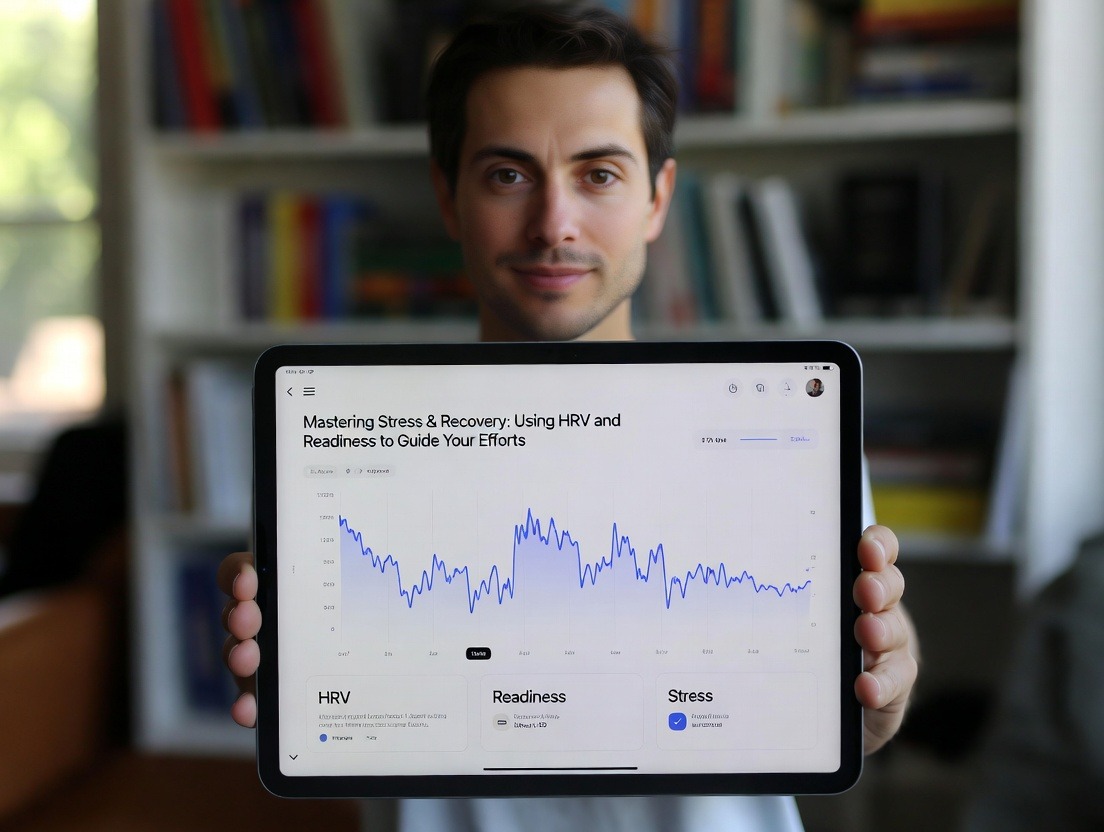
In the pursuit of health, we often focus on the "stress" we apply—the hard workouts, the demanding projects. But adaptation and growth happen in the recovery that follows. Your wellness ring, through HRV and Readiness/Recovery scores, gives you a real-time window into this delicate balance, allowing you to guide your efforts with precision, not guesswork.
HRV: Your Personal Recovery Compass
Think of your HRV trend as your body’s "confidence meter" for handling stress. When it’s high and stable, your system is resilient and adaptable. When it’s low or dropping, your body is signaling that resources are stretched thin.
The Readiness Score: Your Daily Prescription
Your daily Readiness or Recovery Score is the synthesis of last night’s sleep, recent activity, and stress indicators (like HRV and RHR). It’s your ring’s direct recommendation for the day’s intensity.
Creating Your Personal Recovery Protocol
Based on your data, build a menu of actions for different readiness levels.
Stress Not as an Enemy, but as a Dosing Problem
Your ring’s daytime stress score (often derived from heart rate and HRV fluctuations) shows your nervous system's reaction to life’s demands. The goal isn’t zero stress—that’s impossible and undesirable. The goal is to manage the dose and punctuate it with recovery.
By using HRV for strategic, long-term planning and the Readiness score for daily tactical decisions, you create a dynamic feedback loop. You learn to stress your body intelligently and recover it deliberately, which is the very essence of sustainable progress and resilience. This principle of intelligent recovery is a core value for us, detailed further in our company's vision.
The old-school approach to fitness was a rigid calendar: Monday Chest, Tuesday Legs, etc., regardless of feeling. Your wellness ring ushers in a new era: adaptive fitness. It allows you to align the type, intensity, and volume of your movement with your body’s actual capacity, leading to better results and fewer injuries.
From a Fixed Schedule to a Flexible Framework
Instead of prescribing exact workouts on exact days, create a weekly framework based on your readiness score and recovery trends.
Using Resting Heart Rate (RHR) as a Load Monitor
A chronically elevated RHR trend is a classic sign of overreaching or overtraining. A useful goal is to keep your weekly average RHR within a certain range. If you see it creep up 3-5 BPM above your normal baseline for several days in a row, it’s a clear signal to insert an extra recovery day or dial back the intensity, even if your readiness score seems okay. It’s an early warning system.
Goal Setting for Different Activity Types
The Post-Workout Metric Check
Develop the habit of reviewing how your body responded to a workout. 24-36 hours later, check your metrics:
This post-workout audit teaches you what your body can handle and recover from, allowing you to adjust future sessions for optimal progress. It turns every workout into a learning experience. Sharing and learning from these experiences is a big part of our community, as seen in user testimonials and stories.
Periodization Guided by Biometrics
Take this concept to the macro level. In a 12-week training plan, use your HRV and RHR trends to guide your deload weeks. Instead of automatically taking a deload in week 4, you might push to week 5 if your metrics are strong. Or, you might take an unexpected deload in week 3 if your data shows you’re accumulating fatigue faster than anticipated. This is truly personalized periodization.
By letting your body’s signals guide your movement, you trade rigidity for responsiveness. You work with your body, not against it, transforming your fitness journey from a pre-written script into an intelligent, co-authored dialogue.

What you eat and drink directly fuels—or disrupts—every metric your ring tracks. While smart rings don’t directly scan your meals, they provide powerful indirect feedback on how your nutrition choices affect your sleep, recovery, stress, and energy levels. This turns your ring into a highly personal nutritional biofeedback device.
The Nighttime Nutrition Audit
Your sleep data is a brilliant proxy for digestive strain and metabolic disruption.
Hydration: The Silent Metric Mover
Chronic, low-level dehydration is a stealthy saboteur of performance and recovery. It can elevate RHR, reduce blood volume (affecting HRV), and worsen sleep.
Caffeine Timing and Sensitivity
Your ring can help you find your personal caffeine cutoff time.
Using Readiness for Nutritional Strategy
Your daily readiness score can inform your nutritional focus for the day.
The 3-Day Food & Metric Log
For true insight, conduct a focused audit. For 3-4 days, log everything you eat and drink (no need for calories, just what and when). In parallel, watch your key ring metrics: sleep score, HRV, RHR, and daytime stress score. Look for patterns. Does dairy seem to affect your resting heart rate? Does a high-sugar afternoon snack correlate with a late-day stress spike? This self-experimentation is the gold standard for personalizing your nutrition.
By connecting the dots between your plate and your physiological data, you move away from generic diet rules and toward a customized eating strategy that directly supports your wellness metrics and life goals. It’s about eating for the outcomes you can measure.
Lasting change doesn’t happen in isolated, perfect moments. It happens in the messy, repeated patterns of daily life. The final—and perhaps most important—step is to integrate your data-informed goals seamlessly into your existing routines, making healthy choices the default, not the exception.
Habituating with Habit-Stacking
Link your new wellness behaviors to established habits. This "stacking" reduces the cognitive load required to act.
Environmental Design for Success
Use your data to redesign your surroundings to make the right choice easier.
Social Accountability and Your Data
Share your journey. Telling a friend or partner, "My goal this month is to improve my deep sleep by getting to bed by 10:30," creates accountability. Better yet, if they also use a wellness ring, you can create friendly, supportive challenges (e.g., "highest average weekly readiness score") that tap into our natural social drive. Seeing real-world success stories can be incredibly motivating, which is why we share user experiences on our site.
Scheduling Your Wellness Like a Meeting
If it’s not scheduled, it’s not real. Based on your monthly campaign, block time in your calendar.
Embracing the 80/20 Rule
Perfection is the enemy of progress. Your ring data will show you that some days, life happens—a late work night, a social event, travel. The goal is not perfect scores every day, but consistent trends in the right direction. Aim for adherence to your processes 80% of the time. The 20% allows for flexibility, life enjoyment, and prevents burnout. What matters is the weekly and monthly trend, not the single off-day.
By weaving your goals into the existing fabric of your life—through tiny habits, smart design, social support, and scheduled commitment—you transform wellness from a separate "project" into simply the way you live. The data from your ring ceases to be a report card and becomes the natural feedback loop of a well-designed life.
You've laid the foundation. You understand your core metrics, interpret their trends, and have begun crafting S.M.A.R.T., tiered goals across sleep, stress, activity, and nutrition. You're no longer a passive observer of your data but an active participant in your wellbeing. This is where the true artistry begins. The following sections will guide you through the advanced skills of navigating inevitable challenges, integrating technology, conducting personal experiments, and forging a sustainable, lifelong philosophy of health—all guided by the unwavering light of your biometric data.
Progress is never a perfect upward trajectory. Even with the best-laid plans, you will encounter plateaus where metrics stall, setbacks where numbers move backwards, and periods where life's "noise" drowns out the signal. This is not failure; it is data. Learning to interpret and navigate these phases is what separates transient effort from lasting transformation.
Diagnosing a Plateau: Is It Stalling or Settling?
A plateau—a sustained period where a key metric (e.g., HRV, RHR, sleep score) stops improving despite consistent effort—requires detective work.
Reframing Setbacks as Strategic Feedback
A setback—a clear negative turn in your trends—feels discouraging. But in the framework of data-driven wellness, it is simply high-fidelity feedback.
Managing the "Noise": Travel, Social Events, and Disruption
Life happens. The goal is not to live in a bubble, but to learn to navigate real life with minimal damage and swift recovery.
The Compassionate Review: Learning Without Judgment
When you hit a rough patch, conduct a "Compassionate Review." Look at the data and ask:
This approach removes emotional self-critique and replaces it with analytical problem-solving. Your ring provides the objective facts; your job is to respond with curiosity, not criticism. For support and community stories on overcoming plateaus, many find inspiration in the experiences shared by others.
Your wellness ring is a powerhouse of physiological data, but it doesn't operate in a vacuum. Your life is also logged in calendars, food apps, fitness platforms, and mindfulness tools. The final frontier of goal setting is creating synergy between these systems, building a centralized command center for your health.
The Integration Trinity: Fitness, Nutrition, and Mindfulness
Automation for Seamless Habit Execution
Use platforms like Apple Shortcuts or IFTTT to create "if-then" rules based on your ring data.
These automations reduce decision fatigue and make your wellness system proactive.
The Centralized Dashboard: Creating Your Personal Health OS
Use a data aggregation platform like Google Sheets, Apple Health, or specialized apps that can pull in data from all your sources. The goal is to create a weekly dashboard where you can see, at a glance:
Reviewing this consolidated dashboard during your weekly planning session gives you a holistic picture of cause and effect that is impossible to see in isolated apps. It turns scattered data points into a coherent narrative of your health. Exploring the technical possibilities of such integration is part of the evolving vision at Oxyzen.
Respecting Data Privacy in Your Ecosystem
As you connect more services, be mindful of data permissions. Only use reputable apps and review privacy policies. The goal is to empower yourself, not expose yourself. Your biometric data is deeply personal; treat its integration with the same care you treat its interpretation.
Beyond following general advice and observing correlations, you can adopt the most powerful tool in personalized health: the structured self-experiment, or N=1 trial. This is the scientific method applied to your own life, with your ring as the primary measurement tool.
The Framework of a Personal Experiment
Every good experiment has a clear structure:
Ideal Candidates for N=1 Experiments
Avoiding Pitfalls: Ensuring Clean Data
Building Your Personal Knowledge Base
Document the results of your experiments in a dedicated journal or note. Over time, you build a living document of what truly works for your unique biology. This is the ultimate personalization. It moves you from relying on generic wellness blogs to becoming the world's leading expert on yourself. This experimental mindset is encouraged and discussed in our community-oriented blog content.
The culmination of this journey is not a set of perfect metrics, but a new relationship with your health—one that is fluid, responsive, and sustainable for decades. Your wellness ring is the tool that facilitates this shift from a goal-oriented "project" to a process-oriented "practice."
From Goals to Systems: The Infinite Game
Author James Clear distinguishes between finite games (played to win) and infinite games (played to keep playing). Health is the ultimate infinite game. You don't "win" and stop. Therefore, the focus must shift from specific, finite goals (e.g., "achieve an HRV of 70") to strengthening the underlying systems that produce health.
Goals are the targets you set within these systems. But the systems themselves are what endure. A strong system will outlast any missed goal.
Embracing Seasonality of Life and Focus
Your health priorities should ebb and flow with your life seasons. Your ring data helps you honor this.
Allowing your focus to shift prevents burnout and makes your health practice adaptable to real life.
The Metric as Guide, Not God
This is the most crucial philosophical shift. The data is there to serve you, not to judge you. A low score is not a failure; it is information. There will be days, weeks, or even months where pursuing "optimal" metrics is not the right choice—because you are pursuing connection, creativity, career milestones, or care for others. The wisdom lies in knowing when to lean into the data for support and when to gently set it aside to live fully, trusting your systems to help you rebound later.
Legacy of Awareness: The Ultimate Gift
The long-term value of wearing a wellness ring is not the database it creates, but the heightened awareness it cultivates. Over time, you begin to feel what before you could only see. You notice the subtle signs of fatigue before your RHR spikes. You sense the need for an early night before your readiness score drops. The ring trains your interoception—your sense of your internal state. This embodied awareness is the ultimate goal: to no longer need the device because its teachings have become integrated into your own consciousness.
This journey from data to direction to embodied wisdom is what transforms a piece of technology into a lifelong companion in wellbeing. It’s a partnership where you bring the intention and life, and your ring brings the feedback and clarity, guiding you not just toward better numbers, but toward a more vibrant, resilient, and attuned way of living.
Having journeyed through the philosophy, science, and strategy of biometric goal setting, we now arrive at the practical implementation stage. This final section is your workshop. Here, you will find ready-to-use templates, a synthesis of core principles, and a clear path to integrate everything you've learned into a sustainable, personalized practice. This is where knowledge becomes action, and action becomes transformation.
Structure liberates. To move from theory to consistent practice, having a simple, repeatable framework is essential. Below are templates you can adapt, whether you prefer a digital notebook, a physical journal, or a dedicated app.
The Monthly Campaign Planner
Use this at the start of each month to define your primary focus.
Month: _________________
Quarterly Theme/ North Star Metric: _______________________________
Monthly Campaign Focus (1-2 key areas): ___________________________
Primary S.M.A.R.T. Goal:
Supporting Daily Process Goals (Tier 1):
Key Tactics & Experiments: (What will I do differently?)
Success Criteria: (What will indicate progress beyond the raw number?)
The Weekly Metrics & Lifestyle Log
Use this for your weekly review (e.g., every Sunday evening). A simple spreadsheet works perfectly.
Week Of:
Sleep Score (Avg)
HRV (Avg)
RHR (Avg)
Readiness (Avg)
Key Lifestyle Notes (e.g., travel, alcohol, stress events, high-intensity workouts)
Win of the Week
Area for Adjustment
Example
84
62ms
54 bpm
82
Heavy project at work, 2x HIIT, 1 social dinner
Hit bed by 10:30 PM 6/7 nights
Felt drained Fri; need to schedule a true recovery day next week
Week 1
Week 2
The Weekly Review Questions:
The N=1 Experiment Worksheet
Use this to structure a personal biohacking experiment.
Experiment Question: _______________________________________________
Hypothesis: I believe that ___________________________________ will cause ___________________________________ in my metrics.
Duration: ____ days for Intervention A, ____ days for Intervention B (or vs. baseline).
Primary Metric to Track: ___________________________________________
Secondary Metrics: ________________________________________________
Control Variables: (What will I keep consistent?) _______________________
Protocol Details: (Be specific about the intervention) ____________________
Results & Conclusion: (To be filled post-experiment) ____________________
Action Decision: Based on the data, I will ❑ Adopt this change ❑ Reject it ❑ Run another experiment.
For those who prefer digital guidance, Oxyzen's FAQ and resources often provide additional context on structuring these self-experiments and interpreting the resulting data.
Let's distill the entire guide into ten foundational commandments. Keep these principles close as you build your practice.
Feeling inspired but overwhelmed? Follow this 30-day onboarding plan to build momentum gradually.
Weeks 1-2: The Observation Phase
Weeks 3-4: The Single-Focus Phase
Month 2: Your First Official Monthly Campaign
Month 3 Onward: Expansion and Refinement
Remember, this is a marathon of self-discovery, not a sprint to perfection. The Oxyzen story itself is rooted in this philosophy of gradual, meaningful progress through technology.
The zenith of this journey is when the technology fades into the background, and its teachings become embodied. Your ring’s ultimate purpose is to train your own internal sensor—your interoceptive awareness.
The "Guess the Metric" Game: Before looking at your app in the morning, ask yourself: "How do I feel? What do I think my readiness score will be today? My sleep score?" Over time, you'll be amazed at how accurately your intuition aligns with the data. This practice builds a powerful mind-body connection.
Data-Validated Intuition: When you have a strong feeling—"I need a rest day," or "I feel incredibly sharp today"—check the data. Does it confirm your intuition? This feedback loop reinforces self-trust. You learn to listen to the subtle whispers of your body before they become shouts reflected in poor metrics.
Knowing When to Disconnect: There will be days—on vacation, during a retreat, on a special celebration—when the most healthful choice is to take off the ring and be fully present. Do so with intention, not guilt. Trust the systems you've built and the awareness you've cultivated. You can always reconnect upon returning to normal rhythms.
We began with a sea of data and the question of what to do with it. We end not with an answer, but with an empowerment. You now possess the framework to transform that sea into a navigable map, charting a course toward your own unique definition of vitality.
Your wellness ring is more than a sensor; it is a translator. It converts the silent language of your physiology—the dip in HRV, the rise in RHR, the architecture of your sleep—into a story you can understand. And you are not just the reader of that story; you are its author. Each choice you make—to honor your readiness, to prioritize sleep, to seek recovery—is a sentence written in the ongoing narrative of your health.
The metrics are not the destination. The destination is a life lived with more energy, resilience, presence, and joy. The numbers are merely the signposts along the way, ensuring you’re headed in the right direction.
This journey is iterative, personal, and profoundly human. There will be chapters of dramatic progress and chapters of quiet maintenance. There will be plot twists and unexpected setbacks. But with your biometric data as your compass and the principles in this guide as your stars, you will never be lost. You will have a constant, objective source of truth about your body’s needs and responses.
Start where you are. Use what you have. Do one thing today that your future self will thank you for, and let your ring show you the proof. The path from data to direction to a life of sustained vitality is now yours to walk.
Your Trusted Sleep Advocate: Sleep Foundation — https://www.sleepfoundation.org
Discover a digital archive of scholarly articles: NIH — https://www.ncbi.nlm.nih.gov/
39 million citations for biomedical literature :PubMed — https://pubmed.ncbi.nlm.nih.gov/
Experts at Harvard Health Publishing covering a variety of health topics — https://www.health.harvard.edu/blog/
Every life deserves world class care :Cleveland Clinic - https://my.clevelandclinic.org/health
Wearable technology and the future of predictive health monitoring :MIT Technology Review — https://www.technologyreview.com/
Dedicated to the well-being of all people and guided by science :World Health Organization — https://www.who.int/news-room/
Psychological science and knowledge to benefit society and improve lives. :APA — https://www.apa.org/monitor/
Cutting-edge insights on human longevity and peak performance:
Lifespan Research — https://www.lifespan.io/
Global authority on exercise physiology, sports performance, and human recovery:
American College of Sports Medicine — https://www.acsm.org/
Neuroscience-driven guidance for better focus, sleep, and mental clarity:
Stanford Human Performance Lab — https://humanperformance.stanford.edu/
Evidence-based psychology and mind–body wellness resources:
Mayo Clinic — https://www.mayoclinic.org/healthy-lifestyle/
Data-backed research on emotional wellbeing, stress biology, and resilience:
American Institute of Stress — https://www.stress.org/


