


How to Create a Nighttime Routine in a Small Space
In a small space, use room dividers, declutter, and use soft lighting to create a distinct, peaceful sleep zone.
In a small space, use room dividers, declutter, and use soft lighting to create a distinct, peaceful sleep zone.
%402x.svg)
Let’s be honest: the dreamy, sprawling nighttime routines you see online don’t fit your reality. They involve steaming bathrooms the size of studios, walk-in closets dedicated to loungewear, and balconies overlooking silent forests. Your reality is a 400-square-foot apartment where the bathroom sink doubles as a kitchen prep area, your bed is your sofa, and your "meditation corner" is currently occupied by a pile of laundry.
But here’s the revolutionary truth that the wellness industry often overlooks: The most profound sleep and restorative evenings are not born from square footage, but from intention and consistency. A small space isn’t a limitation; it’s a design constraint that, when embraced, can lead to a more focused, efficient, and deeply personal ritual. In a world of constant overstimulation, your compact living quarters can become your greatest ally in cultivating a true sanctuary.
The science is unequivocal. A consistent nighttime routine signals to your primal brain that safety is near, triggering the cascade of hormones like melatonin that guide you into restorative sleep. It lowers cortisol (the stress hormone), regulates your circadian rhythm, and improves everything from cognitive function to emotional resilience. Yet, when your entire life exists within a few paces, the boundaries between work, leisure, and sleep blur into a stressful haze. Your living room is your office, your dining table is your desk, and your bed often becomes a multimedia hub. This lack of physical demarcation creates a lack of psychological separation, making true relaxation elusive.
This is where modern technology, like the sophisticated wellness tracking offered by a smart ring, becomes not a luxury, but an essential interpreter of your unique physiology. A device like the Oxyzen smart ring operates silently on your finger, gathering data on your heart rate variability, skin temperature, and sleep stages without needing a single extra inch of space. It provides the objective feedback necessary to tailor a routine that works for you, in your space, cutting through the noise of generic advice.
This guide is your blueprint for transforming your compact living area into a sleep-optimized haven. We will move beyond mere “tips” and into a holistic system that integrates environmental design, behavioral psychology, and data-driven insights. Forget trying to replicate a spa; we’re going to build a personalized, efficient, and utterly transformative nighttime routine that fits perfectly within your four walls. The journey to better sleep, reduced anxiety, and more energized mornings begins not with a bigger apartment, but with a smarter approach to the one you have.

You might think of your bedroom—or your studio apartment—as a passive container for your life. In reality, it is an active participant in your nervous system’s nightly performance. Every element, from the light bleeding under the door to the hum of a mini-fridge, is a line of dialogue in a conversation with your brain. In a small space, this conversation is more intense, more immediate. There’s no hallway buffer, no separate wing. The entire environment is your sleep chamber, making its optimization non-negotiable.
The cornerstone of sleep biology is your circadian rhythm, your body’s internal 24-hour clock governed by the suprachiasmatic nucleus (SCN) in your brain. The SCN’s primary cue is light. When sunlight diminishes, it signals the pineal gland to produce melatonin, the “sleep hormone.” In a small, multi-functional space, artificial light from laptops, TVs, and even bright overhead lights after sunset bombards this system with false “daylight” signals, delaying melatonin production by hours. A 2022 study in the Journal of Clinical Sleep Medicine found that exposure to room lighting before bedtime suppressed melatonin in 99% of participants, shortening total melatonin duration by about 90 minutes.
But light is just the opening act. Temperature is a critical co-star. Your core body temperature needs to drop by about 1-2 degrees Fahrenheit to initiate and maintain sleep. A cluttered, poorly ventilated small room can trap heat, creating a microclimate that fights this natural drop. Furthermore, noise intrusion—from neighbors, street sounds, or even your own appliances—can cause micro-arousals, fragmenting your sleep architecture even if you don’t fully wake. You may spend 8 hours in bed, but your deep sleep (the physically restorative phase) and REM sleep (the mentally restorative phase) are constantly being interrupted.
This is where the concept of “sleep pressure” or homeostatic sleep drive, intersects with your environment. Throughout the day, adenosine, a byproduct of brain activity, builds up in your system, creating a drive for sleep. A stressful, stimulating small-space environment can accelerate adenosine buildup while simultaneously activating the sympathetic (fight-or-flight) nervous system, creating a torturous state of being exhausted yet wired. Your body is screaming for rest, but your environment is screaming “Danger!” or “Work!”
Enter the role of objective biometric tracking. In a limited space, you must be a scientist of your own sleep. Subjective feelings of “I slept okay” are often misleading. A smart ring like Oxyzen measures key biomarkers all night: Heart Rate Variability (HRV) indicates autonomic nervous system balance—a higher HRV suggests better recovery and resilience. Resting heart rate trends can show overtraining or stress. Body temperature data can reveal if your room is too warm. And detailed sleep stage analysis shows how much deep and REM sleep you’re truly getting, not just total time in bed.
By pairing environmental adjustments with this data, you move from guesswork to precision. You’ll learn if that 8 PM email check truly impacts your sleep latency (the time it takes to fall asleep), or if the new blackout curtains improved your deep sleep percentage. You can see the direct correlation between a cooler room temperature and more stable sleep cycles. For a deeper dive into the metrics that matter, our comprehensive resource center at Oxyzen.ai/blog offers articles on interpreting HRV and sleep architecture.
Your small space is not a sleep desert; it’s a laboratory. By understanding the non-negotiable biology of sleep, you can begin to engineer your environment to work with your body, not against it. The goal is to make every square foot a conscious ally in your quest for restoration.
Before you buy a single product or rearrange a piece of furniture, you must shift your mindset. The philosophy for a small-space nighttime routine isn’t about adding more—more steps, more products, more gadgets. It’s about curated subtraction and intentional design. It’s the art of creating psychological and physical transitions using only what you have, but arranging it with purpose.
Think of your evening as a structured, gentle descent. You are moving from the broad, outward-focused awareness of the day (the sympathetic state) to the narrow, inward-focused calm of the night (the parasympathetic state). In a studio or one-bedroom, you lack the physical journey from office to living room to bedroom that naturally facilitates this descent. Therefore, you must create this journey through ritual, light, and space reconfiguration. This is often called "sequencing" your environment.
The core principle is psychological zoning. Even if your bed is three feet from your desk, you can create distinct zones through sensory cues. This leverages what psychologists call “context-dependent memory.” Your brain associates specific cues with specific behaviors. When your bed is also your dining table, your brain gets confused—is this a place for alert work, social eating, or deep rest? By creating clear, time-based zones, you tell your brain exactly what to expect.
Start by conducting an “evening audit.” For one night, be a passive observer of your space from 7 PM until bedtime. Note:
This audit isn’t about judgment; it’s about awareness. You are mapping the friction points in your descent to sleep.
The next step is applying the principles of minimalism and sensory design, not as an aesthetic, but as a functional tool for calm. Marie Kondo’s question—“Does this spark joy?”—can be adapted to your nighttime routine: “Does this object support my transition to rest?” That stack of magazines by the bed may spark joy during the day, but at night, it’s visual noise reminding you of things you haven’t read. The laptop charger snaking across the floor is a trip hazard and a symbol of work.
The philosophy extends to your digital space. A 2021 study from the University of Pennsylvania linked limiting social media use to significant reductions in loneliness and depression. Your phone is a portal to the waking, anxious world. Its very presence on your nightstand, even face down, creates what researchers call “anticipatory arousal”—the subconscious expectation of a notification. Part of intentional design is designing your digital boundaries.
This curated approach is at the heart of the Oxyzen brand ethos. We believe technology should serve calm, not disrupt it. That’s why our design focuses on seamless, unobtrusive data collection that empowers you to make these intentional choices. You can learn more about this human-centered approach to wellness tech on our About Us page, which details our mission to integrate seamlessly into your life, not dominate it.
By adopting this philosophy of intentional design, you stop fighting your small space and start partnering with it. You move from living in a cluttered box to inhabiting a curated sanctuary that actively guides you from day into night.

Your first and most critical transition zone is not a physical location, but a temporal one: the Digital Sunset. This is the deliberate, gradual winding down of your interaction with screens and the hyper-connected world, initiated 60-90 minutes before your target bedtime. In a small space, where work and leisure devices are always within arm’s reach, this practice isn’t just helpful; it’s a defensive necessity for your mental sanctuary.
The rationale is rooted in both photobiology and neuropsychology. The blue light emitted by LEDs in our screens has a particularly potent effect on melanopsin, a photopigment in our eyes that directly signals the SCN to suppress melatonin. But the harm goes beyond light. The content itself—the endless scroll of social media, the tense work email, the stimulating show—activates cognitive and emotional centers. It feeds your brain with novel information, spikes cortisol through conflict or FOMO (Fear Of Missing Out), and engages the default mode network with social comparison.
Implementing a Digital Sunset in a confined area requires a system, not just willpower.
Step 1: The Physical Handshake. Designate a specific, slightly inconvenient charging station for all devices outside your main living/sleeping area. If possible, this is a shelf in the hallway, a drawer in the kitchen, or even a box by the front door. The act of physically walking your phone, tablet, and laptop to this “docking station” is a powerful ritual that marks the end of their dominion over your evening. It creates a physical barrier to mindless pick-up.
Step 2: The Gradual Dim. Don’t go from bright screen to pitch black. 90 minutes out, enable “Night Shift” or “Blue Light Filter” settings on all devices. 60 minutes out, this is your hard stop for active screen engagement (work, social media, intense videos). The final 30 minutes can allow for passive, low-stimulation screen use if absolutely necessary, such as listening to a calm podcast or audiobook with the screen off or using an e-ink reader like a Kindle, which is front-lit, not back-lit.
Step 3: Replace the Void. The hardest part of quitting screens is the sudden silence and boredom. Have your “analog replacements” pre-prepared and inviting. This is where your small space setup is key. Have your current book on your favorite chair, a simple journal and pen on your bedside table, or a soothing tactile activity like knitting or a puzzle in a designated spot. The goal is to give your hands and mind a gentle, offline focus.
Step 4: Audit Your Automation. Use this time to set up technology to work for your sleep. Enable “Do Not Disturb” on your phone, scheduling it to align with your sunset. Use app timers to lock you out of social media after a certain hour. Consider a smart plug for your router to cut Wi-Fi at a set time—a drastic but profoundly effective measure for those serious about digital boundaries.
What does success look like? This is where data trumps feeling. After establishing your Digital Sunset, use your Oxyzen ring to track the impact. Look for:
You’ll likely see a correlation between the consistency of your sunset and the quality of your biometric data. Many of our users share how this single change transformed their rest; you can read their experiences in our Testimonials section.
The Digital Sunset is the foundational wall you build between the chaos of the day and the peace of your evening. By reclaiming this mental space, you clear the cognitive clutter, making room for true relaxation to begin.
Once you’ve begun to quiet the digital noise, it’s time to actively engineer your physical environment for calm. In a small space, your senses are constantly receiving input. The goal of the Sensory Reset is to take conscious control of that input, transforming it from random stimulation into a curated, soporific symphony. This zone is about using light, sound, and scent as deliberate tools to down-regulate your nervous system.
Light: From Harsh to Hospitable
Light is your most powerful environmental cue. The mission is to mimic the natural progression of a sunset indoors.
Sound: From Noise to Soundscape
You can’t always control external noise, but you can mask and transform it.
Scent: The Direct Line to the Brain
Your olfactory system has a direct neural pathway to your amygdala and hippocampus, brain centers for emotion and memory. This makes scent a potent, space-efficient tool.
The magic happens in the combination. Imagine this sequence: You’ve docked your phone. The overhead light is off, and the room is bathed in the amber glow of two salt lamps. A diffuser quietly puffs a light lavender and cedarwood mist. In the background, a sound machine emits a soft, steady pink noise, like distant rainfall. In this multi-sensory cocoon, your brain has no choice but to receive the message: It is safe. It is time to rest.
For more ideas on creating a sensory sanctuary, including product-free approaches, explore the curated guides on Oxyzen.ai/blog.
After calming your senses, it’s time to address the physical vessel—your body. The day’s stress manifests as physical tension: tight shoulders, a clenched jaw, a stiff lower back. In a small space, you may not have a yoga studio, but you have enough room to stand, sit, and lie down. That is all you need. The Physical Unwind is about using gentle, intentional movement and myofascial release to signal safety to your musculoskeletal system and complete the mind-body transition to rest.
The Principle of Paradoxical Relaxation: Sometimes, to relax a muscle, you must first gently engage it. The goal is not a workout, but conscious release. Your routine should last 10-20 minutes and be performed in your newly softened sensory environment.
A Sample Small-Space Sequence:
Incorporating Myofascial Release:
Breathing as Movement:
Weave a simple breathing technique into your movements or do it lying down at the end.
The key is consistency and gentleness. You are not trying to break a sweat; you are trying to break the cycle of physical tension. After this routine, your body temperature may have risen slightly—allowing it to cool in your prepared, cool bedroom environment will further aid sleep onset. Track the effect of this unwind on your “time to fall asleep” and “resting heart rate” metrics in your Oxyzen app to see its tangible benefit. If you have questions about how movement affects your specific biometrics, our FAQ can provide helpful guidance.
By dedicating this time to physical release, you ensure your body is as ready for sleep as your mind, completing the holistic transition.
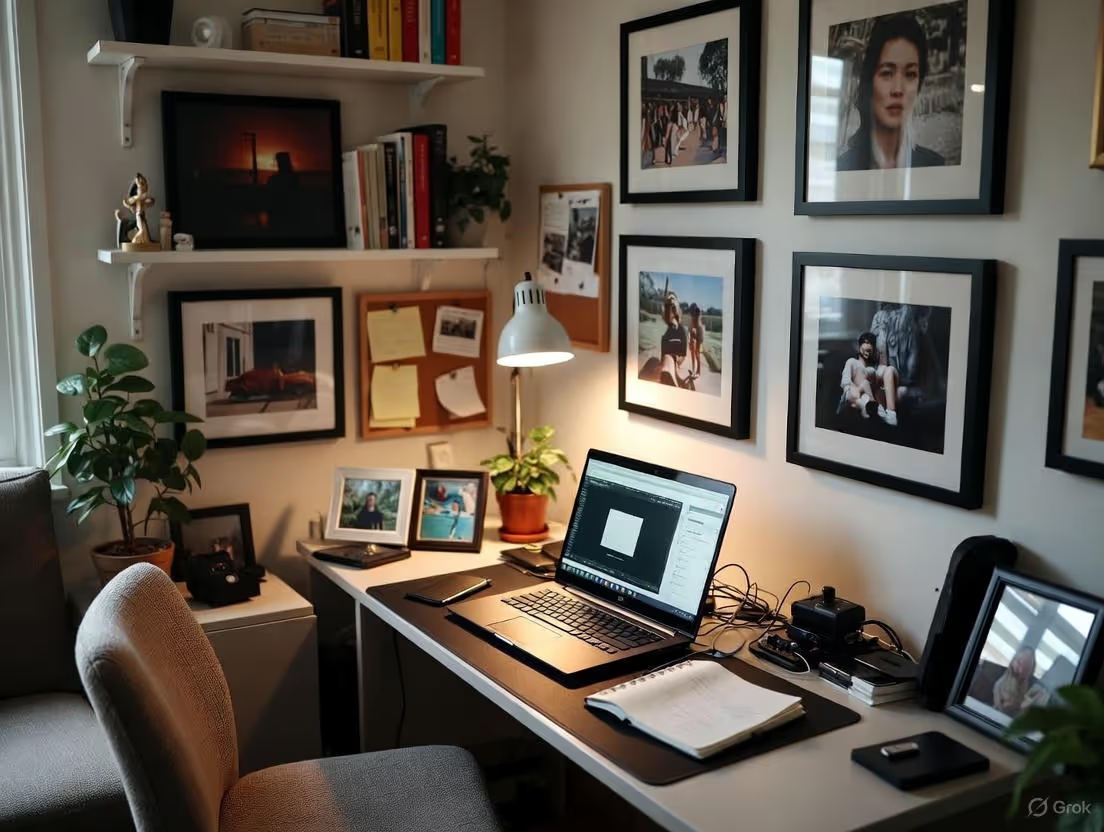
Your physical space may be tidy, and your body may be relaxed, but what about the attic of your mind? The Mental Declutter is the process of downloading the day’s thoughts, worries, and to-dos from your brain onto an external medium, effectively clearing your cognitive RAM for sleep. In a small space, where reminders of responsibilities are ever-present, this practice is your nightly mental filing system.
Research from the University of Texas and other institutions shows that expressive writing, particularly about future tasks and worries, can reduce bedtime cognitive arousal and improve sleep. The act of writing organizes chaotic thoughts, reduces their emotional charge, and offloads the burden of remembering.
Creating a “Brain Dump” Ritual in Minimal Space:
Alternative & Supplemental Practices:
The beauty of this practice is its space efficiency. It requires only a notebook’s worth of space but creates vast mental space. It turns the relentless mental clutter—a huge problem in confined living—into a managed, closed system. For many, this is the missing link between physical relaxation and true mental stillness. Our founders integrated this philosophy of mindful reflection into the very purpose of Oxyzen; you can read about the human-centric values that guide our technology on Our Story page.
When your mind is decluttered, you approach your bed not with a racing brain, but with a quiet, open readiness for sleep.
Now we arrive at the epicenter: your bed and its immediate surroundings. In a studio or small bedroom, this area is multifunctional by necessity. The challenge is to transform it each night into a hyper-optimized, single-purpose sleep capsule. This isn’t just about a nice mattress; it’s about curating every sensory detail within a 5-foot radius to be unequivocally pro-sleep.
The Bed Itself: Your Sleep Platform
The Immediate Environment: The 5-Foot Rule
Audit everything you can see, hear, or touch from your bed.
The “Bed is for Sleep (and Sex)” Rule: This is the golden rule of sleep hygiene, doubly important in a small space. Train your brain to associate your bed with sleep and intimacy only—not with work, eating, or watching thrilling movies. If you don’t fall asleep within 20 minutes, get up, go to your designated “evening chair” (see next section), and do a quiet, relaxing activity until you feel sleepy. Then return to bed. This strengthens the bed-sleep connection.
Tracking Your Sanctuary’s Success: Your Oxyzen ring provides direct feedback on this optimization. After making changes—new bedding, a cooler room, a weighted blanket—observe:
By treating your bed and its immediate surroundings as a precision-engineered sleep capsule, you create the final, most powerful cue for your brain and body. It becomes a fortress against the wakeful world, a perfectly designed environment for one purpose only: profound, restorative rest.

You now have the zones and the philosophy. But how do you make it stick, especially when life gets chaotic? The answer lies not in heroic, hour-long routines, but in Micro-Rituals—tiny, repeatable, almost effortless actions that act as behavioral keystones. In a small space, these micro-rituals are especially potent because they rely on environmental cues that are always present. They build consistency, which is far more important than perfection.
A micro-ritual is a specific, contextualized action with a clear start and finish. It takes less than 2 minutes and is intentionally linked to another routine activity (a “habit stack”) or a specific location in your space.
Examples of Powerful Evening Micro-Rituals:
How to Build Your Own Micro-Rituals:
The genius of micro-rituals in a small space is that they turn your environment into a guide. The dimmer switch by the door, the specific spot for the journal, the charging station—all become prompts that automate your wind-down. They reduce decision fatigue and willpower drain.
Leveraging Technology as a Micro-Ritual Cue: Your Oxyzen app can be part of this. Making a habit of checking your “Readiness Score” in the morning creates a feedback loop. The simple act of putting the ring on your finger at night can itself become a micro-ritual—a physical token that signifies your commitment to tracking and improving your rest. To understand how the ring fits seamlessly into a habit-driven life, visit our homepage to see it in action.
Consistency is built brick by tiny brick. By focusing on these nearly invisible rituals, you build an unshakable routine that withstands the chaos of life in a compact world. You’re not building a grand monument; you’re laying a dependable path, one small, sure step at a time.
Even with the best-laid plans, unique challenges arise in compact living. Here, we address the most common pain points with practical, space-smart solutions.
Challenge 1: “My Partner and I Have Different Schedules/Routines.”
This is a major stressor in a shared small space.
Challenge 2: “I Work/Relax/Eat/Sleep All in One Room. I Can’t Escape the ‘Work Energy’.”
Challenge 3: “Noise From Neighbors/Street is Unavoidable.”
Challenge 4: “No Space for ‘Zones’ – My Bed is Literally Next to My Desk.”
In a small space, every tool must earn its keep. A smart ring like Oxyzen is the ultimate multi-tool for sleep optimization, acting as a personal sleep scientist, a silent accountability partner, and a feedback mechanism—all from a device that takes up zero physical space. This isn't about adding more screen time; it's about leveraging precise, passive data to make your compact environment work smarter for you.
From Guesswork to Guided Precision:
Most of us guess at what improves our sleep. "I think I slept better when I read." "That coffee after 3 PM might have been a problem." The Oxyzen ring removes the guesswork by providing objective biometrics. In a space where environmental factors are intense and immediate, this data is your compass.
Key Metrics and What They Tell You About Your Small-Space Routine:
Actionable Feedback Loop: The "Test & Learn" Cycle
This is where you become an active experimenter. Use the Oxyzen app to track the impact of each change you make to your small-space routine.
By creating these clear "if-then" experiments, you move from following generic advice to cultivating a routine that is uniquely calibrated to your biology and your specific environment. The ring provides the "then" data.
The Ultimate Small-Space Benefit: Invisible Guidance
The Oxyzen ring requires no charging pads on your nightstand, no wrist-based device you have to remember to wear. It's a single, elegant piece of jewelry that works 24/7. It doesn't add to your clutter; it helps you understand and eliminate the sources of your restlessness. It turns your body itself into the most important sensor in your home.
For those curious about the technical specifics or how to interpret their own data in more depth, a great resource is the support and knowledge base available at Oxyzen.ai/faq. The story of why we built technology that fits into life this seamlessly is part of our core mission, which you can explore further on Our Story page.
When your environment is limited, your data becomes limitless. By integrating this silent guide into your routine, you gain the power to transform your small space from a constraint into a perfectly tuned instrument for sleep.
Theory is powerful, but implementation is everything. This 7-night plan is designed to systematically introduce these concepts without overwhelm. Each night, you'll focus on layering in one or two core elements, building towards a complete, personalized routine by the week's end. Think of it as a "sleep boot camp" for your small space.
Your Pre-Game Checklist:
The 7-Night Plan:
Nights 1 & 2: The Foundation – Light & Digital Boundaries
Nights 3 & 4: Add the Sensory Layer – Sound & Scent
Nights 5 & 6: Integrate the Body & Mind – Movement & Download
Night 7: The Full Ritual & Sanctuary Optimization
Tracking Your Progress:
Use your Oxyzen app each morning to check your Sleep Score, HRV, and note how you feel subjectively. Look for trends. Often, by Night 5 or 6, you'll see a tangible uptick in your scores. This positive reinforcement is fuel for consistency.
Troubleshooting the Plan:
This plan is a scaffold, not a cage. By the end of the week, you will have experienced each component and can begin to edit, adapt, and personalize. Maybe you love the journaling but shorten the stretches. Perhaps the sound machine is a game-changer, but the scent isn't for you. That's perfect. The goal is to build your routine.
As you progress on this journey, remember you're part of a larger community exploring the same challenges and triumphs. For ongoing inspiration and to see how others have personalized their paths, the stories shared at Oxyzen.ai/testimonials can be a powerful source of encouragement.
You’ve built the framework, but what if your natural rhythm seems to fight against it? You’re not broken; you likely have a specific chronotype. A chronotype is your body’s innate predisposition for sleep and wake times, dictated by genetics. It’s why some people are vibrant “early birds” at 5 AM and others are creative “night owls” after 10 PM. In a small space, ignoring your chronotype can make a routine feel like a straitjacket. The key is not to force yourself into a generic 10 PM-6 AM box, but to scaffold your routine around your biological truth.
Understanding the Spectrum: From Lions to Wolves
While the classic “morning lark” and “night owl” are well-known, sleep expert Dr. Michael Breus popularized a more nuanced animal model:
Why Chronotype Matters in a Small Space: Your chronotype influences your ideal schedule for everything from work focus to exercise to your wind-down. A Wolf forcing a 9 PM bedtime will spend hours frustrated in a dark room, feeling trapped and alert. A Lion trying to burn the midnight oil will be fighting a biological tide of sleepiness, often leading to poor-quality late-night work and disrupted sleep. This mismatch creates stress, which is amplified when you have no other rooms to escape to.
Discovering Your Chronotype:
Tailoring Your Small-Space Routine by Chronotype:
For the Wolf (Night Owl):
For the Lion (Early Riser):
For the Bear (Follow-the-Sun):
For the Dolphin (Light, Anxious Sleeper):
By aligning your small-space routine with your chronotype, you work with your biology, not against it. This reduces friction and makes the routine feel natural, sustainable, and uniquely yours. For more personalized insights on how your daily habits interact with your physiology, the data from your Oxyzen ring combined with the resources at Oxyzen.ai/blog can help you fine-tune this alignment over time.
For those in a true studio or single-room dwelling, the concept of a “bedroom” is theoretical. Your entire home is your sleep environment for 8+ hours a night. Therefore, your nighttime routine cannot start and end at the edge of your bed; it must encompass the curation of your entire living space. This is the principle of the Holistic Micro-Sanctuary—transforming your entire footprint into a place that supports rest, not just a corner of it.
The Evening Tidy: The 10-Minute Reset
Clutter is a visual stressor. In a small space, a daytime mess is unavoidable, but an evening mess is a sleep disruptor. It represents unfinished tasks and chaos.
Air Quality & Ventilation: The Invisible Essential
In a small, sealed space, air can become stale, CO2 levels can rise, and allergens can concentrate—all of which impair sleep quality and cognitive function.
The “Work in Progress” Concealment
The single biggest psychological barrier in a studio is the visible presence of work.
Creating “Transitional” Zones Within One Room
Even without walls, you can create implied zones that guide your evening descent.
The Role of Plants and Natural Elements
Bringing in elements of nature (biophilia) reduces stress and improves well-being.
By extending the sanctuary principle to your entire micro-home, you ensure that every direction you look supports calm. The environment itself becomes a co-therapist, gently shepherding you from daytime alertness to nighttime peace. This holistic approach turns the limitation of square footage into an advantage: every single design choice serves your well-being. To see how thoughtful design integrates with wellness technology, learn about the philosophy behind products built for holistic living on our About Us page.
We’ve focused intensely on the evening, but the ultimate power of a mastered nighttime routine is its ripple effect. It becomes what behavioral scientists call an “anchor habit”—a keystone practice that naturally creates positive cascades into every other area of your life. In the constrained ecosystem of a small space, where energy and focus are precious, this anchor effect is transformative.
The Science of the Ripple Effect:
A 2006 study published in the Journal of Personality and Social Psychology found that individuals who successfully cultivated one positive habit (like regular exercise) often experienced “spillover” effects, unconsciously improving other areas like diet and financial discipline. Why? Success builds self-efficacy—the belief in your own ability to execute and achieve. A consistent nighttime routine is a daily, winnable battle that proves to yourself, “I have agency over my well-being.”
The Morning After: The Direct Benefits
A proper night’s sleep, facilitated by your routine, directly fuels your next day in a small space by:
The Indirect Cascades: How the Evening Shapes the Day
Your nighttime routine doesn’t just affect sleep; it proactively designs a better tomorrow.
Creating a Self-Reinforcing Loop:
This is where your Oxyzen ring closes the feedback loop, making the anchor habit incredibly strong.
This positive reinforcement loop turns discipline into desire. You’re not just “going through the motions” to sleep; you’re engaging in a proven system that makes your entire life in a small space feel more manageable, productive, and joyful.
The anchor habit proves that the effort invested in your evening is not subtracted from your day; it’s multiplied across it. By mastering the transition out of your day, you gain mastery over the day itself. For real-world examples of how this daily practice has transformed the lives of others in similar situations, the experiences shared in our Testimonials section offer powerful validation and inspiration.
No routine is fireproof. Life in a small space is often volatile—work deadlines intensify, relationships go through phases, you travel, you get sick. The danger is viewing a missed night or a chaotic week as a “failure” that voids the entire system. The advanced skill is routine resilience: the ability to bend without breaking, to have a “minimum viable routine” (MVR) that sustains you through turbulence and allows for easy reintegration when calm returns.
The Philosophy of the “Non-Zero Day”
The concept is simple: do not let a day pass where you do nothing for your nighttime well-being. Even on the worst day, the MVR is your lifeline. It maintains the neural pathway of the habit, preventing a total reset.
Building Your Minimum Viable Routine (MVR):
Your MVR should consist of the 1-3 most high-impact, low-effort actions from your full routine. For most people, this is:
Navigating Specific Disruptions:
During High Stress or Work Crunches:
While Traveling or Away From Home:
When Sharing the Space with Guests:
During Illness:
The Re-Entry Protocol:
After disruption passes, don’t jump back to the full routine. Use a 3-Day Re-Entry:
This resilient approach acknowledges that life is not a laboratory. It’s what makes a routine truly sustainable. Your Oxyzen ring is a compassionate tool here, too. After a disruptive period, the data shows you the path back to baseline, objectively measuring your recovery without judgment. If you have questions about interpreting data during stressful times, our support team has compiled helpful guidance in the FAQ.
The mark of a mastered routine isn’t perfect execution; it’s graceful, guilt-free navigation of the inevitable storms.
Your small-space nighttime routine is not a monument you build once and admire. It is a living, breathing entity—a garden that needs to change with the seasons of the year and the seasons of your life. What works in the vibrant, light-filled summer may not serve in the dark, introspective winter. What calmed you in your single, city studio may need adjustment when living with a partner or starting a family. The long game is about attunement, not rigid adherence.
Seasonal Adjustments: Syncing with Nature’s Rhythms
Your circadian rhythm is deeply influenced by the changing light and temperature of the earth’s seasons. Fighting it is exhausting; flowing with it is restorative.
Life Stage Evolutions: The Routine Grows With You
Using Data to Guide Evolution: Your Oxyzen ring is your compass through these changes. Notice seasonal trends in your HRV or sleep duration. See the impact of a new life stage on your Resting Heart Rate. The data provides objective feedback, allowing you to ask: “Is my current routine still serving my body’s needs, or does it need a seasonal update?”
This evolutionary view prevents stagnation and burnout from the routine itself. It frames your nighttime practice as a lifelong conversation with your own needs, responsive to the internal data from your body and the external context of your world. To see how a commitment to adaptable, human-centric wellness has been part of our journey from the start, you can explore Our Story.
Creating a perfect routine in isolation can feel like a lonely pursuit, especially when you’re physically confined. Yet, you are not alone. Millions are navigating the same challenge of finding peace in compact living. Tapping into this community of calm—both online and, when possible, offline—can provide invaluable support, fresh ideas, and the powerful reassurance that your journey is shared.
The Power of Shared Experience:
Knowing others are implementing Legs-Up-The-Wall in their studio apartments, wrestling with neighbor noise, or crafting digital sunsets creates a sense of solidarity. It normalizes the struggle and multiplies the collective creativity for solutions. Community turns individual effort into a shared endeavor.
Where to Find Your Tribe:
How to Engage Constructively:
The Caution: Comparison is the Thief of Joy.
Community is for inspiration, not prescription. Your perfect routine is unique. Seeing someone’s immaculate, aesthetic minimalist bedroom online can trigger feelings of inadequacy if yours is a multifunctional mess. Remember: they are showing a curated moment. Focus on the principles (how they use light, how they store things) rather than copying the exact aesthetic.
Creating Micro-Communities: If you share your small space, turn your household into a micro-community of calm. Have a shared whiteboard for “quiet hour” requests or gratitude notes. Develop a household wind-down signal, like a specific lamp being turned on. This builds a shared culture of respect for rest.
By connecting with a community, you externalize the process. It becomes less about personal willpower and more about participating in a collective movement toward intentional living. It reminds you that the pursuit of restful sleep in a busy world is a noble, shared human endeavor. For a continuous stream of researched insights, community tips, and expert advice that can fuel your own journey, the library of articles at Oxyzen.ai/blog is regularly updated with this community in mind.
We have journeyed from the fundamental science of sleep in confined quarters, through the philosophy of intentional design, and into the practical, step-by-step construction of sensory zones, micro-rituals, and a resilient mindset. You’ve explored how to align with your chronotype, extend the sanctuary principle, leverage technology as a guide, and adapt through life’s inevitable disruptions.
The core truth that emerges is this: Your small space is not the antagonist in your story of sleep; it is the setting for a profound experiment in self-care. Its limitations force clarity, innovation, and focus. By applying these principles, you are not just creating a routine; you are architecting a personal ecosystem that honors your biological need for restoration in the midst of modern life’s density.
You now hold the blueprint. The materials are the objects already in your home, the rhythms of your own body, and the intention in your mind. The first step is not a giant leap, but a simple, deliberate action: tonight, turn off one overhead light 30 minutes earlier than usual. Or place your phone in another room to charge. Or write down one single worry on a piece of paper and close it in a drawer.
Begin with your Minimum Viable Routine. Observe. Adjust. Use the data from your body—whether it’s the subjective feeling of calm or the objective metrics from a tool like your Oxyzen ring—as your guide. This is not a race to a perfect night’s sleep; it is the beginning of a lifelong conversation with your own well-being.
The adventure of transforming your nights, and by extension your days, starts now, right where you are. There is no need for more space. There is only a need for more intention. Your sanctuary awaits your first, quiet act of creation.
Your Trusted Sleep Advocate: Sleep Foundation — https://www.sleepfoundation.org
Discover a digital archive of scholarly articles: NIH — https://www.ncbi.nlm.nih.gov/
39 million citations for biomedical literature :PubMed — https://pubmed.ncbi.nlm.nih.gov/
Experts at Harvard Health Publishing covering a variety of health topics — https://www.health.harvard.edu/blog/
Every life deserves world class care :Cleveland Clinic - https://my.clevelandclinic.org/health
Wearable technology and the future of predictive health monitoring :MIT Technology Review — https://www.technologyreview.com/
Dedicated to the well-being of all people and guided by science :World Health Organization — https://www.who.int/news-room/
Psychological science and knowledge to benefit society and improve lives. :APA — https://www.apa.org/monitor/
Cutting-edge insights on human longevity and peak performance:
Lifespan Research — https://www.lifespan.io/
Global authority on exercise physiology, sports performance, and human recovery:
American College of Sports Medicine — https://www.acsm.org/
Neuroscience-driven guidance for better focus, sleep, and mental clarity:
Stanford Human Performance Lab — https://humanperformance.stanford.edu/
Evidence-based psychology and mind–body wellness resources:
Mayo Clinic — https://www.mayoclinic.org/healthy-lifestyle/
Data-backed research on emotional wellbeing, stress biology, and resilience:
American Institute of Stress — https://www.stress.org/


