


The Sleep Score Journey: Tracking Improvement Over Months
Tracking your score over months shows real progress and helps cement habits, more than focusing on daily fluctuations.
Tracking your score over months shows real progress and helps cement habits, more than focusing on daily fluctuations.
%402x.svg)
You wake up. For a moment, you hover in that hazy space between sleep and consciousness. Then, the first thought of the day arrives, not about your schedule or your inbox, but a silent, personal inquiry: How did I sleep?
For generations, the answer was pure intuition—a groggy guess based on how heavy your eyelids feel or how much you dread the alarm. But intuition is a fickle metric, easily clouded by stress, hope, or a strong cup of coffee. What if you could know, with the precision of a scientist, the exact quality of your rest? What if you could see, mapped over weeks and months, the tangible story of your nights? This is no longer a futuristic fantasy. It is the daily reality for anyone embarking on the quantified sleep journey, guided by the silent sentinel on their finger: a smart ring.
Welcome to the deep dive into your sleep score. This isn’t about a single number on a single morning. It’s about the narrative arc of your recovery, the long-term trends that reveal the profound impact of your daily choices, and the empowering path from passive sleeper to active architect of your own rest. Over the coming months, the data you collect will cease to be just points on a graph. It will become a personal biography of your nights, a mirror reflecting the interplay of your lifestyle, your biology, and your environment. By tracking your sleep score journey, you move from wondering to knowing, from guessing to optimizing, and ultimately, from feeling drained to truly thriving.
This comprehensive exploration will guide you through every facet of understanding and improving your sleep over time. We’ll start with the fundamentals of what a sleep score truly measures, then move into the practical art of establishing your personal baseline. From there, we’ll decode the nightly fluctuations and uncover the powerful lifestyle levers you can pull. We’ll confront the inevitable plateaus, celebrate the compounding rewards of consistency, and look at how this journey reshapes your very relationship with rest. This is the beginning of a transformative process, where data meets self-awareness to build a foundation of lasting wellness.
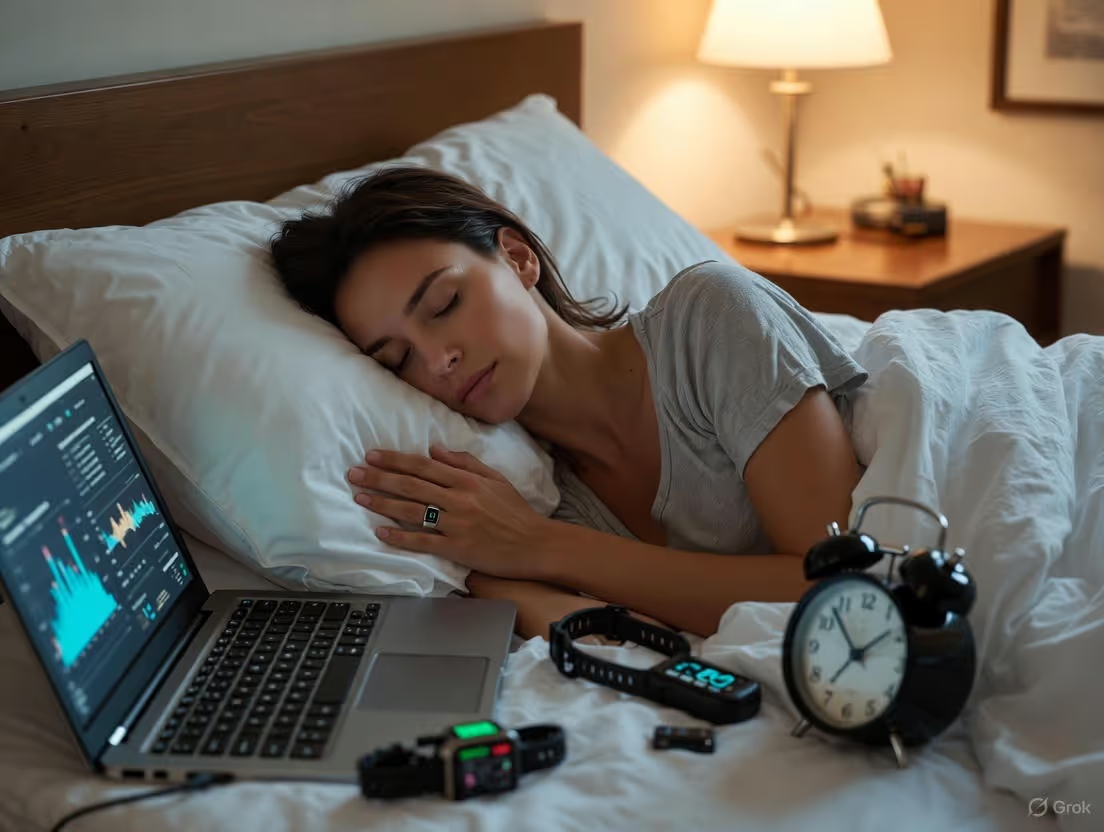
Before you can improve something, you must first understand how it’s measured. Your sleep score is not a random number generated by an algorithm’s whim. It is a sophisticated composite index, a distillation of multiple physiological signals into a single, comprehensible metric. Think of it not as a grade, but as a holistic performance review for your night’s most vital activity.
At its core, a sleep score is typically calculated using three to five key pillars of sleep architecture, each tracked by the advanced sensors in a device like the Oxyzen smart ring. These sensors—including photoplethysmography (PPG) for heart rate and blood oxygen, an accelerometer for movement, and a skin temperature thermometer—work in concert throughout the night to paint a complete picture.
The Core Pillars of Your Score:
A device like Oxyzen synthesizes these data points, weighting them based on established sleep science, to generate your score, often on a scale of 0-100. A score of 85+ might indicate an excellent, restorative night. A score in the 70s suggests adequate but suboptimal sleep with room for improvement. Scores consistently below 70 signal a need for investigation and intervention.
It’s crucial to remember: The score is a guide, not a gospel. A slightly lower score after an intense workout (as your body repairs itself) is different from a low score after a late-night alcohol indulgence. The true power is unlocked not in obsessing over a single morning’s digit, but in observing the trends and correlations over time. To dive deeper into the science behind these measurements, you can always explore our blog for more detailed breakdowns of sleep physiology.

You cannot chart a course for improvement if you don’t know your starting point. The first critical phase of your sleep score journey—spanning the initial 2 to 4 weeks—is not about change. It’s about observation. It’s about gathering data with the neutral curiosity of a researcher studying a fascinating subject: you.
This period is dedicated to establishing your personal sleep baseline. This baseline is your unique fingerprint of rest, reflecting your current lifestyle, stress levels, habits, and physiology. Its purpose is to separate your subjective feeling of "I’m always tired" from objective data. You may discover your sleep efficiency is better than you thought, or you may uncover a startling inconsistency in your deep sleep that explains your daytime brain fog.
How to Conduct Your Baseline Assessment:
After 14-21 days, you step back from the daily numbers and look at the averages and ranges. What is your typical sleep score? What’s your average deep sleep percentage? How variable is your bedtime? This dataset is invaluable. For instance, you might see that your baseline sleep score average is 72, but it ranges from a 65 on weekend nights (after social drinks) to a 79 on nights after a yoga session.
This baseline becomes your control group. Every intervention you make going forward will be measured against this starting point. It removes guesswork and provides irrefutable, personal evidence. It answers the question, "Is this new habit actually helping me?" without relying on generic advice. Many users find this objective mirror so enlightening that they share their "before" stories in our collection of real user experiences and testimonials.
With your baseline established, you now graduate from passive observer to active interpreter. You’ll begin to notice that your sleep score is not a static number but a dynamic reflection of your daily life. This phase is about connecting the dots, transforming the data from a report card into a conversation with your body.
Nightly fluctuations are not your enemy; they are your teachers. A sudden dip or a surprising peak is a data point begging for investigation. This is where your contextual journaling pays dividends.
Common Correlations and Their Lessons:
The goal here is to move from "I feel tired today" to a specific hypothesis: "I feel tired today, and my sleep score is 68. I see my deep sleep was low and my heart rate was elevated. Last night, I had two drinks and worked until 10 PM. I will test if eliminating just one of those factors improves my score tomorrow night."
This iterative process of action, measurement, and learning is the engine of improvement. It turns abstract wellness concepts into personal, validated truths. For answers to common questions about how these patterns are detected, our comprehensive FAQ resource is an excellent support tool.

Armed with insights into what affects your sleep, you now enter the most active and rewarding phase of the journey: systematic experimentation. This is where you become the scientist of your own life, testing hypotheses to see which "levers" have the most significant positive impact on your sleep score. The beauty of this process is its personalization—you discover what works for your unique biology.
Here are the primary lifestyle levers, backed by your ring’s data, that you can begin to test:
1. Light & Circadian Rhythm Management:
Your body’s master clock is exquisitely tuned to light. Testing a strict "no blue light" policy 60-90 minutes before bed (using blue-light blockers or switching to dim, warm lamps) can profoundly improve sleep latency. Conversely, seeking bright, natural light within 30 minutes of waking solidifies your wake-up time and improves evening sleep pressure. Watch how this affects your "Regularity" pillar.
2. The Nutrition & Timing Experiment:
Track how different meals affect your score. A large, high-fat meal within three hours of bedtime often leads to a higher resting heart rate and less restorative sleep as your body digests. Test finishing dinner earlier. Similarly, monitor caffeine’s "half-life" in your system—that 3 PM coffee might still be impacting your 11 PM latency. Alcohol, as your baseline likely showed, is a major depressant of sleep quality. Try a "dry" week and observe the dramatic shift in your sleep stage architecture.
3. Strategic Movement:
Use your ring to find your optimal exercise "sweet spot." Does a 30-minute afternoon walk boost your score more than a high-intensity morning workout? Does gentle yoga or stretching before bed lower your nighttime heart rate? The data will guide you to the right type, duration, and timing of movement for your sleep.
4. Temperature Optimization:
Skin temperature is a key signal for sleep onset. A cool bedroom (around 65°F or 18°C) is universally recommended. Your ring can show you if you’re overheating at night. Experiment with lighter bedding, a cooling mattress pad, or even a warm bath 90 minutes before bed (which raises core temperature temporarily, leading to a compensatory cool-down that aids sleep onset).
5. The Wind-Down Ritual:
This is about signaling safety to your nervous system. Test different rituals: 10 minutes of meditation (observe its impact on pre-sleep heart rate), reading a physical book, journaling, or gentle breathing exercises. The lever here is reducing cognitive and physiological arousal.
The method is simple: change one variable at a time for 3-5 nights while holding others constant, and observe the trend in your score and its sub-metrics. This disciplined approach prevents overwhelm and yields clear, actionable conclusions. You’re not following a generic list of "sleep hacks"; you’re building your own, evidence-based sleep protocol. The Oxyzen blog is filled with deeper dives on experimenting with each of these levers.
A profound realization on the sleep score journey is that last night’s sleep was largely determined by yesterday’s choices. And tomorrow night’s sleep is being shaped right now. Sleep is not an isolated event but the culmination of a 24-hour cycle. By tracking your score over time, you begin to identify the daytime habits that are the strongest predictors of a high-scoring night.
The Powerful Daytime Levers:
By viewing your sleep score as the final grade for your daily lifestyle exam, you cultivate a more holistic approach to wellness. You start to make choices at 10 AM or 3 PM with your 11 PM score in mind. This forward-thinking, preventive approach is far more effective than trying to "fix" your sleep only in the 30 minutes before bed. It’s about building a sleep-conducive life, not just a sleep-conducive bedroom.
After several weeks or months of steady improvement, you will likely encounter it: The Plateau. Your sleep score, which once climbed excitedly from the low 70s into the low 80s, now seems stubbornly stuck. You’re doing all the "right things," but the number won’t budge. This is not a failure; it is a natural and expected phase in any mastery journey, from fitness to learning an instrument to optimizing sleep.
The plateau is a signal. It tells you that the low-hanging fruit has been picked. The major lifestyle disruptors (like chronic late nights or nightly alcohol) have been addressed. Now, you’re in the realm of fine-tuning. This is where the journey gets more nuanced and requires a shift in strategy.
Strategies for Breaking Through the Sleep Score Plateau:
The plateau is where patience and a long-term perspective are essential. It’s a sign to deepen your practice, not abandon it. For inspiration during these phases, learning about the dedication and vision behind the tools you use can provide renewed motivation.
This is where the months of tracking pay their greatest dividend. When you zoom out from the daily fluctuations and weekly plateaus to view 3, 6, or 12 months of data, a powerful story emerges. This long-term trend line is the ultimate measure of your journey. It shows not just that you had a good night, but that you have sustainably improved your foundational health.
What the Long-Term View Reveals:
Watching these long-term trends is profoundly validating. It provides objective proof that the effort is worth it. It transforms sleep from a commodity you try to get into a cornerstone of health you actively build. This holistic view of interconnected wellness metrics is at the heart of the philosophy behind tools designed for lifelong health journeys.
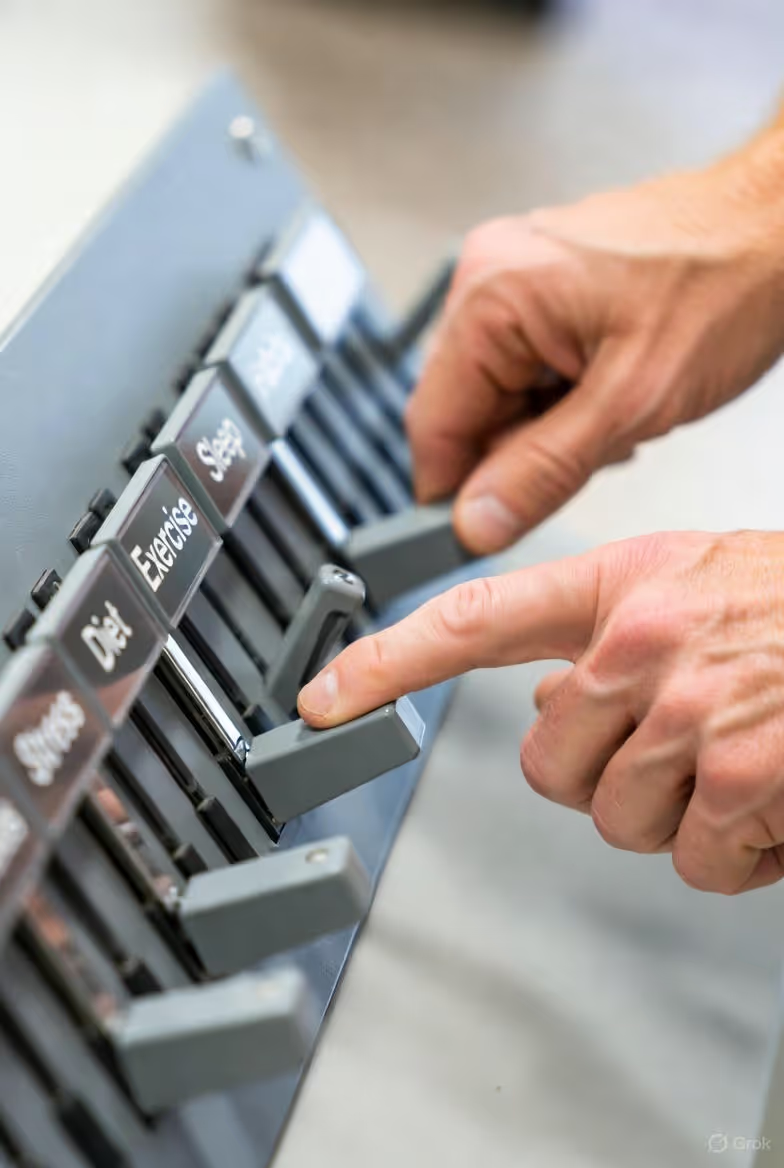
An unexpected, beautiful outcome of the long-term sleep score journey is a fundamental shift in your relationship with your own body. In the beginning, you are entirely data-dependent. You need the number to tell you how you slept. But over months of consistent tracking and experimentation, something begins to change. The external data starts to align with, and then refine, your internal sensing.
You develop what can be called "Data-Informed Intuition."
This doesn’t make the tracking obsolete. Instead, it elevates its purpose. You wear your ring not because you’re ignorant of your state, but because it provides a continuous, objective feedback loop for a complex system. It helps you catch subtle regressions, confirms your positive habits, and allows you to run new experiments as your life changes (e.g., a new job, a new training cycle, becoming a parent).
The mindset evolves from "What does my score say?" to "I am collaborating with this data to steward my well-being." This is the mark of true integration. The tool has served its ultimate purpose: it has helped you rebuild a trusting, communicative relationship with your own physiology. It has made you the expert on you.
As your sleep score journey progresses past the initial months, a more expansive picture begins to emerge. The singular focus on sleep naturally widens, revealing its role as the central pillar in a temple of wellness. You start to see sleep not as a standalone metric, but as the foundational input that influences, and is influenced by, every other aspect of your health. This is the stage of integration, where the data from your nights becomes the key to unlocking peak performance and vitality in your days.
Your smart ring, acting as a 24/7 health monitor, provides the perfect platform for this synthesis. By correlating your sleep score with daytime metrics, you move beyond sleep quality and begin to assess sleep sufficiency and efficiency for your unique life demands.
The Critical Day-After Correlations:
This holistic view fosters a systems-thinking approach to health. You stop optimizing sleep in a vacuum and start managing your entire energy budget. You understand that an intense workout is an investment that demands a sleep payoff. You see that a high-stress day requires a deliberate, protective wind-down ritual to safeguard the night’s recovery. The ring becomes the dashboard for your human operating system, with the sleep score as its most critical diagnostic. For those interested in how this integrated approach shapes our product philosophy, you can learn more about our mission to connect these data dots.
With several months of rich, correlated data, you possess something incredibly valuable: a personalized audit trail of your life. This allows you to move from micro-experiments ("What happens if I don't drink coffee after 2 PM?") to macro-analyses ("What seasonal patterns affect my sleep, and how can I adapt?"). Quarterly reviews of your sleep score trends become strategic planning sessions for your well-being.
Conducting Your Quarterly Sleep Audit:
This audit process transforms your wellness from a series of reactions into a managed, strategic endeavor. It provides a clear feedback loop that either reinforces effective strategies or prompts intelligent pivots. It’s the difference between driving while only looking at the speedometer (daily score) and periodically reviewing the map and trip computer (quarterly trends) to ensure you’re on the most efficient route to your destination. Sharing these long-term success patterns is a cornerstone of the community stories we celebrate.
No long-term journey is a straight, upward line. Life, in its vibrant complexity, will interject. The true test of your sleep score journey isn’t maintaining perfection during ideal conditions; it’s how skillfully you navigate the inevitable disruptions: cross-time-zone travel, a bout of the flu, a period of intense grief or stress. These are not failures; they are data-rich chapters that teach resilience.
Framework for Navigating Disruptions:
In these phases, the sleep score becomes a diagnostic tool for your recovery capacity, not a performance metric. It teaches you to listen even more deeply. The resilience built from seeing yourself bounce back after these setbacks—watching your score climb back to its baseline—is a profound confidence builder. It proves that your healthy habits have created a system that can withstand shocks and regain equilibrium. For practical tips on managing sleep during life’s challenges, our resource library on the blog offers ongoing support.
After mastering the personal levers of diet, exercise, and routine, your journey leads you outward. You begin to see how your sleep is woven into your social fabric and physical environment. This stage is about optimizing the external world to support your internal recovery.
The Social Sync:
The Environmental Fine-Tuning:
This stage of the journey is about claiming agency over your entire sleep ecosystem. It moves from personal discipline to environmental design, creating a world that passively supports your rest. It’s a powerful testament to how deep self-knowledge, facilitated by a tool like Oxyzen, can reshape your external reality for the better. The pursuit of this holistic harmony is deeply connected to the story and vision behind our technology.
This is perhaps the most profound and motivating aspect of the multi-year sleep score journey: its predictive power. Chronic sleep deficiency is a well-established risk factor for a host of serious conditions, including hypertension, cardiovascular disease, type 2 diabetes, obesity, and depression. Conversely, high-quality, consistent sleep is a powerful prophylactic. Your long-term trend line is more than a record of past rest; it’s a leading indicator of your future health trajectory.
Understanding the Predictive Biomarkers:
By tracking these metrics, you are engaging in preventative health monitoring. You’re not waiting for a symptom to appear; you’re watching the foundational metrics that precede symptoms. A gradual, unwanted shift in your sleep architecture or associated biomarkers is an early warning system, giving you time to intervene—to adjust your training, manage stress more aggressively, or seek medical advice—long before a clinical issue emerges.
This transforms your relationship with healthcare from passive to proactive. You walk into a doctor’s office not just with symptoms, but with a detailed, longitudinal report on your primary recovery process: your sleep. This is the ultimate empowerment of the quantified self. To understand more about the science behind these long-term health connections, our blog features ongoing research and insights.
After a year or more of tracking, a subtle yet significant shift occurs. The initial fervor for optimization mellows into a sustainable, integrated practice. The sleep score journey matures from a project into a culture—a permanent, woven-in part of your life’s fabric. This is the stage of mastery, where the habits are automatic, the intuition is sharp, and the data serves as a gentle guide rather than a demanding coach.
Hallmarks of a Sustainable Sleep Culture:
By this stage in your sleep score journey, you have moved from general wellness into the realm of high-resolution personal optimization. Your data is no longer just telling you if you slept well; it's providing the blueprint for achieving specific, ambitious goals. Whether you're an athlete chasing a personal record, a professional preparing for a high-stakes presentation, or a creative seeking a state of flow, your sleep architecture holds the key to unlocking peak performance.
Sleep Architecture as Performance Fuel:
Different types of performance are supported by distinct neural and physiological processes, which are, in turn, fueled by specific sleep stages. Your long-term data allows you to tailor your sleep to your goals.
The Pre-Event Sleep Taper:
Just as athletes taper their training before a competition, you can learn to "taper" your sleep. Your historical data reveals how many nights of optimal sleep you need to feel and perform at your best. For many, it's not just one good night, but a 3-5 day series of high-score nights that culminates in peak readiness. You'll use your data to meticulously protect your schedule, nutrition, and stress levels in this lead-up window, treating it with the same importance as the event itself. This transforms sleep from a recovery tool into a strategic performance enhancer.
Your sleep tracking tool is not a static device. As a piece of advanced technology, it evolves. Firmware updates, algorithm improvements, and new feature integrations are not mere technicalities; they are upgrades to your own perceptual system, offering ever-deeper clarity into your health. Understanding and embracing this evolution is part of the long-term journey.
When the Algorithm Changes:
It's possible that after an update, you might see a shift in your baseline scores or the weighting of different metrics. This is not a sign that your sleep has changed overnight, but that the measurement has become more sophisticated.
Integrating with the Broader Ecosystem:
The true power of a device like Oxyzen is unlocked when it speaks to other apps and services. Over time, you can integrate your sleep data with:
This interconnected web of data creates a holistic feedback loop that is greater than the sum of its parts. It automates the correlation process, providing insights like, "On days when you log a mindfulness session and keep saturated fat under 30g, your deep sleep increases by an average of 12%." To stay abreast of how these integrations and updates can enhance your journey, our FAQ section is regularly updated with the latest technical guidance.
Humans are social creatures, and wellness is often amplified in community. While sleep is a solitary act, the journey to improve it doesn't have to be lonely. One of the most rewarding phases of long-term tracking is connecting with others on a similar path, transforming personal data into shared stories and collective wisdom.
The Power of Shared Data (Anonymously):
Platforms that allow for safe, anonymized community benchmarking can be incredibly motivating. Seeing that your month-over-month improvement in sleep regularity is in the top 20% of users in your age group provides a powerful sense of progress. It normalizes struggles ("Oh, everyone's deep sleep dips in January!") and celebrates collective wins.
Accountability and Friendly Challenge:
Forming a small, trusted "sleep circle" with friends, family, or online peers can elevate your commitment. You can:
This social layer adds a dimension of encouragement and accountability that pure self-tracking cannot. It turns the journey from a private experiment into a shared exploration of human potential.
Contributing to the Larger Story:
Your long-term data, when aggregated anonymously with millions of others, contributes to population-level health insights. This "citizen science" aspect is profoundly meaningful. You're not just improving your own life; your journey helps researchers understand sleep patterns across cultures, age groups, and lifestyles. You become part of the story of advancing human understanding of rest. This collective mission is a core part of the vision we are building towards.
The ultimate testament to the value of the sleep score journey is its relevance across a lifetime. Your sleep needs and patterns will change as you age. A tool that provides longitudinal data becomes an invaluable companion, helping you navigate these transitions with grace and intelligence, not anxiety.
Tracking Life Stage Transitions:
A Baseline for Health Conversations:
Perhaps most importantly, your multi-year dataset becomes a powerful asset in healthcare settings. Instead of telling a doctor, "I sleep poorly," you can say, "My deep sleep, which has averaged 22% for five years, has dropped to an average of 14% over the last three months, coinciding with an elevated nocturnal heart rate." This objective, longitudinal information is invaluable for diagnosing underlying conditions and measuring the efficacy of treatments.
Your sleep data becomes the longest, most consistent health diary you will ever keep. It is the story of your body's nightly journey through decades of life, a story of resilience, adaptation, and the lifelong pursuit of restoration.
We have now traversed the expansive landscape of the sleep score journey, from the first days of establishing a baseline to the lifelong practice of aging with data-informed grace. This journey reveals that a sleep score is far more than a number—it is a dynamic language through which your body communicates its needs, its struggles, and its triumphs.
You began by seeking a simple answer to "How did I sleep?" and discovered a profound dialogue about how you live. You learned to interpret nightly fluctuations, wield lifestyle levers with precision, navigate plateaus with patience, and celebrate the compounding rewards of consistency. You saw sleep integrate with your daily performance, your long-term health forecasting, and your very sense of self, evolving from tracked metric to honed intuition.
The path does not end here. Each new life chapter, each technological advancement, each deeper question you ask will open new avenues of exploration. The journey is iterative and unending, a continuous cycle of observation, insight, adaptation, and growth.
The most powerful tool in this endeavor is not just the sophisticated sensor on your finger, but the mindset it fosters: one of curiosity, self-compassion, and empowered agency. You are no longer a passenger in your own health; you are the navigator, charting a course toward sustained vitality, guided by the reliable stars of your own data.
This is the promise of the sleep score journey. It is an invitation to a lifelong partnership with yourself, facilitated by knowledge, and dedicated to the simple, revolutionary act of resting well to live fully.
By now, you understand the "what" behind your sleep score. You've identified correlations and run experiments. The next frontier of mastery is the deliberate, systematic design of your pre-sleep environment and behavior—the wind-down ritual. This isn't just about avoiding screens; it's about architecting a 60- to 90-minute transitional period that actively shifts your nervous system from a state of sympathetic (fight-or-flight) dominance to parasympathetic (rest-and-digest) readiness. Your data provides the blueprint for this engineering project.
Deconstructing the Wind-Down: A Multi-System Approach
A high-impact wind-down ritual addresses four key systems: neurological, physiological, cognitive, and environmental. Your sleep score, particularly the Sleep Latency and Restoration metrics, will be your report card on its effectiveness.
The goal is to make this ritual non-negotiable and enjoyable—a gift to yourself, not a chore. Over months, the compounding effect on your sleep score consistency is profound. For more ideas on crafting the perfect personalized ritual, our blog offers a wealth of user-tested strategies.
The world of sleep supplements is vast and often confusing. Magnesium, melatonin, GABA, L-theanine, glycine—the list is long, and effects are highly individual. Relying on anecdote can be expensive and ineffective. Your sleep score journey provides the perfect framework for conducting rigorous, personal trials to determine if, when, and which supplements work for you.
Principles for a Data-Driven Supplement Trial:
Common Data-Led Insights:
This empirical approach demystifies supplementation. It turns guesswork into a science, saving you money and ensuring you only put into your body what your own data confirms is beneficial. Always consult with a healthcare professional before starting any new regimen, and use your data to inform those conversations. For community-driven insights on what others have tried, browsing user testimonials can provide helpful context.
Your sleep journey will inevitably lead you to the concept of chronotype—your genetically influenced predisposition for sleep and wake times. Are you a natural early bird (lion), a night owl (wolf), or something in between (bear/dolphin)? Fighting your chronotype is a recipe for suboptimal sleep scores and constant friction. The wisdom lies in using your data to confirm your type and then orchestrating your life to harmonize with it, as much as possible.
Using Data to Discover Your True Chronotype:
While questionnaires can hint, your long-term Oxyzen data provides objective evidence.
Strategies for Harmonizing Life with Chronotype:
Your Trusted Sleep Advocate: Sleep Foundation — https://www.sleepfoundation.org
Discover a digital archive of scholarly articles: NIH — https://www.ncbi.nlm.nih.gov/
39 million citations for biomedical literature :PubMed — https://pubmed.ncbi.nlm.nih.gov/
Experts at Harvard Health Publishing covering a variety of health topics — https://www.health.harvard.edu/blog/
Every life deserves world class care :Cleveland Clinic - https://my.clevelandclinic.org/health
Wearable technology and the future of predictive health monitoring :MIT Technology Review — https://www.technologyreview.com/
Dedicated to the well-being of all people and guided by science :World Health Organization — https://www.who.int/news-room/
Psychological science and knowledge to benefit society and improve lives. :APA — https://www.apa.org/monitor/
Cutting-edge insights on human longevity and peak performance:
Lifespan Research — https://www.lifespan.io/
Global authority on exercise physiology, sports performance, and human recovery:
American College of Sports Medicine — https://www.acsm.org/
Neuroscience-driven guidance for better focus, sleep, and mental clarity:
Stanford Human Performance Lab — https://humanperformance.stanford.edu/
Evidence-based psychology and mind–body wellness resources:
Mayo Clinic — https://www.mayoclinic.org/healthy-lifestyle/
Data-backed research on emotional wellbeing, stress biology, and resilience:
American Institute of Stress — https://www.stress.org/


