


The Weekly Stress Report: How to Review Your Data Effectively
A weekly review helps you spot what contributed to high and low stress periods, allowing you to plan and adjust for the coming week.
A weekly review helps you spot what contributed to high and low stress periods, allowing you to plan and adjust for the coming week.
%402x.svg)
You wake up feeling frayed. Your to-do list mocks you from the nightstand, your shoulders are tight knots of tension, and a low hum of anxiety about the day ahead is already buzzing in your ears. You feel stressed. But what’s the real story? Was it the late-night work email, the two extra cups of coffee, the unresolved argument, or the poor sleep that’s tipping you over the edge? For decades, stress management was guesswork—a game of pinning feelings to potential causes. But that era is over.
Welcome to the age of quantified self-awareness, where technology like advanced wellness wearables transforms vague feelings into precise, actionable data. At the forefront of this revolution is the smart ring, an unobtrusive device that gathers a 24/7 stream of physiological intelligence as you live your life. The crown jewel of this continuous tracking isn’t just the raw numbers; it’s the curated, insightful narrative delivered to you each week: your Weekly Stress Report.
This report is more than a dashboard; it’s a personal stress ethnography. It connects the dots between your heart rate variability (HRV), sleep architecture, activity levels, and physiological stress responses to paint a holistic picture of your nervous system’s weekly journey. But data alone is just noise. The profound power lies in your ability to interpret it—to move from simply seeing your stress to understanding and managing it.
This comprehensive guide is your master key. We will dive deep into the art and science of effectively reviewing your Weekly Stress Report. Whether you’re a new user of a smart ring like Oxyzen or a seasoned data enthusiast, you’ll learn how to translate complex biomarkers into a clear roadmap for enhanced resilience, better sleep, and a more balanced life. By the end, you won't just be reading a report; you'll be conducting a strategic review of your most valuable asset—your well-being.
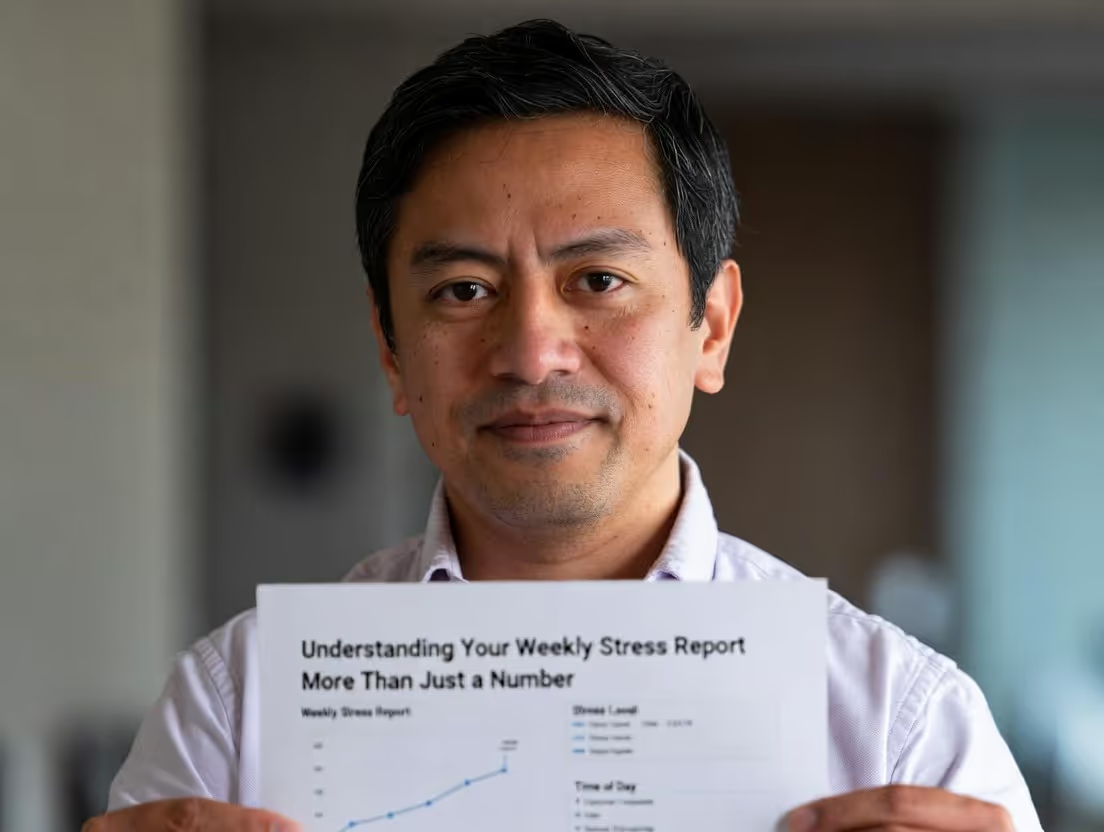
Before you can master the review, you need to understand the document itself. Your Weekly Stress Report is a synthesized story, compiled from over 100,000 discrete data points your ring collects daily. It’s not merely an average; it’s a narrative that highlights trends, patterns, and pivotal moments.
At its core, the report interprets signals from your autonomic nervous system (ANS). Think of your ANS as your body’s autopilot, managing everything from your heartbeat to digestion. It has two main branches: the sympathetic ("fight-or-flight") and the parasympathetic ("rest-and-digest"). Chronic stress tips the balance heavily toward sympathetic dominance, a state linked to burnout, inflammation, and a host of health issues.
Your smart ring, like the one from Oxyzen, acts as a non-invasive window into this system. The primary metric here is Heart Rate Variability (HRV). Contrary to popular belief, a healthy heart doesn’t beat like a metronome. The tiny, millisecond variations between beats are crucial. Higher HRV generally indicates a resilient, adaptable nervous system that can smoothly transition between stress and recovery. Lower HRV suggests your system is under strain, stuck in a stressed or fatigued state.
Your Weekly Stress Report translates this and other data into intuitive sections:
The goal is not to achieve a stress-free report—that’s neither possible nor desirable. Stress is a natural, essential response. The goal is to see a dynamic, responsive pattern where stress is followed by adequate recovery, creating a rhythm of resilience. Understanding this framework is the first step to moving from passive observation to active management.
You wouldn’t review your financial portfolio in a noisy cafe while distracted by notifications. Your inner portfolio—your physiological well-being—deserves the same, if not greater, focused attention. Creating a consistent ritual for reviewing your Weekly Stress Report is fundamental to deriving value from it.
1. Choose Your Time & Space: Dedicate a calm, 20-30 minute window each week. Sunday evening is a popular choice, offering a reflective close to the past week and a planning session for the week ahead. Alternatively, Monday morning can set an intentional tone. Find a quiet space where you won’t be interrupted.
2. Gather Your Tools: Have your report open on a large screen if possible (tablet or computer), a notebook or digital document for notes, and a pen. The physical act of writing can deepen processing and commitment.
3. Center Yourself First: Before diving into the data, take two minutes to check in with yourself. Close your eyes. How do you feel about the past week? What moments of tension or ease stand out? This subjective benchmark is crucial. It allows you to later compare your perception of stress with the physiological reality shown in the data. Sometimes they align perfectly; other times, you may discover hidden stressors or unrealized resilience.
4. Adopt a Curious, Non-Judgmental Mindset: This is perhaps the most important step. Your data is not a report card. A "red" or high-stress day is not a failure. It is information. Approach it with the curiosity of a scientist studying a fascinating subject: yourself. Ask "what" and "why," not "why did I fail?" Judgment triggers defensiveness and disengagement. Curiosity fuels insight and change.
5. Review in Context: Quickly jot down any major events from the week: a big work project deadline, a social conflict, a change in routine, travel, or illness. This life-log will be invaluable when you start correlating.
This ritualistic approach transforms data review from a chore into a meaningful practice of self-care and self-knowledge. It’s the foundation upon which all effective analysis is built. For those just starting this journey, Oxyzen's FAQ page offers excellent guidance on establishing these kinds of consistent wellness habits with your device.
Now, with your ritual established, you open the report. The first place your eyes should land is the Overall Stress Trend. This is your executive summary. It typically uses a visual metric—like a dial, a score, or a trend line—to give you the week’s "vibe."
Don't Fixate on the Single Score. Instead, focus on the trend. Was the score stable? Did it improve or decline over the course of the seven days? A steady, moderate score might indicate consistency, even if it’s not your ideal. A score that started high and ended low could tell a story of successful stress management or recovery from an acute event.
This is where your personal baseline becomes your most important reference point. Your baseline is not a universal number; it’s your unique, established normal range for metrics like HRV and RHR, calculated over time. The report’s true power lies in comparing your weekly data to yourself, not to population averages or your super-fit friend.
Key Questions for the Big Picture:
Understanding your big picture sets the stage. It tells you whether this was a typical week or an outlier, and it primes you to dig into the daily details to understand the "why" behind the trend. Remember, the mission of devices like the Oxyzen ring is to help you find and maintain your optimal balance, not someone else's. You can read about the philosophy behind this personalized approach in Oxyzen's Our Story page.
Zooming in from the weekly trend, the daily breakdown is where your detective work truly begins. This view, often a timeline or calendar with color-coded stress states (e.g., blue for recovery, yellow for balanced, orange/red for stressed), provides a chronological map of your nervous system’s activity.
Your task here is correlation. You are matching the objective data on the screen with your subjective life-log from the ritual.
Start with the Obvious Peaks: Identify the days or specific hours with the highest stress signals. Now, consult your notes.
Don’t Neglect the Valleys: Equally important are the periods of deep recovery (often marked in blue). What were you doing during those times?
Look for Patterns, Not Just Isolated Events:
This forensic analysis moves you from "I had a stressful week" to "The key stressors were my Tuesday meeting and poor sleep hygiene on Friday, while my most potent recovery activities were Wednesday yoga and Sunday disconnection." This specificity is what makes the data empowering. For more ideas on interpreting daily patterns and improving your routine, a wealth of resources can be found on the Oxyzen blog.
If daily analysis is detective work, then sleep analysis is cornerstone evidence. The relationship between sleep and stress is a vicious—or virtuous—cycle. High stress degrades sleep quality; poor sleep degrades stress resilience. Your Weekly Stress Report intimately links these two.
Don’t just look at sleep duration (though 7-9 hours is the well-established target). The report will provide deep insight into sleep quality:
Key Review Questions for Sleep:
By mastering the sleep section of your report, you identify the most powerful lever for improving your overall stress resilience. Improving sleep is often the most effective first step in changing your entire weekly stress profile.
Not all stress is bad. Eustress, or positive stress, is the kind that challenges us in a manageable way and leads to growth, adaptation, and improved resilience. Your physical activity is a primary source of eustress. The challenge in your report is to distinguish between the productive stress of a good workout and the counterproductive strain of overtraining or chronic, unrecovered exertion.
Your report will integrate activity data, often through an Activity Score or Strain metric. This looks at your daily movement volume and intensity.
How to Review Activity in Context with Stress:
Activity is a key contributor to your weekly picture. A well-planned week will show a rhythmic wave of activity strain and recovery. A poorly managed week might show either constant, flat-line low activity (detrimental to health) or constant, high activity with no recovery valleys—a direct path to burnout and injury.

By this point in your review, you’ve synthesized the overall trend, the daily forensic log, the sleep analysis, and the activity interplay. Now, you ascend to a higher level of insight: identifying your personal, repeatable stress triggers.
The report’s "Contributing Factors" or correlation analysis section is designed for this. It uses algorithms to highlight the lifestyle metrics that most strongly correlated with your stress levels for that specific week.
Common Triggers Revealed by Data:
Your action here is to move from correlation to hypothesis. The data doesn’t prove caffeine caused your stress, but it shows a strong correlation. This gives you the evidence to run a personal experiment: "Next week, I will limit myself to one coffee before 10 AM and observe if my afternoon stress scores improve."
This process of identifying and testing your personal triggers is the essence of biohacking. It turns abstract wellness advice into personalized, verifiable truth. Many users share their own trigger-discovery journeys and the experiments that changed their data; you can find inspiring examples in the Oxyzen testimonials section.
Data without action is just trivia. The entire purpose of your weekly review ritual is to inform deliberate, intelligent choices for the week ahead. This is where you transition from analyst to strategist.
Based on your findings, create a simple, focused plan. Limit yourself to 1-3 actionable items to avoid overwhelm.
Sample Actions Derived from Common Insights:
Write these actions down. Place them where you’ll see them. The goal is not perfection, but mindful experimentation. You are using the upcoming week to test a hypothesis generated by your past week’s data. This creates a beautiful, closed-loop system: Live → Measure → Learn → Adjust → Repeat.

A significant pitfall on the path to quantified self-awareness is becoming a slave to the data. Constantly checking your live score, fixating on a single bad night, or feeling anxious because your HRV is 2 points lower today are counterproductive states. This is called data anxiety, and it defeats the entire purpose of reducing stress.
Healthy Data Hygiene Practices:
The technology, like the Oxyzen ring, is designed to be an empowering partner, not a punitive overseer. The company's vision, detailed in their About Us page, often centers on this harmony between technology and human intuition, not replacement.
Your final skill in effective data review is developing a long-term perspective. True changes in stress resilience and autonomic nervous system health happen over months and seasons, not days and weeks. Your weekly reports are individual chapters; you need to occasionally read the whole book.
What to Look for in Long-Term Trends (3-6 months):
This longitudinal review is where the investment in a smart ring truly pays off. It provides objective proof of your wellness journey, showing you how far you’ve come and guiding your future direction. It turns subjective feelings of "I think I'm handling things better" into an undeniable, graphed reality.
As we conclude this deep-dive into the mechanics of your Weekly Stress Report, we must arrive at the most human destination: the reintegration of intuition. The most effective well-being strategy is a marriage of objective data and subjective wisdom.
Your body has an intelligence that predates any wearable. The data is a powerful interpreter and clarifier of that intelligence, but it is not a replacement for it.
Scenarios for Prioritizing Intuition:
Your weekly review is the structured conversation between your quantified self and your felt self. Let them inform each other. Ask: "Does this data resonate with my experience? Does it explain something, or does it reveal a disconnect I need to explore?"
By mastering your Weekly Stress Report—from the ritual to the forensic analysis, from sleep decoding to long-term tracking—you graduate from being passively stressed to actively managing your resilience. You move from wondering why you're tired to knowing how to rest. You stop guessing at what works for you and start knowing, with data-backed confidence. This is the promise of modern wellness technology: not just to tell you your stress score, but to empower you to write a better story for the week ahead.
Human physiology is not linear; it is profoundly rhythmic. We are governed by cycles within cycles: the circadian rhythm (day/night), the ultradian rhythm (90-120 minute cycles of focus and rest within a day), and for many, infradian rhythms like menstrual cycles. Your Weekly Stress Report, when viewed over time, begins to reveal your personal symphony of these rhythms. Disrupting them is a primary source of stress; harmonizing with them is a foundation of resilience.
1. Circadian Alignment:
Your body expects stress and activity during the day and recovery and repair at night. A healthy report shows this clear diurnal pattern: higher stress/arousal metrics during waking hours, followed by a distinct, uninterrupted plunge into recovery during sleep. A red flag is a "flattened" pattern where daytime stress is not high enough (sedentary, under-stimulated) or, more commonly, nighttime recovery is not low enough (poor sleep, late-night stress). Ask: Does my data show a clear, daily rhythm of purposeful activity followed by deep recovery?
2. Ultradian Respect:
Within your day, your brain and body operate in ~90-minute waves of higher and lower alertness. Forcing yourself through these natural dips with caffeine or sheer willpower creates a stress debt. While your report may not show 90-minute cycles explicitly, you can infer them. A day of solid, focused work should, in a well-managed system, be followed by good recovery. If you are grinding through focus cycles without breaks ("monkey mind," constant context-switching), your overall daily stress score will be higher and more erratic. The action item becomes scheduling deliberate breaks to honor this rhythm.
3. Hormonal & Infradian Cycles (For Cycling Individuals):
For those who menstruate, this is a non-negotiable layer of context. Estrogen and progesterone dramatically influence autonomic nervous system function, core body temperature, and metabolism. It is critical to cycle-sync your data review.
Ignoring this cycle is like ignoring the tide. Reviewing your week without this context can lead to false conclusions ("Why is my resilience so bad this week?"). Instead, tag your cycle phase in your app or notes. Learn your personal patterns. Plan accordingly: schedule demanding tasks and intense workouts in your follicular phase, and prioritize restorative movement, flexibility, and stress-management techniques in your luteal phase. This isn't a limitation; it's a profound optimization of your energy.
Your report measures the physiological outcome of stress. The sources of that stress are manifold, and many are environmental or contextual—often invisible until you learn to spot their signature in your data.
1. Digital Stress (Doomscrolling, Notifications, Blue Light):
This is a pervasive modern stressor with a clear physiological footprint. An evening spent passively scrolling social media or watching stimulating content keeps your sympathetic nervous system subtly engaged, suppressing melatonin and impairing sleep onset and quality. The signature? A stress score that doesn’t descend properly in the evening, elevated resting heart rate during supposed downtime, and poor sleep latency (time to fall asleep). The correlation between "screen time after 9 PM" and "low sleep score" is often one of the strongest you’ll find.
2. Nutritional Inflammation:
Food is information. While a smart ring doesn't measure glucose directly (unless integrated with a CGM), the inflammatory response to certain foods can show up in your autonomic metrics. A meal high in processed sugars, unhealthy fats, or foods you have a sensitivity to can trigger a stress response: increased heart rate, reduced HRV, and even disrupted sleep as your body works to process it. Look for patterns: do days with certain dietary choices (e.g., heavy restaurant meals, high sugar intake) correlate with afternoon energy crashes and higher stress scores?
3. Psychological & Emotional Carryover:
This is the stress that doesn’t have a discrete event. It’s the low-grade worry about a future deadline, the unresolved tension in a relationship, the feeling of being overwhelmed by clutter. Its signature is often a persistently elevated baseline. Your stress score might not have dramatic peaks, but it never seems to dip into true recovery, even during sleep or on weekends. You might see a higher-than-normal resting heart rate throughout the night. This data is a powerful mirror, showing you that your body is holding the tension your mind is generating. It’s a call to address the root thought patterns or situations, not just the symptoms. For strategies on managing this mental load, many users find great support in the community stories shared on Oxyzen's testimonials page.
4. Sensory Overload:
Noise pollution, harsh lighting, and chaotic environments activate the nervous system. A workday in a loud open office, a commute in heavy traffic, or even a home environment with constant background noise can create a steady drip of stress hormones. Your data may show a consistently higher stress score during these environments compared to days spent in quiet, calm spaces.
By learning to recognize these invisible loads, you can create targeted interventions: implementing a digital sunset, identifying inflammatory foods, setting boundaries for worry time, or using noise-cancelling headphones. You move from feeling vaguely "stressed by life" to precisely identifying and mitigating specific environmental drains.
A powerful mental model for reviewing your Weekly Stress Report is to think of your resilience as a financial system. You have different "Stress Buckets" that get filled, and "Recovery Accounts" you can deposit into.
Your Primary Stress Buckets:
Your Recovery Accounts:
How This Model Informs Your Weekly Review:
This model, grounded in your data, helps you make strategic trades. It moves you from a simplistic "stress is bad" mindset to a sophisticated resource management paradigm. It answers the question: "I have to handle this stressful thing; what do I need to protect and amplify elsewhere to get through it resiliently?"
We've discussed identifying correlations. The next level is designing clean, personal experiments to test causation and find what works for you. Your Weekly Stress Report is the perfect laboratory notebook.
The Biohacking Loop:
1. Observe & Hypothesize (From Your Report): "My data shows my sleep HRV is consistently 15% lower on nights after I have a glass of wine after 8 PM."
2. Design an Experiment: "For the next two weeks, I will eliminate all alcohol after 6 PM. I will keep all other sleep variables as constant as possible (same bedtime, similar activity levels, etc.)."
3. Execute & Measure: Live the experiment. Your ring continues to collect data seamlessly.
4. Analyze & Conclude: After two weeks, review the reports. Compare the "no evening alcohol" weeks to your baseline. Did your average sleeping HRV improve? Did sleep restlessness decrease? Did morning readiness scores go up?
5. Iterate: If it worked, you've found a powerful lever. You can adopt it as a rule, or test modifications ("What about one glass before 6 PM?"). If it didn't change your data, the culprit might be something else. Form a new hypothesis.
Examples of Powerful Personal Experiments:
The key is to change one variable at a time and to give it enough time (at least 1-2 full weeks) to see a signal beyond daily noise. This process turns wellness from a set of generic rules into a personalized, evidence-based operating system. For inspiration and to learn about the science behind many of these levers, the Oxyzen blog is an excellent repository of research and user-tested ideas.

Inevitably, you will have weeks where the report looks like a disaster. Everything is "red," recovery is absent, and your scores are far from baseline. This could be due to illness, a family emergency, a work catastrophe, or simply a perfect storm of life events. How you review these weeks is critical.
The Unhelpful Response: Self-criticism. "I failed." "All my progress is lost." This adds psychological stress to the physiological stress, digging a deeper hole.
The Strategic, Compassionate Response: Curious, non-judgmental analysis focused on learning and damage control.
1. Context is Everything: First, note the obvious cause. You had the flu. You were traveling across 8 time zones. You had a major project deliverable. This immediately explains the data. The goal is not to judge it, but to observe the impact.
2. Look for the Body's Signals: Often, your data will show the onset of illness before you feel symptoms. A sustained elevation in resting heart rate and a drop in HRV can be an early warning sign. In a "sick week" report, look back 2-3 days before you felt bad. You might see the precursor signals. This is invaluable learning for the future.
3. Focus on the Recovery Curve: The most important part of a bad week is not the depth of the trough, but the slope of the recovery. As the acute stressor passes (the fever breaks, the project is submitted), does your data show a sharp rebound? A steep recovery curve indicates underlying resilience. A slow, sluggish return to baseline suggests you need to be more intentional with recovery practices.
4. Extract the Lesson: What was the primary stress bucket? What recovery account was most depleted? The lesson from a travel week might be, "My system is highly sensitive to time zone changes. I need a more robust plan for jet lag next time, including stricter light exposure on arrival." The lesson from an illness week might be, "When my RHR starts creeping up for two days, I need to pull back and rest immediately, even if I don't feel sick yet."
5. Practice Radical Rest: Let the data give you permission to rest without guilt. Seeing the physiological proof of your strain can be the catalyst you need to truly shut down, cancel plans, and prioritize sleep and nourishment.
A "red" week is not a failure; it's a stress test. It reveals your current limits and provides the most potent data on what it takes for you to recover. It's an essential part of the long-term journey.
Humans are social animals, and our relationships are a massive modulator of our nervous system. Safety and connection stimulate the parasympathetic (rest-and-digest) system. Conflict, loneliness, and lack of safety stimulate the sympathetic (fight-or-flight) system. Your stress data is quietly recording the quality of your social world.
Signatures of Positive Connection:
Signatures of Relational Stress:
Using This Insight:
Review your weekly log with a social lens. Tag days with significant social interactions (positive or negative). Do you see a pattern? This data isn't meant to make you avoid conflict, but to understand its true cost and to highlight the incredible value of positive connection as a recovery activity. It might prompt you to schedule more quality time with supportive people or to address lingering conflicts that are creating a chronic physiological tax. Understanding this holistic impact is core to the vision of wellness technology as a tool for a better life, a principle you can explore further in Oxyzen's Our Story.
Your smart ring’s Weekly Stress Report is a powerhouse of autonomic data. But you are more than your HRV. To get the fullest picture, consider integrating insights from other data streams you might already have. This creates a holistic dashboard for your health.
1. Sleep with a Dedicated Tracker: While rings are excellent for sleep, some users pair them with a under-mattress pad (like Withings) for even more detailed sleep environment data (room temperature, snoring, room noise). Correlate this with your ring’s sleep score for a complete view.
2. Nutrition & Glucose Monitoring: If you use a food logging app (like Cronometer) or a Continuous Glucose Monitor (CGM), you have a goldmine for correlation. Sync up your timelines. Does that post-lunch glucose spike coincide with an afternoon crash and a rise in your stress score? Does a day of balanced, protein-rich meals correlate with more stable energy and lower stress?
3. Calendar & Productivity Apps: Your Google Calendar or project management tool (like Todoist) holds the official record of your time. Export a busyness log. Do weeks with back-to-back 30-minute meetings show higher average stress than weeks with deep work blocks? Does a day with no breaks between events line up with a terrible night's sleep?
4. Journaling & Mood Tracking: This is the qualitative counterpart to your quantitative data. Apps like Day One or even a simple notebook entry provide context that numbers cannot. "Felt anxious all morning" next to a measured stress spike validates the data. "Felt great despite low HRV" prompts a different investigation (e.g., coming down with a cold).
The practice here is not to become overwhelmed by data, but to perform targeted, occasional deep dives. Once a month, perhaps, lay out your stress report, your food log, and your calendar for a representative week. Look for the story they tell together. This multi-layered analysis can reveal root causes that single-stream data can only hint at. It exemplifies the comprehensive approach to well-being that guides companies like Oxyzen, whose mission you can learn more about on their About Us page.
As you practice this weekly review month after month, a shift occurs. The initial focus is almost always stress management—putting out fires, reacting to red zones, and trying to feel less overwhelmed. But with consistent practice and the long-term perspective, the focus naturally evolves to resilience building.
Resilience is not the absence of stress; it is the capacity to withstand, adapt to, and recover from stress more efficiently. Your long-term data charts this evolution.
Signs You Are Building Resilience:
In this phase, your weekly review becomes less about "what went wrong" and more about "how can I strategically stress my system for positive adaptation?" You might look at a week of good recovery and think, "My system is strong. I can safely increase my workout intensity next week to build more fitness." Or, "My stress resilience is high, so I can take on that challenging new project at work."
You transition from being a passive recipient of stress to an active architect of your capacity. This is the ultimate goal: using data not just to survive your life, but to strategically and intentionally build a life of greater strength, vitality, and purpose. It’s a journey of continuous learning, and for common questions along the way, the Oxyzen FAQ serves as a helpful companion guide.
The pinnacle of engaging with your biometric data is not becoming dependent on the device, but rather, using it to refine your internal compass. The goal is embodied awareness—the ability to accurately perceive your body’s signals of stress, energy, and need without constantly checking an app. Your smart ring is the training wheels for this innate human capacity, which modern life has often suppressed.
How the Report Fosters Embodied Awareness:
The Practice: Periodically, try a “sense-check” before viewing your daily data. In the morning, ask: “Based on how I feel, what will my sleep score be?” In the evening: “How stressed does my body feel today on a scale of 1-10?” Then, check the app. The discrepancy is where learning happens. The ultimate aim is for the internal sense and the external data to align so closely that the device becomes a periodic validator, not a constant crutch. This harmonious relationship between human intuition and technology is a core value explored in Oxyzen's Our Story.
Well-being is not a solitary pursuit. While your stress data is deeply personal, selectively sharing insights from your Weekly Stress Report can transform your relationships and create powerful accountability structures.
1. With a Partner or Family:
Sharing your data can foster empathy and collaborative problem-solving. Instead of a vague “I’m tired,” you can say, “My data shows my nervous system is really struggling to recover this week. The report suggests my sleep has been poor. Can we brainstorm how to make our evening routine more conducive to rest?” This moves conversations from blame (“You’re keeping me up!”) to shared solutions (“How can we both wind down better?”). You might discover joint patterns—like weekend over-scheduling that drains you both—and make changes as a team.
2. With a Coach, Therapist, or Healthcare Provider:
This is where your report becomes a powerful clinical tool. Bringing concrete data to a professional session breaks through the fog of subjective reporting.
3. In a Trusted Community:
Online forums or local groups focused on biohacking or wellness provide a space to share anonymized charts, ask for interpretation help, and learn from others’ experiments. Seeing how others navigate similar data patterns can be incredibly enlightening. The shared journeys of real users, often filled with trials and triumphs, can be found in spaces like the Oxyzen testimonials page, offering both inspiration and practical ideas.
The key is to share with intention and clear communication. The data is not a weapon or a scorecard; it’s a communication tool that brings objectivity to the deeply subjective experience of being human.
As we embrace the power of biometric data, we must also navigate its ethical complexities with eyes wide open. A mindful practice requires boundaries to ensure the tool serves you, not the other way around.
1. Data Privacy and Ownership:
This is paramount. You must understand:
A trustworthy company will be transparent about these policies. Before fully committing to any ecosystem, review their privacy documentation carefully. Your physiological data is among the most personal information that exists; its stewardship should be treated with the utmost seriousness. For a clear example of how one company approaches this responsibility, you can review Oxyzen's FAQ and policy pages for detailed information.
2. Avoiding Obsession and Orthosomnia:
“Orthosomnia” is a clinically recognized condition where the pursuit of perfect sleep data via trackers ironically causes anxiety and insomnia. The same can happen with stress data. Warning signs include:
The Antidote: Remember the mantra: The data is a guide, not a god. Use the weekly review rhythm, not minute-by-minute monitoring. Let life happen. A late night out with old friends might “red” your sleep score but “green” your soul. The data will capture the cost, but you alone can measure the value. Balance the quantitative with the qualitative.
3. The Socioeconomic and Accessibility Lens:
It’s important to acknowledge that advanced bio-tracking is a privilege. Not everyone has the resources for a smart ring or the bandwidth to analyze data. As you benefit from this technology, cultivate humility. The insights you gain about universal human physiology—the need for rhythm, recovery, and connection—are truths that can be respected and pursued in myriad ways, with or without technology.
The technology behind your Weekly Stress Report is not static. We are on the cusp of a revolution where passive tracking evolves into active, predictive, and deeply personalized guidance. Understanding this horizon helps you appreciate the tool’s potential and engage with it thoughtfully.
1. From Descriptive to Predictive Analytics:
Current reports are largely descriptive: they tell you what happened. The next frontier is predictive. By analyzing your long-term data trends alongside population models, AI will be able to:
2. Hyper-Personalized Recommendations:
Generic advice (“get 8 hours of sleep”) will be replaced by hyper-personalized insights. The AI will learn your unique response patterns.
3. Integrated Wellness Ecosystems:
Your stress report will not live in a silo. It will seamlessly integrate with other data—from your electronic health record (with your permission) to your fitness apps, calendar, and even smart home devices. Imagine:
This future is one of proactive well-being, where technology doesn’t just report on your state but helps you actively steward it. It’s a partnership where the machine handles pattern recognition at scale, freeing you to focus on the human experience of living well. To stay abreast of these evolving capabilities, following resources like the Oxyzen blog can provide ongoing updates and context.
Ultimately, the discipline of reviewing your Weekly Stress Report should lead you to a deeper question: What is my philosophy of well-being? The data provides the “how,” but you must define the “why.”
Your data-driven journey will inevitably clarify your values:
Let your data inform, not dictate, these answers. A report might show you are most resilient with 8.5 hours of sleep, but your life phase with a newborn baby makes that impossible. Your philosophy then guides your response: “I will prioritize sleep where I can, and use other recovery levers (nutrition, micro-breaks, connection) to support myself compassionately through this season.”
Your well-being philosophy becomes the lens through which you interpret every report. It turns data points into meaningful choices aligned with your life’s purpose.
For this to be transformative, it must be sustainable. It must weave into the fabric of your life, not be a burdensome add-on. Here’s how to build a lifelong practice.
1. Keep It Simple: Your review ritual should be lean. 20-30 minutes, a few key questions, 1-2 action items. Avoid the trap of over-complication.
2. Embrace Seasonality: Your engagement will ebb and flow. There will be months you dive deep into experiments, and months you simply check the trend and move on. That’s healthy. Allow the practice to breathe.
3. Celebrate Non-Linear Progress: Well-being is not a straight line upward. It’s a spiral with setbacks, plateaus, and leaps. Use your long-term charts to see the overall direction of travel, not the weekly wobbles. Celebrate the rising baseline over a year.
4. Revisit Your “Why”: Periodically, ask yourself why you do this. Is it still to manage anxiety? To improve athletic performance? To age vibrantly? Connecting to a core motivation renews your commitment.
5. Know When to Step Away: If you feel the onset of obsession or anxiety, take the ring off for a week. Reconnect with your unmeasured self. This isn’t quitting; it’s a meta-habit that ensures the tool remains in service to you.
The Weekly Stress Report is far more than a feature of a smart ring. It is a portal to self-mastery. It represents a fundamental shift from being a passive passenger in your body to becoming an informed, compassionate pilot of your own nervous system.
You began this journey seeking to understand a graph. You end it with a deeper understanding of yourself—your rhythms, your triggers, your capacities, and your needs. You have learned to speak the language of your autonomic nervous system, to respect its whispers before they become screams, and to strategically invest in your resilience.
This practice merges the cutting-edge with the ancient: technology that offers microscopic clarity, in service of the timeless human pursuits of balance, vitality, and peace. It empowers you to build a life not just of less stress, but of greater strength; not just of avoidance, but of engaged and resilient living.
Let your Weekly Stress Report be your compass. Review it not with judgment, but with curiosity. Not with rigidity, but with wisdom. Let it guide you toward a life where data informs intuition, discipline fosters freedom, and self-awareness blossoms into genuine well-being. The story it tells is ultimately yours to write.
Your Trusted Sleep Advocate: Sleep Foundation — https://www.sleepfoundation.org
Discover a digital archive of scholarly articles: NIH — https://www.ncbi.nlm.nih.gov/
39 million citations for biomedical literature :PubMed — https://pubmed.ncbi.nlm.nih.gov/
Experts at Harvard Health Publishing covering a variety of health topics — https://www.health.harvard.edu/blog/
Every life deserves world class care :Cleveland Clinic - https://my.clevelandclinic.org/health
Wearable technology and the future of predictive health monitoring :MIT Technology Review — https://www.technologyreview.com/
Dedicated to the well-being of all people and guided by science :World Health Organization — https://www.who.int/news-room/
Psychological science and knowledge to benefit society and improve lives. :APA — https://www.apa.org/monitor/
Cutting-edge insights on human longevity and peak performance:
Lifespan Research — https://www.lifespan.io/
Global authority on exercise physiology, sports performance, and human recovery:
American College of Sports Medicine — https://www.acsm.org/
Neuroscience-driven guidance for better focus, sleep, and mental clarity:
Stanford Human Performance Lab — https://humanperformance.stanford.edu/
Evidence-based psychology and mind–body wellness resources:
Mayo Clinic — https://www.mayoclinic.org/healthy-lifestyle/
Data-backed research on emotional wellbeing, stress biology, and resilience:
American Institute of Stress — https://www.stress.org/


