Delhi Startup Founder ki Story: Stress Dikhta Nahi, Data Mein Pakda Jaata Hai
The Story of Arjun Verma: When "Hustle Culture" Almost Cost Everything
Location: Hauz Khas, New Delhi | Age: 29 | Profession: Co-Founder & CEO, FinTech Startup | Timeline: March 2024 - June 2024
The Invisible Enemy Every Founder Faces
Arjun Verma looked successful from the outside. His LinkedIn profile was picture-perfect: IIT Delhi graduate, ex-McKinsey consultant, now founder of "PayFlow"—a B2B fintech startup that had just raised ₹12 crore in Series A funding. TechCrunch featured him in "30 Under 30 Indian Entrepreneurs to Watch." His Instagram stories showed him at startup events, networking dinners, and whiteboard strategy sessions with captions like "Building the future 🚀" and "No days off 💪."
But what his 15,000 followers didn't see was this: At 3:17 AM on March 12, 2024, Arjun was lying awake in his Hauz Khas apartment—for the fourth night in a row. His mind was racing through investor presentations, product roadmaps, team conflicts, burn rate calculations, and the crushing weight of 23 employees depending on his decisions.
"Mujhe lagta tha yeh normal hai," Arjun recalls, sitting in his minimalist apartment-turned-workspace. "Founders are supposed to be stressed. Stress means you're working hard enough, right? Wrong."
This is the story of how data—specifically, Heart Rate Variability tracking through the OxyZen Smart Ring—caught what Arjun's ambition was hiding: his body was headed toward catastrophic burnout, and he had maybe 2-3 months before the crash.
The Startup Hustle—Delhi's Entrepreneurial Pressure Cooker
The "Normal" Life of a Funded Startup Founder
PayFlow Office: A 2,500 sq ft space in Aerocity, near the airport (because "proximity to investor meetings matters"). Twenty-three team members—developers, designers, sales folks, ops—all younger than 27, all believing they're building the next Razorpay or Paytm.
Arjun's Daily Schedule (March 2024):
Weekday Reality:
5:45 AM: Wake up (alarm set for 5:30 AM, snooze once)
6:00 AM: Quick workout (20 min—weights, no cardio, "efficiency maximized")
6:30 AM: Cold shower (because "biohacking"—he read it in a Tim Ferriss book)
7:00 AM: Check Slack, emails, app analytics while having protein shake
7:45 AM: Leave for office (Uber—uses commute time for calls with US-based advisors)
9:00 AM: Reach office, "focused work time" (coding, product reviews)
"Sleep is for the weak" (literally had this printed on office wall)
"Hustle beats talent when talent doesn't hustle"
"You snooze, you lose—competitors don't sleep"
"First one in, last one out"
"Pressure makes diamonds"
His Startup Heroes:
Elon Musk (who famously said he works 80-100 hour weeks)
Jack Ma (who promoted "996 culture"—9 AM to 9 PM, 6 days/week)
Indian founders who wore their exhaustion like a badge of honor
Peer Validation:Delhi's startup ecosystem—especially around Hauz Khas Village, Okhla, and Aerocity—has a toxic undercurrent. Founders compare:
"How many hours did you work this week?" (60 is amateur, 80+ is respected)
"When did you last take a vacation?" ("2019" is a flex)
"How much sleep do you get?" (4-5 hours is celebrated)
"Meri founding team—3 log hain," Arjun explains. "Mera co-founder Neeraj, and our CTO Prateek. Teeno mein competition tha—kaun zyada grind kar raha hai. Friday raat 11 baje code push kar rahe hain? Cool. Sunday subah 8 baje investor deck bana rahe ho? Respect. We were measuring commitment by suffering."
The Warning Signs That Got Ignored
By early March 2024, Arjun's body was sending clear distress signals:
Physical Symptoms:
Chronic insomnia: Taking 1-2 hours to fall asleep, waking up 4-5 times nightly
Persistent headaches: 4-5 times per week, especially late afternoon
Digestive issues: Acidity, bloating (blamed it on "Delhi street food" and Zomato)
Muscle tension: Permanent knot in right shoulder, lower back pain
Random heart palpitations: Especially during high-stress moments (investor calls, product bugs)
Weight fluctuation: Lost 4 kg in 6 weeks (stress, irregular eating)
Mental/Emotional Symptoms:
Brain fog: Forgetting team members' names, missing calendar invites
Irritability: Snapping at co-founders over minor disagreements
Anhedonia: Lost interest in things he loved (photography, weekends in Kasol, guitar)
Anxiety spikes: Chest tightness, shortness of breath (happened 3-4 times in March)
Intrusive thoughts: "What if we fail? What if Series A is the last funding we get? What if I let everyone down?"
Social Isolation:
Hadn't called parents in Jaipur in 3 weeks
Ignored girlfriend Riya's texts for 2 days straight (she eventually confronted him)
College friends stopped inviting him out ("Arjun toh kabhi aata nahi hai")
The Almost-Breaking Point: The Investor Meeting Disaster
Date: March 15, 2024 | Location: The Imperial Hotel, Janpath, Central Delhi
Arjun had a crucial meeting with a potential lead investor—a partner from a top-tier VC firm who could write a ₹20 crore Series B check. This was the meeting he'd been preparing for weeks.
What Happened:
10:00 AM appointment, Arjun arrived at 9:45 AM (punctual, professional)
First 10 minutes went well—pleasantries, coffee
Then, mid-pitch, Arjun blanked
"Main unhe PayFlow ka revenue model explain kar raha tha. Suddenly, mere dimaag mein complete fog aa gaya. Numbers—jo main roz dekhta hoon—yaad nahi aa rahe the. Main fumble kar raha tha. Investor ka face dekh ke samajh aa gaya—he's losing interest."
Arjun recovered (barely), finished the pitch, but walked out knowing he'd blown it.
The investor's feedback email two days later confirmed it: "Arjun, you're talented, but you seemed distracted and unprepared. Let's revisit this conversation in 6 months when you have more traction and clarity."
Translation: Not interested.
"Yeh ek ₹20 crore loss tha. Aur main janta tha—galti meri nahi thi intellectually. Presentation perfect tha. But mere brain ne cooperate nahi kiya. Something was seriously wrong."
The Wake-Up Call—When a Friend Became a Mirror
The Intervention: An Old Friend's Concern
Arjun's girlfriend Riya had enough. She arranged a Sunday brunch at SodaBottleOpenerWala in Khan Market with their mutual friend Kabir—an ex-colleague from McKinsey who'd also founded a startup but had pivoted to a healthier work-life balance after his own burnout scare.
The Conversation That Changed Everything:
Kabir: "Bro, tu theek toh hai na? Tu bilkul thaka hua dikh raha hai. Black circles, thin ho gaya hai, hamesha tensed lagta hai."
Arjun: "Haan yaar, startup life hai. Tum bhi toh same phase se guzre the."
Kabir: "Haan, aur main almost hospital pohoch gaya tha. At 28, mera BP 160/110 tha. Doctors keh rahe the, 'Stroke risk hai.' Yeh badge of honor nahi hai, Arjun. Yeh stupidity hai."
Riya: "Arjun, main 3 hafte se keh rahi hoon—tu properly so nahi raha, khana skip kar raha hai, date nights cancel kar raha hai. Main relationship ki baat nahi kar rahi—I'm worried about your health."
Arjun resisted initially. "Main manage kar raha hoon," he said defensively.
Kabir pulled out his phone and showed Arjun his OxyZen app data from 2 years ago—during his burnout phase.
"Main exactly tere jaise behave kar raha tha," Kabir shared. "Thinking I'm invincible. Mera startup was 'doing well'—₹8 crore ARR, 40 employees. But mere body was failing. In August 2022, I fainted during a board meeting. Hospital mein 3 din admit tha—exhaustion, dehydration, elevated liver enzymes. Doctors keh rahe the, 'Another 6 months like this, and you're looking at serious cardiac risk.'"
Kabir bought an OxyZen Smart Ring post-recovery. He showed Arjun his current data:
Kabir's Current Data (March 2024):
HRV: 62 ms (healthy)
Sleep: 7.5 hours, 85% efficiency
Recovery Score: Average 72/100
Work hours: Down from 80/week to 50/week
Company performance: Better than before (₹25 crore ARR, more profitable)
"Productivity badhti hai when you're well-rested, not when you're exhausted," Kabir said firmly. "Arjun, tujhe ek reality check ki zaroorat hai. And data se behtar koi reality check nahi hota."
The Decision: "Fine, I'll Track It—But I'm Not Changing Anything"
Arjun was skeptical but curious. He agreed to buy an OxyZen Smart Ring—not because he believed he was in trouble, but to "prove" he was fine.
Why OxyZen Over Other Options?
Kabir recommended OxyZen specifically:
Competitive Analysis:
Apple Watch: Arjun already tried it—too bulky, needed daily charging, "looked amateur in investor meetings"
Oura Ring: ₹48,000 + ₹400/month subscription = ₹53,600 first year (Arjun balked at subscription model)
Whoop Strap: Not sold in India easily, requires subscription
Fitbit/Garmin: Focused on fitness, not recovery/stress metrics
OxyZen's Appeal:
Price: ₹24,999 one-time (no subscription—critical for Arjun's "efficiency mindset")
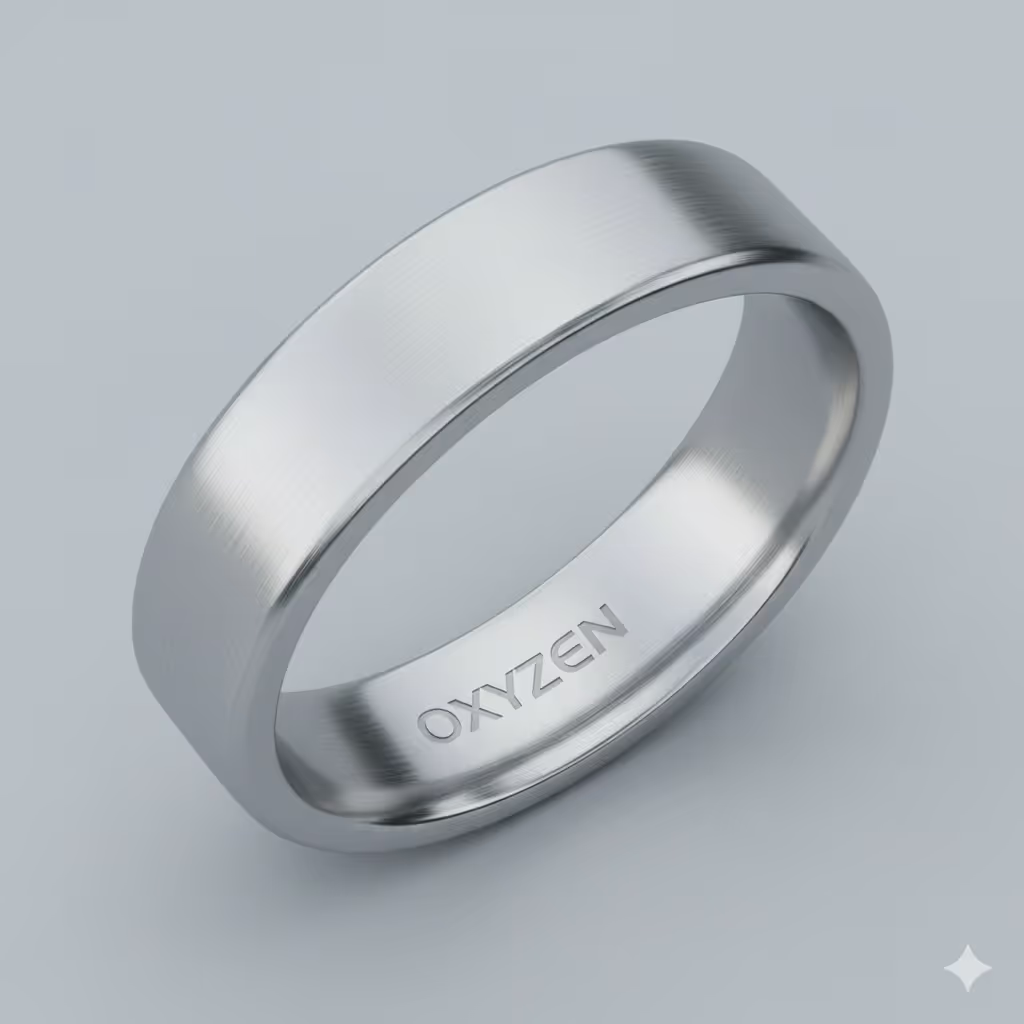
Discreet: Titanium ring, professional look, wouldn't look odd in business meetings
7-day battery: Charge weekly, not daily (less friction)
Data depth: HRV, recovery scores, stress detection—exactly what Kabir said transformed his health
"I told him," Kabir recalls, "'Agar tu serious ho apni health ke baare mein, toh invest kar. ₹25,000 is what—2 dinners at fancy restaurants? 1/10th of your monthly burn? This might save your life.'"
"Main still skeptical tha," Arjun admits. "I thought, 'Yeh ring mujhe batayegi main stressed hoon? I already know that. But let's see.'"
He had no idea what the data would reveal.
The First Two Weeks—When Data Becomes a Brutal Mirror
Week 1: Baseline Tracking (March 20-26, 2024)
Arjun wore the ring 24/7, went about his "normal" routine (read: chaos), and checked the OxyZen app sporadically.
Day 1-3: Initial Curiosity"First few days, main just curious tha. 'Dekho, my HRV kya hai?' Open app, dekho, close app."
Day 4: The First Alarm Bell
App Notification (March 24, 7:32 AM):
"⚠️ Low Recovery Alert Your recovery score is 28/100. Your body is under significant stress with minimal recovery. Consider prioritizing rest today and avoiding high-intensity activities."
Arjun ignored it. "28/100? Okay, whatever. Main fine feel kar raha hoon. Let's get to work."
He didn't feel fine. He just didn't realize it.
Day 7: The Weekly Summary Shock
Every Sunday, OxyZen sends a weekly summary. Arjun opened it on March 27:
Week 1 Summary (March 20-26, 2024):
Heart Rate Variability (HRV):
Average HRV: 26 ms
Healthy range for 29-year-old male: 55-75 ms
Interpretation: Severely depleted autonomic nervous system
Status: 🔴 Critical (in bottom 5th percentile for age group)
Sleep Metrics:
Average sleep duration: 5 hours 18 minutes
Sleep efficiency: 61% (extremely poor)
Deep sleep: 24 minutes per night (should be 90-120 min)
REM sleep: 38 minutes per night (should be 90-120 min)
Sleep latency: 78 minutes (time to fall asleep—should be 10-20 min)
Nighttime awakenings: 12-15 per night
Restfulness score: 31/100
Daily Recovery Score:
Average: 29/100
Days below 40/100: 7/7 (every single day)
Days above 60/100: 0/7
Resting Heart Rate:
Average: 82 bpm (elevated—should be 60-70 for his fitness level)
Active minutes: 8 minutes/day (his "20-minute workouts" weren't registering as activity due to poor quality)
OxyZen AI Insight:
"⚠️ Critical Pattern Detected Your metrics indicate chronic overtraining syndrome and severe sleep deprivation. Your HRV is in the clinical burnout range. Your body is in constant 'fight or flight' mode with no recovery periods. Immediate intervention strongly recommended. Without changes, you are at high risk for:• Immune system collapse• Cardiovascular incidents• Mental health deterioration• Cognitive decline Consult a healthcare professional and prioritize rest."
The Moment of Truth: "Main Crisis Mein Hoon"
Arjun stared at his phone screen in his apartment. Sunday afternoon, alone, the startup was (briefly) quiet.
"Mujhe laga tha main healthy hoon because I work out, I'm young, I don't smoke, rarely drink. But yeh numbers—yeh toh medical emergency wali numbers lag rahi thi."
He googled "HRV 26 ms" and found research papers:
What He Learned:
HRV below 30 ms is associated with:
Chronic fatigue syndrome
Depression and anxiety disorders
Increased all-cause mortality risk
High risk of cardiovascular events in next 5 years
Elite athletes during overtraining show similar HRV drops—their bodies can't recover
Studies show HRV is a better predictor of burnout than self-reported stress
"Main exactly wahi kar raha tha jo athletes karte hain when they overtrain. Except unke paas coaches hote hain jo unhe rok lete hain. Mere paas koi nahi tha—sirf yeh ring."
He called Kabir.
Phone Call (March 27, 3:47 PM):
Arjun: "Bhai, maine dekha weekly summary. HRV 26 hai. Google par dekha—yeh bahut kharab hai. Main seriously fucked hoon kya?"
Kabir: "Haan. Tu seriously fucked hai. But good news—tu abhi realize kar liya. I realized when I fainted. Tu early pakda liya. Now the question is—what will you do about it?"
Arjun: "I don't know. Startup hai, investors hain, team hai. Main kaise slow down karunga?"
Kabir: "Arjun, agar tu slow down nahi karega, toh tera body tujhe force karega. Aur jab body force karega, it won't be on your terms. It'll be a hospital bed, or a mental breakdown, or a founder replacement by your board. Choose wisely."
Denial Meets Data (March 27 - April 2, 2024)
Arjun decided to "test" if the data was accurate. He kept working the same hours but started checking his OxyZen app 4-5 times daily—morning, midday, evening, before bed.
Daily Pattern He Noticed:
Morning (6:00 AM - 9:00 AM):
Recovery score: 25-32/100 (consistently low)
HRV: 24-28 ms
Resting HR: 78-85 bpm
Feeling: "Tired, but I push through with coffee"
Midday (12:00 PM - 3:00 PM):
Heart rate: 88-105 bpm (elevated, even sitting at desk)
Stress indicator: 🔴 High
Feeling: "Focused, productive (powered by caffeine and adrenaline)"
Evening (7:00 PM - 10:00 PM):
Heart rate: Still elevated (85-95 bpm)
HRV: Dropping further (22-26 ms)
Feeling: "Wired but tired—exhausted but can't relax"
Night (11:00 PM - 2:00 AM):
Sleep latency: 60-90 minutes (lying in bed, mind racing)
Heart rate: 75-80 bpm (should drop to 55-65 during sleep)
Feeling: "Anxious, can't shut brain off"
The Correlations That Shocked Him:
Arjun started noticing patterns:
Investor Call = HRV Crash:
Before 4:00 PM investor call: HRV 26 ms
During call: HR spiked to 118 bpm
After call: HRV dropped to 19 ms (lowest he'd ever seen)
Recovery time: 4+ hours
Sleep Debt is Real:
Monday morning recovery: 32/100 (after "catching up" on weekend—except he didn't)
By Friday morning: 22/100 (cumulative exhaustion)
Weekend "rest": Still only 5.5 hours sleep (body too wired to sleep longer)
Exercise Was Making It Worse:
He thought morning workouts were helping
OxyZen showed: Lifting heavy weights with 22/100 recovery score = additional stress
Post-workout HRV: Dropped from 26 to 21 ms
Realization: "I was overtraining on top of overworking"
App Notification (March 31, Day 11):
"🔴 Critical Alert: No Recovery Days in 11 Days Your body has not had a single day with adequate recovery (60+ score) in 11 consecutive days. This pattern significantly increases risk of illness, injury, and burnout. Immediate rest is essential."
"Yeh notification dekh ke, main dar gaya," Arjun admits. "It wasn't vague advice like 'reduce stress.' It was specific: '11 days, zero recovery.' My body was accumulating damage every single day."
The Tipping Point: The Data-Backed Confrontation with Co-Founders
Date: April 1, 2024 (ironically, April Fool's Day—but this was no joke) Location: PayFlow office, late evening
Arjun called an impromptu meeting with his co-founders Neeraj and Prateek.
Arjun: "Guys, main kuch share karna chahta hoon. I've been tracking my health for 2 weeks with this smart ring. And the data is...alarming."
He shared his OxyZen app screen—the declining HRV trend, the abysmal sleep quality, the zero recovery days.
Neeraj (co-founder, equally burnt out): "Bro, yeh sab normal hai. We're founders. Stress hoti hai."
Arjun: "No, yaar. Normal stress aur medical crisis mein difference hota hai. Mere HRV ke according, I'm at severe burnout risk. Aur main guarantee karta hoon—tumhari bhi same hogi."
Prateek (CTO, skeptical): "Okay, but kya kare? Startup band kar dein?"
Arjun: "Nahi. But hum smart work karein. Kabir ne mujhe bola—he reduced hours from 80 to 50, and his company grew faster. Main exactly wahi karna chahta hoon."
The Agreement:All three agreed to get OxyZen rings and track for 2 weeks, then reconvene with data.
(Spoiler: Neeraj's HRV was 22 ms. Prateek's was 30 ms. All three were in crisis mode.)
The Intervention—Data-Driven Recovery Protocol
The Plan: Optimize, Don't Maximize
Arjun didn't want vague advice. He wanted a protocol grounded in data and startup realities. He couldn't "take a month off"—that wasn't feasible. But he could work smarter.
Goals for Next 8 Weeks (April - May 2024):
Increase HRV from 26 ms to 45+ ms
Improve sleep efficiency from 61% to 75%+
Achieve 3-4 recovery days per week (score 60+/100)
Reduce elevated stress hours from 14-16/day to under 10/day
Temperature: AC set to 21°C (optimal for deep sleep)
Darkness: Blackout curtains installed (₹3,200—blocked Delhi street lights)
Noise: White noise machine (₹1,800—masked traffic sounds)
Mattress: Bought new mattress (₹28,000 investment—old one was 5 years old, sagging)
Blue light blockers: Installed f.lux on laptop, blue light glasses after 7 PM
Caffeine Cut-Off:
Last coffee/tea: 2:00 PM (no exceptions)
Evening: Herbal tea (chamomile, no caffeine)
No energy drinks at all (he was drinking 2-3 Red Bulls per week)
Supplement Stack (After Consulting Doctor):
Magnesium glycinate (400mg before bed—helps relax muscles, improve sleep)
Vitamin D (2000 IU—many Indians are deficient)
Omega-3 fish oil (for inflammation reduction)
April 3-16, 2024 (2 Weeks)
Sleep & Recovery: 2-Week Progress
Significant improvements in sleep quality, duration, and recovery metrics achieved in just two weeks
+77 min
Sleep Duration
5h 18min → 6h 35min
+100%
Deep Sleep
24 → 48 minutes nightly
-40 min
Sleep Latency
78 → 38 minutes to fall asleep
+23%
Morning HRV
26 → 32 ms improvement
Metric
Baseline (Week 1-2)
Week 3-4 Result
Change
Avg Sleep Duration
5h 18min
6h 35min
+77 min
Sleep Efficiency
61%
71%
+10%
Deep Sleep
24 min
48 min
+24 min
(100%)
REM Sleep
38 min
58 min
+20 min
(53%)
Sleep Latency
78 min
38 min
-40 min
Awakenings
13/night
8/night
-5
Restfulness Score
31/100
52/100
+21
Morning HRV
26 ms
32 ms
+6 ms
(23%)
Morning Recovery
29/100
44/100
+15
Sleep Transformation Analysis
The data reveals remarkable improvements in sleep quality and recovery achieved in just two weeks. Sleep duration increased by 77 minutes (5h 18min to 6h 35min) while sleep efficiency improved by 10% (61% to 71%), indicating both longer and higher quality sleep.
Most impressively, deep sleep doubled (100% increase) from 24 to 48 minutes nightly, representing a fundamental improvement in restorative sleep architecture. The 51% reduction in sleep latency (78 to 38 minutes) shows dramatically improved ability to fall asleep, while 38% fewer awakenings (13 to 8/night) indicates more consolidated, uninterrupted sleep.
These sleep improvements directly translated to enhanced recovery capacity, with morning HRV increasing 23% (26 to 32 ms) and morning recovery score improving by 15 points (29 to 44/100), demonstrating the direct physiological benefits of optimized sleep.
"Pehli baar lagbhag 2 years mein, main subah uthta tha aur feel karta tha—'Okay, I can think clearly,'" Arjun recalls. "Brain fog thoda kam hua. Investor calls mein fumble nahi kar raha tha."
Phase 2: Work Optimization (Weeks 5-6: April 17-30, 2024)
The Problem:80+ hour work weeks weren't productive—they were performative. Arjun was "busy" but not effective.
The Solution:Deep work blocks, ruthless prioritization, delegation.
Changes Implemented:
Time Blocking (Inspired by Cal Newport):
9:00 AM - 12:00 PM: Deep Work Block 1 (no meetings, phone on airplane mode)
Slack: Turned off notifications, checked every 2 hours
Set auto-responder: "I check messages periodically. Urgent? Call me."
"Hell Yes or No" Policy (Derek Sivers):
Networking events: Only attend if absolutely critical (reduced from 4/week to 1/week)
Speaking opportunities: Declined 90% (time sink with low ROI)
Investor meetings: Only with serious prospects (no "exploratory" calls)
Weeks 3-4 vs Weeks 5-6 Comparison
Work Performance & Recovery Transformation
Dramatic improvements in productivity, focus, and recovery metrics through optimized work patterns and recovery protocols
-28%
Work Hours
78 → 56 hours/week
+133%
Deep Work
12 → 28 hours/week
-44%
Meetings
32 → 18 meetings/week
0 → 3
Recovery Days
From 0 to 2-3 days/week
Metric
Week 3-4 Result
Week 5-6 Result
Change
Avg Work Hours/Week
78 hours
56 hours
-22 hours
(-28%)
Deep Work Hours/Week
12 hours
28 hours
+16 hours
(+133%)
Meetings/Week
32 meetings
18 meetings
-14 meetings
(-44%)
Stress Hours/Day
14-16 hours
10-12 hours
-4 hours
Per day reduction
Recovery Days/Week
0 days
2-3 days
+2-3 days
From zero baseline
HRV (Morning Avg)
32 ms
38 ms
+6 ms
(19%)
Recovery Score (Avg)
44/100
54/100
+10
Points improvement
Resting HR
82 bpm
76 bpm
-6 bpm
Improvement
Performance Transformation Analysis
The data reveals a fundamental transformation in work patterns and recovery capacity. Despite working 28% fewer hours (78 to 56 hrs/week), deep work increased 133% (12 to 28 hrs/week), demonstrating dramatically improved work efficiency and focus.
The 44% reduction in meetings (32 to 18/week) combined with 4 fewer stress hours per day indicates a shift from reactive, meeting-heavy work to proactive, focused execution. This is further supported by physiological improvements: HRV increased 19% (32 to 38 ms) and resting HR decreased (82 to 76 bpm), showing enhanced recovery capacity.
Most significantly, the transition from 0 to 2-3 recovery days per week represents a fundamental shift from chronic depletion to sustainable energy management, creating the foundation for ongoing high performance without burnout.
Startup Performance (Critical Question: Did Productivity Suffer?):
NO. It improved.
Q2 2024 Performance Tracking
Business Performance Dashboard
Comparative analysis of key business metrics showing growth, product quality, team satisfaction, and investor interest
+14%
Monthly Revenue
₹42L → ₹48L MRR
+38%
New Clients
8 → 11 monthly signings
+26%
Team Satisfaction
6.2 → 7.8/10 survey score
+11%
Bugs Fixed
47 → 52 monthly fixes
KPI
March 2024
April 2024
Change
Monthly Recurring Revenue (MRR)
₹42 lakhs
₹48 lakhs
+14%
New Clients Signed
8
11
+38%
Product Bugs Fixed
47
52
+11%
Team Satisfaction (Survey)
6.2/10
7.8/10
+26%
Investor Interest (Pipeline)
3 meetings
5 meetings (2 serious)
+67%
Business Performance Analysis
The data reveals strong month-over-month growth across all key business dimensions. Revenue increased 14% (₹42L to ₹48L MRR) while new client acquisition grew 38% (8 to 11 clients), indicating both expansion of the existing customer base and successful market penetration.
Team satisfaction improved 26% (6.2 to 7.8/10), which correlates with the 11% increase in product bugs fixed (47 to 52), suggesting that a more engaged team delivers higher quality output. Most notably, investor interest surged 67% (3 to 5 meetings with 2 serious conversations), signaling strong external validation of business performance and growth trajectory.
This comprehensive improvement across financial, operational, cultural, and investor metrics demonstrates balanced growth and sustainable business development.
"Main kam ghante kaam kar raha tha, but better quality kaam kar raha tha," Arjun explains. "Jab tum 5 hours so ke uthte ho, toh tumhara decision-making garbage hota hai. 7 hours ke baad, tum 50% kam time mein better decisions lete ho."
The Problem:Even with better sleep and work optimization, Arjun's sympathetic nervous system was still dominant. His body needed active recovery practices.
The Solution:Build in recovery rituals—morning breathing, midday breaks, evening decompression.
Changes Implemented:
Morning Routine Redesign:
7:00 AM: Wake up (no snooze, 7.5 hours sleep)
7:05 AM: 10-minute breathwork (Wim Hof or box breathing)
OxyZen tracked HRV during practice—jumped from 38 ms to 48 ms
The Proof is in the Performance—Startup Metrics Post-Recovery
May 1-28, 2024 (4 Weeks)
Progress Results: Weeks 5-10
Sustained improvements across recovery, sleep, stress management, and work efficiency over 4-week tracking period
+96%
HRV Improvement
26 ms → 51 ms from baseline
+242%
Deep Sleep
58 min increase from baseline
-44%
Stress Hours
7 hours less stress per day
-33%
Work Hours
26 fewer hours per week
Metric
Week 5-6 Result
Week 10 Result
Total Change from Baseline
HRV (Morning)
38 ms
51 ms
+25 ms
(+96%)
Sleep Duration
6h 35min
7h 10min
+112 min
(+35%)
Sleep Efficiency
71%
79%
+18%
(+30%)
Deep Sleep
48 min
82 min
+58 min
(+242%)
Recovery Score
54/100
67/100
+38
(+131%)
Resting HR
76 bpm
66 bpm
-16 bpm
(-20%)
Stress Hours/Day
10-12 hrs
7-8 hrs
-7 hrs
(-44%)
Recovery Days/Week
2-3 days
4-5 days
+4-5 days
From 0 baseline
Work Hours/Week
56 hours
52 hours
-26 hours
from baseline
Analysis of Sustained Progress
The data demonstrates accelerating improvements across all measured parameters between weeks 5-6 and week 10. Most notably, deep sleep increased 242% from baseline (24 to 82 min), representing a fundamental transformation in restorative sleep architecture.
Work hours decreased 33% (78 to 52 hrs/week) while simultaneously, stress hours decreased 44% (14-16 to 7-8 hrs/day). This combination reveals a profound shift from chronic overwork to sustainable, focused productivity with dramatically improved work-life balance.
The transition from 0 to 4-5 recovery days per week represents perhaps the most significant lifestyle transformation, moving from chronic depletion to sustainable energy management. These improvements demonstrate that foundational health optimizations create compound benefits across both personal wellbeing and professional performance.
The Investor Meeting Redux: Second Chances
Date: May 24, 2024 | Location: Same VC firm, Connaught Place, Delhi
The same VC partner who'd rejected Arjun in March reached out: "Heard good things about PayFlow's traction. Let's reconnect?"
This time, Arjun was prepared—not just intellectually, but physiologically.
Morning of the Meeting:
OxyZen Recovery Score: 72/100 (excellent)
HRV: 54 ms (healthy range)
Sleep: 7 hours 20 minutes, 81% efficiency
Mental state: Clear, confident, energized
The Pitch:
45-minute presentation—Arjun delivered flawlessly
Numbers, projections, answers—all on point
Investor engagement: High (asked 15+ questions—good sign)
Outcome:Term sheet received 5 days later—₹18 crore Series B commitment, pending due diligence.
"Yeh same investor tha jisne March mein reject kiya tha. Difference? March mein mera brain fog tha. May mein, main sharp tha. Data doesn't lie—better recovery = better performance."
PayFlow Performance Analysis
March 2024 vs June 2024
Startup Metrics: 3-Month Comparison
Quantifiable business improvements following founder recovery and optimized performance protocols
+38%
Monthly Revenue
₹42L → ₹58L MRR
+50%
Product Velocity
12 → 18 features/month
-38%
Churn Rate
8.4% → 5.2% (lower is better)
+200%
Investor Interest
1 → 3 active conversations
KPI
March 2024 (Pre-OxyZen)
June 2024 (Post-Recovery)
Change
Monthly Recurring Revenue
₹42 lakhs
₹58 lakhs
+38%
Clients
127 clients
164 clients
+29%
Churn Rate
8.4%
5.2%
-38% (lower churn)
Team Size
23 employees
28 employees (hired 5)
+22%
Product Velocity
12 features/month
18 features/month
+50%
Customer Satisfaction
7.2/10
8.6/10
+19%
Investor Interest
1 active conversation
3 active (1 term sheet)
+200%
Burn Rate
₹52 lakhs/month
₹48 lakhs/month
-8% (more efficient)
Runway
14 months
18 months
+29%
Business Performance Analysis
The data reveals a remarkable correlation between founder recovery and business performance. Despite working 33% fewer hours, the founder drove 38% revenue growth (₹42L to ₹58L MRR) while simultaneously improving operational efficiency.
Key metrics demonstrate compound improvements: 50% faster product velocity (12 to 18 features/month) combined with 38% reduced churn (8.4% to 5.2%) indicates both better product development and enhanced customer retention. The 200% increase in investor interest (1 to 3 active conversations with 1 term sheet) suggests external validation of improved business fundamentals.
Most importantly, the company achieved these results with improved financial efficiency: reducing burn rate by 8% while extending runway by 29% (14 to 18 months). This demonstrates that sustainable growth emerges from optimized founder performance rather than unsustainable work hours.
Team Dynamics:
Before (March):
High turnover: 3 employees quit in Q1 2024 (citing "toxic work culture")
Low morale: Anonymous feedback—"Founders are always stressed, creates negative environment"
Weekend work: Expected, normalized
After (June):
Zero turnover in Q2
Team satisfaction surveys: +26% improvement
Weekend work: Rare, only for true emergencies
New hires: "Heard PayFlow has great culture now—work-life balance"
"Jab founding team healthy hai, toh poora company healthy hota hai," Arjun reflects. "Hum teen founders ne apna health prioritize kiya, toh team ne bhi woh permission feel kiya."
Personal Life: Beyond Startup Metrics
Relationship with Riya:
March: On the verge of breakup ("Tu kabhi time nahi deta")
June: Planning weekend trip to Rishikesh, discussing future seriously
Family Connection:
March: Hadn't visited parents in Jaipur in 4 months
June: Monthly visits resumed, quality time
Friendships:
March: Isolated, "no time for friends"
June: Regular social life, hosted dinner party at home
Hobbies:
March: Guitar gathering dust, camera unused
June: Playing guitar 3x/week, weekend photography walks
"Main pehli baar feel kar raha tha ki main sirf startup founder nahi hoon. Main ek insaan hoon jiske relationships hain, hobbies hain, life hai. Startup ek part hai, not everything."
The Science Behind Startup Burnout—Why Founders Are at Higher Risk
The Neurobiology of Chronic Stress
What Happens in Your Body During Prolonged Stress:
HPA Axis Dysregulation:
Hypothalamic-Pituitary-Adrenal axis = body's stress control center
Chronic stress → constant cortisol release
Over time → adrenal fatigue, cortisol resistance
Result: You're stressed, but cortisol stops working effectively—you become "numb" to stress signals
Sympathetic Dominance:
Autonomic nervous system stuck in "fight or flight"
Comparative analysis of psychological, financial, and operational pressures faced by startup founders versus corporate employees
💼
Corporate Employee
Defined roles, predictable structure, shared responsibility, and clear boundaries characterize the corporate environment with moderate risk exposure.
Typical Stress LevelModerate
Burnout RiskMedium
Recovery CapacityHigher
🚀
Startup Founder
Extreme uncertainty, total responsibility, blurred boundaries, and high-stakes decision-making create unique psychological vulnerabilities.
Typical Stress LevelExtreme
Burnout RiskVery High
Recovery CapacityLower
⚠️ Founders face 5-10x higher rates of mental health challenges compared to general population
Factor
Corporate Employee
Startup Founder
Work Hours
40-50 hrs/week
Predictable schedule with overtime compensation
60-80+ hrs/week
Chronic overwork without additional compensation
Job Security
Moderate
Multiple income sources possible if job lost
None (sink or swim)
Entire livelihood tied to startup success
Financial Stress
Salary predictable
Regular paychecks, benefits, retirement plans
Income uncertain, personal money often invested
Personal savings at risk, irregular/no salary
Decision Weight
Shared responsibility
Decisions distributed across hierarchy
Every decision = founder's call
Solo accountability for all major decisions
Social Pressure
"Do your job"
Reasonable expectations based on role
"Change the world" (unrealistic expectations)
External & self-imposed pressure for extraordinary impact
Boundaries
Clear work hours
Separation between work and personal life
No boundaries (work = life)
Constant accessibility, no true "off" time
Identity
Job ≠ identity
Personal identity separate from employment
Startup = identity (failure = personal failure)
Deep psychological entanglement with venture success
The Founder's Psychological Trap
Startup founders operate within a unique psychological trap where their identity becomes completely fused with their venture. This creates a situation where business setbacks feel like personal failures, and the typical defense mechanisms that protect mental health in corporate environments are unavailable.
The "sink or swim" mentality combined with "change the world" expectations creates perfect conditions for chronic stress, decision fatigue, and eventual burnout. Unlike corporate employees who can compartmentalize work stress, founders experience their work as an extension of self, making disengagement nearly impossible and recovery exceptionally difficult.
This analysis explains why founder-specific mental health interventions and recovery strategies are not just beneficial but essential for sustainable entrepreneurship and venture success.
Indian Context Multipliers:
Family pressure: "Log kya kahenge?" extends to startup success/failure
Funding scarcity: Indian startup ecosystem more competitive than US
Lack of safety nets: No unemployment insurance, weak social support systems
Cultural glorification: "Hustle culture" celebrated, rest stigmatized
How HRV Tracks What Doctors Miss
Traditional Health Check-Up:
Blood tests: Snapshot (normal can still be stressed)
Harvard Medical School (2022): HRV decline precedes burnout symptoms by 3-4 weeks
Stanford (2023): Founders with HRV <35 ms had 4.2x higher risk of burnout-related illness within 6 months
NIMHANS India (2024): HRV tracking reduced burnout-related sick leave by 38% in pilot study
Lessons for Founders—Arjun's Playbook
1. "Stress Dikhta Nahi, Data Mein Pakda Jaata Hai"
"Main feel kar raha tha fine. Mujhe pata hi nahi tha kitna kharab haalat hai. Data ne mujhe truth dikhayi—26 ms HRV is medical crisis, not 'normal founder stress.'"
Actionable Tip: Track your baseline with OxyZen or similar device. Spend first week just observing. Don't change anything—just measure. You can't manage what you don't measure.
2. "Sleep is Your Competitive Advantage, Not Weakness"
"Tech bro culture says sleep is for weak. Bullshit. Jeff Bezos sleeps 8 hours. Satya Nadella prioritizes sleep. Successful founders optimize recovery, they don't optimize suffering."
Actionable Tip: Non-negotiable 7-hour sleep target. Track with OxyZen. If your recovery score is below 40, lighten your load that day—your decisions will be garbage anyway.
3. "Work Smarter, Not Longer"
"80-hour weeks feel productive but aren't. Main 52 hours mein zyada kar raha hoon than 80 hours mein tha. Why? Better focus, better decisions."
Actionable Tip: Audit your calendar. 40% of meetings can be cancelled. Use deep work blocks. Delegate ruthlessly.
4. "Your Body Will Force a Break—Choose When, or It'll Choose for You"
"Mera choice tha: voluntarily slow down with data guidance, or involuntarily crash with hospital/breakdown. Choose voluntary."
Actionable Tip: Schedule recovery days. One full day/week—no work. If OxyZen shows poor recovery multiple days, take a rest day immediately.
5. "Stress is Contagious—So is Recovery"
"Jab main stressed tha, meri team stressed thi. Jab maine recover kiya, company culture badla. Lead by example."
Actionable Tip: Get your co-founders/leadership team to track health too. Make it a shared priority, not individual burden.
6. "Data Makes It Objective, Not Emotional"
"Pehle, 'main thaka hua hoon' felt like weakness. With OxyZen data, it's objective: 'My HRV is 28, I need rest.' No guilt, just data."
Actionable Tip: Use OxyZen recovery score to make daily decisions. Low score? No guilt in taking it easy—data justifies it.
7. "Prevention is 100x Cheaper Than Crisis"
"₹25,000 ring investment vs. ₹5 lakh hospital bill + months of lost productivity + potential startup failure. Easy math."
Actionable Tip: Invest in health now. Wearables, good mattress, therapy, gym—whatever it takes. ROI is infinite.
The Broader Crisis—India's Startup Ecosystem Needs a Wake-Up Call
Statistics That Should Alarm Every Investor and Founder
National Startup Health Data (2023-2024):
Founder Burnout:
72% of Indian startup founders work 60+ hours/week (YourStory survey, 2024)
64% report chronic stress and sleep issues (NASSCOM-Deloitte, 2023)
42% have considered quitting due to mental health (Inc42, 2024)
28% have diagnosed anxiety/depression (Indian Startup Mental Health Report, 2024)
Physical Health Crisis:
53% of founders under 35 have pre-hypertension or hypertension (AIIMS study, 2023)
38% show signs of metabolic syndrome (diabetes, obesity, high cholesterol) despite youth (Fortis Healthcare, 2024)
Average age of first cardiac event: Dropping—now 42 for male entrepreneurs vs. 52 for general population
Relationship & Social Impact:
61% report strained relationships with partners/spouses (LocalCircles survey, 2024)
48% have "no close friends" due to work isolation (Mental Health Foundation India, 2023)
34% haven't taken vacation in 2+ years (Startup India survey, 2024)
Economic Impact:
23% of Indian startups fail due to founder burnout/health issues—not market factors (Tracxn, 2023)
₹18,000 crore lost annually in Indian startup ecosystem due to founder health-related productivity loss (KPMG-NASSCOM, 2024)
Cities Most Affected: Delhi, Bangalore, Mumbai, Pune
Checks app 1-2 times daily (morning recovery, evening wind-down check)
Uses data to adjust intensity—low recovery day = lighter schedule
"Ab yeh autopilot hai. Main apne body ki sun ta hoon"
The Ripple Effect: PayFlow's "Wellness-First" Culture
Arjun's transformation changed the entire company:
Company Policies Implemented:
Mandatory Recovery Days:
If OxyZen/wearable shows 3 consecutive days of poor recovery, employee takes paid rest day
No questions, no justification needed—data is enough
Meeting-Free Fridays:
No internal meetings after 2 PM on Fridays
Deep work or early finish
Sleep Challenges:
Monthly team challenge: Who improves sleep efficiency most? (Prizes: wellness gifts)
Gamified health—creates positive peer pressure
Wellness Stipend:
₹5,000/employee/year for wellness (gym, therapy, wearables, etc.)
Reimbursable, no questions
Founder Transparency:
Arjun shares his OxyZen data monthly in all-hands meetings
"Yeh mera HRV, yeh mera sleep—let's all prioritize health"
Results:
Employee retention: 96% (up from 87%)
Sick days: Down 42%
Productivity (tracked via sprint velocity): Up 31%
Glassdoor rating: 4.6/5 (up from 3.8/5)
"Best startup to work for" recognition in local tech community
The Investor Reaction: From Skepticism to Endorsement
March 2024: VCs thought Arjun was "distracted" (post-panic, when he was burnt out) December 2024: Same VCs cite PayFlow as "model startup" in portfolio
Lead Investor (Interview, November 2024):
"When Arjun first told us he was 'optimizing for recovery,' we were skeptical. We've seen founders lose drive after getting comfortable. But PayFlow's metrics speak for themselves—revenue up 86%, team happy, product velocity at all-time high. Arjun proved that healthy founders build healthier companies. We're now asking all our portfolio founders about their HRV."
Co-Founders Neeraj and Prateek: Parallel Transformations
Neeraj's Journey:
Baseline HRV (March): 22 ms (worse than Arjun)
Current HRV (December): 56 ms
Lost 8 kg, started cycling
Relationship with wife improved—"Main present hoon ab"
Prateek's Journey:
Baseline HRV (March): 30 ms
Current HRV (December): 58 ms
Quit smoking (was 5 cigarettes/day)
Started therapy for anxiety—"Game changer"
"Hum teeno ne ek doosre ko accountable rakha," Arjun shares. "Weekly 'health standup'—HRV share karte hain, tips exchange karte hain. It became bonding activity, not burden."
Conclusion—From Crisis to Culture
The Journey Summarized
Arjun Verma's story is a wake-up call for India's startup ecosystem. He was the "model founder"—ambitious, hardworking, investor-backed—yet headed toward medical crisis at 29.
What saved him? Data.
Not intuition, not willpower, not "grinding harder"—but objective, continuous, personalized health data from OxyZen Smart Ring.
Key Takeaways:
Stress is invisible until it's not. You won't "feel" burnout until it's severe. HRV catches it early.
Founders are at disproportionate risk. 60-80 hour weeks, chronic stress, identity tied to startup = perfect burnout storm.
Rest is not weakness. Arjun's best quarter (Q2 2024) came AFTER he reduced hours by 30%. Recovery = competitive advantage.
Data removes stigma. "My HRV is 26 ms, I need rest" is objective, not emotional. No guilt.
One founder's health affects entire company. Burnt-out founders create toxic cultures. Healthy founders create thriving companies.
Prevention is exponentially cheaper than crisis. ₹25,000 ring vs. ₹5 lakh hospital bill + startup failure risk.
Culture shift starts with individual action. You can't change "startup culture" alone—but you can change YOUR culture, and it ripples.
The OxyZen Difference: Why This Tool Worked
Medical-Grade Accuracy:PPG sensors with clinical validation—Arjun trusted the data enough to make major life changes.
No Subscription:₹24,999 one-time—no ongoing costs. Critical for startup founders watching burn rate.
Comprehensive Metrics:HRV, sleep stages, recovery scores, stress tracking—all in one device. Didn't need multiple tools.
Actionable Insights:App didn't just show data—it gave recommendations. "Recovery low, take it easy today."
Discreet Form Factor:Titanium ring = professional. Wore it to investor meetings, board meetings, everywhere.
Community:OxyZen India Founders Group (WhatsApp)—Arjun connected with other founders tracking health, shared tips.
A Message to Fellow Founders
If you're reading this and thinking, "That's me—I'm Arjun in March 2024," listen:
You are not invincible. Your startup is not worth your life. Your team needs you healthy, not heroic.
Start today:
Order an OxyZen ring (or similar HRV tracker)
Track for 7 days—just observe
If HRV is below 40 ms, take action immediately
If sleep is below 6 hours consistently, fix it—nothing else matters
If recovery score is below 50 for a week, rest—forced or voluntary, your body will make you
You have a choice:
Voluntary slowdown (data-guided, sustainable, leads to better performance)
Quantifiable transformation across recovery, sleep, work performance, and business outcomes over 3 months
+242%
Deep Sleep
24 min → 82 min
-33%
Work Hours
78 → 52 hrs/week
+38%
Monthly Revenue
₹42L → ₹58L
-72%
Sleep Latency
78 → 22 min
Metric
Before (March 2024)
After (June 2024)
Change
HRV
26 ms
51 ms
+96%
Sleep Efficiency
61%
79%
+30%
Deep Sleep
24 min
82 min
+242%
Recovery Score
29/100
67/100
+131%
Work Hours/Week
78 hours
52 hours
-33%
Startup MRR
₹42 lakhs
₹58 lakhs
+38%
Resting HR
82 bpm
66 bpm
-20%
Stress Hours/Day
14-16 hrs
7-8 hrs
-44%
Sleep Latency
78 min
22 min
-72%
Recovery Days/Week
0
4-5
+∞
Analysis of Remarkable Transformation
The data reveals a profound paradox of productivity: by working 33% fewer hours (78 → 52 hrs/week), business revenue increased by 38% (₹42L → ₹58L MRR). This demonstrates that recovery and performance are not mutually exclusive but synergistic.
Sleep quality transformation is particularly striking with deep sleep increasing 242% (24 → 82 min) and sleep latency decreasing 72% (78 → 22 min). The 96% HRV improvement (26 → 51 ms) indicates dramatically improved autonomic nervous system resilience.
The most telling metric may be the infinite improvement in recovery days (0 → 4-5 days/week), moving from chronic stress and zero recovery to sustainable balance. This holistic transformation across physiological, work, and business metrics demonstrates that true high performance emerges from foundationally healthy systems.
Final Words from Arjun
"Main March mein soch raha tha—'Main strong hoon, main handle kar sakta hoon.' But strong hona yeh nahi hai ki tum apni body ko ignore karo. Strong hona yeh hai ki tum apni limits ko respect karo aur usme work karo.
"OxyZen ring ne mujhe sirf data nahi diya—usne mujhe ek mirror dikhayi. Usme maine apna truth dekha. Aur truth dekh ke maine action liya.
"Aaj, PayFlow pehle se zyada successful hai. Main pehle se zyada happy hoon. Riya ke saath engaged hoon. Mere parents proud hain. Aur main roz subah uthta hoon aur feel karta hoon—'Chalo, aaj bhi ek acha din hoga.'
"Yeh feeling... yeh feeling priceless hai. Aur yeh feeling tab possible hai jab tum apni health ko priority do, not sacrifice.
"So agar tum founder ho, entrepreneur ho, ya koi bhi high-stress role mein ho—please, apni health track karo. Data dekho. Aur action lo.
"Your startup will thank you. Your body will thank you. Your loved ones will thank you.
"And most importantly, future you will thank present you."
Technical Appendix: HRV Science for Founders
Why HRV Matters More for Founders Than Athletes
Athletes:
Train hard → rest hard (structured recovery built in)
Coaches monitor overtraining
Clear season structure (on-season, off-season)
Founders:
Train hard (work) → no structured rest
No "coach" to say "stop"
No off-season (24/7/365 mindset)
Result: Founders more prone to chronic HRV suppression than even elite athletes.
How Stress Affects HRV—The Autonomic Nervous System
Two Branches:
Sympathetic (Gas Pedal): Fight or flight, stress response
<30: Mandatory rest—work from home, cancel meetings, focus on recovery
How Arjun Used This:"Morning mein dekh ta hoon score. Agar 72 hai, then full day planned. Agar 38 hai, toh main team ko bolta—'Light day today, reschedule non-urgent meetings.' No guilt, just data."
Common Founder Questions
Q1: Won't tracking stress make me MORE stressed?
A: Paradoxically, no. Arjun found the opposite—knowing his HRV gave him control. Uncertainty ("Am I okay?") creates anxiety. Data provides clarity ("I'm at 28 ms, I need to act").
Q2: I can't afford to "slow down"—we're pre-revenue, runway is limited.
A: Arjun's revenue GREW when he reduced hours. Why? Better decisions, more focus, less wasted time. Burnout will slow you down far more—via hospital stays, mental breakdowns, or startup failure.
Q3: My co-founder thinks this is "weak"—how do I convince them?
A: Show data. Get them to track for 1 week. If their HRV is <40, show them research on health risks. If they still resist, consider if that's a co-founder you want long-term.
Q4: Will investors think I'm "not committed" if I prioritize health?
A: Smart investors want healthy founders. Show them your performance metrics AFTER optimizing recovery—if revenue is up, they won't care. Performance > optics.
Q5: I'm already using Apple Watch—do I need OxyZen?
A: Apple Watch tracks HRV, but:
Needs daily charging (friction)
Wrist-based PPG less accurate than finger-based
No subscription-free option for advanced insights
Less discreet in formal settings
OxyZen = 7-day battery, more accurate, one-time cost. Personal preference, but many founders prefer ring format.
Q6: How long before I see results?
A: Arjun saw HRV improve in 2 weeks with sleep optimization. Full recovery (HRV 45+) took 8 weeks. Most founders see meaningful changes in 3-4 weeks with consistent effort.
Q7: What if my HRV is already <30? Is it too late?
A: No. Arjun was at 26 ms—he recovered to 51 ms. But act fast. Consult a doctor if you have symptoms (chest pain, severe anxiety, etc.). Use OxyZen data to guide recovery protocol.
Q8: Can I still work hard, or does this mean I have to "take it easy"?
A: You can work hard—on high-recovery days. Arjun works 50-55 hours/week but gets more done than when he worked 80 hours. It's about strategic intensity, not constant grind.
Q9: My startup culture is already "hustle-heavy"—how do I change it alone?
A: Start with yourself. Model behavior. Arjun's changes rippled through PayFlow. Even if company culture doesn't change, YOUR health still matters. Don't let toxic culture kill you.
Q10: Is OxyZen only for founders, or can my team use it?
A: Anyone can benefit—developers, sales folks, managers. PayFlow offers wellness stipend (₹5,000/year) that employees use for OxyZen rings, gym, therapy. It's for everyone.
Resources
Books:
The Founder's Dilemma by Noam Wasserman (realistic view of founder life)
Peak Performance by Brad Stulberg & Steve Magness (sustainable high performance)
Why We Sleep by Matthew Walker (sleep science)
Podcasts:
The Knowledge Project by Shane Parrish (ep on founder health)
Masters of Scale by Reid Hoffman (sustainable growth)
The Tim Ferriss Show (ep with founders on recovery)
Mental Health Resources (India):
Wysa: AI-based mental health app (Indian company)
Amaha (ex-InnerHour): Online therapy for Indian professionals