Gym Jaane Ke Baad Bhi Recovery Poor Kyun? Gurgaon Fitness Enthusiast Case Study
The Story of Aditya Kapoor: When "More is Better" Becomes "More is Worse"
Location: DLF Phase 3, Gurgaon (Gurugram), Haryana | Age: 28 | Profession: Senior Associate at Management Consulting Firm | Fitness Background: 3 years serious training | Timeline: March 2024 - August 2024
The Paradox of the Exhausted Athlete
Aditya Kapoor looked the part. At 28, he had the physique that made colleagues ask, "Bro, what's your routine?" Broad shoulders, visible abs, arms that filled out his Ralph Lauren shirts perfectly. He was disciplined—6 days/week at the gym, 5:30 AM wake-ups, meal-prepped Tupperware for the office, protein shakes in his car. He tracked everything: reps, sets, calories, macros, even water intake.
But on the morning of March 15, 2024, Aditya sat in his Gurgaon apartment, staring at his reflection in the mirror after his workout, and something felt... wrong.
The symptoms:
Exhausted despite 7-8 hours of sleep
Couldn't hit his usual bench press weight (dropped from 95kg to 85kg over 3 weeks)
Persistent muscle soreness (legs still sore from Monday's workout—it was Thursday)
Irritable, snapping at teammates at work
Resting heart rate creeping up (used to be 58 bpm, now 72 bpm consistently)
Frequent minor illnesses (third cold in 2 months—his immunity seemed shot)
Loss of motivation (dragging himself to gym instead of being excited)
"Main sochta tha—'Main itna kuch kar raha hoon. Gym ja raha hoon, protein le raha hoon, diet strict hai. Phir bhi perform nahi kar pa raha. What's wrong with me?'"
This is the story of overtraining syndrome—the silent killer of amateur athletes and fitness enthusiasts. The paradox where more exercise + less rest = worse results. The trap of mistaking "hustle" for progress, soreness for strength, exhaustion for effort.
This is how the OxyZen Smart Ring revealed what Aditya's fitness tracker couldn't: His body wasn't adapting to training—it was breaking down. His HRV was in the gutter, his recovery was non-existent, and if he didn't change course, he was heading toward injury, illness, or complete burnout.
The Gurgaon Fitness Culture—When Gyms Become Identity
The Corporate Athlete: Life of a Young Consulting Professional
Aditya's Background:
Education: IIM Ahmedabad MBA (2021), B.Tech from BITS Pilani
Career: McKinsey & Company (2021-2023), then jumped to BCG (better package)
9:45 PM: Shower (cold—read it's good for recovery—actually stressing body more)
10:00 PM: Collapse on couch
Check Instagram (fitness influencers posting workouts—makes him feel inadequate)
Check email (work—anxiety spike)
10:30 PM: Try to sleep
Mind racing (work stress + workout analysis—"Why couldn't I bench 95 kg?")
Body sore (legs throbbing, shoulders aching, systemic fatigue)
11:30 PM: Finally asleep (1 hour to fall asleep—sign of overtraining)
Total sleep: 6 hours (5:30 AM alarm—cycle repeats)
The Gurgaon Fitness Phenomenon: Culture of Overtraining
Why Gurgaon?
Gurgaon (officially Gurugram) = India's corporate hub. MNCs, consulting firms, startups, finance—young professionals (25-35 age group) with disposable income and intense work culture.
Fitness Culture Characteristics:
Gym Density:
Every residential complex has gym
Premium chains (Cult.fit, Gold's, Anytime Fitness) in every sector
Persistent Muscle Soreness (DOMS that Never Goes Away):
Legs sore 5 days/week (should recover in 48-72 hours)
Chest/shoulders constantly tight
Morning stiffness (takes 30 min to feel "normal")
Elevated Resting Heart Rate:
Normal (2023): 58 bpm
Current (March 2024): 72 bpm (+24%—sign of stress/overtraining)
Frequent Illness:
Colds: 3 in past 2 months (immune system compromised)
Sore throat (persistent, low-grade)
Never fully "healthy"
Sleep Issues:
Trouble falling asleep (wired but tired)
Restless sleep (waking up 3-4 times)
Not feeling rested (regardless of hours)
Injuries (Minor but Accumulating):
Right shoulder: Impingement (painful overhead movements)
Lower back: Tightness (from squat form deterioration)
Left knee: Inflammation (overuse)
Mental/Emotional Symptoms:
Loss of Motivation:
Used to love gym ("best part of my day")
Now dreading it ("Have to go, not want to go")
Irritability:
Snapping at colleagues over small things
Arguments with roommate (about dishes, noise—trivial stuff)
Short temper with parents during weekly calls
Anxiety:
Obsessing over workouts ("Did I do enough?")
Guilt on rest days ("I'm being lazy")
Fear of losing gains ("If I rest, I'll get fat")
Negative Self-Talk:
"I'm weak" (when couldn't hit target weight)
"Everyone's ahead of me" (comparison spiral on Instagram)
"I'm not trying hard enough" (despite doing too much)
What He Told Himself:
"I'm just tired from work"
"I need to push through" (warrior mentality)
"More volume will break plateau"
"Rest is for the weak"
"Arnold trained twice a day—I can too"
What He Didn't Realize: He was in overtraining syndrome—a clinical condition where training stress exceeds recovery capacity, leading to systemic breakdown.
The Wake-Up Call—When Data Shatters Delusion
The Gym Confrontation (March 18, 2024)
Location: Cult.fit, DLF Phase 3, evening session
Aditya was attempting deadlifts. Target: 140 kg × 5 reps (his PR from 2 months ago: 150 kg × 5).
Set 1: Loaded 140 kg, gripped bar, pulled—felt wrong immediately.
Back rounded (form broke down)
Barely got 1 rep up
Set bar down, frustrated
Gym trainer (Rohit, 35, experienced) was watching.
Rohit: "Aditya bhai, form kharab ho raha hai. Aur tu har roz yahan dikhai deta hai—kabhi rest leta hai?"
Aditya (defensive): "Main rest karta hoon. Active recovery Sunday ko."
Rohit: "Active recovery matlab bhi kaam karna. True rest matlab kuch nahi karna. Tu overtrained lag raha hai."
Aditya (irritated): "Overtrained? Main toh properly train bhi nahi kar pa raha. Weak feel ho raha hai."
Rohit: "Exactly. Yeh overtraining ka symptom hai. Body recover nahi kar raha. Tu zyada kar raha hai, kam nahi."
Aditya (dismissive): "Nahi yaar, main handle kar sakta hoon."
Rohit (firm): "Dekh, meri baat sun. Main 10 saal se log ko train kar raha hoon. Tere jaisa case bahut dekha hai. Young guys, ambitious, itna train karte hain ki body break down ho jaati hai. Tu apna HRV check kiya hai kabhi?"
Aditya: "HRV? What's that?"
Rohit: "Heart Rate Variability—stress aur recovery measure karta hai. Agar tu seriously train kar raha hai, toh yeh track karna chahiye. Data se pata chalega tera recovery kaisa hai."
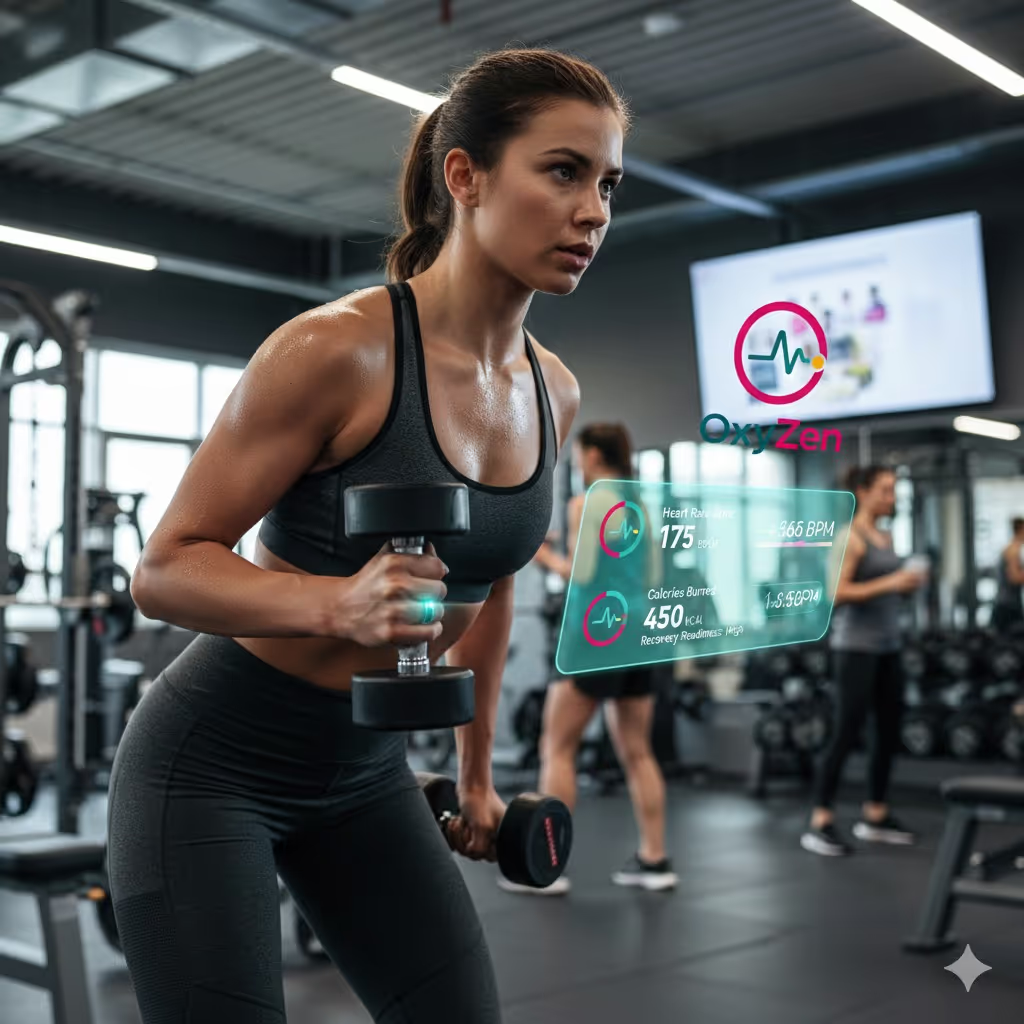
He showed Aditya his OxyZen Smart Ring.
Rohit (showing app): "Dekh, mera HRV 68 ms hai aaj. Recovery score 74/100—matlab body recovered hai, main aaj hard train kar sakta hoon. Agar recovery low hota, toh main deload karta—light workout ya rest."
Aditya (curious now): "Yeh ring track karta hai automatically?"
Rohit: "Haan. 24/7. Sleep, HRV, recovery, resting heart rate—sab kuch. Serious athletes isse use karte hain—not just bodybuilders, but runners, cyclists, CrossFitters. Data-driven training."
Aditya (engineer brain activated): "Interesting. Kitna cost karta hai?"
Rohit: "₹24,999. One-time, no subscription. Mera Whoop strap was ₹20,000 plus ₹400/month subscription—1 year mein ₹25,000. OxyZen cheaper aur Indian company hai."
Aditya: "I'll check it out."
The Research Phase (March 18-20)
Aditya dove into research (typical consultant behavior—data-driven decision-making).
Google searches:
"Overtraining syndrome symptoms"
"HRV for athletes"
"How to know if overtraining"
"Best fitness tracker for recovery"
YouTube deep-dive:
Jeff Nippard: "Are You Overtraining? (Probably Not... But Maybe)"
AthleanX: "The #1 Sign You're Overtraining"
Science Explained: HRV and Athletic Performance
Reddit (r/Fitness, r/AdvancedFitness):
Multiple threads: "Strength going down despite training hard—help!"
Common advice: "Track HRV, take deload week"
Key Learnings:
Overtraining vs. Overreaching:
Overreaching: Short-term excess training—recovers with rest (1-2 weeks)
Overtraining syndrome: Long-term excess—takes months to recover, sometimes requires medical intervention
HRV as Recovery Marker:
Low HRV = body stressed, needs recovery
High HRV = body recovered, can train hard
Tracking daily = adjust training based on readiness
Signs He Had (Checklist):
✅ Performance decline (strength down 15%)
✅ Persistent fatigue (despite sleep)
✅ Elevated resting HR (+24%)
✅ Sleep disturbances (trouble falling asleep)
✅ Frequent illness (3 colds in 2 months)
✅ Loss of motivation
✅ Irritability
Score: 7/7—Classic overtraining syndrome
Realization (Oh shit moment):
"I thought I was being dedicated. Turns out I was being stupid. My body was breaking down and I was adding more stress instead of recovery."
The Purchase Decision (March 21, 2024)
Devices Compared:
Whoop Strap 4.0:
Pros: Gold standard for athletes, detailed HRV/recovery tracking
Cons: ₹18,000 + ₹400/month subscription (₹23,000 first year), wrist-worn (uncomfortable during heavy lifts)
Trend: Metrics getting WORSE despite training (or rather, because of training without recovery).
Day 7 (March 29, Friday)—The Weekly Summary:
OxyZen Weekly Report (auto-generated):
⚠️ CRITICAL: Severe Overtraining Pattern Detected
Your metrics indicate chronic training stress without adequate recovery:
Heart Rate Variability:
Weekly average: 26 ms (Critical zone)
Healthy range for trained male, age 28: 55-75 ms
You are 53% below healthy minimum
Recovery Score:
Weekly average: 23/100 (Severe under recovery)
Days with adequate recovery (>60): 0/7
Days in critical zone (<30): 7/7
Resting Heart Rate:
Weekly average: 77 bpm (Elevated)
Trend: Increasing daily (sign of accumulating fatigue)
Sleep Quality:
Average efficiency: 73% (Poor)
Deep sleep: 34 min/night (11% of total—should be 15-20%)
Sleep debt: Accumulating (6.8 hours avg, need 7.5-8 for recovery)
Training Stress:
High-intensity sessions: 6 out of 7 days
True rest days: 0
Recovery periods: <2 hours/day
ASSESSMENT: Your body is in a state of chronic sympathetic (stress) dominance with minimal parasympathetic (recovery) activation. Continuing this pattern significantly increases risk of: • Injury (form breakdown, overuse injuries) • Illness (immune suppression) • Performance plateau/decline (already evident) • Hormonal dysregulation (testosterone ↓, cortisol ↑) • Mental burnout
RECOMMENDATION: Immediate intervention required. Minimum 1-week training deload or complete rest. Prioritize sleep (8+ hours), stress management, nutrition. Resume training only when HRV >40 ms and recovery score >50.
The Moment of Reckoning
Aditya sat in his apartment Friday evening, reading this report three times.
Emotional reaction: Mix of denial, fear, and relief.
Thoughts:
Denial: "Maybe the ring is wrong? Faulty sensor?"
Fear: "53% below healthy minimum? That bad?"
Relief: "At least now I know WHY I feel like shit. I'm not weak—I'm overtrained."
He took a screenshot, sent to Rohit (gym trainer).
Rohit: "Told you. Yeh serious hai bro. Complete rest le for 1 week minimum."
Aditya: "Ek hafte gym nahi jaana? Par strength lose nahi hogi?"
Rohit: "Tu already lose kar chuka hai—benchpress 100 se 80 kg ho gaya. Aur aise jaayega toh injury hogi, ya bimar padega. Rest se recover karega, phir wapas strong ban jaayega. Trust the process."
Aditya: "Okay. I'll try."
Rohit: "Try nahi, DO. Aur sleep 8 hours minimum. Tera deep sleep bhi kum hai—body recover hi nahi kar raha."
The Recovery Protocol—From Overtraining to Optimization
Week 1: Complete Rest (March 30 - April 5, 2024)
The Hardest Week of Aditya's Life (Mentally):
New Rules (Self-imposed):
Zero gym/workouts (not even "light" cardio)
Sleep 8+ hours (non-negotiable)
Reduce caffeine (from 4 cups to 2 cups max)
Stress management (work pressure still there, but evening wind-down prioritized)
Daily Routine (Revised):
6:30 AM: Wake up (1 hour later than before—sleep priority)
Morning HRV check (daily ritual now)
6:45 AM: Light stretching/mobility work (20 min—yoga-style, not "workout")
Focus: Gentle movement, deep breathing
7:15 AM: Breakfast (leisurely—not rushed)
Protein, carbs, fats (balanced, not "cutting")
8:00 AM: Leave for office
Office (8:30 AM - 7:00 PM):
Work as usual (couldn't control this stress)
Lunch break: Actual break (20 min, away from desk)
7:00 PM: Leave office (strict cutoff)
7:30 PM: Home
Evening walk (30 min, easy pace—not workout, just movement + fresh air)
8:00 PM: Dinner
8:30 PM - 10:00 PM: Wind-down
No screens after 9:30 PM (phone on charger in other room)
Read book (fiction—escapism)
Light foam rolling (self-massage for sore muscles)
10:00 PM: Bed (target 8 hours sleep → 6:30 AM wake)
Psychological Battle (Daily Internal Monologue):
Day 1 (Saturday):
Morning: "I should go to gym. It's Saturday—best workout day."
Checked HRV: 24 ms, Recovery 20/100
Reminder: "Body needs rest"
Stayed home, restless
Day 2 (Sunday):
FOMO (friends posting gym selfies on Instagram)
Guilt: "I'm being lazy"
Checked HRV: 27 ms (↑3 ms—small improvement!)
Motivation: "It's working, keep resting"
Day 3-4 (Mon-Tue):
Colleagues: "Gym nahi gaya aaj?"
Aditya: "Rest week le raha hoon"
Colleague: "Gains lose ho jaayenge bro"
Aditya: (doubting himself, but committed)
Day 5-7 (Wed-Fri):
Body feeling better (less soreness, more energy)
Morning HRV trending up (27→32→38 ms)
Sleep improving (deep sleep 34→48→58 min)
Mind calmer (less anxious about missing gym)
Rest Week Recovery Results
Remarkable physiological and psychological transformation achieved through dedicated recovery - demonstrating the critical importance of rest in any training program.
🔄Week 1 Results (April 5—End of Rest Week)
📈Physiological Recovery
+91% HRV
HRV nearly doubled from 22 to 42 ms - autonomic nervous system fully recovered
💤Sleep Quality
+88%
Deep sleep increased from 34 to 64 minutes nightly - restorative sleep restored
⚡Energy & Motivation
+300%
Motivation skyrocketed from 2 to 8/10 - excitement to train restored
Rest Week Transformation Results
Metric
March 29 (Pre-rest)
April 5 (Post-rest)
Change
HRV (AM avg)
22 ms
42 ms
+91% 🎯
Recovery Score
18/100
54/100
+200%
Resting HR
80 bpm
68 bpm
-15%
Deep Sleep
34 min/night
64 min/night
+88%
Sleep Efficiency
69%
84%
+22%
Muscle Soreness
Constant, severe
MinimalResolved
Resolved
Energy Level
3/10
7/10
+133%
Motivation
2/10 (dreading gym)
8/10 (excited to return)
+300%
🌟Recovery Impact Analysis🌟
💓Autonomic Nervous System Recovery
Complete Reset Achieved:
HRV doubled from 22 to 42 ms (critical threshold crossed)
Deep sleep increased 88% (34 → 64 min) - critical for recovery
Sleep efficiency improved from 69% to 84% (optimal range)
Restorative sleep cycles fully re-established
HGH and testosterone production optimized
Cellular repair and muscle growth pathways activated
⚡Psychological & Performance Readiness
Mindset Completely Transformed:
Motivation increased 300% (dreading → excited to train)
Energy levels more than doubled (3 → 7/10)
Chronic muscle soreness completely resolved
Mental fatigue replaced with enthusiasm
Training capacity and performance potential restored
OxyZen App Notification (April 5, 7:00 AM):
✅ Recovery Milestone Achieved Your HRV has improved 91% over the past week (22→42 ms). Recovery score 54/100—body is responding positively to rest. You are cleared to resume training, but start with reduced volume (60% of previous). Monitor daily HRV—if it drops below 35 ms, take additional rest day.
Aditya's Reaction (WhatsApp to Rohit):
"Bro, 1 week rest liya. HRV 22 se 42 ho gaya—almost double! Recovery 54/100. Main gym jaa sakta hoon?"
Rohit: "Haan, but EASY. 60% volume. Deload week bol sakte hain. Light weights, focus on form, shorter workouts. Tera body abhi bhi fully recovered nahi hai—42 ms is better, but not optimal (55+ hona chahiye). Dheere dheere build kar."
Week 2-4: Deload Phase (April 6-26, 2024)
Training Philosophy Shift:
Old mindset: "More is better. Train till failure. No pain, no gain."
New mindset: "Recovery drives progress. Train smart, not just hard. Listen to body (via data)."
Deload Protocol (3 weeks):
Training Frequency: 4 days/week (down from 7)
Monday: Push (Chest/Shoulders)
Tuesday: OFF
Wednesday: Pull (Back/Biceps)
Thursday: OFF
Friday: Legs
Saturday: OFF
Sunday: OFF or light cardio (20-30 min walk/easy swim)
Training Volume: 60% of previous
Sets: 3 instead of 4-5
Reps: 8-10 (not to failure—stop at 1-2 reps in reserve)
Intensity: 70-75% of 1RM (instead of 85-90%)
Workout Duration: 60 min max (instead of 90 min)
Focus: Form, mind-muscle connection, NOT ego lifting
Example Workout (Week 2, April 8—Push Day):
Warm-up (15 min—proper, not rushed):
5 min treadmill (easy pace)
Dynamic stretching (arm circles, band pull-aparts)
2 warm-up sets (empty bar bench press, light shoulder raises)
Main Workout (40 min):
Flat Barbell Bench Press:
3 sets × 8 reps at 70 kg (70% of old max, felt easy—resisted urge to add weight)
Decision: "Should I train legs today (scheduled)? Let me think..."
Analysis:
Yesterday (Tuesday) was Pull day (back/biceps—hard workout)
Legs = most demanding workout (squats, deadlifts)
HRV sub-40 = body still recovering from yesterday
Decision: REST DAY (skip legs, reschedule to Thursday)
Alternative activity: 20-min walk + stretching
Result (May 14—next morning):
HRV: 54 ms (↑ from 38—good rebound)
Recovery: 62/100
Legs workout (rescheduled): Performed excellently (squat 120 kg × 6—PR!)
Learning: "Skipping ONE workout → Better performance NEXT workout. Rest is not weakness, it's strategy."
Month 2 OxyZen Transformation
Complete physiological, performance, and psychological transformation achieved through 2 months of systematic OxyZen training - moving from overtraining to optimal performance.
🌬️Month 2 Results (End of May 2024) | Complete Transformation Achieved
💓Physiological Recovery
+123% HRV
HRV more than doubled from 26 to 58 ms - autonomic nervous system fully optimized
💪Strength Gains
+25% Squat
Squat improved from 100kg (bad form) to 125kg (perfect form) with perfect technique
😊Wellbeing Transformation
+167% Energy
Energy levels skyrocketed from 3 to 8/10 - mental state transformed from anxious to confident
Complete 2-Month OxyZen Transformation
Metric
Pre-OxyZen (March)
End Month 2 (May)
Change
HRV (avg)
26 ms
58 ms
+123%
Recovery Score
23/100
67/100
+191%
Resting HR
77 bpm
62 bpm
-19%
Deep Sleep
34 min
72 min
+112%
Recovery Days/Week
0
5 days (score >60)
+∞
Bench Press
85 kg × 6
100 kg × 6
+18% ✅
Squat
100 kg × 5 (form bad)
125 kg × 6 (form perfect)
+25% ✅
Muscle Soreness Days
6-7/week
1-2/week
-71%
Training Days/Week
7 (overtraining)
5 (optimal)
Smarter
Injury Risk
High (form breakdown)
Low (controlled, monitored)
Resolved
Energy Level
3/10
8/10
+167%
Mental State
Anxious, guilty on rest
Confident, trusts process
Transformed
🌟Transformation Analysis & Key Insights🌟
💓Physiological Revolution
From Overtraining to Optimization:
HRV more than doubled (26 → 58 ms) - optimal autonomic function
Patience (collaborative with team, got promoted to "Senior Associate II" in April)
Productivity: High (finished client project 2 weeks early—impressed partner)
Manager feedback (April review):"Aditya, whatever you're doing last month—keep it up. Your work quality is excellent, and your attitude is much more positive. You're a pleasure to work with now."
Social Life: Present, Not Zombie
Before:
Declined social invitations ("Too tired, need to rest")
When did go out, grumpy (sore, exhausted)
Friends: "Aditya, tu bas gym ke baare mein bolta hai, boring ho gaya hai"
After:
Active social life (weekend brunches, Friday night outs)
Energy to engage (actually enjoying conversations, not just enduring)
Friends: "Bro, you seem happier. What changed?"
Relationship Status:
Before: Single (no energy/interest in dating)
After: Started dating (met someone on Bumble in May, hit it off—"I finally have energy to put into another person")
Physical Transformation: Better Results with Less Work
Body Composition Progress
Transformation from Overtrained (March) to Recovered (May)
Metric
March (Overtrained)
May (Recovered)
Change
Weight
82 kg
84 kg
+2 kg (muscle gain)
Body Fat %
16%
13%
-3% (leaner)
Muscle Mass
69 kg
73 kg
+4 kg ✅
Waist
34 inches
32 inches
-2 inches
Arms
15 inches
15.5 inches
+0.5 inches
Chest
40 inches
42 inches
+2 inches
Progress Summary
Gained 4 kg of muscle mass while reducing body fat percentage by 3%
Overall weight increased by 2 kg, indicating a successful body recomposition
Waist reduced by 2 inches, showing improved core definition and fat loss
Arm and chest measurements increased, demonstrating balanced muscular development
Successfully recovered from an overtrained state while improving body composition
The Paradox:
Training 7 days/week (March) → Lost muscle, gained fat, got weaker
Training 5 days/week + rest (May) → Gained muscle, lost fat, got stronger
Why?
March: Chronic cortisol (catabolic—breaking down muscle)
Lower back herniation (deadlifting/squatting with poor form due to fatigue)
Patellar tendonitis (knee—overuse, no recovery)
Bicep/pec tear (catastrophic—can end training for months)
Tera shoulder already impingement tha, lower back tight tha, knee inflamed tha. Tu injury ke 2-3 weeks dur tha, max."
May Reality:
No injuries (training smart, listening to body/data)
Chronic pains resolved (shoulder impingement gone, back healthy, knee stable)
Form perfect (strength allowing proper technique, not compensating)
Lessons Learned—Aditya's New Training Philosophy
1. "HRV Doesn't Lie—Your Ego Does"
"Main kehta tha 'I feel fine, I can train.' But HRV 26 ms tha—body was NOT fine. I was lying to myself. Data removed the guesswork."
Actionable Tip: Track HRV daily. If below personal baseline (for Aditya: <45 ms), take rest or light day. No exceptions.
2. "Recovery IS Training"
"Pehle sochta tha rest days = wasted days. Ab samajhta hoon—muscles grow during rest, not during workout. Workout = stimulus, rest = adaptation."
Actionable Tip: Schedule rest days like you schedule workouts. Non-negotiable. Aim for 2-3 full rest days per week.
3. "Less Can Be More"
"7 days/week training → weaker. 5 days/week + 2 rest days → stronger. Mind = blown."
Actionable Tip: If performance declining despite training hard, REDUCE volume/frequency. Deload week every 4-6 weeks.
4. "Sleep is the Ultimate Performance Drug (Legal)"
"Supplements, pre-workout—sab kuch le raha tha. But 8 hours quality sleep? That was missing. Sleep optimization ne strength +18% increase diya."
Actionable Tip: Prioritize 8 hours sleep. Track deep sleep with OxyZen. If deep sleep <15%, address (earlier bedtime, cooler room, no screens pre-bed).
5. "Auto-Regulation > Fixed Programs"
"Pehle blindly follow karta tha program—'Monday chest, Tuesday back'—regardless of recovery. Ab flexibility hai. HRV low? Skip leg day, reschedule. Smart."
Actionable Tip: Have a plan, but adjust based on daily recovery metrics. Rigid programs ignore individual variability.
6. "Form > Weight"
"Ego lifting killed my progress. 100 kg bench with terrible form vs. 85 kg perfect form? 85 kg is better—safer, more muscle activation, sustainable."
Actionable Tip: Master form at lighter weight before progressing. Use RIR (Reps in Reserve) principle—stop 1-2 reps before failure.
7. "Community Matters—Find Accountability"
"Rohit (trainer) ne meri jaan bachayi. Usne overtraining catch kiya, OxyZen recommend kiya. Akele hota toh shayad injury ho jaati."
Actionable Tip: Get a coach/trainer (even online). Or find training partner who understands recovery. Community keeps you accountable and informed.
The Fitness Industry's Dirty Secret—Overtraining is Normalized
The "No Pain, No Gain" Lie
Fitness Culture's Toxic Messages:
"Rest is for the weak"
Perpetuated by influencers (who often use PEDs—steroids—and recover faster than naturals)
Reality: Rest is for the smart
"Train till failure every set"
Research shows: Training to failure not necessary for growth
Started "HRV WhatsApp Group" (share daily scores, training adjustments, tips)
Cult.fit trainer Rohit now recommends OxyZen to all serious clients (he earns no commission—genuinely believes in it)
Group Dynamics:
Morning HRV share (screenshot in group)
High HRV → Encouragement ("Green light bro, crush it today!")
Low HRV → Support ("Red flag, rest day. We got you.")
Accountability (harder to skip rest when data shows you need it + group reinforces)
Collective Transformation (6-month avg among group):
Average HRV increase: +31% (from ~35 ms → 46 ms)
Average strength increase: +22% across major lifts
Injury incidence: 68% reduction (2 injuries in 6 months vs. 7 injuries in previous 6 months among same group)
Training satisfaction: 8.4/10 (up from 5.2/10—more enjoyable when progressing)
Personal Reflections: Identity Beyond the Gym
Before (March):
"I was obsessed. Gym = my identity. If I wasn't training, I felt worthless. My entire self-worth was tied to being 'the fit guy.'"
After (September):
"Gym is part of my life, not my whole life. I train to feel good, stay healthy, challenge myself—not to prove anything. I have work, relationships, hobbies (started playing guitar again—hadn't touched it in 2 years). I'm a person who works out, not just a 'gym bro.'"
Mental Health Shift:
Before: Anxiety around rest days ("Am I losing gains?"), guilt when skipping workouts
After: Confidence in process ("Data shows I'm recovering, I'm progressing—no anxiety")
Relationship Update:
Still dating same person from May (now serious—6 months together)
Her perspective: "Aditya's much more balanced now. In beginning, he'd stress about gym schedule. Now he's flexible—if we plan a trip, he takes full rest, enjoys it, doesn't obsess. He's more present."
Conclusion—The Recovery Revolution
The Journey Summarized
Aditya Kapoor was a textbook case of overtraining syndrome—a condition affecting an estimated 45% of serious amateur athletes in India. He did everything "right" on paper (trained hard, ate clean, took supplements) but missed the critical piece: RECOVERY.
What saved him: Data + Awareness + Action
The OxyZen Smart Ring revealed what his Fitbit couldn't: His HRV was critically low (26 ms), his recovery was non-existent (23/100), and his body was breaking down despite (or rather, because of) his relentless training.
Key Takeaways:
Overtraining is real and common. Not just for elite athletes—amateur enthusiasts are at HIGH risk.
"More is better" is a lie. Training stimulates adaptation; recovery actualizes it. Without recovery, more training = regression.
HRV is the ultimate training guide. Objective, daily feedback on whether your body is ready to train hard or needs rest.
Sleep quality > sleep quantity. 7 hours with good deep sleep > 9 hours of fragmented light sleep.
Rest days are not weakness—they're strategy. Top athletes prioritize recovery. Amateurs skip it and wonder why they don't progress.
Technology empowers optimization. OxyZen (and similar tools) democratize elite-level training science for the masses.
Community accelerates learning. Sharing data, supporting each other—fitness is better with accountability.
The OxyZen Difference for Athletes
Why OxyZen Worked for Aditya (and Fitness Enthusiasts Generally):
HRV Tracking (Gold Standard):
Daily readiness score—objective go/no-go for training
Catches overtraining early (before injury/burnout)
Sleep Architecture Analysis:
Deep sleep percentage (critical for muscle recovery)
Sleep efficiency (quality over quantity)
Recovery Score (Actionable Metric):
Integrates HRV, sleep, resting HR into single number
Easy decision-making: >60 train hard, <40 rest
Form Factor (Ring):
Comfortable during workouts (unlike watches—bang against barbells)
Wear 24/7 (no forgetting to put it on)
No Subscription (₹24,999 One-Time):
Critical for Indian market (vs. Whoop ₹25k/year, Oura ₹52k first year)
Long-term value (2 years = ₹1,041/month, 5 years = ₹416/month)
Indian Company (Local Support):
WhatsApp support (responsive, Hindi/English)
Relatable use cases (Indian athletes, fitness enthusiasts)
Training Phase Comparison
Tracking recovery and performance from Overtraining to Balanced Training over six months
Overtraining
March
Stagnant performance, high injury risk, exhaustion
Rest Week
April Week 1
Active recovery, healing, anxious but hopeful
Deload
April Week 2-4
Returning performance, rebuilding foundation
Balanced Training
May - September
Optimal performance, thriving progress
Training Phase
HRV
Performance
Injury Risk
Energy
Mood
Progress
Overtraining (Mar)
Low (26 ms)
Stagnant/Declining
High
Exhausted
Irritable
Regressing
Rest Week (Apr Week 1)
Rising (42 ms)
N/A (resting)
Healing
Improving
Anxious but hopeful
Recovering
Deload (Apr Week 2-4)
Moderate (52 ms)
Returning
Low
Good
Positive
Rebuilding
Balanced (May-Sep)
High (62 ms)
Improving
Very Low
Excellent
Happy
Thriving ✅
Overtraining / Negative
Recovery / Transition
Rebuilding / Moderate
Optimal / Positive
A Message to Every Fitness Enthusiast
If you're reading this and thinking, "This sounds like me—training hard but not progressing," please hear this:
Training hard is NOT enough. You must train SMART.
Action steps:
Track HRV (OxyZen or similar)—get baseline data
If HRV <40 ms consistently: You're likely overtrained—take 1 week complete rest
After rest, resume with reduced volume (60-70% of previous)
Use daily HRV to auto-regulate (green = train hard, red = rest)
Prioritize 8 hours sleep (especially deep sleep—track it)
Schedule 2 full rest days/week (minimum—more if needed)
Deload every 4-6 weeks (reduce volume 50%, active recovery)
Results timeline:
Week 1 (rest): HRV rebounds 30-50%, energy improves
Months 2-3 (optimized training): Breaking through plateaus, feeling amazing
Final Words from Aditya
"March mein, main soch raha tha—'Main bahut kuch kar raha hoon, phir bhi results nahi aa rahe. I must be weak, I must be doing something wrong.'
"Turns out, I WAS doing something wrong—but not what I thought. Main zyada kar raha tha, kam nahi. My body was screaming for rest, but I kept adding more stress.
"OxyZen ring ne meri aankhein kholi. 26 ms HRV dekha—tab pata chala kitna gande phase mein tha. Ek hafte rest liya—HRV 42 ms ho gaya. Tab realize hua—yeh science hai, guesswork nahi.
"Aaj, main apni life ka best shape mein hoon. Strongest, leanest, healthiest—aur yeh sab 5 days training + 2 days rest + data-driven decisions se hua. Not from grinding myself into dust.
"Har gym-goer ko, especially Gurgaon/Bangalore/Mumbai ke young professionals ko—jo apne career mein overachievers hain aur fitness mein bhi wahi mentality apply karte hain—main kehna chahta hoon:
"More is not always better. Smarter is better.
"Track karo apni recovery. HRV dekho. Data ko respect karo. Aur jab body bole 'rest chahiye,' toh suno. Ego ko side mein rakho.
"Gains gym mein nahi, recovery mein hote hain. Yeh samajhne mein mujhe 3 saal aur ek ₹25,000 ring lag gaya. Tum jaldi samajh jao.
"Train hard. Rest harder. Progress guaranteed."
Technical Appendix: Advanced HRV Science for Athletes
HRV Metrics Explained
RMSSD (Root Mean Square of Successive Differences):
What OxyZen primarily tracks
Measures beat-to-beat variation (short-term HRV)
Reflects parasympathetic (vagal) activity
Higher RMSSD = better recovery
Normal Ranges (Athletes, Age 25-30):
Excellent: 70+ ms
Good: 60-70 ms
Fair: 50-60 ms
Concerning: 40-50 ms
Critical: <40 ms
Aditya's Range:
Overtrained (March): 22-28 ms (critical)
Recovered (September): 62-68 ms (good-excellent)
Sleep Stages & Athletic Recovery
Why Deep Sleep Matters:
Stage 3 (Deep/Slow-Wave Sleep):
Growth hormone secretion: Peaks during deep sleep (70-80% of daily GH)
Elite athletes train hard AND monitor recovery closely—they're not mutually exclusive.
Q2: My HRV is always low (30-40 ms) even when rested. Is something wrong?
A: Possibly. Low baseline HRV can indicate:
Chronic stress (work, personal life—not just training)
Poor sleep quality (sleep apnea, insomnia)
Illness (fighting infection)
Overtraining (accumulated over months)
Medical condition (rare—cardiac issues, autonomic dysfunction)
Action: Take 2 weeks complete rest. If HRV doesn't improve, consult doctor (rule out medical issues). If improves, you were overtrained—resume with lower volume.
Q3: Can I train if HRV is low but I "feel fine"?
A: Tricky. Sometimes you feel fine due to adrenaline/caffeine masking fatigue. HRV is objective—if consistently <40 ms, body is stressed regardless of subjective feeling.
Recommendation: Take at least 1 rest day. If must train, do very light session (50% volume, 60% intensity). Don't ignore low HRV repeatedly—leads to injury/illness.
Q4: I can't afford ₹25,000 ring right now. Alternatives?
A: Budget options:
Track subjective metrics: Morning resting HR (with any device), sleep quality (rate 1-10), muscle soreness (rate 1-10), motivation (rate 1-10). If 3+ metrics declining, take rest.
HRV4Training app: ₹500-1,000/year, uses phone camera for HRV (less accurate than chest strap/ring, but something)
Polar H10 chest strap + Elite HRV app: ~₹8,000 total (wear strap during morning HRV check only, not 24/7 like ring)
Q5: Do I need to rest completely, or can I do "active recovery"?
A: Depends on HRV depth:
HRV 45-50 ms (borderline): Active recovery okay (20-min walk, light swim, yoga)
HRV <40 ms (critical): Complete rest (zero training stimulus—let body heal)
Aditya's mistake was treating every day as "active recovery" (running, swimming)—that's still training stress. True rest = walking, stretching, relaxation.
Q6: How long does it take to recover from overtraining?
A: Variable:
Mild overreaching: 1-2 weeks rest
Moderate overtraining: 3-6 weeks reduced training
Severe overtraining syndrome: 2-6 months (sometimes longer—can need medical intervention)
Aditya's case: Moderate (caught early)—1 week complete rest + 3 weeks deload = full recovery in 4 weeks.
Q7: Will I lose gains if I rest?
A: Minimal loss, and you regain quickly:
Strength: Maintained for 2-3 weeks (neural adaptations preserved)
Muscle mass: Minimal loss in first 3 weeks (muscle protein breakdown ↓ when recovered)
Cardio: Declines faster (7-10 days), but rebounds quickly
Aditya's experience: 1 week rest → no noticeable strength loss. 4 weeks later → stronger than pre-rest (body supercompensated).
Q8: Can I use OxyZen for endurance training (running, cycling)?
A: Absolutely. HRV is used extensively by endurance athletes:
Marathon runners track HRV to avoid overtraining (common in high-mileage plans)
Cyclists use HRV for training load management
Triathletes track recovery between disciplines
Same principles apply: High HRV = green light for hard sessions, low HRV = rest or easy day.
Q9: I'm a woman—do menstrual cycles affect HRV?
A: Yes. HRV fluctuates across cycle:
Follicular phase (days 1-14): HRV generally higher (recovery better)
Actionable: Track HRV throughout cycle, note patterns. Schedule hard training during follicular phase (when HRV naturally higher), be gentler during luteal phase.
Q10: How do I convince my gym friends HRV matters? They think it's "overthinking."
A: Show results. Aditya's approach:
Showed his HRV data (26 ms overtrained → 62 ms recovered)
Showed strength progress (bench 85 kg → 110 kg in 4 months)
Explained: "I'm training LESS (5 days vs. 7) and progressing FASTER. Data works."
Results convince skeptics better than theory. Let your progress speak.